
QUANTIFIERSCLASSIFIERS QUALIFIERS IN CHINESE Measure words BRIEF OVERVIEW
QUANTIFIERS/CLASSIFIERS/ QUALIFIERS IN CHINESE “Measure words”
BRIEF OVERVIEW
WHAT IS A CLASSIFIER/QUANTIFIER? • A classifier/quantifier (also known as a “measure word” or a “counter”) • Required in many East-Asian languages to quantify nouns in proper grammatical form. • In English, we just pair up numerals with nouns to indicate quantification. • Example: “Three dogs” or “Many cats” • However, in Chinese, numbers cannot be used to measure an object by itself. • Example: “三 只 狗 (sān zhī gǒu)” = “Three [Classifier] Dogs. ” • A better example would be to compare these to how we treat uncountable or mass-classifier nouns in English. You would rarely say “three waters. ” Instead, you would say “three cups of water. ” • The Chinese language applies this principle when counting any noun.
TYPES OF CLASSIFIERS • Count-classifiers are used to quantify nouns and usually have no direct counterpart in English. • Perhaps similar to how we may say “a grain of rice, ” Mandarin has classifiers that are used to name single counts of objects. • Example: “an apple” = “一� 苹果 (yī kē píng guǒ) • “Three bananas” = “三条香蕉 (sān tiáo xiāng jiāo) • Similar to English, where we would identify groups of objects like “five pounds of meat” or “a bag of sweets” Mandarin grammar does the same. • Example: “five pounds of meat” directly translates into Mandarin as “ 五磅肉 (wǔ bàng ròu)” and “a bag of sweets” is synonymous with “一 包糖 (yī bāo táng).
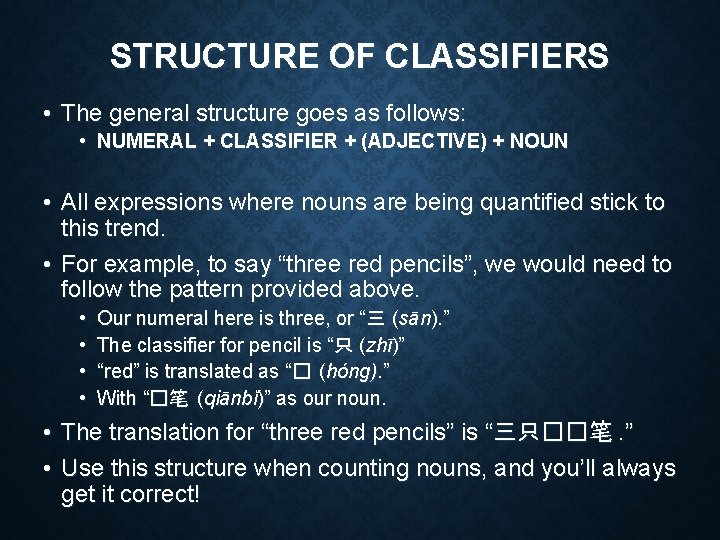
STRUCTURE OF CLASSIFIERS • The general structure goes as follows: • NUMERAL + CLASSIFIER + (ADJECTIVE) + NOUN • All expressions where nouns are being quantified stick to this trend. • For example, to say “three red pencils”, we would need to follow the pattern provided above. • • • Our numeral here is three, or “三 (sān). ” The classifier for pencil is “只 (zhī)” “red” is translated as “� (hóng). ” With “�笔 (qiānbǐ)” as our noun. The translation for “three red pencils” is “三只��笔. ” Use this structure when counting nouns, and you’ll always get it correct!
COMMONLY USED CLASSIFIERS • Although there are thousands of classifiers in the Chinese language, here are some commonly used classifiers that you would encounter, or need to know! • **Note**: When counting, 2 is always 两 (liǎng), not 二 (èr).
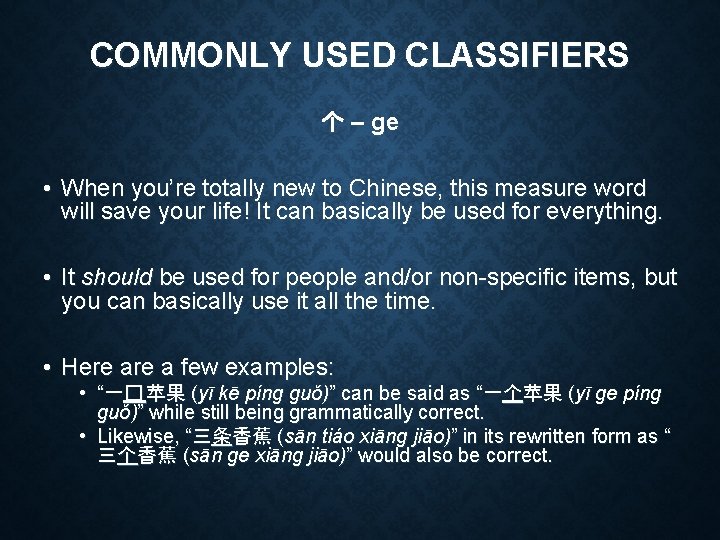
COMMONLY USED CLASSIFIERS 个 – ge • When you’re totally new to Chinese, this measure word will save your life! It can basically be used for everything. • It should be used for people and/or non-specific items, but you can basically use it all the time. • Here a few examples: • “一� 苹果 (yī kē píng guǒ)” can be said as “一个苹果 (yī ge píng guǒ)” while still being grammatically correct. • Likewise, “三条香蕉 (sān tiáo xiāng jiāo)” in its rewritten form as “ 三个香蕉 (sān ge xiāng jiāo)” would also be correct.
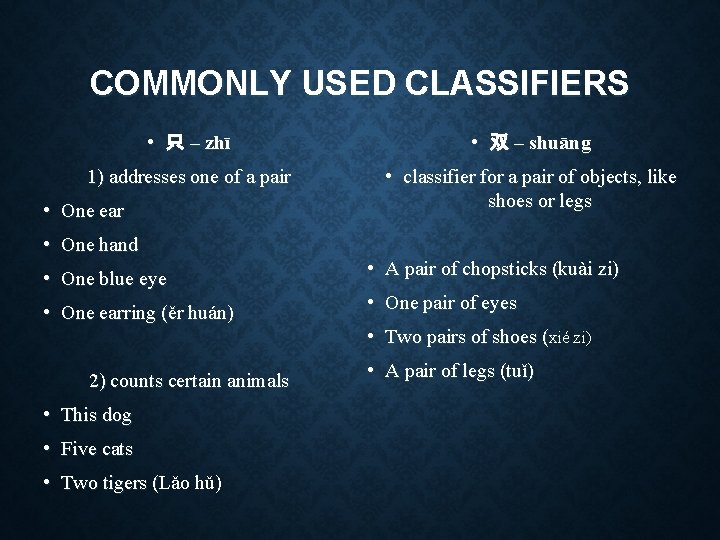
COMMONLY USED CLASSIFIERS • 只 – zhī • 双 – shuāng 1) addresses one of a pair • classifier for a pair of objects, like shoes or legs • One ear • One hand • One blue eye • A pair of chopsticks (kuài zi) • One earring (ěr huán) • One pair of eyes • Two pairs of shoes (xié zi) 2) counts certain animals • This dog • Five cats • Two tigers (Lǎo hǔ) ( • A pair of legs (tuǐ)
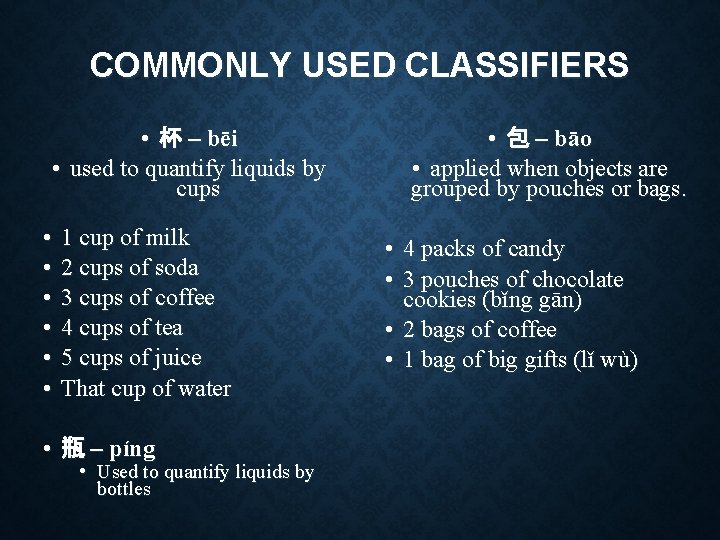
COMMONLY USED CLASSIFIERS • 杯 – bēi • used to quantify liquids by cups • • • 1 cup of milk 2 cups of soda 3 cups of coffee 4 cups of tea 5 cups of juice That cup of water • 瓶 – píng • Used to quantify liquids by bottles • 包 – bāo • applied when objects are grouped by pouches or bags. • 4 packs of candy • 3 pouches of chocolate cookies (bǐng gān) • 2 bags of coffee • 1 bag of big gifts (lǐ wù)
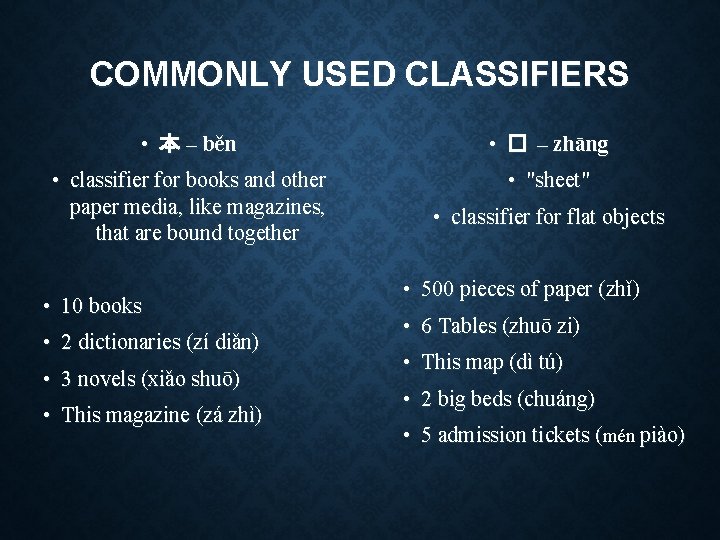
COMMONLY USED CLASSIFIERS • 本 – běn • � – zhāng • classifier for books and other paper media, like magazines, that are bound together • "sheet" • 10 books • 2 dictionaries (zí diǎn) • 3 novels (xiǎo shuō) • This magazine (zá zhì) • classifier for flat objects • 500 pieces of paper (zhǐ) ( • 6 Tables (zhuō zi) ( • This map (dì tú) • 2 big beds (chuáng) • 5 admission tickets (mén piào)
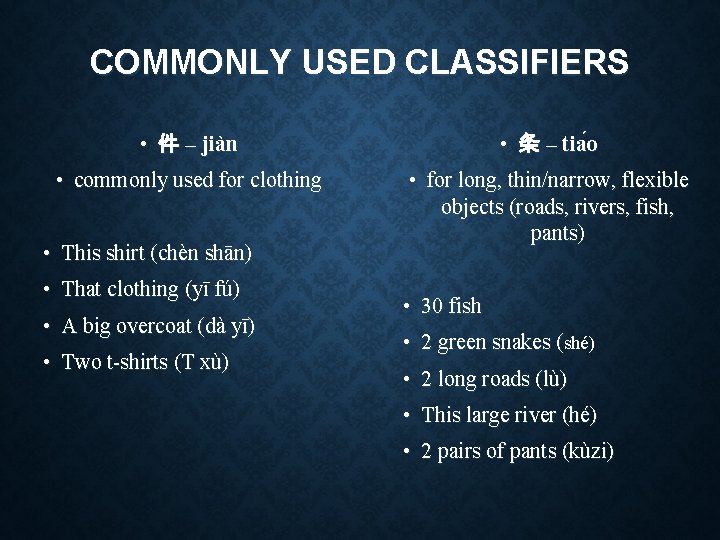
COMMONLY USED CLASSIFIERS • 件 – jiàn • 条 – tia o • commonly used for clothing • for long, thin/narrow, flexible objects (roads, rivers, fish, pants) • This shirt (chèn shān) • That clothing (yī ( fú) • A big overcoat (dà yī) • Two t-shirts (T xù) • 30 fish • 2 green snakes (shé) • 2 long roads (lù) • This large river (hé) • 2 pairs of pants (kùzi)
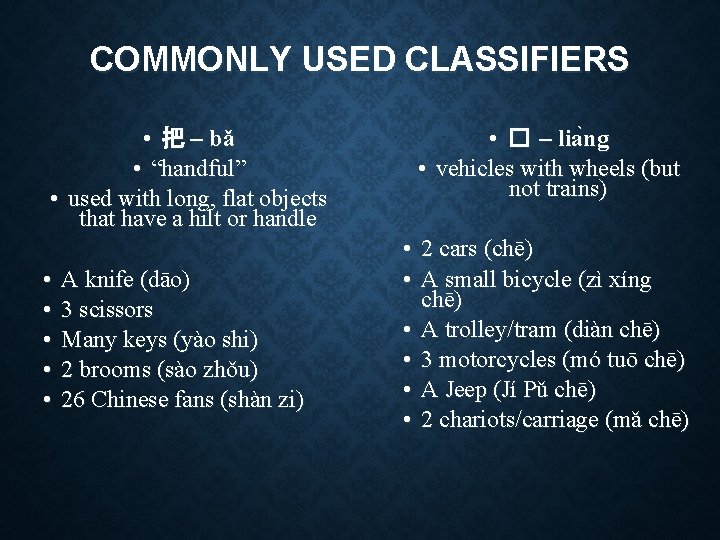
COMMONLY USED CLASSIFIERS • 把 – bǎ • “handful” • used with long, flat objects that have a hilt or handle • • • A knife (dāo) ( 3 scissors Many keys (yào shi) 2 brooms (sào zhǒu) 26 Chinese fans (shàn zi) • � – lia ng • vehicles with wheels (but not trains) • 2 cars (chē) • A small bicycle (zì xíng chē) • A trolley/tram (diàn chē) • 3 motorcycles (mó tuō chē) • A Jeep (Jí Pǔ chē) • 2 chariots/carriage (mǎ chē)
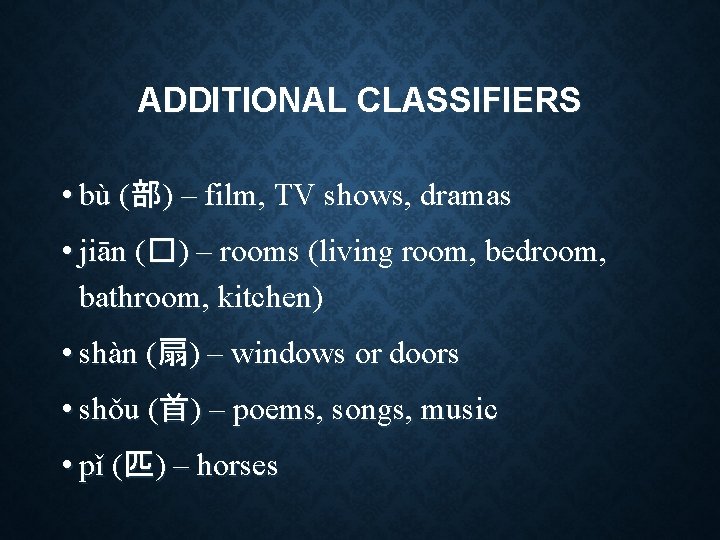
ADDITIONAL CLASSIFIERS • bù (部) – film, TV shows, dramas • jiān (�) – rooms (living room, bedroom, bathroom, kitchen) • shàn (扇) – windows or doors • shǒu (首) – poems, songs, music • pǐ (匹) – horses
- Slides: 13