
Quantification of drug in living cells using Infrared


- Slides: 18
Quantification of drug in living cells using Infrared Spectroscopy Wachirun Terakosolphan Institute of Pharmaceutical Science King’s College London Drug Delivery to the Lung (DDL 2018), 13 th December 2018
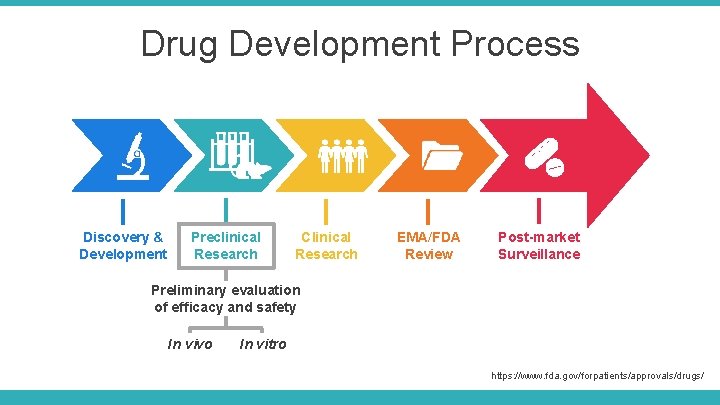
Drug Development Process Discovery & Development Preclinical Research Clinical Research EMA/FDA Review Post-market Surveillance Preliminary evaluation of efficacy and safety In vivo In vitro https: //www. fda. gov/forpatients/approvals/drugs/
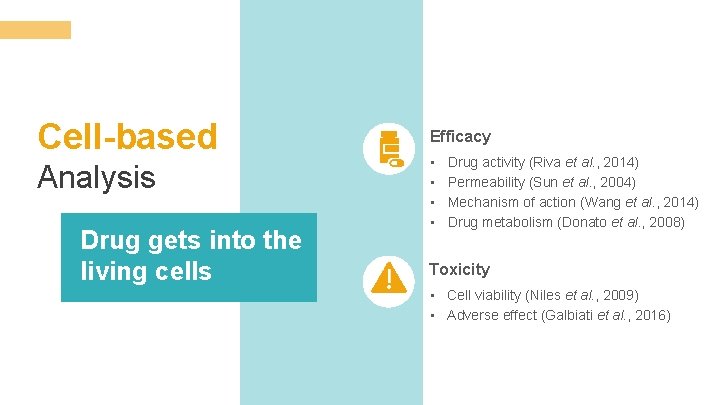
Cell-based Analysis Drug gets into the living cells Efficacy • • Drug activity (Riva et al. , 2014) Permeability (Sun et al. , 2004) Mechanism of action (Wang et al. , 2014) Drug metabolism (Donato et al. , 2008) Toxicity • Cell viability (Niles et al. , 2009) • Adverse effect (Galbiati et al. , 2016)
Key Question “ “ Could the drug uptake by living cells be studied quantitatively using a common analytical technique?
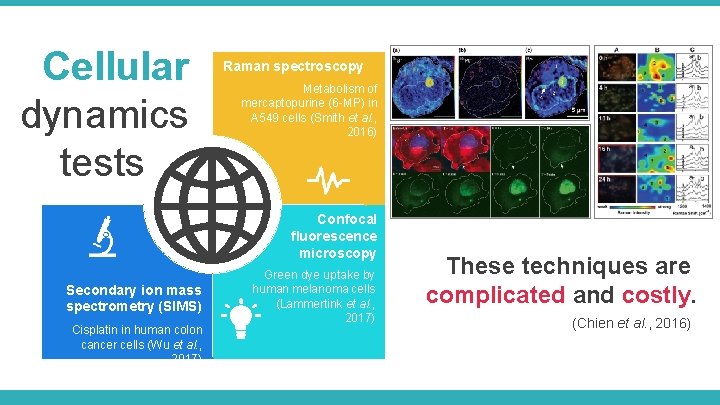
Cellular dynamics tests Raman spectroscopy Metabolism of mercaptopurine (6 -MP) in A 549 cells (Smith et al. , 2016) Confocal fluorescence microscopy Secondary ion mass spectrometry (SIMS) Cisplatin in human colon cancer cells (Wu et al. , 2017) Green dye uptake by human melanoma cells (Lammertink et al. , 2017) Metal element Fluorescent probe Label-free Living cells These techniques are Single time point Continuous scan complicated and costly. Image analysis / Fluorescence Image analysis / Fixed frozen cells Signal intensity ₤₤₤₤₤ al. , 2016) intensity(Chien et Raman intensity ₤₤₤₤
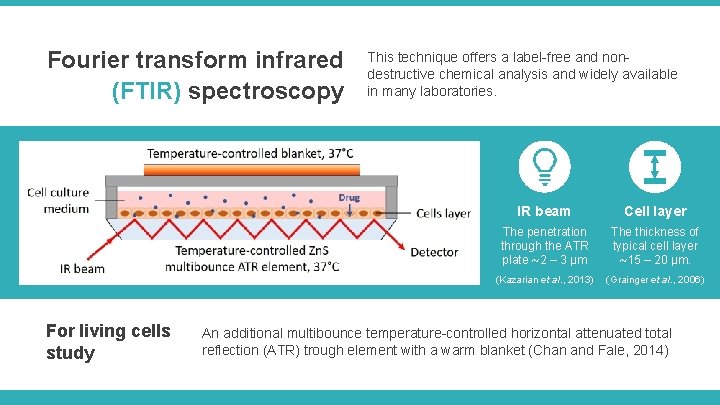
Fourier transform infrared (FTIR) spectroscopy For living cells study This technique offers a label-free and nondestructive chemical analysis and widely available in many laboratories. IR beam Cell layer The penetration through the ATR plate ~2 – 3 μm The thickness of typical cell layer ~15 – 20 μm. (Kazarian et al. , 2013) (Grainger et al. , 2006) An additional multibounce temperature-controlled horizontal attenuated total reflection (ATR) trough element with a warm blanket (Chan and Fale, 2014)
Model for respiratory cell drug uptake Calu-3 cells • Human bronchial epithelial cells • Model of the airway epithelial barrier (Grainger et al. , 2006) • Useful tool in the respiratory drug delivery research (Foster et al. , 2000) Beclomethasone dipropionate (BDP) • Widely used inhaled corticosteroid as a controller • Mainstay therapy for respiratory diseases (Adams et al. , 2007) • Recent guidelines for asthma and COPD (GINA and GOLD 2018)
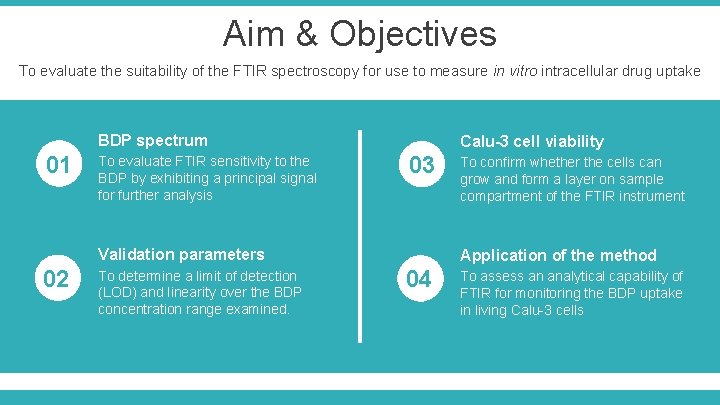
Aim & Objectives To evaluate the suitability of the FTIR spectroscopy for use to measure in vitro intracellular drug uptake BDP spectrum 01 To evaluate FTIR sensitivity to the BDP by exhibiting a principal signal for further analysis Calu-3 cell viability 03 Validation parameters 02 To determine a limit of detection (LOD) and linearity over the BDP concentration range examined. To confirm whether the cells can grow and form a layer on sample compartment of the FTIR instrument Application of the method 04 To assess an analytical capability of FTIR for monitoring the BDP uptake in living Calu-3 cells
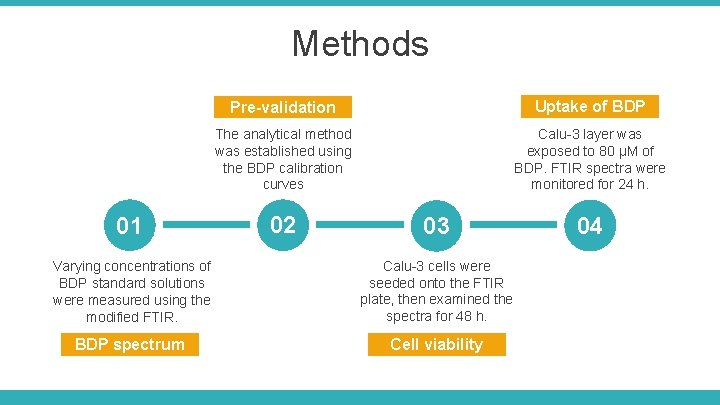
Methods 01 Pre-validation Uptake of BDP The analytical method was established using the BDP calibration curves Calu-3 layer was exposed to 80 μM of BDP. FTIR spectra were monitored for 24 h. 02 % 03 Varying concentrations of BDP standard solutions were measured using the modified FTIR. Calu-3 cells were seeded onto the FTIR plate, then examined the spectra for 48 h. BDP spectrum Cell viability 04
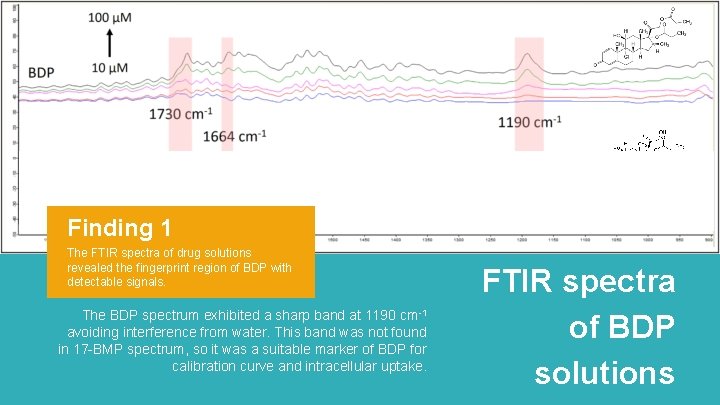
Finding 1 The FTIR spectra of drug solutions revealed the fingerprint region of BDP with detectable signals. The BDP spectrum exhibited a sharp band at 1190 cm-1 avoiding interference from water. This band was not found in 17 -BMP spectrum, so it was a suitable marker of BDP for calibration curve and intracellular uptake. FTIR spectra of BDP solutions
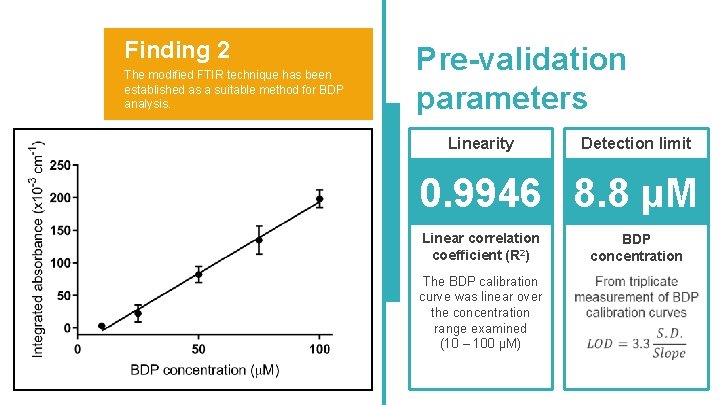
Finding 2 The modified FTIR technique has been established as a suitable method for BDP analysis. Pre-validation parameters Linearity Detection limit 0. 9946 8. 8 μM Linear correlation coefficient (R 2) The BDP calibration curve was linear over the concentration range examined (10 – 100 μM) BDP concentration
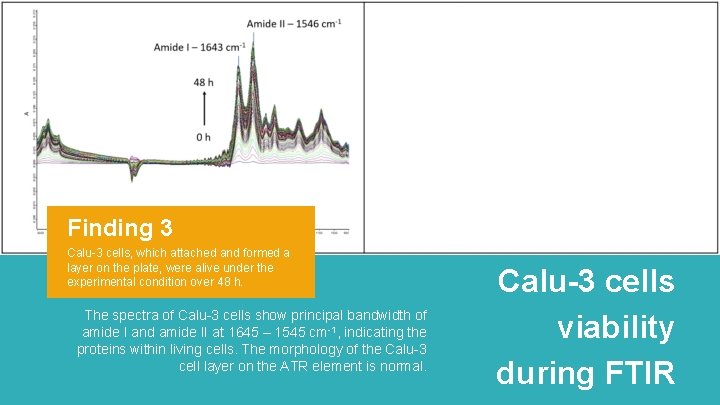
Finding 3 Calu-3 cells, which attached and formed a layer on the plate, were alive under the experimental condition over 48 h. The spectra of Calu-3 cells show principal bandwidth of amide I and amide II at 1645 – 1545 cm-1, indicating the proteins within living cells. The morphology of the Calu-3 cell layer on the ATR element is normal. Calu-3 cells viability during FTIR
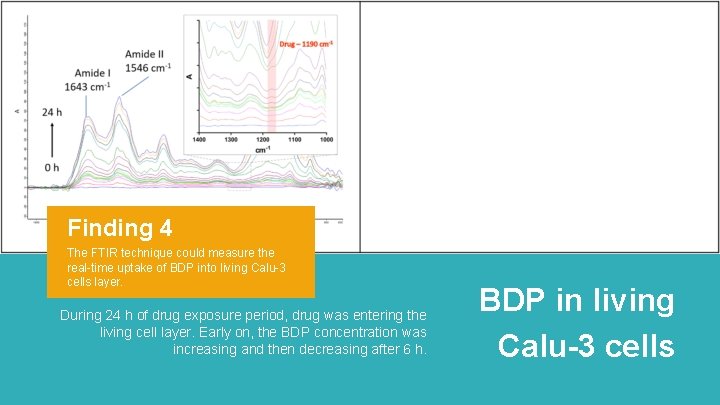
Finding 4 The FTIR technique could measure the real-time uptake of BDP into living Calu-3 cells layer. During 24 h of drug exposure period, drug was entering the living cell layer. Early on, the BDP concentration was increasing and then decreasing after 6 h. BDP in living Calu-3 cells
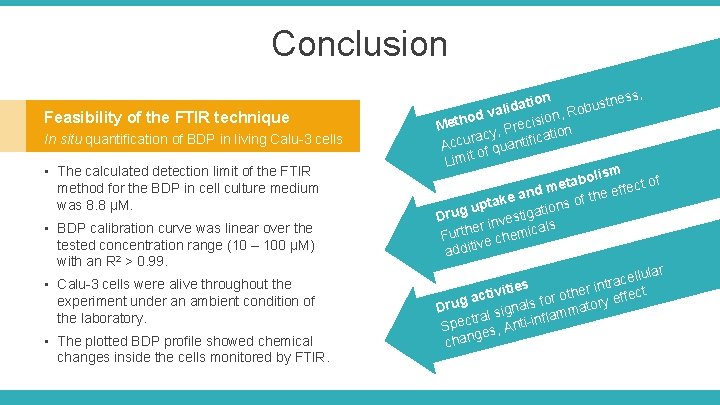
Conclusion Feasibility of the FTIR technique In situ quantification of BDP in living Calu-3 cells • The calculated detection limit of the FTIR method for the BDP in cell culture medium was 8. 8 μM. • BDP calibration curve was linear over the tested concentration range (10 – 100 μM) with an R 2 > 0. 99. • Calu-3 cells were alive throughout the experiment under an ambient condition of the laboratory. • The plotted BDP profile showed chemical changes inside the cells monitored by FTIR. ess, on n i t t s a u d li , Rob d va n o o i h s t i c Me , Pre cation y c a r Accu f quantifi o Limit m bolis f a t e ect o m f f d e n e h ea s of t ptak n u o i t g a Dru estig ls v n i r e a Furth e chemic iv addit llular e c a r t es her in effect t tiviti o c r a fo Drug nals mmatory g i s l tra nfla Spec es, Anti-i g chan
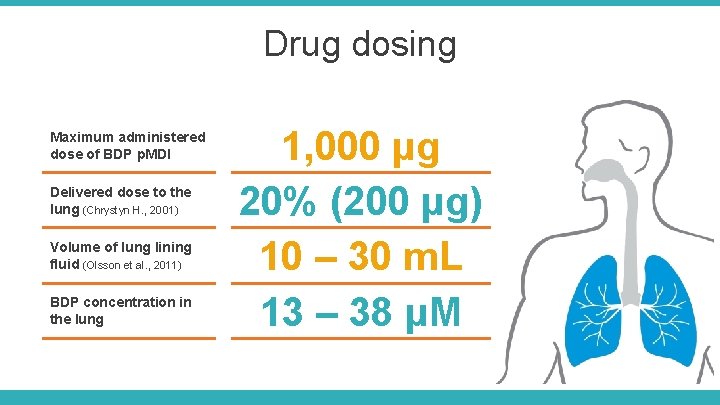
Drug dosing Maximum administered dose of BDP p. MDI Delivered dose to the lung (Chrystyn H. , 2001) Volume of lung lining fluid (Olsson et al. , 2011) BDP concentration in the lung 1, 000 μg 20% (200 μg) 10 – 30 m. L 13 – 38 μM
Key Question “ “ FTIR isthe a powerful tool in medicine Could drug uptake by living development process by elucidating the cells be studied quantitatively using rate and extent of drug uptake in cells common analytical asa well as other drug-celltechnique? interactions.
Acknowledgement Institute of Pharmaceutical Science, King’s College London • Prof Ben Forbes • Dr Andrew Chan • Mr Ali Altharawi The DDL conference committee
Thank you