
Quantification of a Novel Group of Ammonia Producing
- Slides: 1
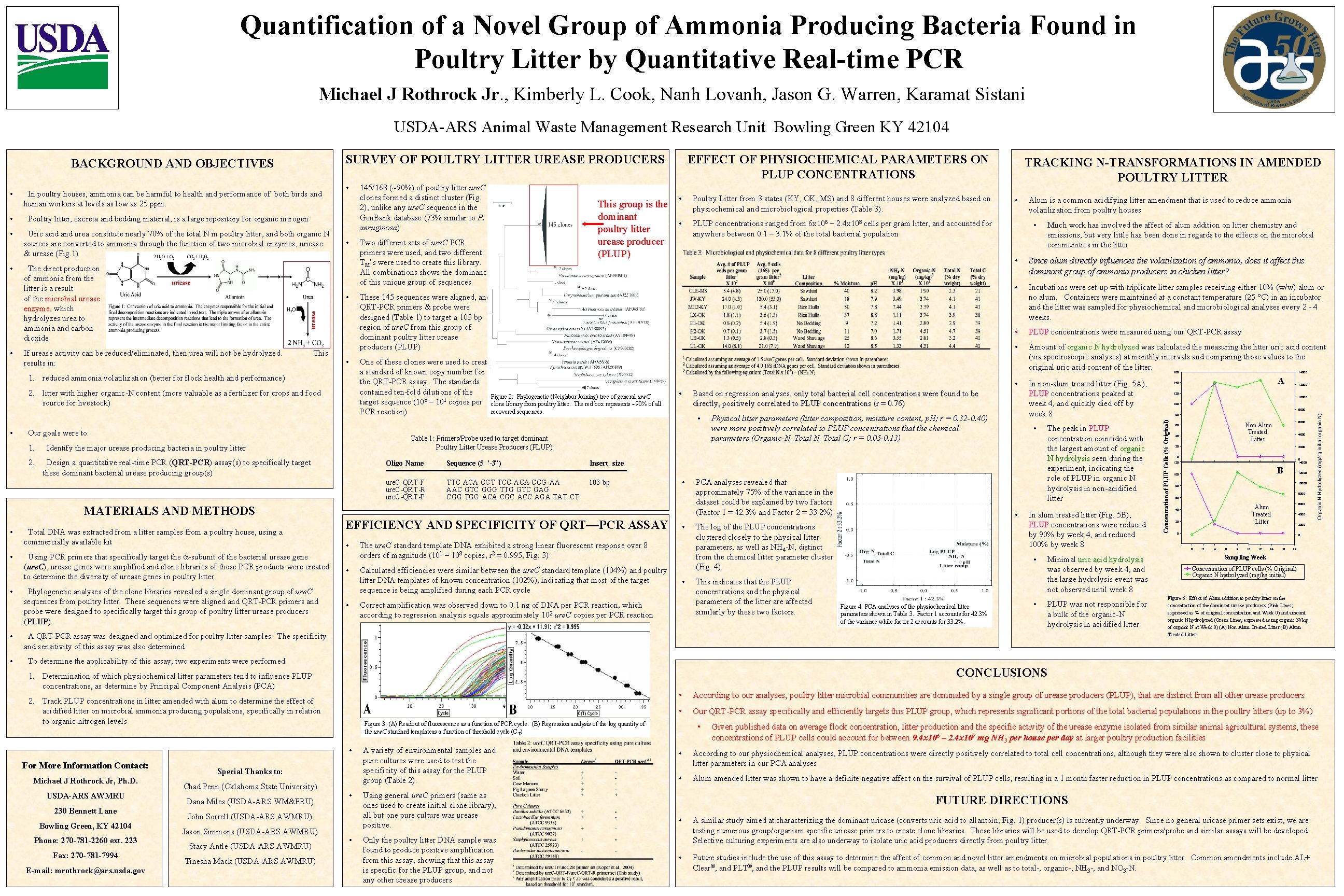
Quantification of a Novel Group of Ammonia Producing Bacteria Found in Poultry Litter by Quantitative Real-time PCR Michael J Rothrock Jr. , Kimberly L. Cook, Nanh Lovanh, Jason G. Warren, Karamat Sistani USDA-ARS Animal Waste Management Research Unit Bowling Green KY 42104 • In poultry houses, ammonia can be harmful to health and performance of both birds and human workers at levels as low as 25 ppm. 145/168 (~90%) of poultry litter ure. C clones formed a distinct cluster (Fig. 2), unlike any ure. C sequence in the Gen. Bank database (73% similar to P. aeruginosa) Poultry litter, excreta and bedding material, is a large repository for organic nitrogen • Uric acid and urea constitute nearly 70% of the total N in poultry litter, and both organic N sources are converted to ammonia through the function of two microbial enzymes, uricase & urease (Fig. 1) • The direct production of ammonia from the litter is a result of the microbial urease enzyme, enzyme which hydrolyzes urea to ammonia and carbon dioxide • • • Two different sets of ure. C PCR primers were used, and two different TM’s were used to create this library. All combinations shows the dominance of this unique group of sequences • If urease activity can be reduced/eliminated, then urea will not be hydrolyzed. results in: This • One of these clones were used to create a standard of known copy number for the QRT-PCR assay. The standards contained ten-fold dilutions of the Figure 2: Phylogenetic (Neighbor Joining) tree of general ure. C target sequence (108 – 101 copies per clone library from poultry litter. The red box represents ~90% of all recovered sequences. PCR reaction) 2. litter with higher organic-N content (more valuable as a fertilizer for crops and food source for livestock) Our goals were to: 1. 2. • Poultry Litter from 3 states (KY, OK, MS) and 8 different houses were analyzed based on physiochemical and microbiological properties (Table 3). • PLUP concentrations ranged from 6 x 10⁶ – 2. 4 x 10⁸ cells per gram litter, and accounted for anywhere between 0. 1 – 3. 1% of the total bacterial population These 145 sequences were aligned, and QRT-PCR primers & probe were designed (Table 1) to target a 103 bp region of ure. C from this group of dominant poultry litter urease producers (PLUP) 1. reduced ammonia volatilization (better for flock health and performance) • This group is the dominant poultry litter urease producer (PLUP) Design a quantitative real-time PCR (QRT-PCR) QRT-PCR assay(s) to specifically target these dominant bacterial urease producing group(s) Oligo Name ure. C-QRT -F ure. C-QRT -R ure. C-QRT -P Sequence (5 ’-3’) ’ TTC ACA CCT TCC ACA CC CCG AA AAC GTC GGG TTG GTC GAG CGG TGG ACA CGC ACC AGA TAT CT • • Total DNA was extracted from a litter samples from a poultry house, using a commercially available kit • Using PCR primers that specifically target the a-subunit of the bacterial urease gene (ure. C), ure. C urease genes were amplified and clone libraries of those PCR products were created to determine the diversity of urease genes in poultry litter Phylogenetic analyses of the clone libraries revealed a single dominant group of ure. C sequences from poultry litter. These sequences were aligned and QRT-PCR primers and probe were designed to specifically target this group of poultry litter urease producers (PLUP) PLUP • 103 bp • Calculated efficiencies were similar between the ure. C standard template (104%) and poultry litter DNA templates of known concentration (102%), indicating that most of the target sequence is being amplified during each PCR cycle • Since alum directly influences the volatilization of ammonia, does it affect this dominant group of ammonia producers in chicken litter? • Incubations were set-up with triplicate litter samples receiving either 10% (w/w) alum or no alum. Containers were maintained at a constant temperature (25 °C) in an incubator and the litter was sampled for physiochemical and microbiological analyses every 2 - 4 weeks. • PLUP concentrations were measured using our QRT-PCR assay • Amount of organic N hydrolyzed was calculated the measuring the litter uric acid content (via spectroscopic analyses) at monthly intervals and comparing those values to the original uric acid content of the litter. Physical litter parameters (litter composition, moisture content, p. H; r = 0. 32 -0. 40) were more positively correlated to PLUP concentrations that the chemical parameters (Organic-N, Total C; r = 0. 05 -0. 13) In non-alum treated litter (Fig. 5 A), PLUP concentrations peaked at week 4, and quickly died off by week 8 • Insert size The ure. C standard template DNA exhibited a strong linear fluorescent response over 8 orders of magnitude (101 – 108 copies, r 2 = 0. 995, Fig. 3) • Much work has involved the affect of alum addition on litter chemistry and emissions, but very little has been done in regards to the effects on the microbial communities in the litter • Based on regression analyses, only total bacterial cell concentrations were found to be directly, positively correlated to PLUP concentrations (r = 0. 76) • EFFICIENCY AND SPECIFICITY OF QRT—PCR ASSAY • Alum is a common acidifying litter amendment that is used to reduce ammonia volatilization from poultry houses • • MATERIALS AND METHODS • • 160 Table 1: Primers/Probe used to target dominant Poultry Litter Urease Producers (PLUP) Identify the major urease producing bacteria in poultry litter TRACKING N-TRANSFORMATIONS IN AMENDED POULTRY LITTER • Correct amplification was observed down to 0. 1 ng of DNA per PCR reaction, which according to regression analysis equals approximately 102 ure. C copies per PCR reaction PCA analyses revealed that approximately 75% of the variance in the dataset could be explained by two factors (Factor 1 = 42. 3% and Factor 2 = 33. 2%) • The log of the PLUP concentrations clustered closely to the physical litter parameters, as well as NH 4 -N, distinct from the chemical litter parameter cluster (Fig. 4). This indicates that the PLUP concentrations and the physical parameters of the litter are affected similarly by these two factors. In alum treated litter (Fig. 5 B), PLUP concentrations were reduced by 90% by week 4, and reduced 100% by week 8 • Figure 4: PCA analyses of the physiochemical litter parameters shown in Table 3. Factor 1 accounts for 42. 3% of the variance while factor 2 accounts for 33. 2%. The peak in PLUP concentration coincided with the largest amount of organic N hydrolysis seen during the experiment, indicating the role of PLUP in organic N hydrolysis in non-acidified litter • Minimal uric acid hydrolysis was observed by week 4, and the large hydrolysis event was not observed until week 8 PLUP was not responsible for a bulk of the organic-N hydrolysis in acidified litter A QRT-PCR assay was designed and optimized for poultry litter samples. The specificity and sensitivity of this assay was also determined To determine the applicability of this assay, two experiments were performed 2. Track PLUP concentrations in litter amended with alum to determine the effect of acidified litter on microbial ammonia producing populations, specifically in relation to organic nitrogen levels USDA-ARS AWMRU 230 Bennett Lane Bowling Green, KY 42104 Phone: 270 -781 -2260 ext. 223 Fax: 270 -781 -7994 E-mail: mrothrock@ars. usda. gov Special Thanks to: Chad Penn (Oklahoma State University) Dana Miles (USDA-ARS WM&FRU) • John Sorrell (USDA-ARS AWMRU) Jason Simmons (USDA-ARS AWMRU) Stacy Antle (USDA-ARS AWMRU) Tinesha Mack (USDA-ARS AWMRU) 12000 120 10000 100 80 6000 Non Alum Treated Litter 60 40 4000 20 2000 0 0 14000 120 B 100 12000 10000 80 8000 60 6000 Alum Treated Litter 40 20 4000 2000 0 2 4 6 8 10 12 14 16 18 Sampling Week Concentration of PLUP cells (% Original) Organic N hydrolyzed (mg/kg initial) Figure 5: Effect of Alum addition to poultry litter on the concentration of the dominant urease producers (Pink Lines; expressed as % of original concentration and Week 0) and amount organic N hydrolyzed (Green Lines; expressed as mg organic N/ kg of organic N at Week 0) (A) Non Alum Treated Litter (B) Alum Treated Litter • According to our analyses, poultry litter microbial communities are dominated by a single group of urease producers (PLUP), that are distinct from all other urease producers • Our QRT-PCR assay specifically and efficiently targets this PLUP group, which represents significant portions of the total bacterial populations in the poultry litters (up to 3%) Figure 3: (A) Readout of fluorescence as a function of PCR cycle. (B) Regression analysis of the log quantity of the ure. C standard templateas a function of threshold cycle (C T) • Michael J Rothrock Jr, Ph. D. A CONCLUSIONS 1. Determination of which physiochemical litter parameters tend to influence PLUP concentrations, as determine by Principal Component Analysis (PCA) For More Information Contact: 14000 140 Concentration of PLUP Cells (% Original) • EFFECT OF PHYSIOCHEMICAL PARAMETERS ON PLUP CONCENTRATIONS Organic N Hydrolyzed (mg/kg initial organic N) SURVEY OF POULTRY LITTER UREASE PRODUCERS BACKGROUND AND OBJECTIVES • A variety of environmental samples and pure cultures were used to test the specificity of this assay for the PLUP group (Table 2). Using general ure. C primers (same as ones used to create initial clone library), all but one pure culture was urease positive. Only the poultry litter DNA sample was found to produce positive amplification from this assay, showing that this assay is specific for the PLUP group, and not any other urease producers • Given published data on average flock concentration, litter production and the specific activity of the urease enzyme isolated from similar animal agricultural systems, these concentrations of PLUP cells could account for between 9. 4 x 10⁶ – 2. 4 x 10⁷ mg NH 3 per house per day at larger poultry production facilities • According to our physiochemical analyses, PLUP concentrations were directly positively correlated to total cell concentrations, although they were also shown to cluster close to physical litter parameters in our PCA analyses • Alum amended litter was shown to have a definite negative affect on the survival of PLUP cells, resulting in a 1 month faster reduction in PLUP concentrations as compared to normal litter FUTURE DIRECTIONS • A similar study aimed at characterizing the dominant uricase (converts uric acid to allantoin; Fig. 1) producer(s) is currently underway. Since no general uricase primer sets exist, we are testing numerous group/organism specific uricase primers to create clone libraries. These libraries will be used to develop QRT-PCR primers/probe and similar assays will be developed. Selective culturing experiments are also underway to isolate uric acid producers directly from poultry litter. • Future studies include the use of this assay to determine the affect of common and novel litter amendments on microbial populations in poultry litter. Common amendments include AL+ Clear®, and PLT®, and the PLUP results will be compared to ammonia emission data, as well as to total-, organic-, NH 3 -, and NO 3 -N.