
QUANDO VENTILARE CON COSA VENTILARE Andrea Vianello S
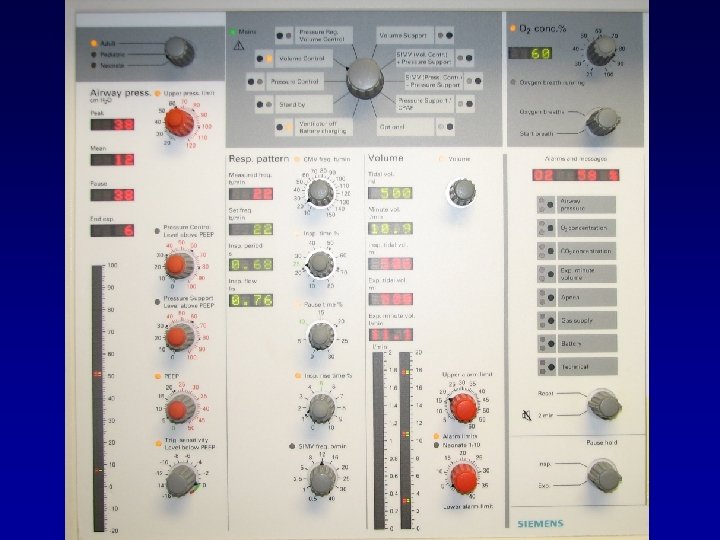

- Slides: 81
QUANDO VENTILARE? CON COSA VENTILARE? Andrea Vianello S. C. Fisiopatologia Respiratoria Ospedale-Università di Padova
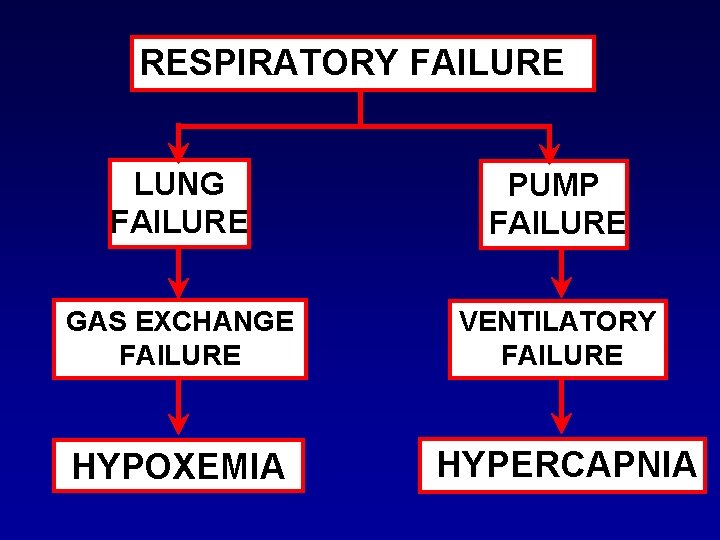
RESPIRATORY FAILURE LUNG FAILURE PUMP FAILURE GAS EXCHANGE FAILURE VENTILATORY FAILURE HYPOXEMIA HYPERCAPNIA
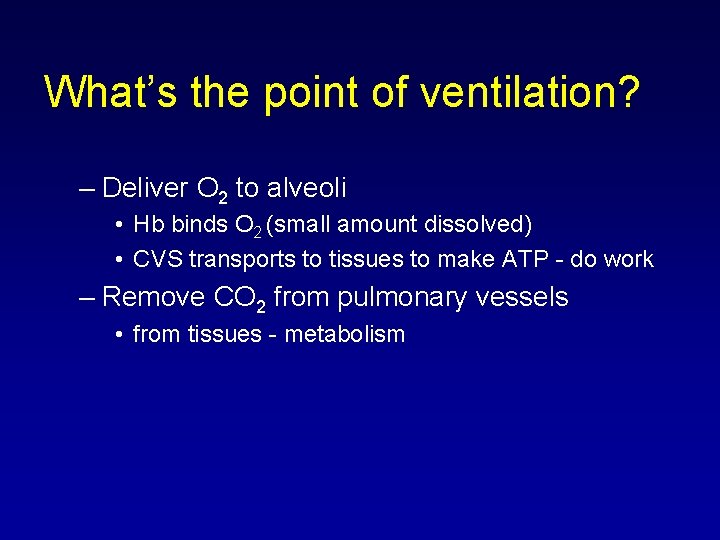
What’s the point of ventilation? – Deliver O 2 to alveoli • Hb binds O 2 (small amount dissolved) • CVS transports to tissues to make ATP - do work – Remove CO 2 from pulmonary vessels • from tissues - metabolism
Why ventilate? - purposes • To maintain or improve ventilation, & tissue oxygenation. • To decrease the work of breathing & improve patient’s comfort.
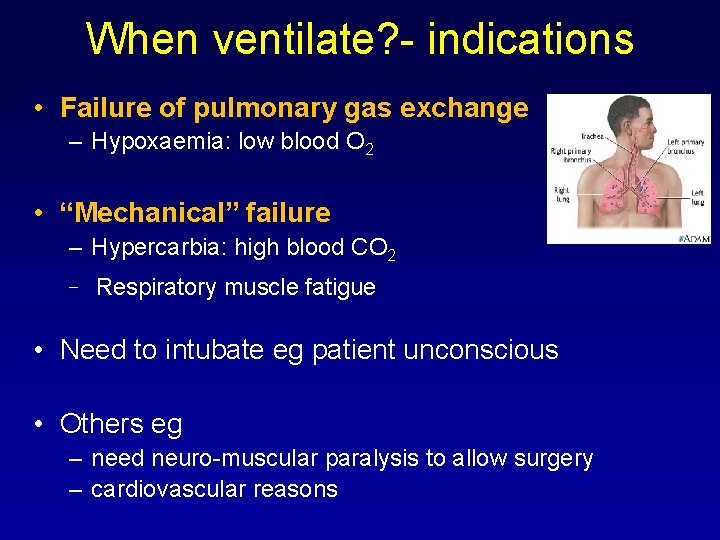
When ventilate? - indications • Failure of pulmonary gas exchange – Hypoxaemia: low blood O 2 • “Mechanical” failure – Hypercarbia: high blood CO 2 – Respiratory muscle fatigue • Need to intubate eg patient unconscious • Others eg – need neuro-muscular paralysis to allow surgery – cardiovascular reasons
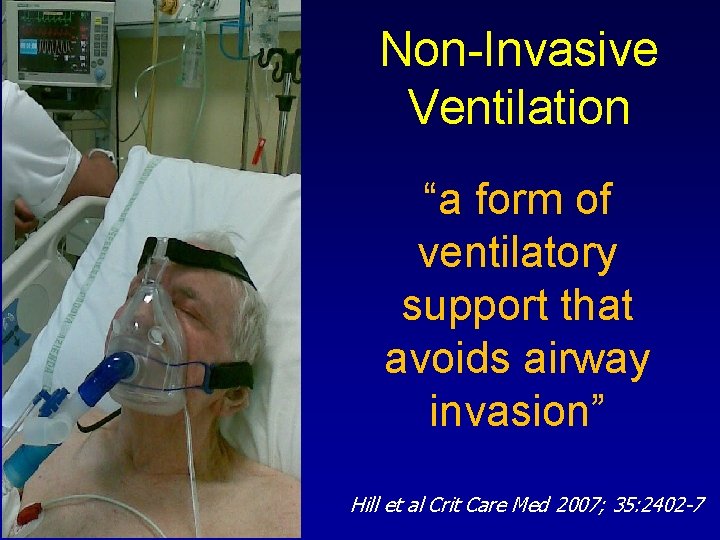
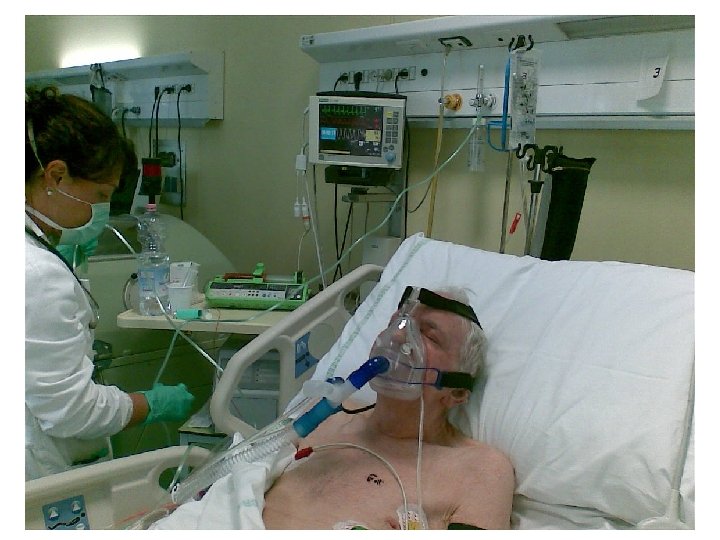
Non-Invasive Ventilation “a form of ventilatory support that avoids airway invasion” Hill et al Crit Care Med 2007; 35: 2402 -7
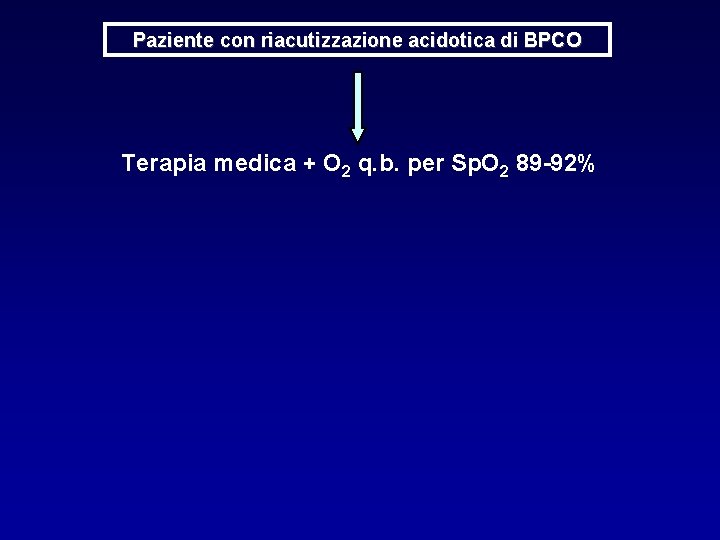
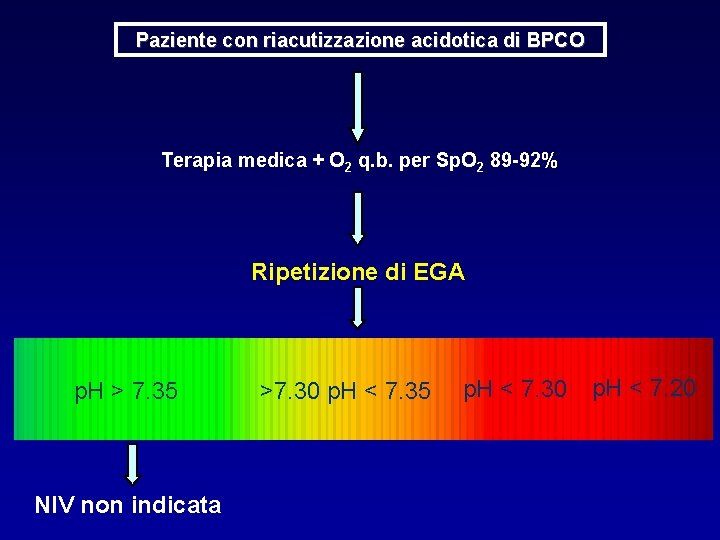
Paziente con riacutizzazione acidotica di BPCO Terapia medica + O 2 q. b. per Sp. O 2 89 -92%
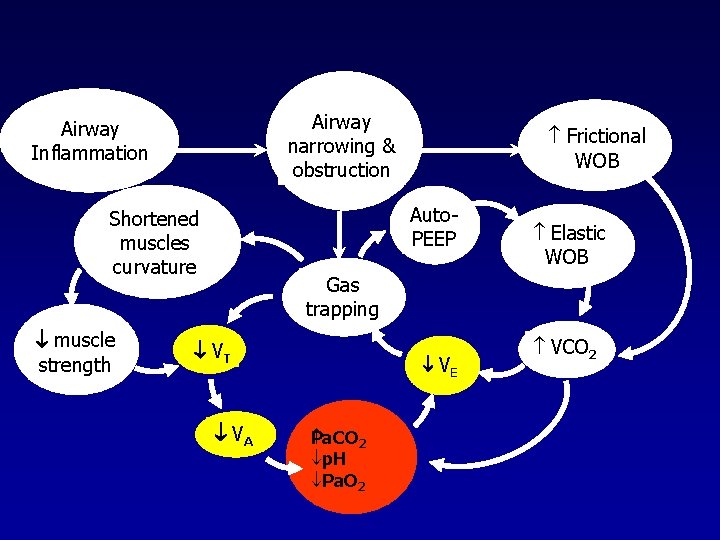
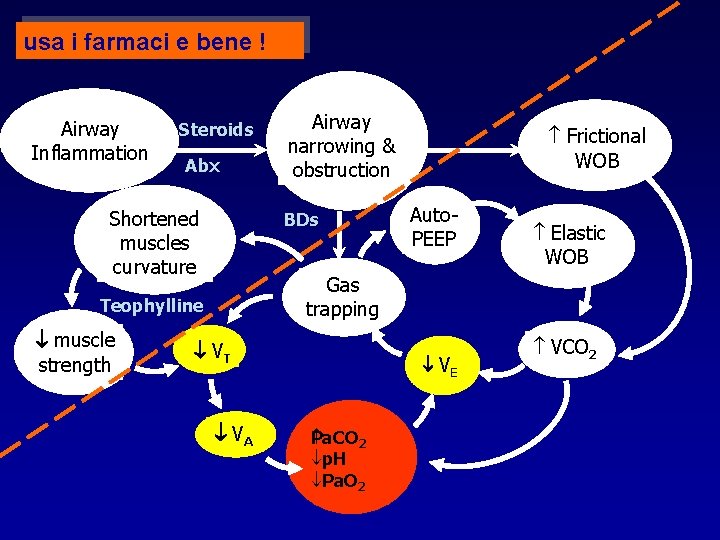
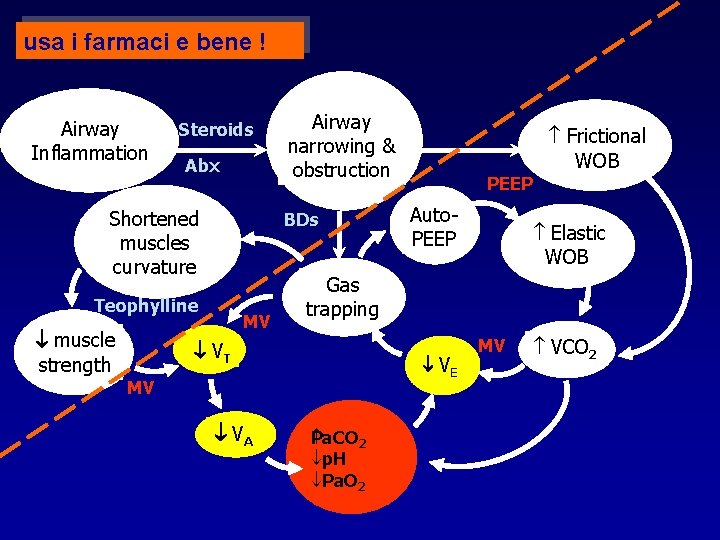
Airway narrowing & obstruction Airway Inflammation Auto. PEEP Shortened muscles curvature muscle strength Frictional WOB Elastic WOB Gas trapping VT VA VE a. CO 2 P p. H Pa. O 2 VCO 2
usa i farmaci e bene ! Airway Inflammation Steroids Abx Shortened muscles curvature BDs Frictional WOB Auto. PEEP Elastic WOB Gas trapping Teophylline muscle strength Airway narrowing & obstruction VT VA VE a. CO 2 P p. H Pa. O 2 VCO 2
usa i farmaci e bene ! Airway Inflammation Steroids Abx Shortened muscles curvature BDs Teophylline muscle strength Airway narrowing & obstruction MV PEEP Auto. PEEP Elastic WOB Gas trapping VT VE MV VA Frictional WOB a. CO 2 P p. H Pa. O 2 MV VCO 2
Paziente con riacutizzazione acidotica di BPCO Terapia medica + O 2 q. b. per Sp. O 2 89 -92% Ripetizione di EGA p. H > 7. 35 NIV non indicata >7. 30 p. H < 7. 35 p. H < 7. 30 p. H < 7. 20
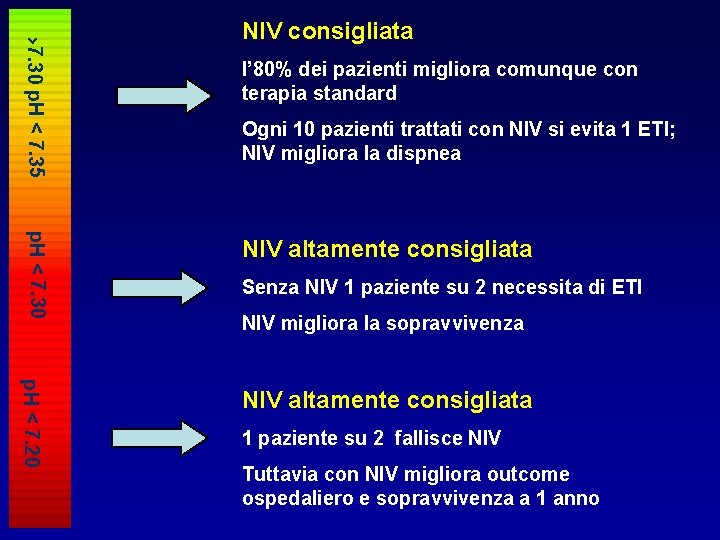
>7. 30 p. H < 7. 35 NIV consigliata l’ 80% dei pazienti migliora comunque con terapia standard Ogni 10 pazienti trattati con NIV si evita 1 ETI; NIV migliora la dispnea p. H < 7. 30 NIV altamente consigliata p. H < 7. 20 NIV altamente consigliata Senza NIV 1 paziente su 2 necessita di ETI NIV migliora la sopravvivenza 1 paziente su 2 fallisce NIV Tuttavia con NIV migliora outcome ospedaliero e sopravvivenza a 1 anno
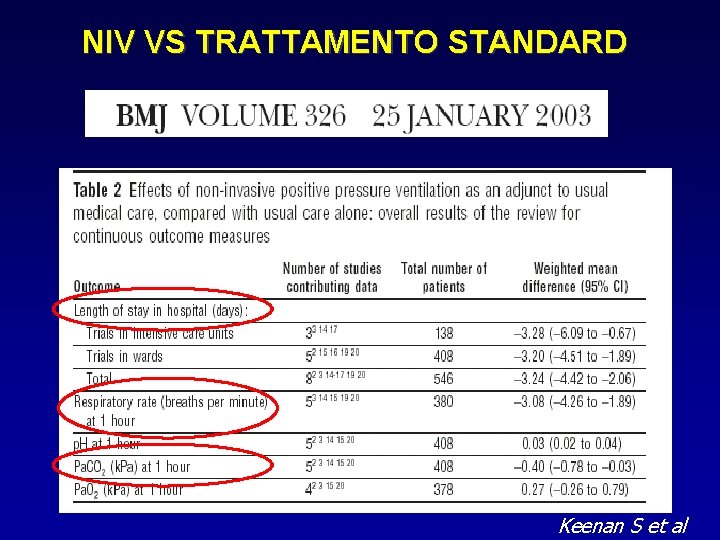
NIV VS TRATTAMENTO STANDARD Keenan S et al
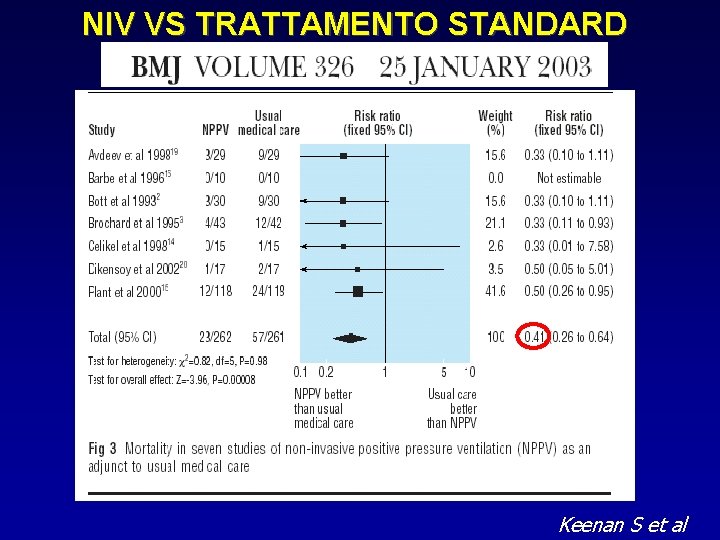
NIV VS TRATTAMENTO STANDARD Keenan S et al
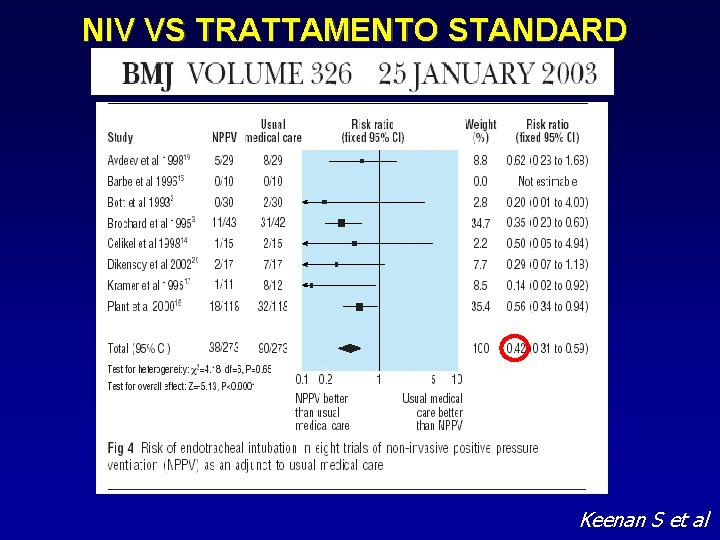
NIV VS TRATTAMENTO STANDARD Keenan S et al
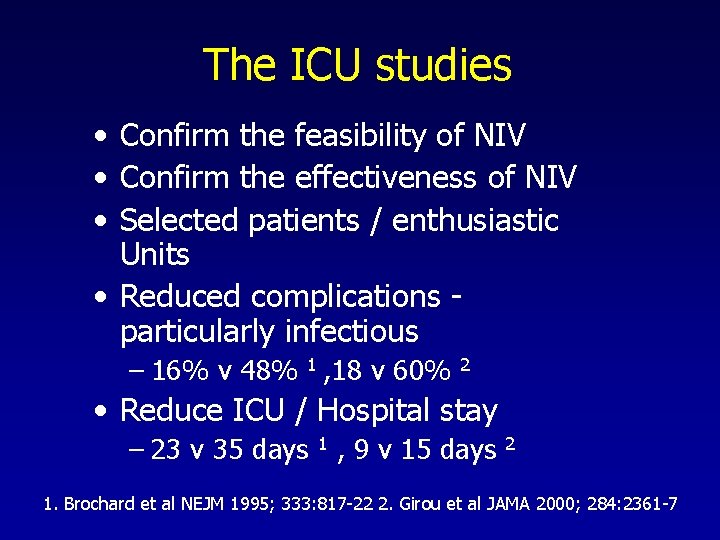
The ICU studies • Confirm the feasibility of NIV • Confirm the effectiveness of NIV • Selected patients / enthusiastic Units • Reduced complications particularly infectious – 16% v 48% 1 , 18 v 60% 2 • Reduce ICU / Hospital stay – 23 v 35 days 1 , 9 v 15 days 2 1. Brochard et al NEJM 1995; 333: 817 -22 2. Girou et al JAMA 2000; 284: 2361 -7
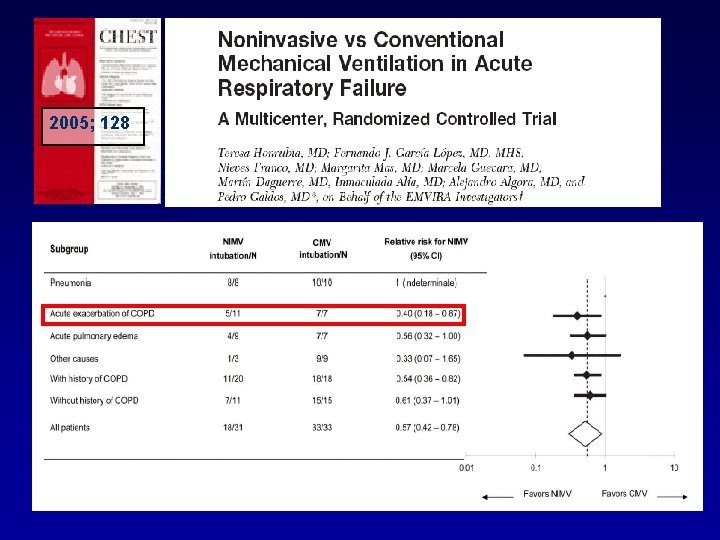
2005; 128
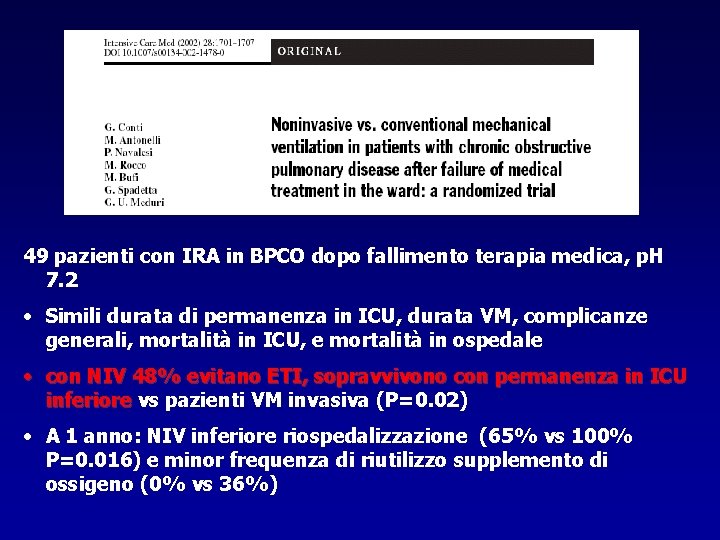
49 pazienti con IRA in BPCO dopo fallimento terapia medica, p. H 7. 2 • Simili durata di permanenza in ICU, durata VM, complicanze generali, mortalità in ICU, e mortalità in ospedale • con NIV 48% evitano ETI, sopravvivono con permanenza in ICU inferiore vs pazienti VM invasiva (P=0. 02) • A 1 anno: NIV inferiore riospedalizzazione (65% vs 100% P=0. 016) e minor frequenza di riutilizzo supplemento di ossigeno (0% vs 36%)
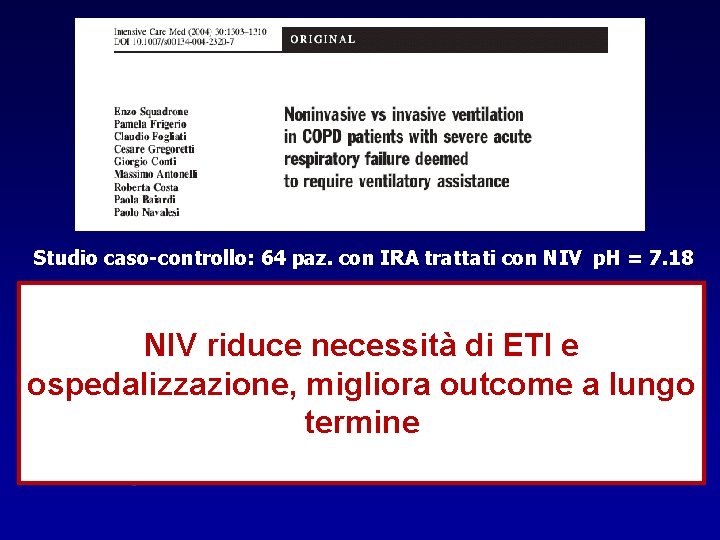
Studio caso-controllo: 64 paz. con IRA trattati con NIV p. H = 7. 18 • 40/64 (62%) fallimento NIV (RR con NIV - 38%) • Simili mortalità in ICU, e mortalità in ospedale; durata di NIV riduce necessità di ETI e permanenza in ICU e post ICU, ma: ospedalizzazione, migliora outcome a lungo • Inferiori complicanze (P=0. 01) e probabilità di rimanenere in VM (P=0. 056) termine • Se NIV efficace (24/64 = 38%) migliore sopravvivenza e ridotta permanenza in ICU vs pazienti VM invasiva
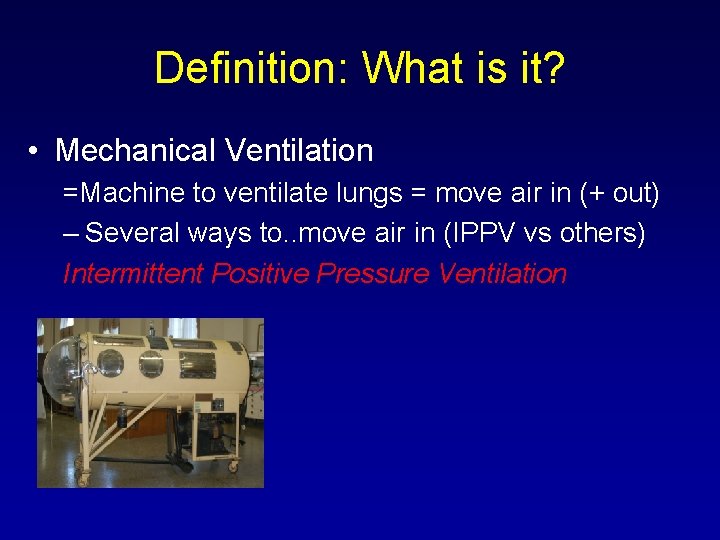
Definition: What is it? • Mechanical Ventilation =Machine to ventilate lungs = move air in (+ out) – Several ways to. . move air in (IPPV vs others) Intermittent Positive Pressure Ventilation
Definition: What is it? • Mechanical Ventilation =Machine to ventilate lungs = move air in (+ out) – Several ways to. . move air in (IPPV vs others) Intermittent Positive Pressure Ventilation – Several ways to connect the ventilator to the patient
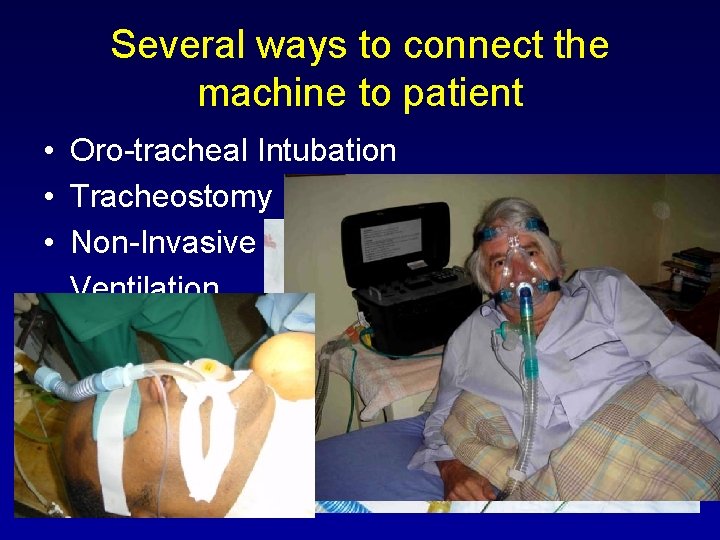
Several ways to connect the machine to patient • Oro-tracheal Intubation • Tracheostomy • Non-Invasive Ventilation
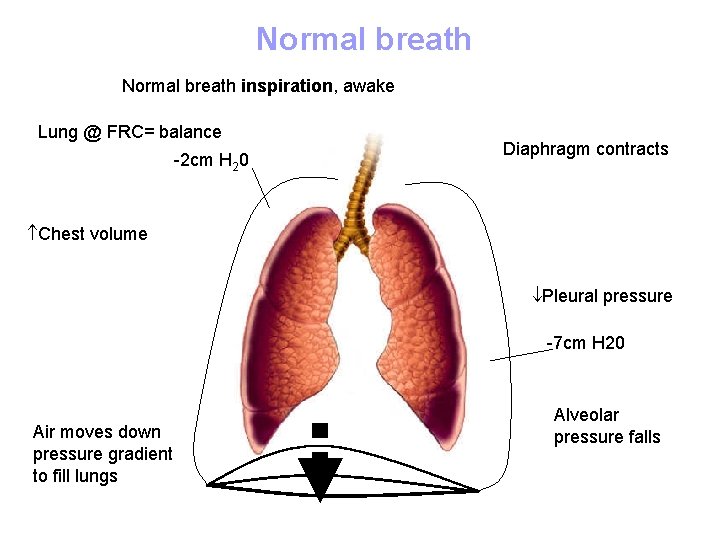
Normal breath inspiration, awake Lung @ FRC= balance -2 cm H 20 Diaphragm contracts Chest volume Pleural pressure -7 cm H 20 Air moves down pressure gradient to fill lungs Alveolar pressure falls
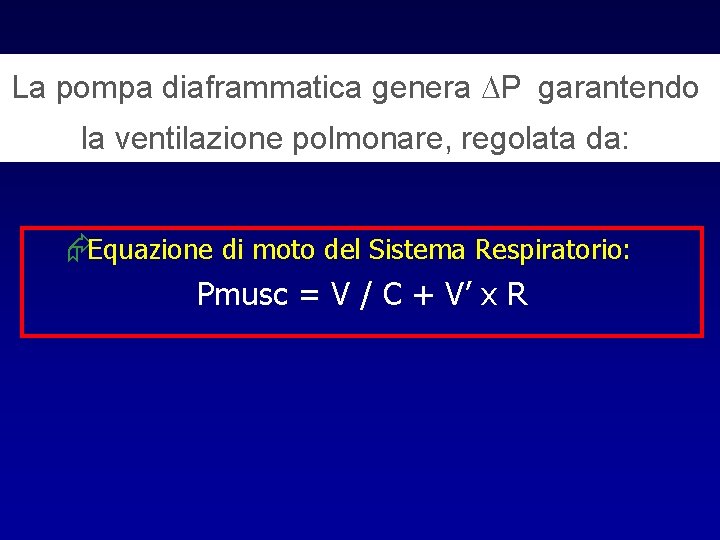
La pompa diaframmatica genera P garantendo la ventilazione polmonare, regolata da: ÆEquazione di moto del Sistema Respiratorio: Pmusc = V / C + V’ x R
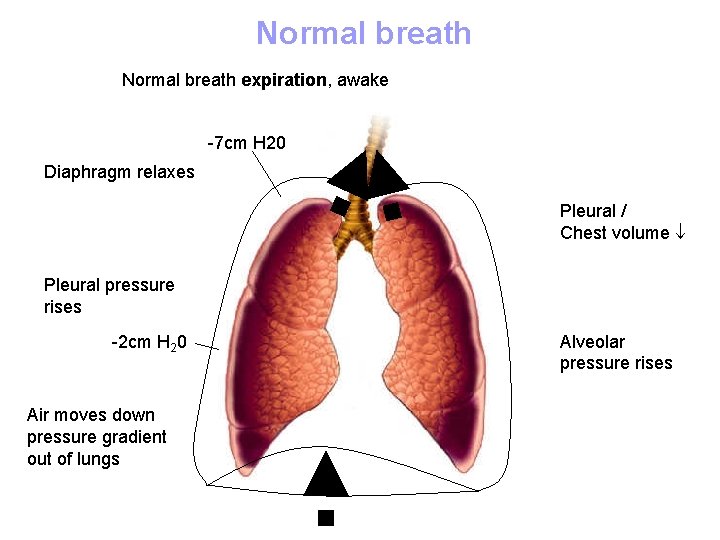
Normal breath expiration, awake -7 cm H 20 Diaphragm relaxes Pleural / Chest volume Pleural pressure rises -2 cm H 20 Air moves down pressure gradient out of lungs Alveolar pressure rises
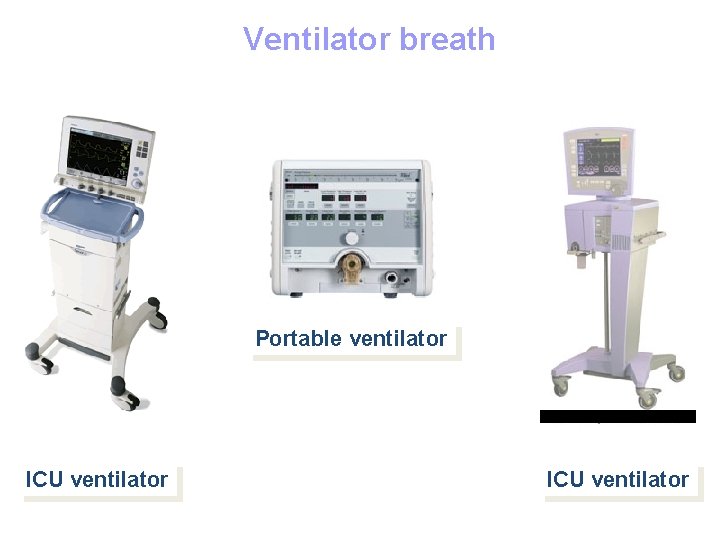
Ventilator breath Portable ventilator ICU ventilator
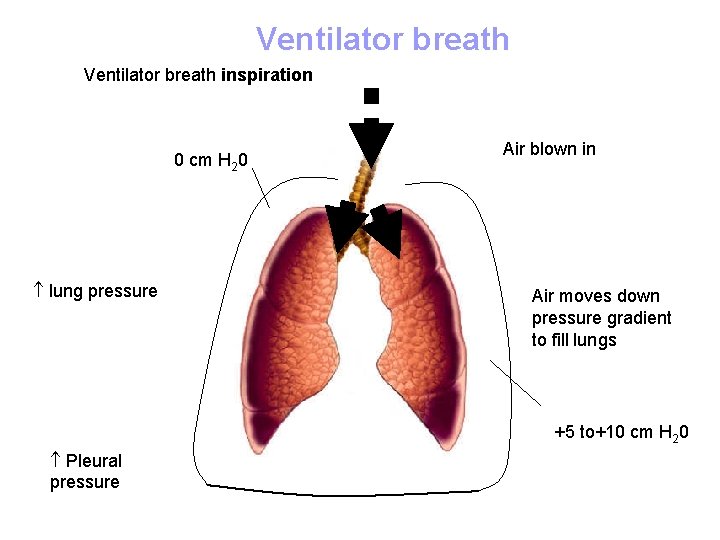
Ventilator breath inspiration 0 cm H 20 lung pressure Air blown in Air moves down pressure gradient to fill lungs +5 to+10 cm H 20 Pleural pressure
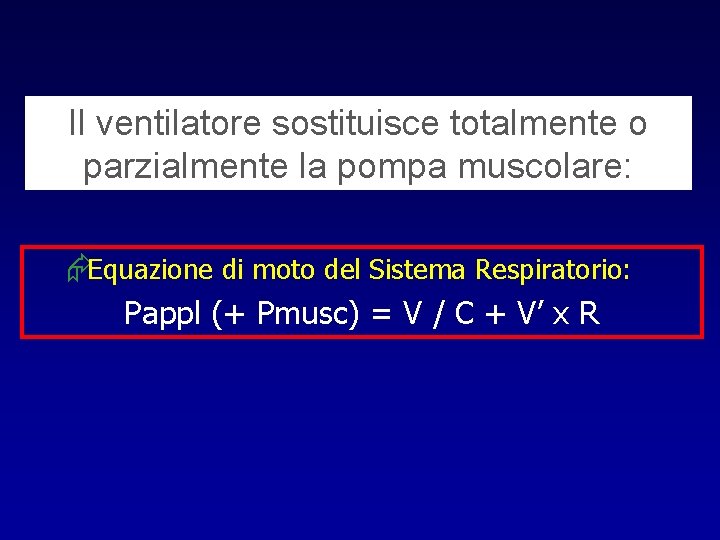
Il ventilatore sostituisce totalmente o parzialmente la pompa muscolare: ÆEquazione di moto del Sistema Respiratorio: Pappl (+ Pmusc) = V / C + V’ x R
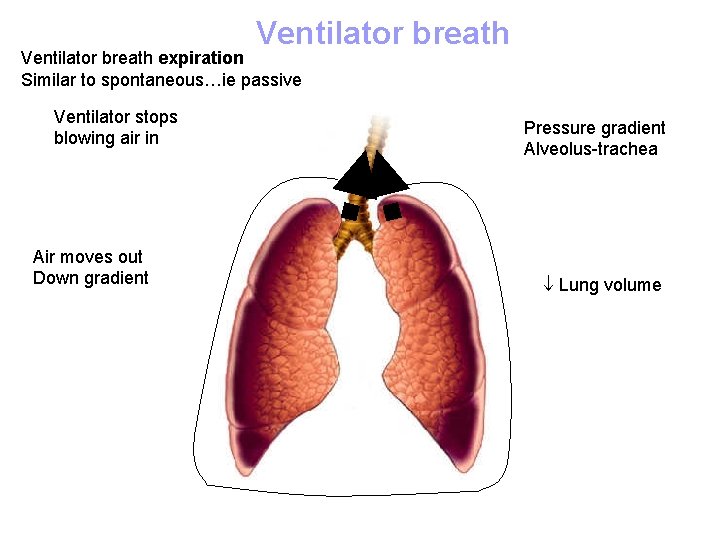
Ventilator breath expiration Similar to spontaneous…ie passive Ventilator stops blowing air in Air moves out Down gradient Pressure gradient Alveolus-trachea Lung volume
Practicalities • Ventilator settings: • Pressure vs volume • ‘Assist’ vs ‘Control’ • Trigger sensitivity • PEEP?
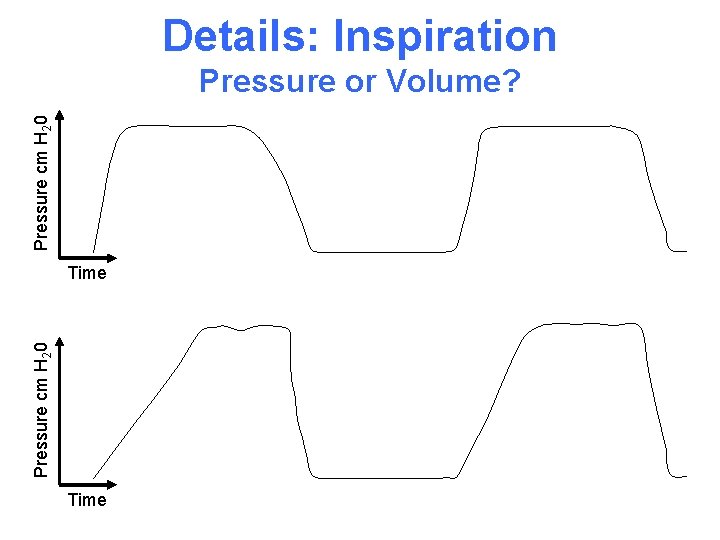
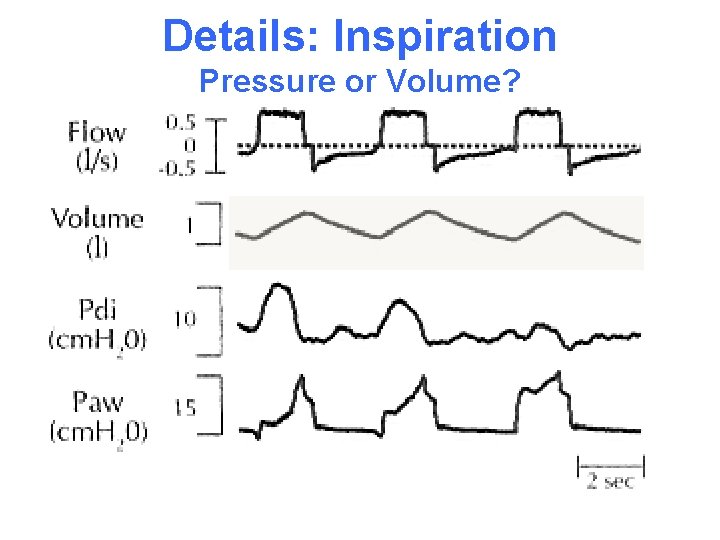
Details: Inspiration Pressure or Volume? • Do you push in. . – A gas at a set pressure? = ‘pressure…. . ’ – A set volume of gas? = ‘volume…. ’
Details: Inspiration Pressure cm H 20 Pressure or Volume? Pressure cm H 20 Time
Pressure Ventilators • The use of pressure ventilators is increasing in critical care units. • A typical pressure mode delivers a selected gas pressure to the patient early in inspiration, and sustains the pressure throughout the inspiratory phase. • By meeting the patient’s inspiratory flow demand throughout inspiration, patient effort is reduced and comfort increased.
• Although pressure is consistent with these modes, volume is not. • Volume will change with changes in resistance or compliance • Therefore, exhaled tidal volume is the variable to monitor closely. • With pressure modes, the pressure level to be delivered is selected, and with some mode options, rate and inspiratory time are preset as well.
Details: Inspiration Pressure or Volume?
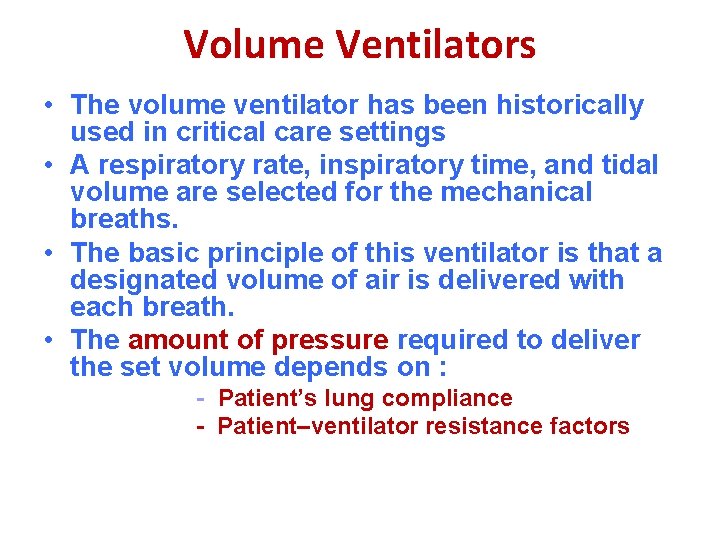
Volume Ventilators • The volume ventilator has been historically used in critical care settings • A respiratory rate, inspiratory time, and tidal volume are selected for the mechanical breaths. • The basic principle of this ventilator is that a designated volume of air is delivered with each breath. • The amount of pressure required to deliver the set volume depends on : - Patient’s lung compliance - Patient–ventilator resistance factors
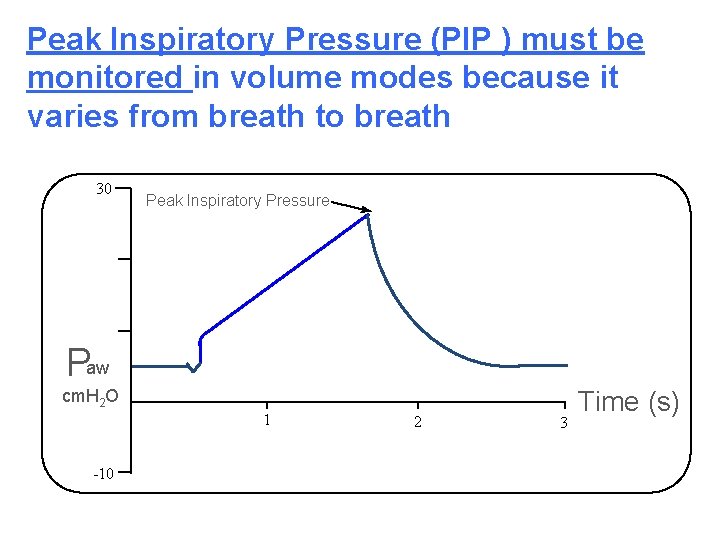
Peak Inspiratory Pressure (PIP ) must be monitored in volume modes because it varies from breath to breath 30 Peak Inspiratory Pressure Paw cm. H 2 O 1 -10 2 3 Time (s)
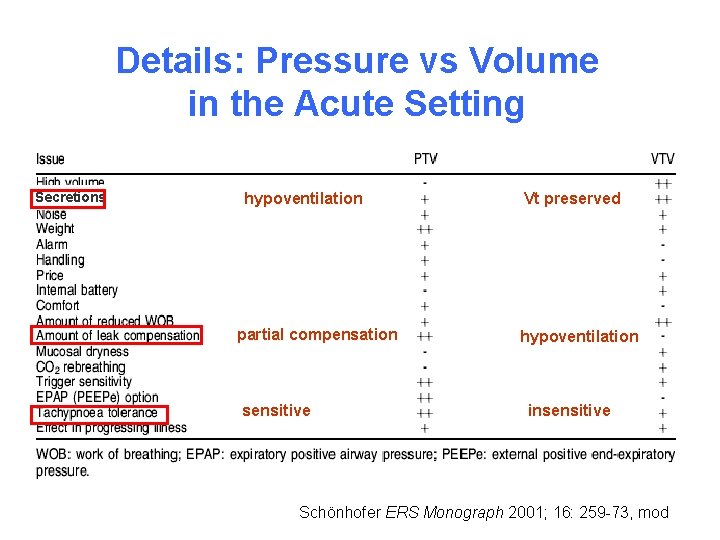
Details: Pressure vs Volume in the Acute Setting Secretions hypoventilation partial compensation sensitive Vt preserved hypoventilation insensitive Schönhofer ERS Monograph 2001; 16: 259 -73, mod
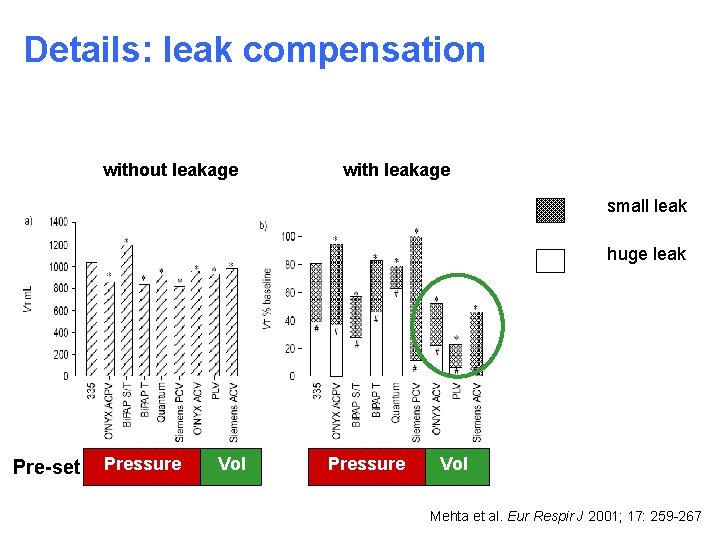
Details: leak compensation without leakage with leakage small leak huge leak Pre-set Pressure Vol Pressure Vol Mehta et al. Eur Respir J 2001; 17: 259 -267
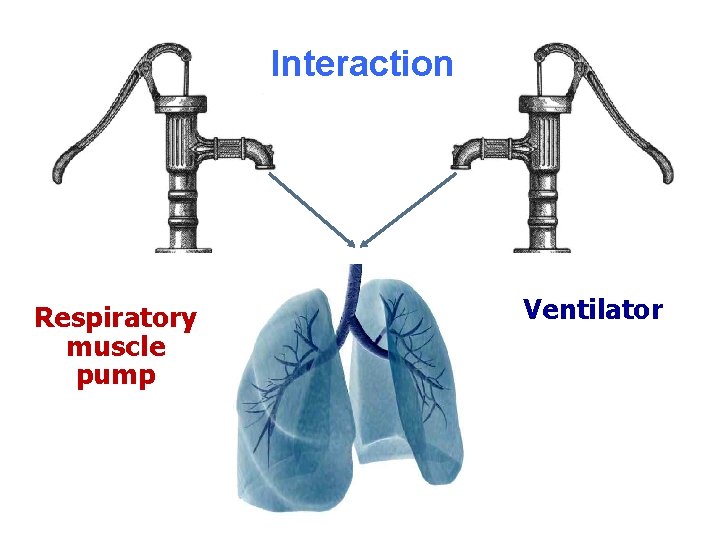
Interaction Respiratory muscle pump Ventilator
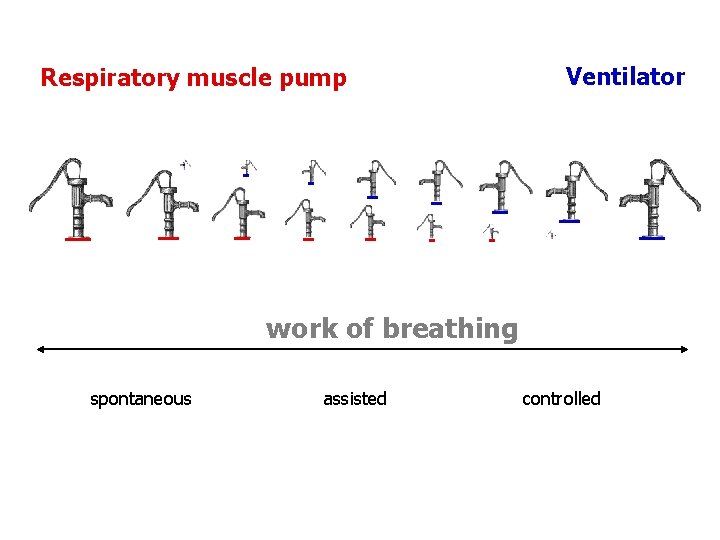
Respiratory Ventilator muscle pump. . work of breathing spontaneous assisted controlled
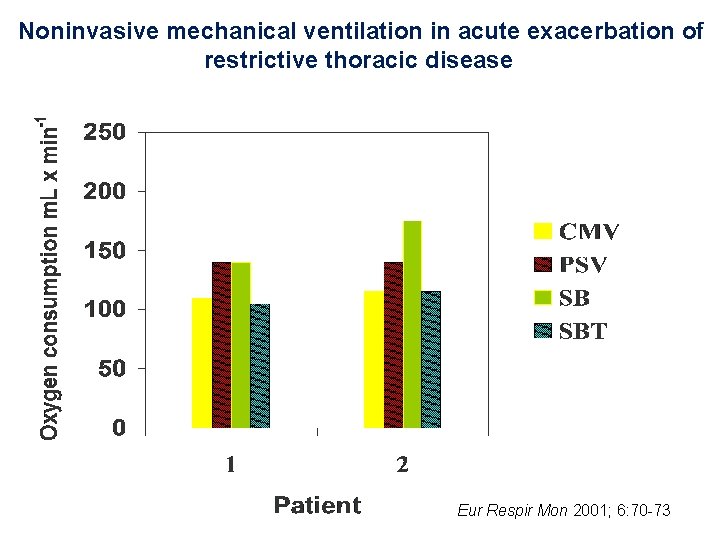
Noninvasive mechanical ventilation in acute exacerbation of restrictive thoracic disease Eur Respir Mon 2001; 6: 70 -73
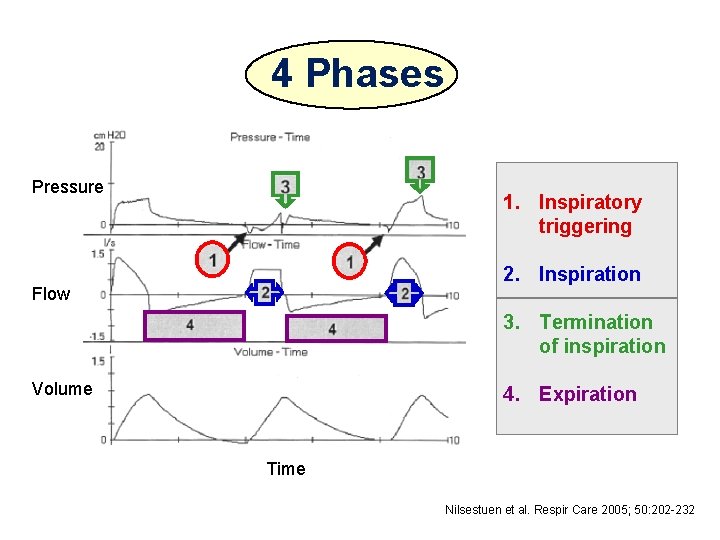
4 Phases Pressure 1. Inspiratory triggering 2. Inspiration Flow 3. Termination of inspiration Volume 4. Expiration Time Nilsestuen et al. Respir Care 2005; 50: 202 -232
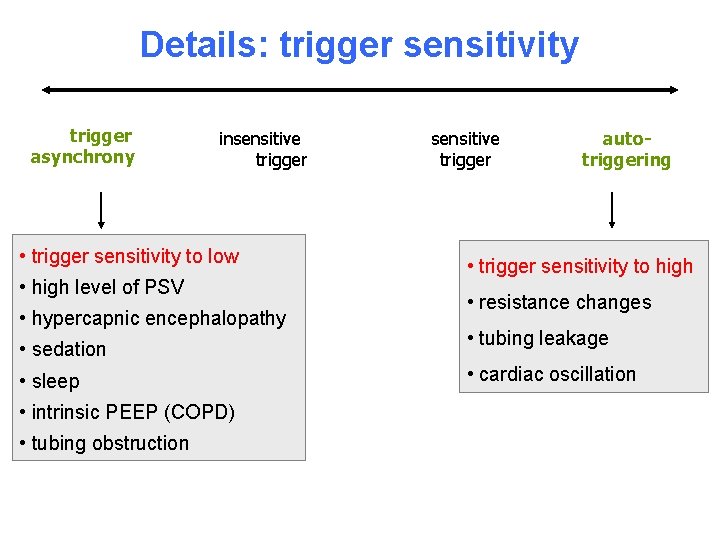
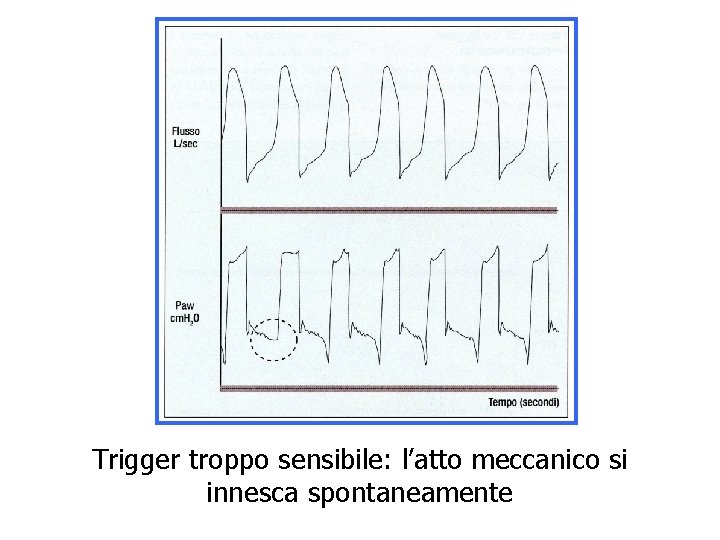
Details: trigger sensitivity trigger asynchrony insensitive trigger • trigger sensitivity to low • high level of PSV • hypercapnic encephalopathy • sedation • sleep • intrinsic PEEP (COPD) • tubing obstruction sensitive trigger autotriggering • trigger sensitivity to high • resistance changes • tubing leakage • cardiac oscillation
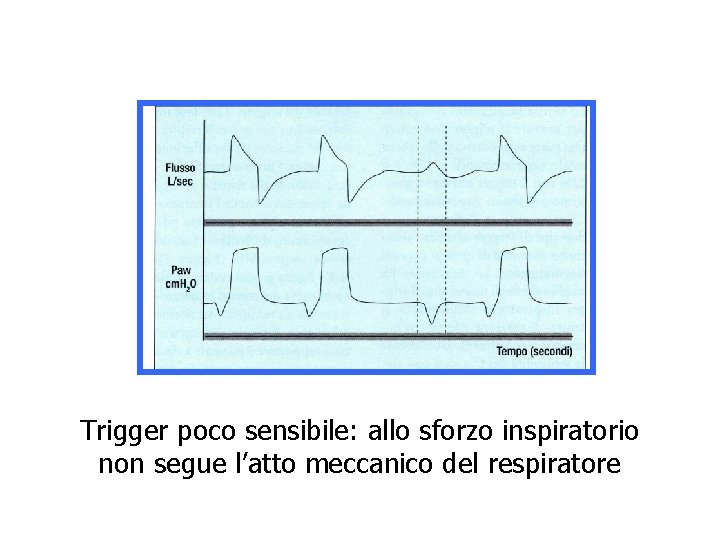
Trigger poco sensibile: allo sforzo inspiratorio non segue l’atto meccanico del respiratore
Trigger troppo sensibile: l’atto meccanico si innesca spontaneamente
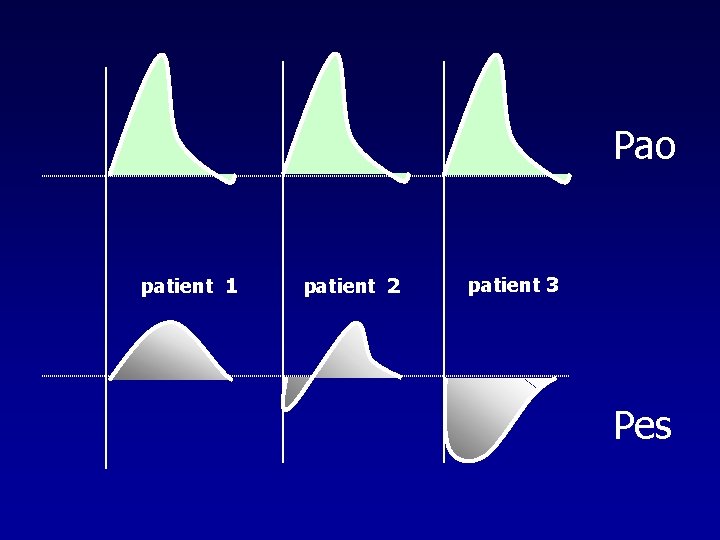
Pao patient 1 patient 2 patient 3 Pes
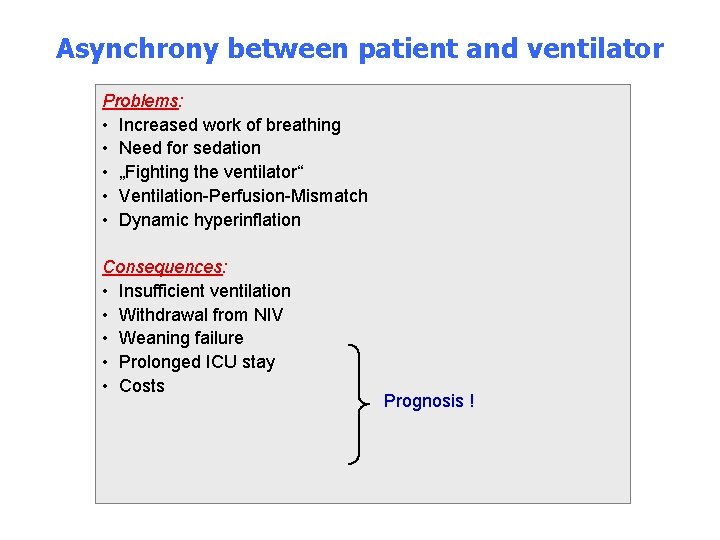
Asynchrony between patient and ventilator Problems: • Increased work of breathing • Need for sedation • „Fighting the ventilator“ • Ventilation-Perfusion-Mismatch • Dynamic hyperinflation Consequences: • Insufficient ventilation • Withdrawal from NIV • Weaning failure • Prolonged ICU stay • Costs Prognosis !
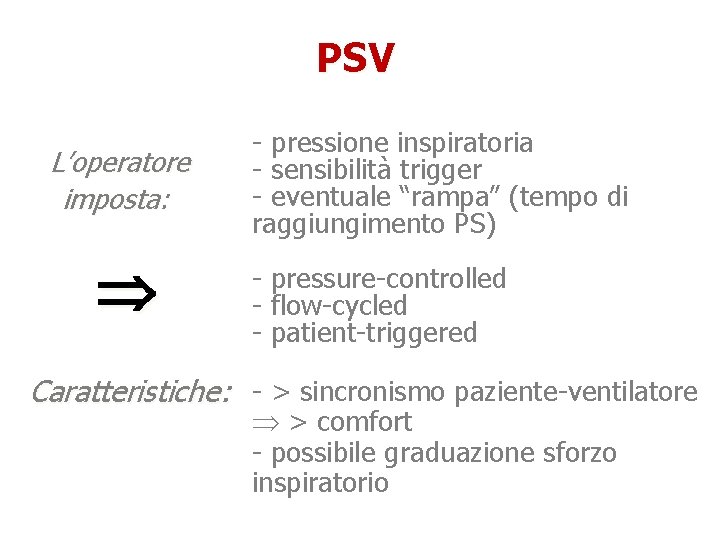
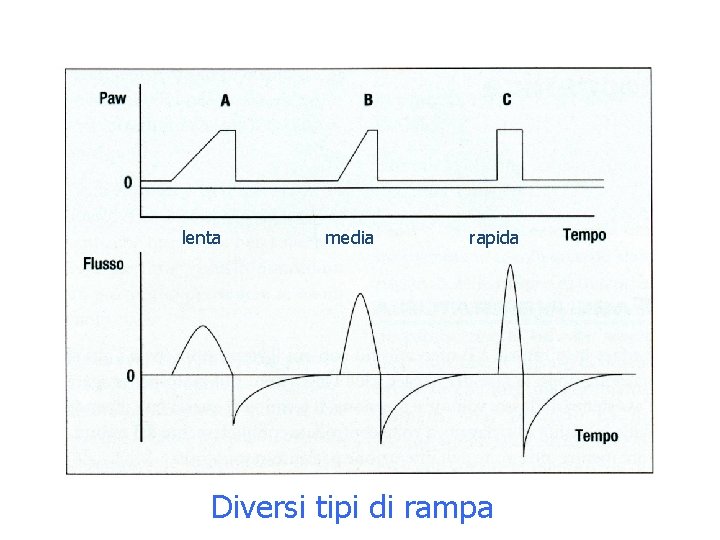
PSV L’operatore imposta: - pressione inspiratoria - sensibilità trigger - eventuale “rampa” (tempo di raggiungimento PS) - pressure-controlled - flow-cycled - patient-triggered Caratteristiche: - > sincronismo paziente-ventilatore > comfort - possibile graduazione sforzo inspiratorio
lenta media rapida Diversi tipi di rampa
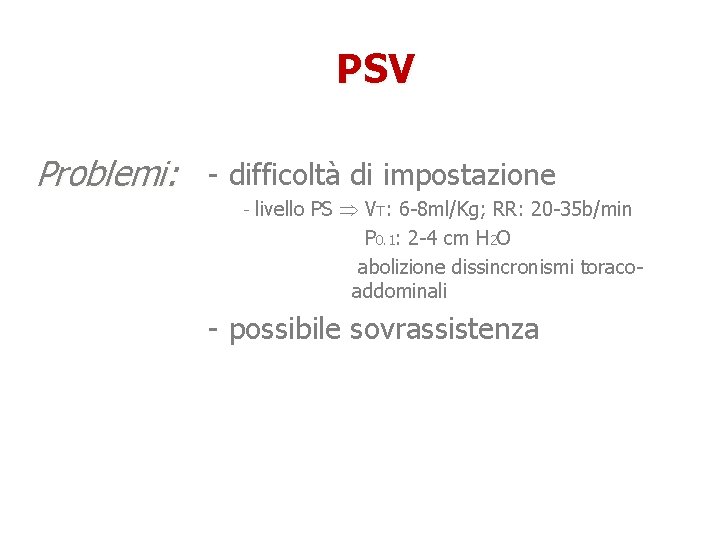
PSV Problemi: - difficoltà di impostazione - livello PS VT: 6 -8 ml/Kg; RR: 20 -35 b/min P 0. 1: 2 -4 cm H 2 O abolizione dissincronismi toracoaddominali - possibile sovrassistenza
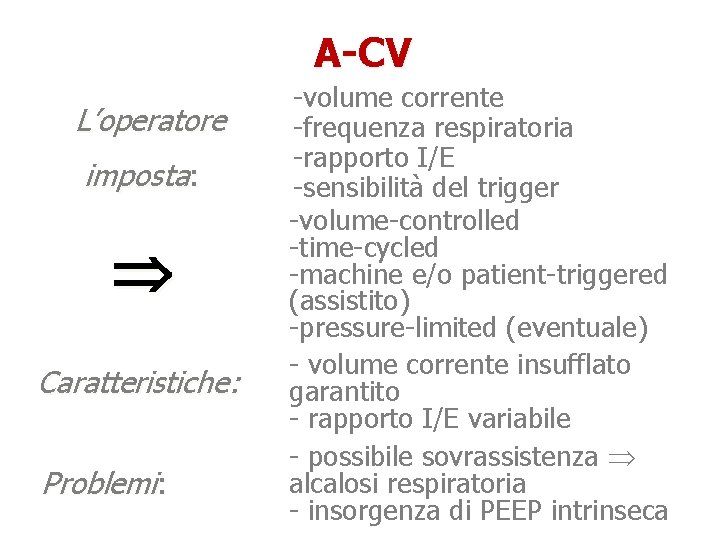
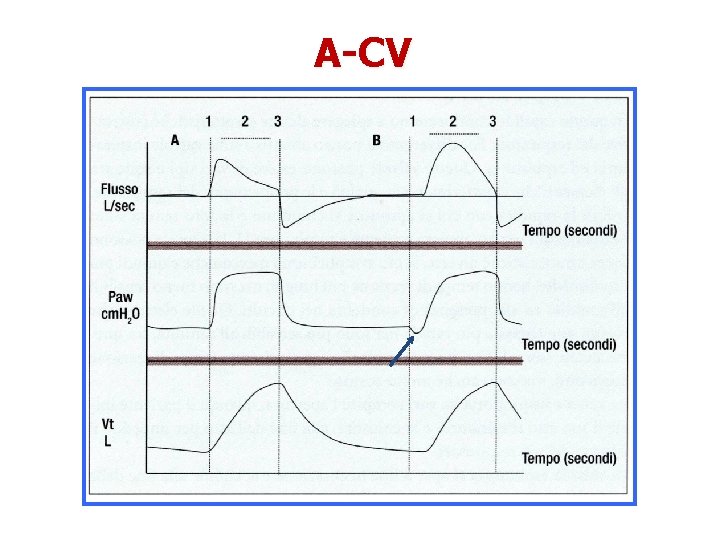
A-CV L’operatore imposta: Caratteristiche: Problemi: -volume corrente -frequenza respiratoria -rapporto I/E -sensibilità del trigger -volume-controlled -time-cycled -machine e/o patient-triggered (assistito) -pressure-limited (eventuale) - volume corrente insufflato garantito - rapporto I/E variabile - possibile sovrassistenza alcalosi respiratoria - insorgenza di PEEP intrinseca
A-CV
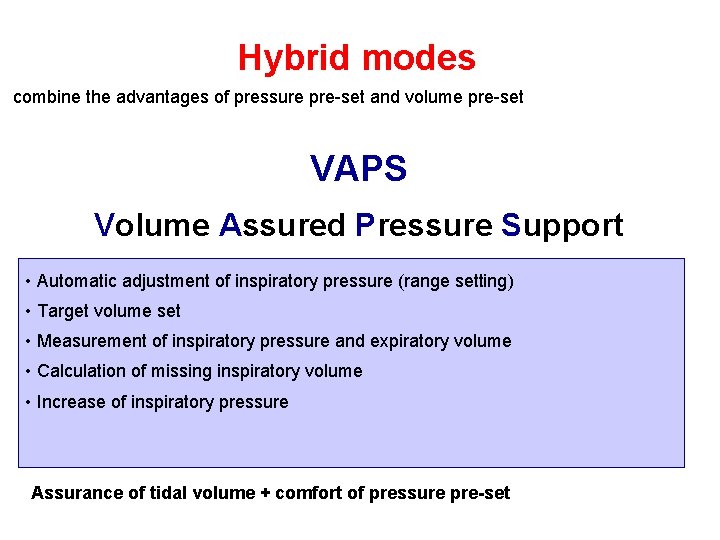
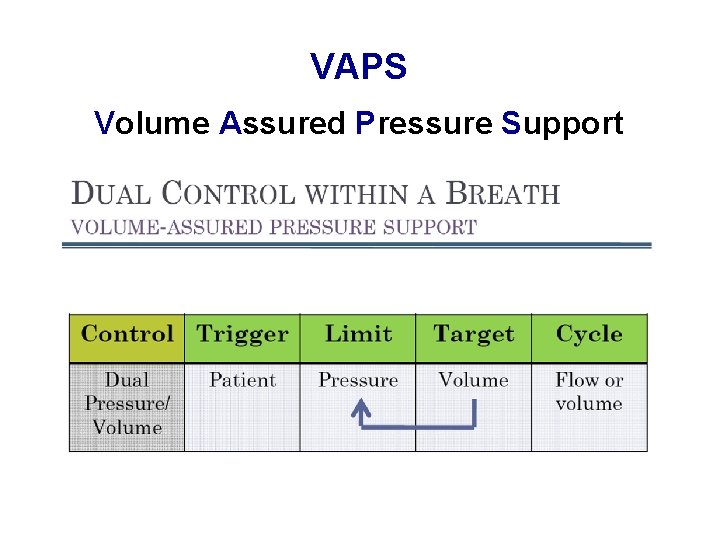
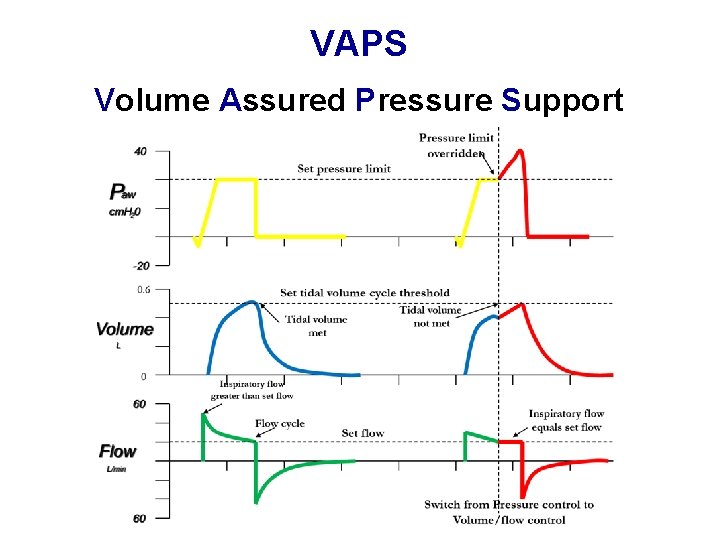
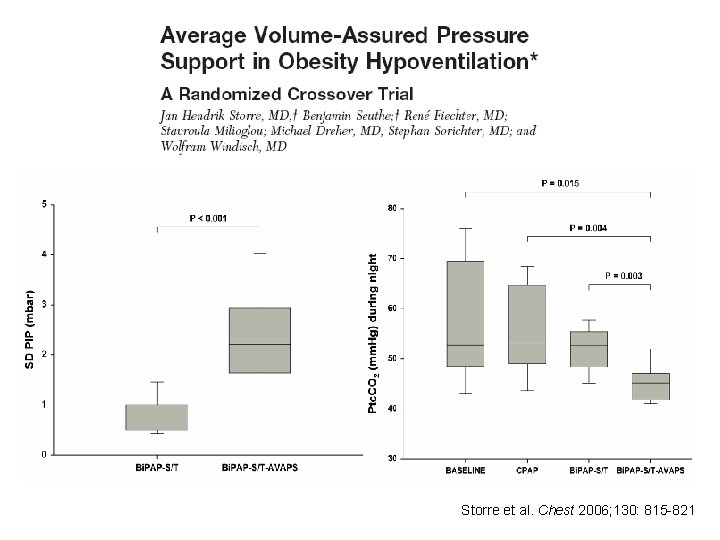
Hybrid modes combine the advantages of pressure pre-set and volume pre-set VAPS Volume Assured Pressure Support • Automatic adjustment of inspiratory pressure (range setting) • Target volume set • Measurement of inspiratory pressure and expiratory volume • Calculation of missing inspiratory volume • Increase of inspiratory pressure Assurance of tidal volume + comfort of pressure pre-set
VAPS Volume Assured Pressure Support
VAPS Volume Assured Pressure Support
Storre et al. Chest 2006; 130: 815 -821
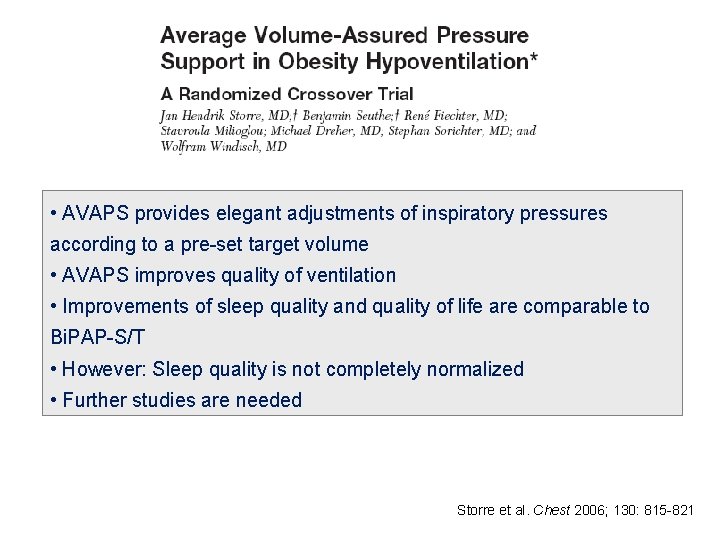
• AVAPS provides elegant adjustments of inspiratory pressures according to a pre-set target volume • AVAPS improves quality of ventilation • Improvements of sleep quality and quality of life are comparable to Bi. PAP-S/T • However: Sleep quality is not completely normalized • Further studies are needed Storre et al. Chest 2006; 130: 815 -821
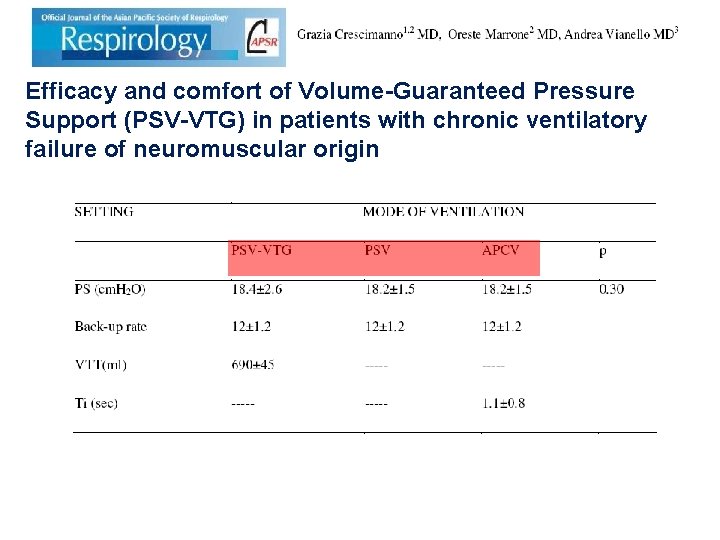
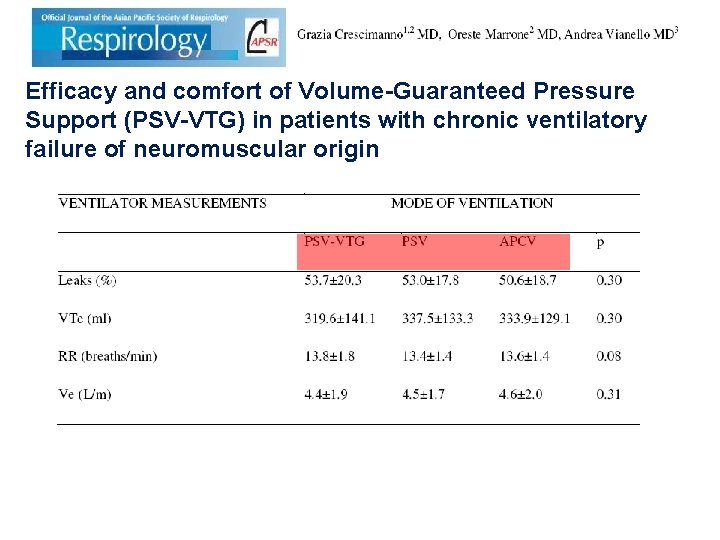
Efficacy and comfort of Volume-Guaranteed Pressure Support (PSV-VTG) in patients with chronic ventilatory failure of neuromuscular origin
Efficacy and comfort of Volume-Guaranteed Pressure Support (PSV-VTG) in patients with chronic ventilatory failure of neuromuscular origin
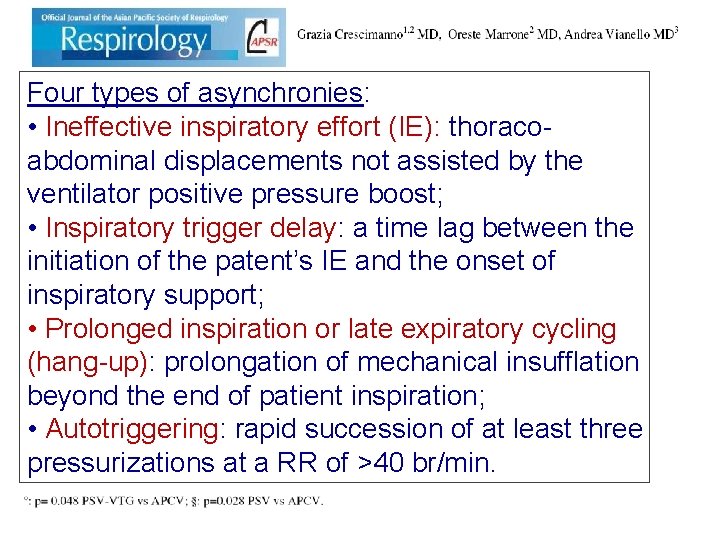
Efficacy and comfort of Volume-Guaranteed Pressure Four types of asynchronies: Support (PSV-VTG) in patients with chronic ventilatory • Ineffective inspiratory effort (IE): thoracofailure of neuromuscular origin abdominal displacements not assisted by the ventilator positive pressure boost; • Inspiratory trigger delay: a time lag between the initiation of the patent’s IE and the onset of inspiratory support; • Prolonged inspiration or late expiratory cycling (hang-up): prolongation of mechanical insufflation beyond the end of patient inspiration; • Autotriggering: rapid succession of at least three pressurizations at a RR of >40 br/min.
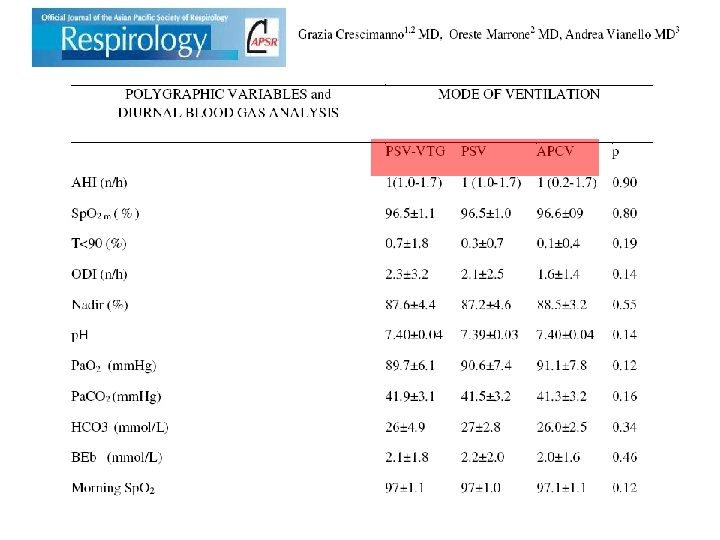
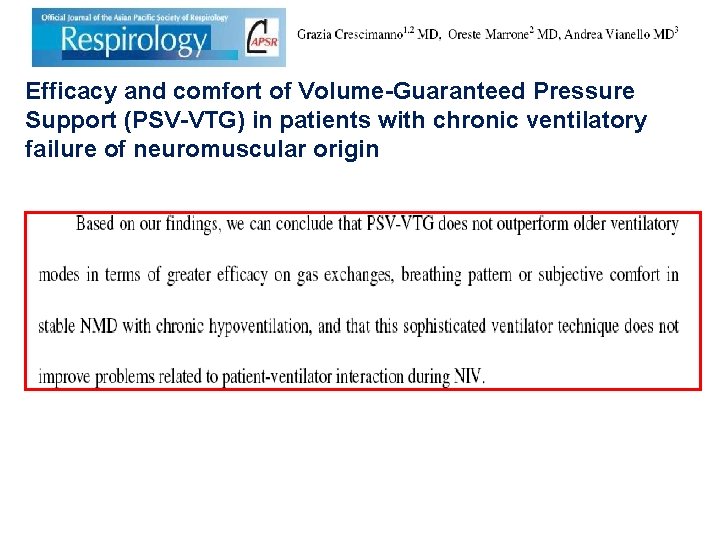
Efficacy and comfort of Volume-Guaranteed Pressure Support (PSV-VTG) in patients with chronic ventilatory failure of neuromuscular origin
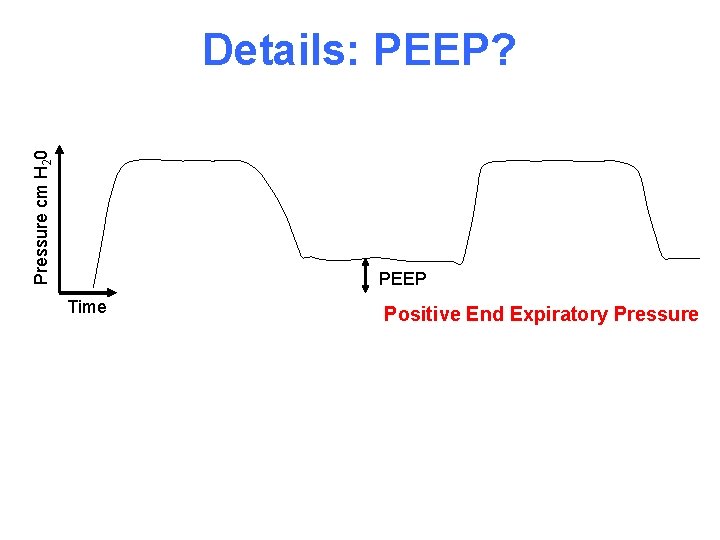
Pressure cm H 20 Details: PEEP? PEEP Time Positive End Expiratory Pressure
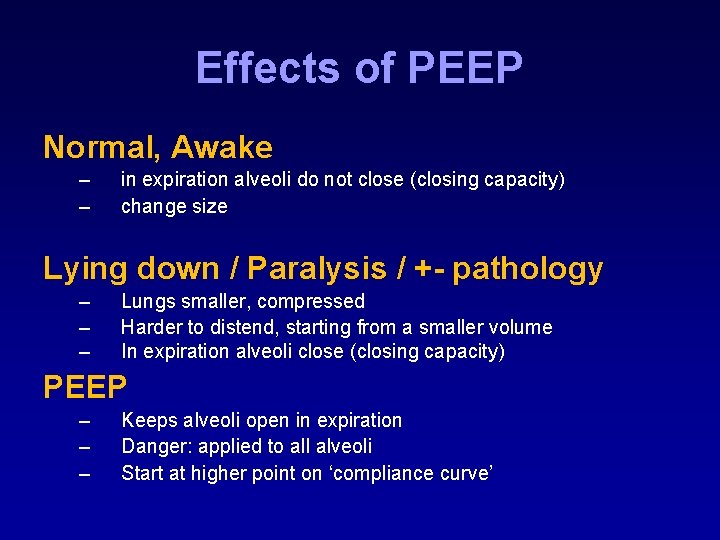
Effects of PEEP Normal, Awake – – in expiration alveoli do not close (closing capacity) change size Lying down / Paralysis / +- pathology – – – Lungs smaller, compressed Harder to distend, starting from a smaller volume In expiration alveoli close (closing capacity) PEEP – – – Keeps alveoli open in expiration Danger: applied to all alveoli Start at higher point on ‘compliance curve’
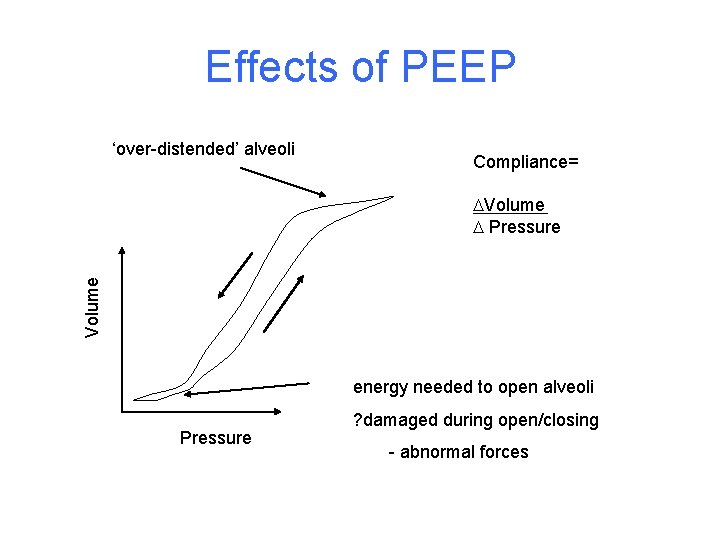
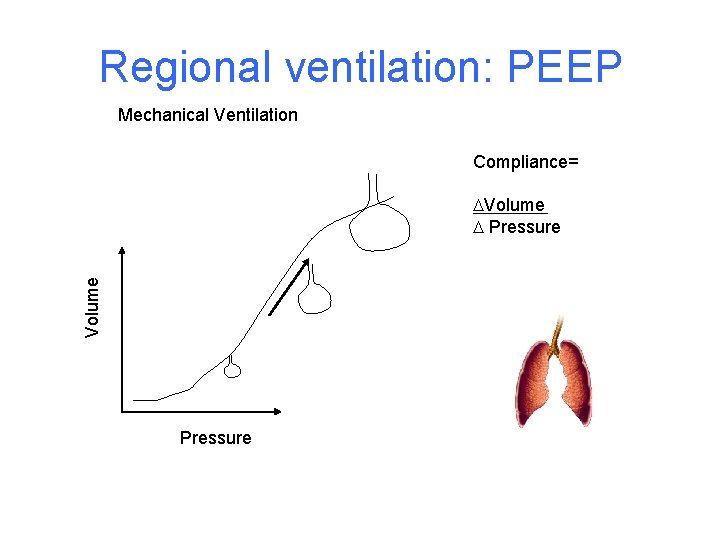
Effects of PEEP ‘over-distended’ alveoli Compliance= Volume Pressure energy needed to open alveoli Pressure ? damaged during open/closing - abnormal forces
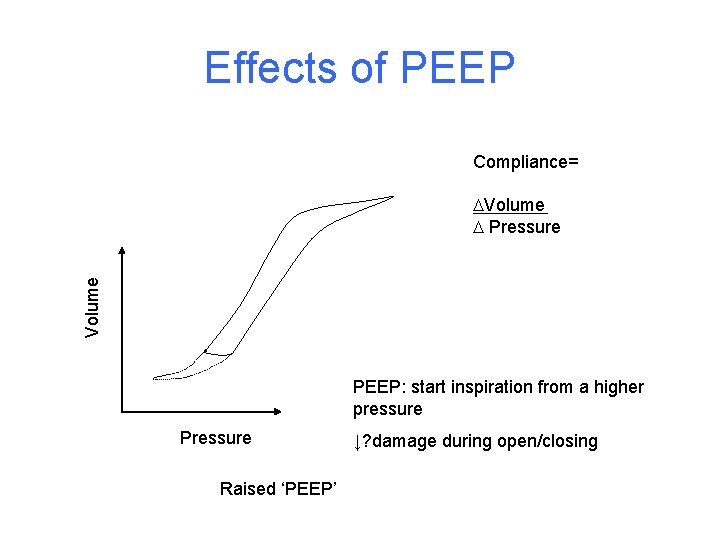
Effects of PEEP Compliance= Volume Pressure PEEP: start inspiration from a higher pressure Pressure Raised ‘PEEP’ ↓? damage during open/closing
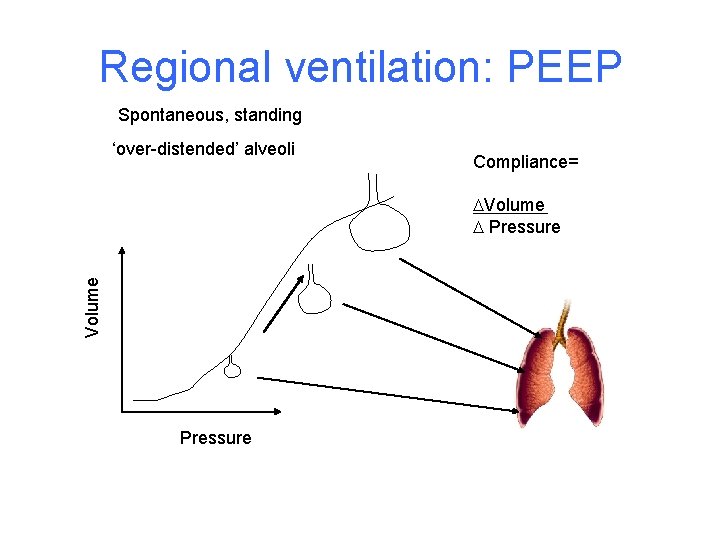
Regional ventilation: PEEP Spontaneous, standing ‘over-distended’ alveoli Compliance= Volume Pressure
Regional ventilation: PEEP Mechanical Ventilation Compliance= Volume Pressure
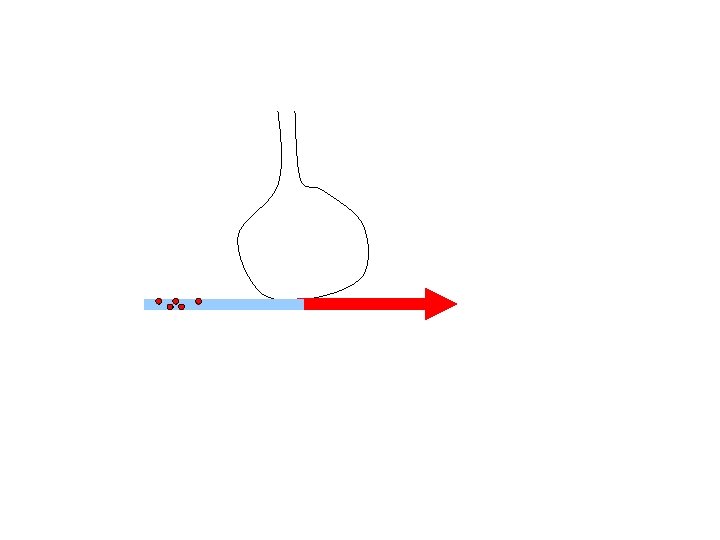
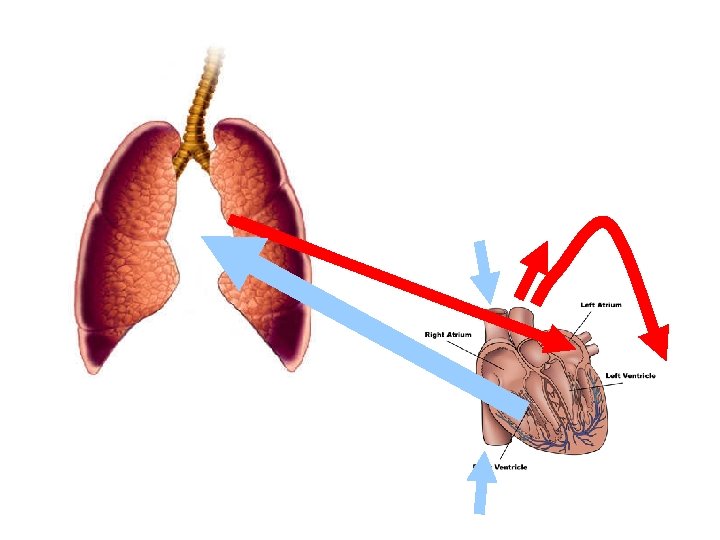
Details: Cardiovascular effects • Compresses Pulmonary vessels • Reduced RV outflow • Reduced LV inflow
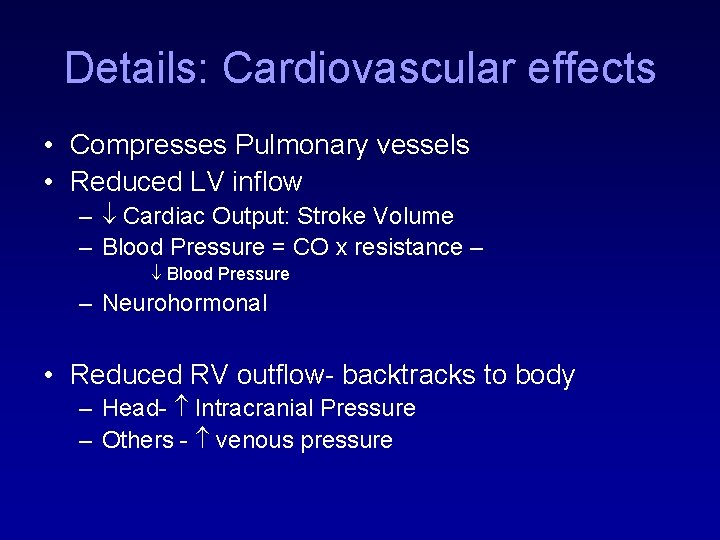
Details: Cardiovascular effects • Compresses Pulmonary vessels • Reduced LV inflow – Cardiac Output: Stroke Volume – Blood Pressure = CO x resistance – Blood Pressure – Neurohormonal • Reduced RV outflow- backtracks to body – Head- Intracranial Pressure – Others - venous pressure
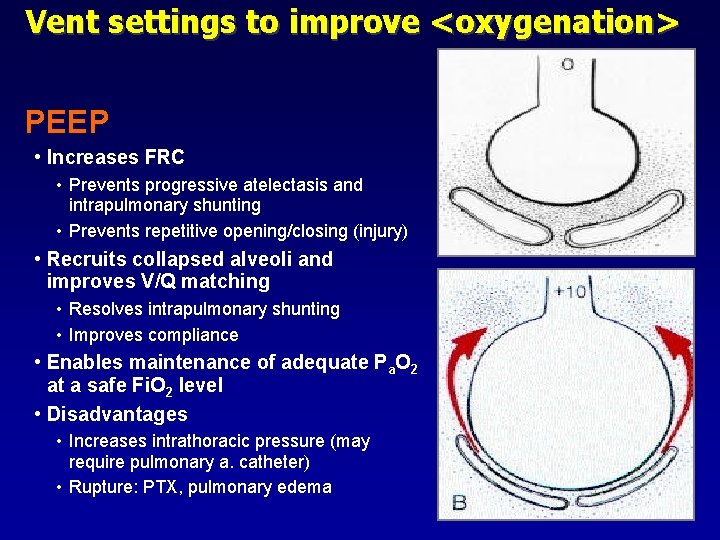
Vent settings to improve <oxygenation> PEEP • Increases FRC • Prevents progressive atelectasis and intrapulmonary shunting • Prevents repetitive opening/closing (injury) • Recruits collapsed alveoli and improves V/Q matching • Resolves intrapulmonary shunting • Improves compliance • Enables maintenance of adequate Pa. O 2 at a safe Fi. O 2 level • Disadvantages • Increases intrathoracic pressure (may require pulmonary a. catheter) • Rupture: PTX, pulmonary edema
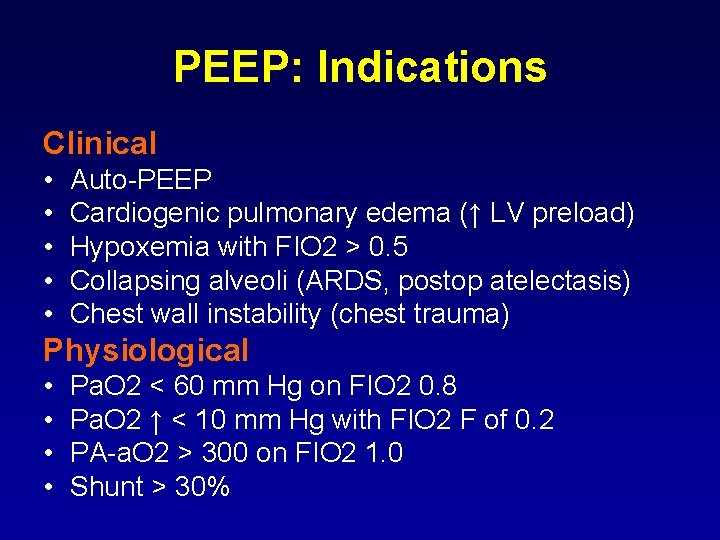
PEEP: Indications Clinical • • • Auto-PEEP Cardiogenic pulmonary edema (↑ LV preload) Hypoxemia with FIO 2 > 0. 5 Collapsing alveoli (ARDS, postop atelectasis) Chest wall instability (chest trauma) Physiological • • Pa. O 2 < 60 mm Hg on FIO 2 0. 8 Pa. O 2 ↑ < 10 mm Hg with FIO 2 F of 0. 2 PA-a. O 2 > 300 on FIO 2 1. 0 Shunt > 30%
NIV treatment: summary • The ventilator management of NIV is continuously evolving; • New ventilators are introduced, offering novel features; • Clinical applications have been expanding; • Clinicians must make selections that best match the ventilator with the patient’s requirements.