
QUALITY OF PERFORMANCE Chapter 11 unit 1 REVISION

- Slides: 24
QUALITY OF PERFORMANCE Chapter 11: unit 1
REVISION (GRADE 10 & 11) QUALITY - is a measure of how good a product or process is - it is the result of good quality process or product meeting high standards TQM - quality involves all business functions - is the responsibility of all employees and not only managers
CONCEPT OF QUALITY ASSURANCE QUALITY CONTROL Essential in business “assuring” that quality is maintained throughout the production process a system that ensures desired quality is attained by inspecting the final product Factors affecting quality: 1. Systems 2. Processes 3. Employees 4. Management 5. Resources 6. Capital 7. Control
CONCEPT OF QUALITY The QUALITY ASSURANCE and QUALITY CONTROL measures include: 1. Quality Training by the Human Resources department 2. Purchasing high-quality inputs 3. Ensuring administrative and purchasing process result in high efficiency 4. Effective and efficient management of quality assurance and control systems
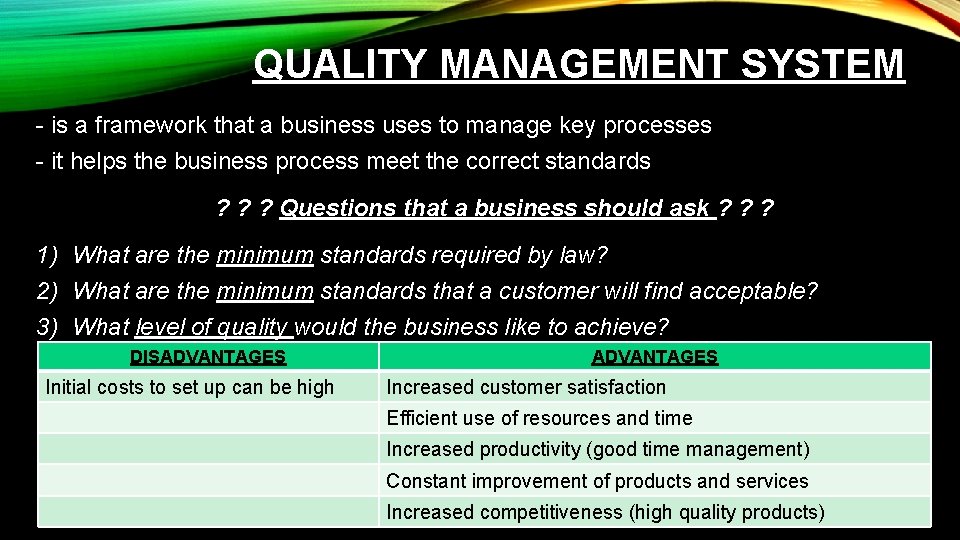
QUALITY MANAGEMENT SYSTEM - is a framework that a business uses to manage key processes - it helps the business process meet the correct standards ? ? ? Questions that a business should ask ? ? ? 1) What are the minimum standards required by law? 2) What are the minimum standards that a customer will find acceptable? 3) What level of quality would the business like to achieve? DISADVANTAGES Initial costs to set up can be high ADVANTAGES Increased customer satisfaction Efficient use of resources and time Increased productivity (good time management) Constant improvement of products and services Increased competitiveness (high quality products)
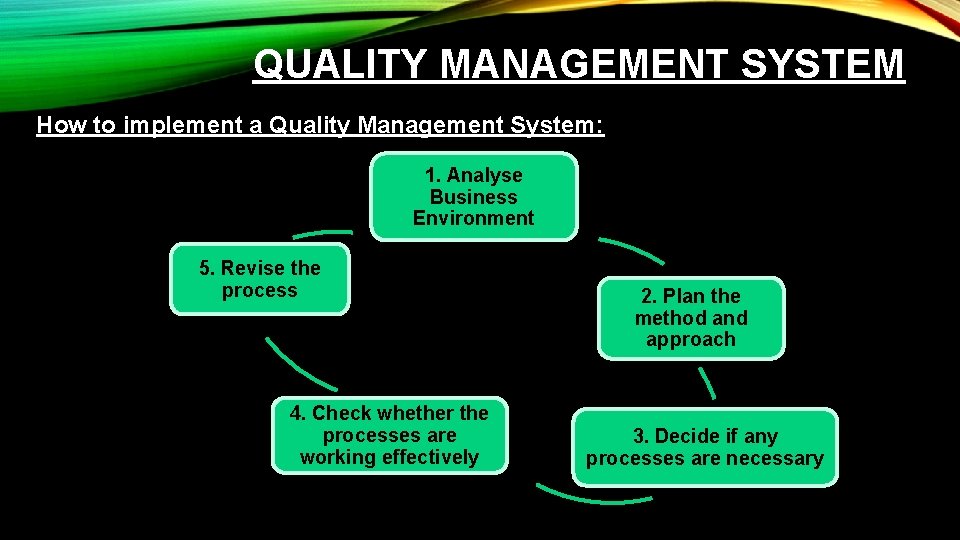
QUALITY MANAGEMENT SYSTEM How to implement a Quality Management System: 1. Analyse Business Environment 5. Revise the process 4. Check whether the processes are working effectively 2. Plan the method and approach 3. Decide if any processes are necessary
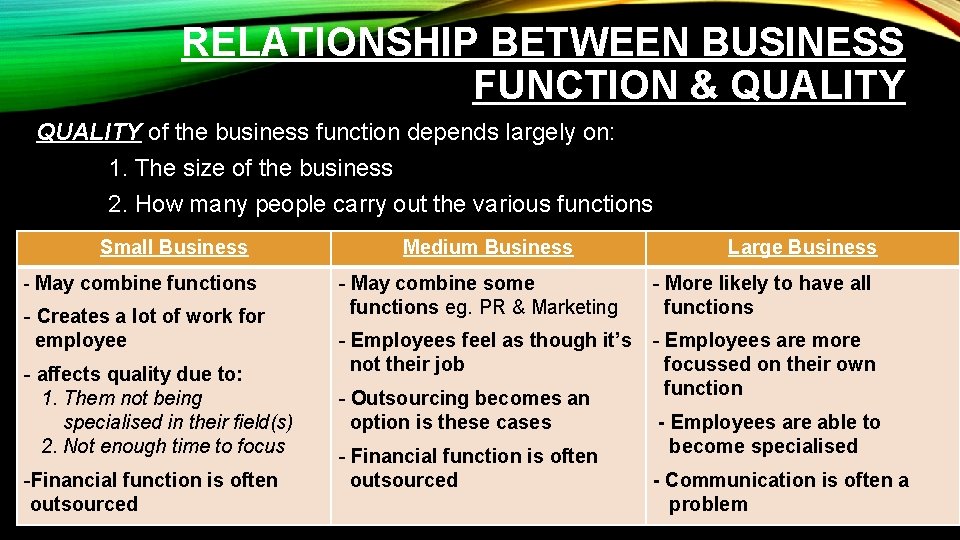
RELATIONSHIP BETWEEN BUSINESS FUNCTION & QUALITY of the business function depends largely on: 1. The size of the business 2. How many people carry out the various functions Small Business - May combine functions - Creates a lot of work for employee - affects quality due to: 1. Them not being specialised in their field(s) 2. Not enough time to focus -Financial function is often outsourced Medium Business Large Business - May combine some functions eg. PR & Marketing - More likely to have all functions - Employees feel as though it’s not their job - Employees are more focussed on their own function - Outsourcing becomes an option is these cases - Financial function is often outsourced - Employees are able to become specialised - Communication is often a problem
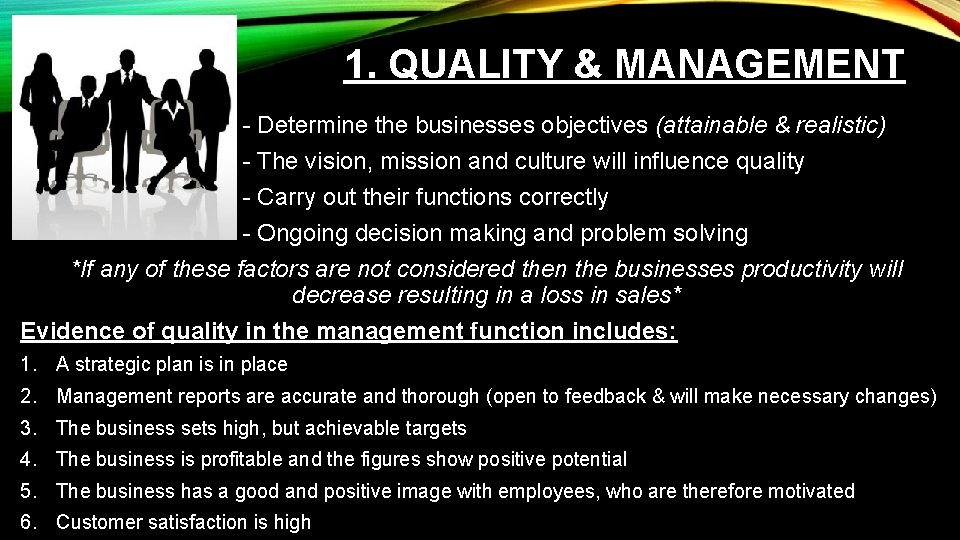
1. QUALITY & MANAGEMENT - Determine the businesses objectives (attainable & realistic) - The vision, mission and culture will influence quality - Carry out their functions correctly - Ongoing decision making and problem solving *If any of these factors are not considered then the businesses productivity will decrease resulting in a loss in sales* Evidence of quality in the management function includes: 1. A strategic plan is in place 2. Management reports are accurate and thorough (open to feedback & will make necessary changes) 3. The business sets high, but achievable targets 4. The business is profitable and the figures show positive potential 5. The business has a good and positive image with employees, who are therefore motivated 6. Customer satisfaction is high
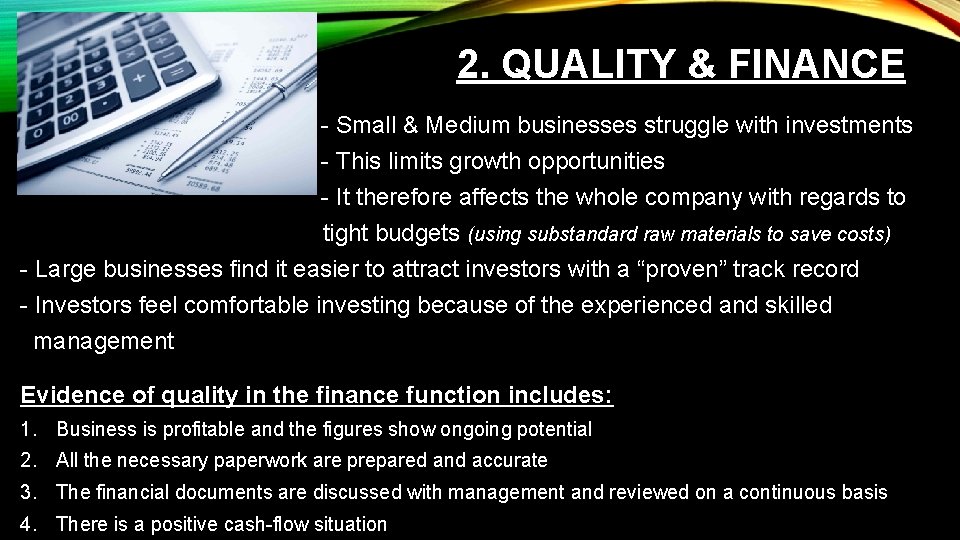
2. QUALITY & FINANCE - Small & Medium businesses struggle with investments - This limits growth opportunities - It therefore affects the whole company with regards to tight budgets (using substandard raw materials to save costs) - Large businesses find it easier to attract investors with a “proven” track record - Investors feel comfortable investing because of the experienced and skilled management Evidence of quality in the finance function includes: 1. Business is profitable and the figures show ongoing potential 2. All the necessary paperwork are prepared and accurate 3. The financial documents are discussed with management and reviewed on a continuous basis 4. There is a positive cash-flow situation
3. QUALITY & PURCHASING -Many businesses cannot afford to purchase raw materials in bulk -They compensate for the high prices by buying lower quality goods to limit their input costs -Quality packaging is often an “extra” and so damaged goods are a regularly occurrence -Larger businesses have more influence over suppliers and will take advantage of their discounts offered Evidence of quality in the purchasing function includes: 1. Raw materials and capital goods are purchased at the best priced 2. Capital goods are purchased from a reputable supplier and are durable 3. The quality of the raw materials is appropriate
4. QUALITY & PRODUCTION - Ideally the production process should have many managers with various skills - Where machinery is involved, the process should still be monitored and controlled - A well-constructed and detailed production plan should identify: best raw materials skills needed production method - Small businesses cannot enter into mass production due to the limited funding - Large businesses on the other hand do take advantage of mass production Evidence of quality in the production function includes: 1. All the production costs are calculated and considered when choosing the method of production 2. The most appropriate method is used 3. Production processes are monitored and evaluated to ensure they meet quality standards 4. SABS or ISO 9001 approval must be obtained
4. QUALITY & PRODUCTION SOUTH AFRICAN BUREAU OF STANDARDS (SABS) - promotes and maintains standards in South Africa The SABS carries out a number of tasks: a) Sets and publishes national standards b) Provides information on international standards and national standards c) Develops technical regulation and specifications and monitors them d) Promotes design excellence e) Promotes training INTERNATIONAL STANDARDS ORGANISATION (ISO) - ISO 9001 is a set of internationally recognised standards set for different industries - Industries are able to measure their own quality against that of industries around the world
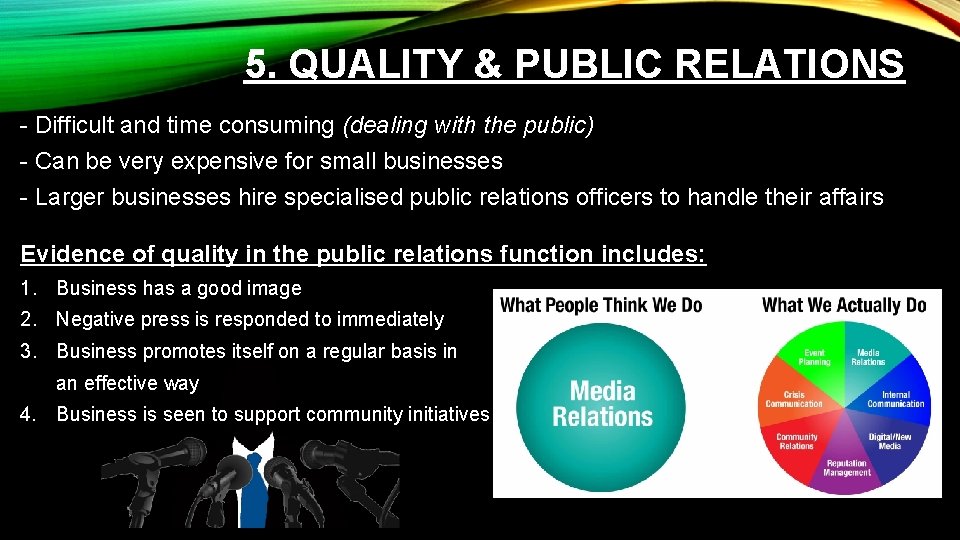
5. QUALITY & PUBLIC RELATIONS - Difficult and time consuming (dealing with the public) - Can be very expensive for small businesses - Larger businesses hire specialised public relations officers to handle their affairs Evidence of quality in the public relations function includes: 1. Business has a good image 2. Negative press is responded to immediately 3. Business promotes itself on a regular basis in an effective way 4. Business is seen to support community initiatives
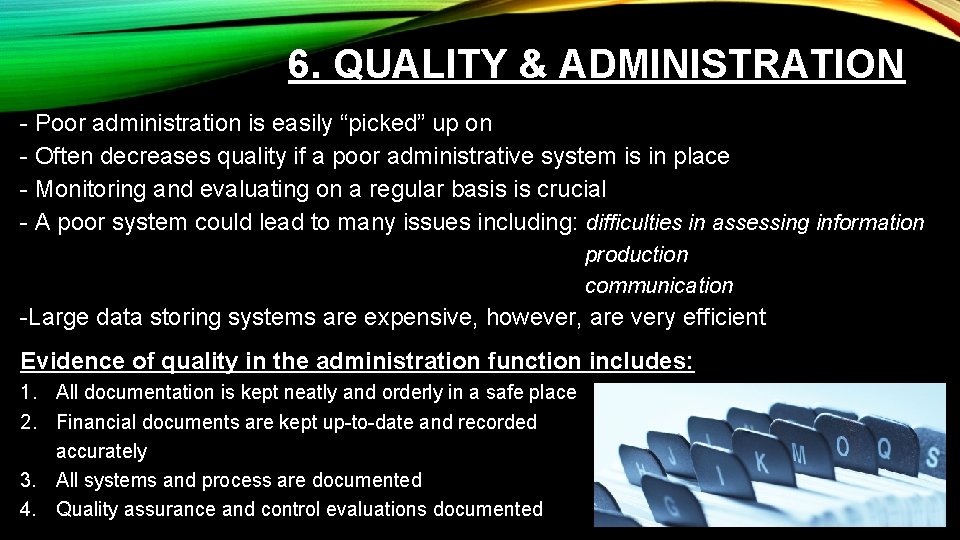
6. QUALITY & ADMINISTRATION - Poor administration is easily “picked” up on - Often decreases quality if a poor administrative system is in place - Monitoring and evaluating on a regular basis is crucial - A poor system could lead to many issues including: difficulties in assessing information production communication -Large data storing systems are expensive, however, are very efficient Evidence of quality in the administration function includes: 1. All documentation is kept neatly and orderly in a safe place 2. Financial documents are kept up-to-date and recorded accurately 3. All systems and process are documented 4. Quality assurance and control evaluations documented
7. QUALITY & HUMAN RESOURCES - One of the most important departments in assuring quality - The employees are key to implement the processes -On-going training & development is essential at all levels - Conflict may arise and therefore affect employees work - The morale and productivity of employees can be affected by: salary disputes conflict with management lack of recognition -Therefore important to incentivise employees properly
7. QUALITY & HUMAN RESOURCES Evidence of quality in the human resources function includes: 1. Effective training and development of employees take place continuously 2. Employees are positive about the business 3. Employees stay at the business for a long time Policies Businesses are legally required to follow the Occupational Health and Safety Act, 1993. - provides safety and health regulations for the workplace
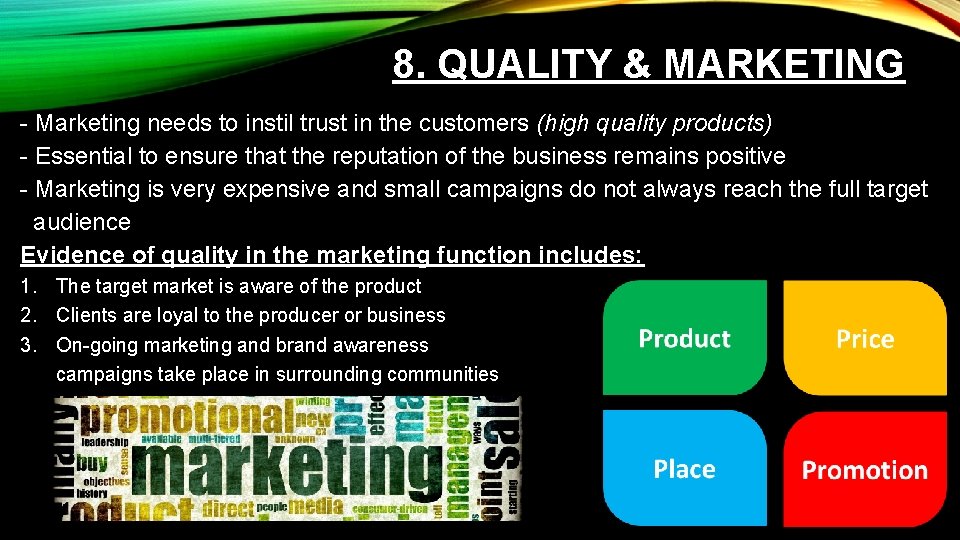
8. QUALITY & MARKETING - Marketing needs to instil trust in the customers (high quality products) - Essential to ensure that the reputation of the business remains positive - Marketing is very expensive and small campaigns do not always reach the full target audience Evidence of quality in the marketing function includes: 1. The target market is aware of the product 2. Clients are loyal to the producer or business 3. On-going marketing and brand awareness campaigns take place in surrounding communities
QUALITY OF PERFORMANCE Chapter 11: unit 2
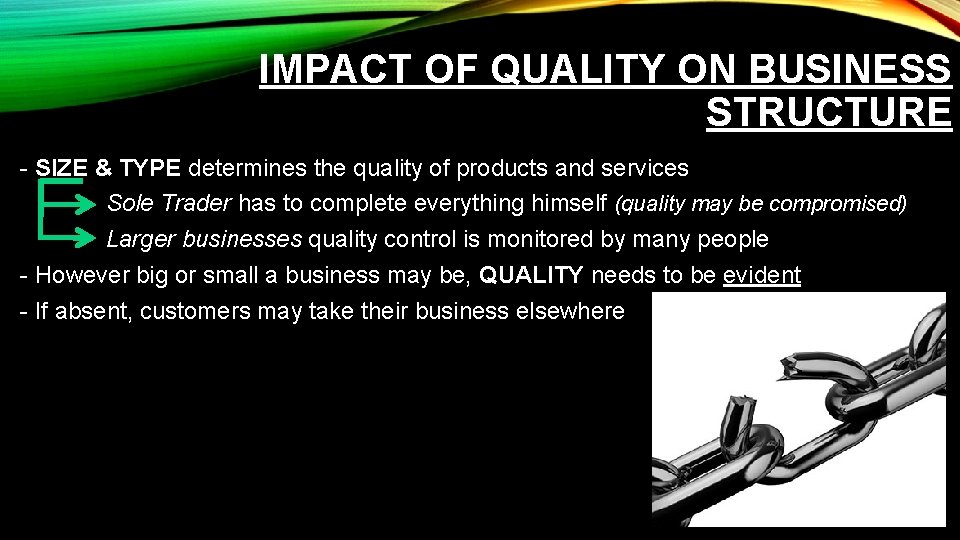
IMPACT OF QUALITY ON BUSINESS STRUCTURE - SIZE & TYPE determines the quality of products and services Sole Trader has to complete everything himself (quality may be compromised) Larger businesses quality control is monitored by many people - However big or small a business may be, QUALITY needs to be evident - If absent, customers may take their business elsewhere
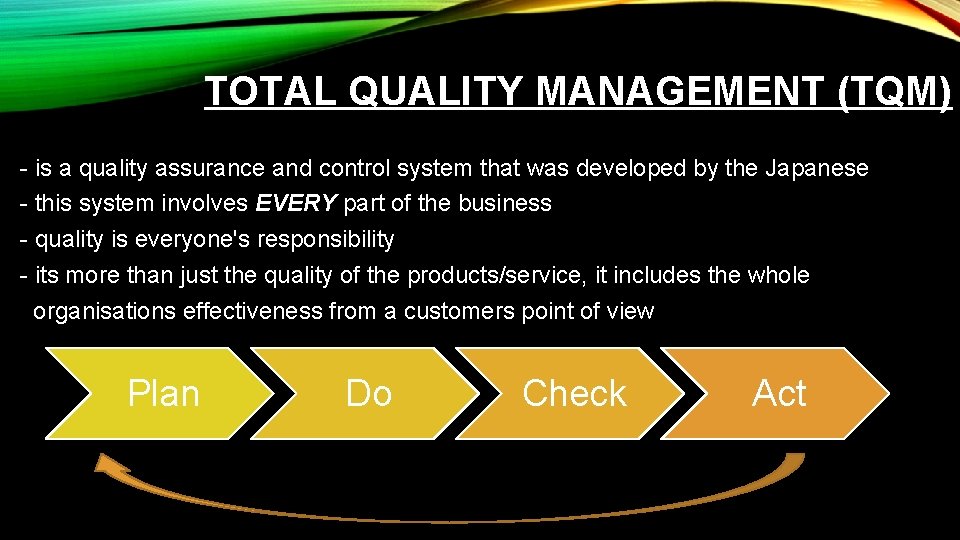
TOTAL QUALITY MANAGEMENT (TQM) - is a quality assurance and control system that was developed by the Japanese - this system involves EVERY part of the business - quality is everyone's responsibility - its more than just the quality of the products/service, it includes the whole organisations effectiveness from a customers point of view Plan Do Check Act
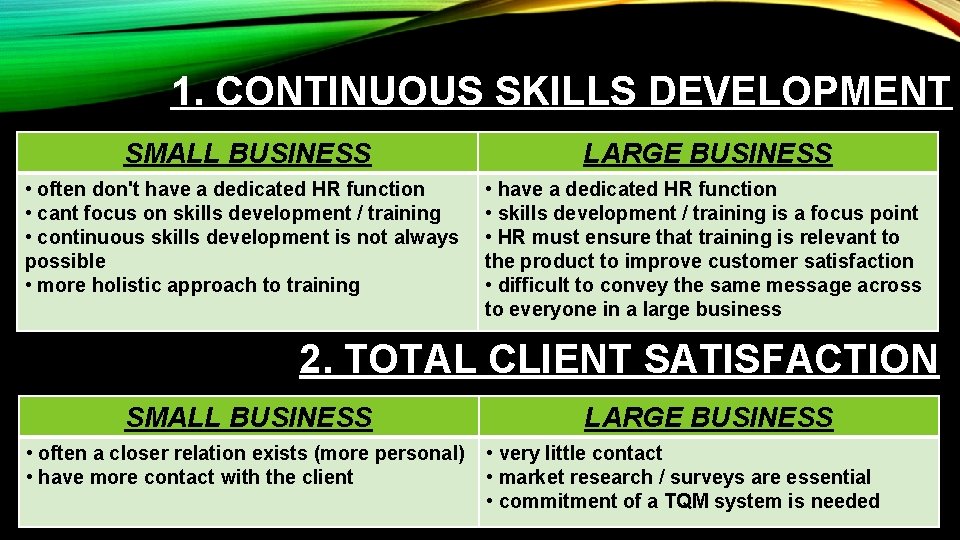
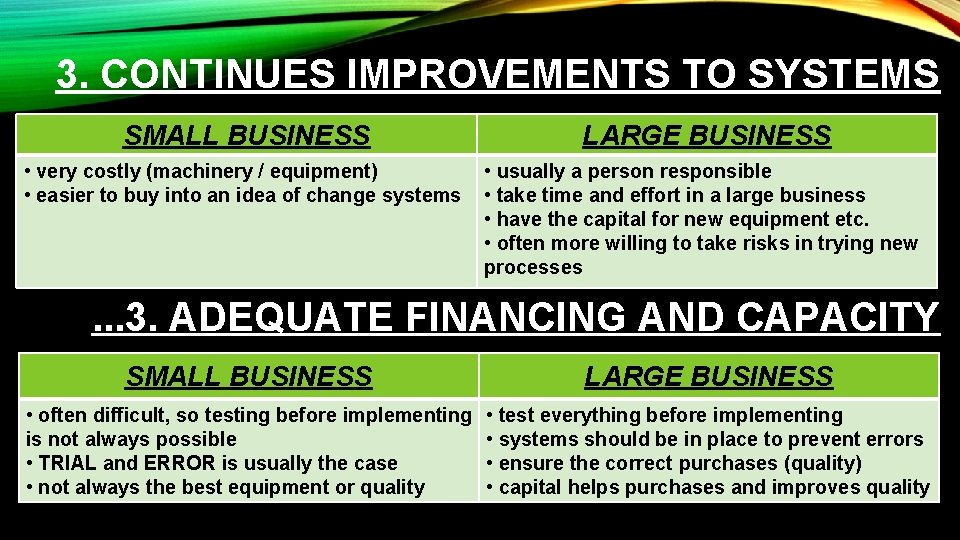
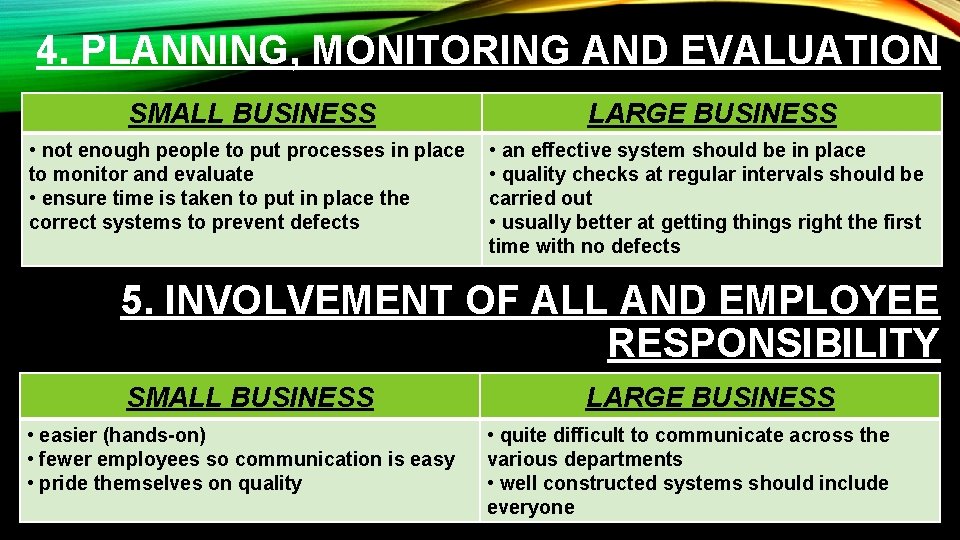
IMPACT OF TQM ON BUSINESSES The elements of TQM are: 1. Continuous skills development 2. Total client satisfaction 3. Continues improvements to systems, adequate financing and capacity 4. Planning, monitoring and evaluation 5. Involvement of all and employee responsibility
1. CONTINUOUS SKILLS DEVELOPMENT SMALL BUSINESS LARGE BUSINESS • often don't have a dedicated HR function • cant focus on skills development / training • continuous skills development is not always possible • more holistic approach to training • have a dedicated HR function • skills development / training is a focus point • HR must ensure that training is relevant to the product to improve customer satisfaction • difficult to convey the same message across to everyone in a large business 2. TOTAL CLIENT SATISFACTION SMALL BUSINESS • often a closer relation exists (more personal) • have more contact with the client LARGE BUSINESS • very little contact • market research / surveys are essential • commitment of a TQM system is needed
3. CONTINUES IMPROVEMENTS TO SYSTEMS SMALL BUSINESS LARGE BUSINESS • very costly (machinery / equipment) • easier to buy into an idea of change systems • usually a person responsible • take time and effort in a large business • have the capital for new equipment etc. • often more willing to take risks in trying new processes . . . 3. ADEQUATE FINANCING AND CAPACITY SMALL BUSINESS LARGE BUSINESS • often difficult, so testing before implementing is not always possible • TRIAL and ERROR is usually the case • not always the best equipment or quality • test everything before implementing • systems should be in place to prevent errors • ensure the correct purchases (quality) • capital helps purchases and improves quality
4. PLANNING, MONITORING AND EVALUATION SMALL BUSINESS LARGE BUSINESS • not enough people to put processes in place to monitor and evaluate • ensure time is taken to put in place the correct systems to prevent defects • an effective system should be in place • quality checks at regular intervals should be carried out • usually better at getting things right the first time with no defects 5. INVOLVEMENT OF ALL AND EMPLOYEE RESPONSIBILITY SMALL BUSINESS • easier (hands-on) • fewer employees so communication is easy • pride themselves on quality LARGE BUSINESS • quite difficult to communicate across the various departments • well constructed systems should include everyone