
Quality Indicators Safety Initiatives Tina Adkins Ann Bancroft
Quality Indicators & Safety Initiatives Tina Adkins, Ann Bancroft, & Sarah Rousseau
The National Database of Nursing Quality Indicators (NDNQI®) • Developed by the American Nurses Association and provides • A repository for nursing-sensitive indicators • The only database containing data collected at the nursing unit level • Provides a process to standardize data submission and policies for maintaining confidentiality (6)
• Nursing Sensitive Indicators (NSI’s) Nursing Sensitive Indicators • Examples Include: • • • Nursing Turnover Nosocomial Infections Pressure Ulcer Rate RN Education/Certification Restraints Staff Mix (11)
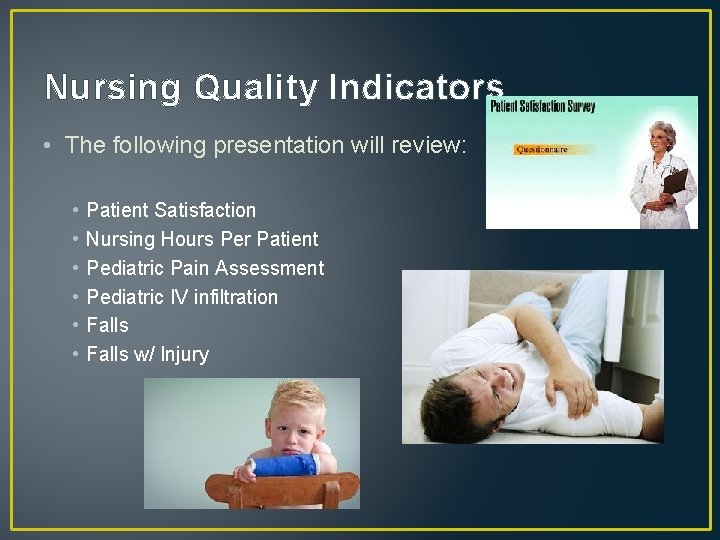
Nursing Quality Indicators • The following presentation will review: • • • Patient Satisfaction Nursing Hours Per Patient Pediatric Pain Assessment Pediatric IV infiltration Falls w/ Injury
Patient Falls • The National Database for Nursing Quality Indicators (NDNQI) definition of a fall is used in current policy. A falls is defined as. . . • “A fall is defined as an unplanned descent to the floor (or extension of the floor, E. g. trash can or other equipment) with or without injury to the patient: this includes falls that are result of physiologic as well as environmental reasons. Falls include both assisted falls (when a staff member attempts to minimize impact of the fall) and unassisted falls. A fall that is reported to have been assisted by a family member or visitor counts as a fall. ” (11) • Description: All documented falls with or without injury, experienced by patients on an eligible unit in a calendar month
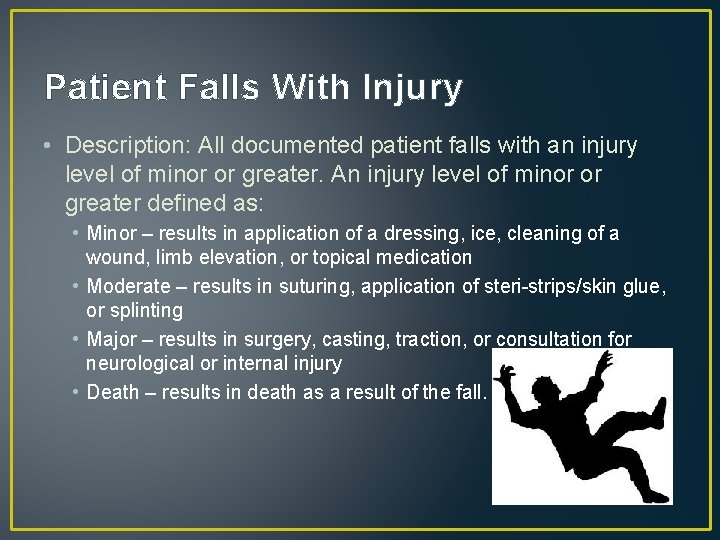
Patient Falls With Injury • Description: All documented patient falls with an injury level of minor or greater. An injury level of minor or greater defined as: • Minor – results in application of a dressing, ice, cleaning of a wound, limb elevation, or topical medication • Moderate – results in suturing, application of steri-strips/skin glue, or splinting • Major – results in surgery, casting, traction, or consultation for neurological or internal injury • Death – results in death as a result of the fall. (11)
Scope of the Problem • Impact of falls on the patient • Impact of falls on the facility • Cost related to falls with/without injury (1 -4)
Impact on patient • Quality of life • Quality of care • Setbacks • Costs (3, 5 -8)
Impact to the Facility & The Associated Cost • Change in care • Costs (3 -6)
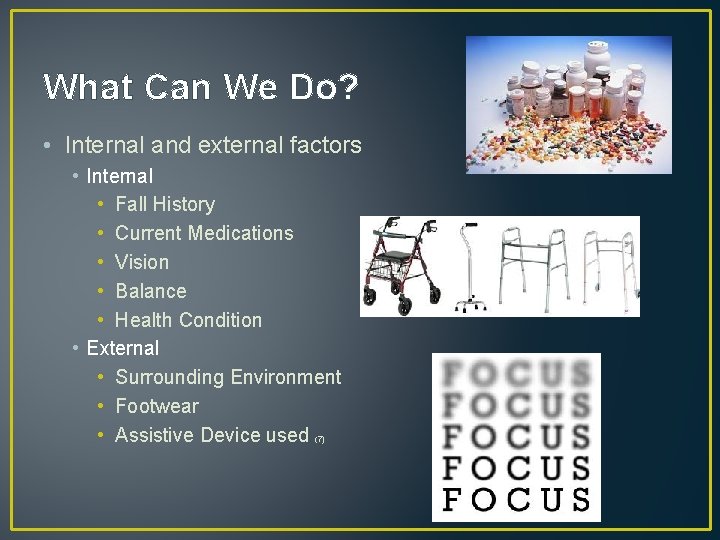
What Can We Do? • Internal and external factors • Internal • Fall History • Current Medications • Vision • Balance • Health Condition • External • Surrounding Environment • Footwear • Assistive Device used (7)
Mayo Clinic Falls Prevention Program • Interdisciplinary Team • Identified gaps in the admission process for fall risk • Initiatives implemented: • Review of fall history • Patient education • Introduction of a collaborative team (11)
Falls Prevention Review • Review of the literature • Continues to be a great challenge • Risk Factors • Interventions to decrease falls • • • Exercise Medication management Multilevel interventions Prevention of injury Development of specific programs (4, 8 -9, 13)
Conclusion We can no longer do things the way they have always been done! • Things change • Importance of NSI’s • What difference do they make
References 1. Berg, W. P. , Alessio, H. M. , Mills, E. M. , &Tong , C. Circumstances and consequences of falls in independent community–dwelling older adults. Age &Ageing, 26(4), 261– 268. 2. Campbell, A. J. , Borrie, M. J. , Spears, G. F. , Jackson, S. L. , Brown, J. S. , & Fitzgerald, J. L. (1990). Circumstances and consequences of falls experienced by a community population 70 years and over during a prospective study. Ageing, 19(5), 345– 346. 3. Centers for Disease Control and Prevention (n. d. ). A toolkit to prevent senior falls: The costs of fall injuries among older adults. Retrieved July 18, 2006, from http: //www. cdc. gov/ncipc/factsheets/fallcost. htm. 4. Chang, J. T. , Morton, S. C. , Rubenstein, L. Z. , Mojica, W. A. , Maglione, M. , Suttorp, M. , et al. (2004). Interventions for the prevention of falls in older adults: Systematic review and meta–analysis of randomized clinical trials. British. Medical. Journal, 328(7441), 680– 683. 5. Donabedian, A. (1988). The Quality of Care How Can it Be Assessed? Journal of the American Medical Association, 260(12), 1743 -1748 6. Gallagher, R. M. & Rowell, P. A. (2003). Claiming the future of nursing through nursing-sensitive quality indicators. Nursing Administration Quarterly, 27(4), 273 -284. 7. Li, W. , Keegan, H. M. , Sternfeld, B. , Sidney, S. , Quesenberry, C. P. , & Kelsey, J. L. (2006). Outdoor falls among middle-aged and older adults: A neglected public health problem. American Journal of Public Health, 96(7), 1192– 1200. 8. Mc. Innes, L. , Appl Sci, G. D. , Gibbons, E. , & Chandler Oatts, J. (2005). Clinical practice Guideline for the assessment and prevention of falls in older people. World views on Evidence–Based Nursing, 2 (1), 33– 36. 9. Morse, J. M. (1997). Enhancing the safety of hospitalization by reducing patient falls. American Journal of Infection Control, 30(6), 376– 380. 10. . Sterling, D. A. , O’Connor, J. A. , & Bonadies, J. (2001). Geriatric falls: Injury severity is high and disproportionate to mechanism. Journal of Trauma–Injury Infection a nd Critical Care, 50(1), 116– 119. 11. Sulla, S. J. , & Mc. Myler, E. (2007). Falls prevention at Mayo clinic Rochester. A path to quality care. Journal of Nursing Care Quality, 22(2), 138 -144. 12. The National Database of Nursing Quality Indicators (NDNQI®), retrieved from www. nursingquality. org 13. Tinetti, M. E. (2003). Clinical practice. Preventing falls in elderly persons. New England Journal of Medicine, 348, 42– 49.
- Slides: 14