
Quality Improvement What is QI n Quality Improvement




- Slides: 23
Quality Improvement
What is QI? n Quality Improvement is a formal approach to the analysis of performance and systematic efforts to improve it. There are numerous models used.
n These models are all means to get at the same thing: Improvement. They are forms of ongoing effort to make performance better.
Why QI n n To improve outcomes!!!!! In industry, quality efforts focus on topics like product failures or work-related injuries. In administration, one can think of increasing efficiency or reducing re-work. In medical practice, the focus is on reducing medical errors and needless morbidity and mortality.
Who is Responsible for QI? n Everyone!!!! Nurses n. Doctors n. Assisstants n. Everyone in the building n
How Do You Define Quality? n The definition of quality often depends on the stakeholders. Stakeholders are, as the name implies, people with some stake or concern in the process.
n In Healthcare, the definition of quality can be complex and controversial because of the different views of people with a stake in good Healthcare. Let’s look at a few different stakeholders. What does each of these stakeholders want?
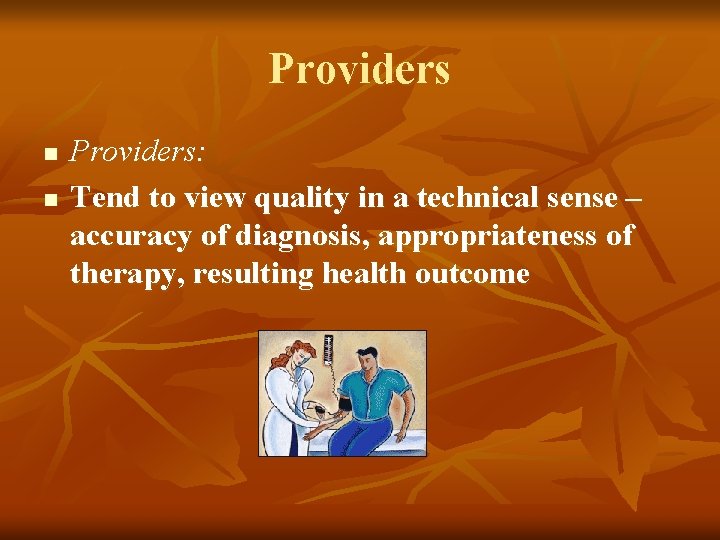
Providers n n Providers: Tend to view quality in a technical sense – accuracy of diagnosis, appropriateness of therapy, resulting health outcome
Payers n Payers: Focus on cost-effectiveness.
Employers n Want both to keep their costs down, and to get their employees back to work quickly.
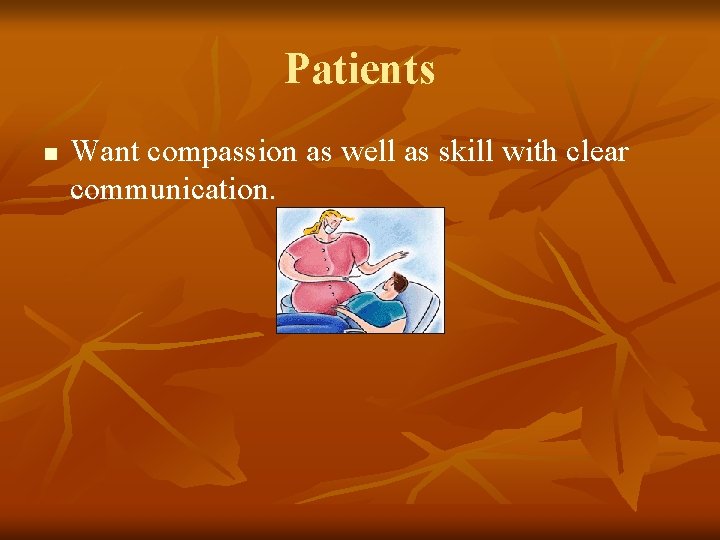
Patients n Want compassion as well as skill with clear communication.
n Can you see any conflicts between what these stakeholders want? The decisions around the conflicts often determine if a QI project will be a success.
Quality in Healthcare n n If you wanted to get a sense of the quality of healthcare delivery, how would you go about it? You could ask each of the providers if they were following the guidelines for a specific disease You could ask providers to keep track of their errors or “near misses” Can you imagine any reason these methods may not work?
Can you imagine any reason these methods may not work? n Earnest Interviewer: Have any of your patients gotten worse because of treatment you provided? Reluctant Provider: Er, um… No, never, of course not. EI: Do you use the approved guidelines for this condition? RP: Of course—every time! EI: What about the time. . . ? RP: (interrupting) Well, that was a special case.
n n These methods would be fraught with problems of validity and reliability. Self-report of errors is shown to be low and, particularly if there is a potential punitive response, reporting would be infrequent and inaccurate. This leaves us with a deficit in how we can assess quality.
QI in a Healthcare Setting n One means of getting around the problems with selfreport is to use more objective data. n n You start with a small problem. Perhaps you want to see how well your group is doing with patients with a chronic disease, such as diabetes, asthma, or hypertension. From that point you can narrow your focus even further. Decide what aspect of care you think might be a problem. n n How about assessment of how well the condition is being controlled? Within an office visit what measurements would be useful?
Measurement: Process and Outcome Indicators n n n Measures There are 3 types of measures used in quality work: Structure: Physical equipment and facilities Process: How the system works Outcome: The final product, results Structure and process are easier to measure; outcome is more important.
Can you think of an example in Healthcare? n If you were concerned about reducing prenatal mortality, you might look at n Structure n n Process n n Availability of physicians and/or midwives providing obstetrical care. Percent of mothers receiving prenatal care prior to 12 weeks gestation. Percent of mothers taking prenatal vitamins. Percent of smoking mothers counseled to quit. Outcome n n Neonatal mortality rate Pre-maturity rate.
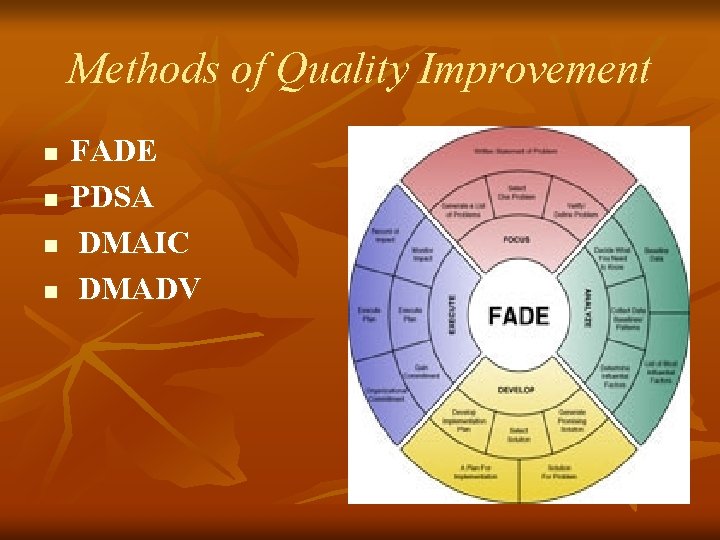
Methods of Quality Improvement n n FADE PDSA DMAIC DMADV
Things Quality Improvement is NOT n Performance Improvement n n The terms quality improvement and performance improvement are sometimes used interchangeably. Performance Improvement means a change in the system performance. In Healthcare, this is often used to refer to administrative systems, as contrasted to QI as impacting the actual quality of healthcare. Research The distinction between QI and research is an important one. There is a spectrum, and it can be blurry sometimes, but there are some key points (with legal implications!).
n n n n n QI: Intent is to improve current practice. For internal use only. By definition, the data is confidential. Action is within existing standards of care. Institutional Review Board (IRB) approval is not necessary. Research: Intended to create generalized knowledge. Desire to publish or present. Testing new methods. Needs approval!
Summary n n n Key points to remember. Improving Healthcare quality is our responsibility. Measurement and improvement are possible. Identify the root cause before making changes. Be creative in developing solutions. THINK OUTSIDE THE BOX!
Any Questions? ? n http: //patientsafetyed. duhs. duke. edu/module_a/module_overview. html