
Quality Improvement Projects the basics Dr Sue Cullis
Quality Improvement Projects - the basics Dr Sue Cullis FRCGP Associate Postgraduate Dean HEEM. Dr Graham Toddd MRCGP Primary Care Educational Lead HEEM
Learning Objectives • To understand the role of PDSA and run charts in a Quality Improvement Project. • To understand some of the other tools used in quality improvement • To learn where to find more information & resources. www. em. hee. nhs. uk
Do GPs need to do this? • Trainees should ‘take part in systems of quality assurance and quality improvement in their clinical work and training. ’ Gold Guide 2014 • ‘A progressive curriculum in quality improvement activity should underpin all training stages of a doctor, building capability and leadership, and a foundation for on-going lifelong learning and implementation. ’ Academy of Royal Colleges, March 2016 • ‘For the purposes of revalidation, you will have to demonstrate that you regularly participate in activities that review and evaluate the quality of your work. Quality improvement activities should be robust, systematic and relevant to your work. They should include an element of evaluation and action, and where possible, demonstrate an outcome or change. ’ revalidation. walesdeanery. org
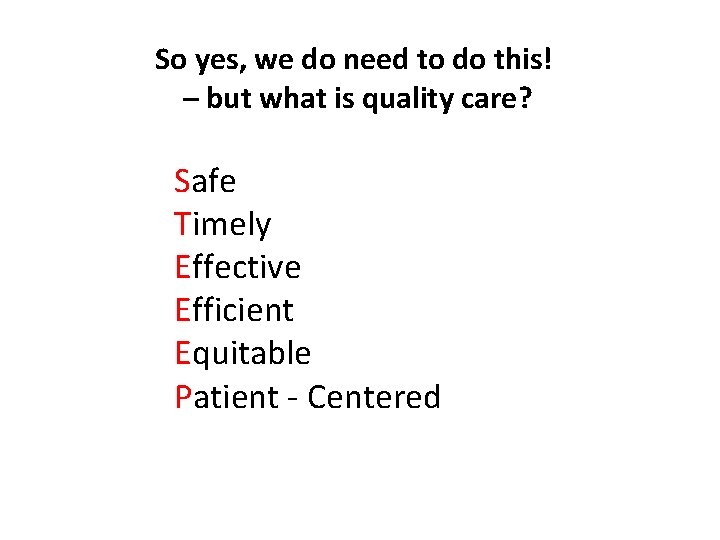
So yes, we do need to do this! – but what is quality care? Safe Timely Effective Efficient Equitable Patient - Centered
So How Can We Improve Quality?
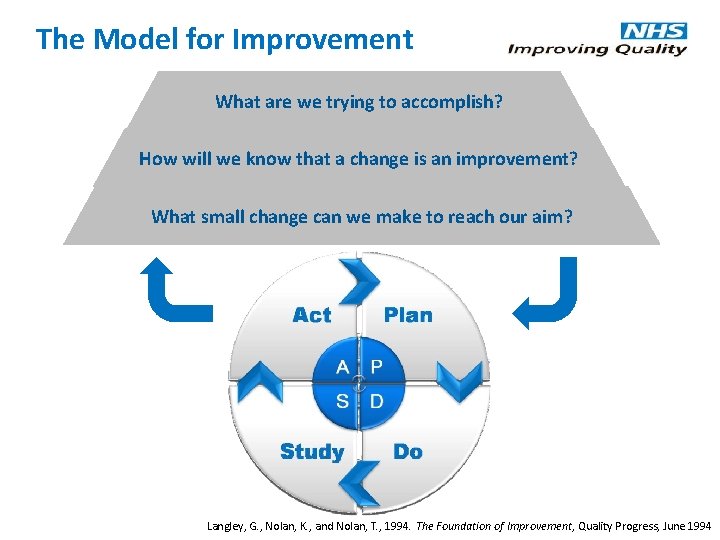
The Model for Improvement What are we trying to accomplish? How will we know that a change is an improvement? What small change can we make to reach our aim? Langley, G. , Nolan, K. , and Nolan, T. , 1994. The Foundation of Improvement, Quality Progress, June 1994
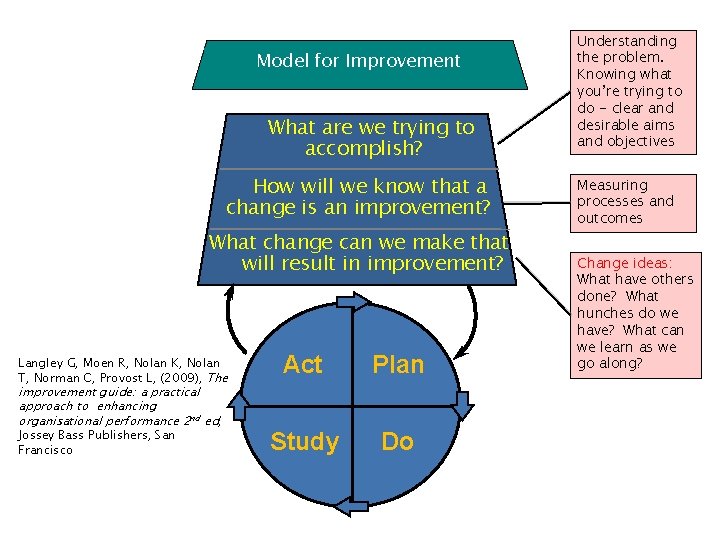
Model for Improvement What are we trying to accomplish? How will we know that a change is an improvement? What change can we make that will result in improvement? Langley G, Moen R, Nolan K, Nolan T, Norman C, Provost L, (2009), The improvement guide: a practical approach to enhancing organisational performance 2 nd ed, Jossey Bass Publishers, San Francisco Act Plan Study Do Understanding the problem. Knowing what you’re trying to do - clear and desirable aims and objectives Measuring processes and outcomes Change ideas: What have others done? What hunches do we have? What can we learn as we go along?
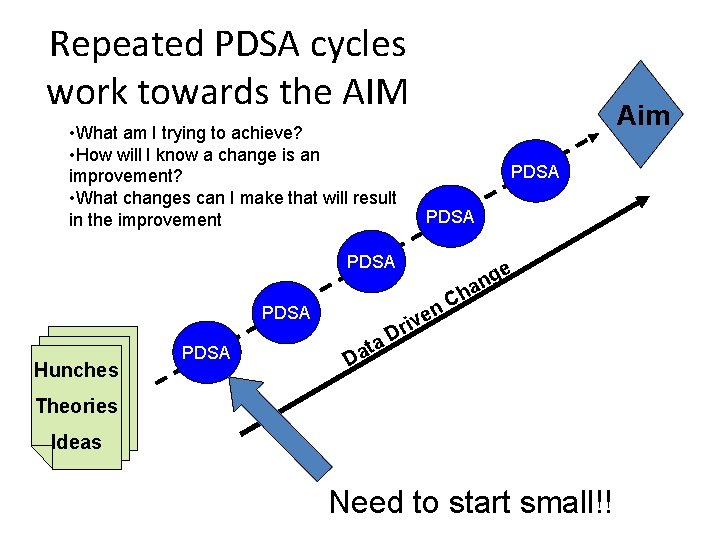
Repeated PDSA cycles work towards the AIM Aim • What am I trying to achieve? • How will I know a change is an improvement? • What changes can I make that will result in the improvement PDSA Hunches PDSA ge n a h C n e riv D a t Da Theories Ideas Need to start small!!
Change through small steps Change. . . • with a clear purpose • you can learn from (without fear of failure) • which is less exhausting • with fewer unintended consequences • which builds engagement and optimism
Benefits of this approach • • • easier to start produces better solutions more quickly engages people better reduces waste easier to continue
PDSA Cycle – Question 1 What are we trying to accomplish? So how can we find out what needs improving? . . . § By looking at data we already have – e. g. complaints, comments, questionaires, audits, significant events etc § By using other QI tools – e. g. 360 patient safety appraisal (including walkrounds & trigger tools), niggle lists, process mapping
PDSA Cycle – Question 2 How will we know that a change is an improvement? By measuring carefully over time… • • Using run charts where possible Or multiple data collection where not possible Being aware of the danger of averages Being aware that change may produce harm or have no effect Let’s look at measurement for improvement more carefully…
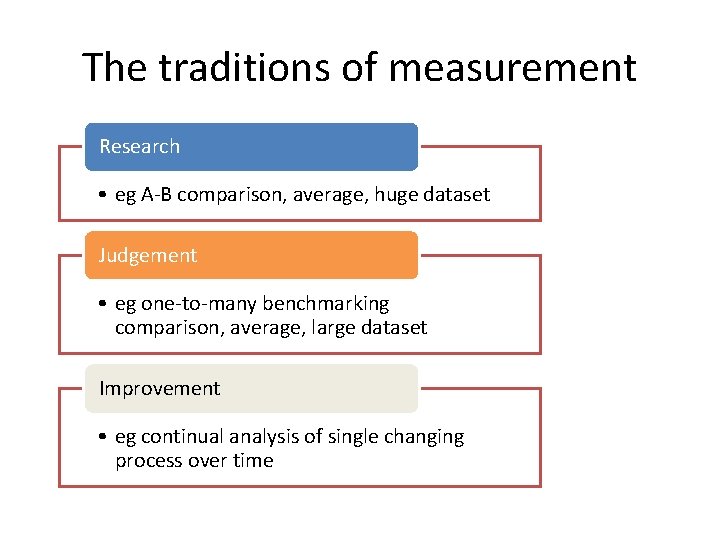
The traditions of measurement Research • eg A-B comparison, average, huge dataset Judgement • eg one-to-many benchmarking comparison, average, large dataset Improvement • eg continual analysis of single changing process over time
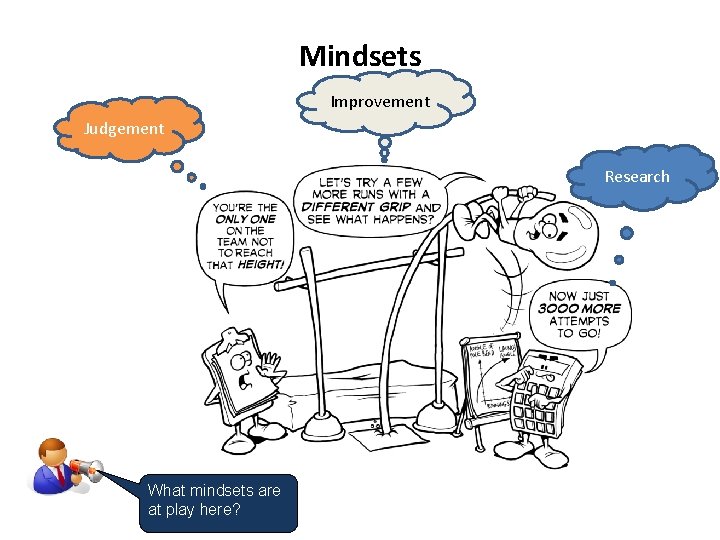
Mindsets Improvement Judgement Research What mindsets are at play here?
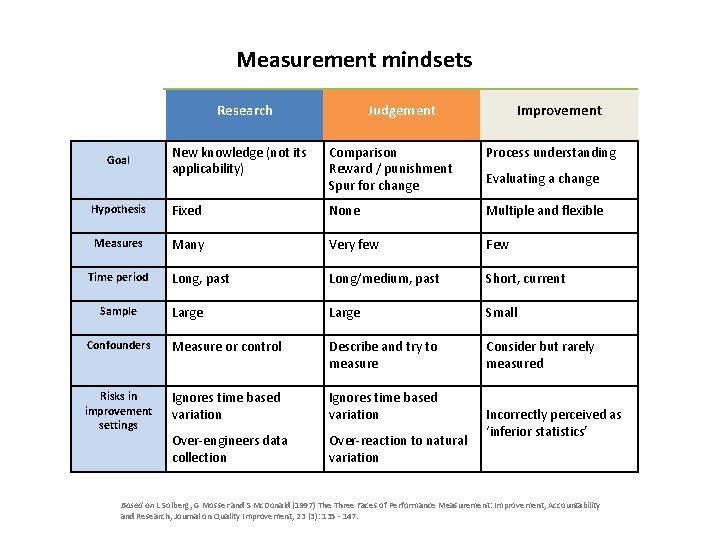
Measurement mindsets Research Judgement Improvement New knowledge (not its applicability) Comparison Reward / punishment Spur for change Process understanding Hypothesis Fixed None Multiple and flexible Measures Many Very few Few Long, past Long/medium, past Short, current Large Small Confounders Measure or control Describe and try to measure Consider but rarely measured Risks in improvement settings Ignores time based variation Over-engineers data collection Over-reaction to natural variation Goal Time period Sample Evaluating a change Incorrectly perceived as ‘inferior statistics’ Based on L Solberg, G Mosser and S Mc. Donald (1997) The Three Faces of Performance Measurement: Improvement, Accountability and Research, Journal on Quality Improvement, 23 (3): 135 - 147.
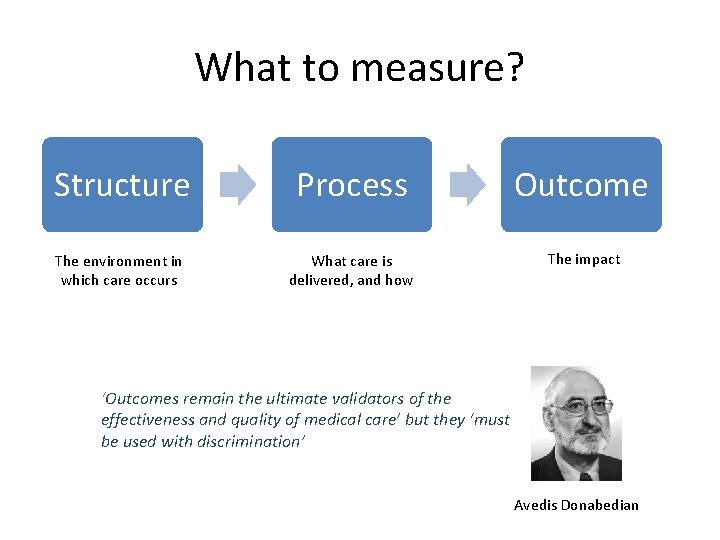
What to measure? Structure Process Outcome The environment in which care occurs What care is delivered, and how The impact ‘Outcomes remain the ultimate validators of the effectiveness and quality of medical care’ but they ‘must be used with discrimination’ Avedis Donabedian
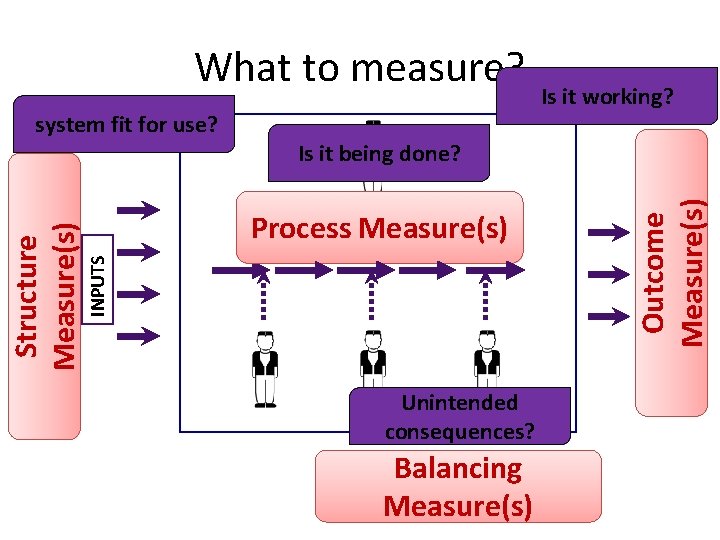
What to measure? Is it being done? HUMAN FACTORS Process Measure(s) INPUTS Structure Measure(s) FACTORS INTERNAL PROCESSES & PROCECEDURES HUMAN FACTORS Unintended consequences? Balancing Measure(s) OUTPUTS Outcome Measure(s) EXTERNAL system fit for use? Is it working?
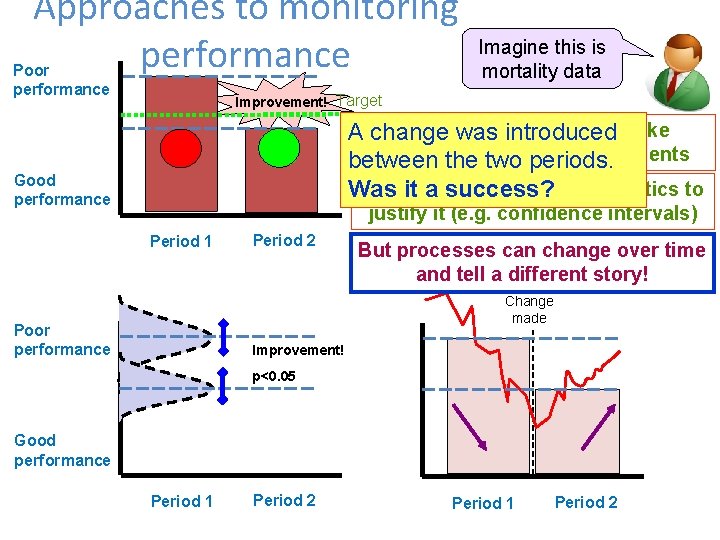
Approaches to monitoring performance Poor performance Imagine this is mortality data Improvement! Target With summary data we make A change was introduced judgements about improvements between the two periods. We may summative statistics to Was it a use success? Good performance justify it (e. g. confidence intervals) Period 1 Period 2 But processes can change over time and tell a different story! Change made Poor performance Improvement! p<0. 05 Good performance Period 1 Period 2
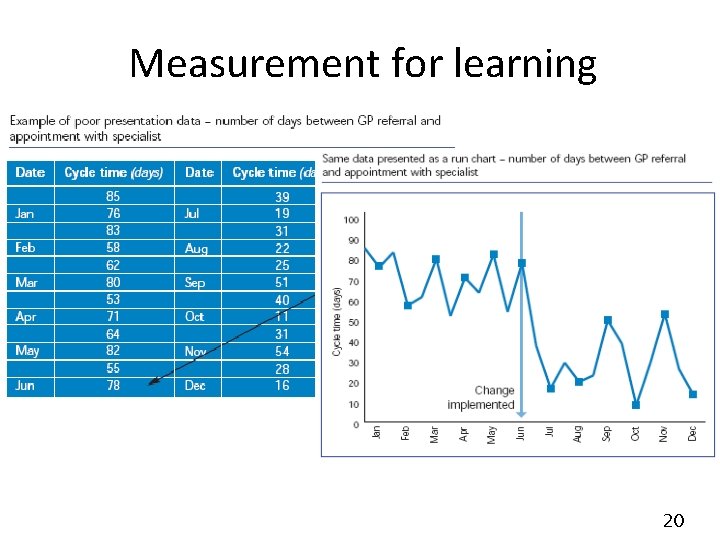
Measurement for learning 20
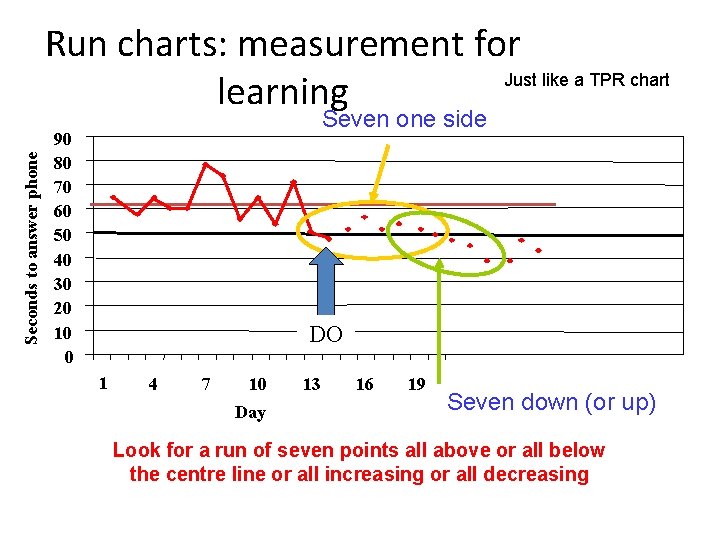
Seconds to answer phone Run charts: measurement for Just like a TPR chart learning Seven one side 90 80 70 60 50 40 30 20 10 0 DO 1 4 7 10 Day 13 16 19 Seven down (or up) Look for a run of seven points all above or all below the centre line or all increasing or all decreasing
PDSA Cycle - Question 3 What small change can we make? We may know what we want to improve (question 1) And know how we are going to measure over time (question 2) But what small thing do we change? Tools to find Change Projects (amongst others) § Process Maps § Driver Diagrams
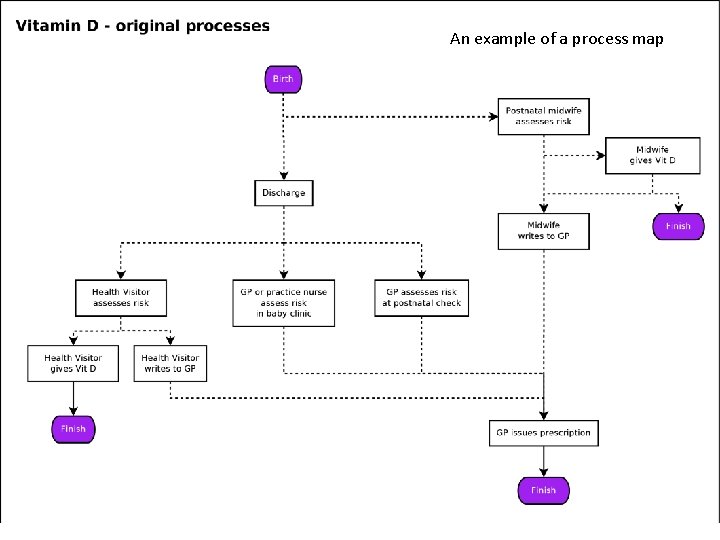
Deliberate reliable design – ? ? ? eg How do at-risk infants get Vitamin D? An example of a process map
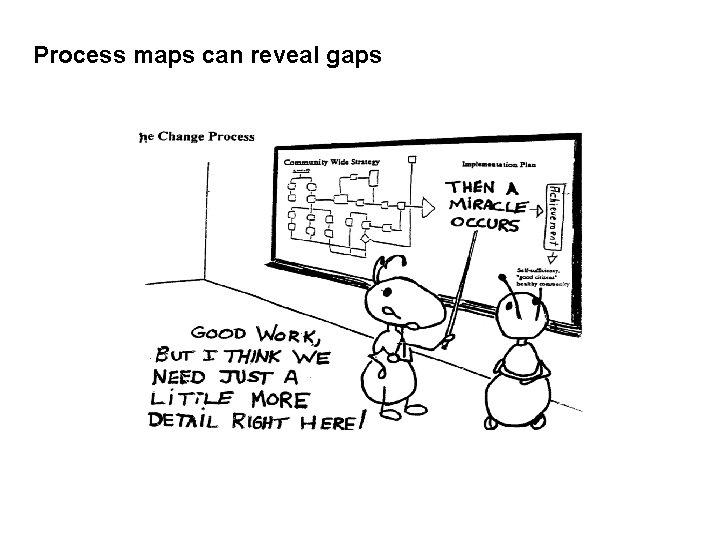
Process maps can reveal gaps
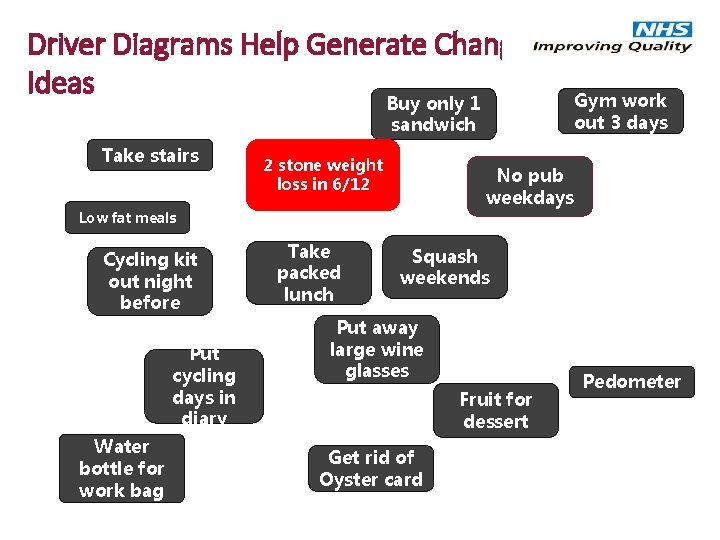
Driver Diagrams Help Generate Change Ideas Buy only 1 sandwich Take stairs 2 stone weight loss in 6/12 No pub weekdays Low fat meals Cycling kit out night before Put cycling days in diary Water bottle for work bag Take packed lunch Gym work out 3 days Squash weekends Put away large wine glasses Fruit for dessert Get rid of Oyster card Pedometer
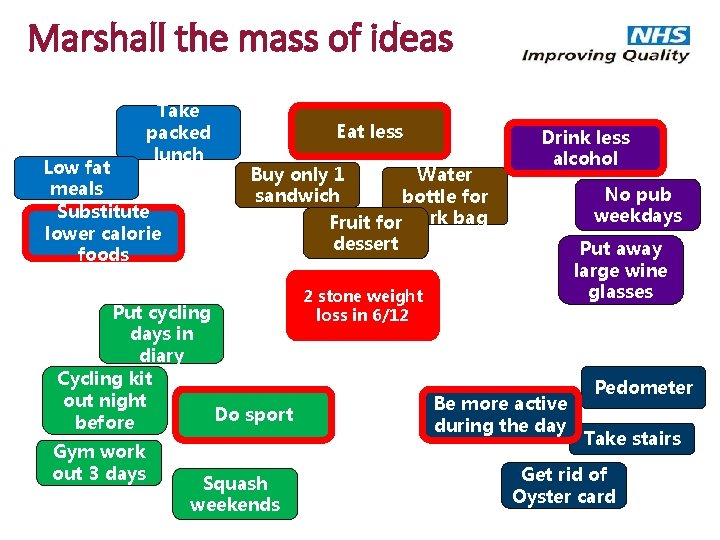
Marshall the mass of ideas Take packed lunch Low fat meals Substitute lower calorie foods Eat less Buy only 1 Water sandwich bottle for Fruit forwork bag dessert Put cycling days in diary Cycling kit out night Do sport before Gym work out 3 days Squash weekends Drink less alcohol No pub weekdays Put away large wine glasses 2 stone weight loss in 6/12 Be more active during the day Pedometer Take stairs Get rid of Oyster card
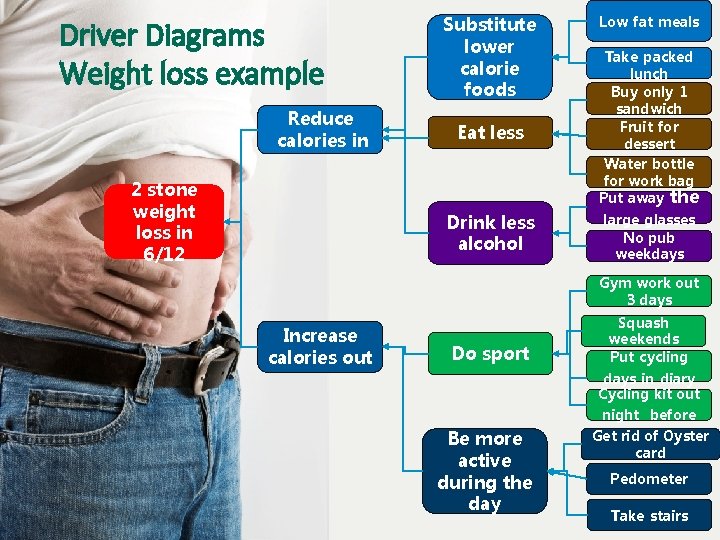
Driver Diagrams Weight loss example Reduce calories in 2 stone weight loss in 6/12 Substitute lower calorie foods Low fat meals Eat less Take packed lunch Buy only 1 sandwich Fruit for dessert Water bottle for work bag Put away the Drink less alcohol large glasses No pub weekdays Gym work out 3 days Increase calories out Do sport Squash weekends Put cycling days in diary Cycling kit out night before Be more active during the day Get rid of Oyster card Pedometer Take stairs
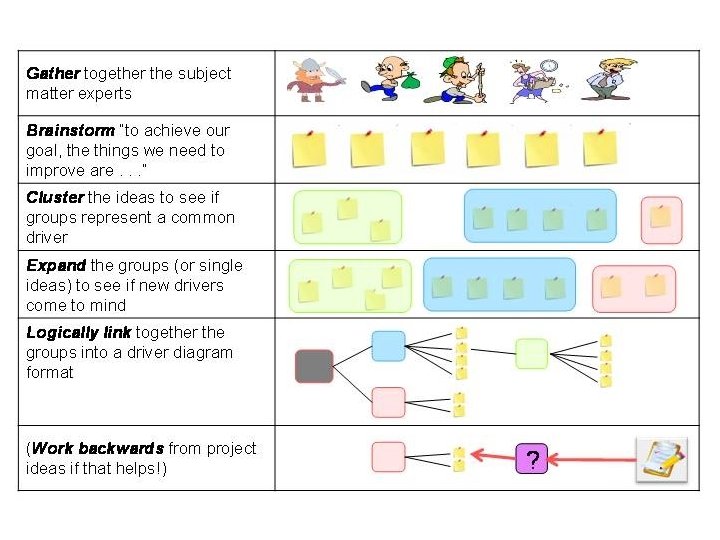
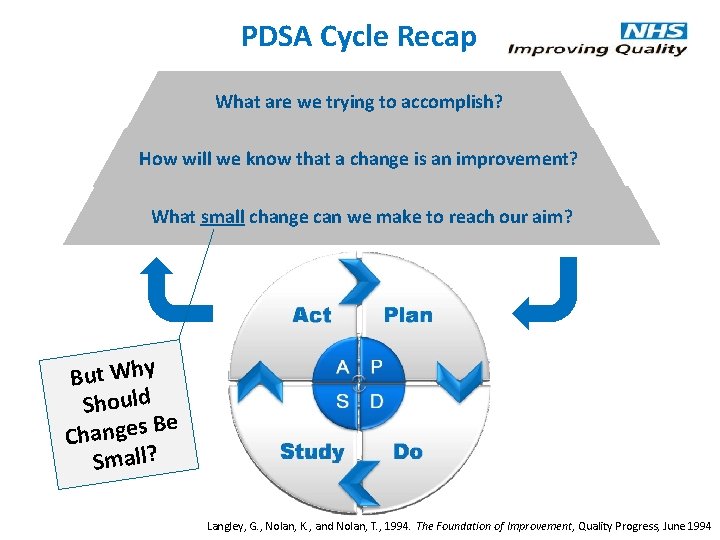
PDSA Cycle Recap What are we trying to accomplish? How will we know that a change is an improvement? What small change can we make to reach our aim? But Why Should Be s e g n a h C Small? Langley, G. , Nolan, K. , and Nolan, T. , 1994. The Foundation of Improvement, Quality Progress, June 1994
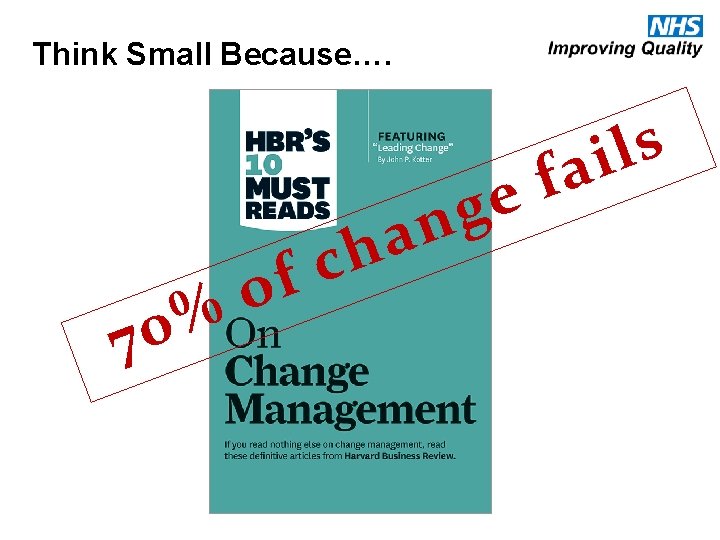
Think Small Because…. h c f o % 70 e g an s l i a f
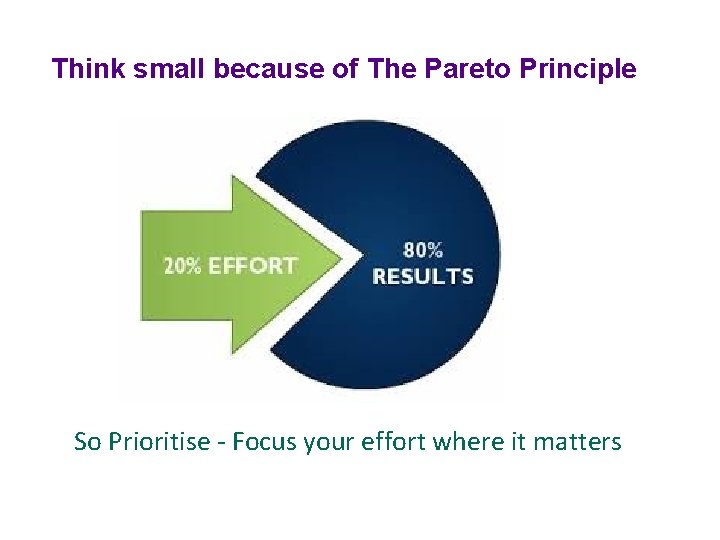
Think small because of The Pareto Principle So Prioritise - Focus your effort where it matters
The Pareto Principle We don’t have time to improve everything A small number of issues account for the majority of the challenge 20% of causes account for 80% of the problem We should focus on the ‘critical few’, not the ‘trivial many’
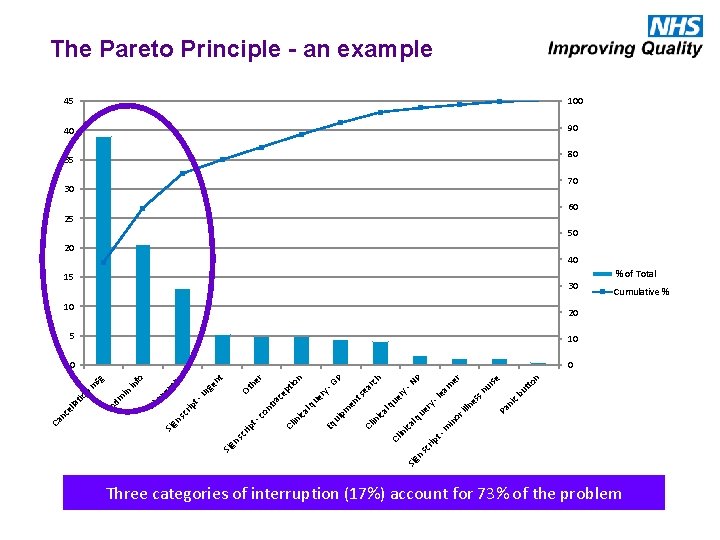
Sig n t- sc rip or in m r n to se ur ut cb ni Pa sn es illn ne P -N ar le ry ue y- ue r lq in ica rc h P n -G ea ry ts en lq ica in Cl ui pm Eq lq ue io r he pt ce nt ra co Ot ge nt ur e on fo in sg m er ap t- rip sc ica Cl in t- rip sc Cl n Sig Ch in m Ad n tio la el nc Ca The Pareto Principle - an example 45 100 40 90 35 80 30 70 25 60 20 50 40 15 30 10 5 10 0 0 % of Total Cumulative % 20 Three categories of interruption (17%) account for 73% of the problem
Learning Objectives - Recap 1. To understand the role of PDSA and run charts in a Quality Improvement Project. 2. To have heard about some of the other tools used in quality improvement 3. To learn where to find more information & resources….
Links to Other Useful Resources. • http: //www. ihi. org • http: //www. vle. eastmidlandsdeanery. nhs. uk/ Search for “QI Resources” • www. changemodel. nhs. uk • www. nhsiq. nhs. uk • www. qihub. scot. nhs. uk/home. aspx www. em. hee. nhs. uk
BMJ Quality • This is an online guide to doing a quality improvement project with links to BMJ Learning modules on relevant topics. • It guides you through the process from start to finish and you can publish your project in their online Quality Journal. • Licenses are available on a first come first served basis by discussing with your PDs. www. em. hee. nhs. uk
BMJ Quality • www. quality. bmj. com www. em. hee. nhs. uk
Our Contact Details • Dr Sue Cullis. APD scullis@nhs. net • Dr Graham Todd todds@doctors. org. uk www. em. hee. nhs. uk
East Midlands QI Forum • Planned for June 2015. Multi-professional multidisciplinary event. • An opportunity to showcase the best QI projects done by trainees. • Exciting QI keynote speakers. www. em. hee. nhs. uk 42
A Final Thought from Don Berwick • “ The most important single change in the NHS in response to this report would be for it to become, more than ever before, a system devoted to continual learning and improvement of patient care, top to bottom and end to end. ” • Don Berwick. A promise to learn - a commitment to act. August 2013. www. em. hee. nhs. uk
- Slides: 39