
Quality Improvement project on documentation of trauma quality
- Slides: 1
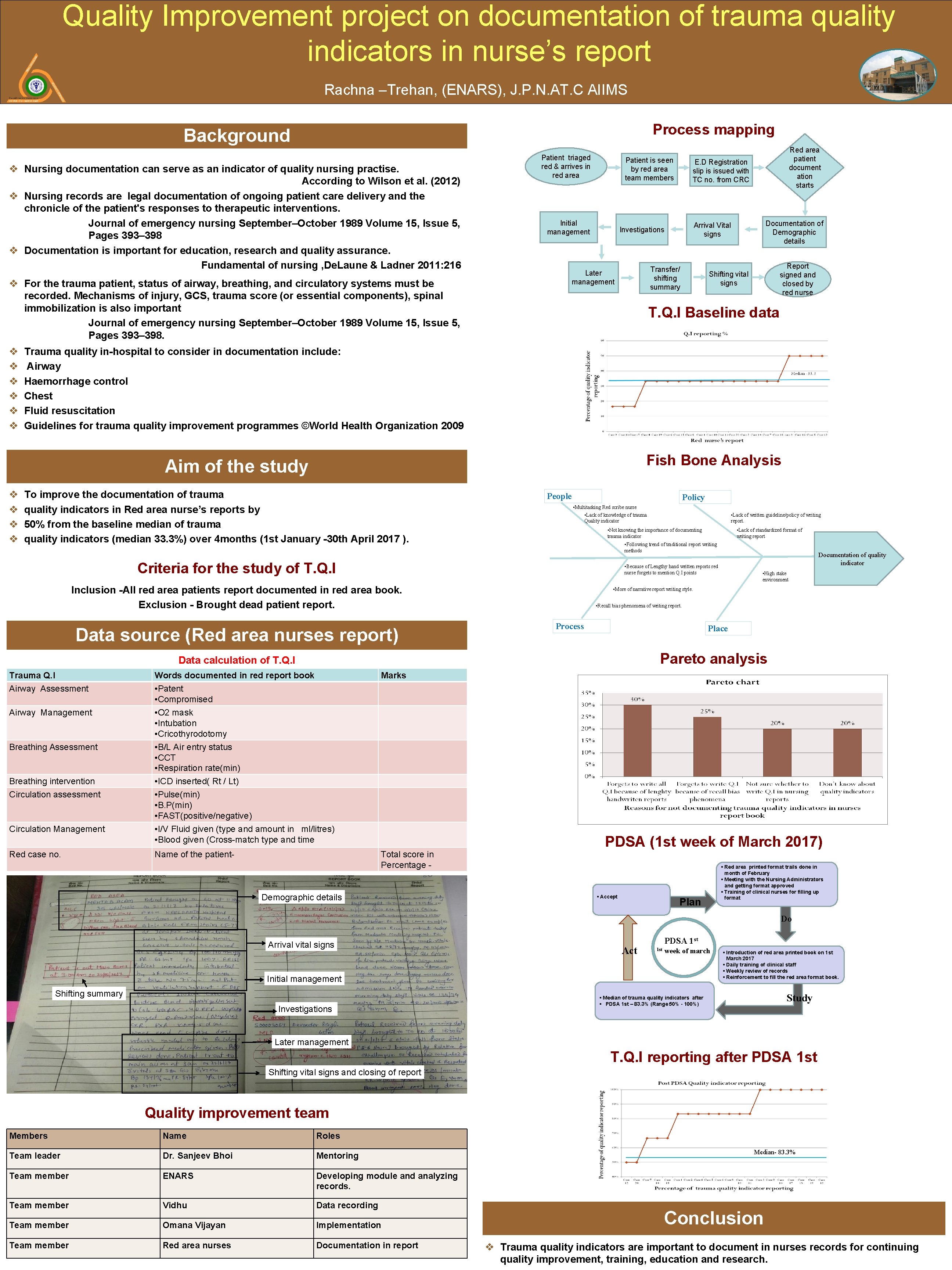
Quality Improvement project on documentation of trauma quality indicators in nurse’s report Rachna –Trehan, (ENARS), J. P. N. AT. C AIIMS Process mapping Background v Nursing documentation can serve as an indicator of quality nursing practise. According to Wilson et al. (2012) v Nursing records are legal documentation of ongoing patient care delivery and the chronicle of the patient's responses to therapeutic interventions. Journal of emergency nursing September–October 1989 Volume 15, Issue 5, Pages 393– 398 v Documentation is important for education, research and quality assurance. Fundamental of nursing , De. Laune & Ladner 2011: 216 Patient triaged red & arrives in red area Initial management Documentation of Demographic details Arrival Vital signs Transfer/ shifting summary Report signed and closed by red nurse Shifting vital signs T. Q. I Baseline data Trauma quality in-hospital to consider in documentation include: Airway Haemorrhage control Chest Fluid resuscitation Guidelines for trauma quality improvement programmes ©World Health Organization 2009 Fish Bone Analysis Aim of the study v v E. D Registration slip is issued with TC no. from CRC Investigations Later management v For the trauma patient, status of airway, breathing, and circulatory systems must be recorded. Mechanisms of injury, GCS, trauma score (or essential components), spinal immobilization is also important Journal of emergency nursing September–October 1989 Volume 15, Issue 5, Pages 393– 398. v v v Patient is seen by red area team members Red area patient document ation starts To improve the documentation of trauma quality indicators in Red area nurse’s reports by 50% from the baseline median of trauma quality indicators (median 33. 3%) over 4 months (1 st January -30 th April 2017 ). People Policy • Multitasking Red scribe nurse • Lack of knowledge of trauma Quality indicator • Not knowing the importance of documenting trauma indicator Data source (Red area nurses report) Breathing intervention Circulation assessment Circulation Management Red case no. • High stake environment • More of narrative report writing style. • Recall bias phenomena of writing report. Process Place Pareto analysis Data calculation of T. Q. I Breathing Assessment Documentation of quality indicator • Because of Lengthy hand written reports red nurse forgets to mention Q. I points Inclusion -All red area patients report documented in red area book. Exclusion - Brought dead patient report. Airway Management • Lack of standardized format of writing report • Following trend of traditional report writing methods Criteria for the study of T. Q. I Trauma Q. I Airway Assessment • Lack of written guideline/policy of writing report. Words documented in red report book • Patent • Compromised • O 2 mask • Intubation • Cricothyrodotomy Marks • B/L Air entry status • CCT • Respiration rate(min) • ICD inserted( Rt / Lt) • Pulse(min) • B. P(min) • FAST(positive/negative) • I/V Fluid given (type and amount in ml/litres) • Blood given (Cross-match type and time Name of the patient- Total score in Percentage - Demographic details PDSA (1 st week of March 2017) § Accept Plan § Red area printed format trails done in month of February § Meeting with the Nursing Administrators and getting format approved § Training of clinical nurses for filling up format Do Arrival vital signs Act PDSA 1 st week of march Initial management Shifting summary Investigations § Introduction of red area printed book on 1 st March 2017 § Daily training of clinical staff § Weekly review of records § Reinforcement to fill the red area format book. Study § Median of trauma quality indicators after § PDSA 1 st – 83. 3% (Range 50% - 100%) Later management T. Q. I reporting after PDSA 1 st Shifting vital signs and closing of report Quality improvement team Members Name Roles Team leader Dr. Sanjeev Bhoi Mentoring Team member ENARS Developing module and analyzing records. Team member Vidhu Data recording Team member Omana Vijayan Implementation Team member Red area nurses Documentation in report Median- 83. 3% Conclusion v Trauma quality indicators are important to document in nurses records for continuing quality improvement, training, education and research.