
QUALITY IMPROVEMENT PLAN 2016 Modbury South Preschool Service
QUALITY IMPROVEMENT PLAN 2016 Modbury South Preschool
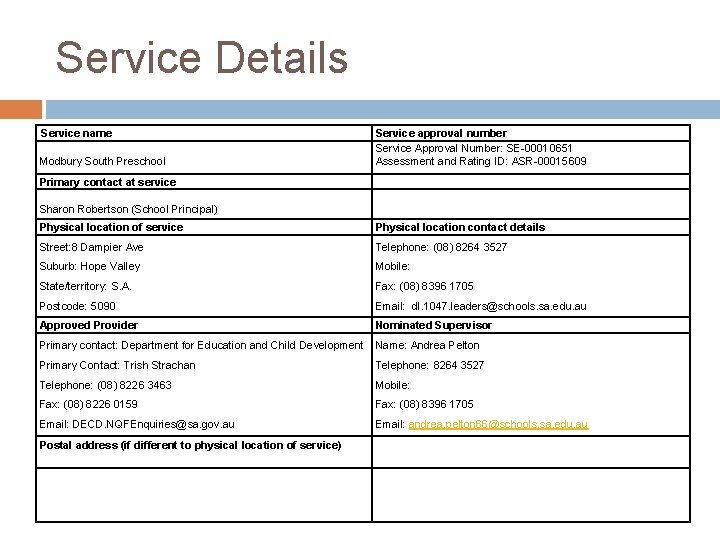
Service Details Service name Modbury South Preschool Service approval number Service Approval Number: SE-00010651 Assessment and Rating ID: ASR-00015609 Primary contact at service Sharon Robertson (School Principal) Physical location of service Physical location contact details Street: 8 Dampier Ave Telephone: (08) 8264 3527 Suburb: Hope Valley Mobile: State/territory: S. A. Fax: (08) 8396 1705 Postcode: 5090 Email: dl. 1047. leaders@schools. sa. edu. au Approved Provider Nominated Supervisor Primary contact: Department for Education and Child Development Name: Andrea Pelton Primary Contact: Trish Strachan Telephone: 8264 3527 Telephone: (08) 8226 3463 Mobile: Fax: (08) 8226 0159 Fax: (08) 8396 1705 Email: DECD. NQFEnquiries@sa. gov. au Email: andrea. pelton 66@schools. sa. edu. au Postal address (if different to physical location of service)
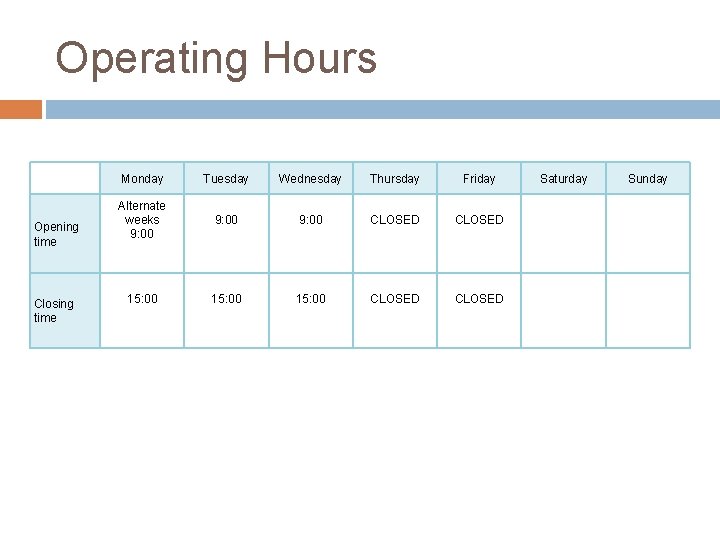
Operating Hours Opening time Closing time Monday Tuesday Wednesday Thursday Friday Alternate weeks 9: 00 CLOSED 15: 00 CLOSED Saturday Sunday
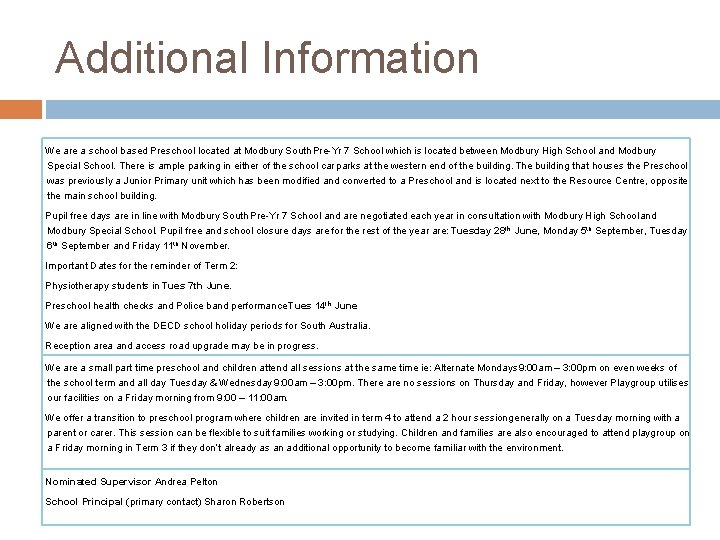
Additional Information We are a school based Preschool located at Modbury South Pre-Yr 7 School which is located between Modbury High School and Modbury Special School. There is ample parking in either of the school car parks at the western end of the building. The building that houses the Preschool was previously a Junior Primary unit which has been modified and converted to a Preschool and is located next to the Resource Centre, opposite the main school building. Pupil free days are in line with Modbury South Pre-Yr 7 School and are negotiated each year in consultation with Modbury High School and Modbury Special School. Pupil free and school closure days are for the rest of the year are: Tuesday 28 th June, Monday 5 th September, Tuesday 6 th September and Friday 11 th November. Important Dates for the reminder of Term 2: Physiotherapy students in Tues 7 th June. Preschool health checks and Police band performance Tues 14 th June We are aligned with the DECD school holiday periods for South Australia. Reception area and access road upgrade may be in progress. We are a small part time preschool and children attend all sessions at the same time ie: Alternate Mondays 9: 00 am – 3: 00 pm on even weeks of the school term and all day Tuesday & Wednesday 9: 00 am – 3: 00 pm. There are no sessions on Thursday and Friday, however Playgroup utilises our facilities on a Friday morning from 9: 00 – 11: 00 am. We offer a transition to preschool program where children are invited in term 4 to attend a 2 hour session generally on a Tuesday morning with a parent or carer. This session can be flexible to suit families working or studying. Children and families are also encouraged to attend playgroup on a Friday morning in Term 3 if they don’t already as an additional opportunity to become familiar with the environment. Nominated Supervisor Andrea Pelton School Principal (primary contact) Sharon Robertson
Statement of Philosophy CHILDREN: We believe each child should be valued as an individual and treated respectfully. We recognise and respect each child’s family context and culture. We believe in providing a safe, secure environment where children are supported in their social, emotional, physical and intellectual development. Children are capable and resourceful and should be able to contribute to their own learning. Positive relationships with children lead to positive learning outcomes. Children should be encouraged to reach their full potential in accordance with their individual ability. FAMILIES & COMMUNITY: Parents/Carers are the primary educators of their children and should be valued as such. We believe in establishing warm, respectful and trusting relationships with families and this is the key to a strong partnership. We are committed to open and constructive communication with families through a variety of media – informal discussions, newsletters, summative reports and portfolios etc We believe in responding to individual family needs and providing support. We encourage families to involve themselves in the Preschool/School community. We believe in providing a link to information and support services within the local community for our families. STAFF: We believe that each staff member contributes valuable knowledge, skills and expertise. Staff should be treated with respect amid a spirit of collegiality, trust and professionalism. Communication between staff members should be open and honest.

Statement of Philosophy (cont. ) PROGRAM: Play forms the basis of our program. It is a powerful medium which allows children to express themselves, make connections with new learning, develop relationships, promotes curiosity and creativity and contributes to their well-being. We provide a rich, stimulating and nurturing environment, where children are supported to develop socially and emotionally and where they have time to practice and consolidate skills in key areas of communication and language, literacy and numeracy. Intentional teaching moments are planned for to extend children’s knowledge and skills. We work towards the learning outcomes as described in the Early Years Learning Framework – Belonging, Being & Becoming. Positive interactions and conversations between children and adults promote skills in collaboration, communication and thinking skills. Diversity is respected and celebrated. The indoor and outdoor environments encourage children to observe, investigate, imagine, make choices and problem solve. Observations and formative assessments together with documentation of children’s learning help to inform our program.

Quality Area 1 Educational Program and Practice Strengths • Information about new students is obtained through enrolment details and discussions with families. Diversity and individual children’s needs are recognised and supported through interactions and within the physical environment through materials, resources and celebrations. • We offer an extended transition to the preschool program through our pre-entry and playgroup sessions as an opportunity to support children’s relationships and well-being. Continuity of learning is supported through these programs as children become familiar with their environment • We offer flexible routines that provide opportunities for uninterrupted play and to meet the needs of individuals and the whole group • Children’s play is their learning time. Play is respected and children are encouraged to extend on their ideas through asking for resources or by staff noticing and offering additional materials to support them. Spontaneous moments are followed through and extended on in the moment and through curriculum planning • Children’s individual and group play is observed to identify intentional teaching moments and determine explicit teaching that will support children’s understanding • The Early Years Learning Framework guides our planning with the social, emotional, physical and cognitive development of each child in mind • Relaxation is a valued part of our day to support children to balance their active play time with rest • Documentation of children’s learning is maintained through displays, Learning Journey Portfolios and written observations. These are analysed and guide further planning. • Staff members are warm and friendly and have established respectful and caring relationships with families and children, responding to their needs and providing support as appropriate. • Staff are available before and after sessions to communicate with families. Children’s learning is discussed regularly with families and through 2 written reports annually

Quality Area 1 Strengths • Reverse interviews are held early in term 1 to clarify and ask questions about the children to support educators understanding of each individual child. Parent-teacher interviews are held toward the end of term 1 and 3 to discuss learning goals and children’s progress • The program is displayed for families and our term overviews and regular newsletters provide further information about the learning occurring • Children who are reluctant to participate or who have difficulties are supported to take part in the program through differentiation of tasks or provided supports necessary to help them. • Children from cultural and linguistically diverse backgrounds have access to English support through the Preschool Bilingual Program and students with additional needs receive individual assistance through the Preschool Support Program. • Children are viewed as competent and capable. They are encouraged to be responsible for their own belongings, articulate their needs and have a go at new challenges. • Educators reflect daily on children’s learning, the physical environment and interactions. This occurs verbally and is written on each fortnights program

Quality Area 1 Identified issue: Documentation of children lacks connection to the Preschool Numeracy and Literacy Indicators Standard/element 1. 2. 3 Critical reflection on children’s learning and development, both as individuals and in groups, is regularly used to implement the program Improvement We want to better reflect on the planning for assessing the Numeracy and Literacy Indicators, including educator Plan Priority capacity, strategies, environment and children’s dispositions and interests How will we get this outcome? • • • How will improvement be measured? Educators to seek and engage in • Educators are sharing their learning as a professional development with a focus team on the Numeracy and Literacy Indicators • Including the RRR into the reflection of the Engage the RRR resource to guide program each fortnight and how this relates planning to children’s learning about numeracy and literacy Timeline Ongoing – all educators • Andrea and Karen attended professional development run by Primary Math Association about analysing the math within play. Ongoing – Andrea to add on to program All educators Consider alternative assessment and • Devising or sharing of assessment tools Ongoing – all educators observation tools to support planning between preschools. as individuals and in groups around numeracy Preschool teacher to attend preschool leadership meetings to keep up to date with Partnership progress. SSO to attend educator network meetings Progress notes • An assessment tool was sourced focussing on numeracy and is being trialled • Regular attendance at preschool leaders Termly – all educators • Date has been set for SSO’s and meetings with time given to reflect and implement partnership goals educators to meet Mon 20 th June Liaise with Directors in the partnership • Discussions with other Directors and Term 2 - Andrea about their processes possible visits to speak with other educators
Quality Area 2 Safety and Health Strengths The health and safety needs of our children and educators are supported in the following ways: Good health and hygiene practices are promoted daily through reminders at eating and toileting time regarding flushing, hand washing and healthy eating habits. Education of parents occurs via newsletters, posters, flyers etc regarding healthy eating practices. Good health and hygiene is promoted though participation in the Stephanie Alexander Kitchen Program, regular and topics incorporated into the Preschool program and school program. Children with specific health needs such as food allergies are supported through school policy and with the necessary medication on hand. Children’s health plans are stored confidentially and are readily accessible to educators Spaces are available for rest and relaxation if needed and opportunities for quiet times are embedded in the Preschool Program. Opportunities for physical activity are offered daily, both spontaneous and planned in nature and children are supervised at all times. Staff have current training in first aid measures. Educators are also trained in asthma and anaphalaxis. First aid is administered when necessary with a record of all incidences documented accordingly and parents informed. The first aid kit is refreshed and updated regularly. Parents are informed of any outbreaks of infectious diseases or other contagious conditions through sign and letter. Any risks in the Preschool environment are reported to the school for the appropriate action to be taken.

Quality Area 2 Strengths Action is taken by staff in a caring manner to attend to the individual needs of children, whether it is to provide comfort, assurance or assistance in times of distress or responding to suspected abuse / neglect. Parents are notified when necessary of accident or illness and phones / contact numbers are readily available. Children are required to have a sun safe hat for outdoor play and families are encouraged to apply sunscreen upon arrival. Evacuation procedures are displayed, reviewed and practised termly Children’s medication is stored out of reach of children in the kitchen cupboard labelled First Aid A spare asthma inhaler is available at all times and is checked for use by date Children’s food is kept indoors. A fridge is available if required by families. Spare clothing is available in case of accidents Sponges are colour co-ordinated for use in wet areas and for food to avoid cross contamination Staff wear gloves when dealing with bodily fluids Families are informed of our Healthy Food Policy on enrolment and through newsletters and displays within the preschool We promote healthy food through discussions with children and families Children provide a drink bottle of water daily. Clean drinking water is available for children if required We utilise the school gym for additional fundamental movement experiences We have a Nut Policy across the whole school Educators maintain adequate supervision of children by moving around the environment and communicating to each other when they are required elsewhere Attendance is taken each morning by staff The outdoor area is assessed by staff each morning. Children are encouraged to identify and notify educators of possible risks

Quality Area 2 Identified issue: Risk assessments currently lack evidence of children’s voice Standard/element 2. 3. 2 Every reasonable caution is taken to protect children from harm and any hazard likely to cause injury Improvement We aim to improve our documentation of risk assessments, including the risks and benefits and children’s voice Plan How will we get this outcome? How will improvement be measured? Timeline • Using the risk/benefit approach and • Documentation of risk/benefits in children’s Ongoing – all staff documentation portfolios, risk assessments folder in the office • Documenting children’s voice in the • Evidence of discussions with children Ongoing – all staff assessment of risks documented in weekly reflections by staff • Regularly reviewing and reflecting on possible risks as a staff and with children • Spontaneous and intentional teaching moments used to reflect and discuss risks with children Progress notes

Quality Area 3 Physical Environment Strengths • The outdoor area offers a shady and natural space to explore and play. • The preschool has ample space both indoors and outdoors in terms of space per child. • There is a combination of wet areas, active play, quiet areas, social/group play and solitary/independent play spaces available • Our outdoor area has shaded and undercover spaces to allow for hot / inclement weather conditions. • The play spaces are adapted regularly to meet the needs and interests of children. Children have access to multi-purpose, age appropriate equipment and resources and activities are designed to promote creativity, independence and imagination. • The environment is clean and safe with daily cleaning routines in place and safety hazards dealt with accordingly. • Equipment that is deemed unsafe is repaired or removed by our grounds-person. Safety audits are conducted annually and the sand pit and soft fall areas are topped up as needed. • The children have opportunities to help care for live animals including caterpillars, fish and stick insects, Living Eggs and specimens borrowed from the Nature Education Centre. • Staff involve themselves in the children’s play, modelling, questioning, listening and guiding to promote competence. • The physical space is flexible and depending on the needs and interests of children, furniture and equipment is rearranged to support learning • Spaces for play are organised with children’s supervision and safety in mind. Smaller nooks inside to deter children from running for example • Children are actively involved in caring for the environment – watering, weeding, sweeping etc • Sustainability is embedded into the program through the Stephanie Alexander Kitchen Garden Program, recycling and worm farm

Quality Area 3 Identified issue: Spaces not being utilised outdoors. Lack of gross motor opportunities and interest in creating natural play spaces Standard/element 3. 1. 2, 3. 2. 1, 3. 3. 1 Premises, furniture and equipment are safe, clean and well maintained. Resources, materials and equipment are sufficient in number, organised in ways that ensure appropriate and effective implementation of the program and allow for multiple uses. Sustainable practices are embedded in services operations Improvement We want to update the outdoor learning space and equipment to provide a stimulating learning environment where Plan Priority children have opportunities to create and be challenged through a natural environment How will we get this outcome? • How will improvement be measured? Engage families and children about • Parent and children’s responses displayed their favourite outdoor activities Timeline Term 2 – all educators Progress notes • Parents are providing feedback that is being displayed for consultation Ongoing – all educators, • Photos and written comments are children and families being added to the display • Create a wish list of designs, spaces, • When displayed equipment • Develop a visual map of the space • When completed and presented to Term 2 including possibilities governing council • Discuss with the Principal, and seek • Discussions are held and a decision Term 2 funding from school and through agreed upon Grants • Seek approval from Principal about • Discussion and time made with grounds Term 2 grounds person removing old plants person and tidying the garden • budgets approved • Purchasing more gross motor • When approval for funding is received. equipment and seeking suppliers of • List of suppliers natural resources such as logs • Contact other preschools for suggestions Ongoing – all educators • Including hen’s into the outdoor • When a chook run is constructed environment • Term 3 • An outdoor plan has begun with initial suggestions for review by governing council • A discussion has taken place with the Principal and plans will be shown to governing council

Quality Area 4 Staffing Arrangements Strengths • Allocated staffing is 1 teacher and 1 SSO • Teaching staff are fully qualified with one of the SSO’s having gained Certificate 3. • Additional educators are employed to meet the needs of individual children. • All staff are inducted into the service by the teacher. This includes identifying individual children’s needs, site policies, emergency procedures and a tour of preschool facilities • Staff are respectful of each other, the children and their families. • Performance development procedures are in place; staff meet with the Principal to recognise skills and strengths and current practices are reviewed and recommendations made. • Staff are a cohesive group who support and learn from each other. Suggestions for improvement can be made without fear of rebuke and professional standards are maintained at all times. • Staff remain consistent with the use of regular relief staff when required to ensure continuity of care and program delivery. • Educators strive for continuous improvement, they seek and engage with personal development opportunities regularly • Educators have been made aware of the Employee Assistance Program and information has been displayed in the office No areas identified

Quality Area 5 Relationships with children Strengths • Our Preschool offers a warm, caring, friendly and nurturing environment where all children are acknowledged by interacting and conversing with them daily to support trusting relationships • A sense of belonging is promoted through children having input into the program and environment. Their portfolios are available to share with families at all times and their creations are displayed with pride • Staff respond with genuine interest when children initiate conversations and take time to get to know them, learning about their likes, dislikes and interests • Children initiate interactions with educators • Experiences and the environment are structured so that children have opportunities to work alone or in groups. • We promote a culture of respect with established routines and clear, consistent expectations. Children receive positive feedback and reinforcement regularly. • Conversations are used as an intentional teaching method to challenge children’s thinking • Children are supported in their interactions with others to behave in socially acceptable ways and staff model these behaviours in their own interactions. • Respectful and friendly relationships exist between staff members which add to the harmony of our centre. • Staff are sensitive to children’s needs in times of distress, fear or discomfort. New children are allowed time to settle and are supported when separation anxiety occurs. Likewise, when children are transitioning into school, support is available when needed to allow time to adjust to the changes. Regular visits from Reception staff and our extended transition programme helps to alleviate anxiety. • Staff support children to recognise their feelings and strategies to manage them in acceptable ways using the Social Skills Program • Children are encouraged to use language assertively with their peers when faced with challenges or differences of opinion
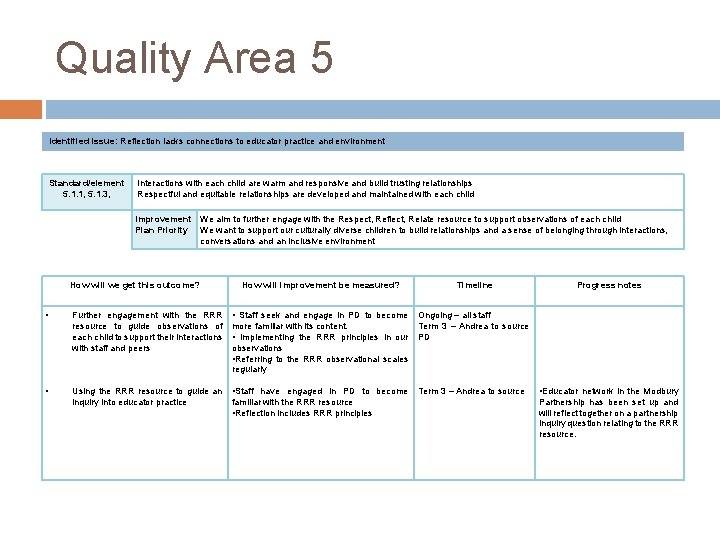
Quality Area 5 Identified issue: Reflection lacks connections to educator practice and environment Standard/element 5. 1. 1, 5. 1. 3, Interactions with each child are warm and responsive and build trusting relationships Respectful and equitable relationships are developed and maintained with each child Improvement We aim to further engage with the Respect, Reflect, Relate resource to support observations of each child Plan Priority We want to support our culturally diverse children to build relationships and a sense of belonging through interactions, conversations and an inclusive environment How will we get this outcome? • • Further engagement with the RRR resource to guide observations of each child to support their interactions with staff and peers How will improvement be measured? Timeline Progress notes • Staff seek and engage in PD to become Ongoing – all staff more familiar with its content. Term 3 – Andrea to source • Implementing the RRR principles in our PD observations • Referring to the RRR observational scales regularly Using the RRR resource to guide an • Staff have engaged in PD to become Term 3 – Andrea to source inquiry into educator practice familiar with the RRR resource • Reflection includes RRR principles • Educator network in the Modbury Partnership has been set up and will reflect together on a partnership inquiry question relating to the RRR resource.
Quality Area 6 Collaborative Partnerships with Families and Communities Strengths • New families to our Preschool are invited to meet individually with the Assistant Principal to organise a Preschool tour and talk through enrolment procedures. • A Preschool Handbook is available on enrolment and in the preschool with information about the preschool • Information is collected from parents on enrolment, to help us better understand cater for each child. • Parents are encouraged to stay with their child in the initial stages of attendance to support them through the transition to Preschool. • A pre-entry program is in place to assist children with the transition to full time Preschool. Many of our children are already familiar with the Preschool prior to beginning through attendance at Playgroup. • Transition between the preschool and school is smooth as children become familiar with the school grounds and staff through participation in many whole school activities such as Sports Day, Assemblies, and buddy class activities. • There is a formal transition to school where children will meet their teacher and become more familiar within the classroom setting. Children participate in a four week program of school visits, gradually increasing in length, culminating in a full day. This program has proven to be very successful with children experiencing little or no anxiety or distress. • Families are encouraged to help in various ways, such as attendance on excursions, assisting with cooking or craft activities, end of term cleaning tasks and working bees. • Opportunities exist for families to join in on social occasions such as Grandparents Day, VIP morning teas, special lunch days and end of year graduation and concert. • Families are able to become involved in a more formal capacity through Governing Council and Playgroup. Involvement at this level allows families to contribute to decision making about particular programs and facilities. • Our Community Notice Board supports families to access outside support services and resources • The Complaints Procedure is displayed
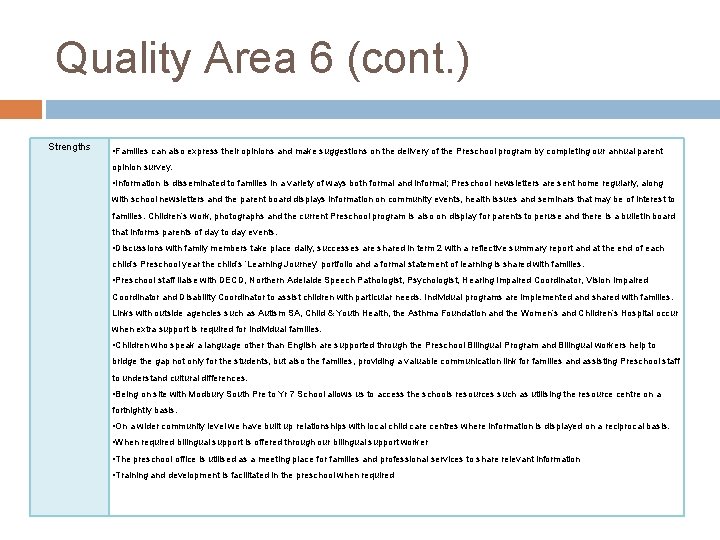
Quality Area 6 (cont. ) Strengths • Families can also express their opinions and make suggestions on the delivery of the Preschool program by completing our annual parent opinion survey. • Information is disseminated to families in a variety of ways both formal and informal; Preschool newsletters are sent home regularly, along with school newsletters and the parent board displays information on community events, health issues and seminars that may be of interest to families. Children’s work, photographs and the current Preschool program is also on display for parents to peruse and there is a bulletin board that informs parents of day to day events. • Discussions with family members take place daily, successes are shared in term 2 with a reflective summary report and at the end of each child’s Preschool year the child’s ‘Learning Journey’ portfolio and a formal statement of learning is shared with families. • Preschool staff liaise with DECD, Northern Adelaide Speech Pathologist, Psychologist, Hearing Impaired Coordinator, Vision Impaired Coordinator and Disability Coordinator to assist children with particular needs. Individual programs are implemented and shared with families. Links with outside agencies such as Autism SA, Child & Youth Health, the Asthma Foundation and the Women’s and Children’s Hospital occur when extra support is required for individual families. • Children who speak a language other than English are supported through the Preschool Bilingual Program and Bilingual workers help to bridge the gap not only for the students, but also the families, providing a valuable communication link for families and assisting Preschool staff to understand cultural differences. • Being on site with Modbury South Pre to Yr 7 School allows us to access the schools resources such as utilising the resource centre on a fortnightly basis. • On a wider community level we have built up relationships with local child care centres where information is displayed on a reciprocal basis. • When required bilingual support is offered through our bilingual support worker • The preschool office is utilised as a meeting place for families and professional services to share relevant information • Training and development is facilitated in the preschool when required
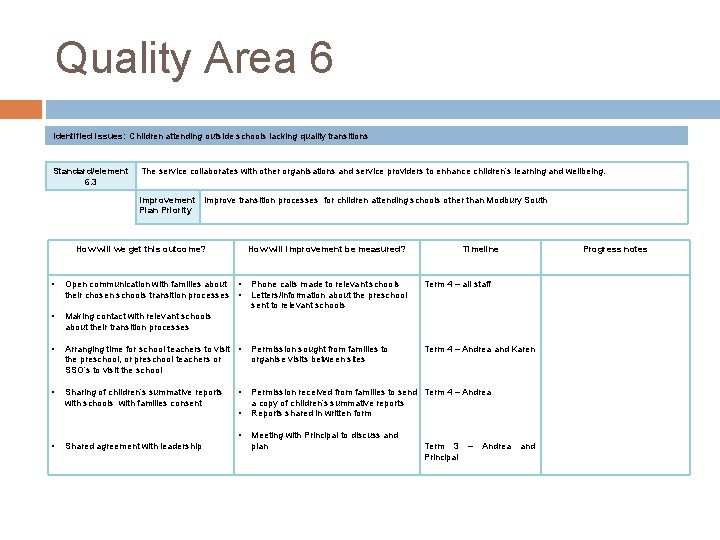
Quality Area 6 Identified issues: Children attending outside schools lacking quality transitions Standard/element 6. 3 The service collaborates with other organisations and service providers to enhance children’s learning and wellbeing. Improvement Improve transition processes for children attending schools other than Modbury South Plan Priority How will we get this outcome? How will improvement be measured? • Open communication with families about • their chosen schools transition processes • • Making contact with relevant schools about their transition processes • Arranging time for school teachers to visit • the preschool, or preschool teachers or SSO’s to visit the school • Sharing of children’s summative reports with schools with families consent • • Shared agreement with leadership Timeline Phone calls made to relevant schools Letters/information about the preschool sent to relevant schools Term 4 – all staff Permission sought from families to organise visits between sites Term 4 – Andrea and Karen Permission received from families to send Term 4 – Andrea a copy of children’s summative reports Reports shared in written form Meeting with Principal to discuss and plan Term 3 – Andrea and Principal Progress notes
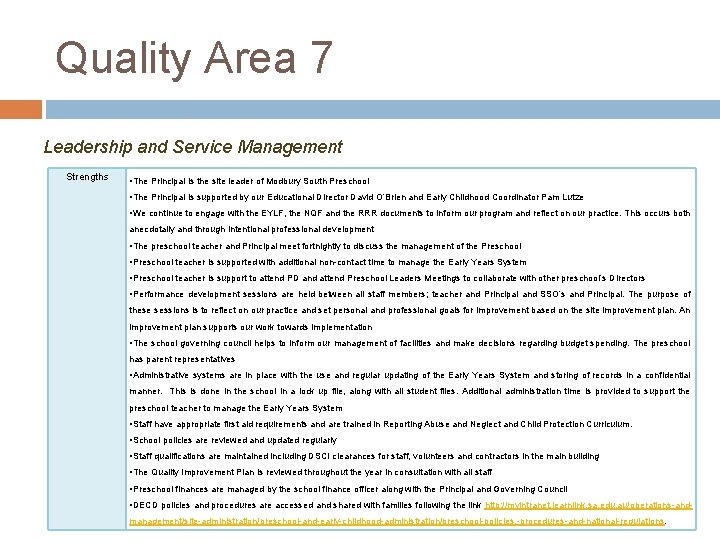
Quality Area 7 Leadership and Service Management Strengths • The Principal is the site leader of Modbury South Preschool • The Principal is supported by our Educational Director David O’Brien and Early Childhood Coordinator Pam Lutze • We continue to engage with the EYLF, the NQF and the RRR documents to inform our program and reflect on our practice. This occurs both anecdotally and through intentional professional development • The preschool teacher and Principal meet fortnightly to discuss the management of the Preschool • Preschool teacher is supported with additional non-contact time to manage the Early Years System • Preschool teacher is support to attend PD and attend Preschool Leaders Meetings to collaborate with other preschool’s Directors • Performance development sessions are held between all staff members; teacher and Principal and SSO’s and Principal. The purpose of these sessions is to reflect on our practice and set personal and professional goals for improvement based on the site improvement plan. An improvement plan supports our work towards implementation • The school governing council helps to inform our management of facilities and make decisions regarding budget spending. The preschool has parent representatives • Administrative systems are in place with the use and regular updating of the Early Years System and storing of records in a confidential manner. This is done in the school in a lock up file, along with all student files. Additional administration time is provided to support the preschool teacher to manage the Early Years System • Staff have appropriate first aid requirements and are trained in Reporting Abuse and Neglect and Child Protection Curriculum. • School policies are reviewed and updated regularly • Staff qualifications are maintained including DSCI clearances for staff, volunteers and contractors in the main building • The Quality Improvement Plan is reviewed throughout the year in consultation with all staff • Preschool finances are managed by the school finance officer along with the Principal and Governing Council • DECD policies and procedures are accessed and shared with families following the link http: //myintranet. learnlink. sa. edu. au/operations-andmanagement/site-administration/preschool-and-early-childhood-administration/preschool-policies, -procedures-and-national-regulations.
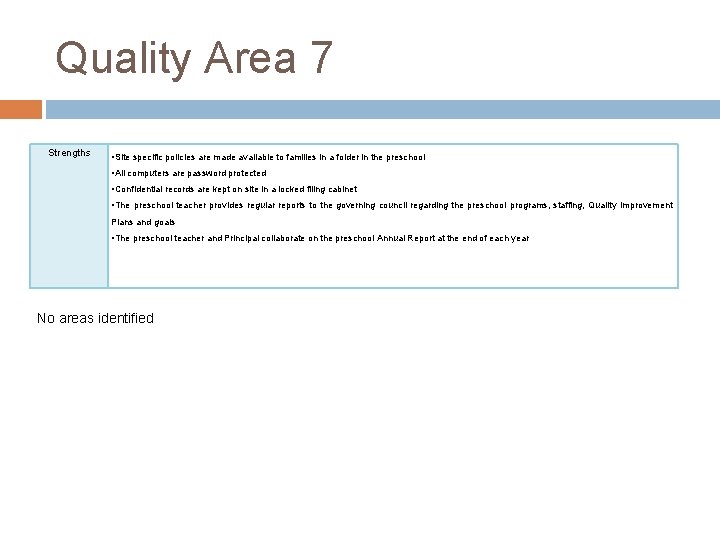
Quality Area 7 Strengths • Site specific policies are made available to families in a folder in the preschool • All computers are password protected • Confidential records are kept on site in a locked filing cabinet • The preschool teacher provides regular reports to the governing council regarding the preschool programs, staffing, Quality Improvement Plans and goals • The preschool teacher and Principal collaborate on the preschool Annual Report at the end of each year No areas identified
- Slides: 22