
Quality Function Deployment and Selection Matrices Customer Driven

- Slides: 28
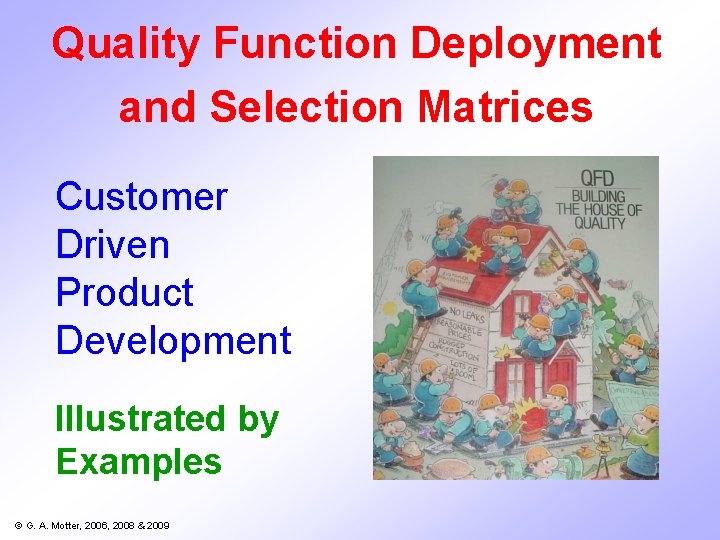
Quality Function Deployment and Selection Matrices Customer Driven Product Development Illustrated by Examples © G. A. Motter, 2006, 2008 & 2009
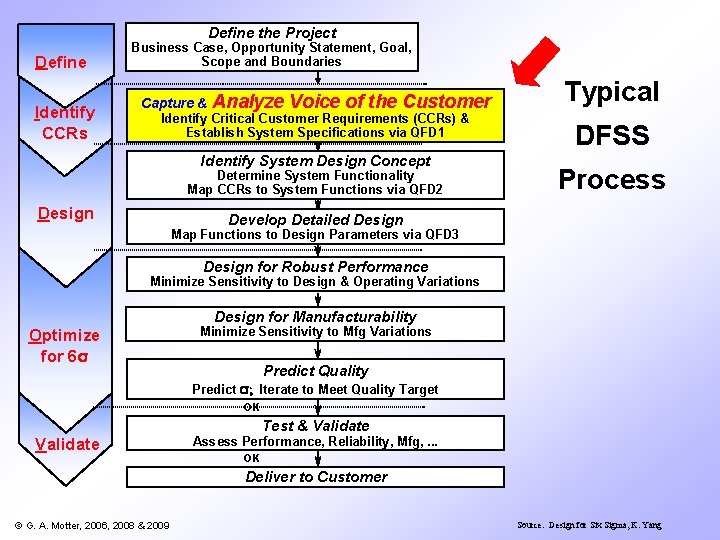
Define the Project Define Identify CCRs Business Case, Opportunity Statement, Goal, Scope and Boundaries Capture & Analyze Voice of the Customer Identify Critical Customer Requirements (CCRs) & Establish System Specifications via QFD 1 Identify System Design Concept Determine System Functionality Map CCRs to System Functions via QFD 2 Design Typical DFSS Process Develop Detailed Design Map Functions to Design Parameters via QFD 3 Design for Robust Performance Minimize Sensitivity to Design & Operating Variations Design for Manufacturability Optimize for 6 s Minimize Sensitivity to Mfg Variations Predict Quality Predict s; Iterate to Meet Quality Target OK Test & Validate Assess Performance, Reliability, Mfg, . . . OK Deliver to Customer © G. A. Motter, 2006, 2008 & 2009 Source: Design for Six Sigma, K. Yang
House of Quality & Selection Matrix Discussion Objectives u Understand purpose of each “Room” in the Matrix u Illustrate 7 -step approach to HOQ, via example u Identify Critical Customer Requirements (CCRs) u Establish System Level Engineering Specifications u Explain Solution Selection Matrix © G. A. Motter, 2006, 2008 & 2009
What are Quality Function Deployment and Solution Selection Matrices? © G. A. Motter, 2006, 2008 & 2009 u Tools to assist in data based decision making u System of matrices translating Customer Needs into Engineering Specifications u Tools to reduce design uncertainty u Applied to Product, Service, Process, IT, or Software Designs
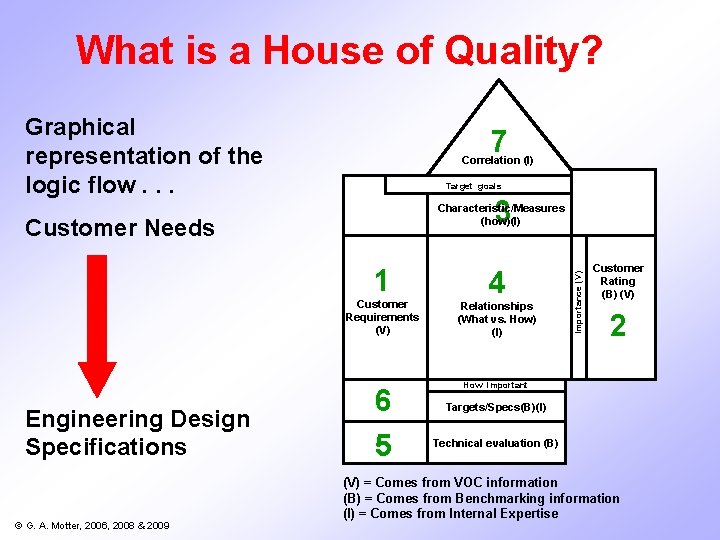
What is a House of Quality? Graphical representation of the logic flow. . . 7 Correlation (I) Target goals 3 Customer Needs 1 Engineering Design Specifications © G. A. Motter, 2006, 2008 & 2009 4 Customer Requirements (V) Relationships (What vs. How) (I) 6 5 How important Importance (V) Characteristic/Measures (how)(I) Customer Rating (B) (V) 2 Targets/Specs(B)(I) Technical evaluation (B) (V) = Comes from VOC information (B) = Comes from Benchmarking information (I) = Comes from Internal Expertise
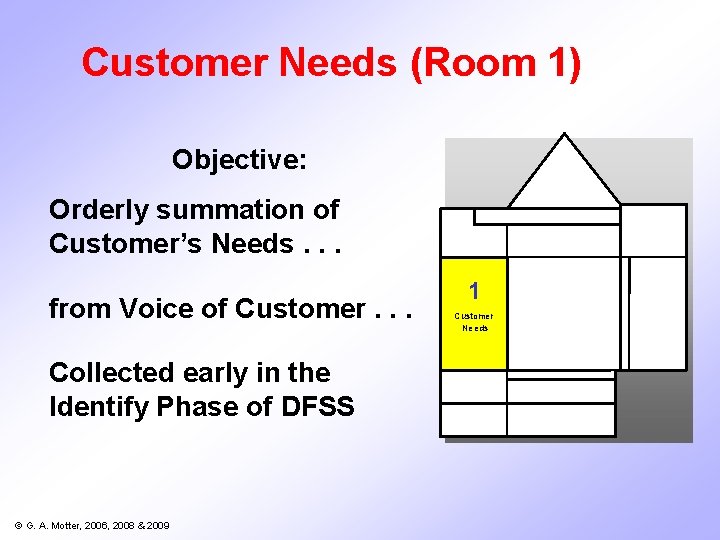
Customer Needs (Room 1) Objective: Orderly summation of Customer’s Needs. . . from Voice of Customer. . . Collected early in the Identify Phase of DFSS © G. A. Motter, 2006, 2008 & 2009 1 Customer Needs
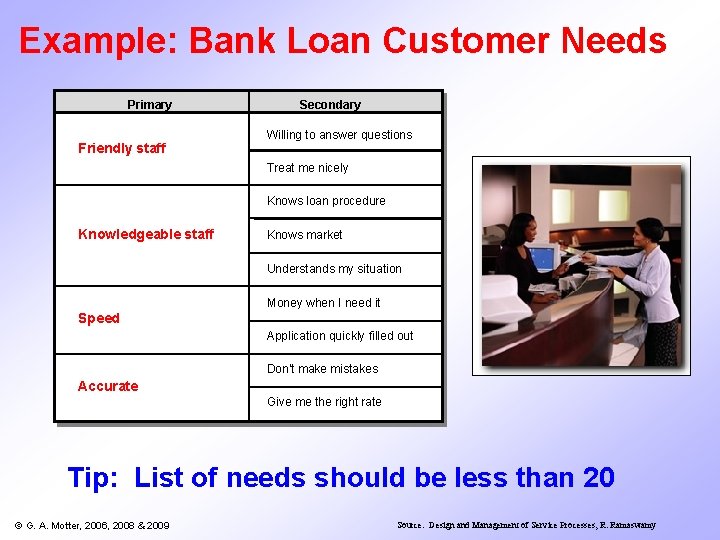
Example: Bank Loan Customer Needs Primary Friendly staff Secondary Willing to answer questions Treat me nicely Knows loan procedure Knowledgeable staff Knows market Understands my situation Money when I need it Speed Application quickly filled out Don’t make mistakes Accurate Give me the right rate Tip: List of needs should be less than 20 © G. A. Motter, 2006, 2008 & 2009 Source: Design and Management of Service Processes, R. Ramaswamy
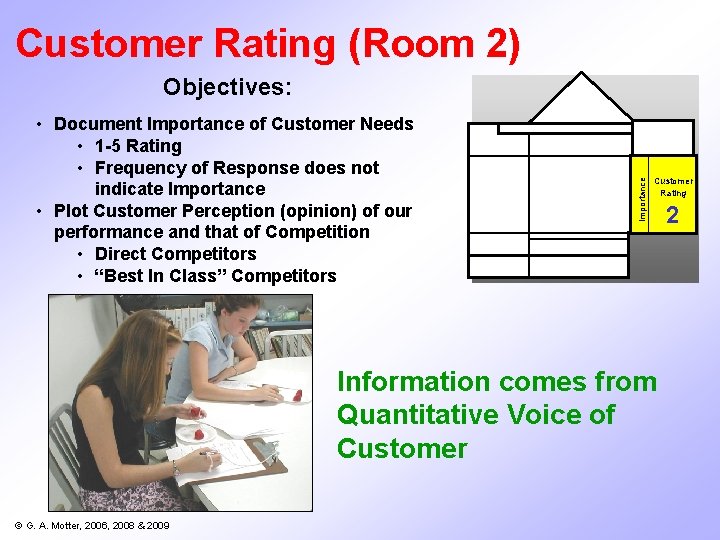
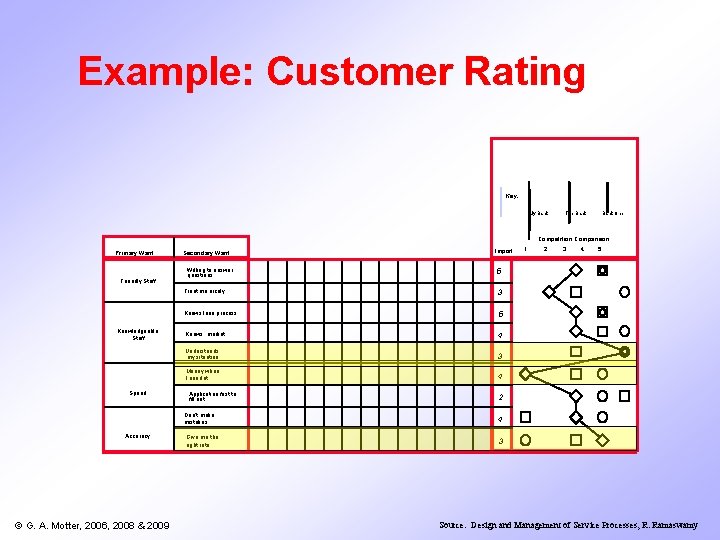
Customer Rating (Room 2) • Document Importance of Customer Needs • 1 -5 Rating • Frequency of Response does not indicate Importance • Plot Customer Perception (opinion) of our performance and that of Competition • Direct Competitors • “Best In Class” Competitors Importance Objectives: Customer Rating Information comes from Quantitative Voice of Customer © G. A. Motter, 2006, 2008 & 2009 2
Example: Customer Rating Key: My Bank The Bank One Competition Comparison Primary Want Friendly Staff Knowledgeable Staff Speed Secondary Want Willing to answer questions 3 Knows loan process 5 Knows market 4 Understands my situation 3 Money when I need iit 4 Application fast to fill out © G. A. Motter, 2006, 2008 & 2009 Give me the right rate 1 2 3 4 5 5 Treat me nicely Don’t make mistakes Accuracy Import 2 4 3 Source: Design and Management of Service Processes, R. Ramaswamy
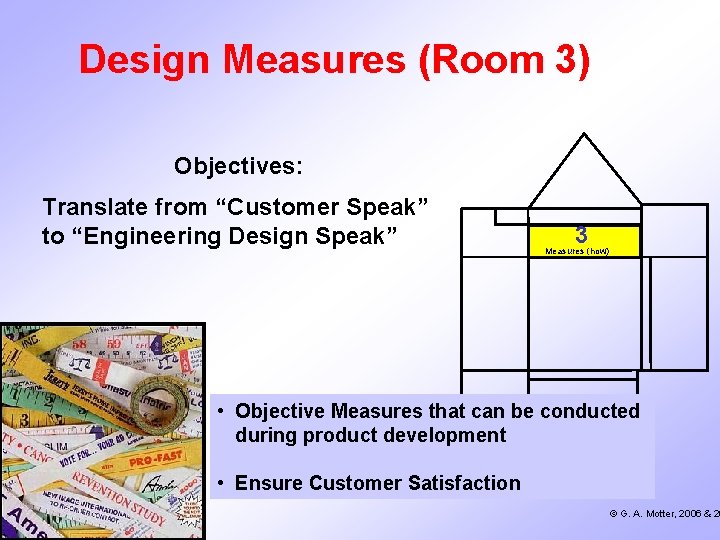
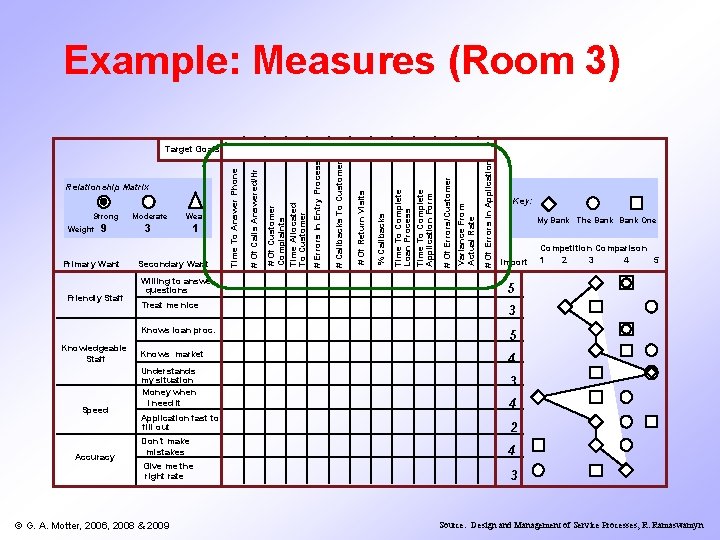
Design Measures (Room 3) Objectives: Translate from “Customer Speak” to “Engineering Design Speak” 3 Measures (how) • Objective Measures that can be conducted during product development • Ensure Customer Satisfaction © G. A. Motter, 2006 & 20 © G. A. Motter, 2006, 2008 & 2009
Example: Measures (Room 3) Friendly Staff Knowledgeable Staff Speed Accuracy Willing to answer questions # Of Errors In Application Variance From Actual Rate Secondary Want # Of Errors/Customer Primary Want Time To Complete Loan Process Time To Complete Application Form 1 % Callbacks 3 # Of Return Visits 9 Weight # Callbacks To Customer Weak # Errors In Entry Process Moderate # Of Customer Complaints Time Allocated To Customer Strong # Of Calls Answered/Hr Relationship Matrix Time To Answer Phone Target Goals Key: My Bank The Bank One Import 5 Treat me nice 3 Knows loan proc. 5 Knows market 4 Understands my situation Money when I need it 4 Application fast to fill out 2 Don’t make mistakes 4 Give me the right rate 3 © G. A. Motter, 2006, 2008 & 2009 Competition Comparison 1 2 3 4 5 3 Source: Design and Management of Service Processes, R. Ramaswamyn
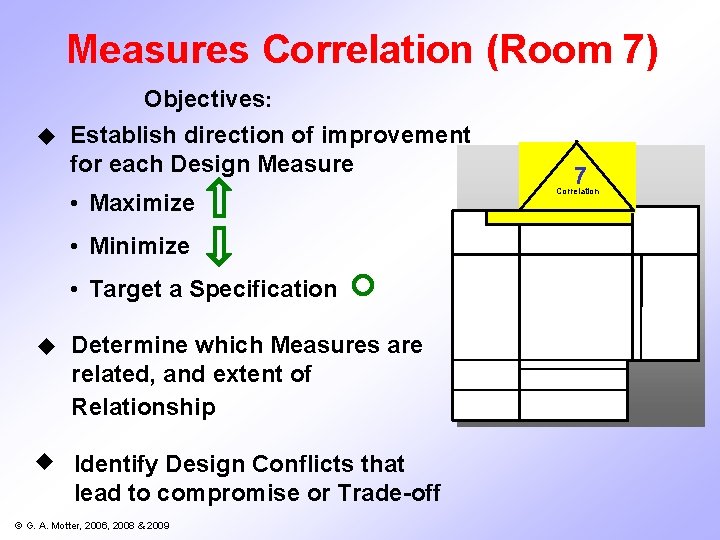
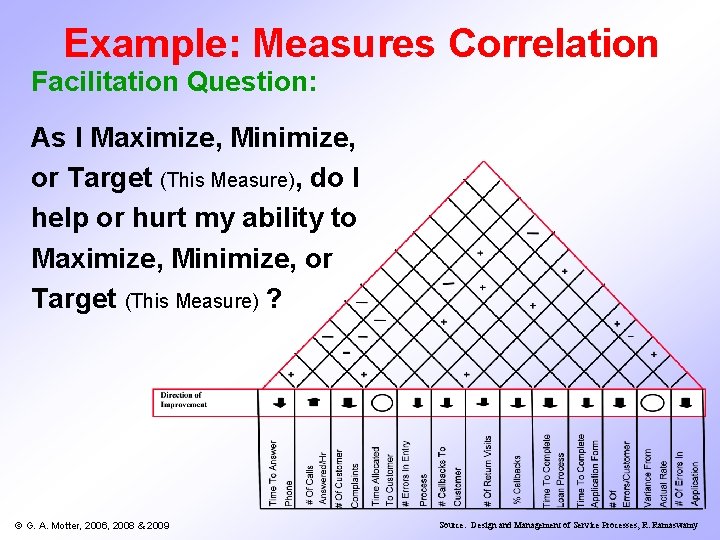
Measures Correlation (Room 7) Objectives: u Establish direction of improvement for each Design Measure • Maximize • Minimize • Target a Specification u Determine which Measures are related, and extent of Relationship u Identify Design Conflicts that lead to compromise or Trade-off © G. A. Motter, 2006, 2008 & 2009 7 Correlation Target goals
Example: Measures Correlation Facilitation Question: As I Maximize, Minimize, or Target (This Measure), do I help or hurt my ability to Maximize, Minimize, or Target (This Measure) ? © G. A. Motter, 2006, 2008 & 2009 Source: Design and Management of Service Processes, R. Ramaswamy
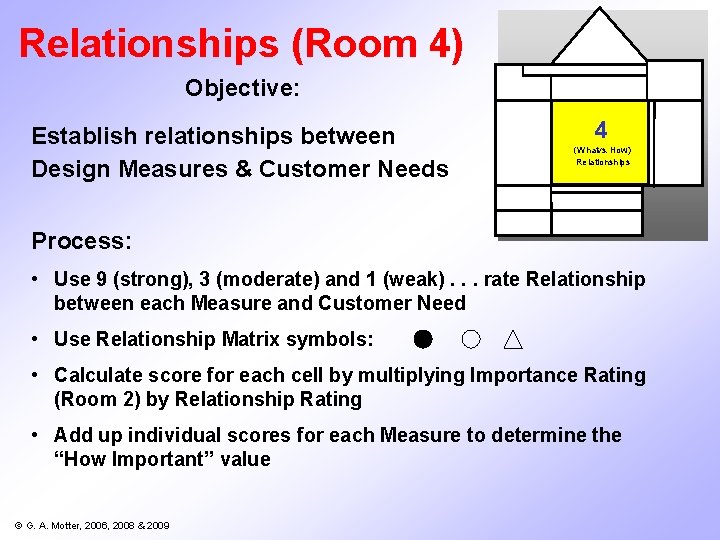
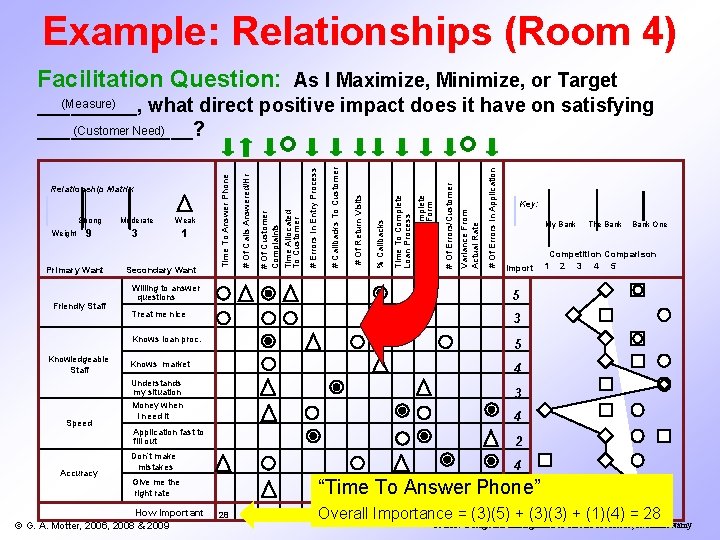
Relationships (Room 4) Objective: Establish relationships between Design Measures & Customer Needs 4 (Whatvs. How) Relationships Process: • Use 9 (strong), 3 (moderate) and 1 (weak). . . rate Relationship between each Measure and Customer Need • Use Relationship Matrix symbols: • Calculate score for each cell by multiplying Importance Rating (Room 2) by Relationship Rating • Add up individual scores for each Measure to determine the “How Important” value © G. A. Motter, 2006, 2008 & 2009
Example: Relationships (Room 4) Facilitation Question: As I Maximize, Minimize, or Target Friendly Staff Knowledgeable Staff Speed Accuracy Willing to answer questions # Of Errors In Application Variance From Actual Rate # Of Errors/Customer Secondary Want Time To Complete Application Form Primary Want Time To Complete Loan Process 1 % Callbacks 3 # Of Return Visits 9 # Callbacks To Customer Weak # Errors In Entry Process Moderate # Of Customer Complaints Time Allocated To Customer Weight Strong # Of Calls Answered/Hr Relationship Matrix Time To Answer Phone (Measure) _____, what direct positive impact does it have on satisfying (Customer Need) _______? Key: My Bank Import Bank One Competition Comparison 2 3 4 5 5 Treat me nice 3 Knows loan proc. 5 Knows market 4 Understands my situation Money when I need it 3 4 Application fast to fill out 2 Don’t make mistakes 4 “Time To Answer Phone” 3 Give me the right rate How Important © G. A. Motter, 2006, 2008 & 2009 1 The Bank 28 5 133 14 35 27 30 Importance 49 46 33 54 = 27 (3)(5) 74 Overall + (3)(3) + (1)(4) = 28 Source: Design and Management of Service Processes, R. Ramaswamy
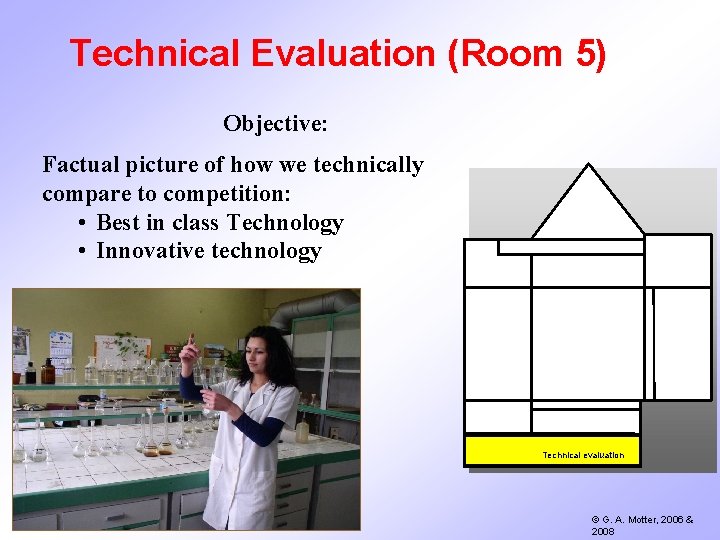
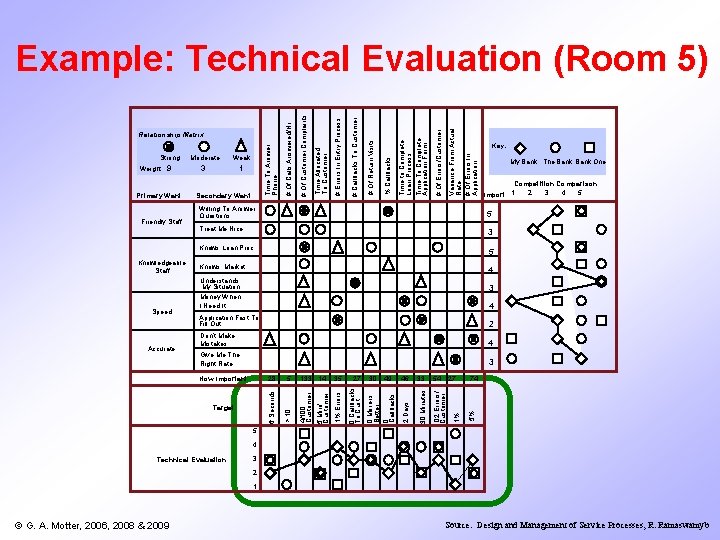
Technical Evaluation (Room 5) Objective: Factual picture of how we technically compare to competition: • Best in class Technology • Innovative technology 5 © G. A. Motter, 2006, 2008 & 2009 Technical evaluation © G. A. Motter, 2006 & 2008
Variance From Actual Rate # Of Errors In Application # Of Errors/Customer Time to Complete Loan Process Time To Complete Application Form % Callbacks # Of Return Visits # Callbacks To Customer # Errors In Entry Process Time Allocated To Customer # Of Customer Complaints Key: My Bank The Bank One Competition Comparison 2 3 4 5 Import 1 Willing To Answer Questions 5 Treat Me Nice 3 Knows Loan Proc. 5 Knows Market 4 Understands My Situation Money When I Need It 4 Application Fast To Fill Out 2 Don’t Make Mistakes 4 Give Me The Right Rate 3 27 30 49 46 33 54 27 74 . 5% 35 1% 133 14 30 Minutes 5 . 02 Errors/ Customer Target 28 0 More is Better 0 Callbacks How Important 2 Days 3 1% Errors Accurate Secondary Want 0 Callbacks To Cust. Speed 1 5 Min/ Customer Knowledgeable Staff 3 4/100 Customer Friendly Staff Weak > 10 Primary Want Moderate 6 Seconds Strong Weight 9 Time To Answer Phone Relationship Matrix # Of Calls Answered/Hr Example: Technical Evaluation (Room 5) 5 4 Technical Evaluation 3 2 1 © G. A. Motter, 2006, 2008 & 2009 Source: Design and Management of Service Processes, R. Ramaswamyb
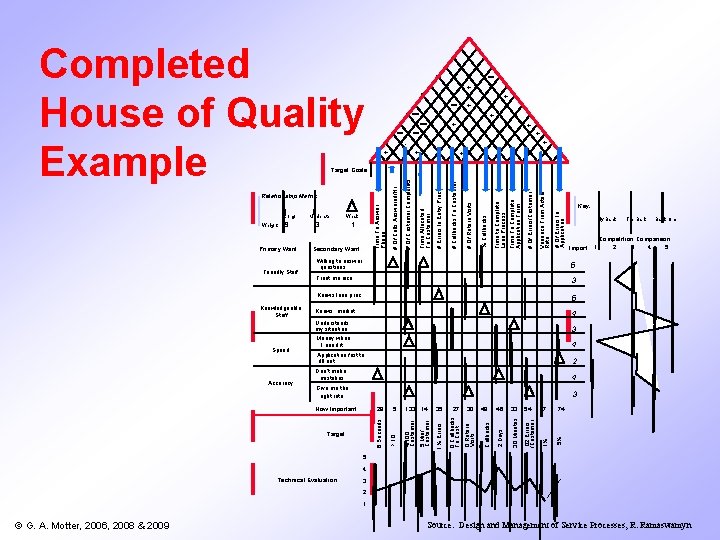
Completed House of Quality Example + + + + + - + # Of Errors In Application Variance From Actual Rate # Of Errors/Customer Time To Complete Application Form % Callbacks Time to Complete Loan Process 3 Knows loan proc. 5 Knows market 4 Understands my situation 3 Money when I need it 4 Application fast to fill out 2 Don’t make mistakes 4 Give me the right rate 1 The Bank One Competition Comparison 2 3 4 5 30 49 46 33 54 27 74 . 5% 27 1% 35 . 02 Errors /Customer 133 14 30 Minutes 5 0 Return Visits 0 Callbacks Target 28 2 Days 3 How Important 0 Callbacks To Cust. Accuracy Import 5 1% Errors Speed My Bank Treat me nice 5 Min/ Customer Knowledgeable Staff Key: Willing to answer questions 4/100 Customer Friendly Staff Secondary Want > 10 Primary Want # Of Return Visits 1 # Callbacks To Customer 3 # Errors In Entry Process 9 Time Allocated To Customer Weak # Of Customer Complaints Moderate 6 Seconds Weight Strong Time To Answer Phone Relationship Matrix # Of Calls Answered/Hr Target Goals 5 4 Technical Evaluation 3 2 1 © G. A. Motter, 2006, 2008 & 2009 Source: Design and Management of Service Processes, R. Ramaswamyn
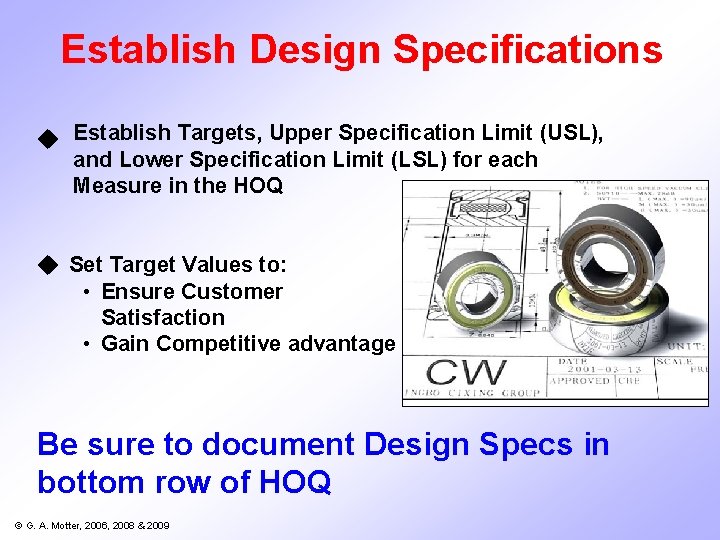
Establish Design Specifications u Establish Targets, Upper Specification Limit (USL), and Lower Specification Limit (LSL) for each Measure in the HOQ u Set Target Values to: • Ensure Customer Satisfaction • Gain Competitive advantage Be sure to document Design Specs in bottom row of HOQ © G. A. Motter, 2006, 2008 & 2009
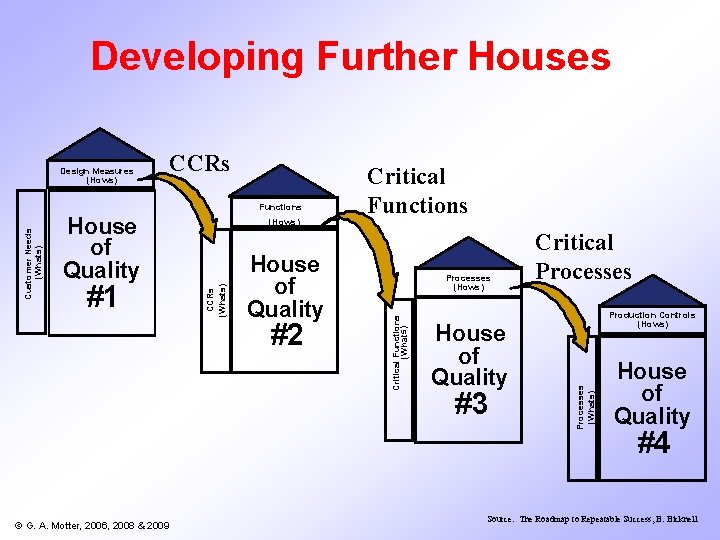
Developing Further Houses House of Quality #1 (Hows) CCRs (Whats) Customer Needs (Whats) Functions House of Quality #2 © G. A. Motter, 2006, 2008 & 2009 Critical Functions Processes (Hows) House of Quality #3 Critical Processes Production Controls (Hows) Processes (Whats) CCRs Critical Functions (Whats) Design Measures (Hows) House of Quality #4 Source: The Roadmap to Repeatable Success, B. Bicknell
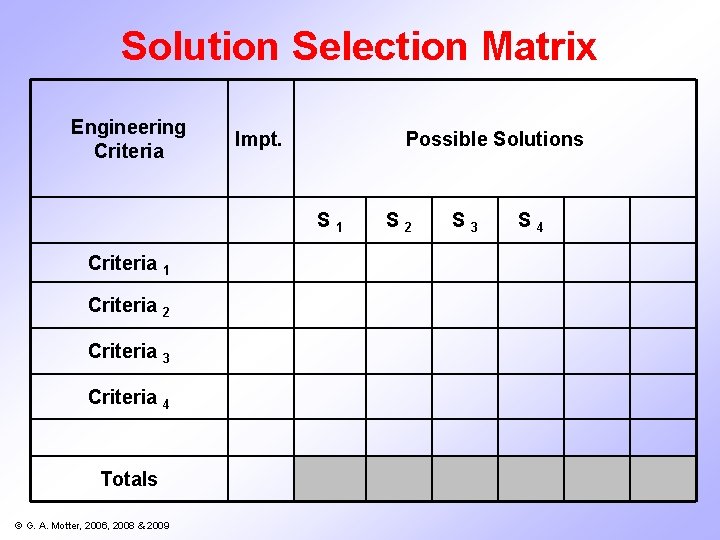
Solution Selection Matrix Engineering Criteria Impt. Possible Solutions S 1 Criteria 2 Criteria 3 Criteria 4 Totals © G. A. Motter, 2006, 2008 & 2009 S 2 S 3 S 4
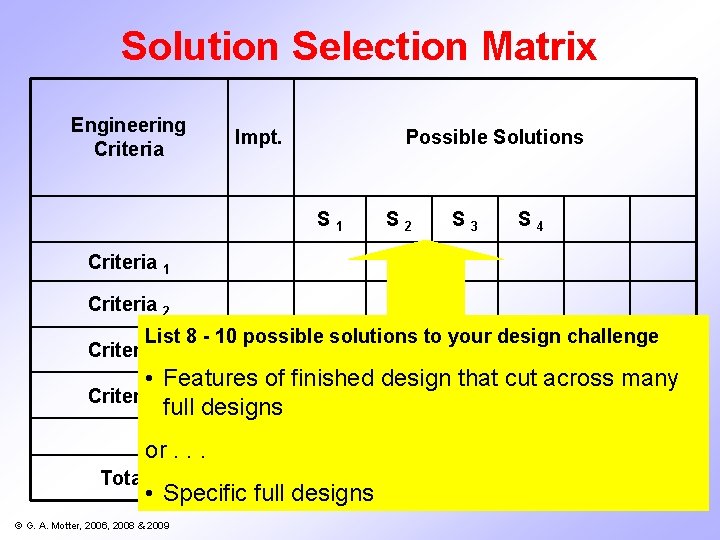
Solution Selection Matrix Engineering Criteria Impt. Possible Solutions S 1 S 2 S 3 S 4 Criteria 1 Criteria 2 List 8 - 10 possible solutions to your design challenge Criteria 3 • Features of finished design that cut across many Criteria 4 full designs or. . . Totals • Specific full designs © G. A. Motter, 2006, 2008 & 2009
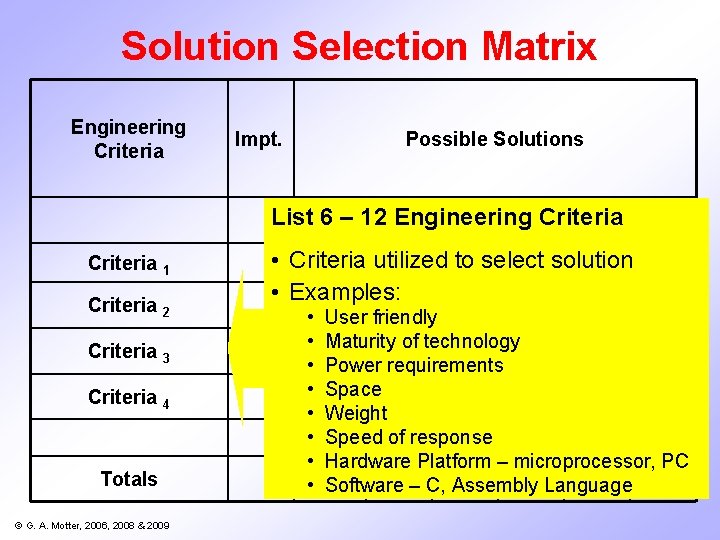
Solution Selection Matrix Engineering Criteria Impt. Possible Solutions List S 6 1– 12 SEngineering S 3 S 4 Criteria 2 Criteria 1 Criteria 2 Criteria 3 Criteria 4 Totals © G. A. Motter, 2006, 2008 & 2009 • Criteria utilized to select solution • Examples: • • User friendly Maturity of technology Power requirements Space Weight Speed of response Hardware Platform – microprocessor, PC Software – C, Assembly Language
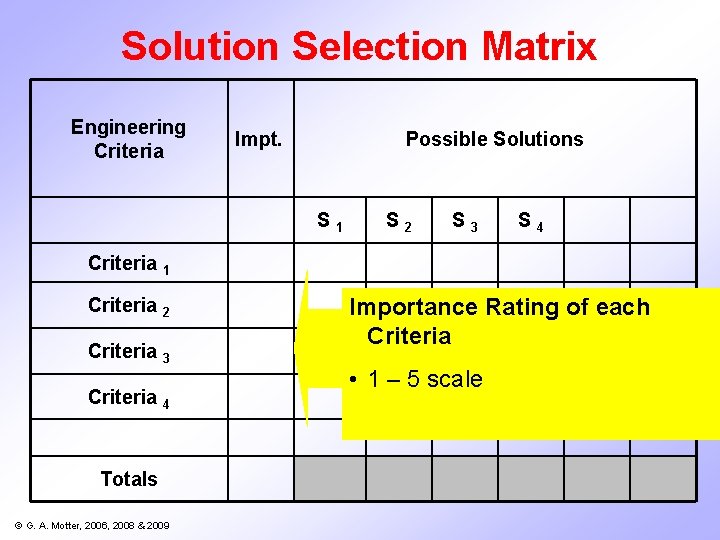
Solution Selection Matrix Engineering Criteria Impt. Possible Solutions S 1 S 2 S 3 S 4 Criteria 1 Criteria 2 Criteria 3 Criteria 4 Totals © G. A. Motter, 2006, 2008 & 2009 Importance Rating of each Criteria • 1 – 5 scale
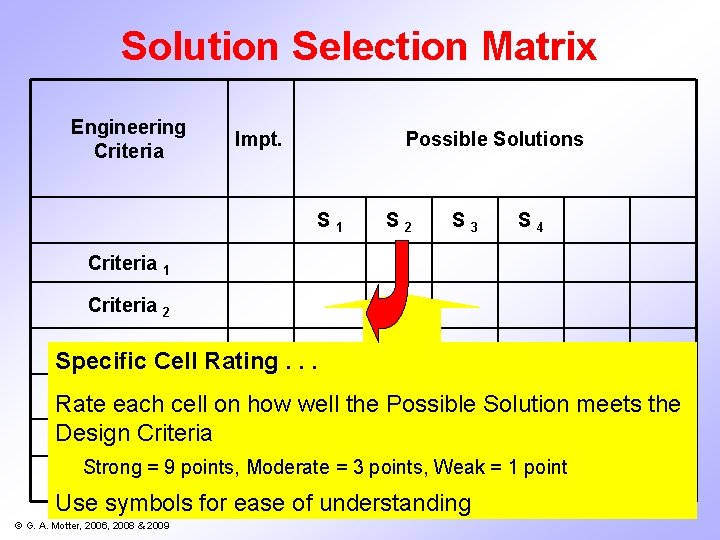
Solution Selection Matrix Engineering Criteria Impt. Possible Solutions S 1 S 2 S 3 S 4 Criteria 1 Criteria 2 Criteria 3 Specific Cell Rating. . . Criteria Rate each 4 cell on how well the Possible Solution meets the Design Criteria Strong = 9 points, Moderate = 3 points, Weak = 1 point Totals Use symbols for ease of understanding © G. A. Motter, 2006, 2008 & 2009
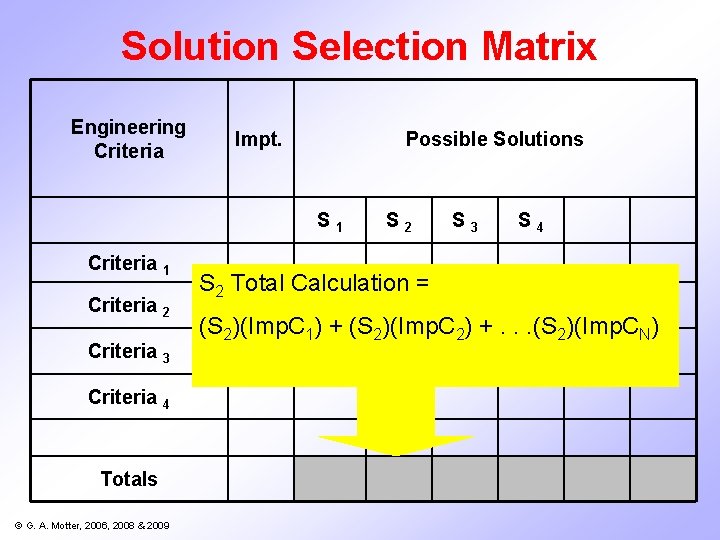
Solution Selection Matrix Engineering Criteria Impt. Possible Solutions S 1 Criteria 2 Criteria 3 Criteria 4 Totals © G. A. Motter, 2006, 2008 & 2009 S 2 S 3 S 4 S 2 Total Calculation = (S 2)(Imp. C 1) + (S 2)(Imp. C 2) +. . . (S 2)(Imp. CN)
House of Quality & Selection Matrix Discussion Summary u Defined the purpose of each “Room” in the House of Quality (HOQ) u. Illustrated, via an example u Provided algorithm to determine Critical Customer Requirements (CCRs) u Illustrated establishment of System Level Engineering Design Specifications u Defined Solution Selection Matrix u Provided Examples © G. A. Motter, 2006, 2008 & 2009
Questions? © G. A. Motter, 2006, 2008 & 2009