
Quality Enhancement Research Initiative QUERI Assessing Organizational Readiness
- Slides: 17
Quality Enhancement Research Initiative (QUERI) Assessing Organizational Readiness to Change: A Review of Research to Date and Development of a Cross-QUERI Agenda Christian D. Helfrich Ischemic Heart Disease-QUERI Carmen Hall Polytrauma and Blast-Related Injuries-QUERI Bryan J. Weiner University of North Carolina, Chapel Hill Daniel T. Holt Air Force Institute of Technology Connecting Research and Patient Care
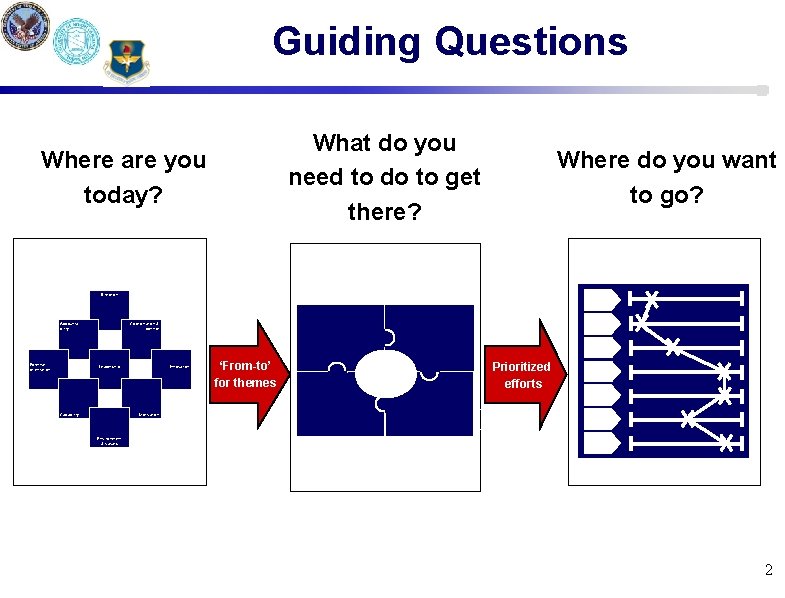
Guiding Questions What do you need to do to get there? Where are you today? Where do you want to go? Direction Accountability External orientation Coordination & control Leadership Capability Innovation ‘From-to’ for themes Prioritized efforts Motivation Environment & values 2
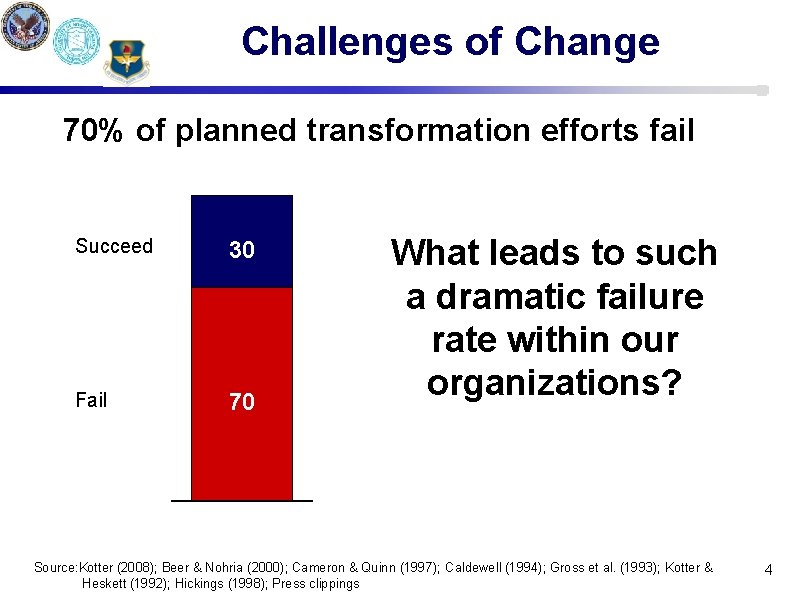
Challenges of Change 70% of planned transformation efforts fail Succeed 30 Fail 70 What leads to such a dramatic failure rate within our organizations? Source: Kotter (2008); Beer & Nohria (2000); Cameron & Quinn (1997); Caldewell (1994); Gross et al. (1993); Kotter & Heskett (1992); Hickings (1998); Press clippings 4
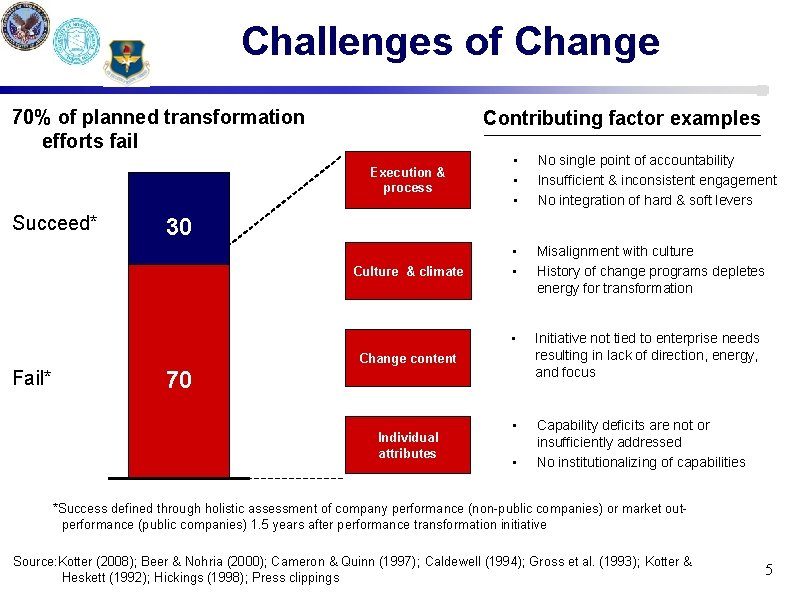
Challenges of Change 70% of planned transformation efforts fail Contributing factor examples Execution & process Succeed* • • • No single point of accountability Insufficient & inconsistent engagement No integration of hard & soft levers • • Misalignment with culture History of change programs depletes energy for transformation • Initiative not tied to enterprise needs resulting in lack of direction, energy, and focus • Capability deficits are not or insufficiently addressed No institutionalizing of capabilities 30 Culture & climate Change content Fail* 70 Individual attributes • *Success defined through holistic assessment of company performance (non-public companies) or market outperformance (public companies) 1. 5 years after performance transformation initiative Source: Kotter (2008); Beer & Nohria (2000); Cameron & Quinn (1997); Caldewell (1994); Gross et al. (1993); Kotter & Heskett (1992); Hickings (1998); Press clippings 5
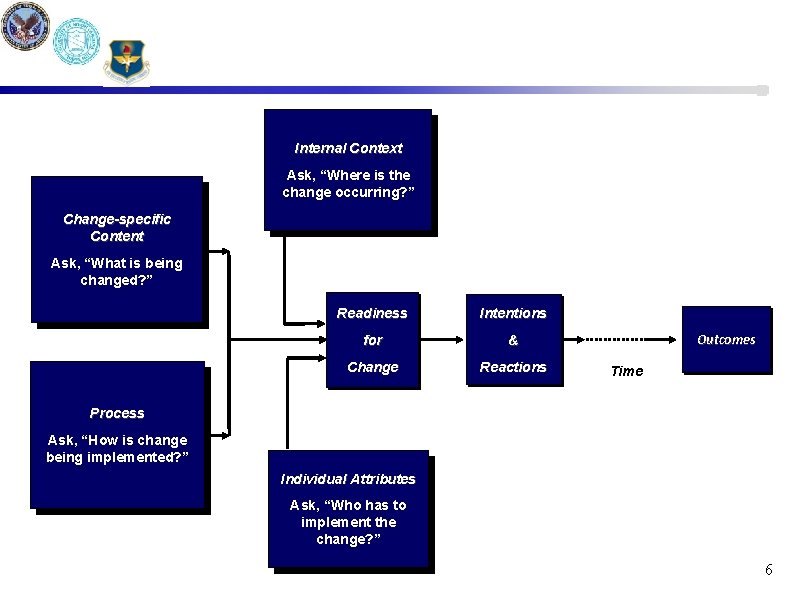
Internal Context Ask, “Where is the change occurring? ” Change-specific Content Ask, “What is being changed? ” Readiness Intentions for & Change Reactions Outcomes Time Process Ask, “How is change being implemented? ” Individual Attributes Ask, “Who has to implement the change? ” 6
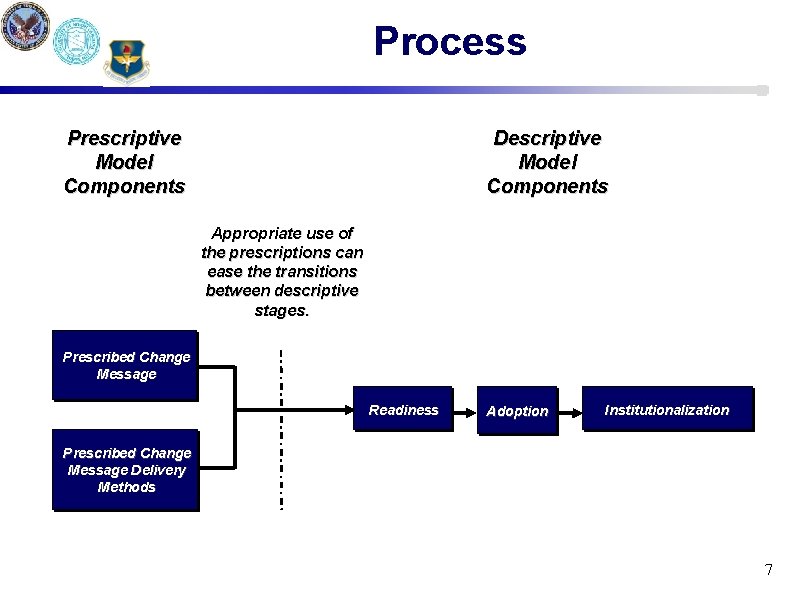
Process Prescriptive Model Components Descriptive Model Components Appropriate use of the prescriptions can ease the transitions between descriptive stages. Prescribed Change Message Readiness Adoption Institutionalization Prescribed Change Message Delivery Methods 7
Readiness for Change Questionnaire Daniel T. Holt Air Force Institute of Technology Connecting Research and Patient Care
Readiness Instruments • Process perspective • Culture & climate perspective • Change-specific perspective • Individual perspective 9
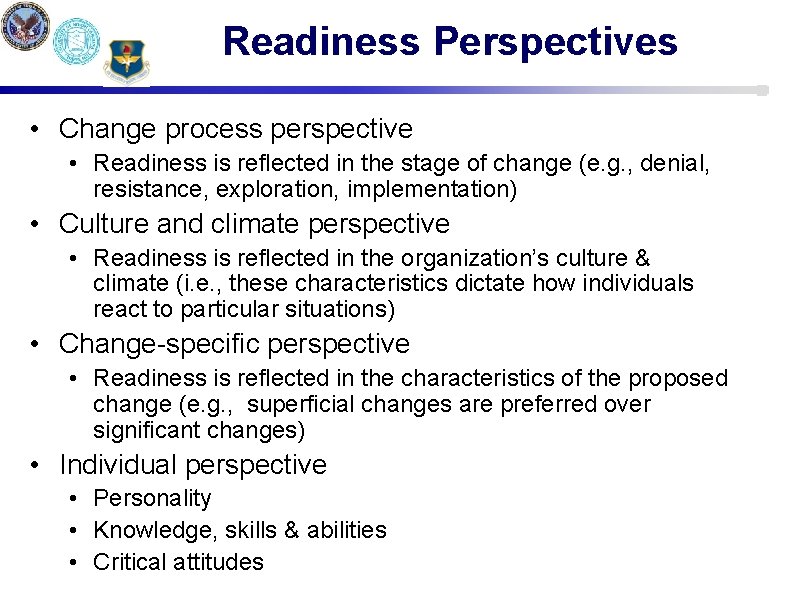
Readiness Perspectives • Change process perspective • Readiness is reflected in the stage of change (e. g. , denial, resistance, exploration, implementation) • Culture and climate perspective • Readiness is reflected in the organization’s culture & climate (i. e. , these characteristics dictate how individuals react to particular situations) • Change-specific perspective • Readiness is reflected in the characteristics of the proposed change (e. g. , superficial changes are preferred over significant changes) • Individual perspective • Personality • Knowledge, skills & abilities • Critical attitudes
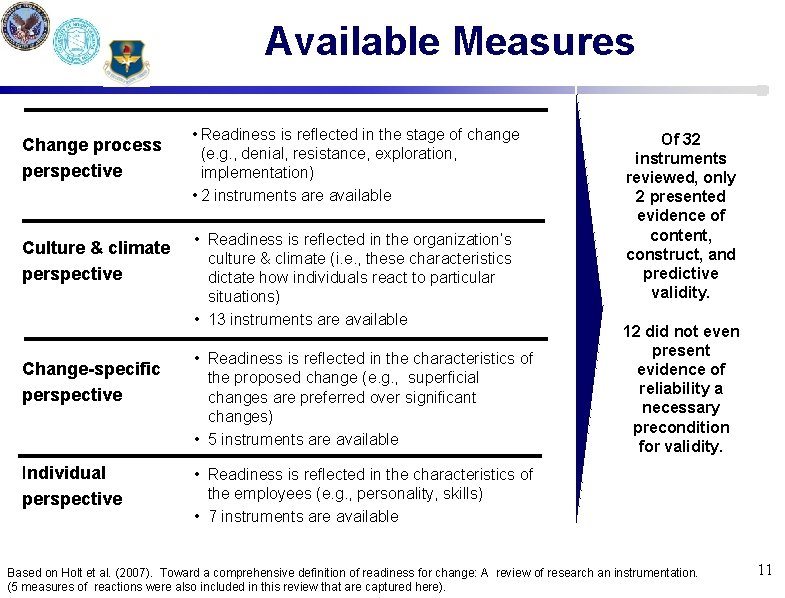
Available Measures Change process perspective Culture & climate perspective Change-specific perspective Individual perspective • Readiness is reflected in the stage of change (e. g. , denial, resistance, exploration, implementation) • 2 instruments are available • Readiness is reflected in the organization’s culture & climate (i. e. , these characteristics dictate how individuals react to particular situations) • 13 instruments are available • Readiness is reflected in the characteristics of the proposed change (e. g. , superficial changes are preferred over significant changes) • 5 instruments are available Of 32 instruments reviewed, only 2 presented evidence of content, construct, and predictive validity. 12 did not even present evidence of reliability a necessary precondition for validity. • Readiness is reflected in the characteristics of the employees (e. g. , personality, skills) • 7 instruments are available Based on Holt et al. (2007). Toward a comprehensive definition of readiness for change: A review of research an instrumentation. (5 measures of reactions were also included in this review that are captured here). 11
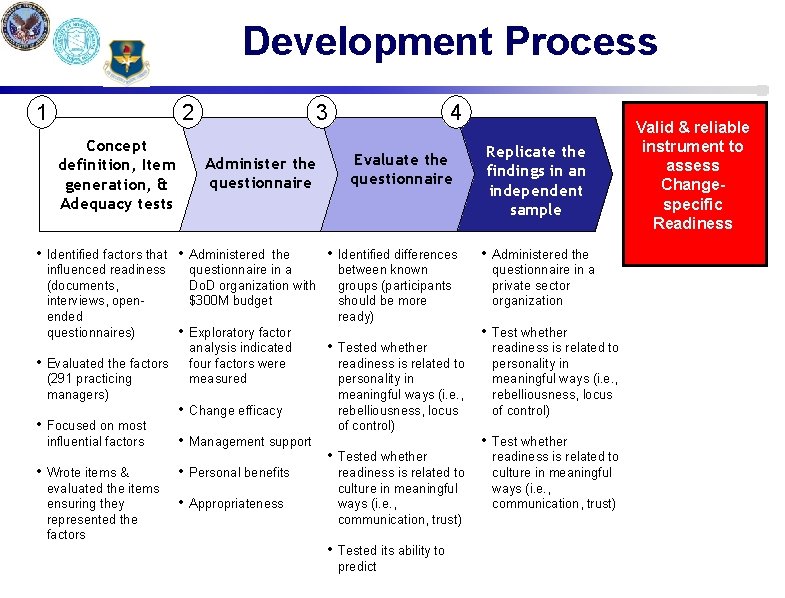
Development Process 1 2 Concept definition, Item generation, & Adequacy tests 3 Administer the questionnaire • Identified factors that • Administered the influenced readiness (documents, interviews, openended questionnaires) • Evaluated the factors (291 practicing managers) • Focused on most influential factors • Wrote items & evaluated the items ensuring they represented the factors questionnaire in a Do. D organization with $300 M budget • Exploratory factor analysis indicated four factors were measured • Change efficacy • Management support • Personal benefits • Appropriateness 4 Evaluate the questionnaire Replicate the findings in an independent sample • Identified differences • Administered the between known groups (participants should be more ready) • Tested whether readiness is related to personality in meaningful ways (i. e. , rebelliousness, locus of control) • Tested whether readiness is related to culture in meaningful ways (i. e. , communication, trust) • Tested its ability to predict questionnaire in a private sector organization • Test whether readiness is related to personality in meaningful ways (i. e. , rebelliousness, locus of control) • Test whether readiness is related to culture in meaningful ways (i. e. , communication, trust) Valid & reliable instrument to assess Changespecific Readiness
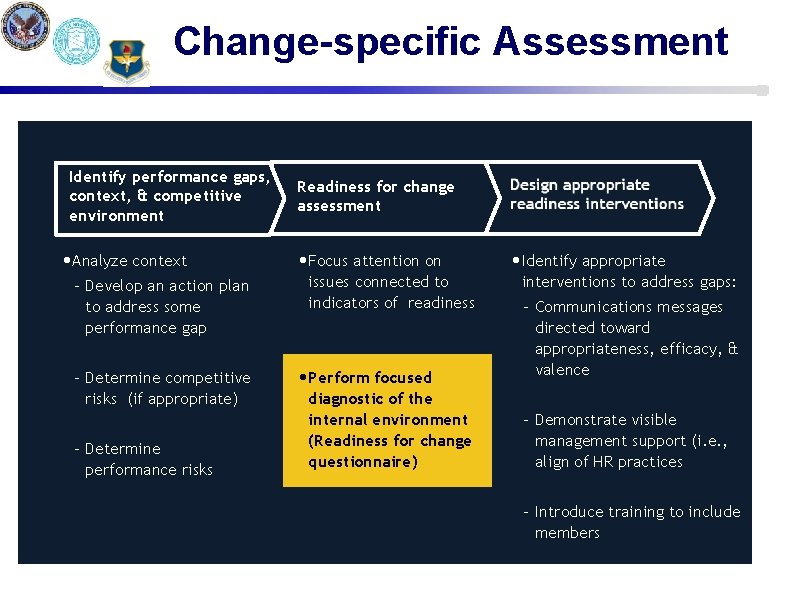
Change-specific Assessment Identify performance gaps, context, & competitive environment • Analyze context – Develop an action plan to address some performance gap – Determine competitive risks (if appropriate) – Determine performance risks Readiness for change assessment • Focus attention on issues connected to indicators of readiness • Perform focused diagnostic of the internal environment (Readiness for change questionnaire) • Identify appropriate interventions to address gaps: – Communications messages directed toward appropriateness, efficacy, & valence – Demonstrate visible management support (i. e. , align of HR practices – Introduce training to include members
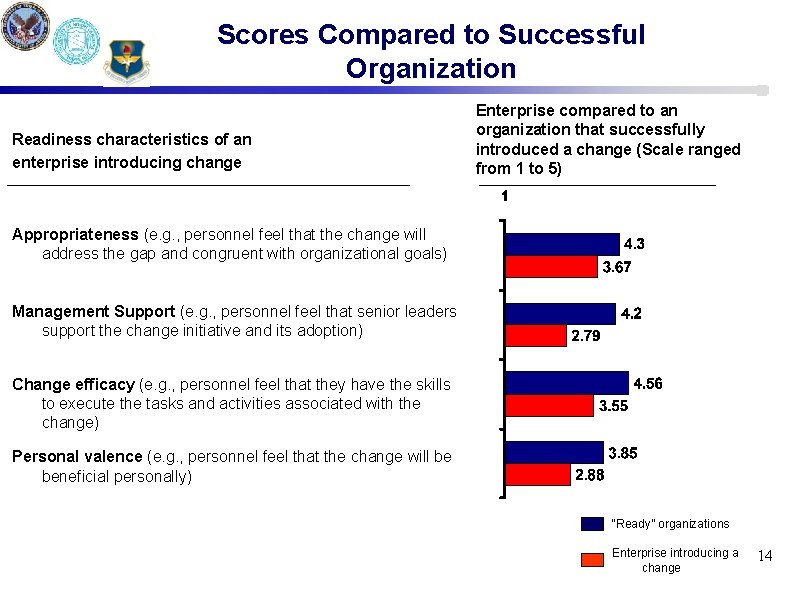
Scores Compared to Successful Organization Readiness characteristics of an enterprise introducing change Enterprise compared to an organization that successfully introduced a change (Scale ranged from 1 to 5) Appropriateness (e. g. , personnel feel that the change will address the gap and congruent with organizational goals) Management Support (e. g. , personnel feel that senior leaders support the change initiative and its adoption) Change efficacy (e. g. , personnel feel that they have the skills to execute the tasks and activities associated with the change) Personal valence (e. g. , personnel feel that the change will be beneficial personally) “Ready” organizations Enterprise introducing a change 14
Summary • Flexible • Used in a variety of organizational settings by members at all organizational levels • Practical • Consistent with criteria that are identified by practitioners • Guides those who are trying to facilitate changes • Gauges the most influential readiness factors • Theoretical • Consistent with current theories of organizational change • Adheres to accepted standards for measurement
Bryan’s Framework • Is ORC a psychological or structural concept? • Conceptualized as a psychological concept • Is ORC an individual-level or collective construct? • Measured at the individual-level • Does ORC refer to a general state of affairs or to a specific change? • Refers to a specific change • Does ORC apply to adoption or to implementation? • Refers to adopition
Danny Holt • Education • • B. S. , Electrical Engineering M. A. , Human Resource Development M. S. , Engineering & Environmental Mgt Ph. D. , Management • Human Resource Management • Organizational Analysis • Organizational Change • Air Force Career • Civil Engineering Officer (Myrtle Beach, SC; Osan AB, ROK; Al Udeid AB, Qatar; Ft Dix, NJ; Ft Bragg, NC) • Academic (Graduate student; Faculty Air Force Institute of Technology) 17
Air Force Institute of Technology Danny Holt AFIT/ENV 2950 Hobson Way Wright Patterson AFB, OH 45433 (937) 255 -3636 extension 7396 (voice) (937) 656 -4699 (fax) daniel. holt@afit. edu 18