
Quality Control Some examples from NILU Main enemies


- Slides: 12
Quality Control Some examples from NILU
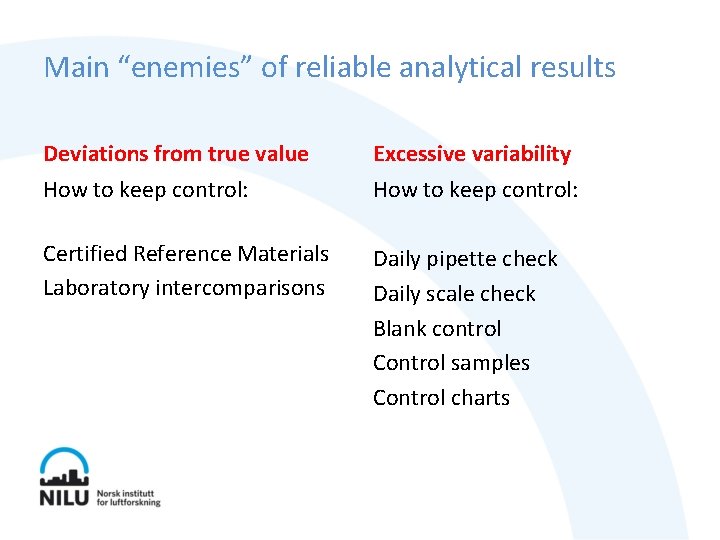
Main “enemies” of reliable analytical results Deviations from true value Excessive variability How to keep control: Certified Reference Materials Laboratory intercomparisons Daily pipette check Daily scale check Blank control Control samples Control charts
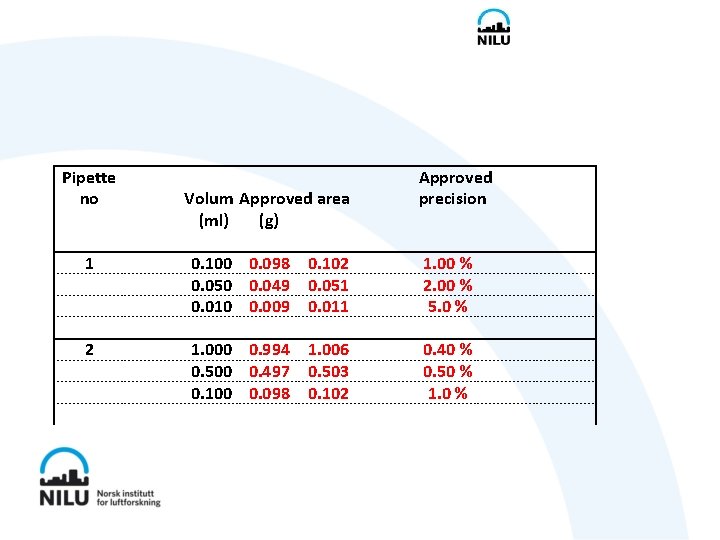
Pipette no Volum Approved area (ml) (g) Approved precision 1 0. 100 0. 098 0. 050 0. 049 0. 010 0. 009 0. 102 0. 051 0. 011 1. 00 % 2. 00 % 5. 0 % 2 1. 000 0. 994 0. 500 0. 497 0. 100 0. 098 1. 006 0. 503 0. 102 0. 40 % 0. 50 % 1. 0 %
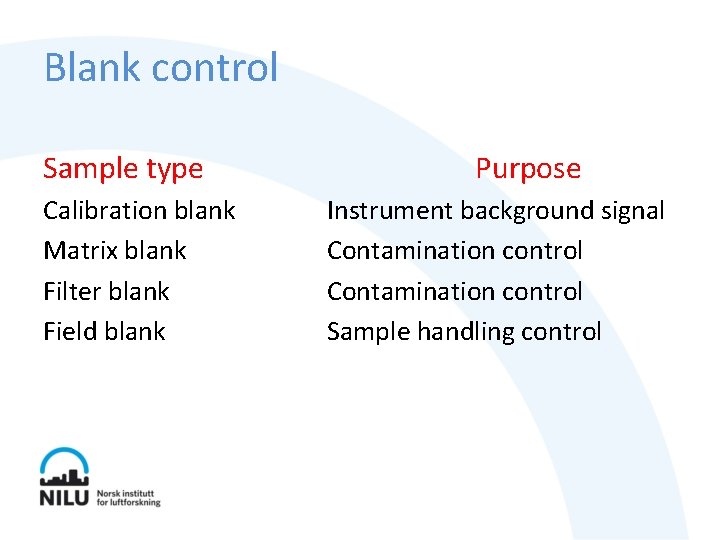
Blank control Sample type Calibration blank Matrix blank Filter blank Field blank Purpose Instrument background signal Contamination control Sample handling control
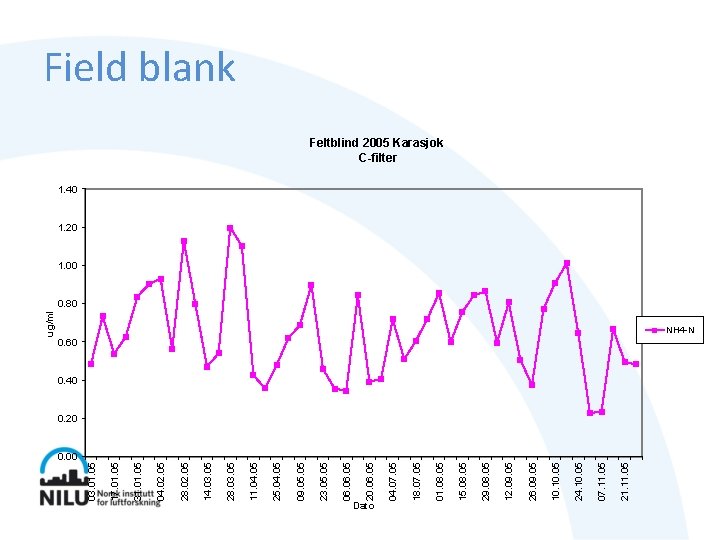
0. 00 06. 05 23. 05 09. 05 25. 04. 05 11. 04. 05 28. 03. 05 14. 03. 05 28. 02. 05 04. 02. 05 31. 05 17. 01. 05 03. 01. 05 Dato 21. 11. 05 07. 11. 05 24. 10. 05 26. 09. 05 12. 09. 05 29. 08. 05 15. 08. 05 01. 08. 05 18. 07. 05 04. 07. 05 20. 06. 05 ug/ml Field blank Feltblind 2005 Karasjok C-filter 1. 40 1. 20 1. 00 0. 80 0. 60 NH 4 -N 0. 40 0. 20
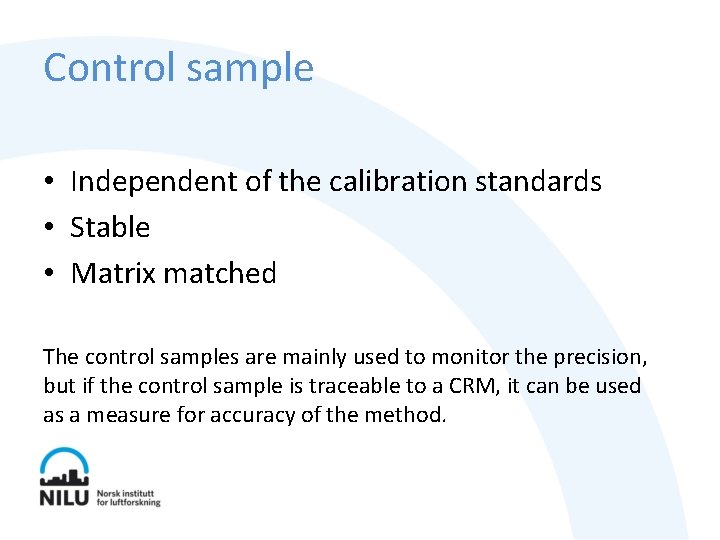
Control sample • Independent of the calibration standards • Stable • Matrix matched The control samples are mainly used to monitor the precision, but if the control sample is traceable to a CRM, it can be used as a measure for accuracy of the method.
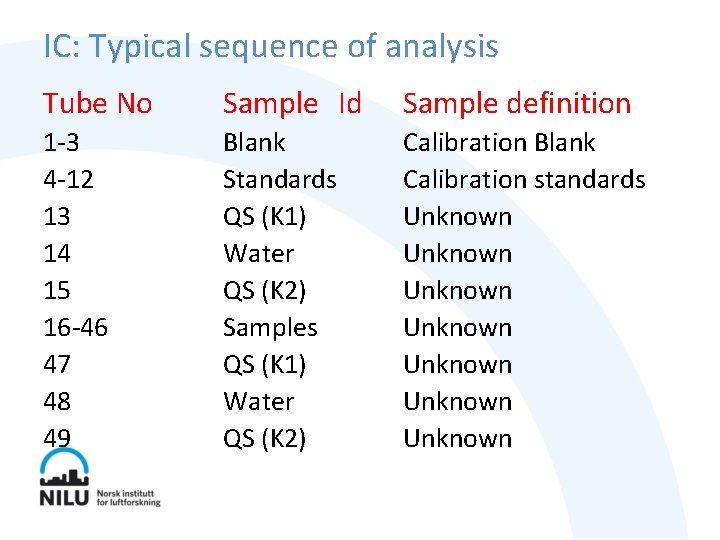
IC: Typical sequence of analysis Tube No Sample Id Sample definition 1 -3 4 -12 13 14 15 16 -46 47 48 49 Blank Standards QS (K 1) Water QS (K 2) Samples QS (K 1) Water QS (K 2) Calibration Blank Calibration standards Unknown Unknown
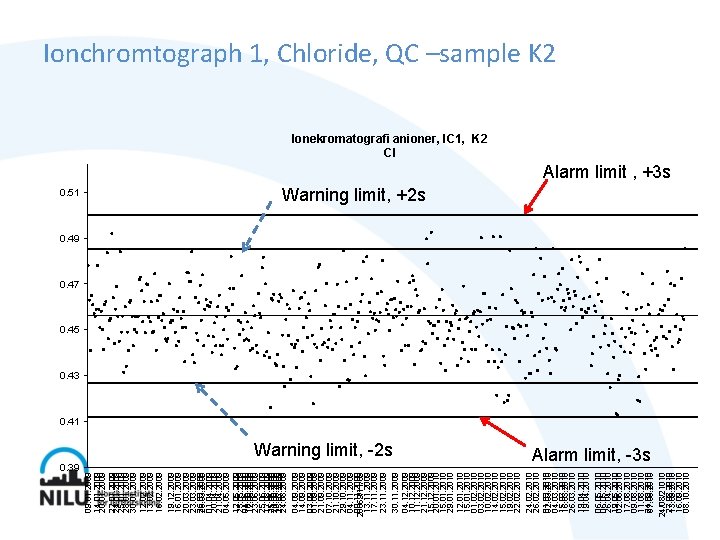
0. 51 0. 39 09. 01. 2009 14. 01. 2009 20. 01. 2009 22. 01. 2009 24. 01. 2009 25. 01. 2009 28. 01. 2009 30. 01. 2009 12. 02. 2009 13. 02. 2009 16. 02. 2009 19. 12. 2009 16. 01. 2009 20. 03. 2009 23. 03. 2009 26. 03. 2009 01. 04. 2009 20. 04. 2009 21. 04. 2009 04. 05. 2009 12. 05. 2009 25. 05. 2009 04. 06. 2009 10. 06. 2009 17. 06. 2009 23. 06. 2009 25. 06. 2009 17. 08. 2009 25. 06. 2009 21. 08. 2009 19. 08. 2009 23. 07. 2009 24. 08. 2009 04. 09. 2009 14. 09. 2009 03. 09. 2009 01. 09. 2009 21. 09. 2009 07. 10. 2009 21. 10. 2009 29. 10. 2009 04. 11. 2009 09. 11. 2009 20069/11/09 13. 11. 2009 17. 11. 2009 23. 11. 2009 30. 11. 2009 04. 12. 2009 10. 12. 2009 11. 12. 2009 21. 12. 2009 15. 12. 2009 20. 01. 2010 15. 01. 2010 29. 01. 2010 12. 01. 2010 15. 01. 2010 01. 02. 2010 03. 02. 2010 10. 02. 2010 14. 02. 2010 15. 02. 2010 19. 02. 2010 22. 02. 2010 24. 02. 2010 26. 02. 2010 01. 03. 2010 02. 03. 2010 04. 03. 2010 15. 03. 2010 16. 03. 2010 26. 03. 2010 19. 04. 2010 06. 05. 2010 26. 04. 2010 19. 05. 2010 02. 06. 2010 17. 08. 2010 09. 08. 2010 11. 08. 2010 24. 08. 2010 07. 06. 2010 24/08/21010 27. 08. 2010 13. 09. 2010 16. 09. 2010 08. 10. 2010 Ionchromtograph 1, Chloride, QC –sample K 2 Ionekromatografi anioner, IC 1, K 2 Cl Alarm limit , +3 s Warning limit, +2 s 0. 49 0. 47 0. 45 0. 43 0. 41 Warning limit, -2 s Alarm limit, -3 s
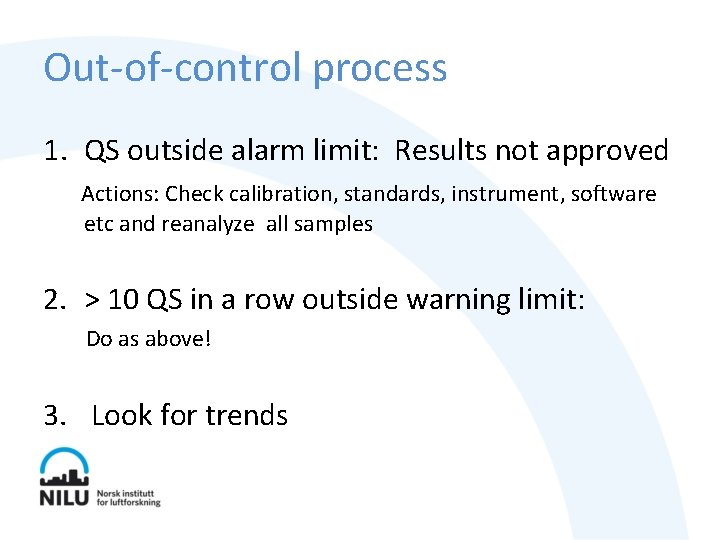
Out-of-control process 1. QS outside alarm limit: Results not approved Actions: Check calibration, standards, instrument, software etc and reanalyze all samples 2. > 10 QS in a row outside warning limit: Do as above! 3. Look for trends
Limit of detection
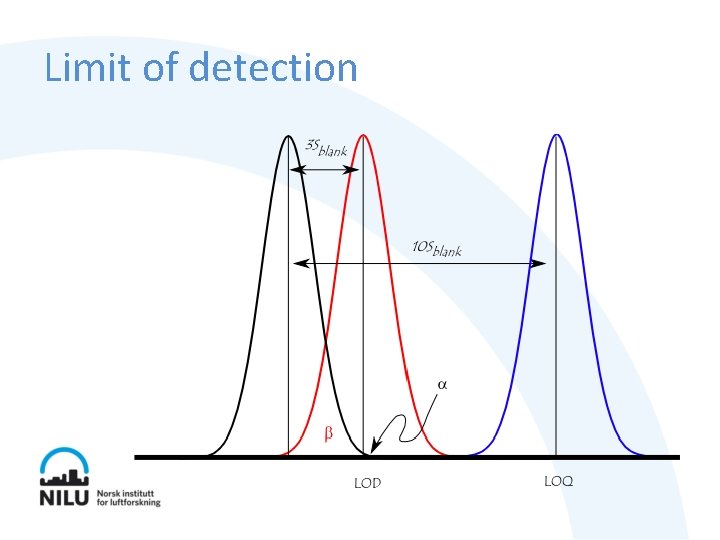
Limit of detection • Instrument LOD (3*s) for 10 or more repetitive measurement of instrument noise or blank (3*s) for y-intercept from 8 - 10 calibration curves • Method LOD 3 times std. dev for 10 or more repetitive measurement of procedure blank(3*s)
Thank you for your time!