
Quality Assurance of Higher Education in The Netherlands
- Slides: 21
Quality Assurance of Higher Education in The Netherlands Organization, basic principles and examples By Erik Martijnse, director department of Higher Education of the Education Inspectorate
Content 1. Dutch Education 2. QA of Higher Education 3. Inspectorate of Higher Education 4. Inspection and others 5. Inspection and management 6. Examples
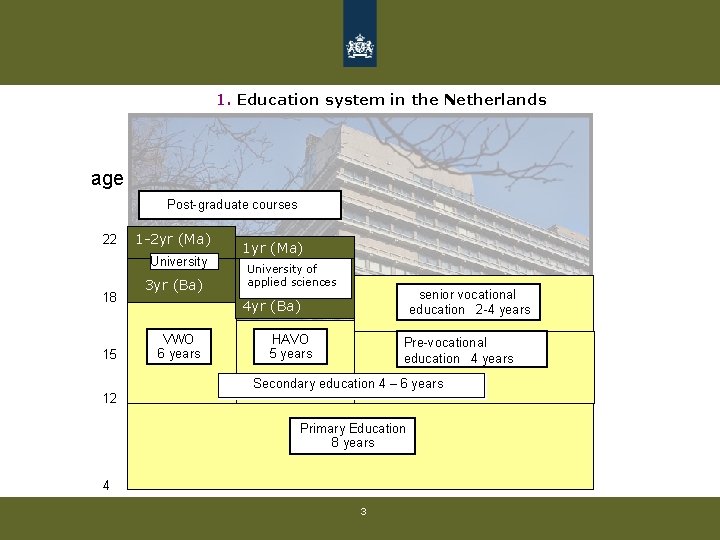
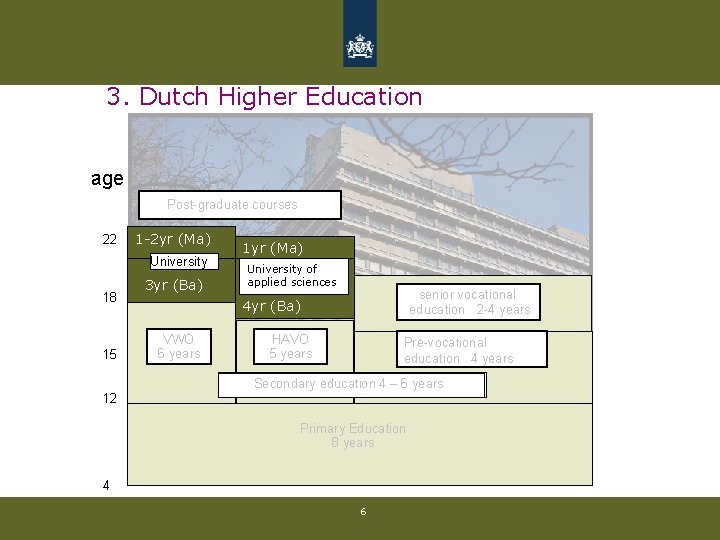
1. Education system in the Netherlands age Post-graduate courses 22 1 -2 yr (Ma) University 18 15 3 yr (Ba) 1 yr (Ma) University of applied sciences senior vocational education 2 -4 years 4 yr (Ba) 4 years VWO 6 years HAVO 5 years Pre-vocational education 4 years Secondary education 4 – 6 years 12 Primary Education 8 years 4 3
1. Dutch Educational system: (religious) autonomy The School Struggle or Schoolstrijd is a historical conflict in the Netherlands between 1848 and 1917 over the equalization of public financing for religious schools. This resulted in: the Separation of School and State by funding all schools equally, both public and private which is enshrined in article 23 of the Dutch constitution. Nowadays: • Many special schools, not only religious, but on the basis of different ideologies on education. • Field with strong stakeholders
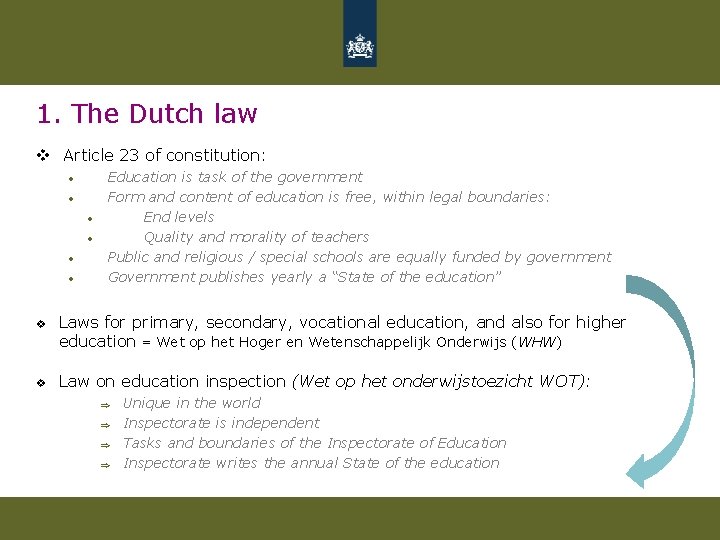
1. The Dutch law v Article 23 of constitution: • • • v v Education is task of the government Form and content of education is free, within legal boundaries: End levels Quality and morality of teachers Public and religious / special schools are equally funded by government Government publishes yearly a “State of the education” Laws for primary, secondary, vocational education, and also for higher education = Wet op het Hoger en Wetenschappelijk Onderwijs (WHW) Law on education inspection (Wet op het onderwijstoezicht WOT): Þ Þ Unique in the world Inspectorate is independent Tasks and boundaries of the Inspectorate of Education Inspectorate writes the annual State of the education
3. Dutch Higher Education age Post-graduate courses 22 1 -2 yr (Ma) University 18 15 3 yr (Ba) 1 yr (Ma) University of applied sciences senior vocational education 2 -4 years 4 yr (Ba) 4 years VWO 6 years HAVO 5 years Pre-vocational education 4 years Secondary education 4 – 6 years 12 Primary Education 8 years 4 6
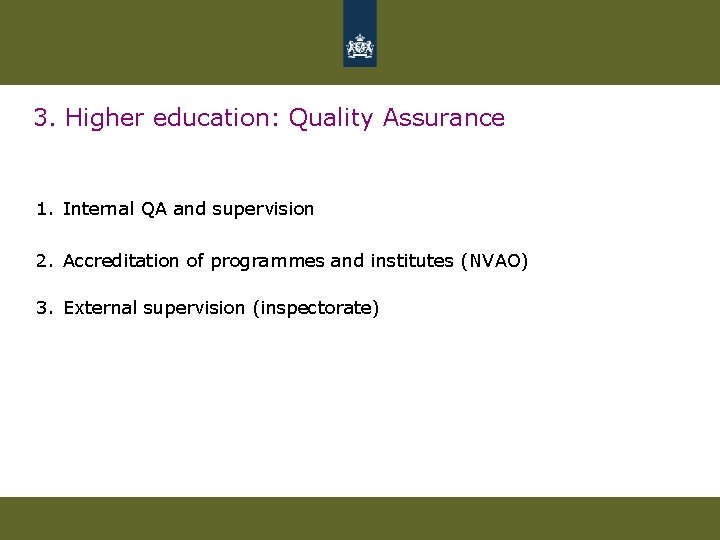
3. Higher education: Quality Assurance 1. Internal QA and supervision 2. Accreditation of programmes and institutes (NVAO) 3. External supervision (inspectorate)
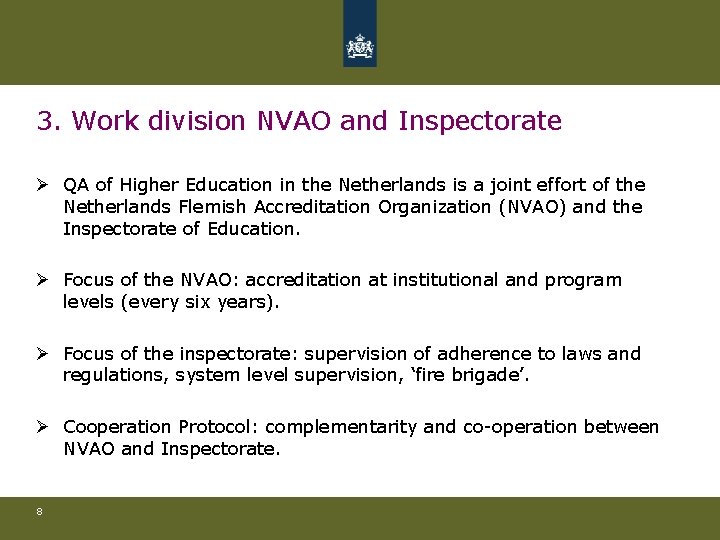
3. Work division NVAO and Inspectorate Ø QA of Higher Education in the Netherlands is a joint effort of the Netherlands Flemish Accreditation Organization (NVAO) and the Inspectorate of Education. Ø Focus of the NVAO: accreditation at institutional and program levels (every six years). Ø Focus of the inspectorate: supervision of adherence to laws and regulations, system level supervision, ‘fire brigade’. Ø Cooperation Protocol: complementarity and co-operation between NVAO and Inspectorate. 8
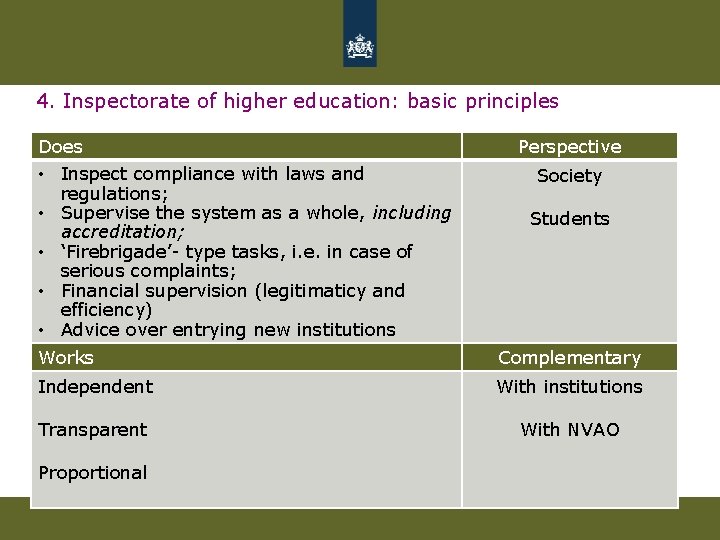
4. Inspectorate of higher education: basic principles Does • Inspect compliance with laws and regulations; • Supervise the system as a whole, including accreditation; • ‘Firebrigade’- type tasks, i. e. in case of serious complaints; • Financial supervision (legitimaticy and efficiency) • Advice over entrying new institutions Perspective Society Students Works Complementary Independent With institutions Transparent With NVAO Proportional
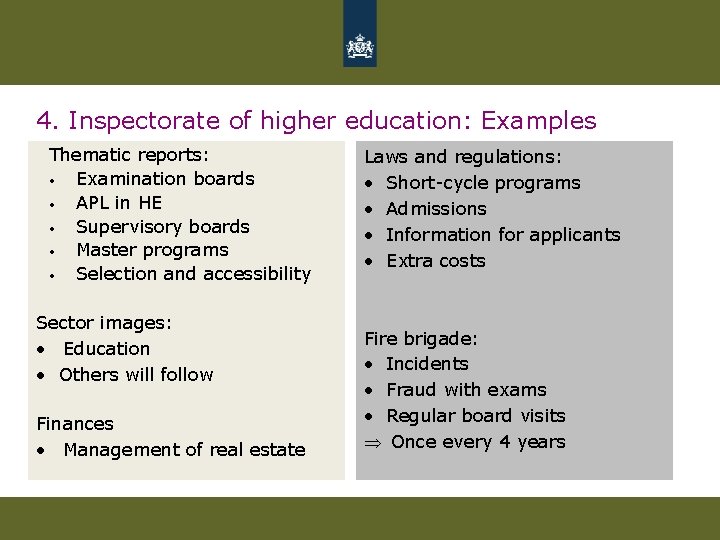
4. Inspectorate of higher education: Examples Thematic reports: • Examination boards • APL in HE • Supervisory boards • Master programs • Selection and accessibility Sector images: • Education • Others will follow Finances • Management of real estate Laws and regulations: • Short-cycle programs • Admissions • Information for applicants • Extra costs Fire brigade: • Incidents • Fraud with exams • Regular board visits Þ Once every 4 years
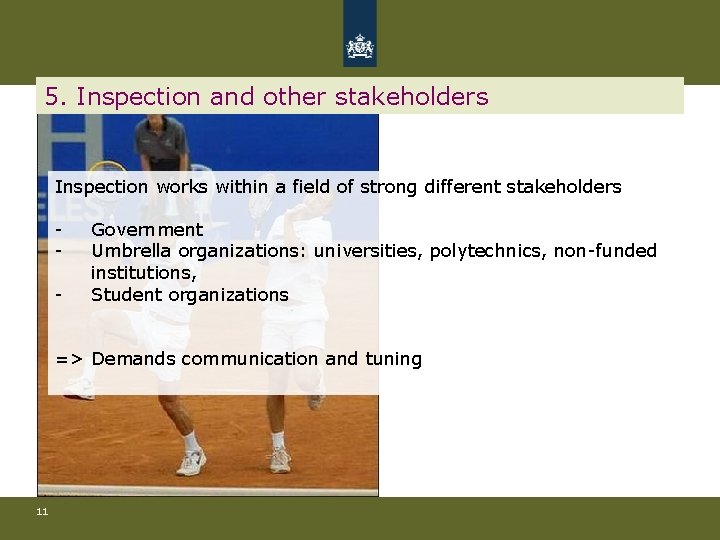
5. Inspection and other stakeholders Inspection works within a field of strong different stakeholders - Government Umbrella organizations: universities, polytechnics, non-funded institutions, Student organizations => Demands communication and tuning 11
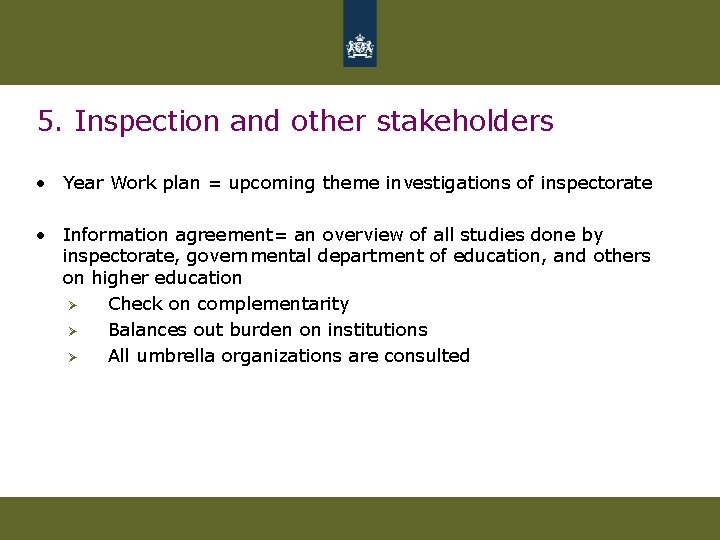
5. Inspection and other stakeholders • Year Work plan = upcoming theme investigations of inspectorate • Information agreement= an overview of all studies done by inspectorate, governmental department of education, and others on higher education Ø Check on complementarity Ø Balances out burden on institutions Ø All umbrella organizations are consulted
6. Inspection and management • Contact after incidents • 4 -annual meeting between inspection and board Ø Is management in control?
6. Inspection and Management Towards trust and compliance • Compliance assistance: theme reports, sector reports, conferences, invitations • Data delivery via governmental offices DUO and CBS • Towards (even) more complementarity • Stronger internal quality assurance with quality indications • More data exchange
7. Example: Investigation transition Bachelor-Master system - On request of minister of education - Bologna 1999: EU adapted to Bachelor/ Master-system - Dutch study programs had to be split up into two different programs - We investigated the result of this separation - We looked at the entry requirements for master programs
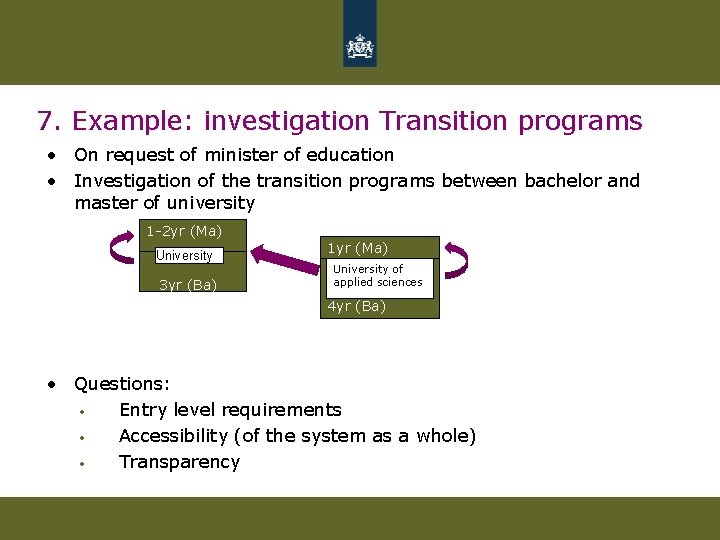
7. Example: investigation Transition programs • On request of minister of education • Investigation of the transition programs between bachelor and master of university 1 -2 yr (Ma) University 3 yr (Ba) 1 yr (Ma) University of applied sciences 4 yr (Ba) • Questions: • Entry level requirements • Accessibility (of the system as a whole) • Transparency
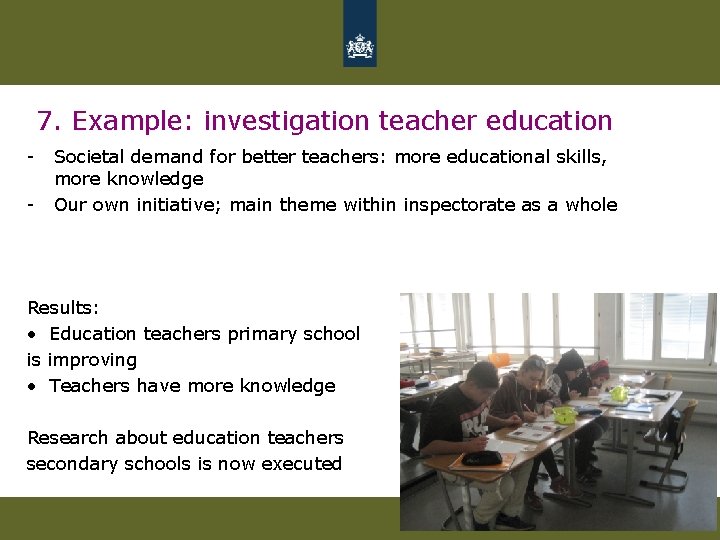
7. Example: investigation teacher education - Societal demand for better teachers: more educational skills, more knowledge Our own initiative; main theme within inspectorate as a whole Results: • Education teachers primary school is improving • Teachers have more knowledge Research about education teachers secondary schools is now executed
7. Example: investigation examination committees On request of minister of education Reason: • The Netherlands has no central defined end level of higher education (besides in abstract terms in Dublin descriptors). • The law has defined examination committees to guard the end level • The composition and the tasks of the examination committees: independent, knowledgeable, exams, fraud, exemptions Our results: examination committees have improved over 4 years, but need further improvement
Example: 4 -annual meeting between inspection and board With the board of an university of applied sciences of a Dutch ‘big’ city Agenda on: • Quality control • Financial control • Fraud with exams • Student satisfaction • Radicalization of students Is the board in control?
Questions? Discussion?
Thank you for your attention Erik Martijnse e. martijnse@owinsp. nl