
Quality Assurance and e Learning Naomi Jackson Director
- Slides: 30
Quality Assurance and e. Learning Naomi Jackson Director of Academic Affairs
Aims • Highlight key principles and priority areas for consideration • Provide guidance relating to best practice
Background & Focus • Personal knowledge and experience - Lecturer applying e. Learning - International validation and review panel experience - Private consultancy to e. Learning providers - Registrar for online and blended learning provider - Member of the QQI working group for “Statutory Quality Assurance Guidelines for Flexible and Distributed Learning” White Paper • Quality assurance perspective • Focus on the organisational context, the programme context, and the learner context.
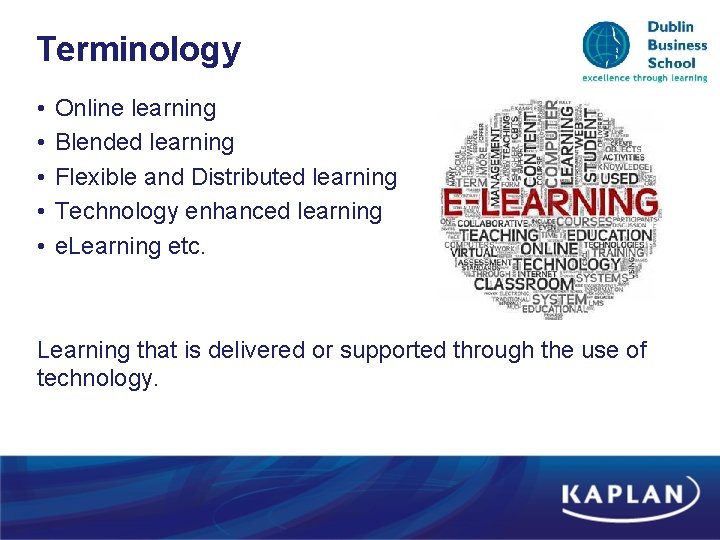
Terminology • • • Online learning Blended learning Flexible and Distributed learning Technology enhanced learning e. Learning etc. Learning that is delivered or supported through the use of technology.
Organisational Context • Strategy • Infrastructure and resource demands • Agreed standards for e. Learning material, resources and teaching, learning and assessment strategies • Implications for transnational or collaborative provision
Strategy “The provider’s approved and published strategy, and its policies to support the strategy, take appropriate account of its existing or planned FDL provision” QQI, 2015 “The institution has established, well understood strategy, governance mechanisms and policies that guide the selection, deployment, evaluation and improvement of the technologies used to support learning and teaching. ” ACODE, 2014 Evidence is available that e. Learning/TEL is an integral part of the institutional strategy” EFQUEL, 2011
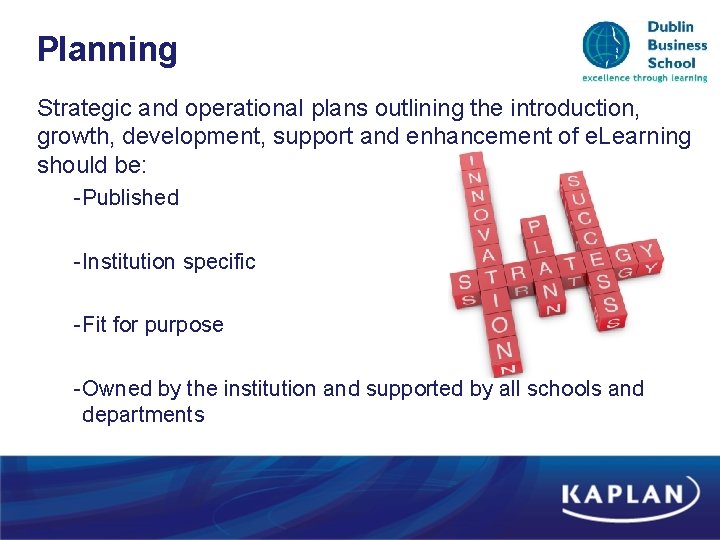
Planning Strategic and operational plans outlining the introduction, growth, development, support and enhancement of e. Learning should be: - Published - Institution specific - Fit for purpose - Owned by the institution and supported by all schools and departments
Implementation • How “alive” is the institutional strategy? • Does it clearly map the path from the start point to the intended end point? • Does it consider all the requirements and implications of the journey? • Are the strategic intentions reflected in other documents and operations? • How are regulations, policies and procedures adapted for suitability?
Risk Management • What is your ambition? - 100% online, online with onsite, or onsite with a VLE to enhance this? - remain local, expand regionally, nationally or internationally? • What is your purpose? - Integrate technology to enhance the learner’s classroom experience? - Widen the potential market for the programme in other regions or jurisdictions? • How will you achieve this? - In isolation or in partnership? - A service collaboration or an academic collaboration? • How realistic and achievable is all of this?
Policies and Procedures “Institution-wide processes for quality assurance are in place and in use to integrate technology enhanced learning at both a program and course level. ” ACODE, 2014 “Quality procedures relating to e-learning and TEL, are in place, and are at least as stringent as those applied to ‘traditional’ learning. ” EFQUEL, 2011 “The provider can demonstrate that it has understood, planned and approved any differences in its quality management that may be appropriate for FDL. ” QQI, 2015
Policies and Procedures • New business proposal approval: - Is a new costing model required? - How will evidence of demand be ascertained? - Will additional expertise be required to contribute to the proposal approval process? • Recruitment & admissions - What alternative strategies might be used? - Can admissions all be done online? - How will qualifications verification be carried out? • Registration - How will fee payment and non-payment be managed? - How will completion of registration trigger access to lessons? - Will induction be online or onsite?
Policies and Procedures • Academic regulations - What changes will be required to the code of conduct? - How will the academic impropriety policy apply? - How will the late submission policy apply? - How will mitigating circumstances be submitted & evidenced? - How will reasonable accommodation be assessed and implemented? - How will Board of Examiners operate? - How will engagement with external examiners take place? - Will appeals and complaints still require a face to face meeting? - How will a request to view an examination script be managed? • Stakeholder engagement - How will this be managed? - What data may be required? - Technology, monitoring and consent
Human Resources “There is a planned approach to the appointment of (or access to) specialist staff to support the provider’s FDL strategy. ” QQI, 2015 “…staff development is offered flexibly, accommodates a range of entry points, is evaluated and is informed by the work of related units. Staff are made aware of and have access to comprehensive technical and educational support for the use of technology enhanced learning tools and services: prior to and during the implementation of the technology, in formal training sessions, on a just-in-time basis, and for troubleshooting purposes. ” ACODE, 2014 “Methodological, organizational and technical support for any staff wishing to develop e. Learning resources is implemented across the entire institution. It is ensured that all faculty members are qualified in information technologies by providing continuous possibilities and incentives for further qualification and development. ” EFQUEL, 2011
Roles and Responsibilities • Who takes institution level ownership of the implementation of e. Learning? • What governance structure is in place to oversee and approve investment in technology and ensure its fitness for purpose? • Who will take responsibility for legal compliance matters – data protection, child protection, intellectual property and copyright, software licencing, etc. ?
Human Resources • What specialist expertise is required? • How will future staff recruitment be amended? • What will the key attributes be of employees in the future? • How will you secure buy-in? • How will existing staff be supported and developed? • What training and development will be implemented and by whom?
Technology and Infrastructure • “The infrastructure and resources required to support good quality FDL are understood, planned, and routinely monitored and evaluated. ” QQI, 2015 • “Technical infrastructure, both physical and virtual, is aligned with institutional learning goals and the technologies are resourced, support staff are trained and the infrastructure is implemented, maintained, administered and supported efficiently and effectively. ” ACODE, 2014
Technology and Infrastructure • Planned approach to procurement, testing, review and updating of hardware and software to support the strategy & ensure reliability • Systems used for information sharing and transfer are reliable and secure • Clear policy on use of a common platform • Effective contingency planning in place in the event of failure • Clear evidence of appropriate investment and budget planning
Standards • Approved and published minimum standards for learning materials and resources • Agreed pedagogic approach and tools for effective teaching, learning and assessment adapted for e. Learning • In all cases e. Learning should be academically led with the technology servicing the pedagogy
Programme Context • Delivery of a programme should add value for the learner in enabling them to meet the intended learning outcomes. • TLA strategy should be explicitly designed for the e. Learning context • Learners should be able to track and monitor their own progress • Quality of learning materials is critical
Programme Design & Delivery “Institution policies, procedures and guidelines provide a framework for how technology enhanced learning should be used at both a course and program level. The pedagogical application of technology enhanced learning is based on sound educational research and guidelines” ACODE, 2014 “Course Design and Delivery Guidelines are available for relevant staff. ” EFQUEL, 2011 “It [the provider] also has approved and published expectations for the effective delivery of teaching, learning and assessment opportunities in all media…adopted for FDL. ” QQI, 2015
Programme Design & Delivery • Learning outcomes led and informed by best practice in e. Learning • Adequately budgeted for • Be specific to e. Learning • Include appropriate QA checks and processes • Undertaken by a multidisciplinary team • Promotes learner engagement and interaction
Learning resources & delivery • Compliant with institutional expectations and standards • Subject to peer review in development • Promote integration of differing media, using synchronous and asynchronous learning • Factor in different learning styles • Owned and led by the academic department • Reflect the validated delivery model • Encourage learner interaction with others
Learner Experience • Central focus of e. Learning • Differs from other modes of learning • Requires specific advanced preparation • Progress, interaction and engagement are key
Information to learners • Pre- Admission - Advise of the delivery model - Expected minimum standards of technical ability - What support will be provided and how? - Terminology clearly explained – flexible, accessible etc. - Technical specification requirements • Pre-Programme Commencement - Induction & registration arrangements - Access requirements - Security information - Details of key contacts and availability
On Programme Experience • Induction, training and support is available and accessible “The provision of student training for the effective use of the institution’s technology enhanced learning services is aligned with the teaching approaches in use; is adequately resourced; is coordinated with other student support services; is flexible; is focused on the needs of students; covers a range of current technologies and reflects good practice in the use of technology” ACODE “Learners have access to…appropriate and sufficient learning resources to support FDL study…. Induction or other support to access these effectively and efficiently (technical and academic support and guidance, as appropriate. ” QQI 2015
On Programme Experience • How do you ensure a safe learning environment? - Security of information - Secure access for authorised users only - Retention of information posted and shared - Acceptable conduct in the online environment • How do you ensure an equitable opportunity for all learners to achieve the LOs? - Suited to individual needs and learning styles - Promotes the development of a community of learning - Access to resources and supports is appropriate - Additional learning needs are catered for - Effective monitoring and feedback mechanisms
On Programme Experience “All students have access to convenient guidance service including psychological, career and social guidance services. Students have universal access (from campus, dorms and home) to library and course resources. ” EFQUEL, 2011 • How are Student Support Services accessed? - Counselling - Academic writing - Library services - Additional learning needs support - Careers and placements support
To conclude…. . • • Requires grounding in a strong, fit for purpose strategic plan Multifaceted Continually evolving Resource intense
Bibliography ACODE, 2014, “Benchmarks for Technology Enhanced Learning” Vers. 3. 1 EFQUEL, 2011, “European Universities Quality in e. Learning. UNIQU-e” QQI, 2015, “Statutory Quality Assurance Guidelines for Flexible and Distributed Learning”
Thank You