
Quality Academy The Model For Improvement Put Your
- Slides: 29
Quality Academy The Model For Improvement: Put Your Data to Use Place holder for date 1
Learning Objectives • This Tutorial will give you a better understanding of: • The Model For Improvement • Some of the tools you can use to develop an intervention • Root Cause Analysis • Brainstorming • Force Field Analysis • Preparing to enter the Plan-Do-Study-Act (PDSA) Cycle! 22
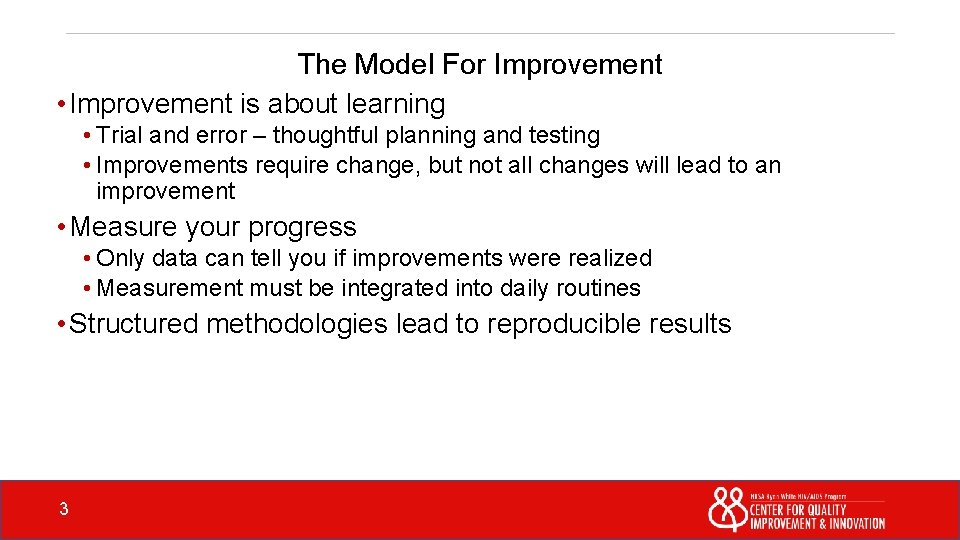
The Model For Improvement • Improvement is about learning • Trial and error – thoughtful planning and testing • Improvements require change, but not all changes will lead to an improvement • Measure your progress • Only data can tell you if improvements were realized • Measurement must be integrated into daily routines • Structured methodologies lead to reproducible results 33
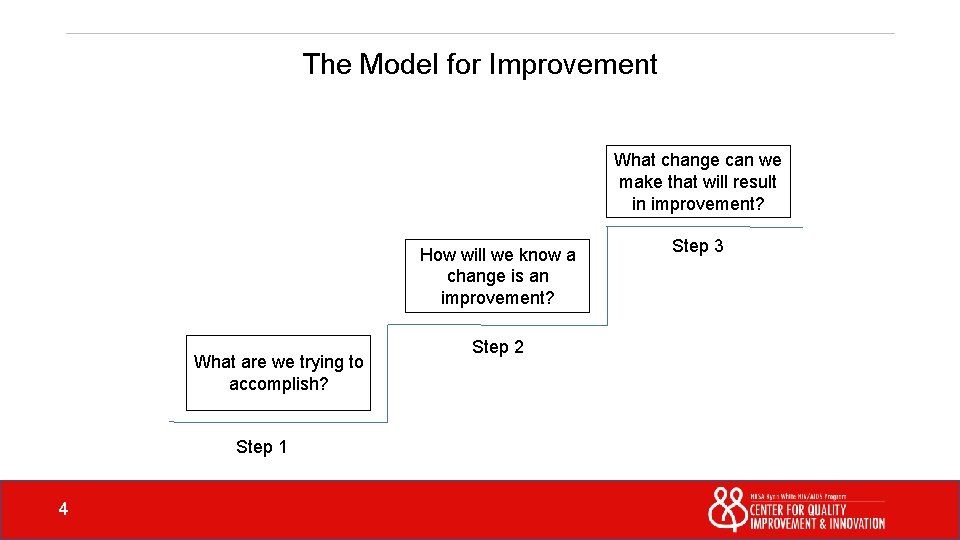
The Model for Improvement What change can we make that will result in improvement? How will we know a change is an improvement? What are we trying to accomplish? Step 1 44 Step 2 Step 3
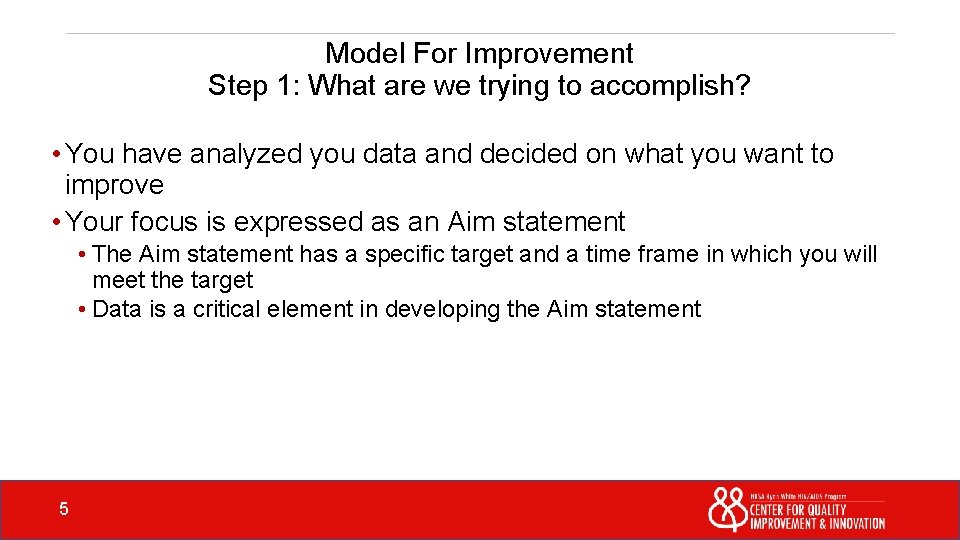
Model For Improvement Step 1: What are we trying to accomplish? • You have analyzed you data and decided on what you want to improve • Your focus is expressed as an Aim statement • The Aim statement has a specific target and a time frame in which you will meet the target • Data is a critical element in developing the Aim statement 55
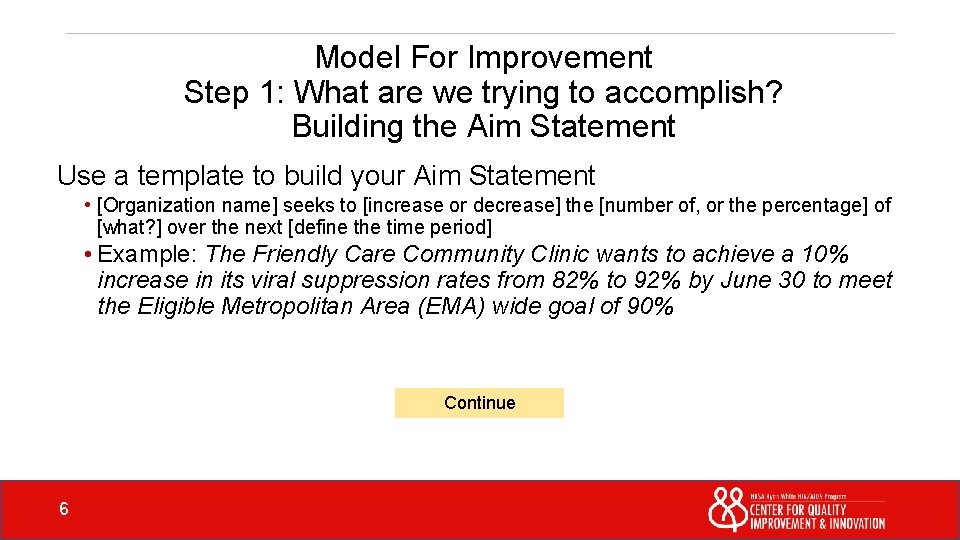
Model For Improvement Step 1: What are we trying to accomplish? Building the Aim Statement Use a template to build your Aim Statement • [Organization name] seeks to [increase or decrease] the [number of, or the percentage] of [what? ] over the next [define the time period] • Example: The Friendly Care Community Clinic wants to achieve a 10% increase in its viral suppression rates from 82% to 92% by June 30 to meet the Eligible Metropolitan Area (EMA) wide goal of 90% Continue 66
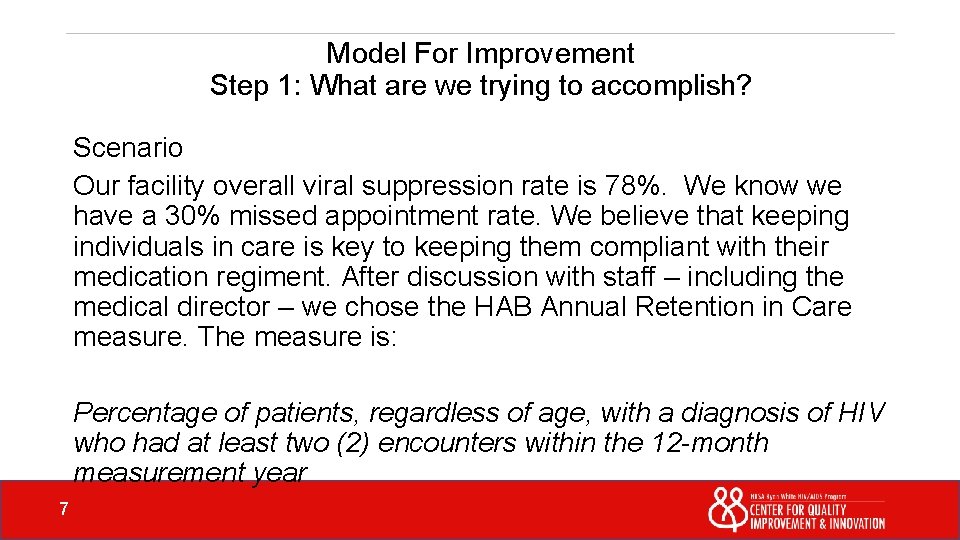
Model For Improvement Step 1: What are we trying to accomplish? Scenario Our facility overall viral suppression rate is 78%. We know we have a 30% missed appointment rate. We believe that keeping individuals in care is key to keeping them compliant with their medication regiment. After discussion with staff – including the medical director – we chose the HAB Annual Retention in Care measure. The measure is: Percentage of patients, regardless of age, with a diagnosis of HIV who had at least two (2) encounters within the 12 -month measurement year 77
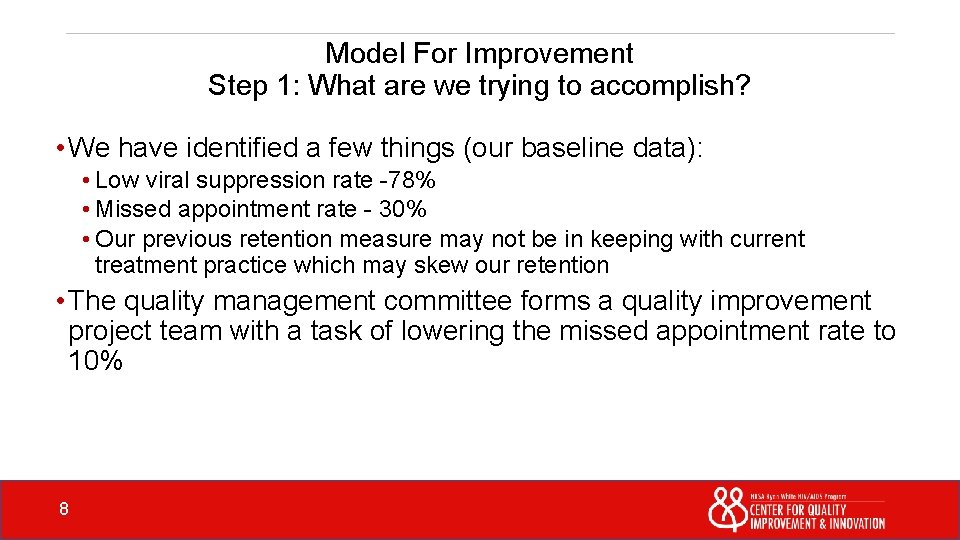
Model For Improvement Step 1: What are we trying to accomplish? • We have identified a few things (our baseline data): • Low viral suppression rate -78% • Missed appointment rate - 30% • Our previous retention measure may not be in keeping with current treatment practice which may skew our retention • The quality management committee forms a quality improvement project team with a task of lowering the missed appointment rate to 10% 88
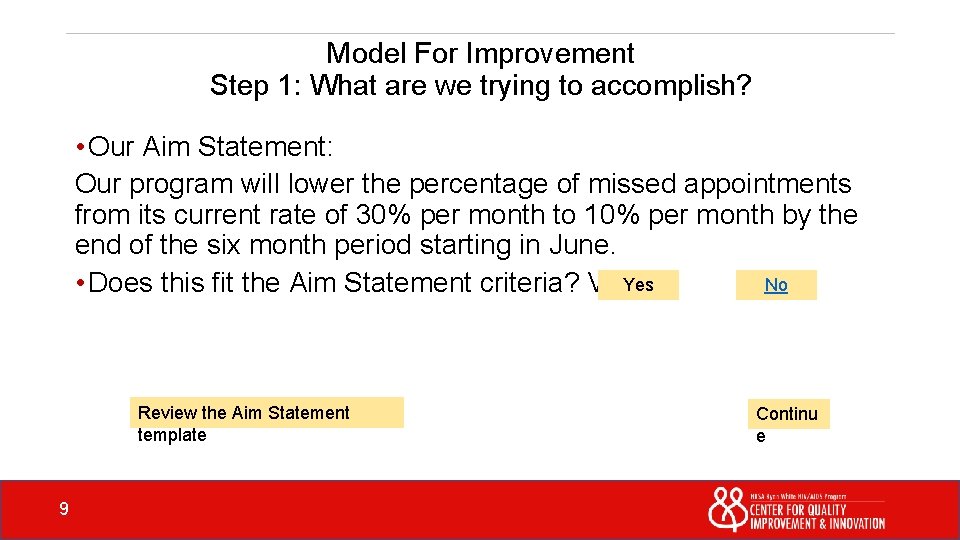
Model For Improvement Step 1: What are we trying to accomplish? • Our Aim Statement: Our program will lower the percentage of missed appointments from its current rate of 30% per month to 10% per month by the end of the six month period starting in June. Yes No • Does this fit the Aim Statement criteria? Vote or Review the Aim Statement template 99 Continu e
Model For Improvement Step 1: What are we trying to accomplish? • Our Aim Statement also suggests something else, a hypothesis • The hypothesis which is not really specified in the Model for Improvement • It is simply an action and a result; if we do this, then this will happen • In our example, our hypothesis is: If we lower the no-show rates, then viral suppression rates should increase 1010
Model For Improvement Step 2: How will we know that a change is an improvement? • This is a good time for fact finding • What may make a positive effect on the Aim statement • Knowledge of/from the past is helpful in deciding the future • This is where you dig into your data – do a deeper dive • Tools are useful to do that • Flowcharts • Ishikawa diagrams • Column or bar charts (see webinar 2 in this series) 1111
Model For Improvement Step 2: How will we know that a change is an improvement? You start to think about measures here • Measures allow you to judge the effect the changes are having • Only use a few and make sure they let you know you’re actually making an improvement 1212
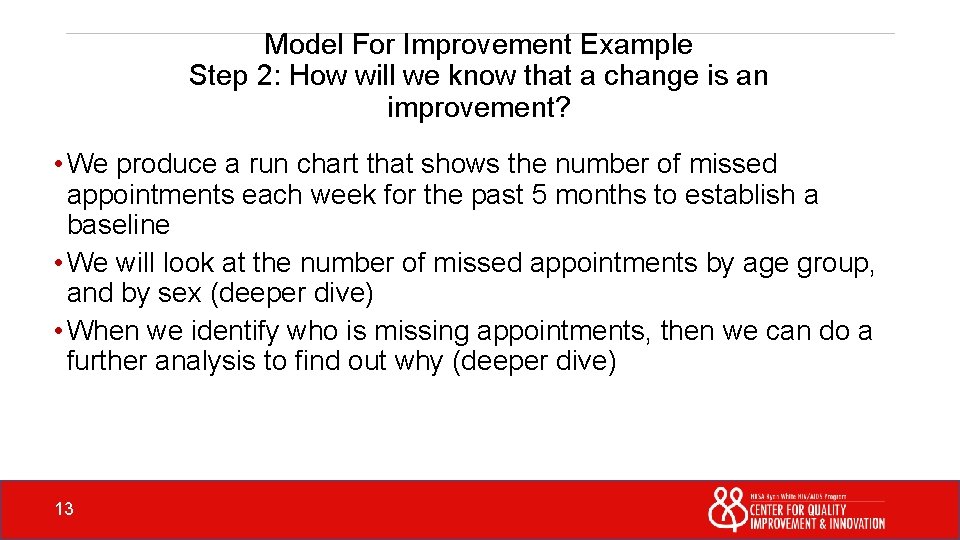
Model For Improvement Example Step 2: How will we know that a change is an improvement? • We produce a run chart that shows the number of missed appointments each week for the past 5 months to establish a baseline • We will look at the number of missed appointments by age group, and by sex (deeper dive) • When we identify who is missing appointments, then we can do a further analysis to find out why (deeper dive) 1313
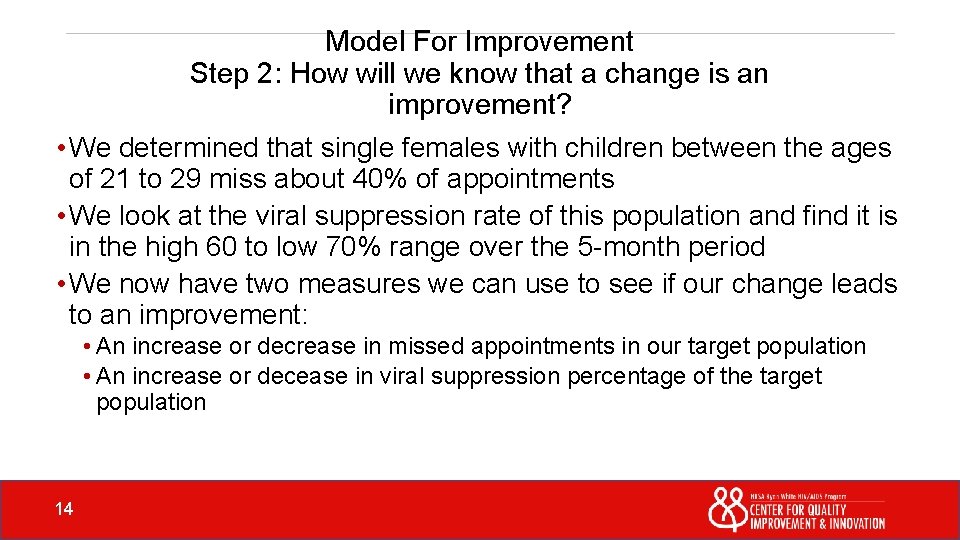
Model For Improvement Step 2: How will we know that a change is an improvement? • We determined that single females with children between the ages of 21 to 29 miss about 40% of appointments • We look at the viral suppression rate of this population and find it is in the high 60 to low 70% range over the 5 -month period • We now have two measures we can use to see if our change leads to an improvement: • An increase or decrease in missed appointments in our target population • An increase or decease in viral suppression percentage of the target population 1414
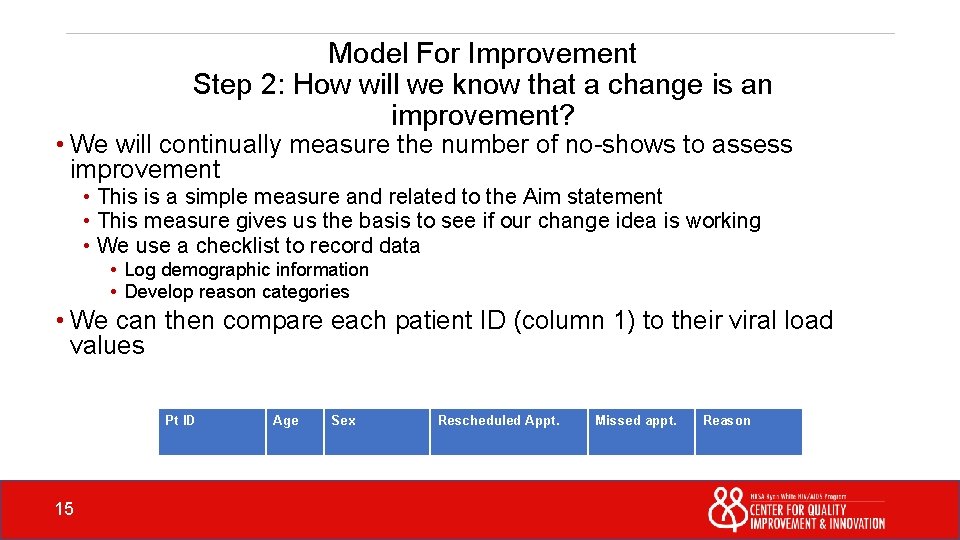
Model For Improvement Step 2: How will we know that a change is an improvement? • We will continually measure the number of no-shows to assess improvement • This is a simple measure and related to the Aim statement • This measure gives us the basis to see if our change idea is working • We use a checklist to record data • Log demographic information • Develop reason categories • We can then compare each patient ID (column 1) to their viral load values Pt ID 1515 Age Sex Rescheduled Appt. Missed appt. Reason
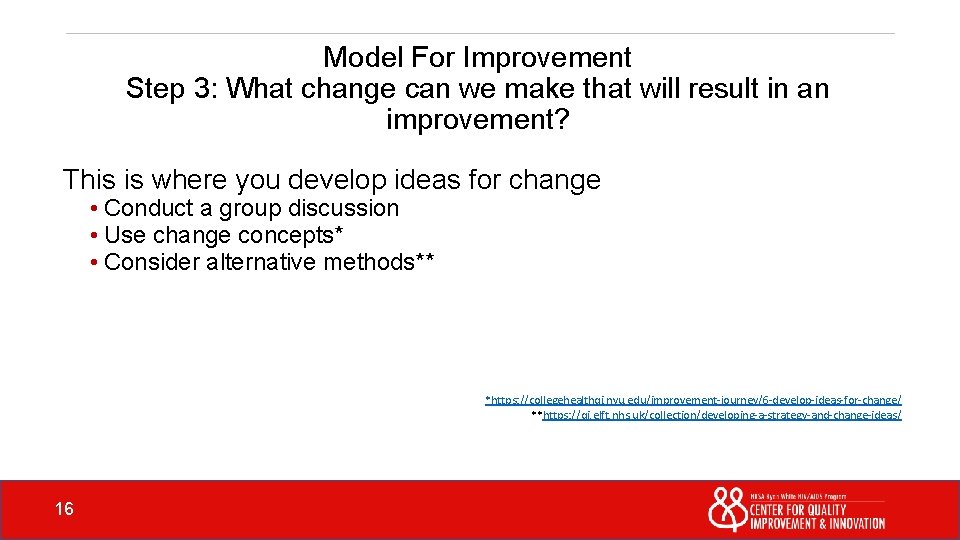
Model For Improvement Step 3: What change can we make that will result in an improvement? This is where you develop ideas for change • Conduct a group discussion • Use change concepts* • Consider alternative methods** *https: //collegehealthqi. nyu. edu/improvement-journey/6 -develop-ideas-for-change/ **https: //qi. elft. nhs. uk/collection/developing-a-strategy-and-change-ideas/ 1616
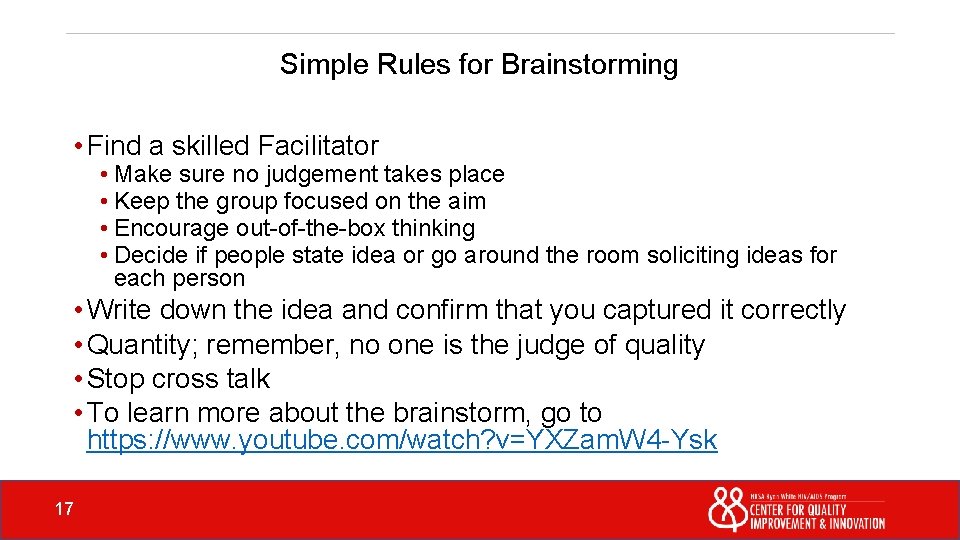
Simple Rules for Brainstorming • Find a skilled Facilitator • Make sure no judgement takes place • Keep the group focused on the aim • Encourage out-of-the-box thinking • Decide if people state idea or go around the room soliciting ideas for each person • Write down the idea and confirm that you captured it correctly • Quantity; remember, no one is the judge of quality • Stop cross talk • To learn more about the brainstorm, go to https: //www. youtube. com/watch? v=YXZam. W 4 -Ysk 1717
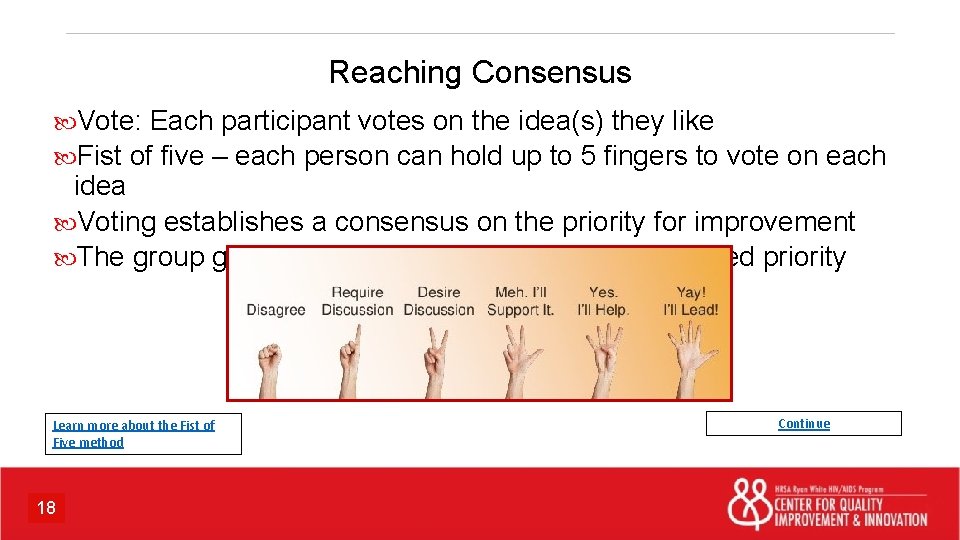
Reaching Consensus Vote: Each participant votes on the idea(s) they like Fist of five – each person can hold up to 5 fingers to vote on each idea Voting establishes a consensus on the priority for improvement The group gains a clear understanding of the preferred priority Learn more about the Fist of Five method 18 18 Continue National Quality Center
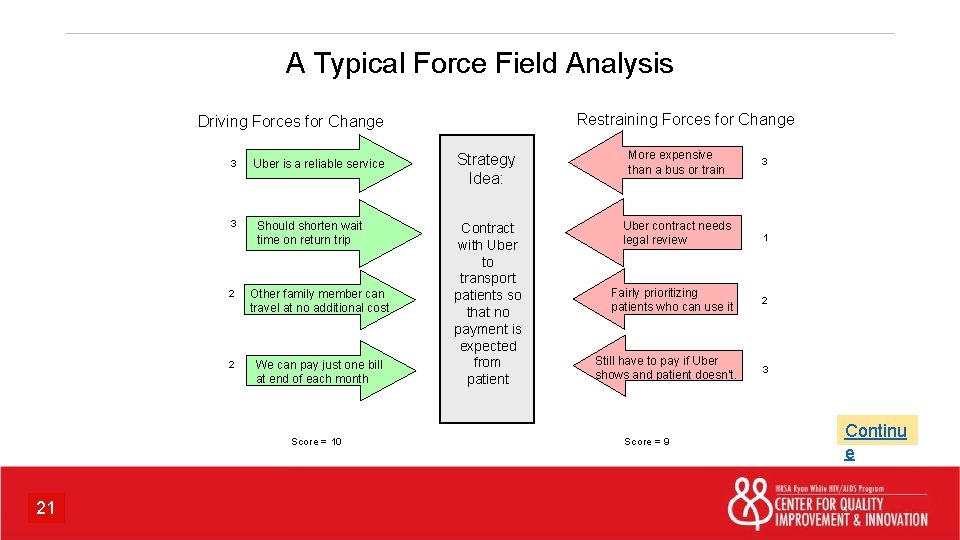
Testing the Proposed Intervention in a Force Field Analysis • Brainstorming results in a suggestion to try to avoid having the patients directly pay for transportation and wait for reimbursement • Brainstorming consensus indicates that the Team should try to contract with Uber to transport patients to and from the clinic. • How sure are we, that we can make this happen successfully? 19 National Quality Center
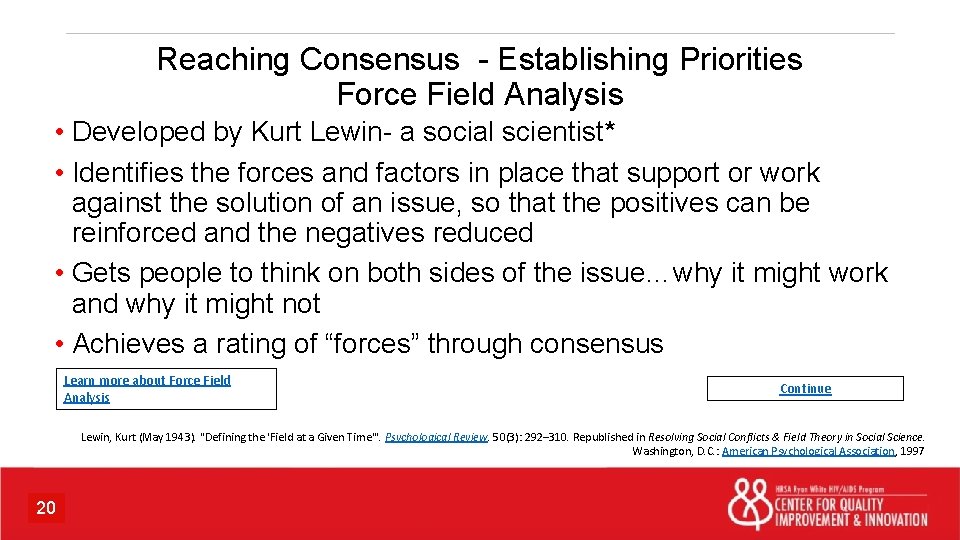
Reaching Consensus - Establishing Priorities Force Field Analysis • Developed by Kurt Lewin- a social scientist* • Identifies the forces and factors in place that support or work against the solution of an issue, so that the positives can be reinforced and the negatives reduced • Gets people to think on both sides of the issue…why it might work and why it might not • Achieves a rating of “forces” through consensus Learn more about Force Field Analysis Continue Lewin, Kurt (May 1943). "Defining the 'Field at a Given Time'". Psychological Review. 50(3): 292– 310. Republished in Resolving Social Conflicts & Field Theory in Social Science. Washington, D. C. : American Psychological Association, 1997 20 20 National Quality Center
A Typical Force Field Analysis Restraining Forces for Change Driving Forces for Change 3 3 Uber is a reliable service Should shorten wait time on return trip 2 Other family member can travel at no additional cost 2 We can pay just one bill at end of each month Score = 10 21 21 Strategy Idea: More expensive than a bus or train 3 Contract with Uber to transport patients so that no payment is expected from patient Uber contract needs legal review 1 Fairly prioritizing patients who can use it 2 Still have to pay if Uber shows and patient doesn’t. Score = 9 3 Continu e National Quality Center
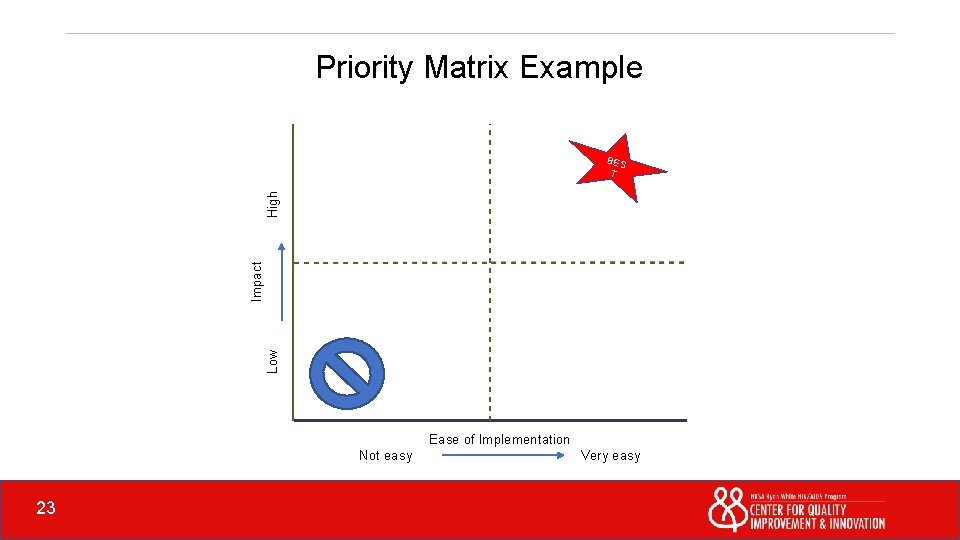
Priority Matrix The Priority Matrix helps you to: • Evaluate the impact and ease of implementation • Gain additional clarity on moving forward with improvements • Take into account available resources Remember, it’s a guide and does not take into account organizational or legislative imperatives 22 22 National Quality Center
Priority Matrix Example Low Impact High BES T Ease of Implementation Not easy 23 23 Very easy
Which to Use? • You can use both! • These tools work synergistically to help you select the idea that best meets you needs and will have the biggest impact 24 24 National Quality Center
Five Suggestions for Successfully Conducting a Model for Improvement Project 1. An improvement project can be: a) Process-focused, related to saving time, money, or improving the quality of a service or system, OR b) Outcome-focused on improving health status, behavior, attitude or knowledge 2. Find the right people to work on your project 3. Make sure you can answer the question “How will we know a change is an improvement” with data 25 25
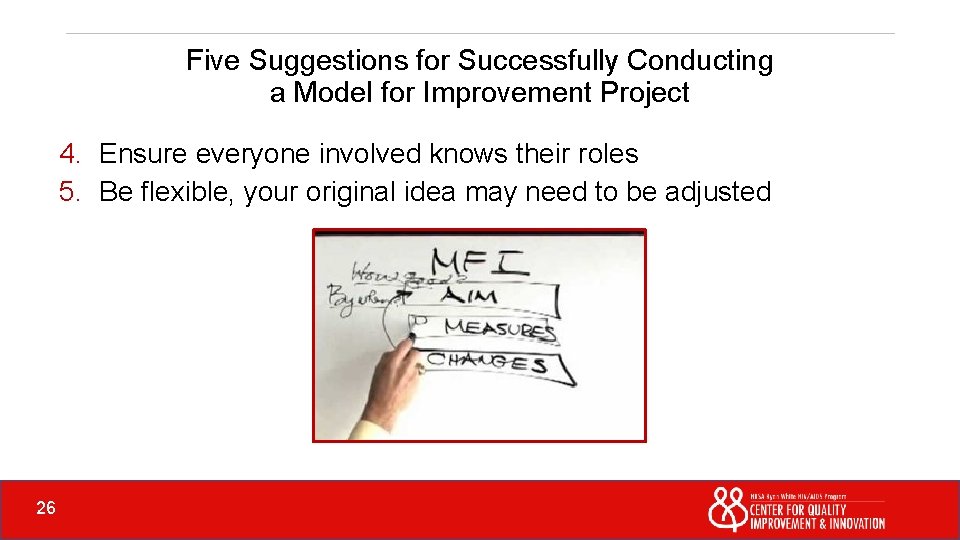
Five Suggestions for Successfully Conducting a Model for Improvement Project 4. Ensure everyone involved knows their roles 5. Be flexible, your original idea may need to be adjusted 26226 6
In Summary • We thought through the Model For Improvement and decided to work on the clinic’s no-show rate • We dove deeper into our data and focused on a specific population • We identified several root causes, with transportation being the most significant • We brainstormed on a solution and focused on direct pay from clinic to service provider • We tested this in a Force Field Analysis • Now we are ready to Plan – Do – Study – Act! 27 27 National Quality Center
Resources Quality Improvement Tools • Seven tools of quality https: //asq. org/quality-resources/sevenbasic-quality-tools • Brainstorm Sessions https: //www. youtube. com/watch? v=YXZam. W 4 -Ysk • Force Field Analysis https: //www. mindtools. com/pages/article/new. TED_06. htm • Ishikawa diagram https: //www. 6 sigma. us/etc/what-is-ishikawafishbone-diagram/ Continue 28 28 National Quality Center
Properties On passing, 'Finish' button: Goes to next slide On failing, 'Finish' button: Goes to next slide Allow user to leave quiz: After user has completed quiz User may view slides after quiz: Any time Show quiz in menu as: Edit in Quizmaker Multiple Items Edit Properties