
QUALITATIVE RESEARCH What is it The study aiming






- Slides: 24
QUALITATIVE RESEARCH What is it? The study aiming to gather an in-depth understanding of human behavior and the reasons
QUALITATIVE RESEARCH Overview: • Examination, analysis and interpretation of observations • Smaller but focused samples are more often needed • Produce information only on the particular cases • Informative “guess” (Hypothesis)
QUALITATIVE RESEARCH Data Collection: • Observation; • Interviews; • Case studies; • Grounded theory; • Survey; • ……
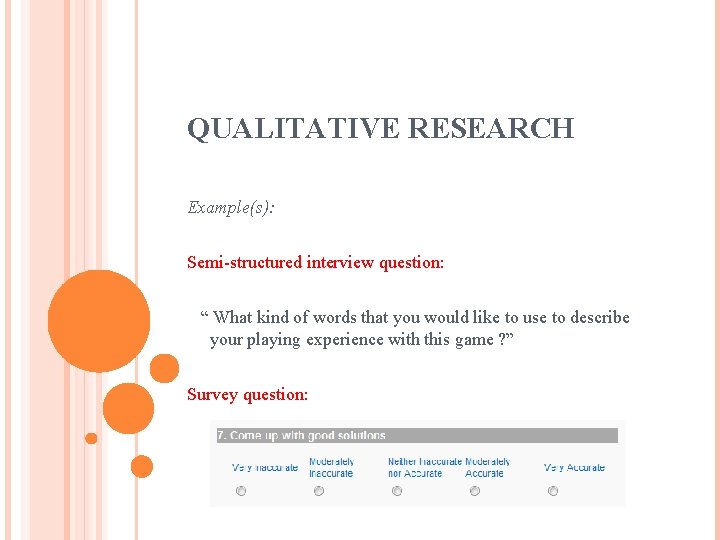
QUALITATIVE RESEARCH Example(s): Semi-structured interview question: “ What kind of words that you would like to use to describe your playing experience with this game ? ” Survey question:
QUALITATIVE RESEARCH Data Analysis: • Interpretive techniques; • Coding; • Recursive abstraction; • Mechanical techniques
QUALITATIVE -> QUANTITATIVE Example(s): A “ 5 -Point Likert” item: • Not Very Effective (1) or (-2) • Not Effective • Somewhat Effective (3) or (0) • Effective • Very Effective (2) or (-1) (4) or (1) (5) or (2) Which “Likert Scale” method is better? “Social desirability bias “
QUANTITATIVE RESEARCH What is it? A systematic empirical investigation of quantitative properties and phenomena and their relationships.
QUANTITATIVE RESEARCH Overview: • The process of measurement is central to quantitative research because it provides the fundamental connection between empirical observation and mathematical expression of quantitative relationships; • Quantitative methods can be used to verify which hypotheses are true
QUANTITATIVE RESEARCH Overview: • The generation of models, theories and hypotheses • The development of instruments and methods for measurement • Experimental control and manipulation of variables • Collection of empirical data • Modeling and analysis of data • Evaluation of results
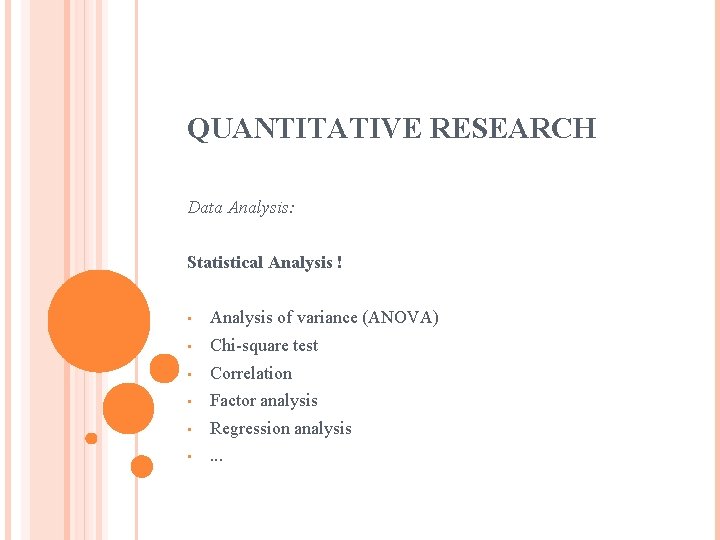
QUANTITATIVE RESEARCH Data Analysis: Statistical Analysis ! • Analysis of variance (ANOVA) • Chi-square test • Correlation • Factor analysis • Regression analysis • . . .
QUANTITATIVE RESEARCH Data Analysis: Example: Chi-square test of independence allows us to determine whether or not two variables are associated in some way.
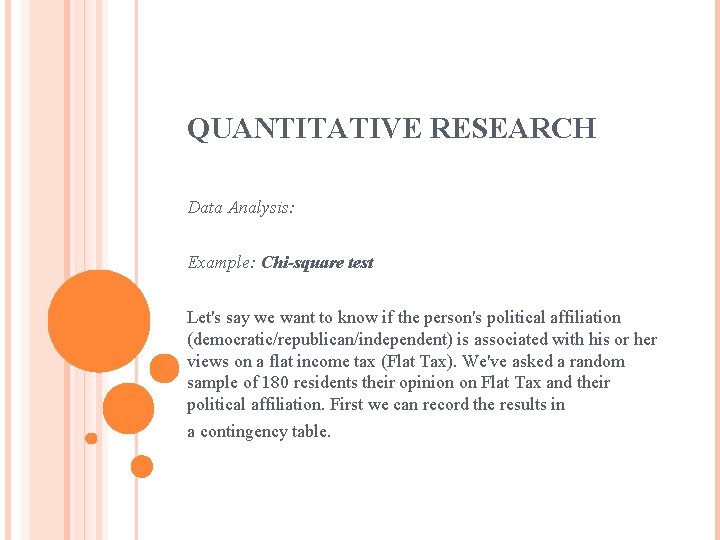
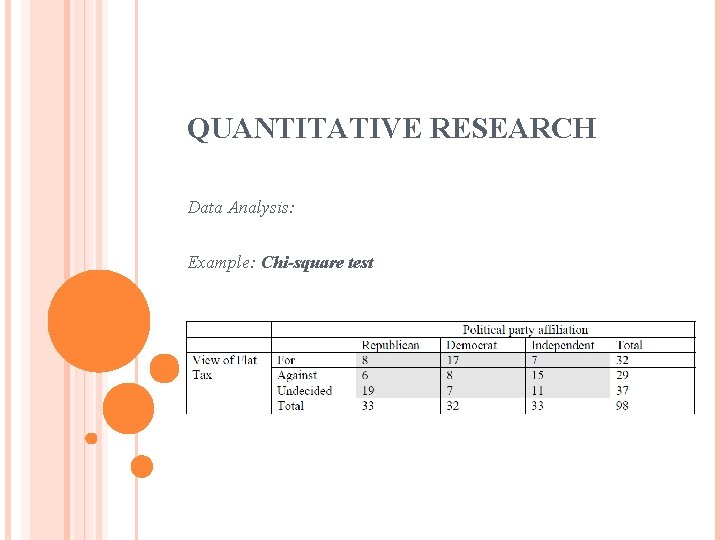
QUANTITATIVE RESEARCH Data Analysis: Example: Chi-square test Let's say we want to know if the person's political affiliation (democratic/republican/independent) is associated with his or her views on a flat income tax (Flat Tax). We've asked a random sample of 180 residents their opinion on Flat Tax and their political affiliation. First we can record the results in a contingency table.
QUANTITATIVE RESEARCH Data Analysis: Example: Chi-square test
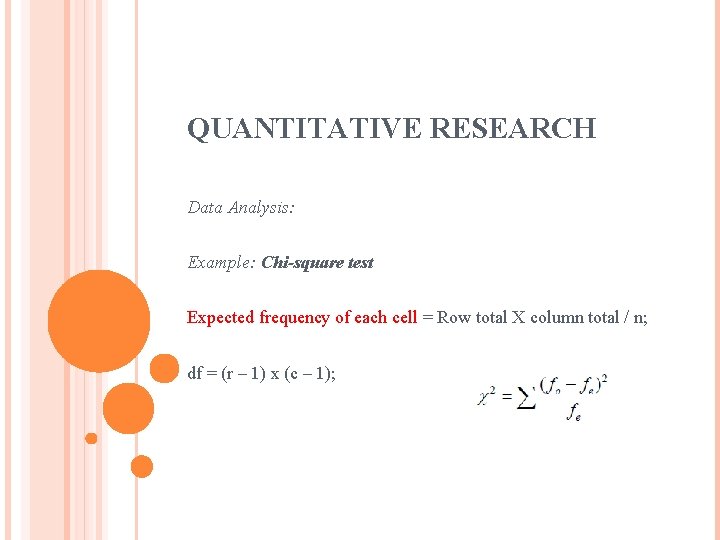
QUANTITATIVE RESEARCH Data Analysis: Example: Chi-square test Expected frequency of each cell = Row total X column total / n; df = (r – 1) x (c – 1);
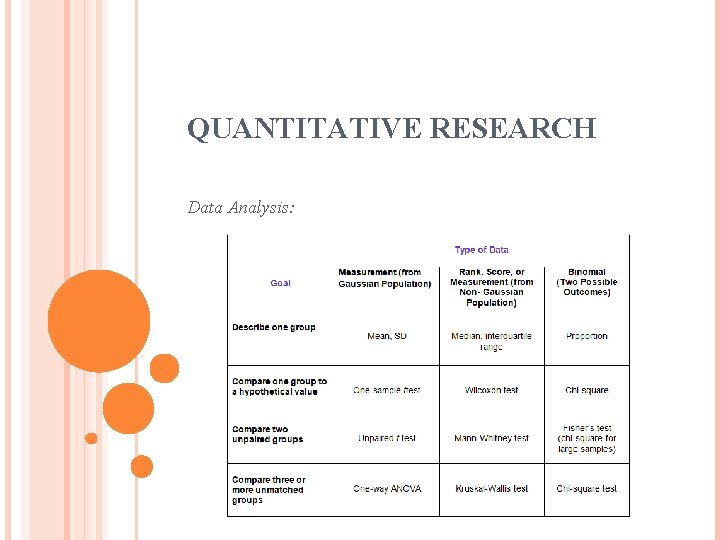
QUANTITATIVE RESEARCH Data Analysis:
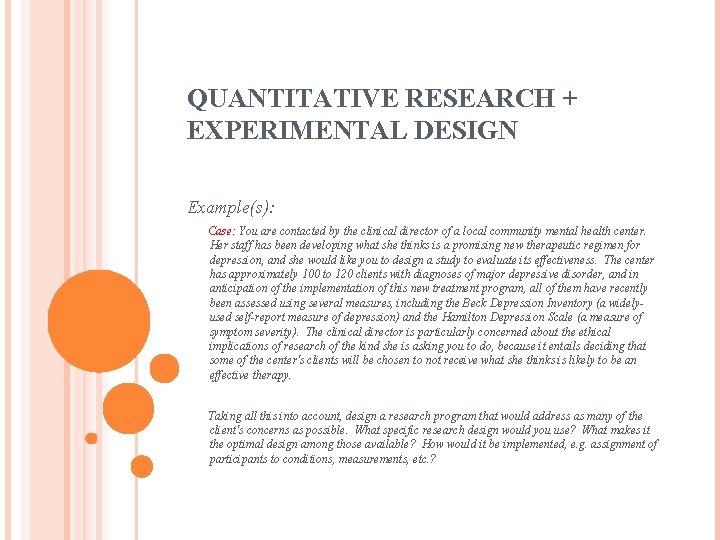
QUANTITATIVE RESEARCH + EXPERIMENTAL DESIGN Example(s): Case: You are contacted by the clinical director of a local community mental health center. Her staff has been developing what she thinks is a promising new therapeutic regimen for depression, and she would like you to design a study to evaluate its effectiveness. The center has approximately 100 to 120 clients with diagnoses of major depressive disorder, and in anticipation of the implementation of this new treatment program, all of them have recently been assessed using several measures, including the Beck Depression Inventory (a widelyused self-report measure of depression) and the Hamilton Depression Scale (a measure of symptom severity). The clinical director is particularly concerned about the ethical implications of research of the kind she is asking you to do, because it entails deciding that some of the center's clients will be chosen to not receive what she thinks is likely to be an effective therapy. Taking all this into account, design a research program that would address as many of the client's concerns as possible. What specific research design would you use? What makes it the optimal design among those available? How would it be implemented, e. g. assignment of participants to conditions, measurements, etc. ?
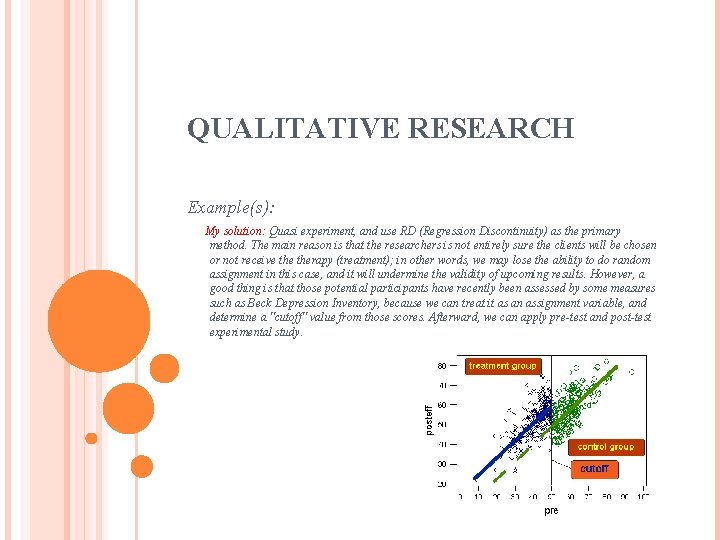
QUALITATIVE RESEARCH Example(s): My solution: Quasi experiment, and use RD (Regression Discontinuity) as the primary method. The main reason is that the researchers is not entirely sure the clients will be chosen or not receive therapy (treatment); in other words, we may lose the ability to do random assignment in this case, and it will undermine the validity of upcoming results. However, a good thing is that those potential participants have recently been assessed by some measures such as Beck Depression Inventory, because we can treat it as an assignment variable, and determine a "cutoff" value from those scores. Afterward, we can apply pre-test and post-test experimental study.
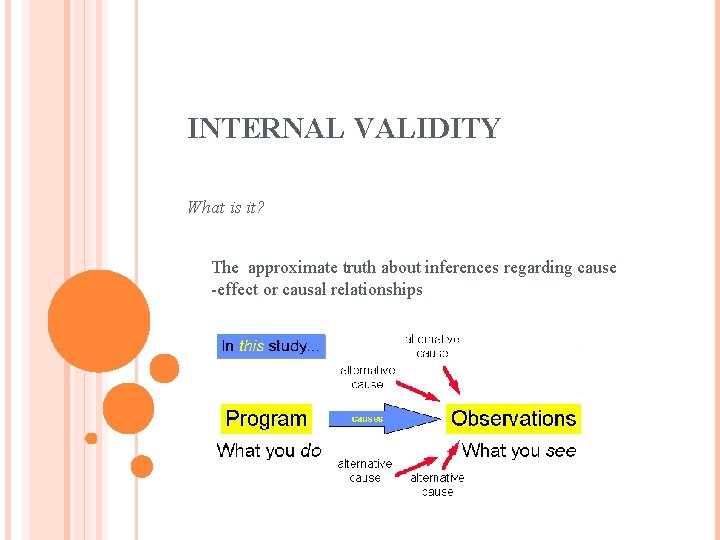
INTERNAL VALIDITY What is it? The approximate truth about inferences regarding cause -effect or causal relationships
INTERNAL VALIDITY Other types of validity: • External validity: more concerns on “Generalizability” than internal validity • Construct validity: Can live with or without internal validity
INTERNAL VALIDITY An example: In a “Post-test” only experiment, group A that receive “math tutorial program” performs better than group B that does not. An key question: whether observed changes can be attributed to your program or intervention (i. e. , the cause) and not to other possible causes (sometimes described as "alternative explanations" for the outcome).
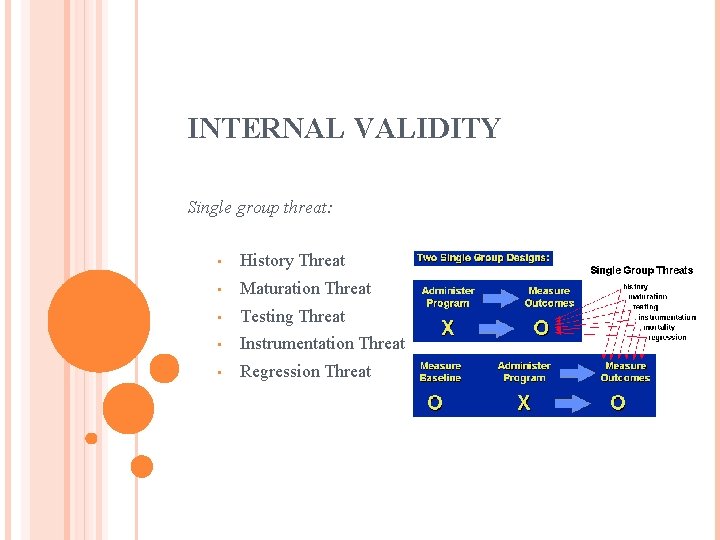
INTERNAL VALIDITY Single group threat: • History Threat • Maturation Threat • Testing Threat • Instrumentation Threat • Regression Threat
INTERNAL VALIDITY Multiple group threat: A multiple-group design typically involves at least two groups and before-after measurement. • There really is only one multiple group threat to internal validity: that the groups were not comparable before the study - selection bias prior group differences?
INTERNAL VALIDITY Social interaction threat: • Diffusion or Imitation of Treatment • Compensatory Rivalry • Resentful Demoralization
THANK YOU And questions for us?