
Qualitative Research Design I Political Science 30 Political






- Slides: 12
Qualitative Research Design I Political Science 30: Political Inquiry
Qualitative Research Design I �Qualitative vs. Quantitative Research Two types of observational study Nonrandom case selection �Selecting Variable Cases on the Independent Most similar systems Most different systems �Income Inequality and Civil War
Qualitative vs. Quantitative Research �Qualitative and quantitative studies are both types of observational studies. Quantitative research measures differences in number for variables, and usually studies a large number of cases (Large “N”). Qualitative research measures differences in kind for variables, and usually studies a small number of cases (Small “N”).
Qualitative vs. Quantitative Research �Because it covers a broad range of cases, quantitative research yields conclusions that can be generalized (it has the strongest external validity). �Because it looks closely at a few cases and traces causal pathways, qualitative research outperforms quantitative research in its measurement validity and internal validity.
Qualitative vs. Quantitative Research �When selecting cases for your quantitative research sample, it is imperative that you use random selection. �In qualitative research, “selection must be done in an intentional fashion, consistent with research objectives and strategy. ” (King, Keohane, and Verba, 1994, p. 139)
Selecting Cases on the Independent Variable �“Selecting on the independent variable” means “selecting your cases according to the values of the independent variable that they take on. ” In order to do this, you have to know a little bit about all of your potential cases. In order to do this right, you cannot act as if you also know the values that the dependent variable takes on.
Selecting Cases on the Independent Variable �The Most Similar Systems method selects cases that take on similar values of confounding variables, but different values of a key independent variable. This “holds constant” the confounds because they take on the same values in all of the cases. This is the design recommended by King, Keohane, and Verba.
Selecting Cases on the Independent Variable �The cases that you might select in a Most Similar Systems design will differ based on the research question you ask. USA, Canada, and Britain in a study of life expectancy. Bill Clinton, Jimmy Carter, and JFK in a study of regional appeal in voting. Genghis Kahn, Hannibal, and Hitler in a study of how to defend invasions.
Selecting Cases on the Independent Variable �The Most Different Systems method selects cases that take on very different values for multiple independent variables. If it turns out that these cases all take on the same value of a dependent variable, then we can rule out the independent variables as causes of the dependent variable. Less useful since it can only disprove a hypothesis.
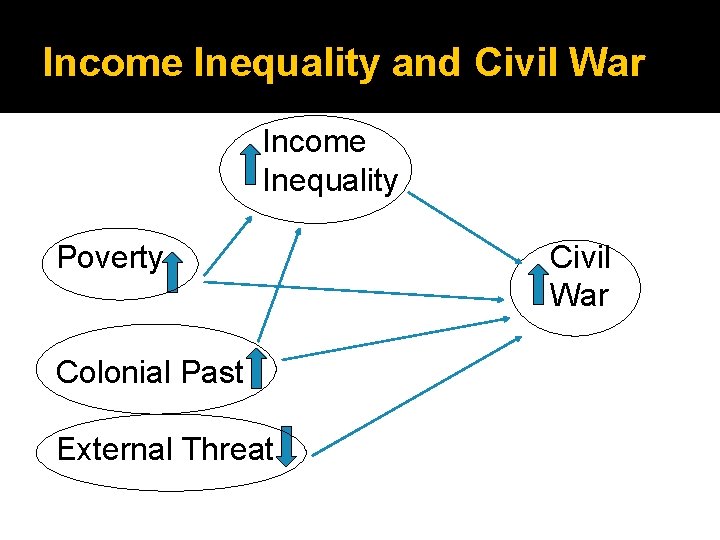
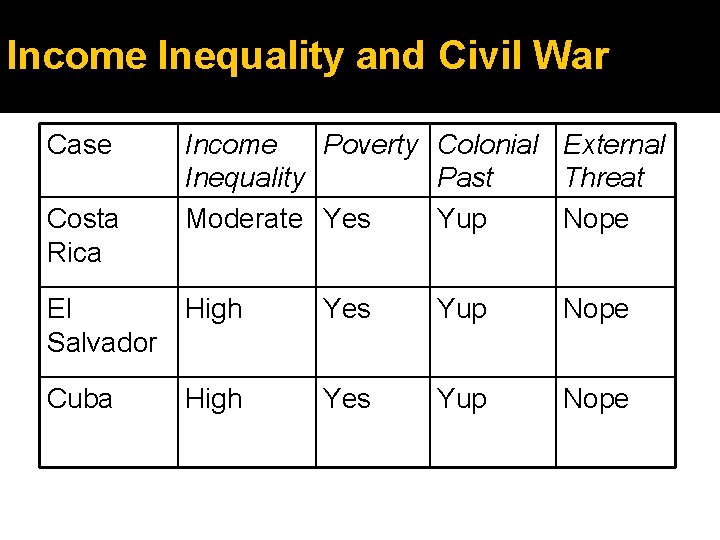
Income Inequality and Civil War Income Inequality Poverty Colonial Past External Threat Civil War
Income Inequality and Civil War Case Costa Rica Income Poverty Colonial External Inequality Past Threat Moderate Yes Yup Nope El High Salvador Yes Yup Nope Cuba Yes Yup Nope High
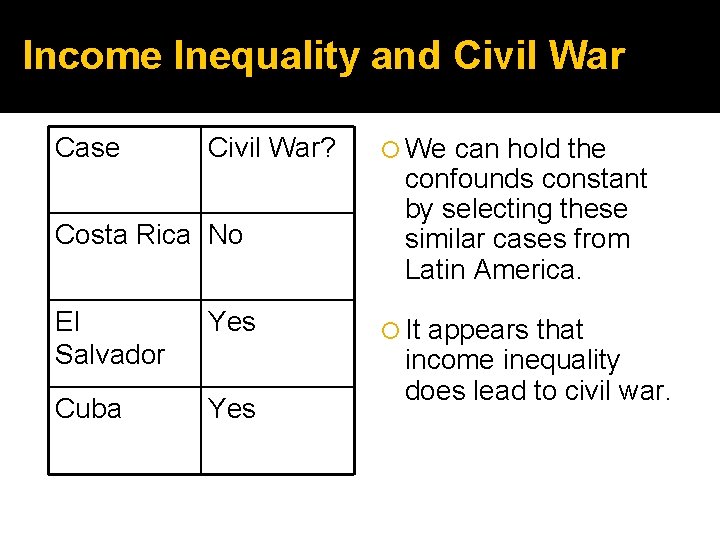
Income Inequality and Civil War Case Civil War? Costa Rica No El Salvador Yes Cuba Yes We can hold the confounds constant by selecting these similar cases from Latin America. It appears that income inequality does lead to civil war.