
QUALITATIVE RESEARCH By Ambreen Anis Nagori M Ed

QUALITATIVE RESEARCH By Ambreen Anis Nagori (M. Ed) Student 1 st Semester at Iqra University) Course Facilitator: Sir Rasool Bakhsh Raisani Date : 19 th April 2015
INTRODUCTION TO QUALITATIVE RESEARCH A systematic subjective approach used to describe life experiences and give them meaning To gain insight; explore the depth, richness, and complexity inherent in the phenomenon Seeking understanding by talking to people, focus on text. Engaged with people in real organizations Based on the notion that knowledge is context dependent Data are approached by questions such as: -what is happening -why is it happening -how has it come to happen, and -when did it happen

QUALITATIVE RESEARCH “Qualitative research is about exploring issues, understanding phenomena and answering questions by analyzing and making sense of unstructured data. From health studies, to academic, market and policy research; qualitative research happens in nearly every workplace and study environment everyday. ”
SAMPLE PROBLEM OF QUALITATIVE RESEARCH Jane Goodall’s study of mountain gorillas involved her living among the gorillas, trying to become an accepted part of their environment, and through observational techniques trying to understand their behaviors. We might contrast this approach with that of a zoo researcher who also examines gorilla behavior through manipulating aspects of their living environment. Both studies would produce different results but who can say which is better! A very different approach would be for a researcher to simply attend class, become friendly with the teacher and students, and though observation and questioning attempt to understand how each of them views the learning environment. What might she learn? Perhaps she would discover that the teacher’s tendency to attempt humor often confused the students. Perhaps the teacher’s explanations about assignments were not clear to the students. The possibility exists that she identify several teacher behaviors that appear to negatively impact upon teaching effectiveness.
CHARACTERISTICS OF QUALITATIVE RESEARCH Merging together of various data collection strategies Holistic, understand the whole Research intensely involved Synthetic Requires ongoing analysis of data to formulate subsequent strategies and to determine when field work is done Focus: complex & broad Subjective Dialectic, inductive reasoning Basis of knowing: meaning & discovery Develops theory Shared interpretation Communication & observation Basic element of analysis: words Individual interpretation Uniqueness

PROS AND CONS OF QUALITATIVE RESEARCH Pros Usually much cheaper than quantitative research Cons Can’t extrapolate to the whole population No better way than qualitative Volume of data research to understand in-depth the motivations and feelings of consumers Qualitative research can improve the efficiency and effectiveness of quantitative research Complexity of analysis Good for examining feelings and motivations Time-consuming in nature Allows for complexity and depth of issues One cannot generalize from individual cases Provides insights Qualitative researchers are involved and biased Attempts to avoid pre-judgments Less easily generalised as a result
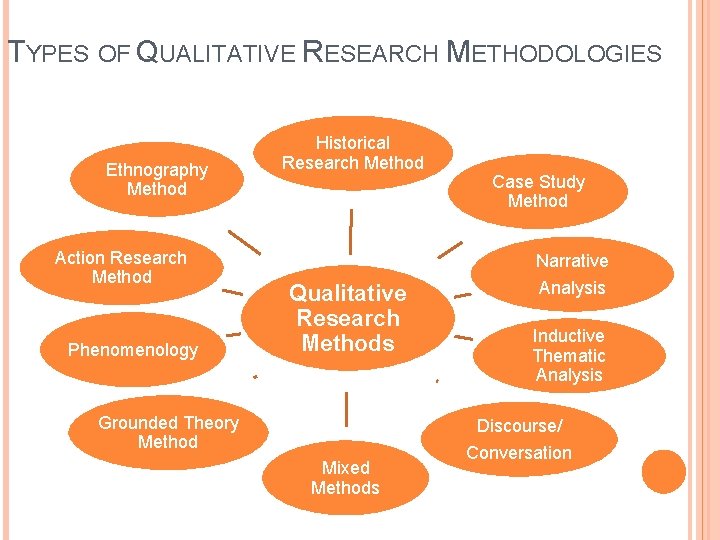
TYPES OF QUALITATIVE RESEARCH METHODOLOGIES Ethnography Method Action Research Method Phenomenology Historical Research Method Case Study Method Narrative Qualitative Research Methods Grounded Theory Method Analysis Inductive Thematic Analysis Discourse/ Mixed Methods Conversation
PHENOMENOLOGY METHOD Purpose, goal – to describe experiences as they are lived examines uniqueness of individual's lived situations each person has own reality; reality is subjective Research question development - What does existence of feeling or experience indicate concerning the phenomenon to be explored What are necessary & sufficient constituents of feeling or experience? What is the nature of the human being? Method - No clearly defined steps to avoid limiting creativity of researcher Sampling & data collection
PHENOMENOLOGY METHOD (CONT…) Seek persons who understand study & are willing to express inner feelings & experiences Describe experiences of phenomenon Write experiences of phenomenon Direct observation Audio or videotape Data analysis - Classify & rank data Sense of wholeness Examine experiences beyond human awareness/ or cannot be communicated Outcomes - Findings described from subject's point-of-view Researcher identifies themes Structural explanation of findings is developed
GROUNDED THEORY METHOD Purpose – theory development Used in discovering what problems exist in a social scene &how persons handle them Involves formulation, testing, & redevelopment of propositions until a theory is developed Method – steps occur simultaneously; a constant comparative process Data collection – interview, observation, record review, or combination Analysis Concept formation, Concept development - reduction; selective sampling of literature; selective sampling of subjects; emergence of core concepts, Concept modification & integration Outcomes – theory supported by examples from data
ETHNOGRAPHY METHOD Purpose – to describe a culture's characteristics Method - Identify culture, variables for study, & review literature Data collection - gain entrance to culture; immerse self in culture; acquire informants; gather data through direct observation & interaction with subjects Analysis – describe characteristics of culture Outcomes – description of culture
HISTORICAL RESEARCH METHOD Purpose – describe and examine events of the past to understand the present and anticipate potential future effects Method – Formulate idea - select topic after reading related literature Develop research questions Develop an inventory of sources - archives, private libraries, papers Clarify validity & reliability of data - primary sources, authenticity, biases Develop research outline to organize investigative process Collect data Analysis – synthesis of all data; accept & reject data; reconcile conflicting evidence Outcomes - select means of presentation - biography, chronology, issue paper
ACTION RESEARCH METHOD Purpose – teacher-initiated, school-based research used to improve the practitioner’s practice by doing or changing something Method - Trying out ideas as a means of increasing knowledge aboutimproving curriculum, teaching and learning (Kemmis & Mc Taggart, 1982) Action research does not apply to large groups Analysis – To research and evaluate on a specific cause to improve the system Outcomes – To apply new or a change in a system of education
QUALITATIVE RESEARCH TECHNIQUES FOR DATA COLLECTION In-depth interview Focus group Projective methods Case study Pilot study Interview with audiotape & videotape Telephonic interviews Open ended questions Group interviews or one to one interviews Structured or unstructured Focused group Observations Electronic interviews
RELIABILITY & VALIDITY - RIGOR Use of researcher's personality Involvement with subject's experience Live with data collection until no new information appears Bracketing Researcher suspends what is known about the phenomenon Keeping an open context Set aside own preconceptions Intuiting Process of actually looking at phenomenon Focus all awareness & energy on topic Absolute concentration & complete absorption in phenomenon Can use > 1 researcher & compare interpretation and analysis of data
DATA ANALYSIS Living with data Cluster & categorize data Examine concepts & themes Define relationships between/among concepts
STEPS OF QUALITATIVE RESEARCH Choose a topic Choose some potential research questions Choose a theoretical framework Given the iterative nature of qualitative research, these might change later

MODEL OF QUALITATIVE RESEARCH DESIGN Written Record (Thesis, book, report, article. . . ) Data Analysis Approach (Hermeneutics, semiotics, narrative analysis. . . ) Data Collection Technique (interviews, participant observation, documents) Research Method Philosophical Assumptions (action research, case study, ethnography, grounded theory. . . ) Philosophical Assumptions (positivist, interpretive, critical)
CONCLUSION Qualitative research focuses on interpretation of phenomena in their natural settings to make sense in terms of the meanings people bring to these settings. Qualitative research as attempting to understand the unique interactions in a particular situation. On validity, qualitative research is much more focused on demonstrating the causes of bias rather than eliminating them. In qualitative research, interest is on understanding the meaning people have constructed and how people make sense of the world they live in and experiences they have undergone. In qualitative research, the sample is small and not chosen randomly but rather, the choice of a sample is purposeful. A qualitative approach can be judged to be appropriate when the research sets out to investigate phenomena that are not easy to quantify or measure accurately, or where such measurement would be arbitrary and inexact. There should be a clear and consistent method for coding and analysing data, and it should be clear how the coding and analytical strategies were derived. All qualitative research involves ethical considerations, and these should be considered within any research report.

BIBLIOGRAPHY Benz, C. & Newman, I. (1998). in their book The Qualitative. Quantitative Research Methodology: Exploring the Interactive Continuum. http: //www. simplypsychology. org/qualitative-quantitative. html http: //en. wikipedia. org/wiki/Qualitative_research http: //www. umsl. edu/~lindquists/qualdsgn. html http: //web. csulb. edu/~msaintg/ppa 696/696 quali. htm http: //www. qsrinternational. com/what-is-qualitativeresearch. aspx Research Methodology in Action consultant editor Sandeep Channan
- Slides: 20