
Qualitative research an overview Dr Salwa Tayel Dr




- Slides: 25
Qualitative research: an overview Dr Salwa Tayel & Dr. Noura Abouammoh KSU College of Medicine October 2016
Learning Objectives • To compare between quantitative / qualitative approaches to research • To understand basic concepts of qualitative research • To be introduced to some examples of qualitative techniques and methods October, 2016 Qualitative Research 2
Consider these questions • Why do people smoke ? • Why do people eat what they eat ? • Why don’t most people in our part of the world exercise ? • How do people contract infection ? • How is such information useful ? October, 2016 Qualitative Research 3
What is qualitative research • Qualitative research is a research methodology that is characterized by its aims, which relate to understanding some aspect of social life, and its methods which (in general) generate words, rather than numbers, as data for analysis. October, 2016 Qualitative Research 4
Aim of Qualitative Research • Understand phenomena to inform policies and services • Answer questions such as What, How and Why of a phenomena • Examples: - • Why do people smoke ? • How do people contract infection ? October, 2016 Qualitative Research 5
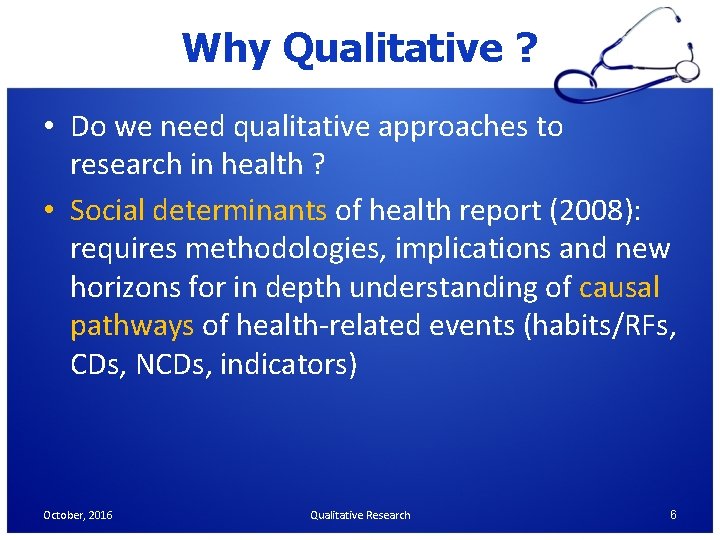
Why Qualitative ? • Do we need qualitative approaches to research in health ? • Social determinants of health report (2008): requires methodologies, implications and new horizons for in depth understanding of causal pathways of health-related events (habits/RFs, CDs, NCDs, indicators) October, 2016 Qualitative Research 6
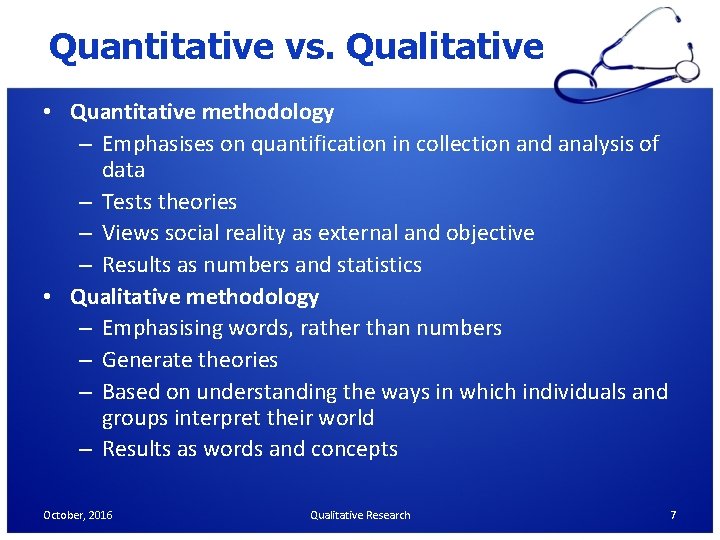
Quantitative vs. Qualitative • Quantitative methodology – Emphasises on quantification in collection and analysis of data – Tests theories – Views social reality as external and objective – Results as numbers and statistics • Qualitative methodology – Emphasising words, rather than numbers – Generate theories – Based on understanding the ways in which individuals and groups interpret their world – Results as words and concepts October, 2016 Qualitative Research 7
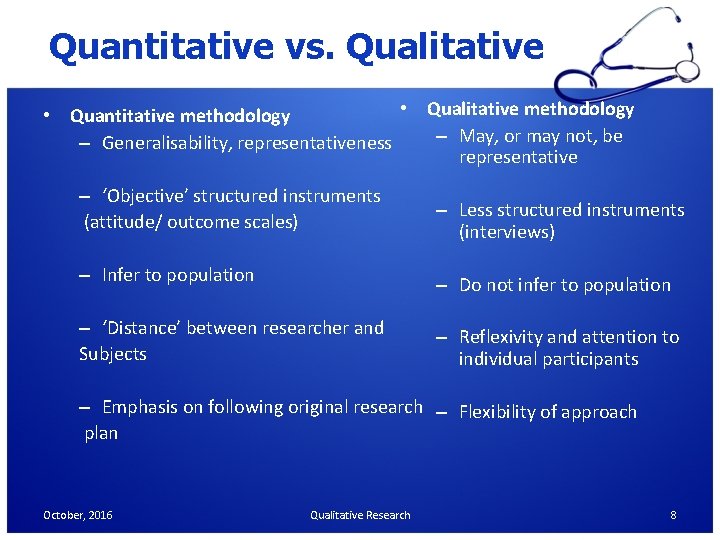
Quantitative vs. Qualitative • Qualitative methodology • Quantitative methodology – May, or may not, be – Generalisability, representativeness representative – ‘Objective’ structured instruments (attitude/ outcome scales) – Less structured instruments (interviews) – Infer to population – Do not infer to population – ‘Distance’ between researcher and Subjects – Reflexivity and attention to individual participants – Emphasis on following original research – Flexibility of approach plan October, 2016 Qualitative Research 8
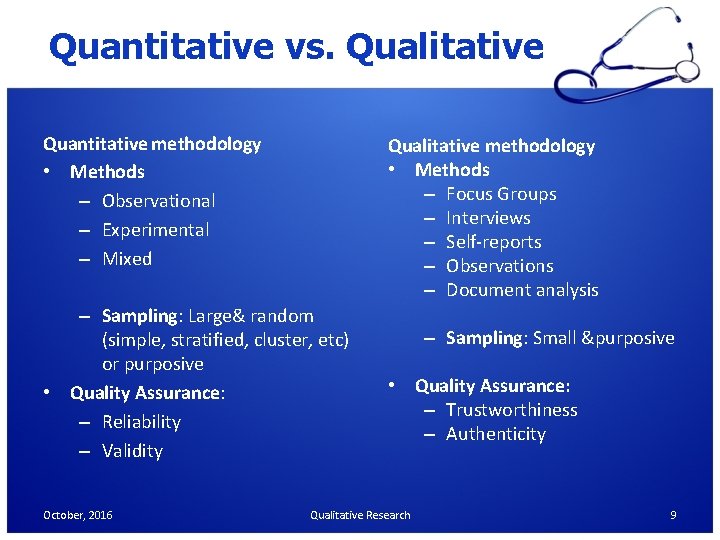
Quantitative vs. Qualitative Quantitative methodology • Methods – Observational – Experimental – Mixed Qualitative methodology • Methods – Focus Groups – Interviews – Self-reports – Observations – Document analysis – Sampling: Large& random (simple, stratified, cluster, etc) or purposive • Quality Assurance: – Reliability – Validity October, 2016 – Sampling: Small &purposive • Quality Assurance: – Trustworthiness – Authenticity Qualitative Research 9
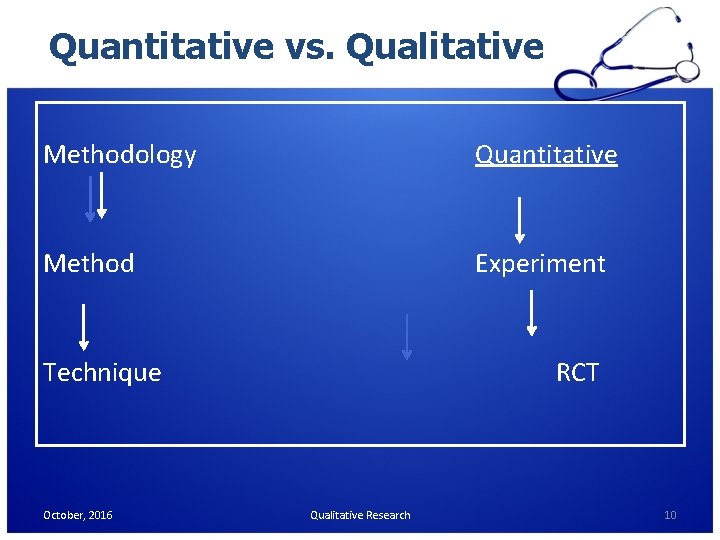
Quantitative vs. Qualitative Methodology Quantitative Method Experiment Technique October, 2016 RCT Qualitative Research 10
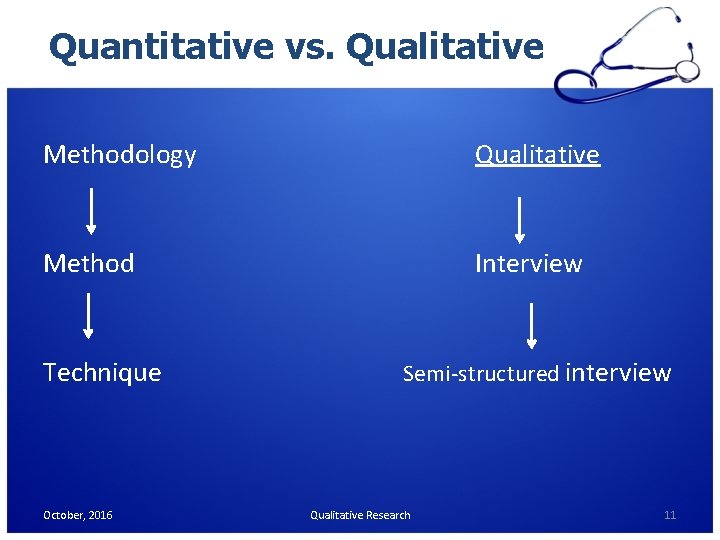
Quantitative vs. Qualitative Methodology Qualitative Method Interview Technique October, 2016 Semi-structured interview Qualitative Research 11
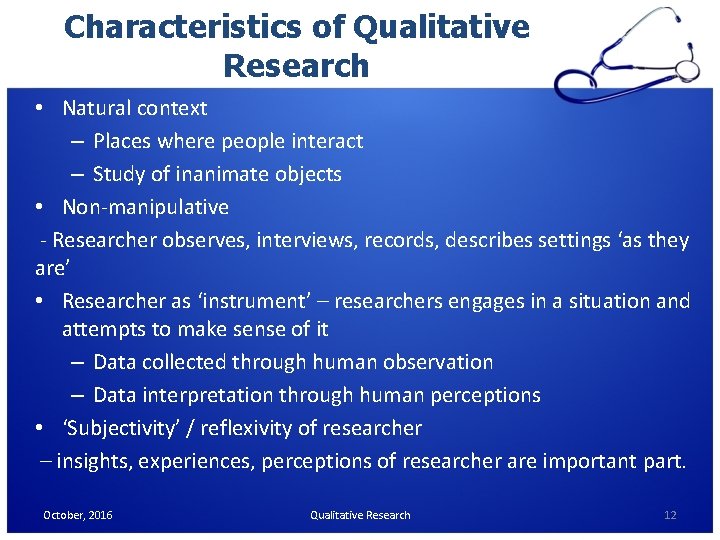
Characteristics of Qualitative Research • Natural context – Places where people interact – Study of inanimate objects • Non-manipulative - Researcher observes, interviews, records, describes settings ‘as they are’ • Researcher as ‘instrument’ – researchers engages in a situation and attempts to make sense of it – Data collected through human observation – Data interpretation through human perceptions • ‘Subjectivity’ / reflexivity of researcher – insights, experiences, perceptions of researcher are important part. October, 2016 Qualitative Research 12
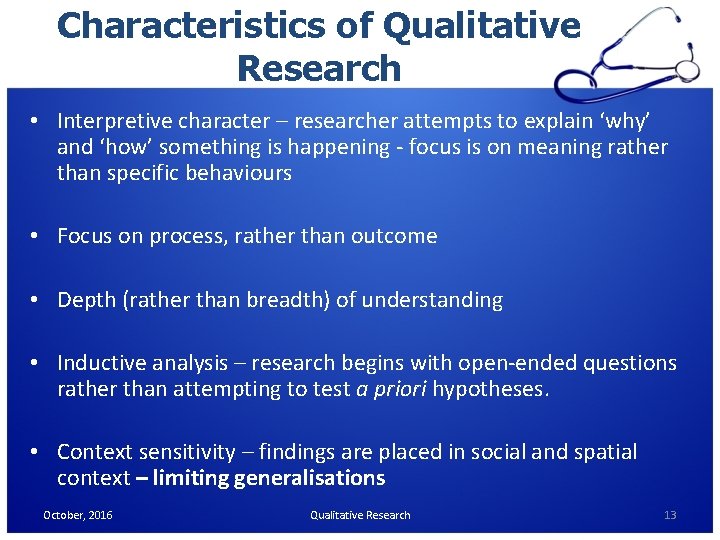
Characteristics of Qualitative Research • Interpretive character – researcher attempts to explain ‘why’ and ‘how’ something is happening - focus is on meaning rather than specific behaviours • Focus on process, rather than outcome • Depth (rather than breadth) of understanding • Inductive analysis – research begins with open-ended questions rather than attempting to test a priori hypotheses. • Context sensitivity – findings are placed in social and spatial context – limiting generalisations October, 2016 Qualitative Research 13
Limitations of Qualitative Research • Subjective • Labour/time intensive • Misunderstanding of novice researchers • Limited generalisability October, 2016 Qualitative Research 15
Qualitative Research Techniques • Participant observation (field notes) • Interviews / Focus groups • Video / Text and Image analysis (documents, media data) October, 2016 Qualitative Research 16
Qualitative Research Techniques • Participants observation (field notes) • Gains insight into understanding cultural patterns to determine what’s necessary and needed in tool development (complementary to interviews) October, 2016 Qualitative Research 17
Qualitative Research Techniques • Interviews/ focus group discussions • Explores how tools are used and could be used in a novice programming course • Gains insight into the meaning of tools for students for learning to programme October, 2016 Qualitative Research 18
Qualitative Research Techniques • Document analysis October, 2016 Qualitative Research 19
Involved Skills • Observing • Conversing • Participating • Interpreting October, 2016 Qualitative Research 20
Qualitative Technique- Data analysis Themes arising from data would provide insight into the issue(s) under investigation and see what is important to students / physicians / administrators October, 2016 Qualitative Research 21
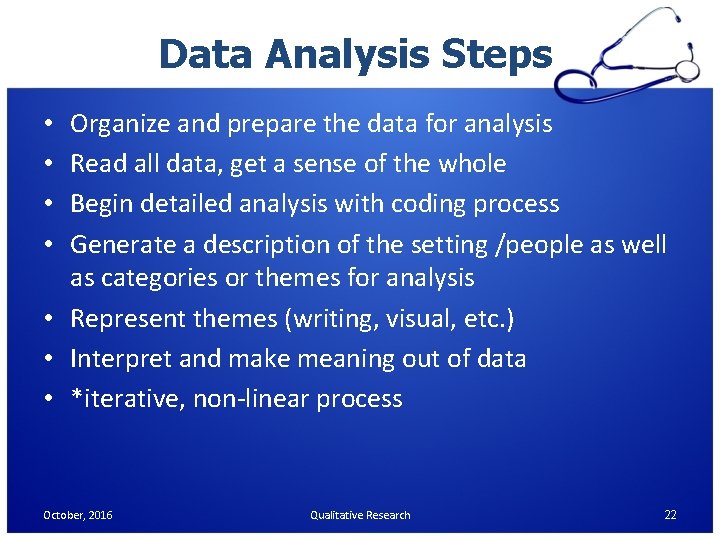
Data Analysis Steps Organize and prepare the data for analysis Read all data, get a sense of the whole Begin detailed analysis with coding process Generate a description of the setting /people as well as categories or themes for analysis • Represent themes (writing, visual, etc. ) • Interpret and make meaning out of data • *iterative, non-linear process • • October, 2016 Qualitative Research 22
Ethical Considerations • Consequences • Rights and Responsibilities • Social Justice • Care October, 2016 Qualitative Research 23
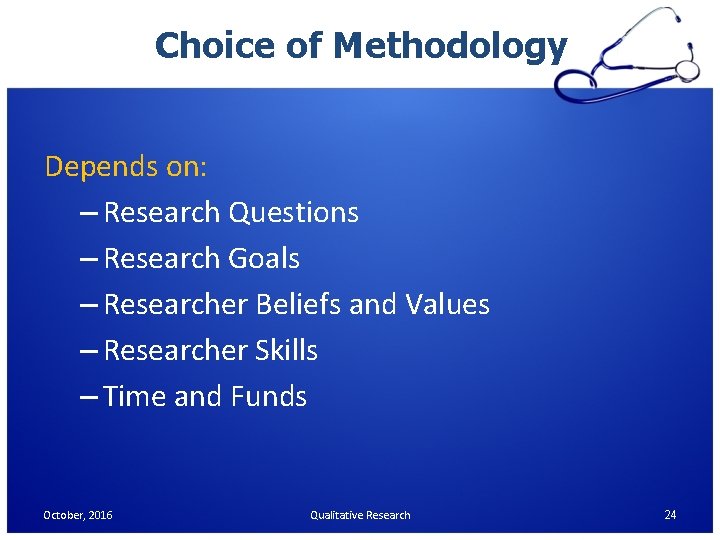
Choice of Methodology Depends on: – Research Questions – Research Goals – Researcher Beliefs and Values – Researcher Skills – Time and Funds October, 2016 Qualitative Research 24
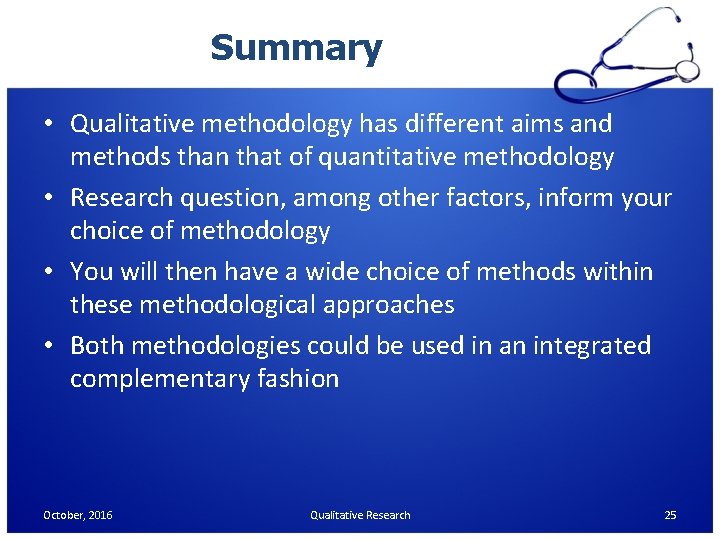
Summary • Qualitative methodology has different aims and methods than that of quantitative methodology • Research question, among other factors, inform your choice of methodology • You will then have a wide choice of methods within these methodological approaches • Both methodologies could be used in an integrated complementary fashion October, 2016 Qualitative Research 25
References • Michaela Mora. Quantitative Vs. Qualitative Research – When to Use Which. 2010 available at http: //www. surveygizmo. com/surveyblog/quantitative-qualitative-research • Creswell JW. Research design. Qualitative, quantitative and mixed methods approaches. Thousand Oaks, CA: SAGE, 2003 • Bricki, N. and Green, J. (2007) A Guide to Using Qualitative Research Methodology. MSF field research. Available at http: //hdl. handle. net/10144/84230 • Silverman, D. (2001), Interpreting Qualitative Data: Methods for Analysing Talk, Text and Interaction, London: Sage October, 2016 Qualitative Research 26