
Qualitative Methods in ME of HIV and AIDS



- Slides: 47
Qualitative Methods in M&E of HIV and AIDS programme (UP Lecture 2011) Prof. Supa Pengpid, M. Sc, Dr. P. H. MBA School of Public Health, University of Limpopo
Scope of Contents �Overview of qualitative methods in M & E �Steps in planning qualitative study �Qualitative data collection methods �Overview qualitative data analysis
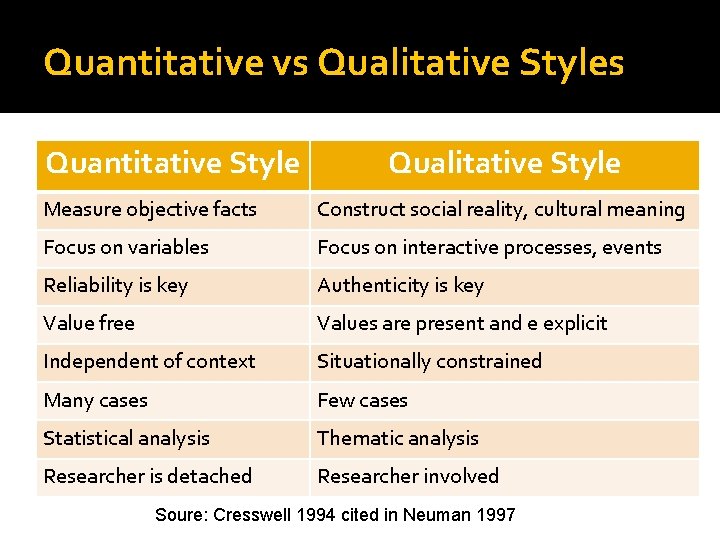
Quantitative vs Qualitative Styles Quantitative Style Qualitative Style Measure objective facts Construct social reality, cultural meaning Focus on variables Focus on interactive processes, events Reliability is key Authenticity is key Value free Values are present and e explicit Independent of context Situationally constrained Many cases Few cases Statistical analysis Thematic analysis Researcher is detached Researcher involved Soure: Cresswell 1994 cited in Neuman 1997
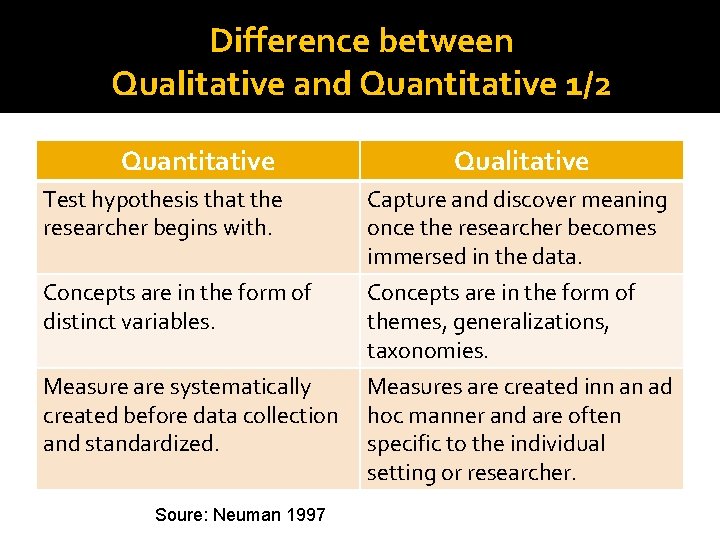
Difference between Qualitative and Quantitative 1/2 Quantitative Test hypothesis that the researcher begins with. Concepts are in the form of distinct variables. Qualitative Capture and discover meaning once the researcher becomes immersed in the data. Concepts are in the form of themes, generalizations, taxonomies. Measure are systematically Measures are created inn an ad created before data collection hoc manner and are often and standardized. specific to the individual setting or researcher. Soure: Neuman 1997
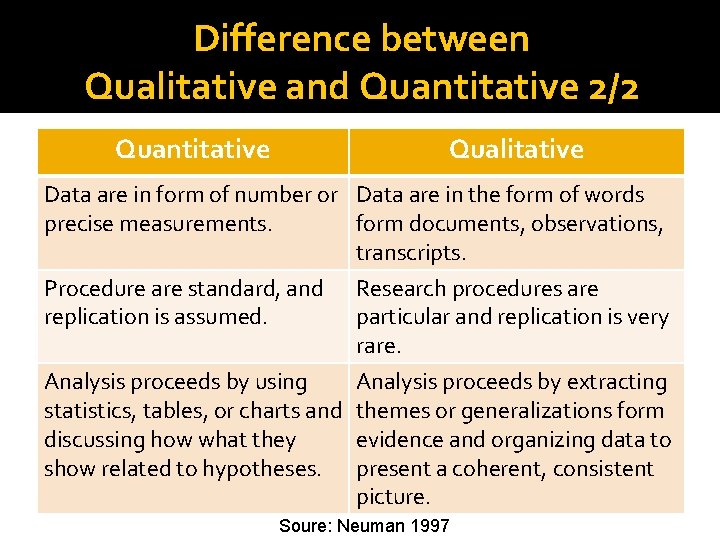
Difference between Qualitative and Quantitative 2/2 Quantitative Qualitative Data are in form of number or Data are in the form of words precise measurements. form documents, observations, transcripts. Procedure are standard, and Research procedures are replication is assumed. particular and replication is very rare. Analysis proceeds by using statistics, tables, or charts and discussing how what they show related to hypotheses. Analysis proceeds by extracting themes or generalizations form evidence and organizing data to present a coherent, consistent picture. Soure: Neuman 1997
Characteristics of Qualitative Study 1/2 �The context is critical: understanding social context for understanding the social world. �Value of the case study: may use case study approach in to greater depth. �Researcher integrity A question of trust Reflect and check evidence
Characteristics of Qualitative Study 2/2 �Different kind of bias: human factor and researcher bias. �Pay attention: to process and sequence. �Interpretation: description of particular events, give meaning or making them understandable). Examining historical documents Elicits and underlying coherence or sense of meaning in the data generalize or link to general theory
Qualitative approaches �Qualitative Improves understanding of the situation Move from knowledge of the external to knowledge of the meaning of experience Dialogue and probing
Quantitative & Qualitative approaches �Use of both approaches improves the quality of the results �Able to implement changes to improve the programme/situation
When Qualitative used? �Exploratory, prior to quantitative work �As a way of examining the context of quantitative findings, or give dept of them (Explanatory) �On their own, in studies addressing questions
Qualitative Methods Exploring a topic about which little is known in order to provide insights for intervention; 2. Investigating the feasibility, acceptability and appropriateness of potential interventions; 3. Developing appropriate questionnaires at the early stage of a study; 4. Validating quantitative data through "triangulation, " i. e. , the use of multiple methods; 1.
Qualitative Methods in M & E Complementing the quantitative component of a study by providing concrete examples or explaining observed practices; 6. Developing appropriate materials for educational interventions; 7. Identifying problems in on-going interventions and suggesting appropriate solutions; 8. Assessing the impact of on-going or completed interventions. 5.
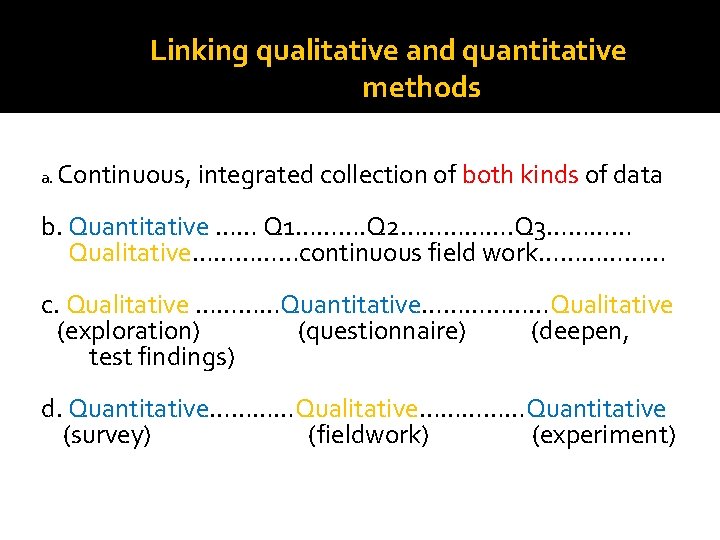
Linking qualitative and quantitative methods Pattern 1: Continuous, integrated collection of both kinds of data
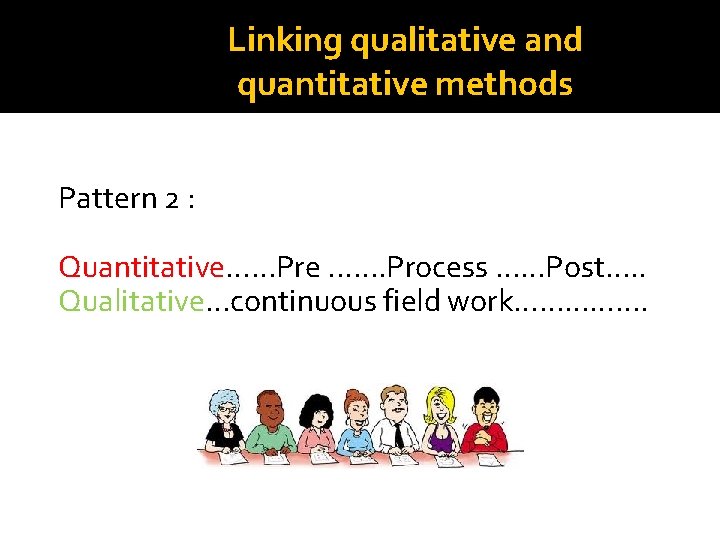
Linking qualitative and quantitative methods Pattern 2 : Quantitative……Pre. . . . Process ……Post. . . Qualitative…continuous field work…………….
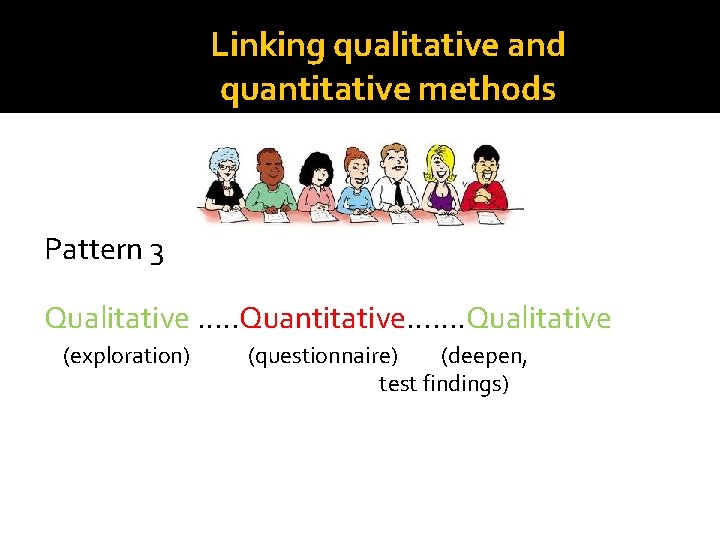
Linking qualitative and quantitative methods Pattern 3 Qualitative …. . Quantitative……. Qualitative (exploration) (questionnaire) (deepen, test findings)
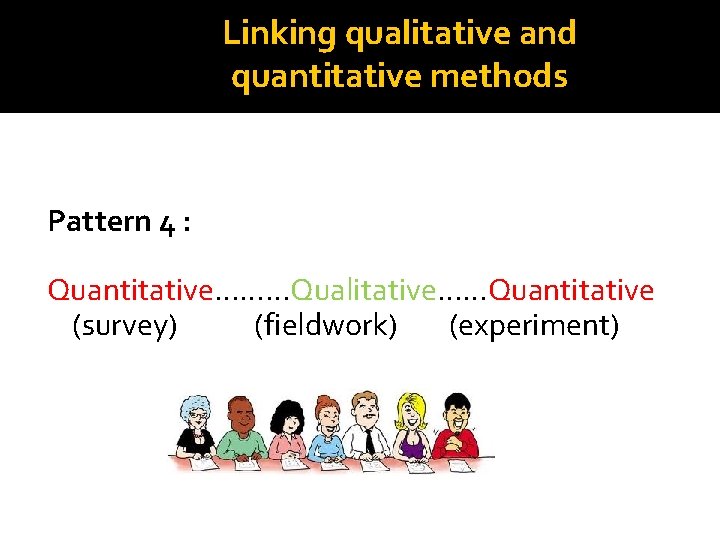
Linking qualitative and quantitative methods Pattern 4 : Quantitative………Qualitative……Quantitative (survey) (fieldwork) (experiment)
Linking qualitative and quantitative methods a. Continuous, integrated collection of both kinds of data b. Quantitative …… Q 1………. Q 2……………. Q 3………… Qualitative……………continuous field work……………… c. Qualitative …………Quantitative………………Qualitative (exploration) (questionnaire) (deepen, test findings) d. Quantitative…………Qualitative……………Quantitative (survey) (fieldwork) (experiment)
The Qualitative Methods in M & E �To find out and to determine why things are the way they are or why people behave as they do. �Able you to learn what people do, explore and interpret their experiences, and �Examine impact of intervention on their behaviours.
Planning A Qualitative Study When considering using the services of a resource person, look for someone who: �analyses situations critically; �recognizes and avoids bias; �is socially sensitive to others feelings; �possesses good powers of observation; �has good inter-actional qualities.
Steps In Planning a Qualitative Study �Step 1 Form a Working Group �Step 2 Formulate Specific Questions �Step 3 Choose a Package of Study Methods �Step 4 Identify Study Groups �Step 5 Plan for execution/ implementation
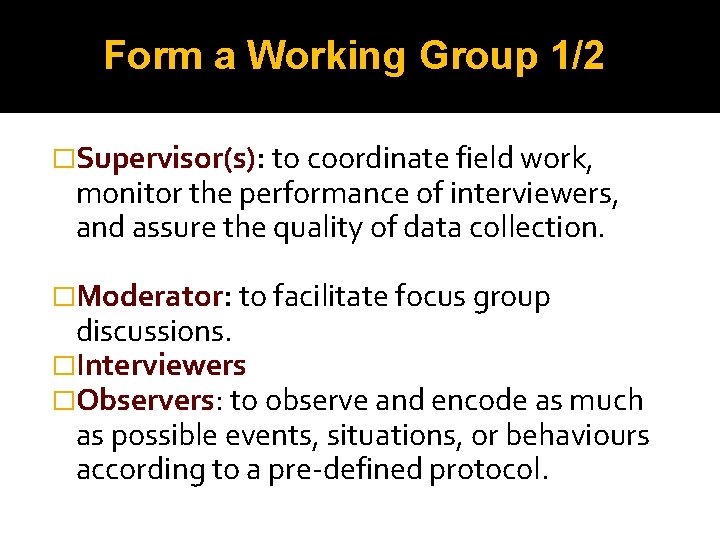
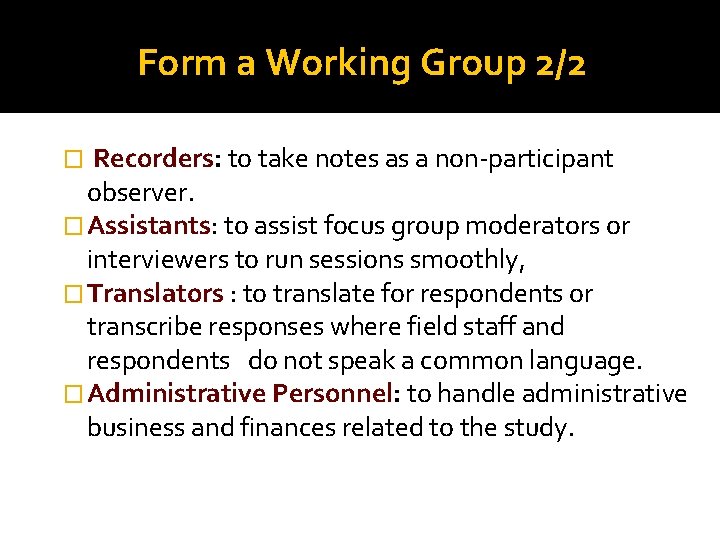
STEP 1: Form A Working Group a. Multidisciplinary Study Team b. Field Staff Qualities � familiarity with the culture; � ability to establish rapport , and gain confidence and trust; � knowledge of HIV/AIDS; � ability to speak the local language; � ability to listen well.
Form a Working Group 1/2 �Supervisor(s): to coordinate field work, monitor the performance of interviewers, and assure the quality of data collection. �Moderator: to facilitate focus group discussions. �Interviewers �Observers: to observe and encode as much as possible events, situations, or behaviours according to a pre-defined protocol.
Form a Working Group 2/2 � Recorders: to take notes as a non-participant observer. � Assistants: to assist focus group moderators or interviewers to run sessions smoothly, � Translators : to translate for respondents or transcribe responses where field staff and respondents do not speak a common language. � Administrative Personnel: to handle administrative business and finances related to the study.
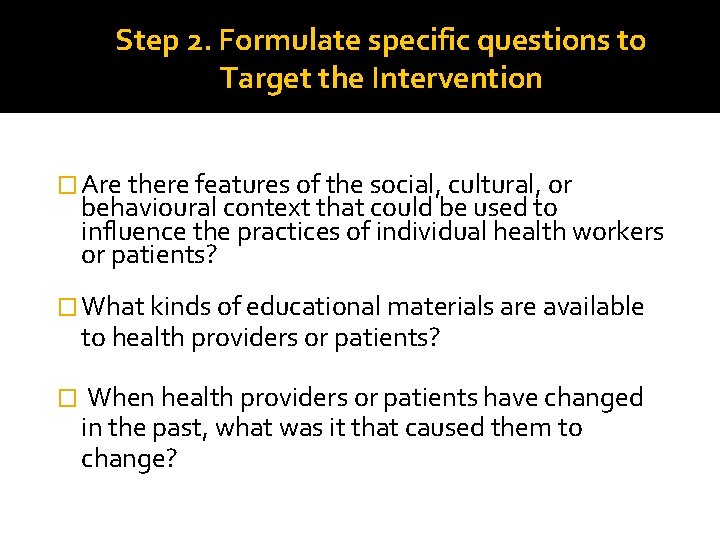
Step 2. Formulate specific questions to Target the Intervention � Are there features of the social, cultural, or behavioural context that could be used to influence the practices of individual health workers or patients? � What kinds of educational materials are available to health providers or patients? � When health providers or patients have changed in the past, what was it that caused them to change?
STEP 3: Choose a Package of Study Methods � The amount of information needed � The resources needed to gather, process, and analyze the data; � The time frame available; � The local research capacity; � The feasibility of implementing each method in the specific local environment, logistics, and time frame.
STEP 4: Identify Study Groups �Non-probability sampling: study members are chosen purposively, with an eye to representing the population in a certain way, or according to quotas. Purposive Accidental Snow ball techniques Socio metrics
STEP 5: Plan for Implementation 1/2 a. Choose Site(s) and Location(s) to be Used for the Study �Obtaining the necessary permission. �Locating and arranging sites for group discussions and interviews when necessary. �Obtaining basic descriptive information about the area/facility. �Recruiting any support staff in the community that may be needed.
STEP 5: Plan for Implementation 2/2 b. Select Coordinators for Each Study Component (if the study have multiple methods). These coordinators will be responsible for identifying field staff, training them for their specific tasks, supervising the field work, and preparing the data for analysis. c. Plan the Schedule for Individual Study Components (Some studies using multiple methods will implement all methods at the same time in the same sites).
Qualitative Data Collection Methods 1. In-dept-interview 2. Focus group discussion (FGD) 3. Observation 3. 1 Participant observation 3. 2 Non-participant observation 4. Structure questionnaires 5. Field note, diary, pictures, VDO etc.
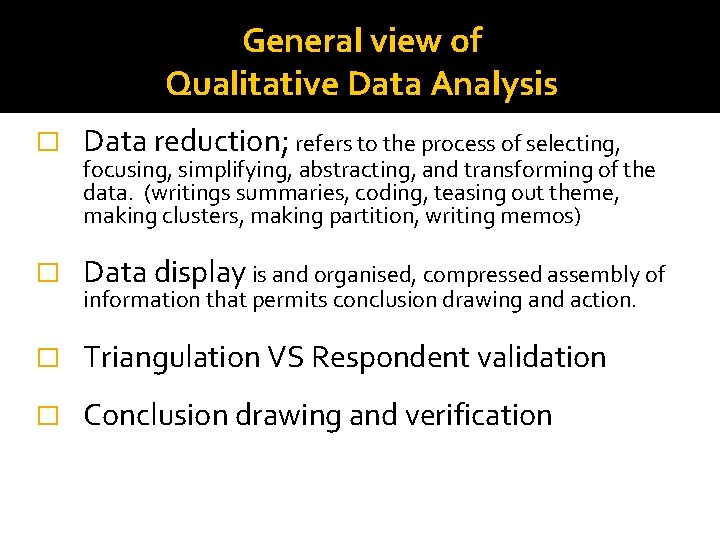
General view of Qualitative Data Analysis � Data reduction; refers to the process of selecting, � Data display is and organised, compressed assembly of � Triangulation VS Respondent validation � Conclusion drawing and verification focusing, simplifying, abstracting, and transforming of the data. (writings summaries, coding, teasing out theme, making clusters, making partition, writing memos) information that permits conclusion drawing and action.
Software for Qualitative Data analysis �Atlas �NVi. Vo �etc
Data preparation and Import �Text file �PDF �Video tape �Audio tape �Picture
How it works? �Searching �Coding �Link �Molding
Section 0, Paragraph 191, 222 characters. I used the common assessment like righting down the data that the learners ha given to me, following the projects that they did and recording that information. That is we often assess our learners, by questionnaires e. t. c. Section 0, Paragraph 194, 110 characters. To find out what much do they know in relation to life, because life orientation has to deal with life skills. Document 'Eketsetseng teacher 1', 1 passages, 237 characters.
Thank you!
In-depth Interviews �allows person to person discussion. �lead to increased insight into people's thoughts, feelings, and behaviour on important issues. �is often unstructured and therefore permits the interviewer to encourage an informant to talk at length about the topic of interest. �uses a flexible interview approach.
Use of In-Depth Interview �In pilot studies to generate ideas. �To obtain greater depth of information on a topic of interest as a supplement to data received from other methods, e. g. , structured questionnaire. �To evaluate the impacts of interventions on attitudes or beliefs.
Summary of Key Steps in Conducting In-depth Interview Step 1: Plan how you will conduct the in-depth interviews. Step 2: Decide who your respondents will be. Step 3: Prepare interview guide for each category of informants. Step 4: Select your interviewers. Step 5: Train the interviewers. Step 6: Conduct the actual interviews. Step 7: Analyse the data. Step 8: Write a report and recommend intervention (s).
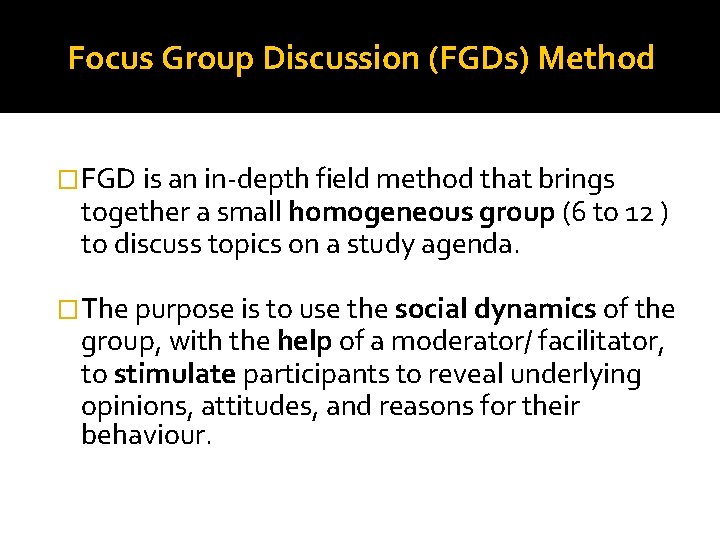
Focus Group Discussion (FGDs) Method �FGD is an in-depth field method that brings together a small homogeneous group (6 to 12 ) to discuss topics on a study agenda. �The purpose is to use the social dynamics of the group, with the help of a moderator/ facilitator, to stimulate participants to reveal underlying opinions, attitudes, and reasons for their behaviour.
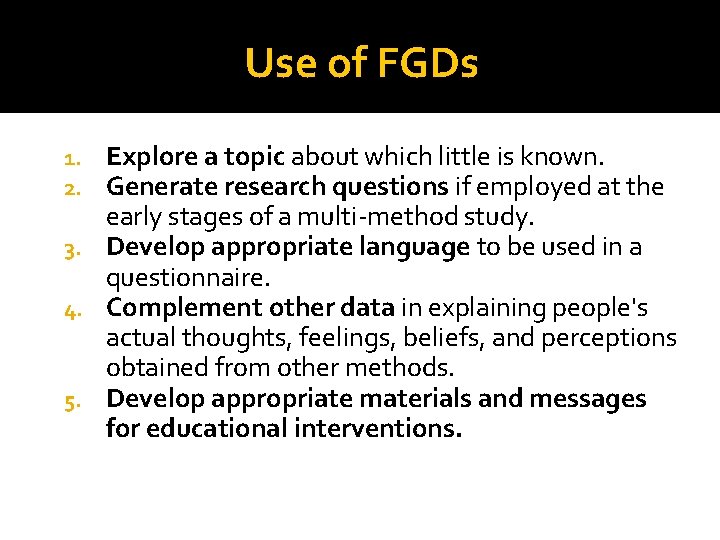
Use of FGDs Explore a topic about which little is known. Generate research questions if employed at the early stages of a multi-method study. 3. Develop appropriate language to be used in a questionnaire. 4. Complement other data in explaining people's actual thoughts, feelings, beliefs, and perceptions obtained from other methods. 5. Develop appropriate materials and messages for educational interventions. 1. 2.
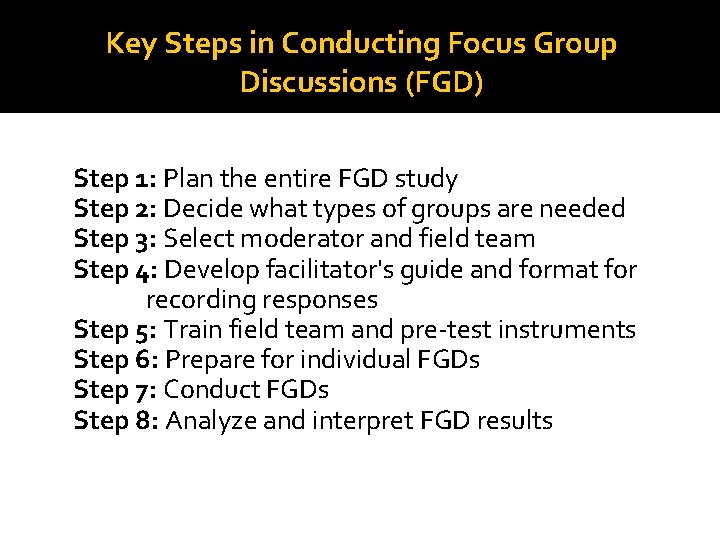
Key Steps in Conducting Focus Group Discussions (FGD) Step 1: Plan the entire FGD study Step 2: Decide what types of groups are needed Step 3: Select moderator and field team Step 4: Develop facilitator's guide and format for recording responses Step 5: Train field team and pre-test instruments Step 6: Prepare for individual FGDs Step 7: Conduct FGDs Step 8: Analyze and interpret FGD results
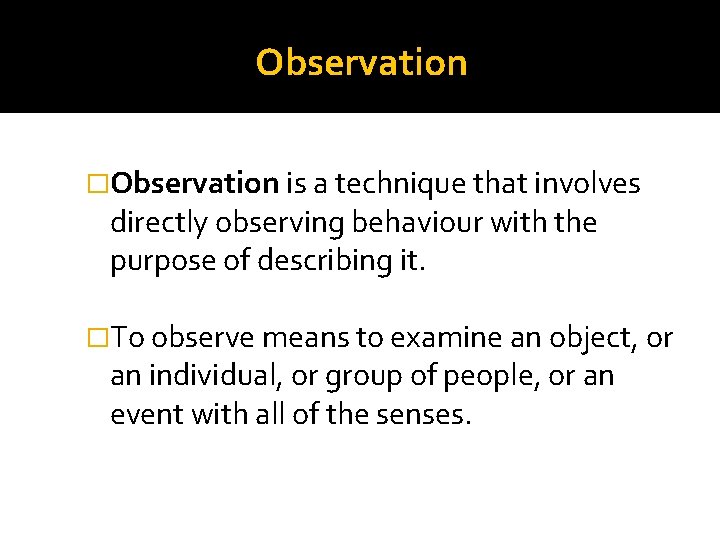
Observation �Observation is a technique that involves directly observing behaviour with the purpose of describing it. �To observe means to examine an object, or an individual, or group of people, or an event with all of the senses.
Type of Observation �Participant observation takes place when an observer participates with the people and in the events he or she is observing. �Non-participant observation occurs when an observer observes events without interacting with the person(s) being observed (structured or unstructured).
Structured vs Unstructured Observation �The aim of unstructured observation is to observe and record behaviour in a holistic way without the use of a pre-determined guide. �Structured observation refers to a technique in which an observer observes events using a guide that has been planned in advance.
Use of Structured Observation �To generate research hypotheses in pilot studies where very little is known about the problem. �To collect information not available in any other way, such as communication patterns during a provider-patient encounter. �To supplement other data as part of a multiple assessment approach where observation may aid in the interpretation of data.
Key Steps in Conducting Structured Observations � 1. Decide if a resource person is needed. � 2. Determine what is to be observed. � 3. Choose the observers. � 4. Develop observation guides. � 5. Select the setting for the observations. � 6. Train observers and pre test observation. � 7. Conduct the observations. � 8. Analyze and interpret the observational findings.
Thanks you and See you again !