
Qualitative Methods and their Application in Global Mental
Qualitative Methods and their Application in Global Mental Health and Migration Research Stevan M. Weine M. D. Professor of Psychiatry University of Illinois at Chicago

“I have two sons and a daughter. Sometimes when I remain alone I think about my life and about my family. It makes me sad and I want to leave Russia and go back home. I think that I don’t need this job and this money, I want to be just with my family, but real life doesn’t let me live as I want and do what I want to do. Sometimes one can hear that some Tajik guys were killed by nationalists and I think that the next can be me, and I’m always scared when I get out for work or any other places. Recently there were cases when even the policemen killed people; therefore I am scare of police too, because they also can beat or even kill the migrants. ” - Male Migrant

“I married him and after 2 months of living together he left me and went to Russia again in order to earn money. Before our wedding he was in Russia and earned money for our wedding, after our wedding he went to Moscow again to earn money. He sent us $100 in the first month when he arrived in Russia. We have a son, but my husband doesn’t take care of him, he didn’t call me, even our son was ill. After 3 months he came back and he stayed with us. It was terrible for me to be patient and live all these difficulties, but despite all of that, I couldn’t say something against him. He stayed with us during three months and then he came back again to Russia. During this time I was at the hospital with my son, I had no other way to find medication for my son and I ask my husband to send us money for the treatments. “I don’t need the money you will send us, please send at least to your son, who need you. ” I said to him, “My parents support me very well, but you’re my child’s father and you must take care of him. ” He answered that, “Yes, of course, tomorrow I will send you money. ” Believe me that until nowadays we don’t know anything about him, his telephone is off and there is not any information about him. ” - Wife of Migrant

Jasmina, age 13 • • • “What would have happened if there wasn’t a war. How would I live? I wouldn’t be living here. I would be living there all my life. And growing up as a real Bosnian and not in a foreign place. ” “This bear has been with me all my life. He went with me to Germany. He went with me on the airplane. He’s just been there all my life. I keep re-sewing him. He’s my pal. He’s going to be real old. ” She pointed to a large doll. “I like that doll because my grandfather gave it to me for Bajram. That doll reminds me of my grandfather because he passed away. Like his spirit is there. So he kind of keeps watching over me. ” Everyday when the kids get home from school, Jasmina’s, father sits and eats with them. Their mother, gets home later, at about 6: 00 p. m. Then, Jasmina says, “We are all together. ” I asked who does the cooking. “I do, ” said the father. “I have nothing else to do, so why not. ” Jasmina and her father and brother were watching a videotape one afternoon when I walked in. This was an important Bosnian singer who sang traditional songs. His cousins made the tape of a concert last summer and mailed it to them. The family has a lot of tapes about which Jasmina said, “I like to watch them. I’m very interested in that kind of music, as well as others – rock and roll, rap, and hip hop. ”
What if you planned to conduct a qualitative research project, wouldn’t it help… • To ensure that your data are rich and useful? • To be able to gather inductive data without getting lost in it? • To have systematic strategies for collecting your data that aid you in creating an original analysis?

Qualitative Methods Can Help You ► Gather rich data through guiding your data collection ► Get started in early data analysis ► Use flexible guidelines for managing your research ► Keep focusing your analysis to make it more original and useful
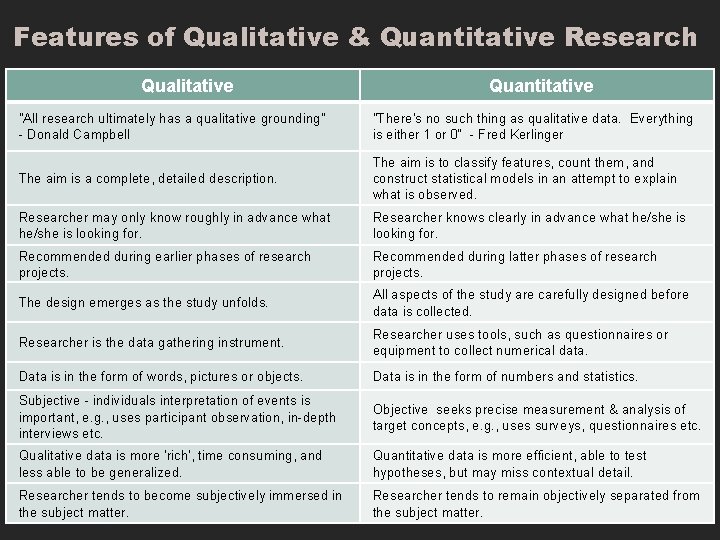
Features of Qualitative & Quantitative Research Qualitative Quantitative "All research ultimately has a qualitative grounding" - Donald Campbell "There's no such thing as qualitative data. Everything is either 1 or 0“ - Fred Kerlinger The aim is a complete, detailed description. The aim is to classify features, count them, and construct statistical models in an attempt to explain what is observed. Researcher may only know roughly in advance what he/she is looking for. Researcher knows clearly in advance what he/she is looking for. Recommended during earlier phases of research projects. Recommended during latter phases of research projects. The design emerges as the study unfolds. All aspects of the study are carefully designed before data is collected. Researcher is the data gathering instrument. Researcher uses tools, such as questionnaires or equipment to collect numerical data. Data is in the form of words, pictures or objects. Data is in the form of numbers and statistics. Subjective - individuals interpretation of events is important, e. g. , uses participant observation, in-depth interviews etc. Objective seeks precise measurement & analysis of target concepts, e. g. , uses surveys, questionnaires etc. Qualitative data is more 'rich', time consuming, and less able to be generalized. Quantitative data is more efficient, able to test hypotheses, but may miss contextual detail. Researcher tends to become subjectively immersed in the subject matter. Researcher tends to remain objectively separated from the subject matter.
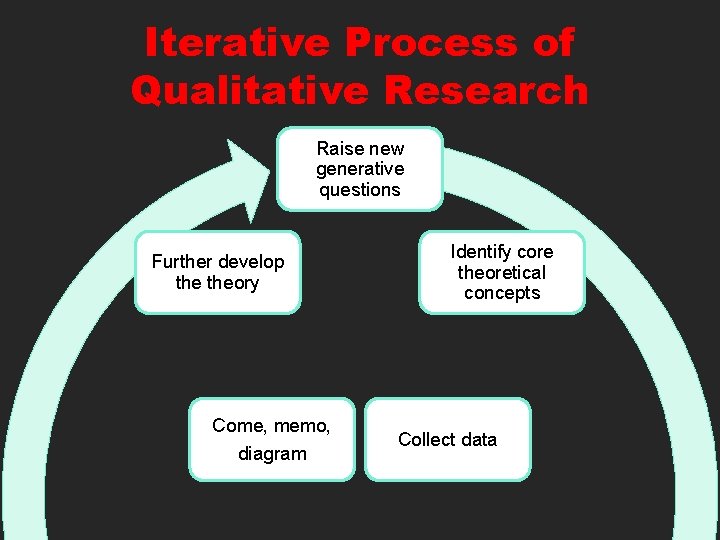
Iterative Process of Qualitative Research Raise new generative questions Further develop theory Come, memo, diagram Identify core theoretical concepts Collect data
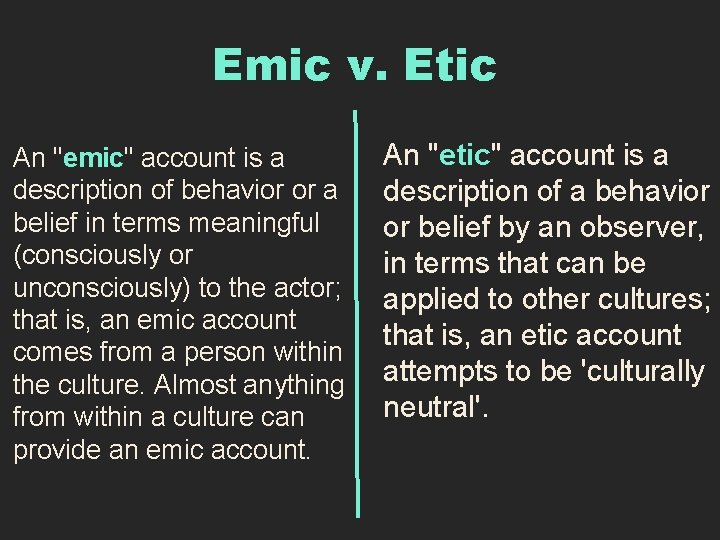
Emic v. Etic An "emic" account is a description of behavior or a belief in terms meaningful (consciously or unconsciously) to the actor; that is, an emic account comes from a person within the culture. Almost anything from within a culture can provide an emic account. An "etic" account is a description of a behavior or belief by an observer, in terms that can be applied to other cultures; that is, an etic account attempts to be 'culturally neutral'.
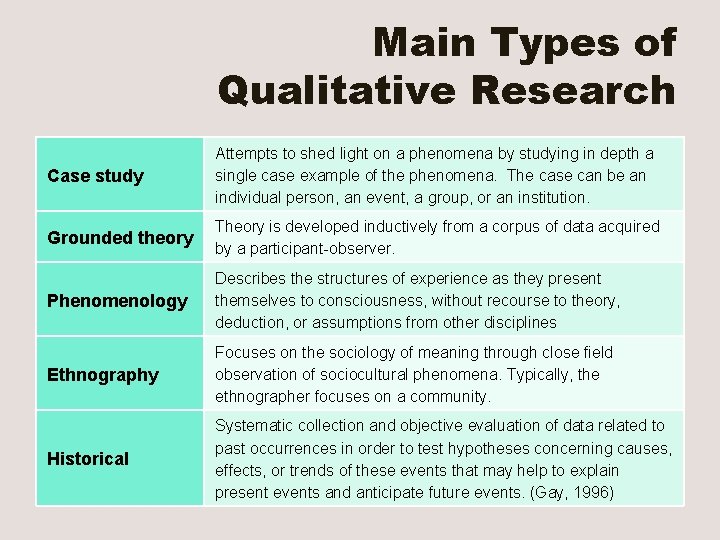
Main Types of Qualitative Research Case study Attempts to shed light on a phenomena by studying in depth a single case example of the phenomena. The case can be an individual person, an event, a group, or an institution. Grounded theory Theory is developed inductively from a corpus of data acquired by a participant-observer. Phenomenology Describes the structures of experience as they present themselves to consciousness, without recourse to theory, deduction, or assumptions from other disciplines Ethnography Focuses on the sociology of meaning through close field observation of sociocultural phenomena. Typically, the ethnographer focuses on a community. Historical Systematic collection and objective evaluation of data related to past occurrences in order to test hypotheses concerning causes, effects, or trends of these events that may help to explain present events and anticipate future events. (Gay, 1996)
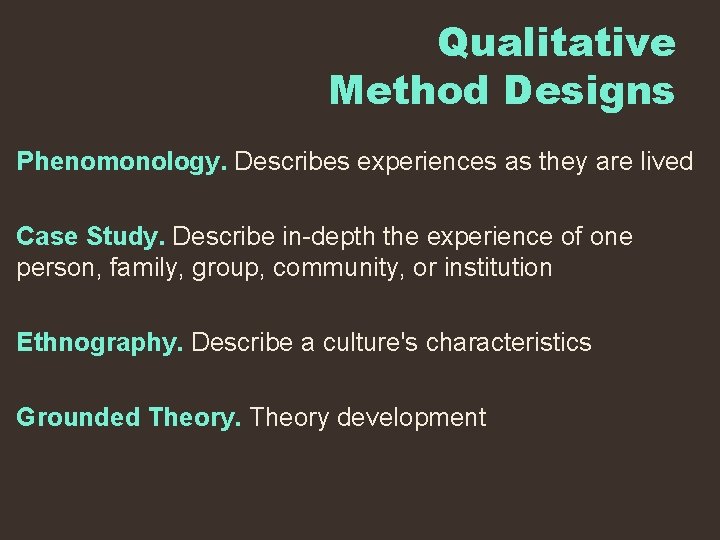
Qualitative Method Designs Phenomonology. Describes experiences as they are lived Case Study. Describe in-depth the experience of one person, family, group, community, or institution Ethnography. Describe a culture's characteristics Grounded Theory development
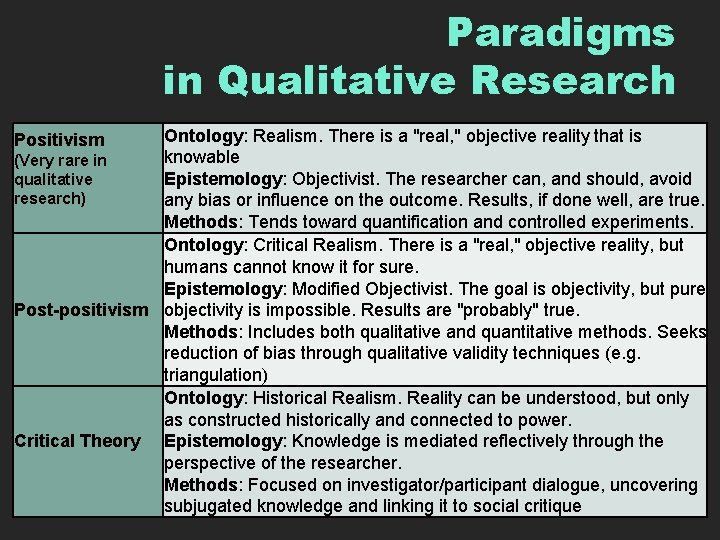
Paradigms in Qualitative Research Ontology: Realism. There is a "real, " objective reality that is knowable (Very rare in Epistemology: Objectivist. The researcher can, and should, avoid qualitative research) any bias or influence on the outcome. Results, if done well, are true. Methods: Tends toward quantification and controlled experiments. Ontology: Critical Realism. There is a "real, " objective reality, but humans cannot know it for sure. Epistemology: Modified Objectivist. The goal is objectivity, but pure Post-positivism objectivity is impossible. Results are "probably" true. Methods: Includes both qualitative and quantitative methods. Seeks reduction of bias through qualitative validity techniques (e. g. triangulation) Ontology: Historical Realism. Reality can be understood, but only as constructed historically and connected to power. Critical Theory Epistemology: Knowledge is mediated reflectively through the perspective of the researcher. Methods: Focused on investigator/participant dialogue, uncovering subjugated knowledge and linking it to social critique Positivism
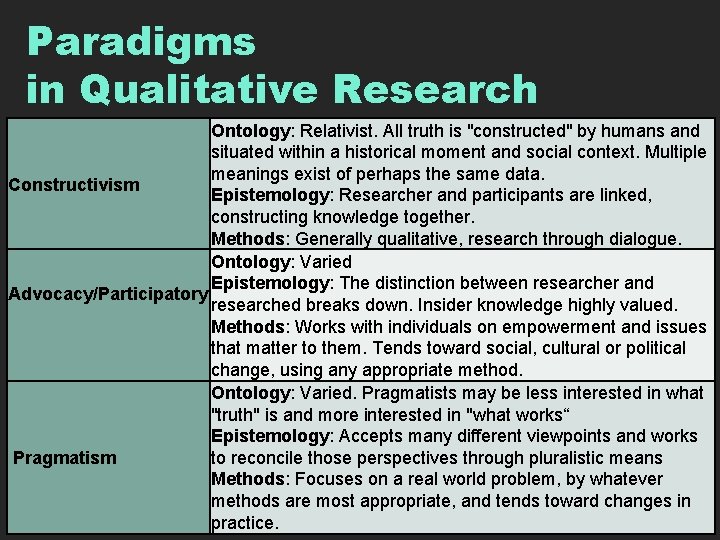
Paradigms in Qualitative Research Ontology: Relativist. All truth is "constructed" by humans and situated within a historical moment and social context. Multiple meanings exist of perhaps the same data. Constructivism Epistemology: Researcher and participants are linked, constructing knowledge together. Methods: Generally qualitative, research through dialogue. Ontology: Varied Epistemology: The distinction between researcher and Advocacy/Participatory researched breaks down. Insider knowledge highly valued. Methods: Works with individuals on empowerment and issues that matter to them. Tends toward social, cultural or political change, using any appropriate method. Ontology: Varied. Pragmatists may be less interested in what "truth" is and more interested in "what works“ Epistemology: Accepts many different viewpoints and works Pragmatism to reconcile those perspectives through pluralistic means Methods: Focuses on a real world problem, by whatever methods are most appropriate, and tends toward changes in practice.
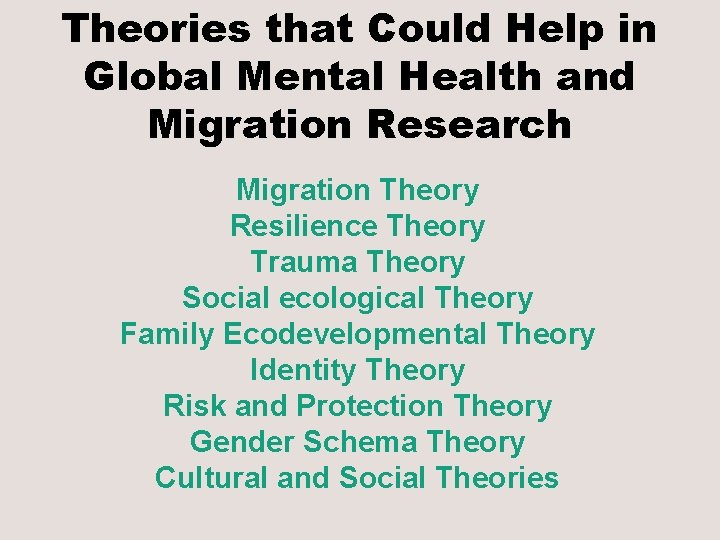
Theories that Could Help in Global Mental Health and Migration Research Migration Theory Resilience Theory Trauma Theory Social ecological Theory Family Ecodevelopmental Theory Identity Theory Risk and Protection Theory Gender Schema Theory Cultural and Social Theories
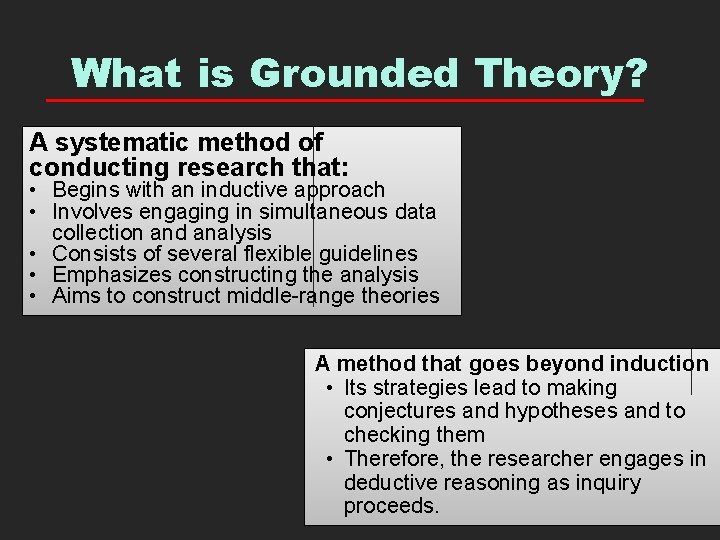
What is Grounded Theory? A systematic method of conducting research that: • Begins with an inductive approach • Involves engaging in simultaneous data collection and analysis • Consists of several flexible guidelines • Emphasizes constructing the analysis • Aims to construct middle-range theories A method that goes beyond induction • Its strategies lead to making conjectures and hypotheses and to checking them • Therefore, the researcher engages in deductive reasoning as inquiry proceeds.
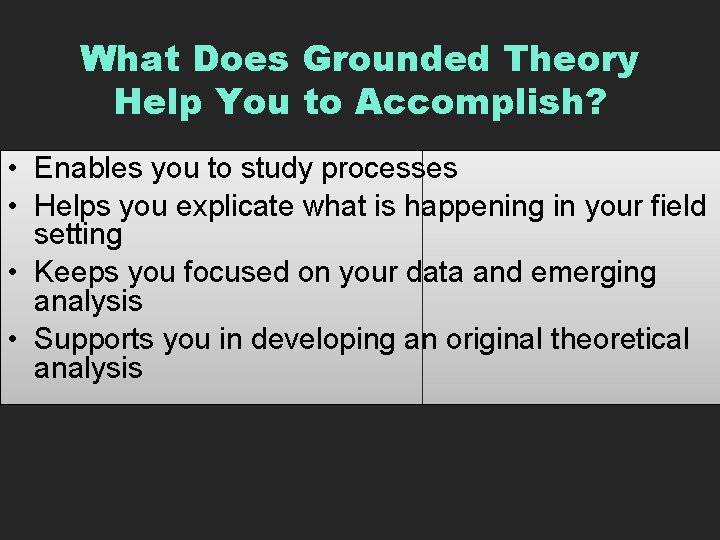
What Does Grounded Theory Help You to Accomplish? • Enables you to study processes • Helps you explicate what is happening in your field setting • Keeps you focused on your data and emerging analysis • Supports you in developing an original theoretical analysis
Purposive Sampling • Selecting participants from whom we are likely to be able to learn the most about the phenomenon under study • Ethnographic sampling approach stratifies the sample based upon “locally relevant forms of social stratification. ” • Maximum variation approach - selects a small number of units or cases that maximize the diversity relevant to the research question
Main Types of Qualitative Data Collection & Analysis Interactive Interviewing. People asked to verbally describe their experiences of phenomenon. Written descriptions by participants. People asked to write descriptions of their experiences of phenomenon. Observation. Descriptive observations of verbal and nonverbal behavior.
Data Collection 1. Minimally Structured Interviews 2. Observations 3. Focus Groups 4. Archival Material
#1 Minimally Structured Interviews These are discussions with study participants beginning with a small number of introductory questions such as, “What do you know about migration? ” The conversation proceeds in whatever direction allows the participant to speak most meaningfully to the research questions from his/her personal experience.
Sample Interview Guide Personal History: • How old are you? • What grade are you in? • Can you tell me a little bit about yourself? • What is the best part of your life?
Protection • Have you ever felt unsafe outside or inside your home? • In what way have you felt unsafe? • What do you do when you feel unsafe? • Has this changed since your father went away for work?
Follow-Up Probes • • How is that? In what ways? Tell me more about that? Would you be willing to give me an example of that? • How did that effect your decision? • How come? • I’m trying to understand how this is related to that.
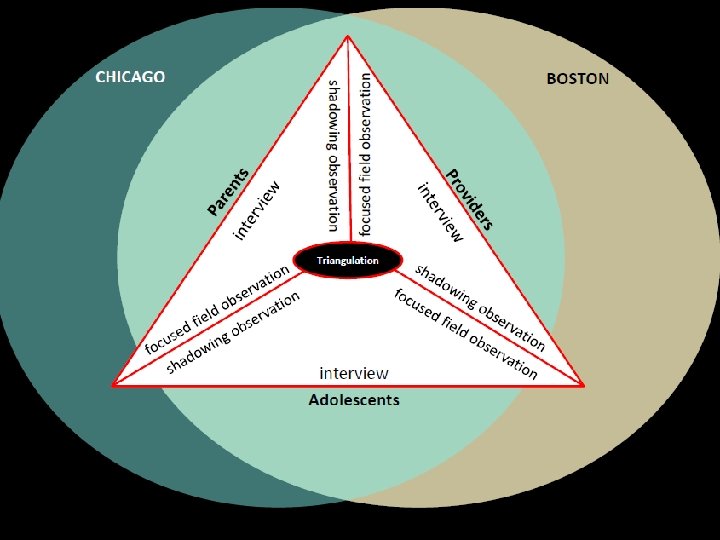
#2 Observations Participant observation: Field observations may be defined as, “a prolonged period of intense social interaction between the researcher and the informants, in the milieu of the latter, during which time data, in the form of field notes, are unobtrusively and systematically collected” Focused field observations: Involve observations that are focused on activities likely to shed light on the research questions Shadowing observation: Shadowing means the ethnographer will accompany the adolescent on his/her normal daily routine in a variety of sites (to include home, school, community, and services). Shadowing observations allow the ethnographers to directly witness the interactions between protective factors, protective mechanisms, outcomes, risks, culture, and service sectors over time.
Purposes of Observations • Is what people do the same as what they say they do? • Illustrates interactions among and between dyads/groups • Captures he whole picture • Depicts the physical environment • Illustrates processes
Field Notes “The ethnographer writes down in regular systematic ways what she observes and learns while participating in the daily rounds of life of others. Thus the researcher creates an accumulating written record of these observations and experiences. ”
#3 Focus Groups • “A carefully planned discussion designed to obtain perceptions on a defined area of interest in a permissive non-threatening environment. ” • Moderator & 6 -10 selected people
Qualitative Data Analysis The process in which we move from the raw data that have been collected as part of the research study and use it to provide explanations, understanding and interpretation of the phenomena, people and situations which we are studying. Involves such processes as coding, categorizing, and making sense of the essential meanings of the phenomenon.
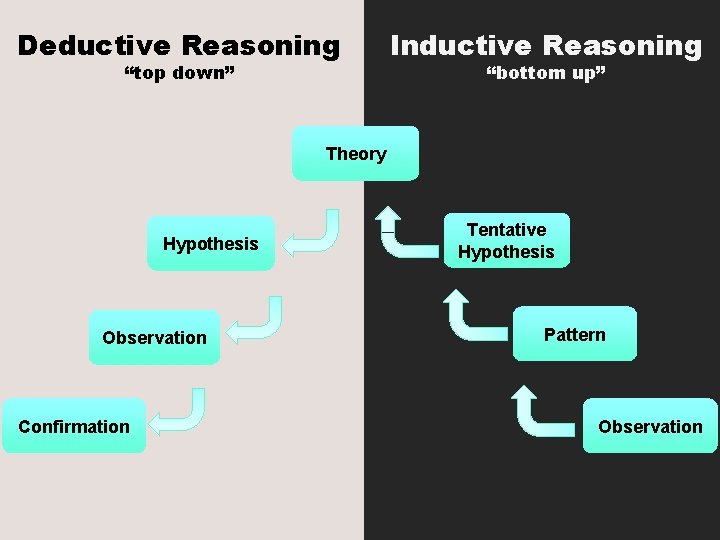
Deductive Reasoning “top down” Inductive Reasoning “bottom up” Theory Hypothesis Observation Confirmation Tentative Hypothesis Pattern Observation
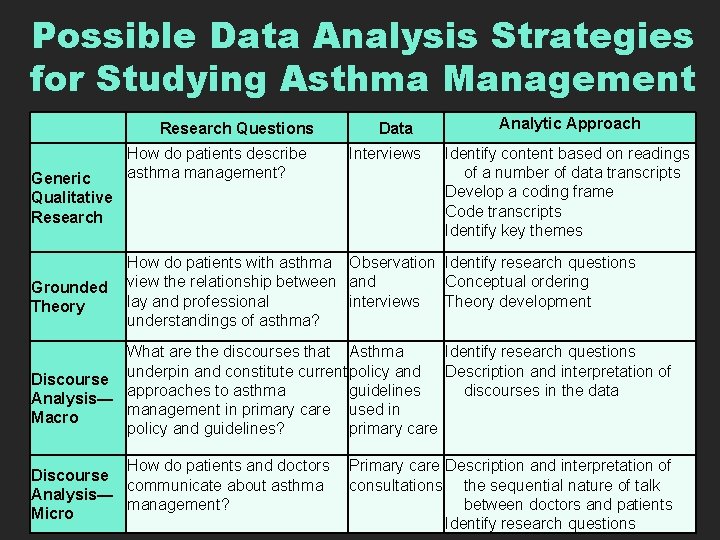
Possible Data Analysis Strategies for Studying Asthma Management Research Questions Generic Qualitative Research Grounded Theory How do patients describe asthma management? Data Interviews Analytic Approach Identify content based on readings of a number of data transcripts Develop a coding frame Code transcripts Identify key themes How do patients with asthma Observation Identify research questions view the relationship between and Conceptual ordering lay and professional interviews Theory development understandings of asthma? What are the discourses that Asthma Identify research questions underpin and constitute current policy and Description and interpretation of Discourse approaches to asthma guidelines discourses in the data Analysis— management in primary care used in Macro policy and guidelines? primary care How do patients and doctors Discourse communicate about asthma Analysis— management? Micro Primary care Description and interpretation of consultations the sequential nature of talk between doctors and patients Identify research questions
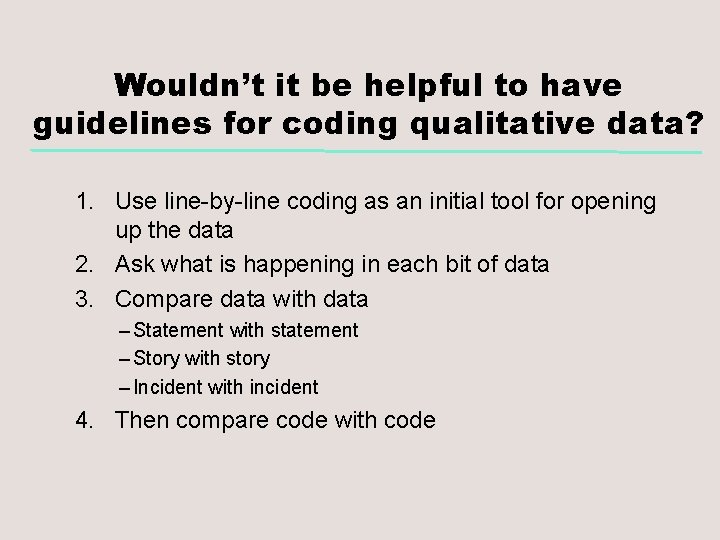
Wouldn’t it be helpful to have guidelines for coding qualitative data? 1. Use line-by-line coding as an initial tool for opening up the data 2. Ask what is happening in each bit of data 3. Compare data with data – Statement with statement – Story with story – Incident with incident 4. Then compare code with code
What is Constructivist Grounded Theory? It is a contemporary revision of Glaser and Strauss’s classic grounded theory that: • Assumes a relativist approach • Acknowledges multiple standpoints and realities of both the grounded theorist and the research participants • Takes a reflexive stance toward our actions, situations, and participants in the field setting, and constructions of them in our analyses.
How does constructivist grounded theory advance data collection? It fosters building explicit “what” and “how” questions into the data collection She said…, But, fortunately, I had the experience of at some point surrendering, you know. I asked, What does that mean to you, surrendering? She said, It means that I don't have, I can't control it and to look at what it has to teach me. Just, you know, let it tell me what it needs to tell me. You know, that willingness and that acceptance.
Where Does Constructivist GT Take Us? This approach leads us to: • Assume that we take as “real” is problematic— and that our analyses are interpretive • Look for multiple definitions of reality • Pay close attention to language—and action • Examine how experience is constituted and structures are enacted
Atlas/ti Software • Software that assists in the process of qualitatively analyzing research data. • Data collected through unstructured or semi-structured methods of data collection. • The researcher is in control of the analysis process.
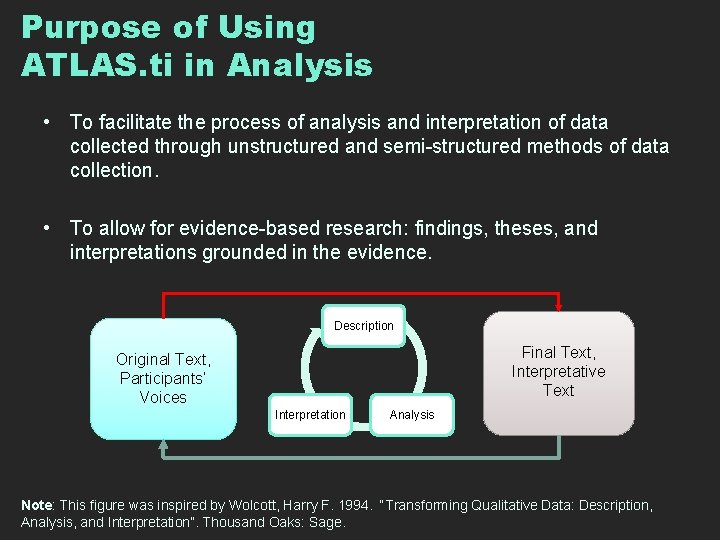
Purpose of Using ATLAS. ti in Analysis • To facilitate the process of analysis and interpretation of data collected through unstructured and semi-structured methods of data collection. • To allow for evidence-based research: findings, theses, and interpretations grounded in the evidence. Description Final Text, Interpretative Text Original Text, Participants’ Voices Interpretation Analysis Note: This figure was inspired by Wolcott, Harry F. 1994. “Transforming Qualitative Data: Description, Analysis, and Interpretation”. Thousand Oaks: Sage.
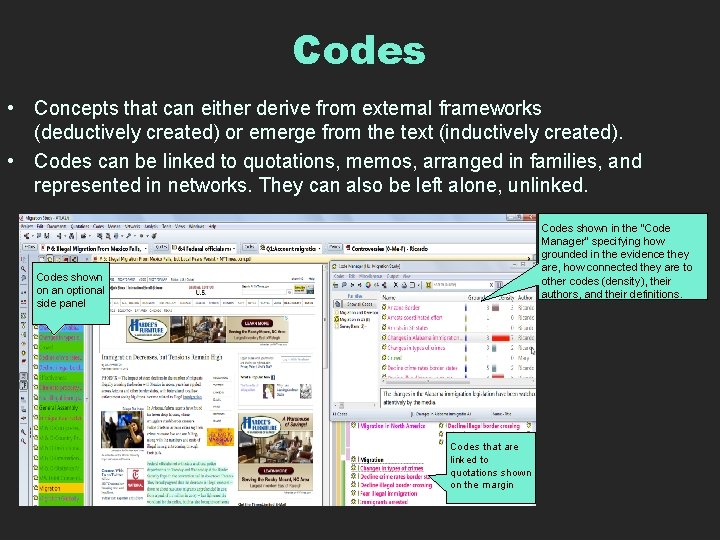
Codes • Concepts that can either derive from external frameworks (deductively created) or emerge from the text (inductively created). • Codes can be linked to quotations, memos, arranged in families, and represented in networks. They can also be left alone, unlinked. Codes shown in the “Code Manager” specifying how grounded in the evidence they are, how connected they are to other codes (density), their authors, and their definitions. Codes shown on an optional side panel Codes that are linked to quotations shown on the margin
Why Code? ► ► ► Minimize data overload Useful in identifying themes and patterns Can be used with many other methods ► ethnography, interviews, surveys, discourse analysis, focus groups
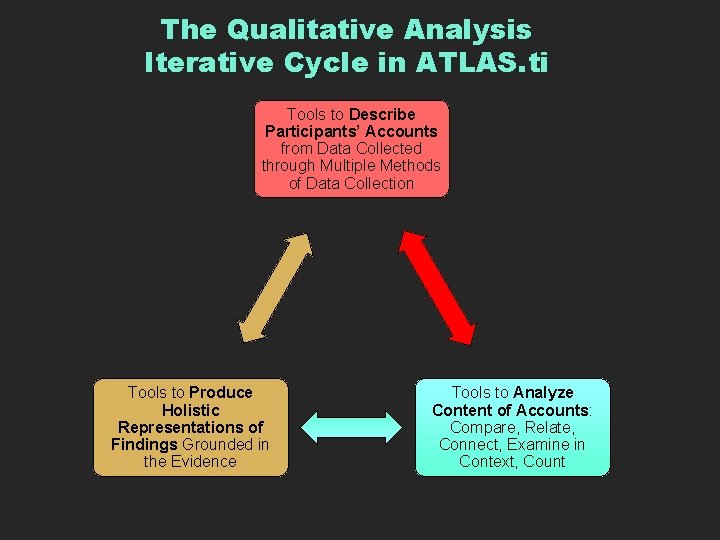
The Qualitative Analysis Iterative Cycle in ATLAS. ti Tools to Describe Participants’ Accounts from Data Collected through Multiple Methods of Data Collection Tools to Produce Holistic Representations of Findings Grounded in the Evidence Tools to Analyze Content of Accounts: Compare, Relate, Connect, Examine in Context, Count
Focus on Ethnographic Interviewing

Use of Figures and Tables in Writing Qualitative Research Results
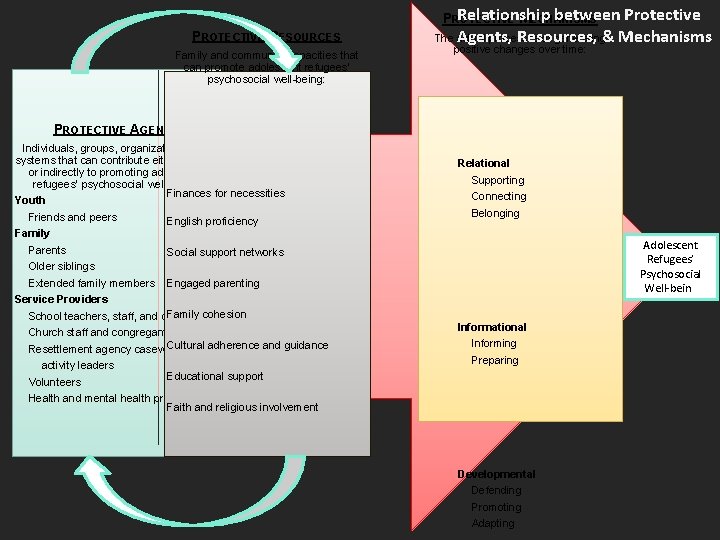
Relationship between Protective PROTECTIVE MECHANISMS PROTECTIVE RESOURCES Family and community capacities that can promote adolescent refugees’ psychosocial well-being: Agents, Resources, & Mechanisms The actual processes of generating positive changes over time: PROTECTIVE AGENTS Individuals, groups, organizations, and systems that can contribute either directly or indirectly to promoting adolescent refugees’ psychosocial well-being: Finances for necessities Youth Friends and peers English proficiency Family Parents Social support networks Older siblings Extended family members Engaged parenting Service Providers Family cohesion School teachers, staff, and coaches Church staff and congregants Cultural adherence and guidance Resettlement agency caseworkers and activity leaders Educational support Volunteers Health and mental health providers Faith and religious involvement Relational Supporting Connecting Belonging Adolescent Refugees’ Psychosocial Well-being Informational Informing Preparing Developmental Defending Promoting Adapting
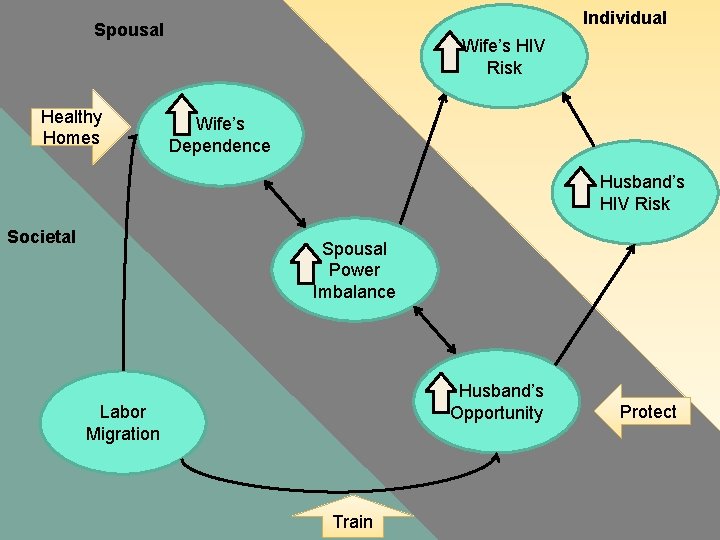
Individual Spousal Healthy Homes Wife’s HIV Risk Wife’s Dependence Husband’s HIV Risk Societal Spousal Power Imbalance Husband’s Opportunity Labor Migration Train Protect

Future Directions
Collaborative Partnerships Engage with migrant sending and diaspora organizations and communities through participatory research and capacity building. The process of working with communities is as or more important than the outcomes.
Transdisciplinary Teams Form transdisciplinary research teams that can address the inherent multidimensional complexity of migration amidst multiple adversities, resiliencies, and transitions.
Theory Development Incorporate multiple diverse theories and further develop new theories so as to explain the key problem or question at hand, such as multi-level changes in relation to migration.
Innovative Designs Devise innovative mixed methods research designs for migration that go beyond just sending or receiving country, and which utilize comparative approaches (e. g. people and places).
Local Resilience Investigate resilience to adversities in local contexts so as to better understand: Which acts of building resilience work with who, under what circumstances, and why?

- Slides: 57