
Qualitative Data Collection Accuracy Credibility Dependability Qualitative Data
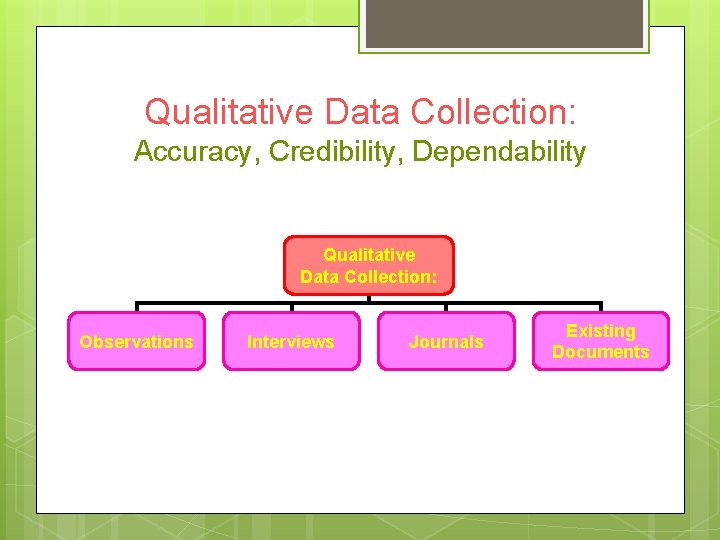
Qualitative Data Collection: Accuracy, Credibility, Dependability Qualitative Data Collection: Observations Interviews Journals Existing Documents
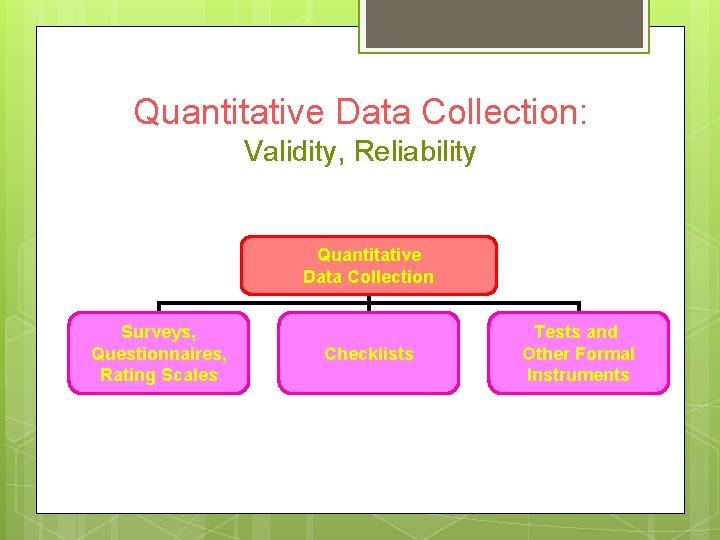
Quantitative Data Collection: Validity, Reliability Quantitative Data Collection Surveys, Questionnaires, Rating Scales Checklists Tests and Other Formal Instruments
Qualitative Data Collection: Observations � Observation: carefully watching, systematically recording what is seen and heard in a particular setting ( Schmuck, 1997). � Structured Observation: observer is looking for specific behaviors, reactions, or interactions. � Unstructured, Semi-structured: observer flexible. May engage in brief, intense periods of observation, note-taking.
Qualitative Data Collection: Observations Field notes: two columns: (1) Observations, (2) Comments, interpretations, meanings. Observation Limitations: Effects of observer, large volume, variance between observers. "Write what you See": most effective way to observe. Videotaping? Later transcription? Patterns?
Qualitative Data Collection: Interviews � Interviews: Teacher/researcher questions posed to study participants: formal, informal. � Individual, Group Interviews, Focus Groups. � Interview Guide: Specific or general questions to be asked prior to interview. � Structured Interview: Pre-determined ? ? � Semi-structured Interview: Base questions. � Open-ended Interviews: Few, broad ? ? ?
Qualitative Data Collection: Journals Data Journals: kept by teachers or students. Student Journals: daily thoughts, perceptions, experiences. Teacher Journals: narrative accounts of personal reflections on professional practice. Class Journal: blank notebook passed around in class or in learning center.
Qualitative Data Collection: Existing Documents and Records � Existing Records: Curriculum materials, textbooks, reports, projects, test scores, grades, discipline records, portfolios. � Data: Retention rates, attendance, graduation rates, socioeconomic data, etc. � Other: Meeting minutes, newspaper stories, standardized test reports, discipline referrals, classroom artifacts. � Caution: Ethical use. Student privacy.
Qualitative Data Collection: Accuracy, Credibility, Dependability � Data Quality: accurate recording, organized processes, match between data gathered and research question. � Triangulation: Multiple data sources. � Member Checking: Sharing interview transcripts, comments, w/ study participants. � Prolonged Engagement, Persistent Observation: 'thick-description', not 'thin'.
Quantitative Data Collection: Surveys, Questionnaires, Rating Scales � Survey Design: Open-ended questions? Multiple Choice? Likert Scale? � Age - Appropriate? � Design affects Data: Consider implications. � Self-assessment. � Focus: Each item focuses on single concept. � Brevity: Each question, clear, necessary. � Unbiased: No leading questions.
Quantitative Data-Gathering: Tests, Checklists, Surveys: Formal Tests, Existing Records: Can be used 'quantitatively' too. Checklists. Pre-Tests, Post-Tests: Specifically designed for study. Standardized Tests: Standardized 'Surveys‘: developed for specific purposes.
Quantitative Data: Checklists Surveys: Formal Tests, Existing Records: Can be used 'quantitatively' too. Checklists. Pre-Tests, Post-Tests: Specifically designed for study. Standardized Tests: Standardized 'Surveys‘: developed for specific purposes.
Quantitative Data Collection: Validity, Reliability � Validity: degree to which all accumulated evidence matches intended interpretation (p. 111, AERA, APA & NCME, 1999). � Reliability: consistency of connected data. � Internal Consistency: statistical estimate of data reliability: � Kuder-Richardson formula 21: or KR-21 r = (K) (SD)2 - M(K - M) (SD)2 (K - 1)
References: 1) Mertler, C. A. (2012). Action Research: Improving Schools and Empowering Educators, 3 rd ed. Los Angeles, CA: Sage Publishers, pp. 119 – 154.
- Slides: 13