
Qualitative Data Archive at the Institute of Philosophy
- Slides: 10
Qualitative Data Archive at the Institute of Philosophy and Sociology of the Polish Academy of Sciences https: //adj. ifispan. pl/ Piotr Filipkowski 18. 03. 2021
About the Archive – the Qualitative Data Archive collects, digitizes and makes available qualitative research data within the broad field of social sciences. – established in 2012 – key inspirations: oral history, biographical research, Polish tradition of „humanistic sociology” Qualitative Data Archive at the Institute of Philosophy and Sociology of the Polish Academy of Sciences – www. adj. ifispan. pl
Our goals • Preserving research materials against loss, scattering or destruction • Providing insight into original empirical data • Promoting: Ø secondary analysis of data and research revisits Ø undertaking a historical-methodological reflection Ø studying the longevity and inter-generational transmission of researcher’s skills and tools Ø using original empirical data in academic teaching Qualitative Data Archive at the Institute of Philosophy and Sociology of the Polish Academy of Sciences – www. adj. ifispan. pl
guiding principle (so far): quality over quantity Qualitative Data Archive at the Institute of Philosophy and Sociology of the Polish Academy of Sciences – www. adj. ifispan. pl
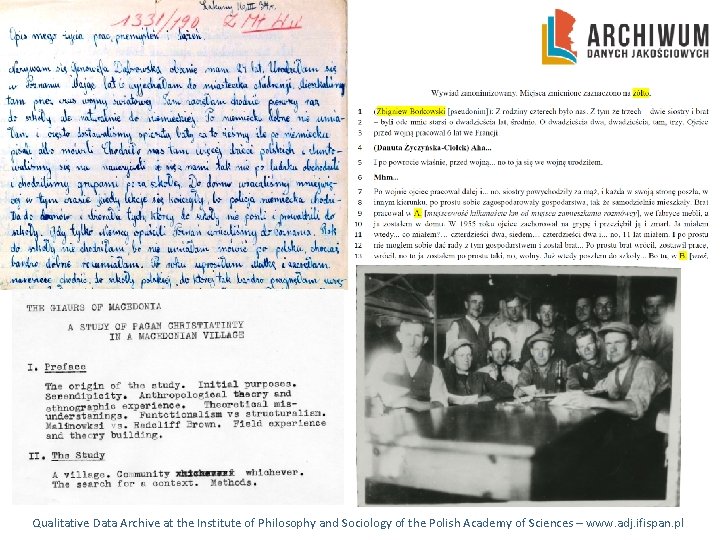
What do we have? The Archive collects digitized research materials such as: • interview transcripts • audio recordings • photos • field notes • first drafts of studies • research tools (e. g. research guidelines, questionnaires) Qualitative Data Archive at the Institute of Philosophy and Sociology of the Polish Academy of Sciences – www. adj. ifispan. pl
Qualitative Data Archive at the Institute of Philosophy and Sociology of the Polish Academy of Sciences – www. adj. ifispan. pl
Some of our Collections • Józef Obrębski’s Macedonia Research from 1932– 1933 • Józef Obrębski’s Polesie Research from 1934– 1937 • Peasant Autobiographies from the 1930 s (materials from a diary competition organized by the National Institute of Rural Culture) • Lifestyles in Polish Cities (Andrzej Siciński’s research from 1976– 1980) • Biography and National Identity (Zbigniew Bokszański’s research from 1992– 1994) • Old and New Forms of Poverty: The Lifestyles of Poor Families (Elżbieta Tarkowska’s research from 1997– 1998) • Changes in Poles’ Lifestyles (Hanna Palska’s research from 1999– 2000) • Life Strategies of Workers in Poland’s New Capitalism (Adam Mrozowicki’s research from 2001– 2004) • Businesspeople (Markieta Domecka’s research from 2002– 2004) • Two collections of interviews with respondents of the Polish Panel Survey POLPAN (Piotr Filipkowski’s research from 2014 and Danuta Życzyńska-Ciołek’s research from 2016) • Immigrant Entrepreneurship in Poland (Katarzyna Andrejuk’s research from 2014– 2017) Qualitative Data Archive at the Institute of Philosophy and Sociology of the Polish Academy of Sciences – www. adj. ifispan. pl
Access to data • • online free of charge for research purposes in anonymized form • sometimes with additional restrictions • so far: highly individulized, personalized, contextualised. . . • from now on: https: //rds. icm. edu. pl/dataverse/adj professionalized, standardized, re- (de-)contextualised. . . Qualitative Data Archive at the Institute of Philosophy and Sociology of the Polish Academy of Sciences – www. adj. ifispan. pl
Open question: What future of qualitative social research are we contributing to? Qualitative Data Archive at the Institute of Philosophy and Sociology of the Polish Academy of Sciences – www. adj. ifispan. pl
thank you Qualitative Data Archive at the Institute of Philosophy and Sociology of the Polish Academy of Sciences – www. adj. ifispan. pl