
Qualitative Analysis Test for Carbohydrates Objectives General information
Qualitative Analysis Test for Carbohydrates
Objectives: • • • General information about Carbohydrates. To differentiate between Carbohydrates. Qualitative analysis of Carbohydrates.
Qualitative Analysis Test • Is concerned with determining, the identity of a substance. • Enables us to detect the presence of things which may be beyond the reach of our senses.
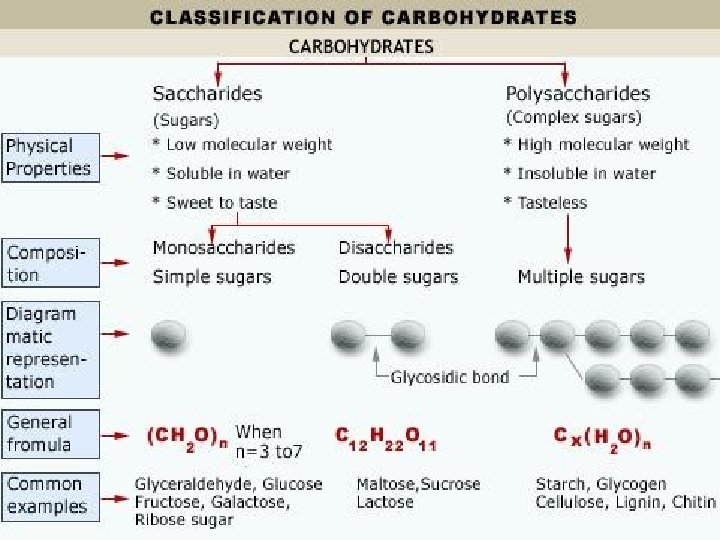
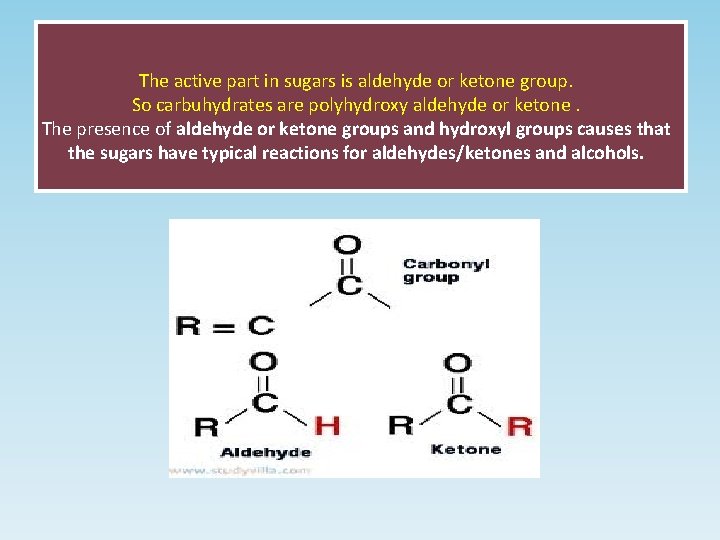
The active part in sugars is aldehyde or ketone group. So carbuhydrates are polyhydroxy aldehyde or ketone. The presence of aldehyde or ketone groups and hydroxyl groups causes that the sugars have typical reactions for aldehydes/ketones and alcohols.
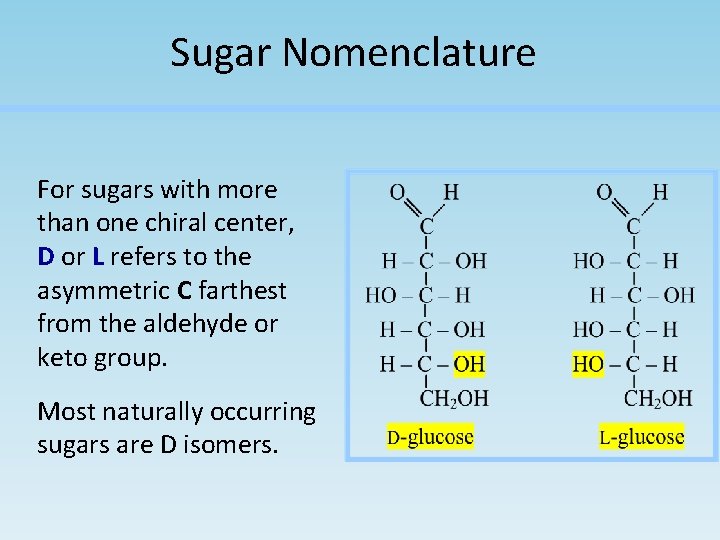
Sugar Nomenclature For sugars with more than one chiral center, D or L refers to the asymmetric C farthest from the aldehyde or keto group. Most naturally occurring sugars are D isomers.
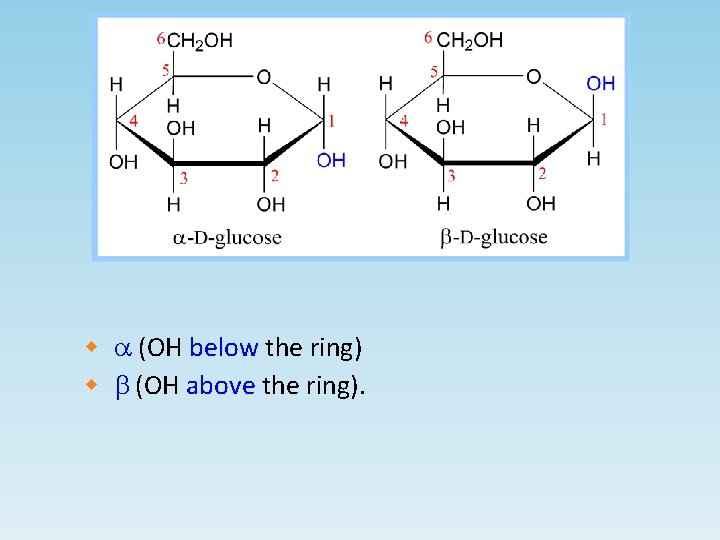
w a (OH below the ring) w b (OH above the ring).
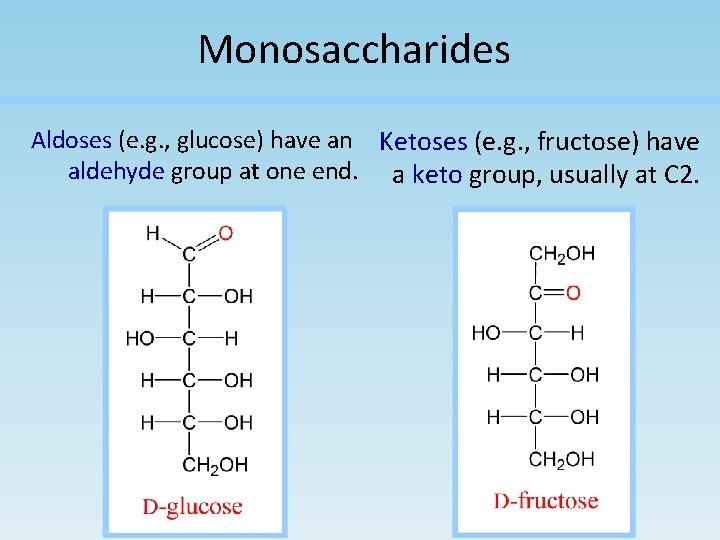
Monosaccharides Aldoses (e. g. , glucose) have an Ketoses (e. g. , fructose) have aldehyde group at one end. a keto group, usually at C 2.
Classification upon reducing end 1. Reducing Sugars Oxidation: loss of electrons Reduction: gain of electrons Have aldehyde group Sugars that can be oxidized by mild oxidizing agents and the oxidizing agent is reduced in the reaction. ( Can be oxidized to acid, Reduces another compound) • All monosaccharides • Maltose, Lactose • •
• A reducing sugar is a carbohydrate possessing either a free aldehyde or free ketone functional group as part of its molecular structure. A functional groups are the regions of a molecule that gives it particular properties. A single molecule can have more than one functional group as part of its structure.
• All of the monosaccharides and most of the disaccharides can be oxidized. • Sugars exist in solution as an equilibrium mixture of open-chain and closed-ring (or cyclic) structures. • All monosaccharides have an open and closed form structure, but oligosaccharides have only closed structure. • When the cyclic structure opens, the aldehyde group is available for oxidation.
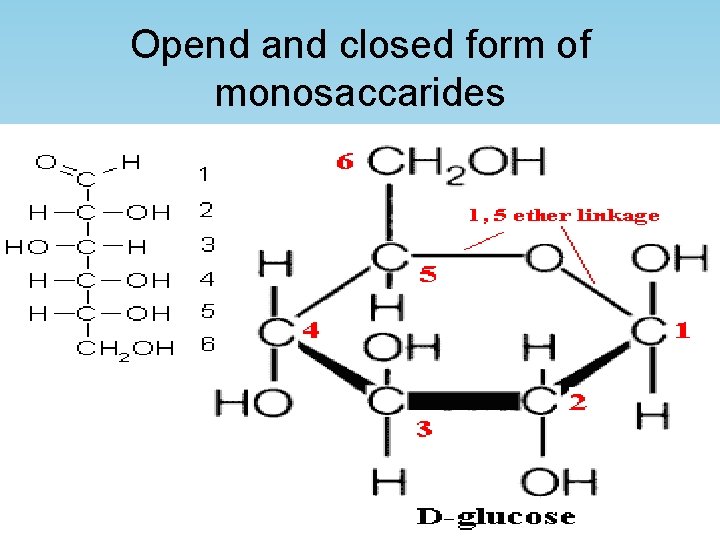
Opend and closed form of monosaccarides
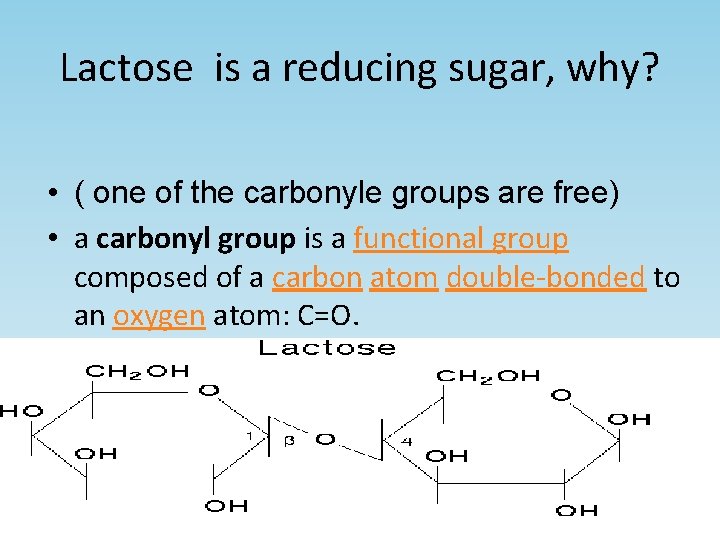
Lactose is a reducing sugar, why? • ( one of the carbonyle groups are free) • a carbonyl group is a functional group composed of a carbon atom double-bonded to an oxygen atom: C=O.
2. NON Reducing Sugars • is not oxidized by mild oxidizing agents. • Sucrose • All polysaccharides
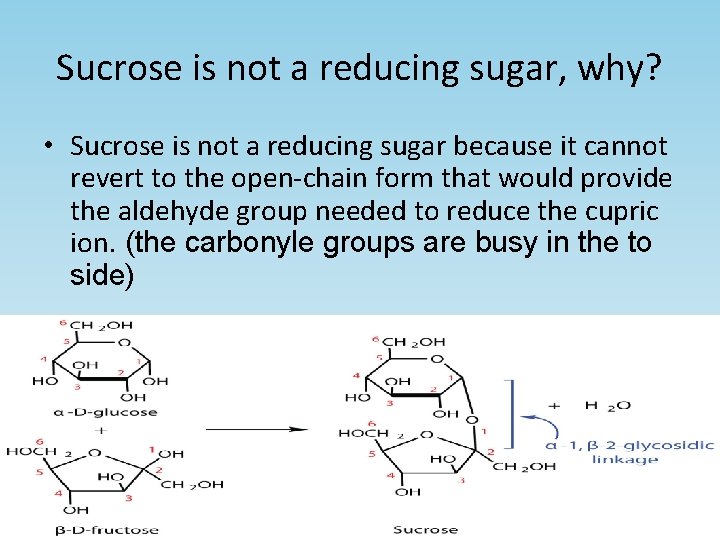
Sucrose is not a reducing sugar, why? • Sucrose is not a reducing sugar because it cannot revert to the open-chain form that would provide the aldehyde group needed to reduce the cupric ion. (the carbonyle groups are busy in the to side)
• Common oxidizing agents used to test for the presence of a reducing sugar are: Benedict's solution, Fehling's solution and picric acid solution. • An oxidizing agent (also called an oxidizer or oxidant) is referred to as a chemical compound that readily transfers oxygen atoms or a substance that gains electrons in a redox chemical reaction. • Aldose(glucose) ---- oxidation ----- carboxylate • Ketose(fructose) ----- oxidation----- hydroxyl carboxylate
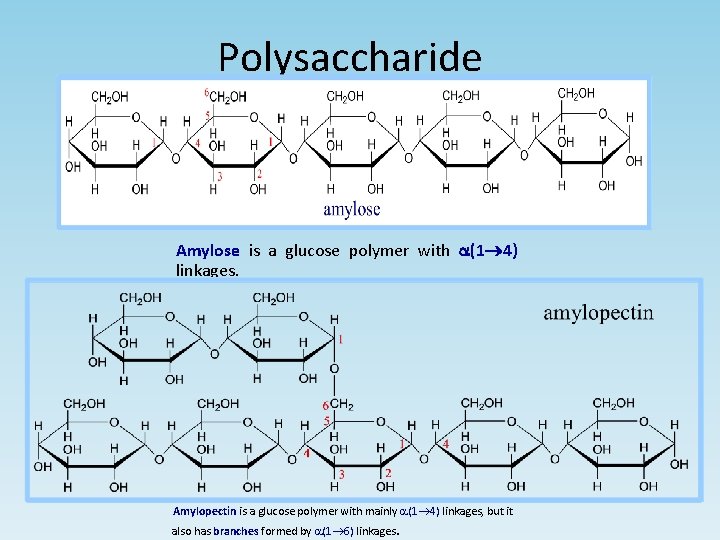
Polysaccharide Amylose is a glucose polymer with a(1 4) linkages. Amylopectin is a glucose polymer with mainly a(1 4) linkages, but it also has branches formed by a(1 6) linkages.
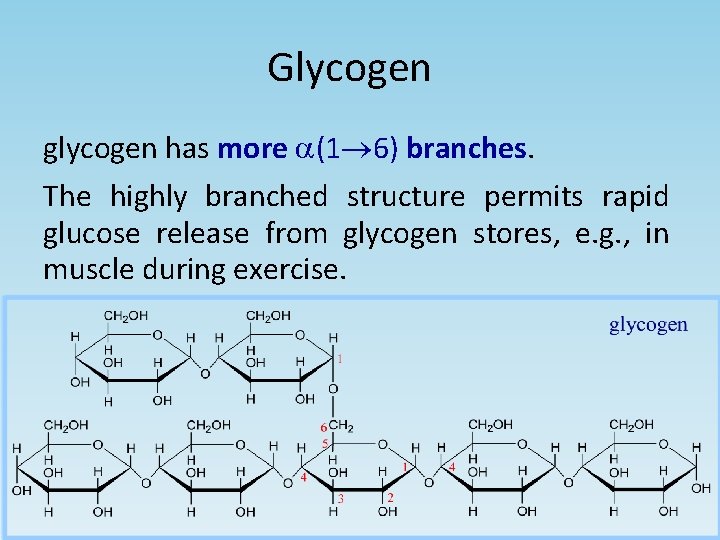
Glycogen glycogen has more a(1 6) branches. The highly branched structure permits rapid glucose release from glycogen stores, e. g. , in muscle during exercise.
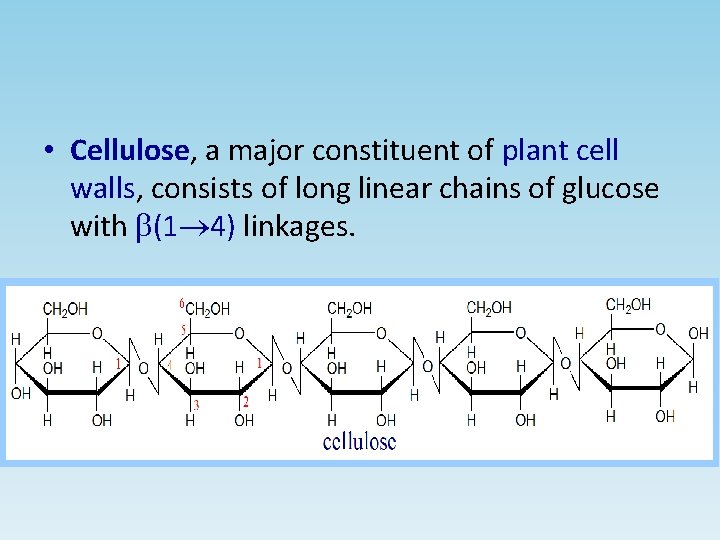
• Cellulose, a major constituent of plant cell walls, consists of long linear chains of glucose with b(1 4) linkages.

1. Benedict's Test (positive for reducing sugars) • Principle: sodium citrate, sodium carbonate , Cu. SO 4. 5 H 2 O solution. cupric ions, which in an alkaline environment, oxidize the aldehyde group to a carboxylic acid. Cupric ions are reduced to cuprous oxide, which forms a red precipitate RCHO + 2 Cu 2+ + 4 OH- ----> RCOOH + Cu 2 O + 2 H 2 O • The color of the precipitate varies from green to gold to red depending on • the concentration of the reducing sugar.
Procedure 1. Place 1 m. L of the following 1% carbohydrate solutions in separate, labeled test tubes: glucose, fructose, sucrose, lactose, maltose, and starch. 2. Also place 1 ml of distilled water in another tube to serve as a control. 3. To each tube, add 1 ml of Benedict's reagent and heat the tubes in a boiling water bath for 5 minutes. 4. Remove the tubes from water bath. Note and record the results. v In the presence of a reducing sugar a precipitate which may be red, yellow or green will form.
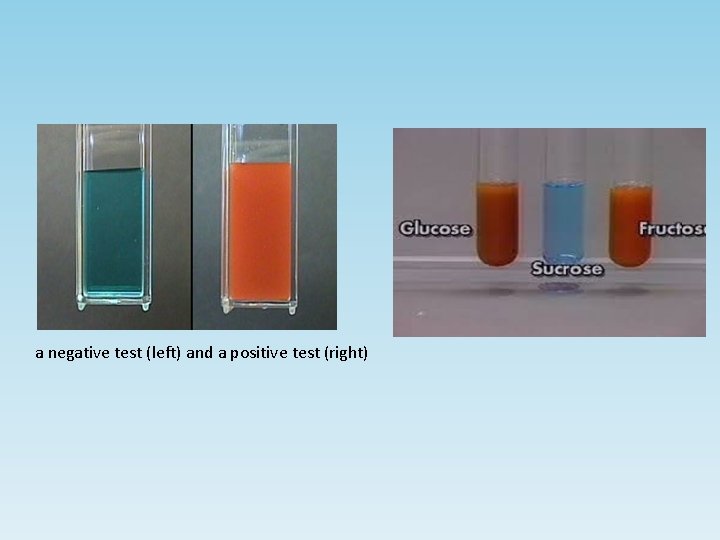
a negative test (left) and a positive test (right)
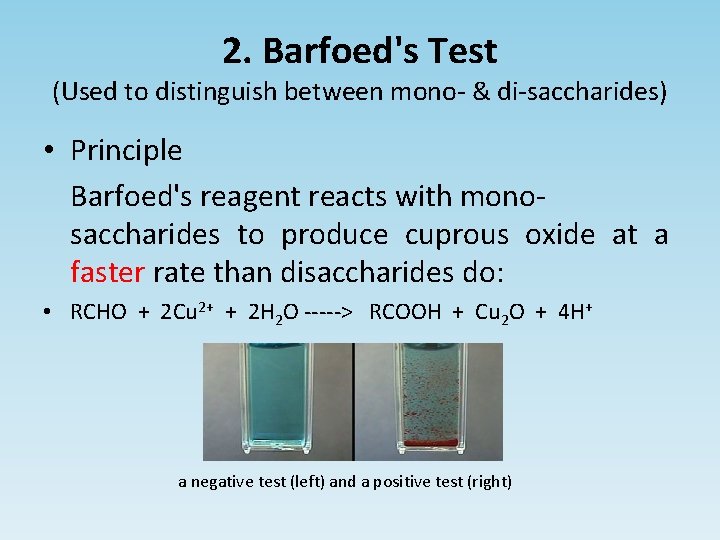
2. Barfoed's Test (Used to distinguish between mono- & di-saccharides) • Principle Barfoed's reagent reacts with monosaccharides to produce cuprous oxide at a faster rate than disaccharides do: • RCHO + 2 Cu 2+ + 2 H 2 O -----> RCOOH + Cu 2 O + 4 H+ a negative test (left) and a positive test (right)
Procedure 1. Place 1 m. L of the following 1% carbohydrate solutions in separate, labeled test tubes: glucose, fructose, sucrose, lactose, and maltose. 2. To each tube, add 1 ml of Barfoed's reagent, and heat in a boiling water bath for 10 minutes. 3. Remove the tubes from water bath. Note and record your observations. v A red precipitate will form if the test is positive.
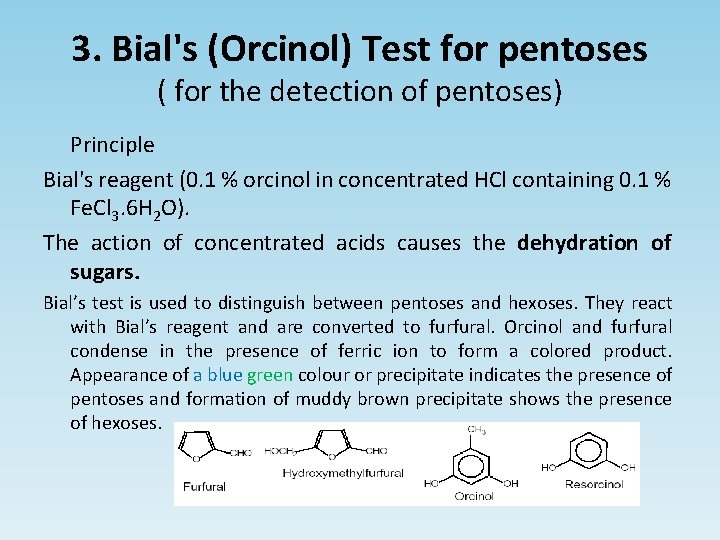
3. Bial's (Orcinol) Test for pentoses ( for the detection of pentoses) Principle Bial's reagent (0. 1 % orcinol in concentrated HCl containing 0. 1 % Fe. Cl 3. 6 H 2 O). The action of concentrated acids causes the dehydration of sugars. Bial’s test is used to distinguish between pentoses and hexoses. They react with Bial’s reagent and are converted to furfural. Orcinol and furfural condense in the presence of ferric ion to form a colored product. Appearance of a blue green colour or precipitate indicates the presence of pentoses and formation of muddy brown precipitate shows the presence of hexoses.
Procedure 1. Add about 1 ml of 1% xylose, glucose, fructose, maltose, arabinose, and xylose solution to their respective labeled test tubes. 2. Add 1. 5 ml of Bial's reagent to each tube and mix well. 3. Carefully heat each tube (with some agitation) directly over the burner flame. Hold the tube at a diagonal and heat along the sides of the tube rather than at the bottom to prevent eruption of the liquid from the tube. Move the tube diagonally in and out of the flame, until the mixture just begins to boil. Stop heating when the mixture begins to boil. v A blue-green color indicates a positive result. Prolonged heating of some hexoses yields hydroxymethyl furfural which also reacts with orcinol to give colored complexes.
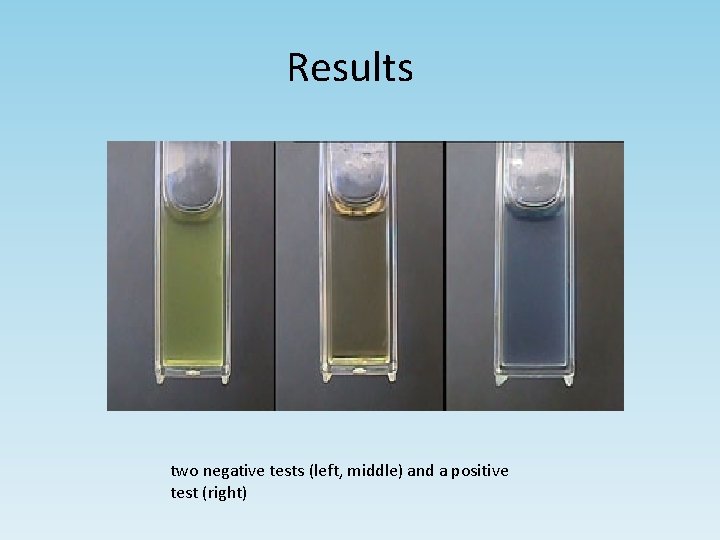
Results two negative tests (left, middle) and a positive test (right)
4. Seliwanoff's (Resorcinol) Test (used for detection of Ketoses) Principle • Seliwanoff’s test is used to distinguish between hexoses with a ketone group and hexoses that are aldehydes. • With ketoses, a deep red color is formed rapidly. • Aldoses give a light pink color that takes a longer time to develop. • The test is most sensitive for fructose, which is a ketose. Ketohexoses (such as fructose) and disaccharides containing a ketohexose (such as sucrose) form a cherryred condensation product. Other sugars (e. g. aldose) may produce yellow to faint pink colors.
• Seliwanoff's reagent (0. 5 % resorcinol in 3 N HCl). • It is a color reaction specific for ketoses. • When conce: HCl is added. ketoses undergo dehydration to yield furfural derivatives more rapidly than aldoses. • These derivatives form complexes with resorcinol to yield deep red color. • The test reagent causes the dehydration of ketohexoses to form 5 -hydroxymethylfurfural reacts with resorcinol present in the test reagent to produce a red product within two minutes (reaction not shown). • Aldohexoses reacts so more slowly to form the same product.
Procedure 1. Add about 3 ml of Seliwanoff's reagent to each labeled test tube. 2. Add 1 drop of the respective sugar solution to the appropriate test tubes, and mix well. 3. Place all the test tubes in the boiling water bath at the same time and heat for 3 min after the water begins to boil again. Record your observations. v A positive result is indicated by the formation of a red color without the separation of a brown-red precipitate.
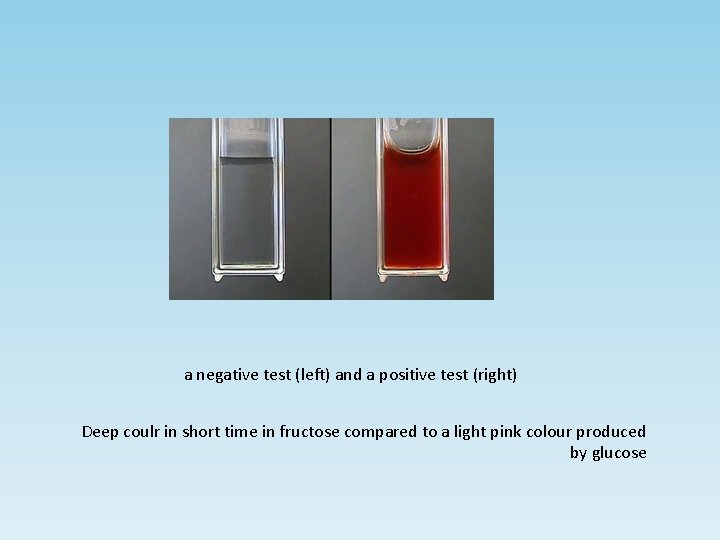
a negative test (left) and a positive test (right) Deep coulr in short time in fructose compared to a light pink colour produced by glucose
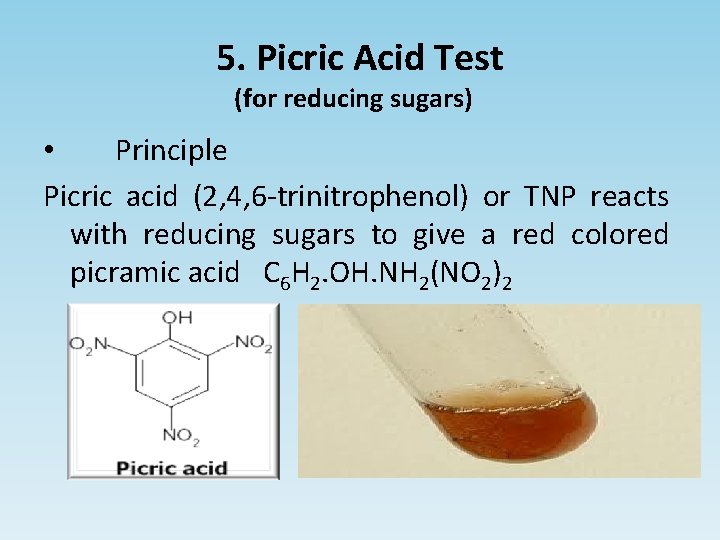
5. Picric Acid Test (for reducing sugars) • Principle Picric acid (2, 4, 6 -trinitrophenol) or TNP reacts with reducing sugars to give a red colored picramic acid C 6 H 2. OH. NH 2(NO 2)2
Procedure 1. Into a test tube add 1 ml of maltose solution, into the second tube, 1 ml of sucrose solution. 2. Add into each tube 1 ml of a saturated solution of picric acid, and then add into each tube 0. 5 ml of sodium hydroxide solution. 3. Heat both samples in a boiling water bath. v In the presence of reducing sugars, the solution stains red; a sodium salt of picric acid is formed.

- Slides: 37