
Qualitative Analysis Reactions that produce an INSOLUBLE SALT
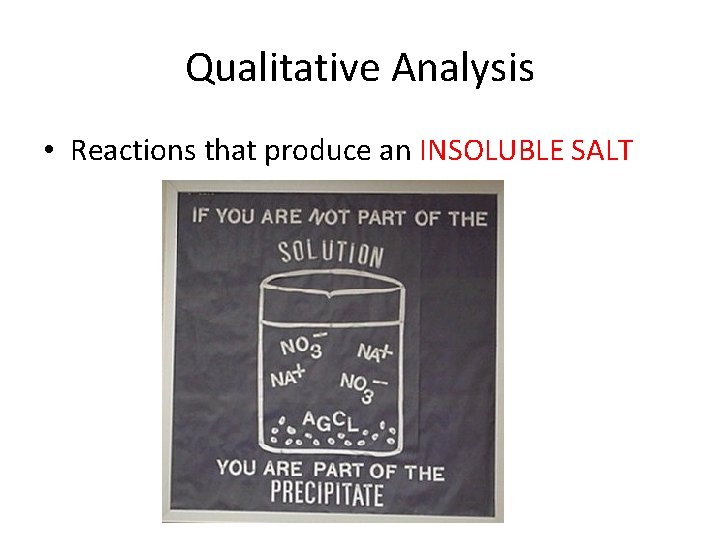
Qualitative Analysis • Reactions that produce an INSOLUBLE SALT
Cations and Anions • When ionic compounds are dissolved into a solution they form cations and anions • Cations (like metals ions) have a positive charge • Anions (like non-metal groups) have negative charges
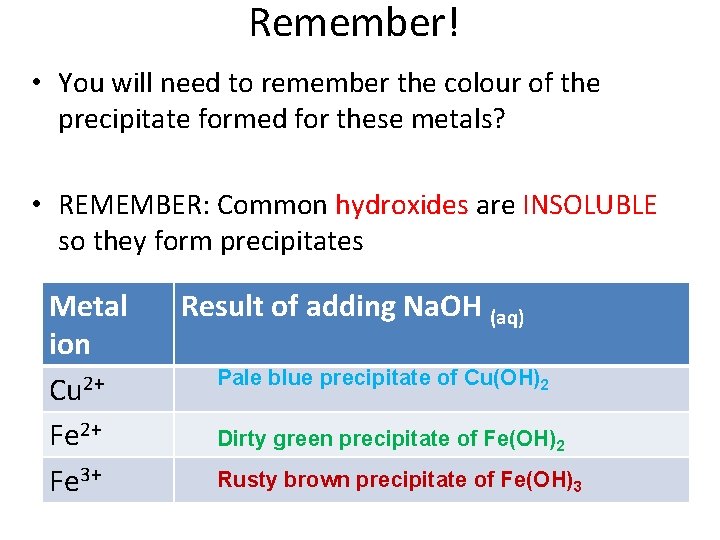
Remember! • You will need to remember the colour of the precipitate formed for these metals? • REMEMBER: Common hydroxides are INSOLUBLE so they form precipitates Metal ion Cu 2+ Fe 3+ Result of adding Na. OH (aq) Pale blue precipitate of Cu(OH)2 Dirty green precipitate of Fe(OH)2 Rusty brown precipitate of Fe(OH)3
Tests for cations (+ve ions) • Li+, Na+, K+, Ca 2+ using flame tests • NH 4+ using Na. OH(aq) • Cu 2+, Fe 2+ and Fe 3+ using Na. OH(aq)
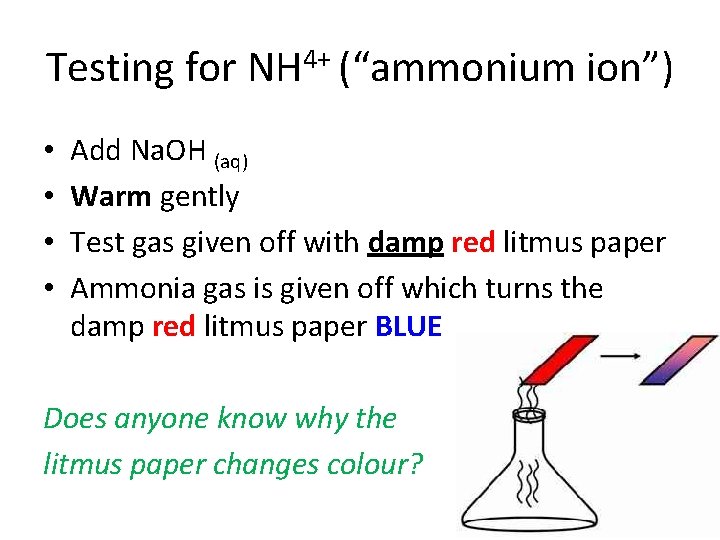
Testing for NH 4+ (“ammonium ion”) • • Add Na. OH (aq) Warm gently Test gas given off with damp red litmus paper Ammonia gas is given off which turns the damp red litmus paper BLUE Does anyone know why the litmus paper changes colour?
Testing for Cl- ions • Add SMALL amounts of silver nitrate solution to salts containing halogen ions that have been dissolved in dilute nitric acid. Type of ion (dissolved in HNO 3(aq)) Result of adding dilute silver nitrate Cl- White precipitate of silver chloride
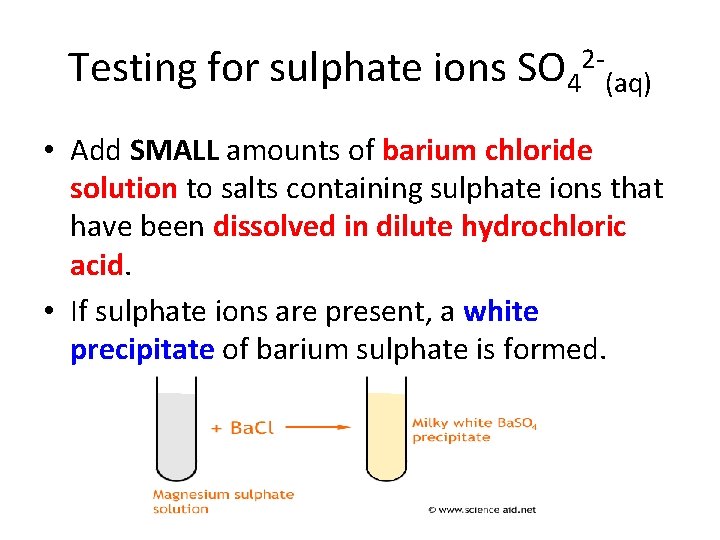
Testing for sulphate ions SO 42 -(aq) • Add SMALL amounts of barium chloride solution to salts containing sulphate ions that have been dissolved in dilute hydrochloric acid. • If sulphate ions are present, a white precipitate of barium sulphate is formed.
Testing for NO 3 - (nitrate ions) • Add Na. OH (aq) • • Add some SMALL pieces of aluminium foil Warm gently Test gas given off with damp red litmus paper Ammonia gas is given off which turns the damp red litmus paper BLUE
Testing for carbonate ions CO 32 -(aq) • Add dilute hydrochloric acid • See if it is effervescent (fizzes due to carbon dioxide gas being given off)
Testing for anions - Summary • Chloride (Cl-) using dilute nitric acid and silver nitrate solution • Sulphate (SO 42 -) using dilute hydrochloric acid and barium chloride solution • Carbonate (CO 32 -) using dilute hydrochloric acid and identifying the carbon dioxide evolved • Nitrate (NO 3 -) using Na. OH and aluminum, then warming gently
- Slides: 10