
Qualifications of a Director As regards to the

- Slides: 17
Qualifications of a Director: • As regards to the qualification of directors, there is no direct provision in the Companies Act, 2013. But, according to the different provisions relating to the directors; the following qualifications may be mentioned: • 1. A director must be a person of sound mind. • 2. A director must hold share qualification, if the article of association provides such. • 3. A director must be an individual. • 4. A director should be a solvent person. • 5. A director should not be convicted by the Court for any offence, etc.
Disqualifications of a director: • Section 164 of Companies Act, 2013, has mentioned the disqualification as mentioned below: • 1) A person shall not be capable of being appointed director of a company, if the director is • (a) Of unsound mind by a court of competent jurisdiction and the finding is in force; • (b) An undischarged insolvent; • (c) Has applied to be adjudicated as an insolvent and his application is pending; • (d) Has been convicted by a court of any offence involving moral turpitude and sentenced in respect thereof to imprisonment for not less than six months and a period of five years has not elapsed from the date of expiry of the sentence; • (e) Has not paid any call in respect of shares of the company held by him, whether alone or jointly with others, and six months have elapsed from the last day fixed for the payment of the call; or • (f) An order disqualifying him for appointment as director has been passed by a court in pursuance of section 203 and is in force, unless the leave of the court has been obtained for his appointment in pursuance of that section;
CONT. . . • 2) Such person is already a director of a public company which: • (a) Has not filed the annual accounts and annual returns for any continuous three financial years commencing on and after the first day of April, 1999; or • (b) Has failed to repay its deposits or interest thereon on due date or redeem its debentures on due date or pay dividend and such failure continues for one year or more: • Provided that such person shall not be eligible to be appointed as a director of any other public company for a period of five years from the date on which such public company, in which he is a director, failed to file annual accounts and annual returns under sub clause (A) or has failed to repay its deposit or interest or redeem its debentures on due date or paid dividend referred to in clause (B)
Qualifications of the Secretary: • Since the amendment of the Companies Act in 1994, only a person having prescribed qualifications can be appointed secretary of a company. Apart from the statutory qualifications, he should also have other qualifications as may be necessary to conduct the affairs of the company. • Statutory Qualifications: • According to Section 2(45) of the Companies Act 1956, as amended in 1974, a Company Secre tary must possess the qualifications prescribed by the Central Govt. from time to time. • The qualifica tionsas prescribed by the Companies (Secretary’s Qualifications) Rules 1975, for the Secretary of a Company are: • (a) In case of a company having a paid up share capital of Rs. 50 lakhs or more, the Secretary must be a member of the Institute of Company Secretar ies of India incorporated under the Companies Act, 1956, and licensed under Sec. 25 of that Act. A per son who is a member of the Institute of Chartered Secretaries of London shall also be eligible for ap pointment as Secretary of such a company.
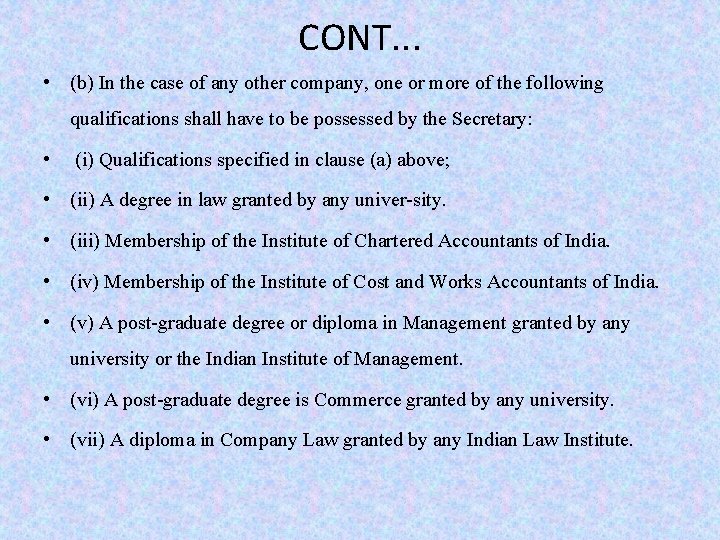
CONT. . . • (b) In the case of any other company, one or more of the following qualifications shall have to be possessed by the Secretary: • (i) Qualifications specified in clause (a) above; • (ii) A degree in law granted by any univer sity. • (iii) Membership of the Institute of Chartered Accountants of India. • (iv) Membership of the Institute of Cost and Works Accountants of India. • (v) A post graduate degree or diploma in Management granted by any university or the Indian Institute of Management. • (vi) A post graduate degree is Commerce granted by any university. • (vii) A diploma in Company Law granted by any Indian Law Institute.
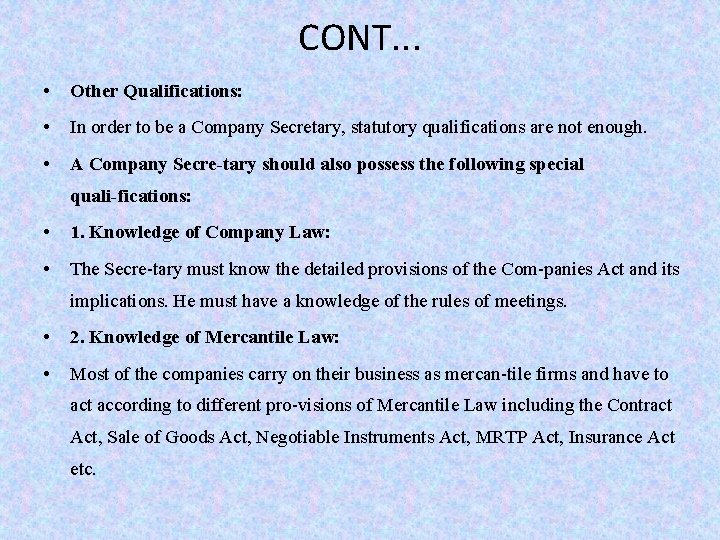
CONT. . . • Other Qualifications: • In order to be a Company Secretary, statutory qualifications are not enough. • A Company Secre tary should also possess the following special quali fications: • 1. Knowledge of Company Law: • The Secre tary must know the detailed provisions of the Com panies Act and its implications. He must have a knowledge of the rules of meetings. • 2. Knowledge of Mercantile Law: • Most of the companies carry on their business as mercan tile firms and have to act according to different pro visions of Mercantile Law including the Contract Act, Sale of Goods Act, Negotiable Instruments Act, MRTP Act, Insurance Act etc.
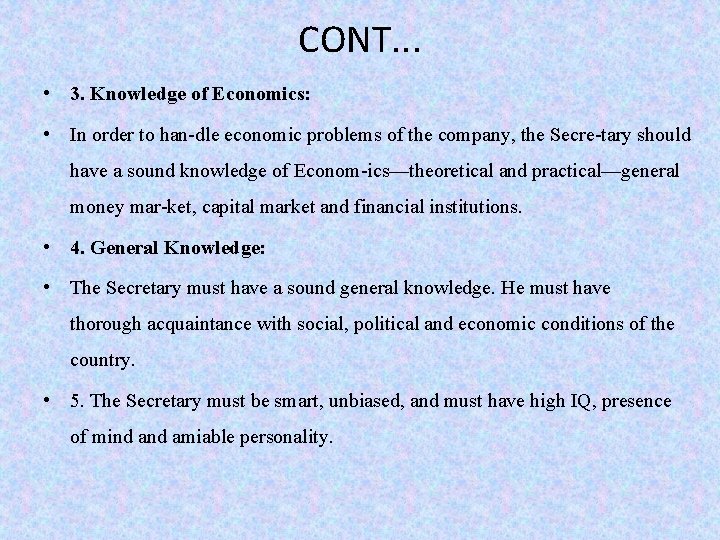
CONT. . . • 3. Knowledge of Economics: • In order to han dle economic problems of the company, the Secre tary should have a sound knowledge of Econom ics—theoretical and practical—general money mar ket, capital market and financial institutions. • 4. General Knowledge: • The Secretary must have a sound general knowledge. He must have thorough acquaintance with social, political and economic conditions of the country. • 5. The Secretary must be smart, unbiased, and must have high IQ, presence of mind amiable personality.
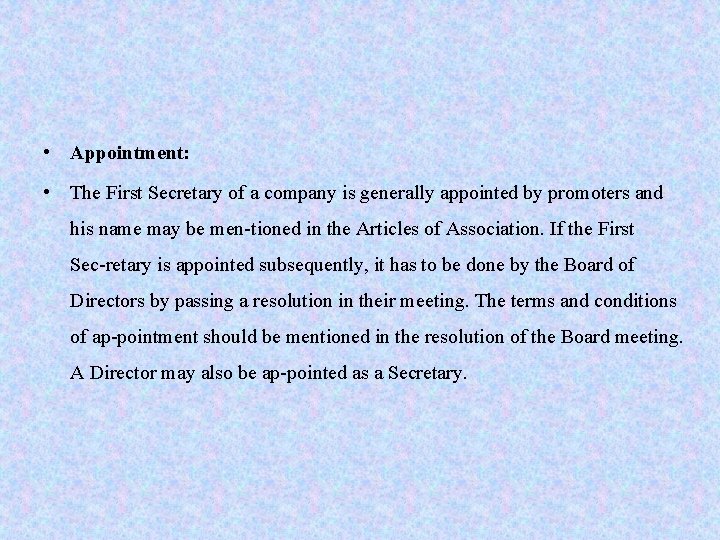
• Appointment: • The First Secretary of a company is generally appointed by promoters and his name may be men tioned in the Articles of Association. If the First Sec retary is appointed subsequently, it has to be done by the Board of Directors by passing a resolution in their meeting. The terms and conditions of ap pointment should be mentioned in the resolution of the Board meeting. A Director may also be ap pointed as a Secretary.
• Dismissal: • The Secretary is a servant of the company and his dismissal is governed by the normal law appli cable to master and servant. The Secretary can or dinarily be dismissed by the Board of Directors. He may be removed in the following manner: • (i) By giving a written notice; • (ii) On the expiry of the tenure of service; • (iii) In such manner as prescribed by the Ar ticles of Association of the company.
CONT. . . • The Secretary may also be removed without notice for: • i. Willful misconduct; • ii. Willful disobedience to order of the man ner; • iii. Negligence of duty; • iv. Permanent disability; and • v. Moral turpitude.
Functions and Duties of the Company Secretary: • Functions of the Company Secretary may be discussed under two headings: • (i) Statutory Functions or Duties and • (ii) Non statutory Functions or Duties. • Statutory Functions: • The Companies Act, 1956, imposes certain duties upon the Secretary.
• The Companies Act has specified the following duties of the Company Sec retary: • 1. Signing of Annual Returns, • 2. Registration of Allotment Returns, • 3. Issuing Share Certificates, • 4. Convening Annual General Meeting, • 5. Maintaining Share Registers, • 6. Maintaining Register of Directors.
CONT. . . • The Indian Stamp Act also requires a Company Secretary to ensure that proper stamps are affixed on the company’s documents. The Indian Sales Tax Act also provides that the Secretary of the Company should arrange for registration of the company, if necessary, and sub mit the tax returns. • Under the Income Tax law, the Company Sec retary has to deduct income tax from the salaries of the staff and dividend payable at source and to submit income tax returns to the authorities in ac cordance with the law. • Under the MRTP Act, FERA (now FEMA) and Essential Commodities Act, he is entrusted with certain obligations under the Payment of Wages Act, Bonus Act, Provident Fund Act and Gratuity Act. He is personally liable for the violation of provi sions of the respective Acts.
APPOINTMENT OF COMPANY SECRETARY • A company secretary is a principally an employee even though he holds very high rank. He / She may be the Chief Executive & then his position is near to those of the directors. In reality, he is the only employee who has advisory powers. • CS advice is pursued in carrying out general administration and in the decision making process at the time of framing policies of the company. He is consulted to determine the lawful suggestions of policy decisions. Therefore, he/she is the only outsider who is present at the Board meetings. • Company Secretary is the person who is a member of the (ICSI) Institute of Company Secretary of India appointed by the company to perform the functions of the Company Secretary.
CONT. . . • Who is required to have company secretary • All listed company and all other company having paid up share capital of Rs. 5 crore or more shall have whole time key managerial personnel and shall have following whole time key managerial personnel namely— • Managing director, or Chief Executive Officer or manager and in their absence, a whole time director; • Company Secretary; and • Chief Financial Officer • Time Period for such appointment of Company Secretary: • The Companies Act 2013 does not provide the period wherein the Company has to designate Company Secretary as (KMP) key managerial personnel. But it is advisable to appoint a Company Secretary as KMP in the first board meeting which is to be conducted after applicability of such a provision.
CONT. . . • Process for appointment of company secretary • Arrange for Board Meeting only after giving notice to every director to discuss besides others the following matters. Approve the terms and conditions at which the Company Secretary (CS) is proposed to be appointed. • Obtain a written consent from the person who is to be appointed as Company Secretary. • Inform the Stock Exchange with which shares of the company are listed on the date of this meeting before the board meeting • Inform the said Stock Exchange within 15 minutes of the Board Meeting, of the outcome of the meeting by letter or fax. • File the relevant form with the concerned ROC within 30 days from the date of Appointment. • Pay the requisite fee for the same. • Make necessary entries in the Register of Directors/ Secretary. • The ‘whole time secretary’ indicates that a Company Secretary must be in the employment of the company.
CONT. . . • • • • • Roles and Responsibilities of Company Secretary The three main areas, a Company Secretary, has the role to play viz. to the Board, to the Company, and to the Shareholder. Core Duties of the Company Secretary Meetings of the Board of Directors General Meetings Memorandum and Articles of Association Requirements of Stock Exchanges Statutory Registers Statistical Books Statutory Returns Report and Accounts Registration of Shares Communications to and from Shareholder Issues of Share and Capital and Restructuring Acquisitions, Disposals, and Mergers Corporate Governance Common Seal of the Company etc.