
Quaker social change ministry with Lucy Duncan Gabriela

Quaker social change ministry with Lucy Duncan & Gabriela Flora 1

Presenters Lucy Duncan, Director of Friends Relations, works in Philadelphia Gabriela Flora, Colorado Area Program Director, Denver 2
Prayer for the coming of the Light The snow is melting, the air is crisp I sit in meeting for worship Notice the ticking of the clock A siren screeches The benches creak Bodies situate them selves Resting their bones Taking a breath, waiting The noise revs up in my head The ‘to do’ list, the moments I said the wrong thing, the news of a friend’s illness The awareness of all the walls we erect to keep what will heal us out I let the clamor go by, I settle Underneath the din, I reach the interior I exhale and feel the sorrow 3
For the pain of the lost city For communities denied love For ancestors with hearts of stone For all the armor that must fall away for peace My heart races, I stand speak, my voice shakes “Hold still, feel the turbulence of creation The old world is crumbling The Light is on the edge of slumber Lend your hands to the labor Midwife the spiritual birth. ” I sit, still shaken My heart lies down A hush encircles us A sparrow trills outside the open door - Lucy Duncan 4
The spiritual roots of QSCM "We can already recognize that today time is split between a present that is already dead and a future that is already living — and the yawning abyss between them is becoming enormous. In time, an event will thrust us like an arrow into that living future. This will be the real political act of love. " —Antonio Negri We are living in evolutionary and revolutionary times. The old world, the already dead present, is coming apart at the seams and all around us are signs of the groaning of the spiritual birth of creation, a new way of living and being grounded in love and connection, which throws off old ways of living disconnected from each other and the earth. The damage that colonialism, super-charged capitalism, and white supremacy have done to our communities 5 and the earth is so clear and evident, and the need to transform our social
The spiritual roots of QSCM The good news is that a new way of being is striving, longing, growing, and working to be born. But this new way of living won't come about without our active participation. God will knit our efforts together, but without many midwives of transformation working for the Beloved Community, creating alternatives, listening carefully to the wisdom of those most impacted by injustice who have learned what else might work, the emergent spiritual reality will likely get stuck, or worse, arrive stillborn. We as a human community are in the throes of a great creative project that could result in real transformation and shifting, but only if we lend our hearts, our minds, our hands to the work before us. 6
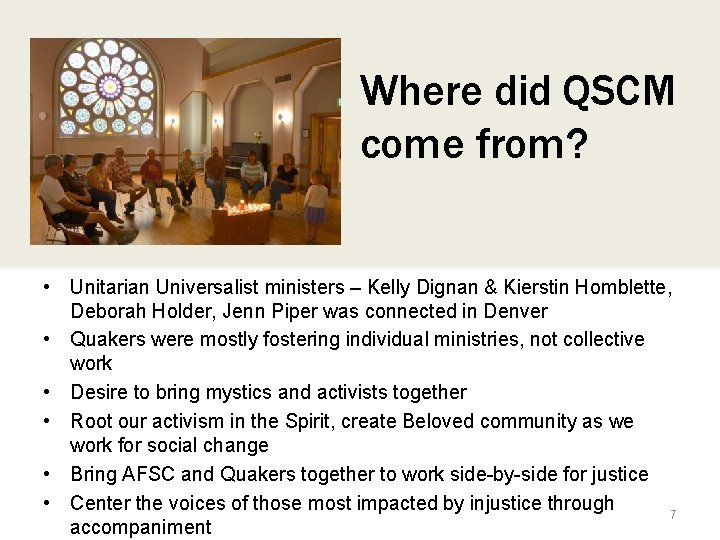
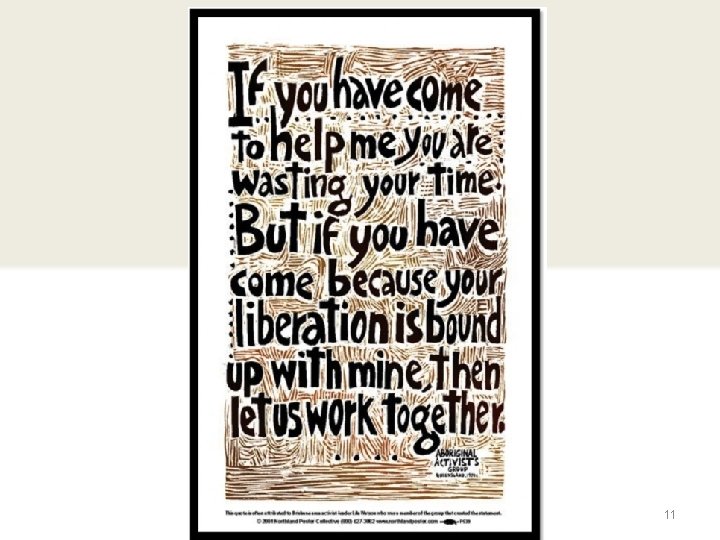
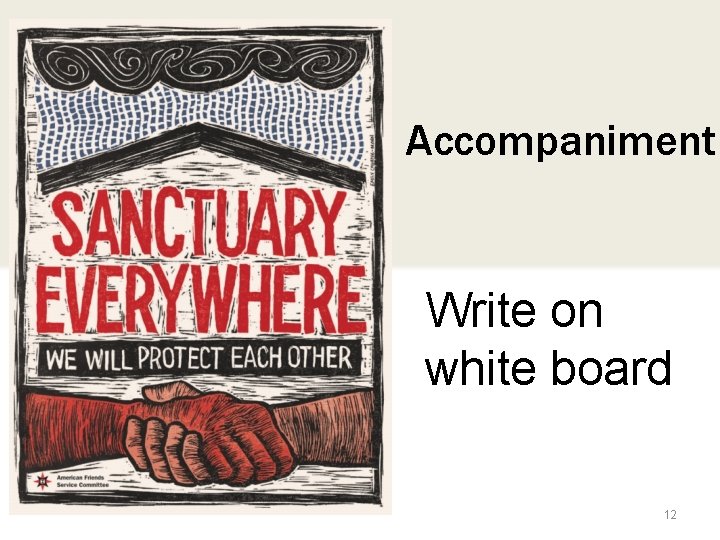
Where did QSCM come from? • Unitarian Universalist ministers – Kelly Dignan & Kierstin Homblette, Deborah Holder, Jenn Piper was connected in Denver • Quakers were mostly fostering individual ministries, not collective work • Desire to bring mystics and activists together • Root our activism in the Spirit, create Beloved community as we work for social change • Bring AFSC and Quakers together to work side-by-side for justice • Center the voices of those most impacted by injustice through 7 accompaniment
Write on white board What would you need from a group of people in order to feel as though you were creating Beloved community together? 8
Sample covenant, adapted from Circles of Trust (Parker Palmer) • • • Be as fully present as possible Assume positive intent on the part of fellow participants. Listen with resilience. Refrain from interrupting others. Set your own boundaries for personal sharing. Speak personal truths in ways that respect other people's truth. No fixing, no saving, no advising, and no setting each other straight. When the going gets rough, turn to wonder. Observe deep confidentiality. Commit to regular attendance 9
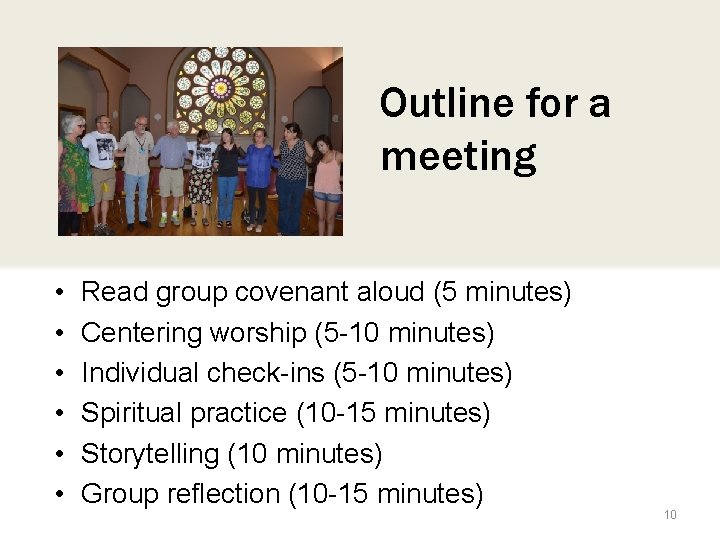
Outline for a meeting • • • Read group covenant aloud (5 minutes) Centering worship (5 -10 minutes) Individual check-ins (5 -10 minutes) Spiritual practice (10 -15 minutes) Storytelling (10 minutes) Group reflection (10 -15 minutes) 10
11
Accompaniment Write on white board 12
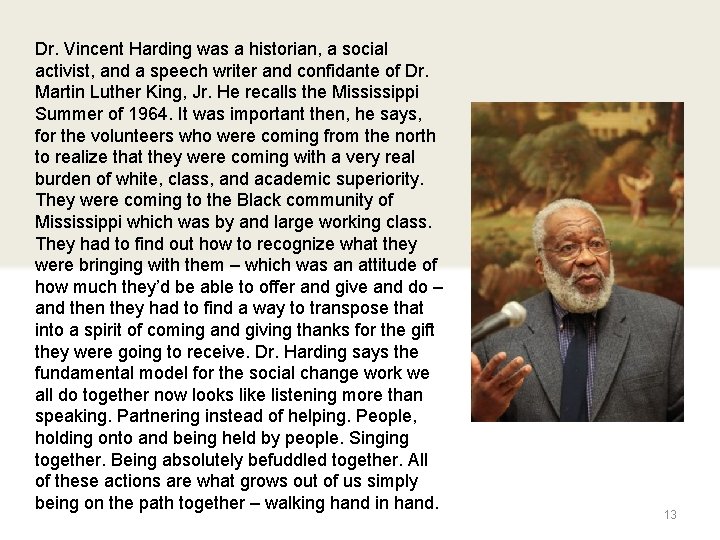
Dr. Vincent Harding was a historian, a social activist, and a speech writer and confidante of Dr. Martin Luther King, Jr. He recalls the Mississippi Summer of 1964. It was important then, he says, for the volunteers who were coming from the north to realize that they were coming with a very real burden of white, class, and academic superiority. They were coming to the Black community of Mississippi which was by and large working class. They had to find out how to recognize what they were bringing with them – which was an attitude of how much they’d be able to offer and give and do – and then they had to find a way to transpose that into a spirit of coming and giving thanks for the gift they were going to receive. Dr. Harding says the fundamental model for the social change work we all do together now looks like listening more than speaking. Partnering instead of helping. People, holding onto and being held by people. Singing together. Being absolutely befuddled together. All of these actions are what grows out of us simply being on the path together – walking hand in hand. 13
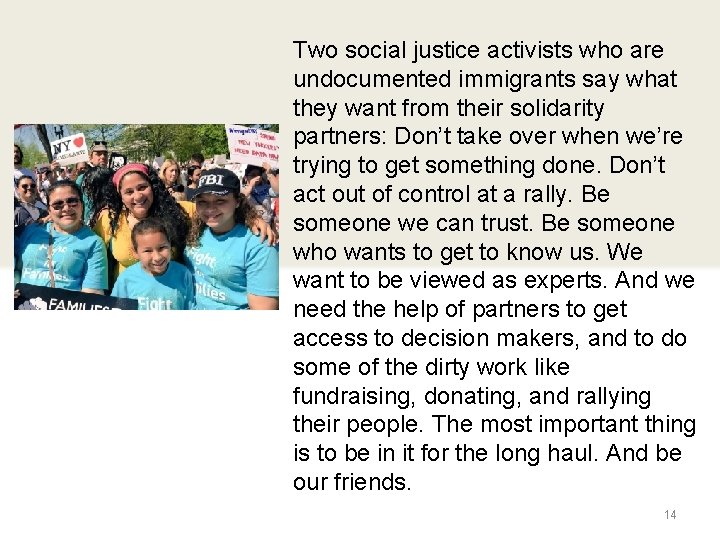
Two social justice activists who are undocumented immigrants say what they want from their solidarity partners: Don’t take over when we’re trying to get something done. Don’t act out of control at a rally. Be someone we can trust. Be someone who wants to get to know us. We want to be viewed as experts. And we need the help of partners to get access to decision makers, and to do some of the dirty work like fundraising, donating, and rallying their people. The most important thing is to be in it for the long haul. And be our friends. 14
Tenets of accompanying for social change 1. Building relationships of trust and accountability with people and communities most impacted by injustice by showing up and staying in the relationships for the long haul. 2. Remembering that the liberation of everyone and everything is inherently connected, and together, we are on a learning journey toward it. 3. Walking together while navigating differences in a loving, respectful, trusting relationship. 4. Struggling together and encouraging one another’s spiritual growth. 5. Contemplating the gifts you are going to receive when accompanying, instead of how you will give, help, teach, tell, or fix. 6. Acknowledging and unlearning your patterns of dominance, like taking charge, leading. making decisions, etc. 7. Asking for and lending empathic support. 8. Moving beyond asking to acting. 9. Getting out of your comfort zone (materially, emotionally, and physically) and allowing yourself to be changed by this process. 10. Disrupting the systems and structures of oppression – with integrity 15 and in authentic community with those most impacted, following their
Questions Comments Use Question and Answer Panel 16
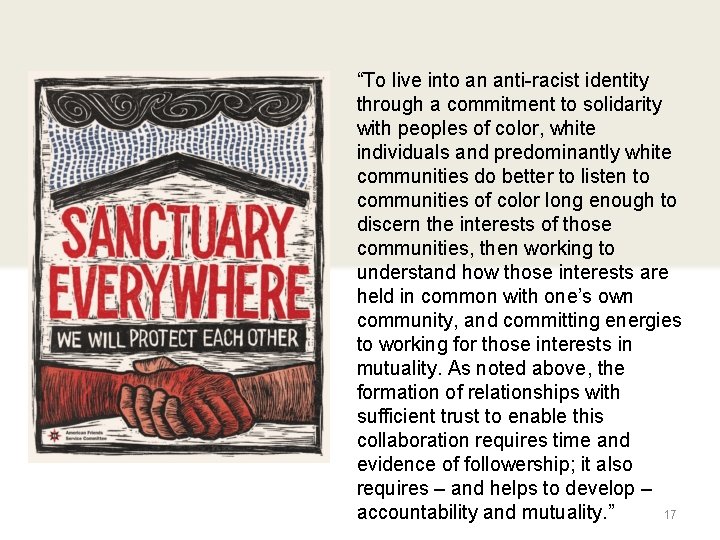
“To live into an anti-racist identity through a commitment to solidarity with peoples of color, white individuals and predominantly white communities do better to listen to communities of color long enough to discern the interests of those communities, then working to understand how those interests are held in common with one’s own community, and committing energies to working for those interests in mutuality. As noted above, the formation of relationships with sufficient trust to enable this collaboration requires time and evidence of followership; it also requires – and helps to develop – 17 accountability and mutuality. ”
- Slides: 17