
Quadruple Pendulum Design Update Norna A Robertson Stanford
Quadruple Pendulum Design Update Norna A Robertson Stanford University and University of Glasgow for the GEO 600 and LIGO suspension teams LSC meeting, Hannover, August 19 th 2003 Plenary Technical Session DCC Number: LIGO-G 030437 -00 -Z
Recent Developments • more time required for sapphire/silica downselect + • firm mass estimate for seismic platform loading required --> • develop design with potential for incorporating either sapphire or silica test mass + • minimise overall mass consistent with meeting requirements
Current Design • Test mass: 40 kg • baseline: sapphire, 31. 4 cm (diam) x 13 cm • fallback: silica, 34 cm (diam) x 20 cm • Penultimate mass: 40 kg • ‘same’ dimensions as test mass (sapphire/SF 4 for sapphire test mass, silica for silica test mass) • Other masses: 22 kg, 22 kg • Common design of upper masses, blades, wire lengths, etc. --> MATLAB/SIMULINK model used to check performance

Quad Layout for End Test Mass (ETM) Chain + Reaction Chain Baseline w/ sapphire test mass C Torrie, M Perreur-Lloyd Fallback - silica
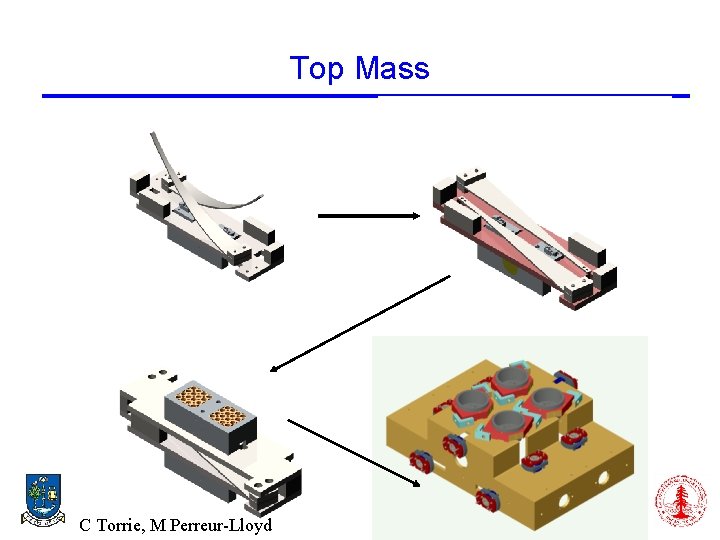
Top Mass M Perreur-Lloyd, C Torrie, M Perreur-Lloyd
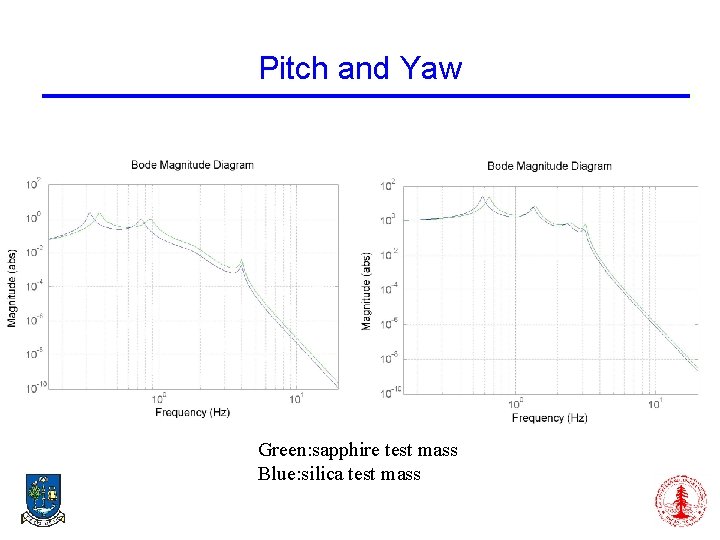
Pitch and Yaw Green: sapphire test mass Blue: silica test mass
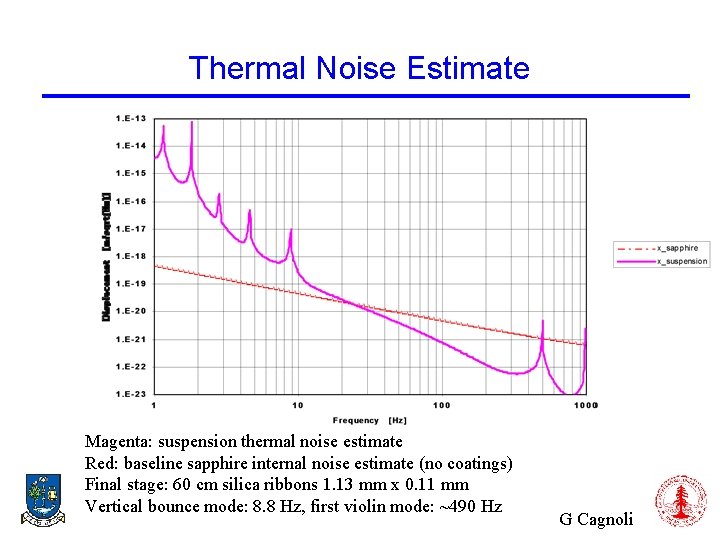
Thermal Noise Estimate Magenta: suspension thermal noise estimate Red: baseline sapphire internal noise estimate (no coatings) Final stage: 60 cm silica ribbons 1. 13 mm x 0. 11 mm Vertical bounce mode: 8. 8 Hz, first violin mode: ~490 Hz G Cagnoli
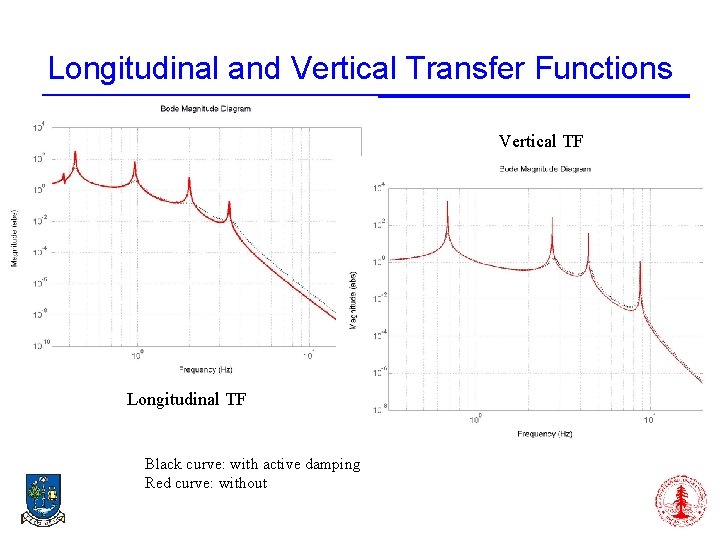
Longitudinal and Vertical Transfer Functions Vertical TF Longitudinal TF Black curve: with active damping Red curve: without
Open Issues/Current Work • Design of ‘fibres’: ribbons or dumbbell fibres can meet suspension thermal noise requirements – research on both in progress at Glasgow and Caltech • Bonding: ongoing investigations • see presentations by C Cantley and H Armandula • Local Control: possible solution to sensor noise “problem” for ETM • For longitudinal, yaw and pitch – use global control signals to take over once interferometer locked, and turn down active control gain • For transverse: current noise level sufficiently quiet • For vertical and roll: turn down active control gain and use eddy current damping to damping times ~ 100 - 200 secs • see presentations by K Strain and M Plissi • Other BSC suspensions: beamsplitter, folding mirror, compensation plate – work starting on designs
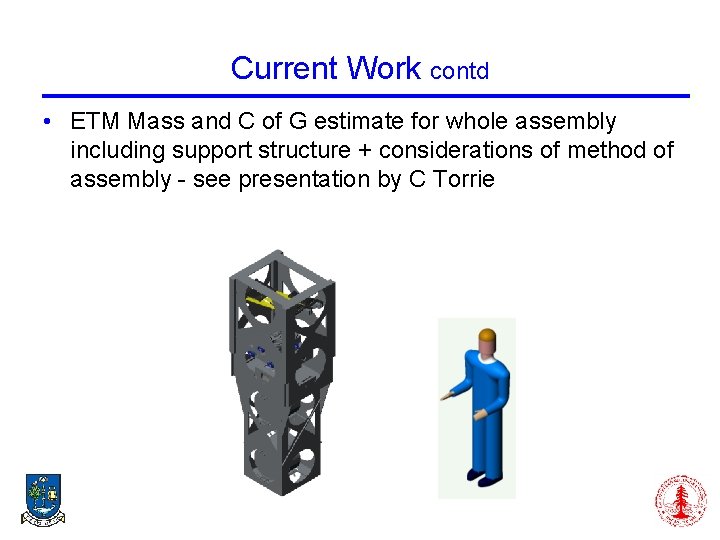
Current Work contd • ETM Mass and C of G estimate for whole assembly including support structure + considerations of method of assembly - see presentation by C Torrie
Finally. . • Advanced LIGO Suspension System Conceptual Design (T 010103) currently being updated • BSC (quadruple) and HAM (triple) suspensions included • reflects developments since Sept 2001
- Slides: 11