
Quadrilaterals and Polygons Polygon A plane figure that





- Slides: 31
Quadrilaterals and Polygons Polygon: A plane figure that is formed by three or more segments (no two of which are collinear), and each segment (side) intersects at exactly two other sides – one at each endpoint (Vertex). Which of the following diagrams are polygons?
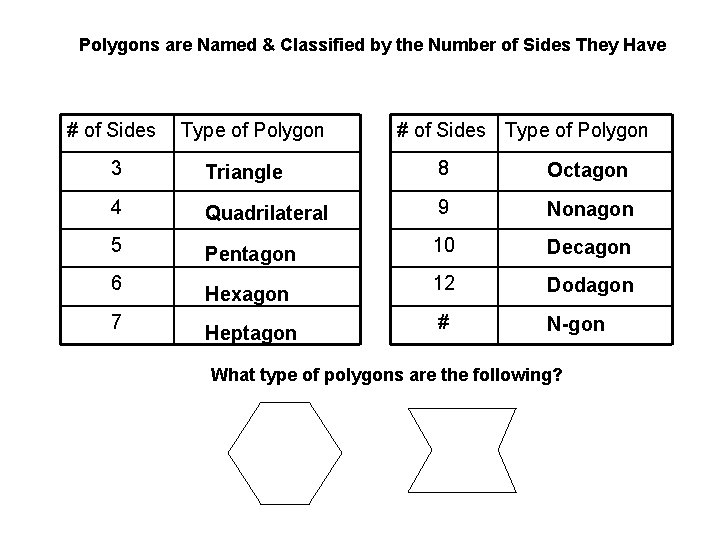
Polygons are Named & Classified by the Number of Sides They Have # of Sides Type of Polygon 3 Triangle 8 Octagon 4 Quadrilateral 9 Nonagon 5 Pentagon 10 Decagon 12 Dodagon # N-gon 6 7 Hexagon Heptagon What type of polygons are the following?
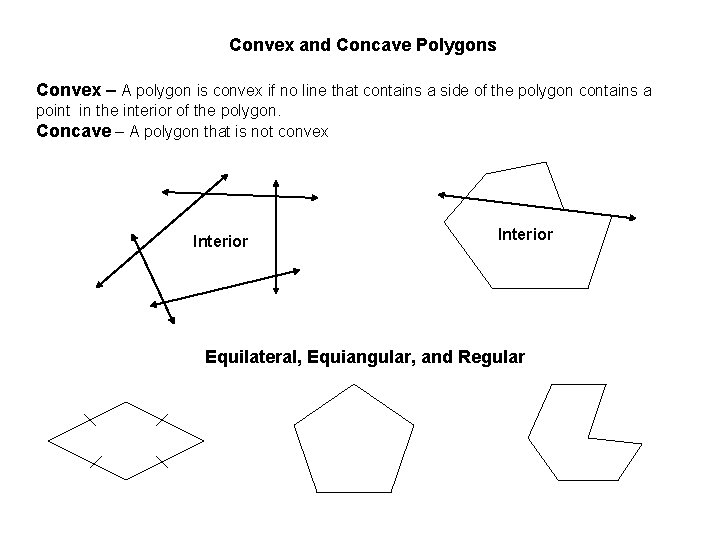
Convex and Concave Polygons Convex – A polygon is convex if no line that contains a side of the polygon contains a point in the interior of the polygon. Concave – A polygon that is not convex Interior Equilateral, Equiangular, and Regular
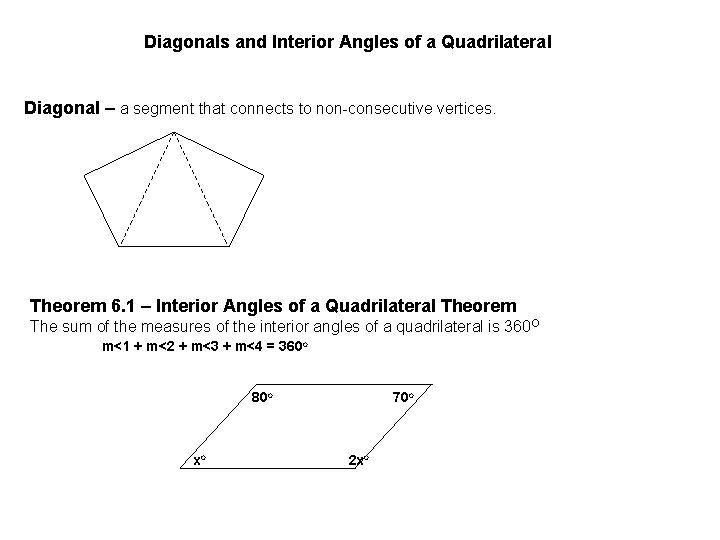
Diagonals and Interior Angles of a Quadrilateral Diagonal – a segment that connects to non-consecutive vertices. Theorem 6. 1 – Interior Angles of a Quadrilateral Theorem The sum of the measures of the interior angles of a quadrilateral is 360 O m<1 + m<2 + m<3 + m<4 = 360 o 80 o xo 70 o 2 xo
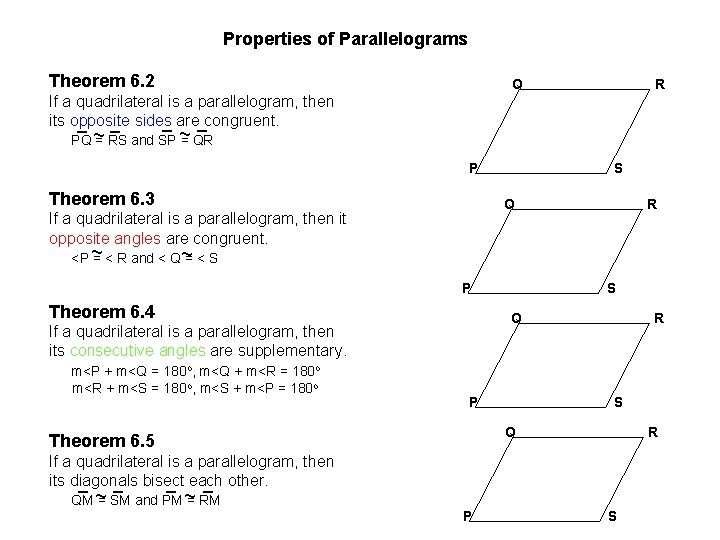
Properties of Parallelograms Theorem 6. 2 Q If a quadrilateral is a parallelogram, then its opposite _ are_congruent. _ _ sides R PQ ~ = RS and SP ~ = QR P Theorem 6. 3 S Q If a quadrilateral is a parallelogram, then it opposite angles are congruent. R <P ~ = < R and < Q ~ =<S P Theorem 6. 4 Q If a quadrilateral is a parallelogram, then its consecutive angles are supplementary. m<P + m<Q = 180 o, m<Q + m<R = 180 o m<R + m<S = 180 o, m<S + m<P = 180 o S P R S Q Theorem 6. 5 R If a quadrilateral is a parallelogram, then its diagonals _ _ bisect _ each _ other. QM ~ = SM and PM ~ = RM P S
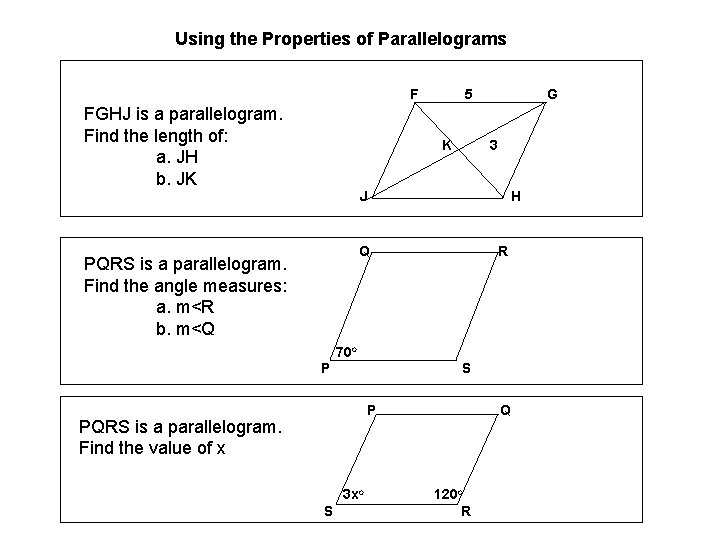
Using the Properties of Parallelograms F FGHJ is a parallelogram. Find the length of: a. JH b. JK 5 K G 3 J H Q PQRS is a parallelogram. Find the angle measures: a. m<R b. m<Q R 70 o P S P PQRS is a parallelogram. Find the value of x 3 xo S Q 120 o R
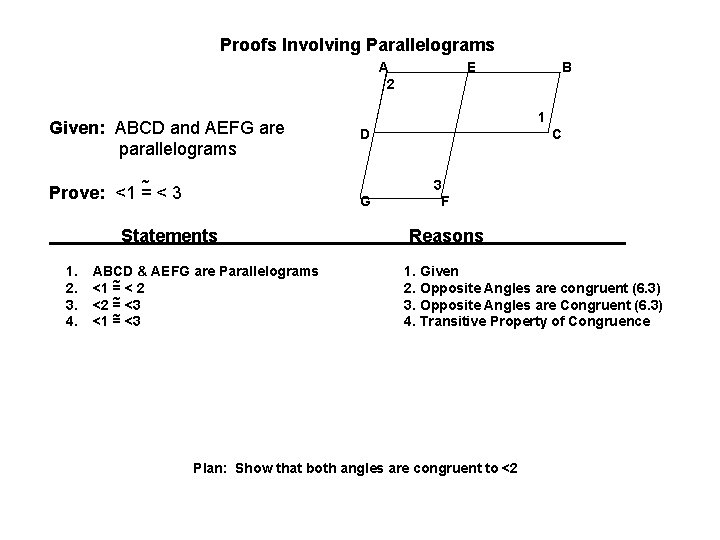
Proofs Involving Parallelograms A 2 Given: ABCD and AEFG are parallelograms D G Statements 1. 2. 3. 4. ABCD & AEFG are Parallelograms ~<2 <1 = <2 ~ = <3 ~ <3 <1 = B 1 ~ Prove: <1 = < 3 E C 3 F Reasons 1. Given 2. Opposite Angles are congruent (6. 3) 3. Opposite Angles are Congruent (6. 3) 4. Transitive Property of Congruence Plan: Show that both angles are congruent to <2
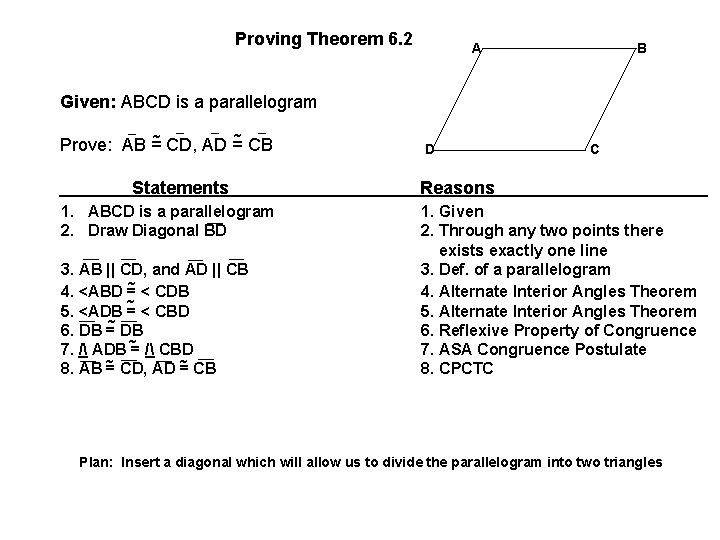
Proving Theorem 6. 2 A B Given: ABCD is a parallelogram _ ~ _ Prove: AB = CD, AD = CB Statements 1. ABCD is a parallelogram __ 2. Draw Diagonal BD __ __ 3. AB || CD, and AD || CB ~ 4. <ABD = < CDB ~ 5. <ADB = < CBD __ __ ~ 6. DB = DB 7. /__ADB__~= / __ CBD __ ~ ~ CB 8. AB = CD, AD = D C Reasons 1. Given 2. Through any two points there exists exactly one line 3. Def. of a parallelogram 4. Alternate Interior Angles Theorem 5. Alternate Interior Angles Theorem 6. Reflexive Property of Congruence 7. ASA Congruence Postulate 8. CPCTC Plan: Insert a diagonal which will allow us to divide the parallelogram into two triangles
Proving Quadrilaterals are Parallelograms Q Theorem 6. 6 R If both pairs of opposite sides of a quadrilateral are congruent, then the quadrilateral is a parallelogram P S Q Theorem 6. 7 R If both pairs of opposite angles of a quadrilateral are congruent, then the quadrilateral is a parallelogram P S Q (180 -x)o Theorem 6. 8 If an angle of a quadrilateral is supplementary to both of its consecutive angles, then the quadrilateral is a parallelogram P xo xo S Q Theorem 6. 9 R If the diagonals of a quadrilateral bisect each other, then the quadrilateral is a parallelogram P R S
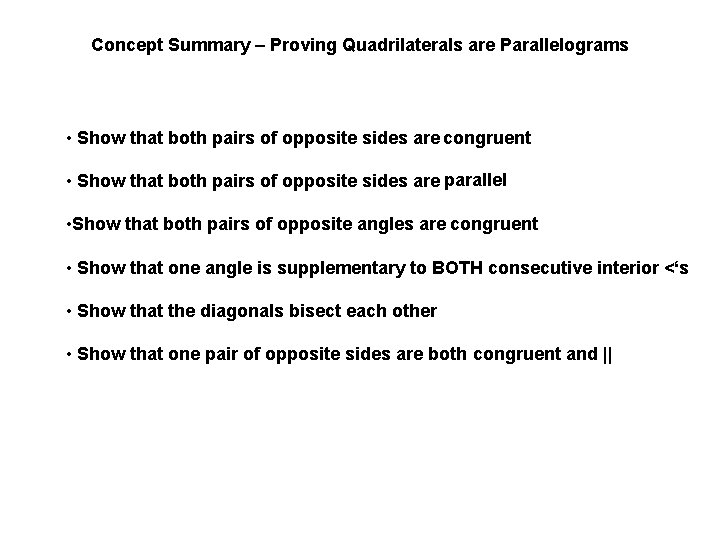
Concept Summary – Proving Quadrilaterals are Parallelograms • Show that both pairs of opposite sides are congruent • Show that both pairs of opposite sides are parallel • Show that both pairs of opposite angles are congruent • Show that one angle is supplementary to BOTH consecutive interior <‘s • Show that the diagonals bisect each other • Show that one pair of opposite sides are both congruent and ||
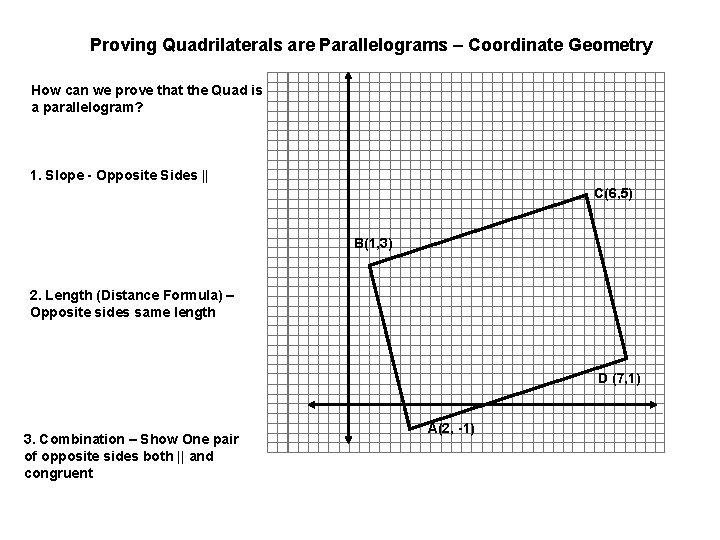
Proving Quadrilaterals are Parallelograms – Coordinate Geometry How can we prove that the Quad is a parallelogram? 1. Slope - Opposite Sides || C(6, 5) B(1, 3) 2. Length (Distance Formula) – Opposite sides same length D (7, 1) 3. Combination – Show One pair of opposite sides both || and congruent A(2, -1)
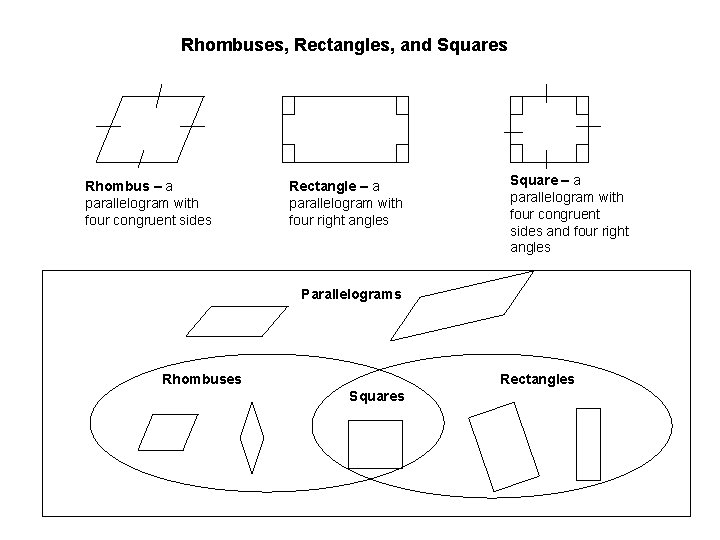
Rhombuses, Rectangles, and Squares Rhombus – a parallelogram with four congruent sides Rectangle – a parallelogram with four right angles Square – a parallelogram with four congruent sides and four right angles Parallelograms Rhombuses Rectangles Squares
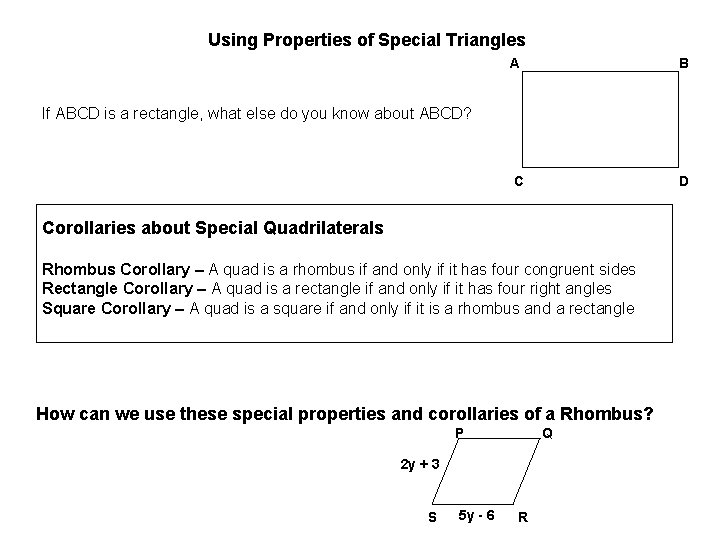
Using Properties of Special Triangles A B C D If ABCD is a rectangle, what else do you know about ABCD? Corollaries about Special Quadrilaterals Rhombus Corollary – A quad is a rhombus if and only if it has four congruent sides Rectangle Corollary – A quad is a rectangle if and only if it has four right angles Square Corollary – A quad is a square if and only if it is a rhombus and a rectangle How can we use these special properties and corollaries of a Rhombus? P Q 2 y + 3 S 5 y - 6 R
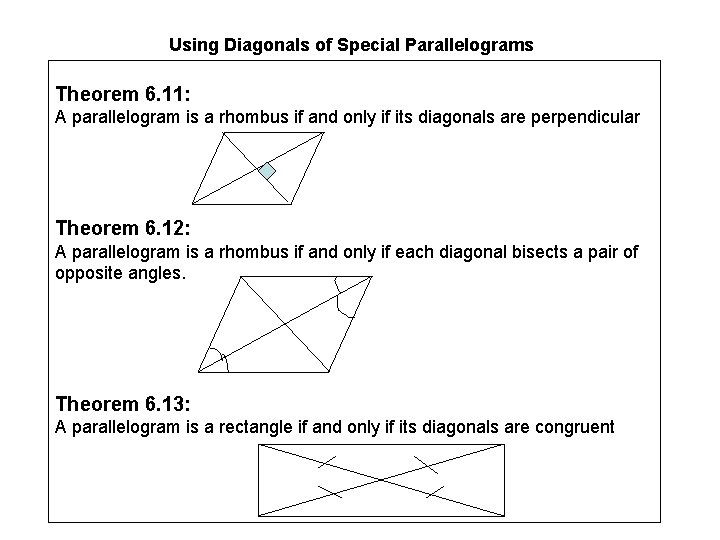
Using Diagonals of Special Parallelograms Theorem 6. 11: A parallelogram is a rhombus if and only if its diagonals are perpendicular Theorem 6. 12: A parallelogram is a rhombus if and only if each diagonal bisects a pair of opposite angles. Theorem 6. 13: A parallelogram is a rectangle if and only if its diagonals are congruent
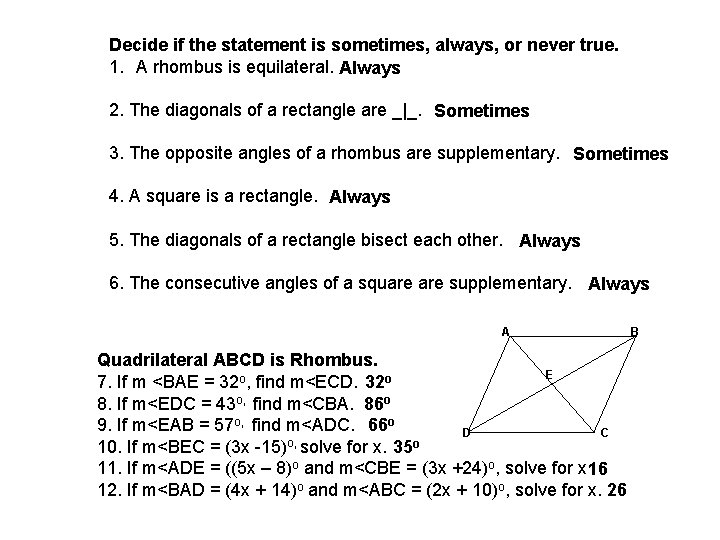
Decide if the statement is sometimes, always, or never true. 1. A rhombus is equilateral. Always 2. The diagonals of a rectangle are _|_. Sometimes 3. The opposite angles of a rhombus are supplementary. Sometimes 4. A square is a rectangle. Always 5. The diagonals of a rectangle bisect each other. Always 6. The consecutive angles of a square supplementary. Always A Quadrilateral ABCD is Rhombus. E 7. If m <BAE = 32 o, find m<ECD. 32 o 8. If m<EDC = 43 o, find m<CBA. 86 o 9. If m<EAB = 57 o, find m<ADC. 66 o D C o, o 10. If m<BEC = (3 x -15) solve for x. 35 11. If m<ADE = ((5 x – 8)o and m<CBE = (3 x +24)o, solve for x 16 12. If m<BAD = (4 x + 14)o and m<ABC = (2 x + 10)o, solve for x. 26 B
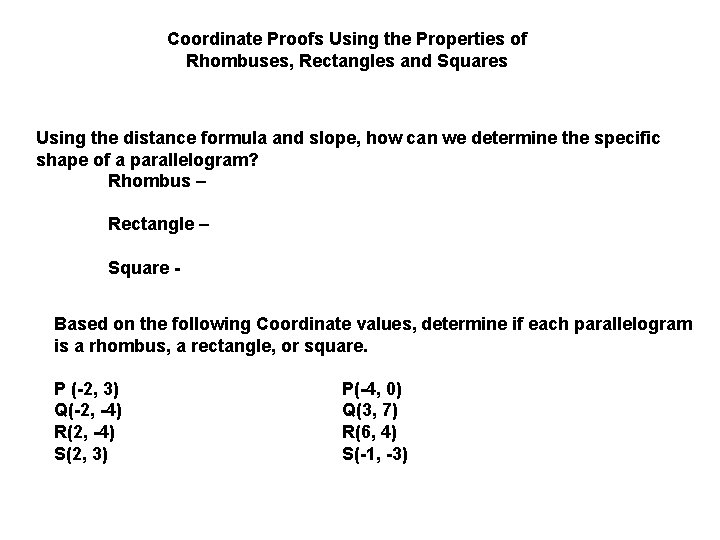
Coordinate Proofs Using the Properties of Rhombuses, Rectangles and Squares Using the distance formula and slope, how can we determine the specific shape of a parallelogram? Rhombus – Rectangle – Square Based on the following Coordinate values, determine if each parallelogram is a rhombus, a rectangle, or square. P (-2, 3) Q(-2, -4) R(2, -4) S(2, 3) P(-4, 0) Q(3, 7) R(6, 4) S(-1, -3)
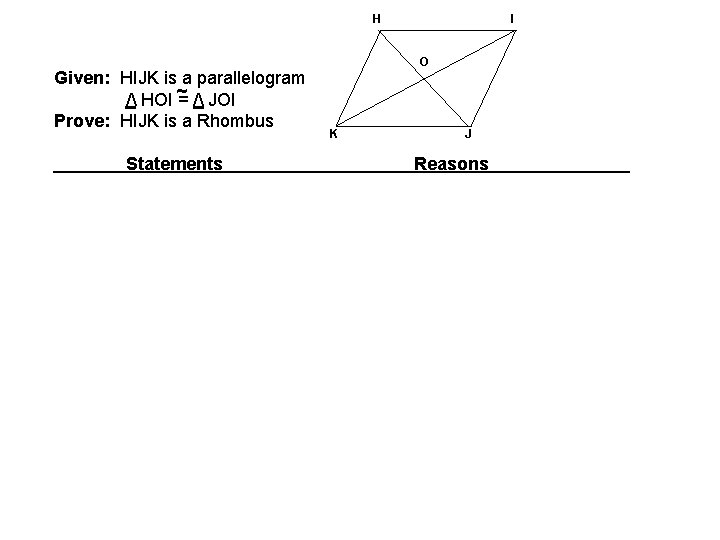
H Given: HIJK is a parallelogram / HOI ~ = / JOI Prove: HIJK is a Rhombus Statements I O K J Reasons
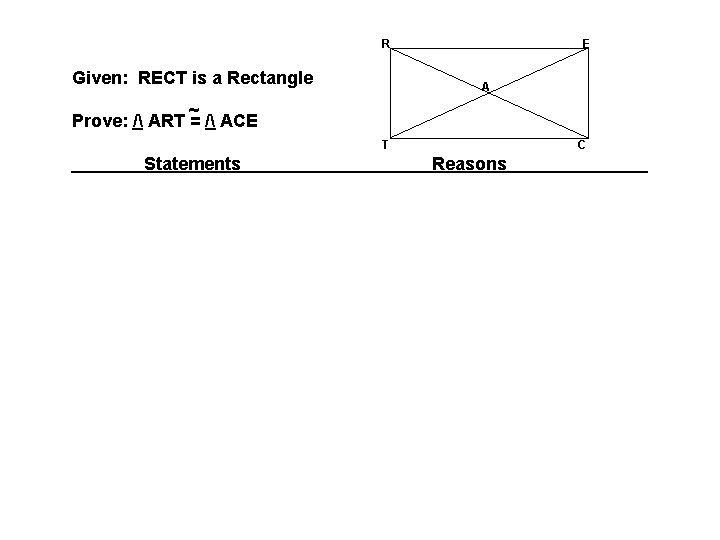
R Given: RECT is a Rectangle E A ~ Prove: / ART = / ACE T Statements C Reasons
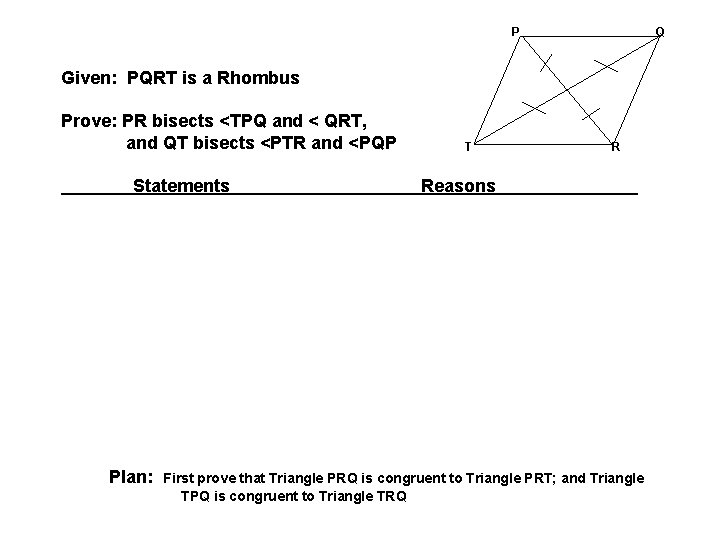
P Q Given: PQRT is a Rhombus Prove: PR bisects <TPQ and < QRT, and QT bisects <PTR and <PQP Statements Plan: T R Reasons First prove that Triangle PRQ is congruent to Triangle PRT; and Triangle TPQ is congruent to Triangle TRQ
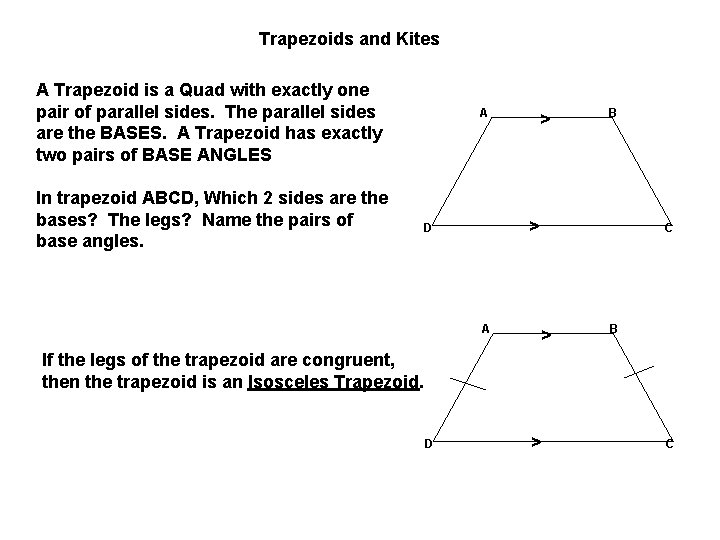
Trapezoids and Kites A Trapezoid is a Quad with exactly one pair of parallel sides. The parallel sides are the BASES. A Trapezoid has exactly two pairs of BASE ANGLES In trapezoid ABCD, Which 2 sides are the bases? The legs? Name the pairs of base angles. A > B > D A C > B If the legs of the trapezoid are congruent, then the trapezoid is an Isosceles Trapezoid. D > C
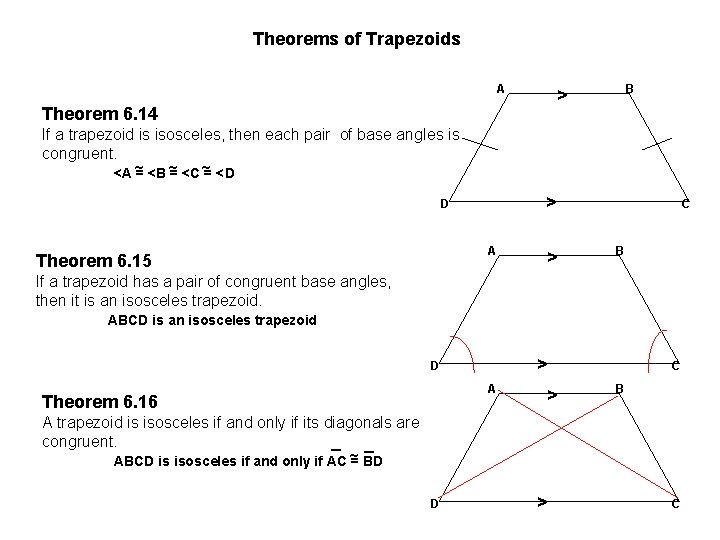
Theorems of Trapezoids A B > Theorem 6. 14 If a trapezoid is isosceles, then each pair of base angles is congruent. <A ~ = <B ~ = <C ~= <D > D A Theorem 6. 15 > C B If a trapezoid has a pair of congruent base angles, then it is an isosceles trapezoid. ABCD is an isosceles trapezoid > D A Theorem 6. 16 C > B A trapezoid is isosceles if and only if its diagonals are congruent. _ _ ABCD is isosceles if and only if AC ~ = BD D > C
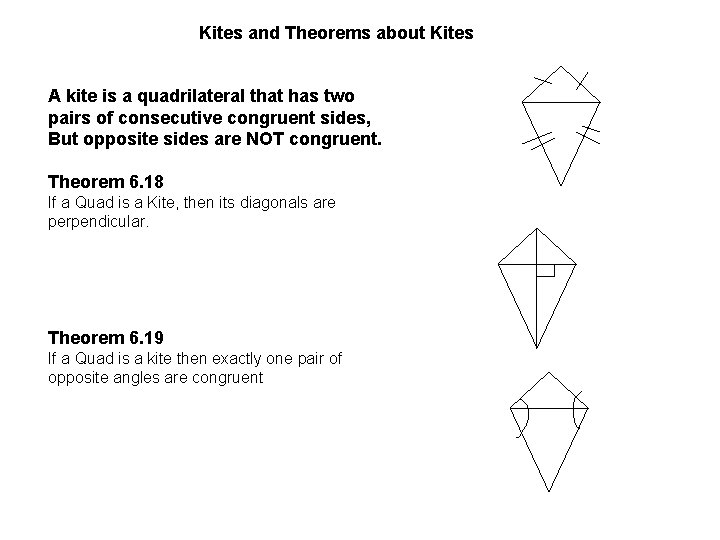
Kites and Theorems about Kites A kite is a quadrilateral that has two pairs of consecutive congruent sides, But opposite sides are NOT congruent. Theorem 6. 18 If a Quad is a Kite, then its diagonals are perpendicular. Theorem 6. 19 If a Quad is a kite then exactly one pair of opposite angles are congruent
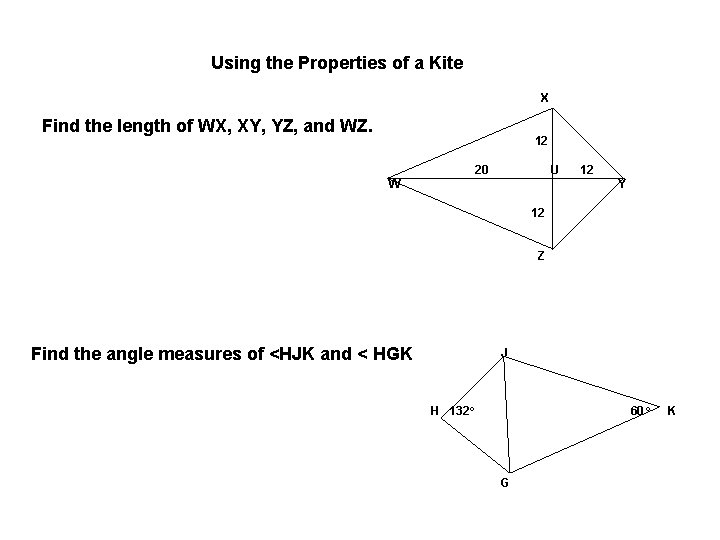
Using the Properties of a Kite X Find the length of WX, XY, YZ, and WZ. 12 20 U W 12 Y 12 Z Find the angle measures of <HJK and < HGK J H 132 o 60 o G K
Summarizing the Properties of Quadrilaterals Kites _______ Parallelograms _________ Trapezoids ________ Rhombus Squares Rectangles _____________ Isosceles Trap. _______
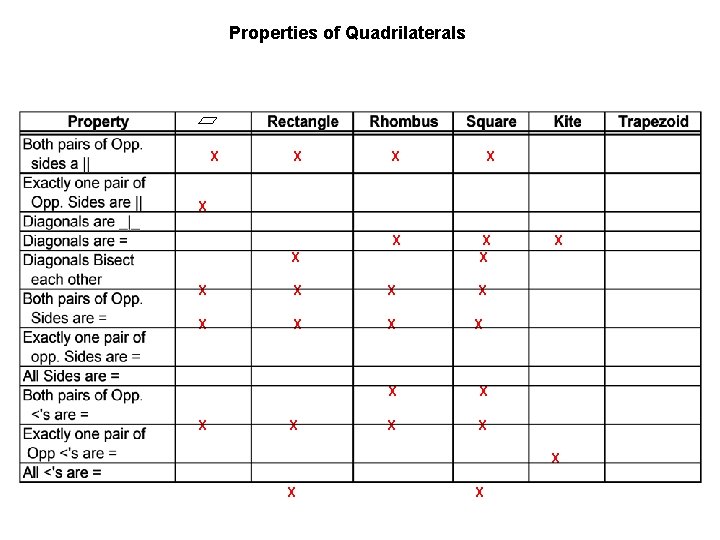
Properties of Quadrilaterals X X X X X X X
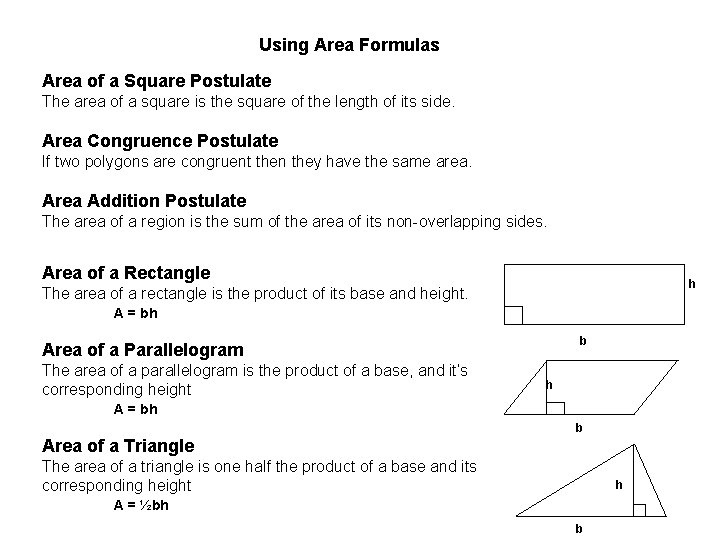
Using Area Formulas Area of a Square Postulate The area of a square is the square of the length of its side. Area Congruence Postulate If two polygons are congruent then they have the same area. Area Addition Postulate The area of a region is the sum of the area of its non-overlapping sides. Area of a Rectangle h The area of a rectangle is the product of its base and height. A = bh b Area of a Parallelogram The area of a parallelogram is the product of a base, and it’s corresponding height h A = bh b Area of a Triangle The area of a triangle is one half the product of a base and its corresponding height h A = ½bh b
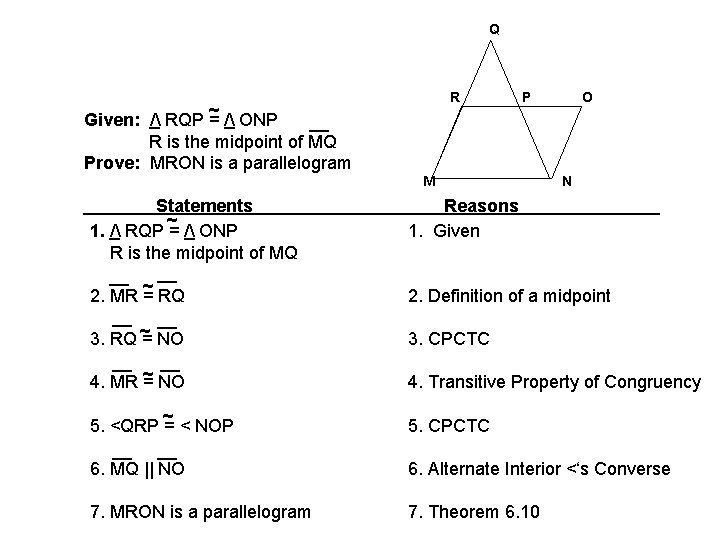
Q R Given: / RQP ~ = / ONP __ R is the midpoint of MQ Prove: MRON is a parallelogram P M Statements ~ 1. / RQP = / ONP R is the midpoint of MQ __ __ ~ 2. MR = RQ __ __ 3. RQ ~= NO __ __ 4. MR ~ = NO Reasons 1. Given 5. <QRP ~ = < NOP __ __ 6. MQ || NO 5. CPCTC 7. MRON is a parallelogram 7. Theorem 6. 10 O N 2. Definition of a midpoint 3. CPCTC 4. Transitive Property of Congruency 6. Alternate Interior <‘s Converse
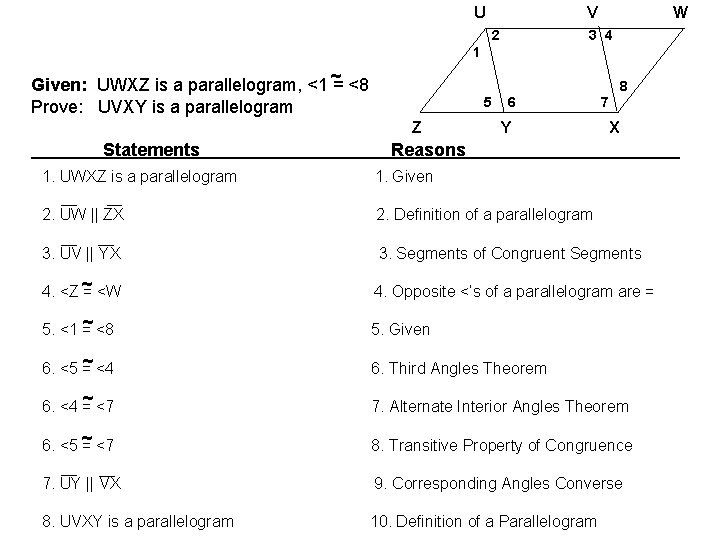
U V 2 W 3 4 1 Given: UWXZ is a parallelogram, <1 ~ = <8 Prove: UVXY is a parallelogram 8 5 Z Statements 1. UWXZ is a parallelogram __ __ 2. UW || ZX __ __ 6 Y 7 X Reasons 1. Given 2. Definition of a parallelogram 3. UV || YX 3. Segments of Congruent Segments 4. <Z ~ = <W 4. Opposite <‘s of a parallelogram are = ~ <8 5. <1 = 5. Given ~ <4 6. <5 = 6. Third Angles Theorem ~ <7 6. <4 = 7. Alternate Interior Angles Theorem 6. <5 ~ = <7 8. Transitive Property of Congruence __ __ 7. UY || VX 9. Corresponding Angles Converse 8. UVXY is a parallelogram 10. Definition of a Parallelogram
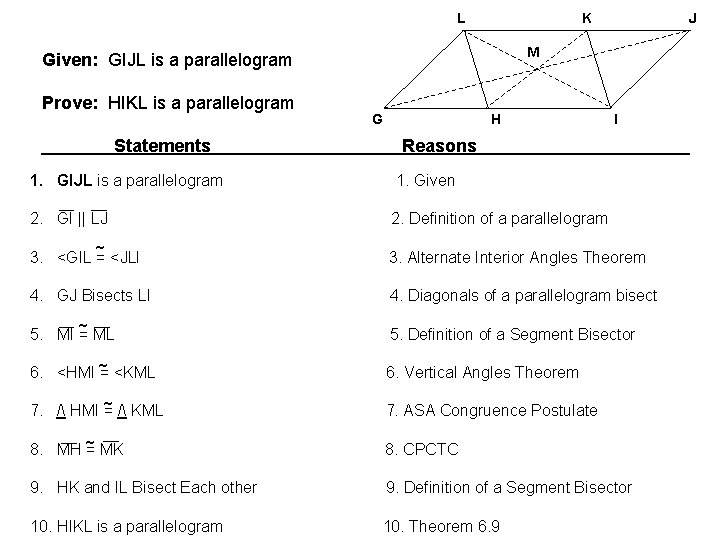
L K M Given: GIJL is a parallelogram Prove: HIKL is a parallelogram Statements 1. GIJL is a parallelogram __ __ J G H I Reasons 1. Given 2. GI || LJ 2. Definition of a parallelogram ~ 3. <GIL = <JLI 3. Alternate Interior Angles Theorem 4. GJ Bisects LI 4. Diagonals of a parallelogram bisect __ ~ __ 5. MI = ML 5. Definition of a Segment Bisector 6. <HMI ~ = <KML 6. Vertical Angles Theorem ~ / KML 7. / HMI = 7. ASA Congruence Postulate __ ~ __ 8. MH = MK 8. CPCTC 9. HK and IL Bisect Each other 9. Definition of a Segment Bisector 10. HIKL is a parallelogram 10. Theorem 6. 9