
Quadrilateral 1 pair of opp Sides 2 pairs


- Slides: 25
Quadrilateral 1 pair of // opp. Sides 2 pairs of equal adjacent sides Kite Trapezium Sum of interior angles is 1800 One of the diagionals is axis of symmetry 2 diagionals are Parallelogram 2 pairs of opp. // sides Rhombus 4 equal sides Properties of trapesium 2 pairs of opposite sides are equal. (opp. sides of // gram) 2 pairs of opposite angles are equal (opp. s of // gram) Diagonals bisect each other (diag. Of // gram) Properties of // gram and kite Diagonals bisects each interior angle 4 right angles and 4 equal sides Rectangle Properties of // gram Diagonals are equal Properties of rhombus/rectangle Square Angles between each diagional and each side is 450
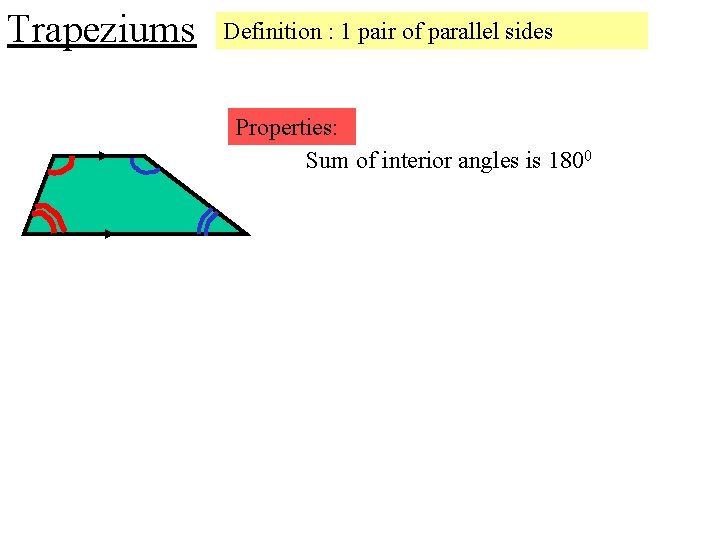
Trapeziums Definition : 1 pair of parallel sides Properties: Sum of interior angles is 1800
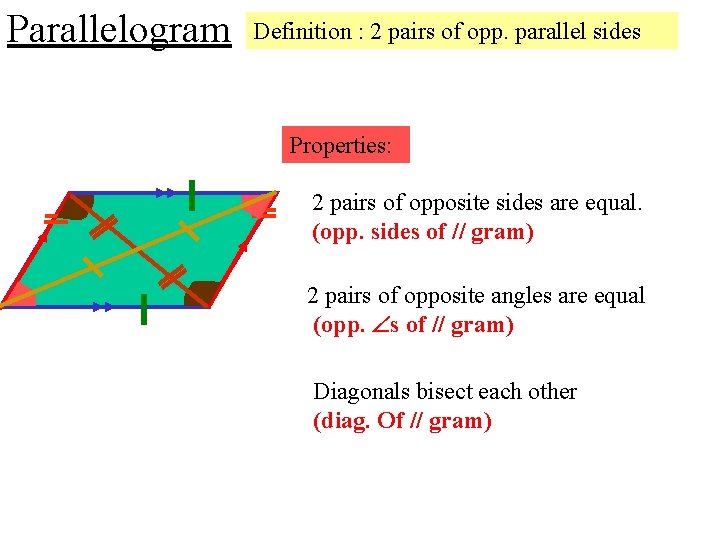
Parallelogram Definition : 2 pairs of opp. parallel sides Properties: 2 pairs of opposite sides are equal. (opp. sides of // gram) 2 pairs of opposite angles are equal (opp. s of // gram) Diagonals bisect each other (diag. Of // gram)
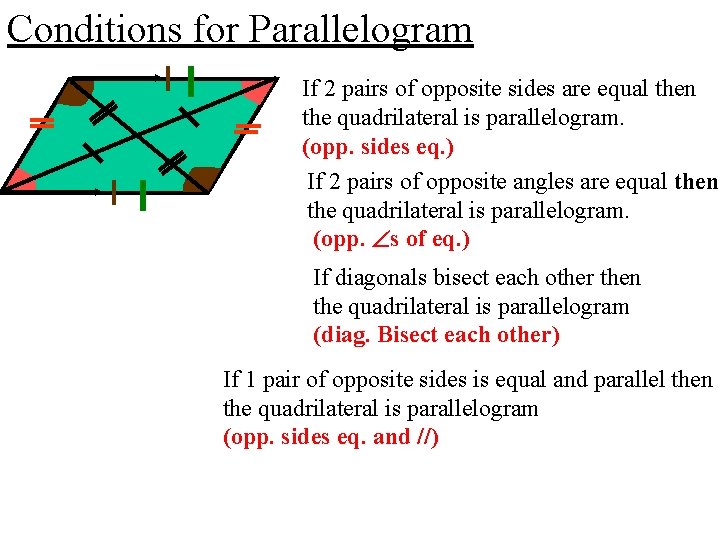
Conditions for Parallelogram If 2 pairs of opposite sides are equal then the quadrilateral is parallelogram. (opp. sides eq. ) If 2 pairs of opposite angles are equal then the quadrilateral is parallelogram. (opp. s of eq. ) If diagonals bisect each other then the quadrilateral is parallelogram (diag. Bisect each other) If 1 pair of opposite sides is equal and parallel then the quadrilateral is parallelogram (opp. sides eq. and //)
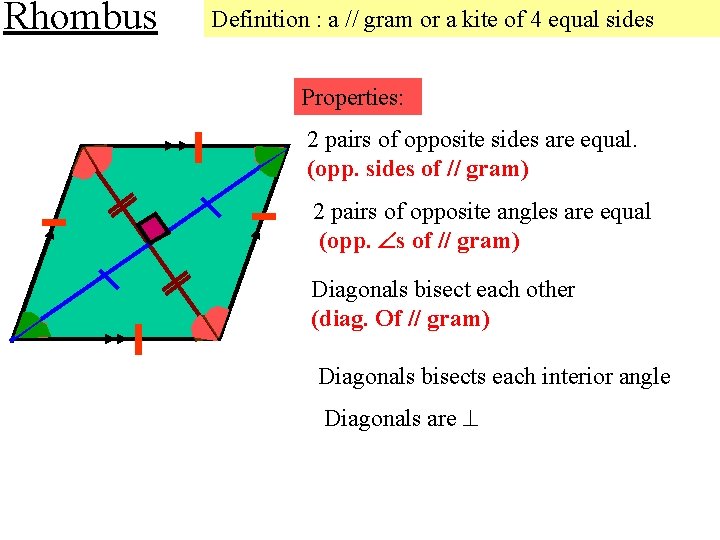
Rhombus Definition : a // gram or a kite of 4 equal sides Properties: 2 pairs of opposite sides are equal. (opp. sides of // gram) 2 pairs of opposite angles are equal (opp. s of // gram) Diagonals bisect each other (diag. Of // gram) Diagonals bisects each interior angle Diagonals are
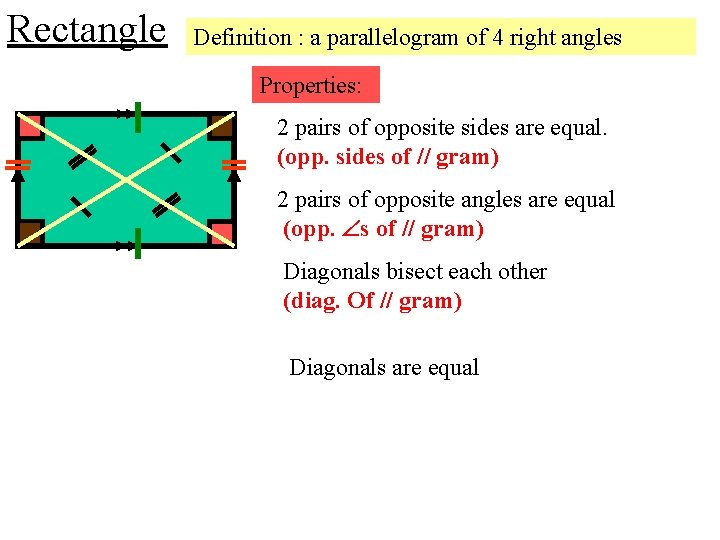
Rectangle Definition : a parallelogram of 4 right angles Properties: 2 pairs of opposite sides are equal. (opp. sides of // gram) 2 pairs of opposite angles are equal (opp. s of // gram) Diagonals bisect each other (diag. Of // gram) Diagonals are equal
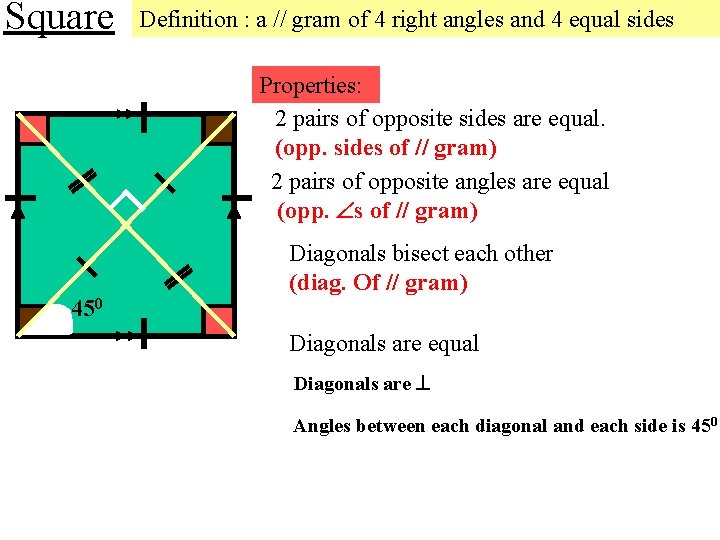
Square Definition : a // gram of 4 right angles and 4 equal sides Properties: 2 pairs of opposite sides are equal. (opp. sides of // gram) 2 pairs of opposite angles are equal (opp. s of // gram) 450 Diagonals bisect each other (diag. Of // gram) Diagonals are equal Diagonals are Angles between each diagonal and each side is 450
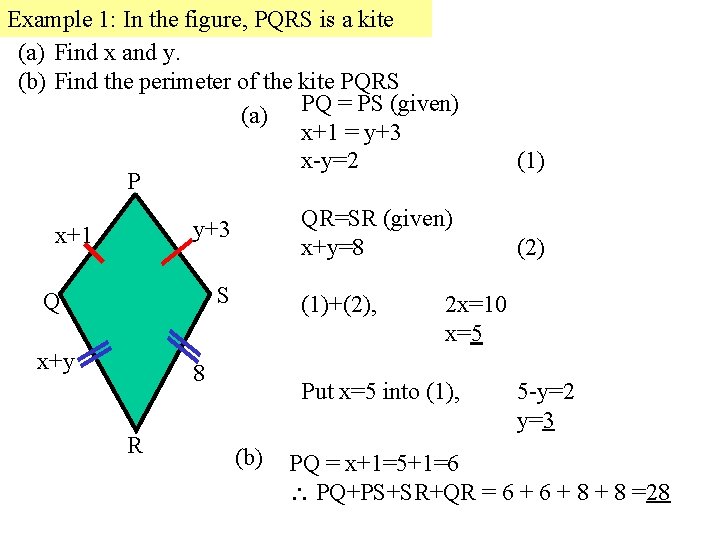
Example 1: In the figure, PQRS is a kite (a) Find x and y. (b) Find the perimeter of the kite PQRS (a) PQ = PS (given) x+1 = y+3 x-y=2 P QR=SR (given) x+y=8 y+3 x+1 S Q x+y (1)+(2), 8 R (2) 2 x=10 x=5 Put x=5 into (1), (b) (1) 5 -y=2 y=3 PQ = x+1=5+1=6 PQ+PS+SR+QR = 6 + 8 + 8 =28
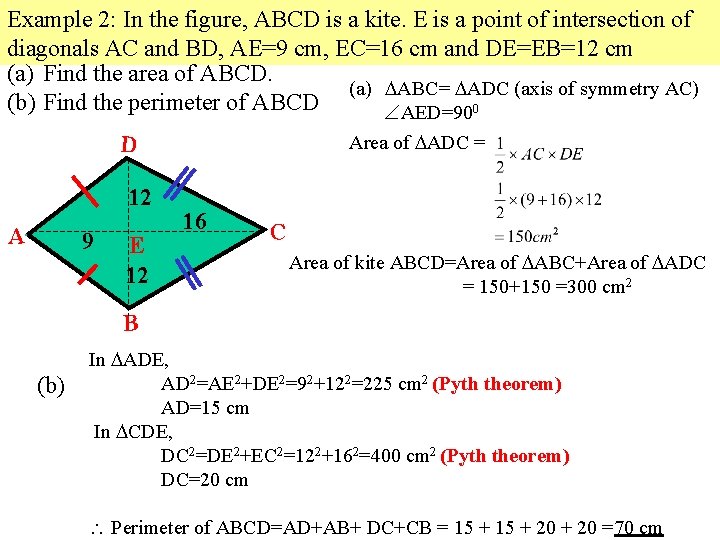
Example 2: In the figure, ABCD is a kite. E is a point of intersection of diagonals AC and BD, AE=9 cm, EC=16 cm and DE=EB=12 cm (a) Find the area of ABCD. (a) ABC= ADC (axis of symmetry AC) (b) Find the perimeter of ABCD AED=900 Area of ADC = D 12 A 9 E 12 16 C Area of kite ABCD=Area of ABC+Area of ADC = 150+150 =300 cm 2 B (b) In ADE, AD 2=AE 2+DE 2=92+122=225 cm 2 (Pyth theorem) AD=15 cm In CDE, DC 2=DE 2+EC 2=122+162=400 cm 2 (Pyth theorem) DC=20 cm Perimeter of ABCD=AD+AB+ DC+CB = 15 + 20 =70 cm
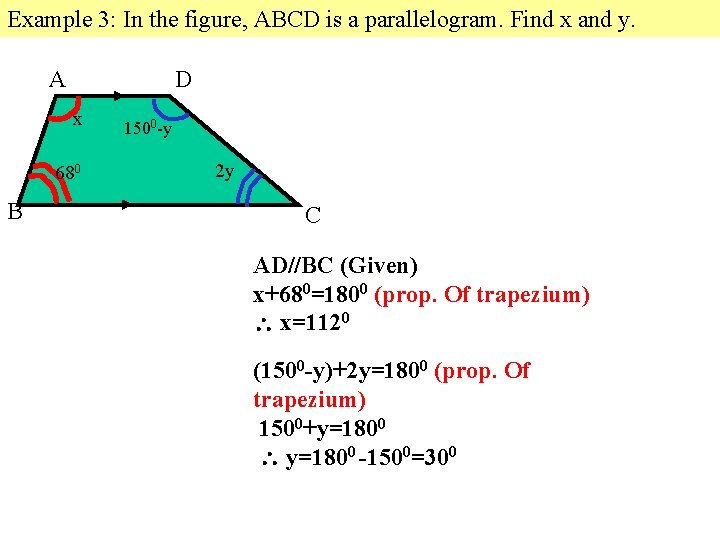
Example 3: In the figure, ABCD is a parallelogram. Find x and y. A D x 680 B 1500 -y 2 y C AD//BC (Given) x+680=1800 (prop. Of trapezium) x=1120 (1500 -y)+2 y=1800 (prop. Of trapezium) 1500+y=1800 -1500=300
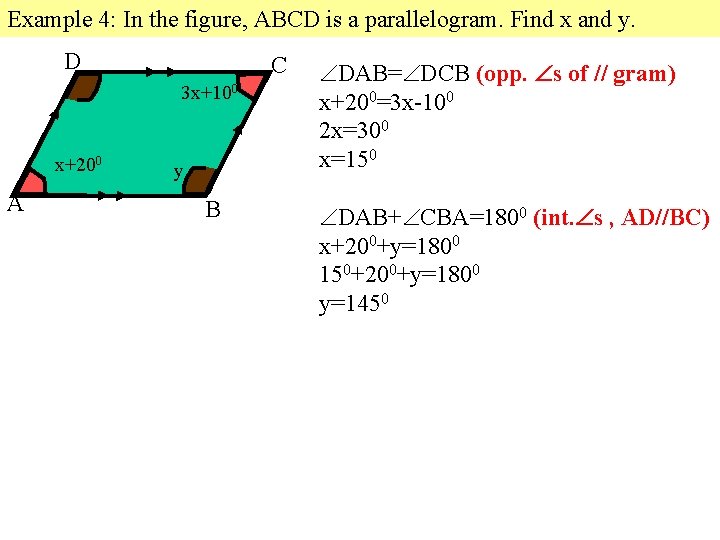
Example 4: In the figure, ABCD is a parallelogram. Find x and y. D C 3 x+100 x+200 A y B DAB= DCB (opp. s of // gram) x+200=3 x-100 2 x=300 x=150 DAB+ CBA=1800 (int. s , AD//BC) x+200+y=1800 150+200+y=1800 y=1450
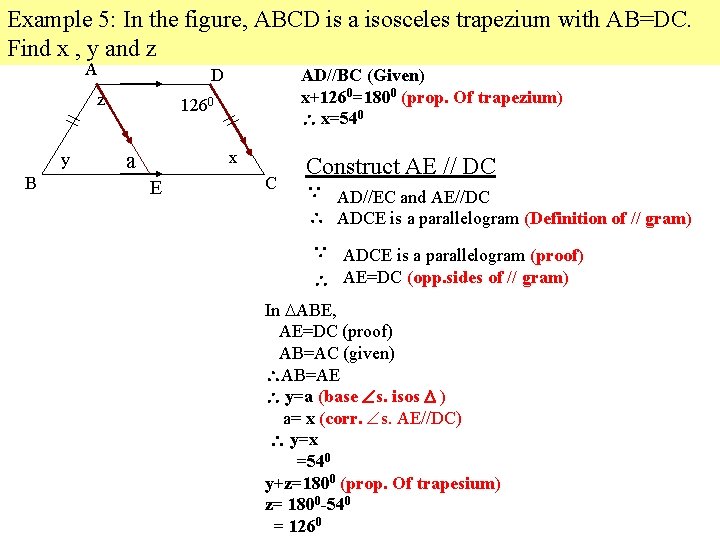
Example 5: In the figure, ABCD is a isosceles trapezium with AB=DC. Find x , y and z z B 1260 x a E C Construct AE // DC AD//EC and AE//DC ADCE is a parallelogram (Definition of // gram) y AD//BC (Given) x+1260=1800 (prop. Of trapezium) x=540 D A ADCE is a parallelogram (proof) AE=DC (opp. sides of // gram) In ABE, AE=DC (proof) AB=AC (given) AB=AE y=a (base s. isos ) a= x (corr. s. AE//DC) y=x =540 y+z=1800 (prop. Of trapesium) z= 1800 -540 = 1260
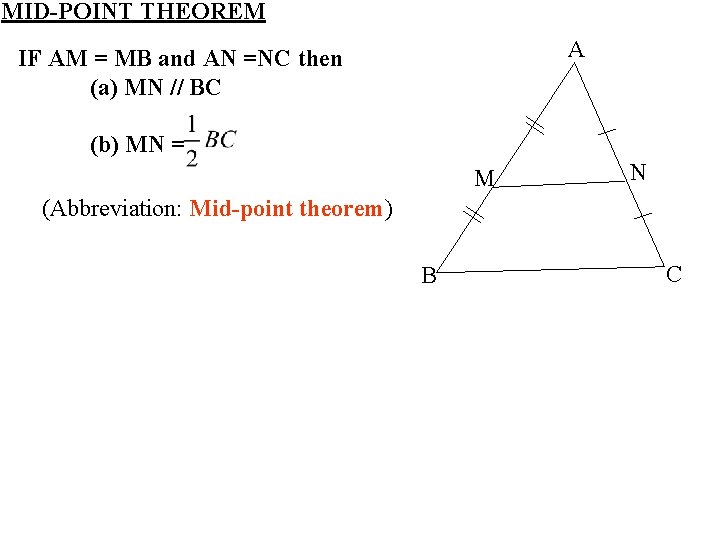
MID-POINT THEOREM A IF AM = MB and AN =NC then (a) MN // BC (b) MN = M N (Abbreviation: Mid-point theorem) B C
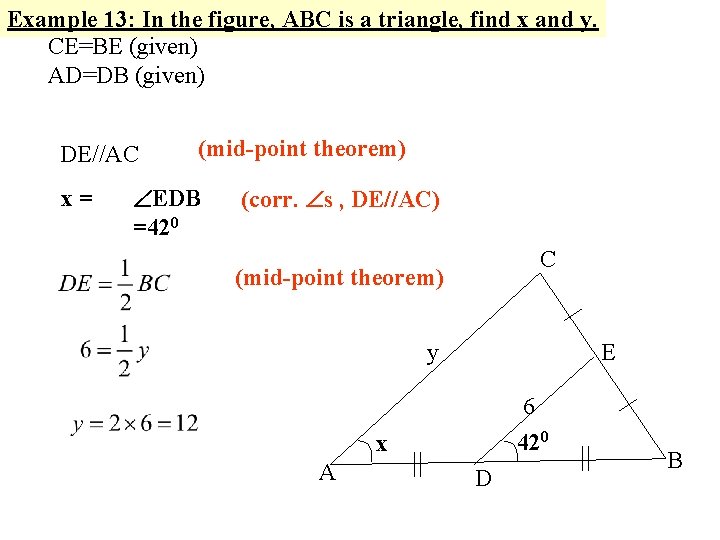
Example 13: In the figure, ABC is a triangle, find x and y. CE=BE (given) AD=DB (given) DE//AC x= (mid-point theorem) EDB =420 (corr. s , DE//AC) C (mid-point theorem) y E 6 420 x A D B
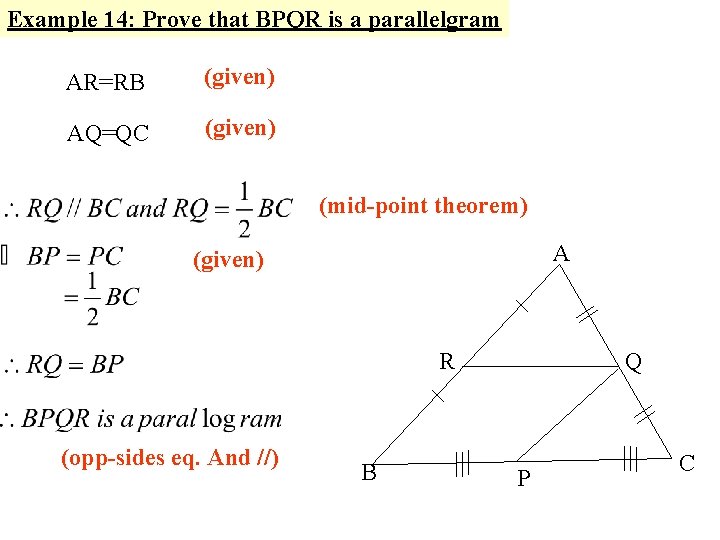
Example 14: Prove that BPQR is a parallelgram AR=RB (given) AQ=QC (given) (mid-point theorem) A (given) R (opp-sides eq. And //) B Q P C
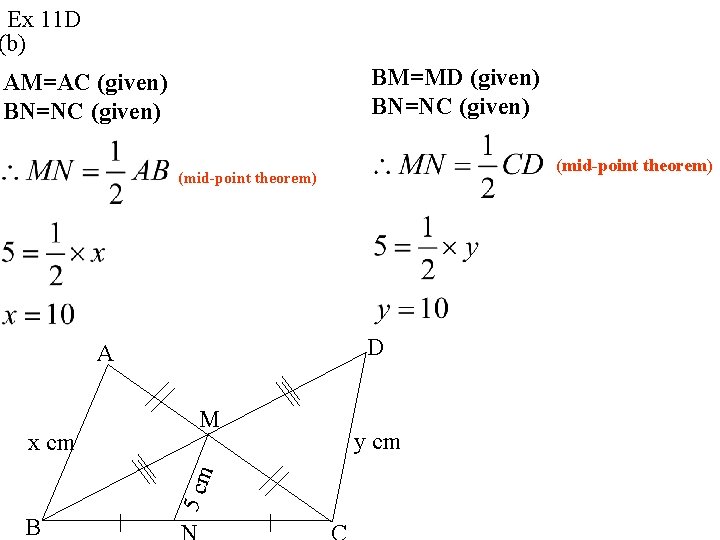
Ex 11 D (b) BM=MD (given) BN=NC (given) AM=AC (given) BN=NC (given) (mid-point theorem) D A 5 cm x cm M B y cm
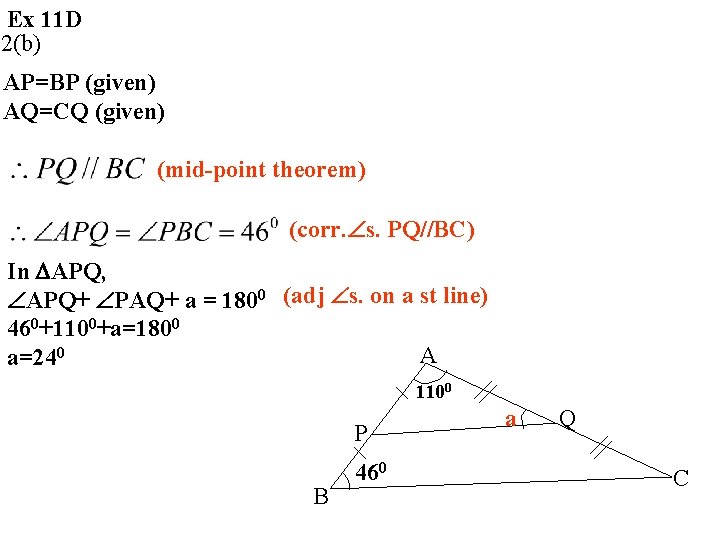
Ex 11 D 2(b) AP=BP (given) AQ=CQ (given) (mid-point theorem) (corr. s. PQ//BC) In APQ, APQ+ PAQ+ a = 1800 (adj s. on a st line) 460+1100+a=1800 A a=240 1100 P B 460 a Q C
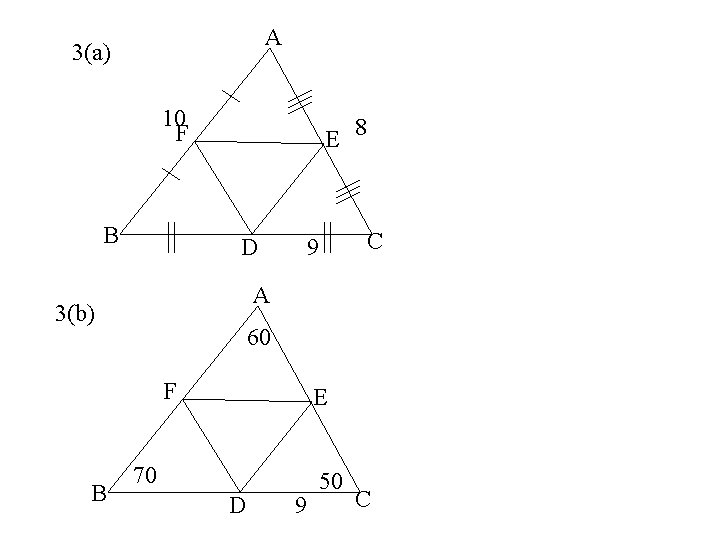
A 3(a) 10 F B E D C 9 A 3(b) 60 F B 8 E 70 D 9 50 C
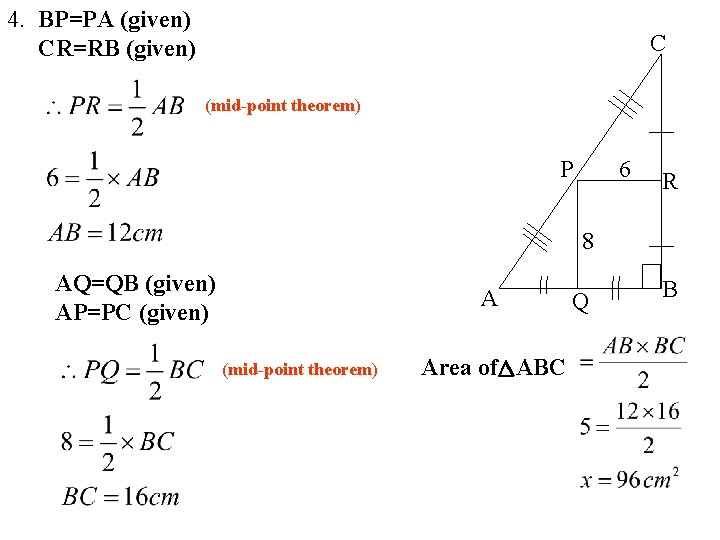
4. BP=PA (given) CR=RB (given) C (mid-point theorem) P 6 R 8 AQ=QB (given) AP=PC (given) A Area of ABC (mid-point theorem) Q B
INTERCEPT THEOREM transversal X cep t P B inte r A C Q Y D
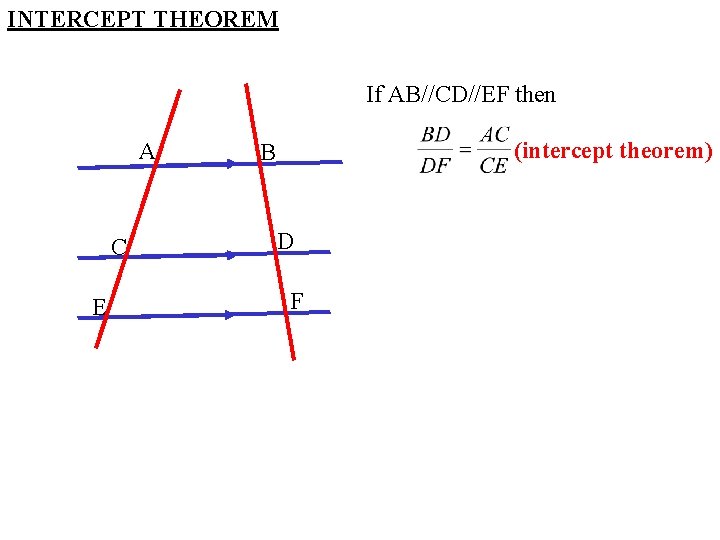
INTERCEPT THEOREM If AB//CD//EF then A C E (intercept theorem) B D F
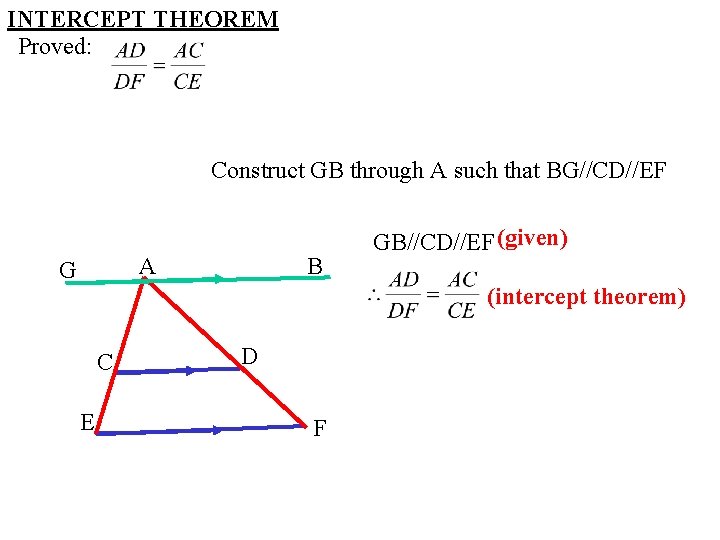
INTERCEPT THEOREM Proved: Construct GB through A such that BG//CD//EF A G B GB//CD//EF (given) (intercept theorem) C E D F
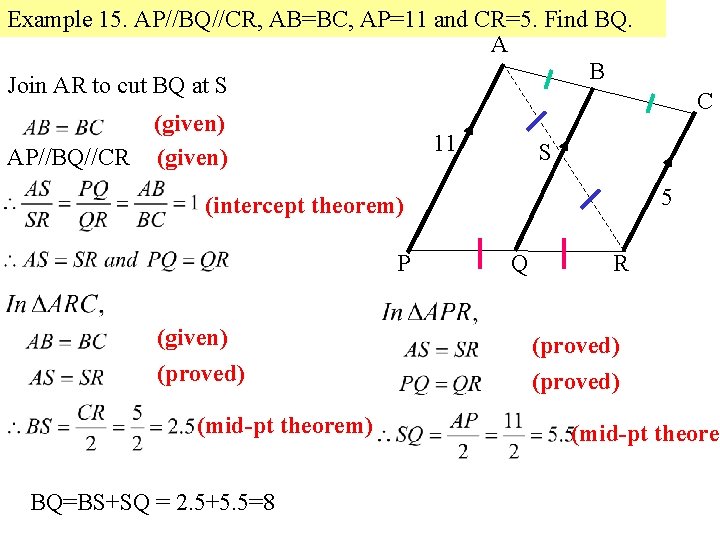
Example 15. AP//BQ//CR, AB=BC, AP=11 and CR=5. Find BQ. A B Join AR to cut BQ at S AP//BQ//CR (given) 11 S 5 (intercept theorem) P (given) (proved) (mid-pt theorem) BQ=BS+SQ = 2. 5+5. 5=8 C Q R (proved) (mid-pt theorem
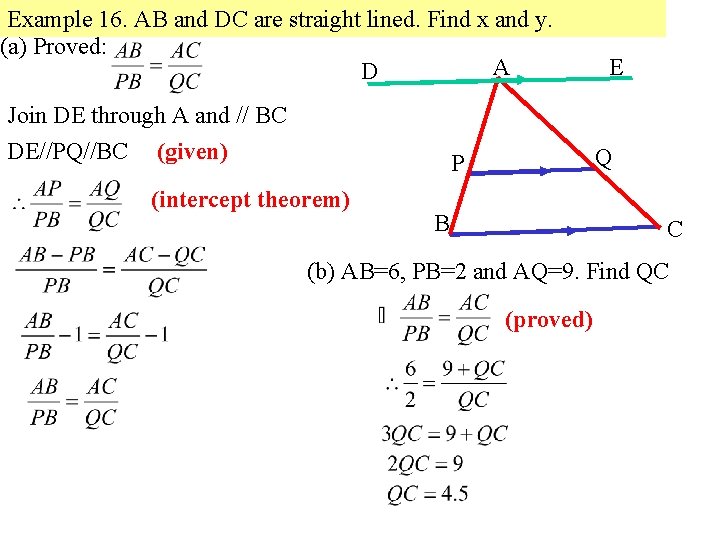
Example 16. AB and DC are straight lined. Find x and y. (a) Proved: A D E Join DE through A and // BC DE//PQ//BC (given) Q P (intercept theorem) B C (b) AB=6, PB=2 and AQ=9. Find QC (proved)
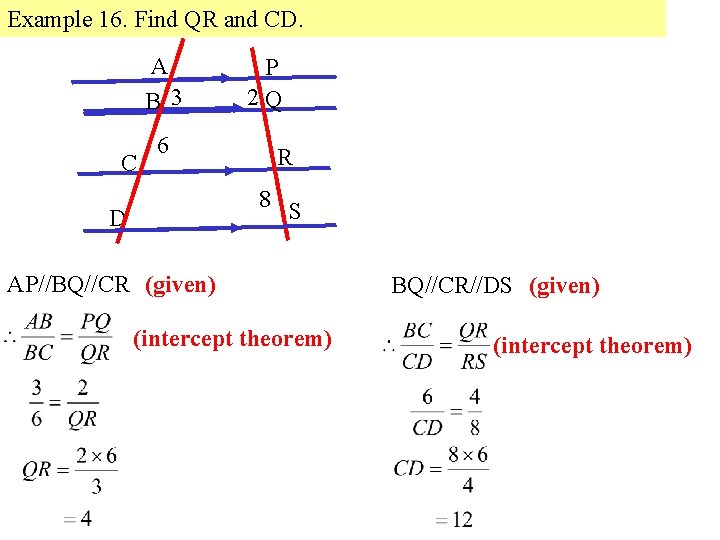
Example 16. Find QR and CD. A B 3 C 6 P 2 Q R 8 S D AP//BQ//CR (given) (intercept theorem) BQ//CR//DS (given) (intercept theorem)