
Quadratic Pythagoras Theorem Starter Solve the following Equation
- Slides: 9
Quadratic Pythagoras’ Theorem
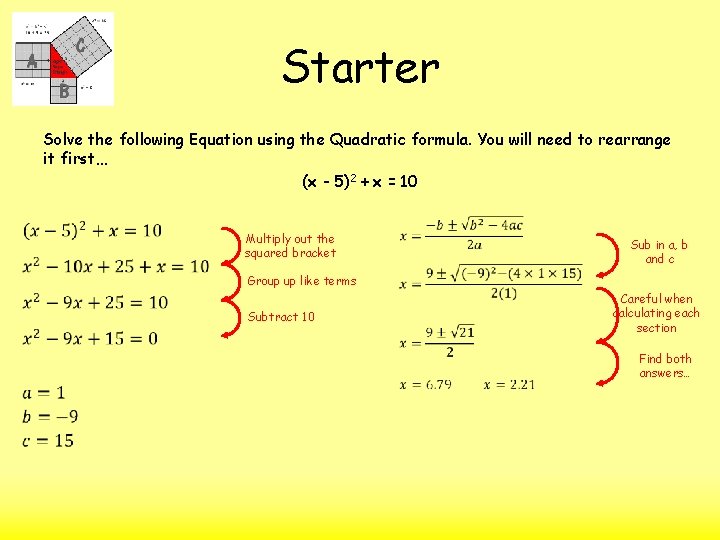
Starter Solve the following Equation using the Quadratic formula. You will need to rearrange it first… (x - 5)2 + x = 10 Multiply out the squared bracket Sub in a, b and c Group up like terms Subtract 10 Careful when calculating each section Find both answers…
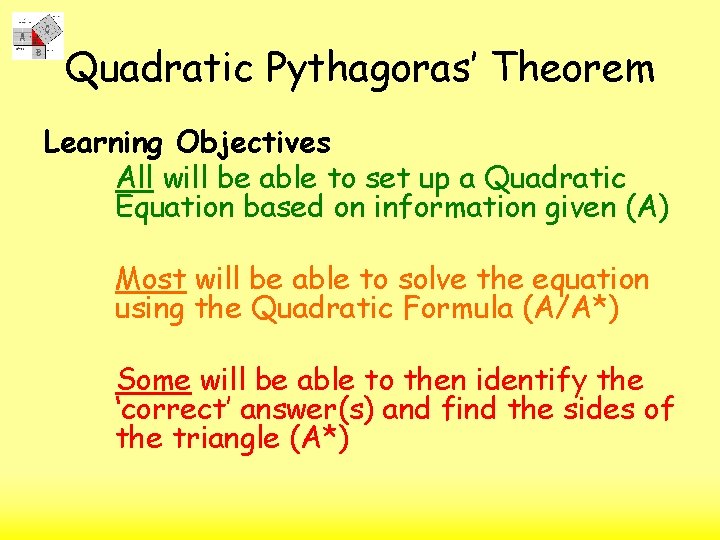
Quadratic Pythagoras’ Theorem Learning Objectives All will be able to set up a Quadratic Equation based on information given (A) Most will be able to solve the equation using the Quadratic Formula (A/A*) Some will be able to then identify the ‘correct’ answer(s) and find the sides of the triangle (A*)
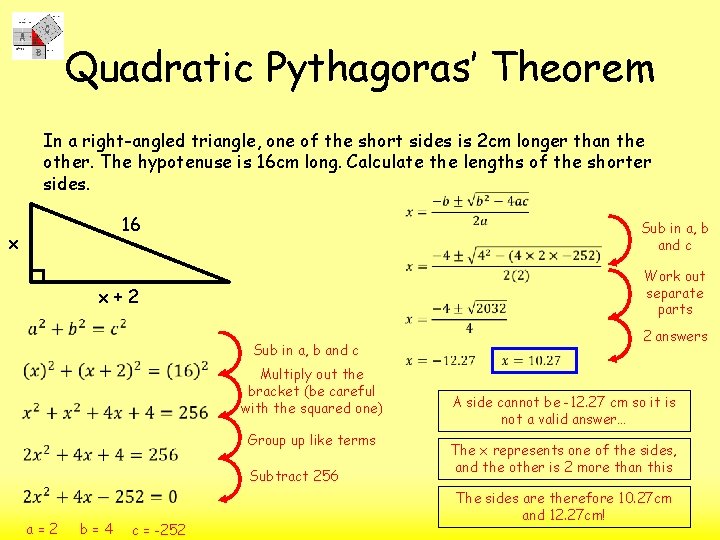
Quadratic Pythagoras’ Theorem In a right-angled triangle, one of the short sides is 2 cm longer than the other. The hypotenuse is 16 cm long. Calculate the lengths of the shorter sides. 16 x Sub in a, b and c Work out separate parts x+2 Sub in a, b and c Multiply out the bracket (be careful with the squared one) Group up like terms Subtract 256 a=2 b=4 c = -252 2 answers A side cannot be -12. 27 cm so it is not a valid answer… The x represents one of the sides, and the other is 2 more than this The sides are therefore 10. 27 cm and 12. 27 cm!
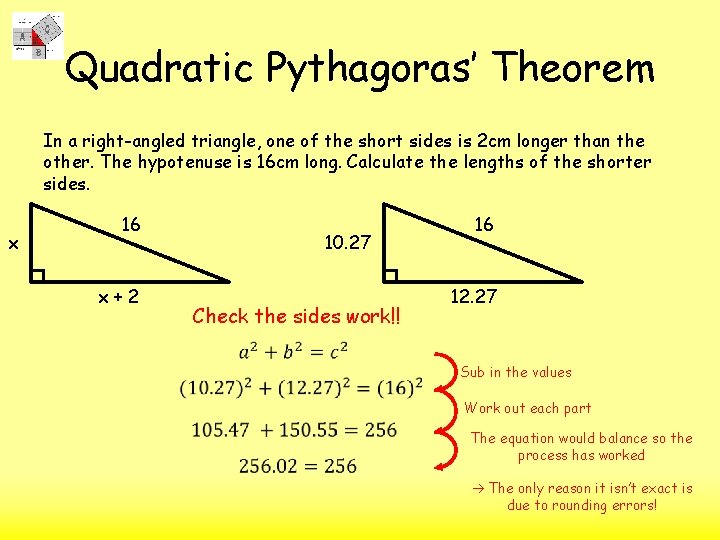
Quadratic Pythagoras’ Theorem In a right-angled triangle, one of the short sides is 2 cm longer than the other. The hypotenuse is 16 cm long. Calculate the lengths of the shorter sides. x 16 x+2 10. 27 Check the sides work!! 16 12. 27 Sub in the values Work out each part The equation would balance so the process has worked The only reason it isn’t exact is due to rounding errors!
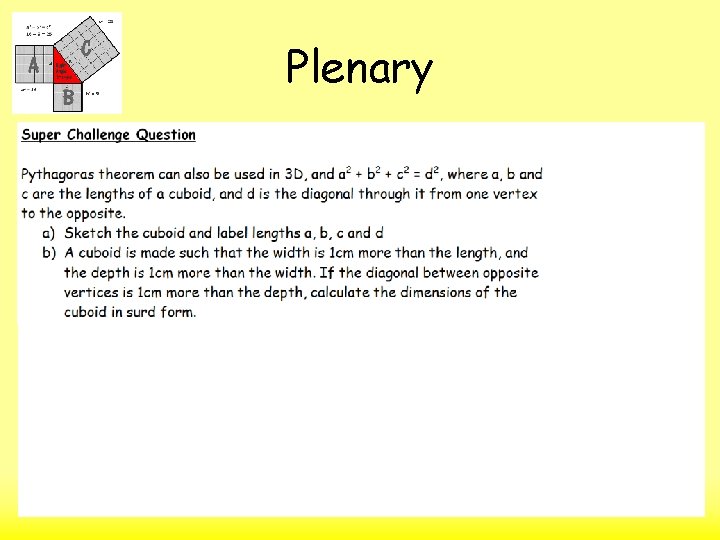
Plenary
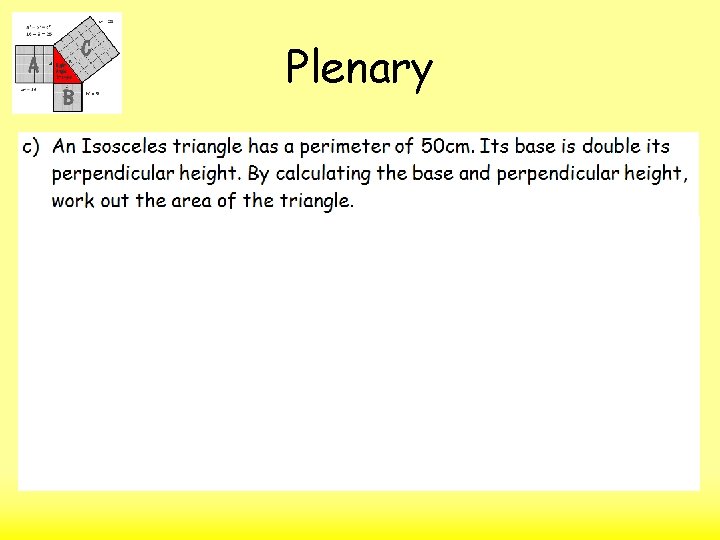
Plenary
Quadratic Pythagoras’ Theorem Learning Objectives All will be able to set up a Quadratic Equation based on information given (A) Most will be able to solve the equation using the Quadratic Formula (A/A*) Some will be able to then identify the ‘correct’ answer(s) and find the sides of the triangle (A*)
Summary • We have recapped our knowledge of both Pythagoras’ Theorem and the Quadratic Formula • We have seen how both of these techniques can be combined in answering questions