
Quadrangular space IV COMMITTEE I LAB QUIZ NOTE
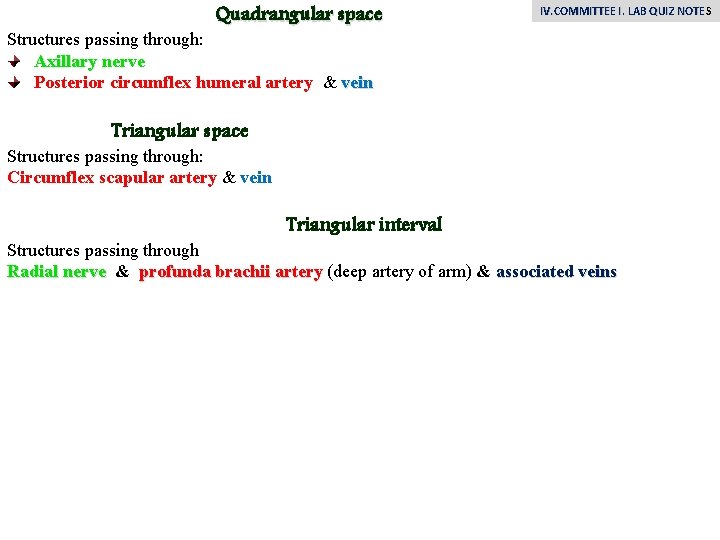
Quadrangular space IV. COMMITTEE I. LAB QUIZ NOTE S Structures passing through: Axillary nerve Posterior circumflex humeral artery & vein Triangular space Structures passing through: Circumflex scapular artery & vein Triangular interval Structures passing through Radial nerve & profunda brachii artery (deep artery of arm) & associated veins
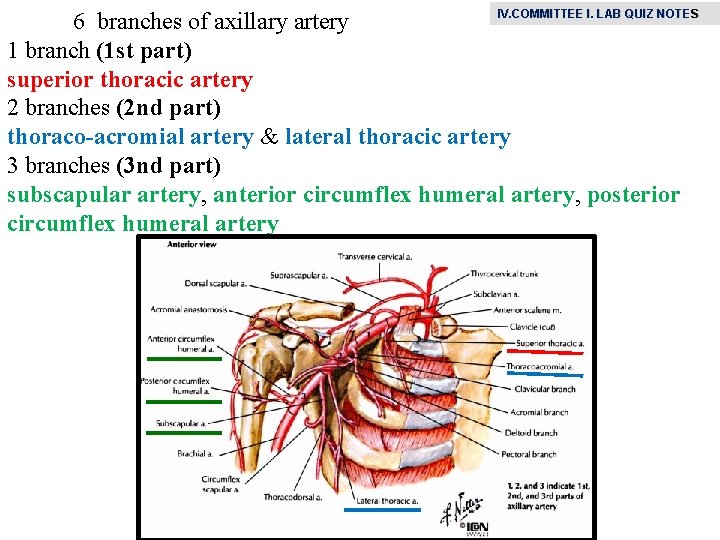
IV. COMMITTEE I. LAB QUIZ NOTE S 6 branches of axillary artery 1 branch (1 st part) superior thoracic artery 2 branches (2 nd part) thoraco-acromial artery & lateral thoracic artery 3 branches (3 nd part) subscapular artery, anterior circumflex humeral artery, posterior circumflex humeral artery
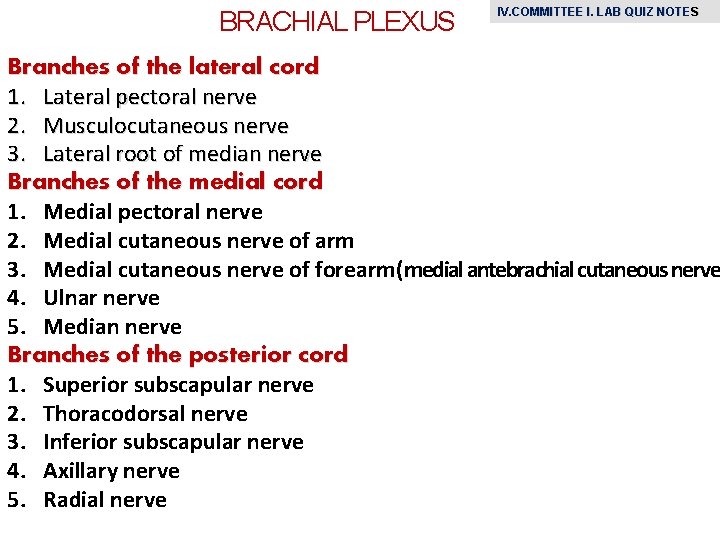
BRACHIAL PLEXUS IV. COMMITTEE I. LAB QUIZ NOTE S Branches of the lateral cord 1. Lateral pectoral nerve 2. Musculocutaneous nerve 3. Lateral root of median nerve Branches of the medial cord 1. Medial pectoral nerve 2. Medial cutaneous nerve of arm 3. Medial cutaneous nerve of forearm(medial antebrachial cutaneous nerve 4. Ulnar nerve 5. Median nerve Branches of the posterior cord 1. Superior subscapular nerve 2. Thoracodorsal nerve 3. Inferior subscapular nerve 4. Axillary nerve 5. Radial nerve
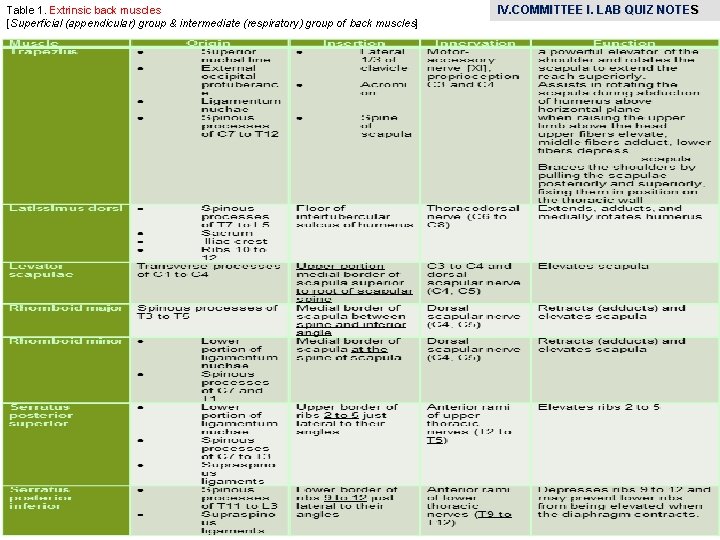
Table 1. Extrinsic back muscles [Superficial (appendicular) group & intermediate (respiratory) group of back muscles] IV. COMMITTEE I. LAB QUIZ NOTE S
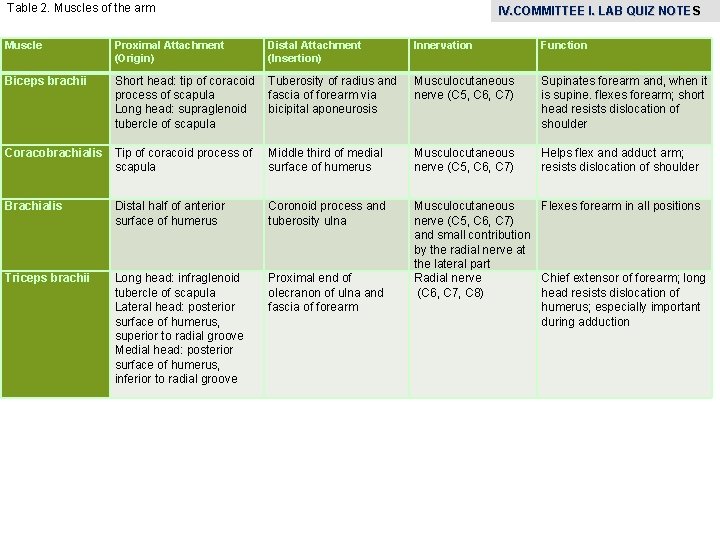
Table 2. Muscles of the arm Muscle Proximal Attachment (Origin) Biceps brachii IV. COMMITTEE I. LAB QUIZ NOTE S Distal Attachment (Insertion) Innervation Function Short head: tip of coracoid Tuberosity of radius and process of scapula fascia of forearm via Long head: supraglenoid bicipital aponeurosis tubercle of scapula Musculocutaneous nerve (C 5, C 6, C 7) Coracobrachialis Tip of coracoid process of scapula Middle third of medial surface of humerus Musculocutaneous nerve (C 5, C 6, C 7) Supinates forearm and, when it is supine. flexes forearm; short head resists dislocation of shoulder Helps flex and adduct arm; resists dislocation of shoulder Brachialis Distal half of anterior surface of humerus Coronoid process and tuberosity ulna Triceps brachii Long head: infraglenoid tubercle of scapula Lateral head: posterior surface of humerus, superior to radial groove Medial head: posterior surface of humerus, inferior to radial groove Proximal end of olecranon of ulna and fascia of forearm Musculocutaneous Flexes forearm in all positions nerve (C 5, C 6, C 7) and small contribution by the radial nerve at the lateral part Radial nerve Chief extensor of forearm; long (C 6, C 7, C 8) head resists dislocation of humerus; especially important during adduction
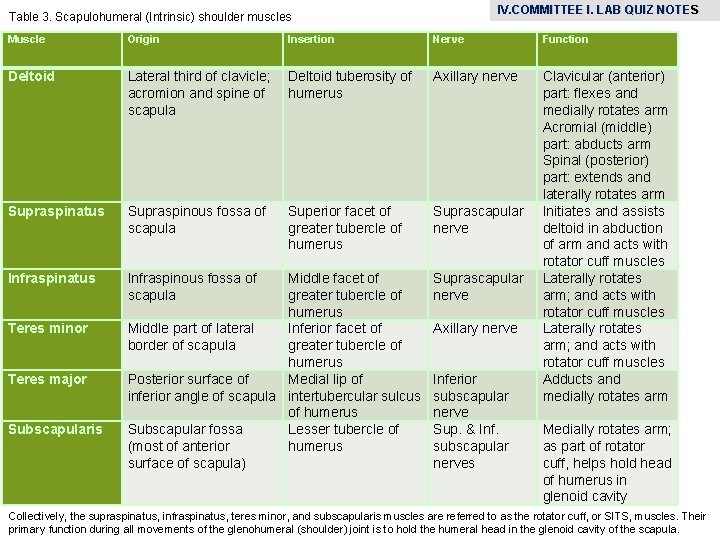
IV. COMMITTEE I. LAB QUIZ NOTE S Table 3. Scapulohumeral (Intrinsic) shoulder muscles Muscle Origin Deltoid Nerve Function Lateral third of clavicle; Deltoid tuberosity of acromion and spine of humerus scapula Axillary nerve Supraspinatus Supraspinous fossa of scapula Suprascapular nerve Infraspinatus Infraspinous fossa of scapula Clavicular (anterior) part: flexes and medially rotates arm Acromial (middle) part: abducts arm Spinal (posterior) part: extends and laterally rotates arm Initiates and assists deltoid in abduction of arm and acts with rotator cuff muscles Laterally rotates arm; and acts with rotator cuff muscles Adducts and medially rotates arm Teres minor Teres major Subscapularis Insertion Superior facet of greater tubercle of humerus Middle part of lateral Inferior facet of border of scapula greater tubercle of humerus Posterior surface of Medial lip of inferior angle of scapula intertubercular sulcus of humerus Subscapular fossa Lesser tubercle of (most of anterior humerus surface of scapula) Suprascapular nerve Axillary nerve Inferior subscapular nerve Sup. & Inf. subscapular nerves Medially rotates arm; as part of rotator cuff, helps hold head of humerus in glenoid cavity Collectively, the supraspinatus, infraspinatus, teres minor, and subscapularis muscles are referred to as the rotator cuff, or SITS, muscles. Their primary function during all movements of the glenohumeral (shoulder) joint is to hold the humeral head in the glenoid cavity of the scapula.
- Slides: 6