
Quadcopters History Also known as quadrotors First flying

- Slides: 33
Quadcopters
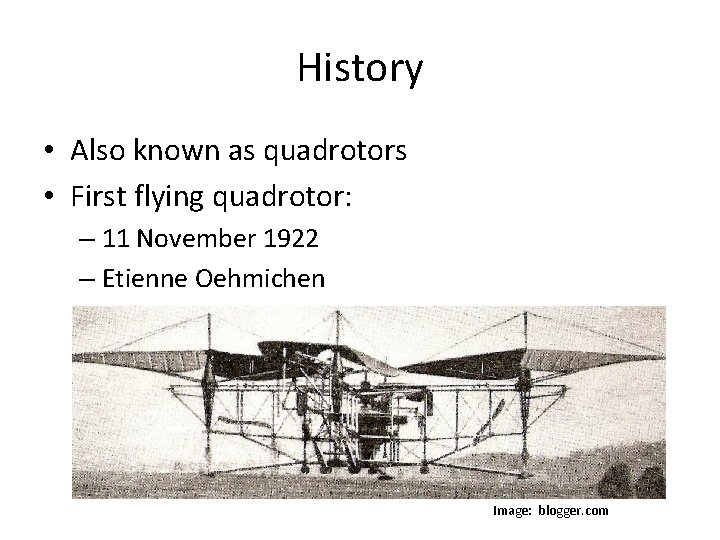
History • Also known as quadrotors • First flying quadrotor: – 11 November 1922 – Etienne Oehmichen Image: blogger. com
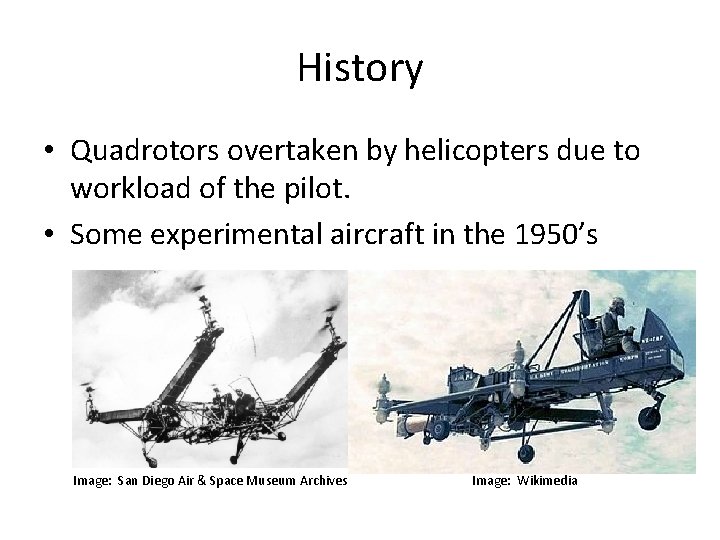
History • Quadrotors overtaken by helicopters due to workload of the pilot. • Some experimental aircraft in the 1950’s Image: San Diego Air & Space Museum Archives Image: Wikimedia
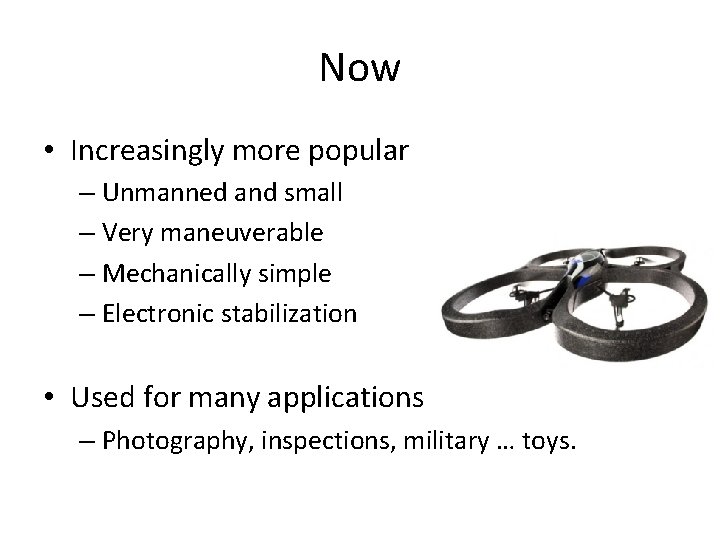
Now • Increasingly more popular – Unmanned and small – Very maneuverable – Mechanically simple – Electronic stabilization • Used for many applications – Photography, inspections, military … toys.
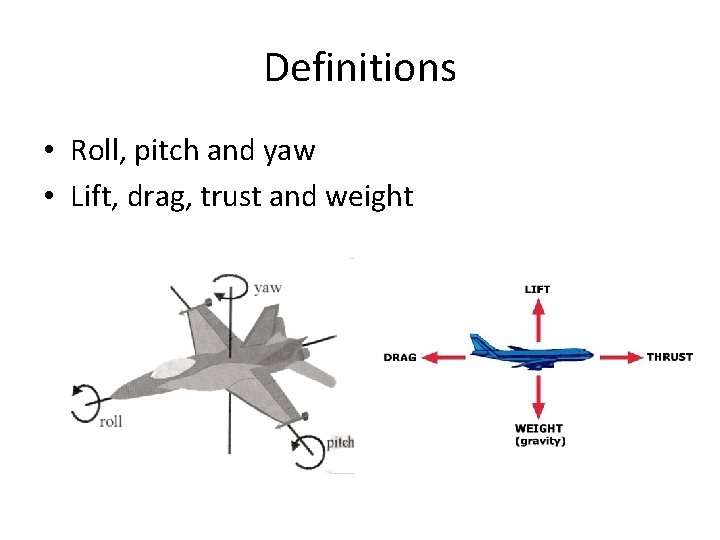
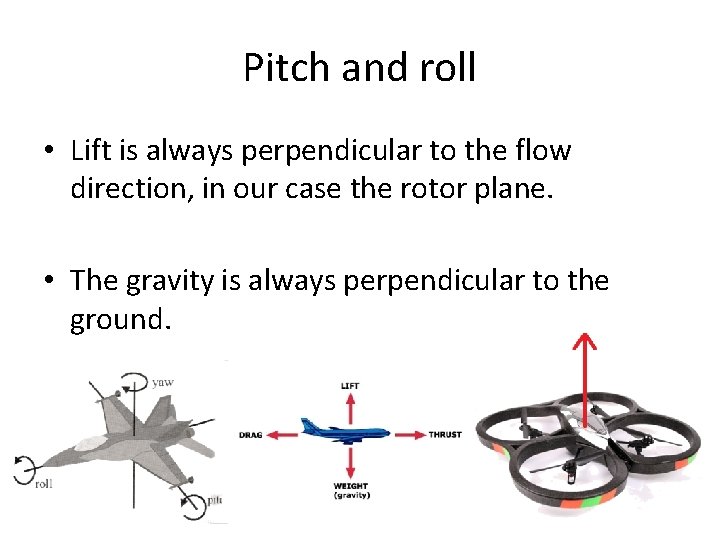
Definitions • Roll, pitch and yaw • Lift, drag, trust and weight
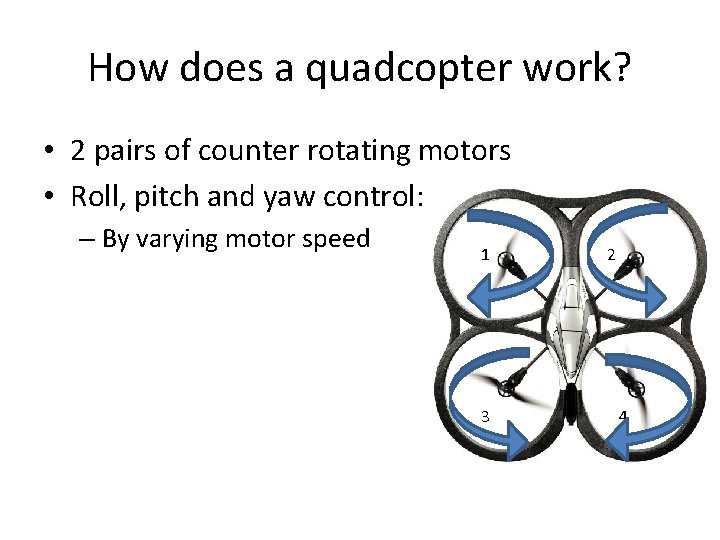
How does a quadcopter work? • 2 pairs of counter rotating motors • Roll, pitch and yaw control: – By varying motor speed 1 3 2 4
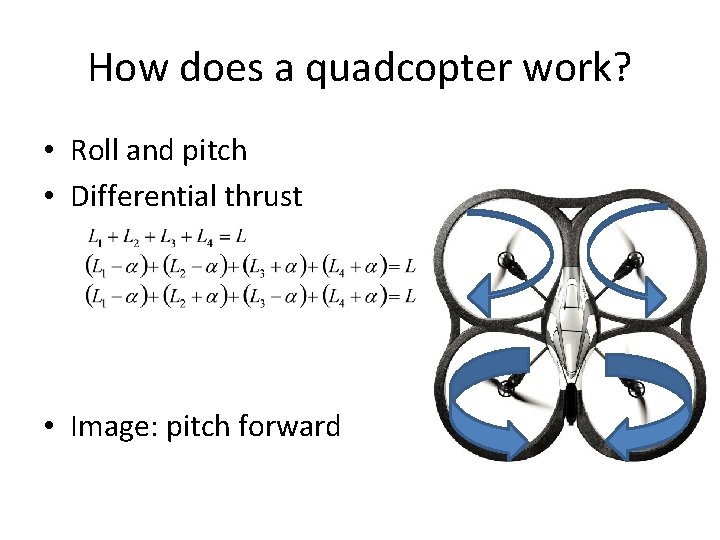
How does a quadcopter work? • Roll and pitch • Differential thrust • Image: pitch forward
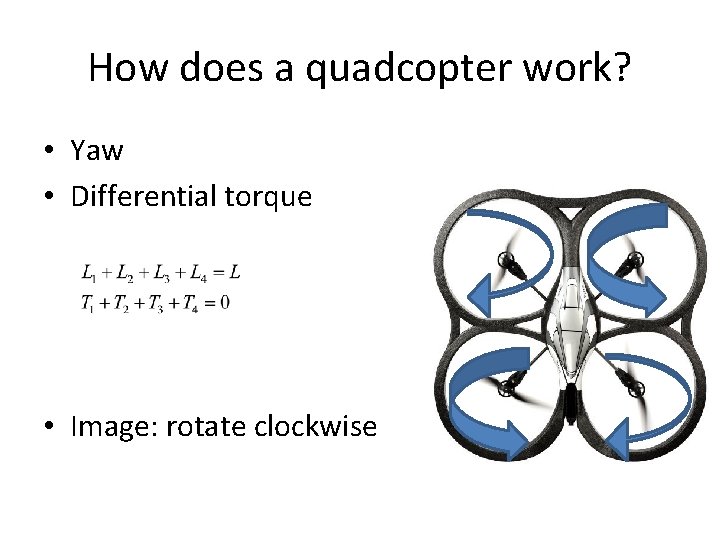
How does a quadcopter work? • Yaw • Differential torque • Image: rotate clockwise
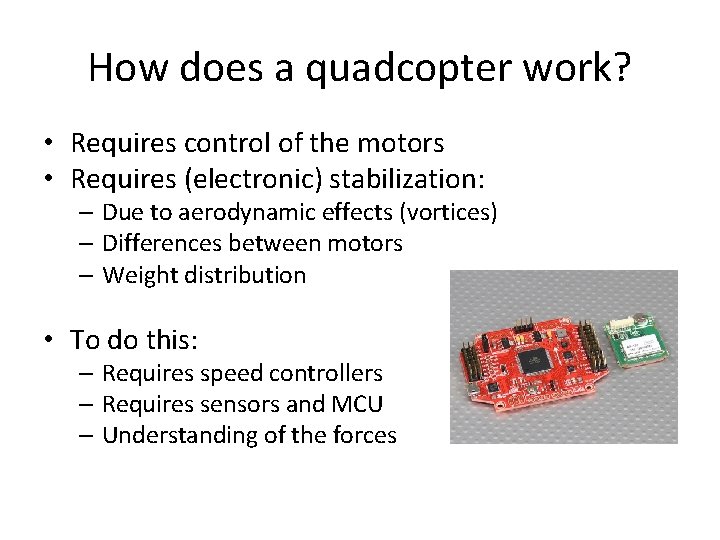
How does a quadcopter work? • Requires control of the motors • Requires (electronic) stabilization: – Due to aerodynamic effects (vortices) – Differences between motors – Weight distribution • To do this: – Requires speed controllers – Requires sensors and MCU – Understanding of the forces
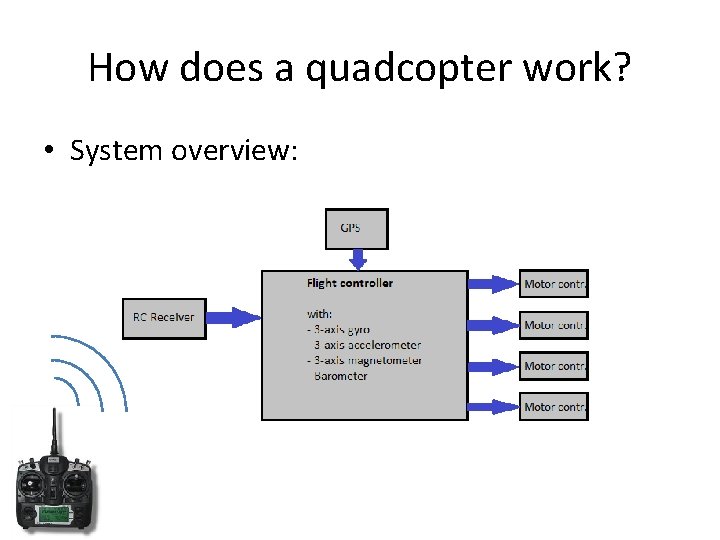
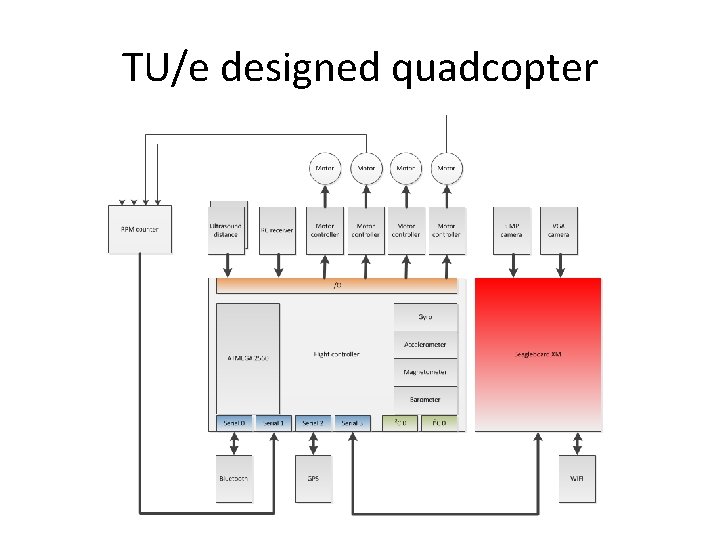
How does a quadcopter work? • System overview:
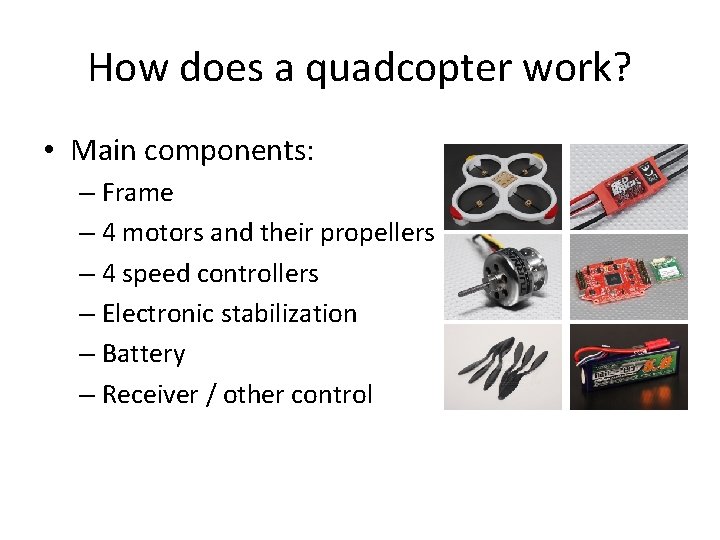
How does a quadcopter work? • Main components: – Frame – 4 motors and their propellers – 4 speed controllers – Electronic stabilization – Battery – Receiver / other control
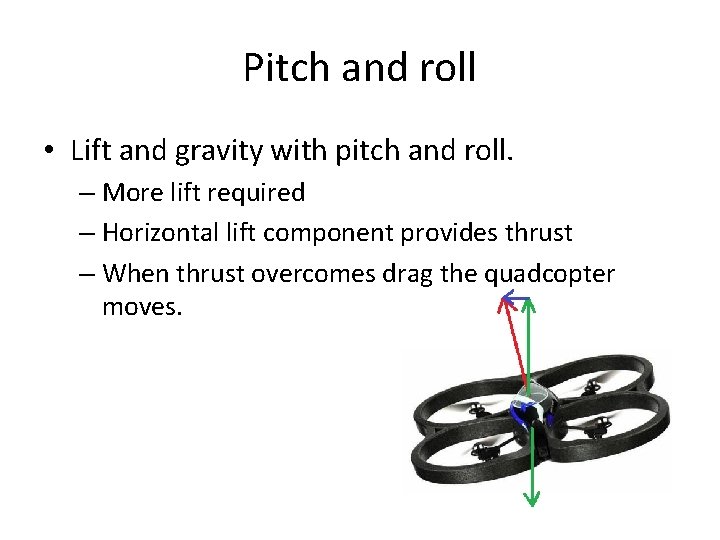
Pitch and roll • Lift is always perpendicular to the flow direction, in our case the rotor plane. • The gravity is always perpendicular to the ground.
Pitch and roll • Lift and gravity with pitch and roll. – More lift required – Horizontal lift component provides thrust – When thrust overcomes drag the quadcopter moves.
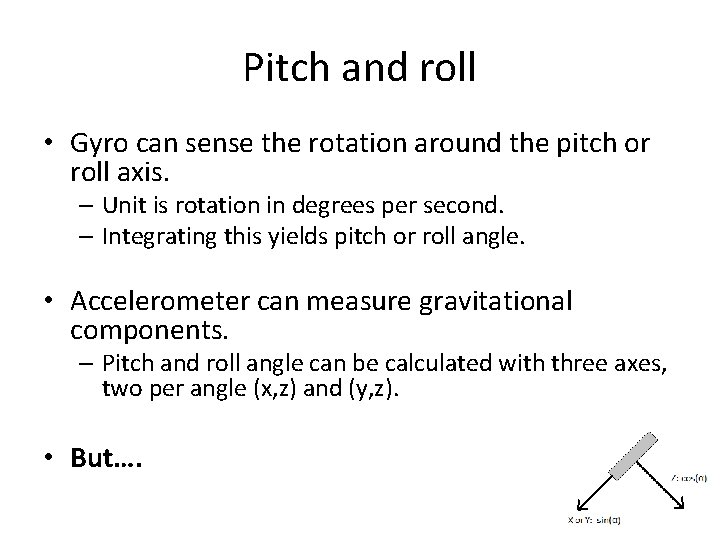
Pitch and roll • Gyro can sense the rotation around the pitch or roll axis. – Unit is rotation in degrees per second. – Integrating this yields pitch or roll angle. • Accelerometer can measure gravitational components. – Pitch and roll angle can be calculated with three axes, two per angle (x, z) and (y, z). • But….
Pitch and roll • Why will this not work well in practice? • Gyro’s (especially MEMS and Piezo): – Have a noisy signal – Have an offset (temperature, other effects) – This results in accumulating error in the integration. – Gyro’s can be used for short corrections • Accelerometers: – The forces described previously are only in uniform linear motion. – In turns there are more forces due to horizontal lift component.
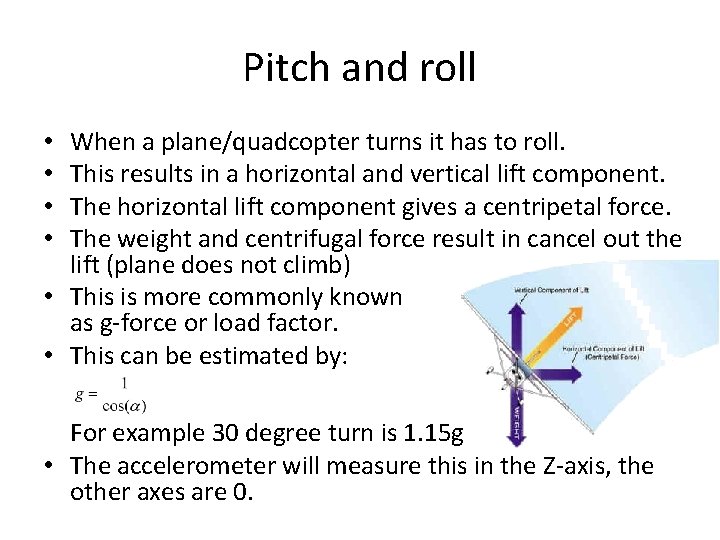
Pitch and roll When a plane/quadcopter turns it has to roll. This results in a horizontal and vertical lift component. The horizontal lift component gives a centripetal force. The weight and centrifugal force result in cancel out the lift (plane does not climb) • This is more commonly known as g-force or load factor. • This can be estimated by: • • For example 30 degree turn is 1. 15 g • The accelerometer will measure this in the Z-axis, the other axes are 0.
Pitch and roll • A quadcopter not only has this for roll but also for pitch in sideways movements. • How to solve this: – Combine both the gyro and accelerometer information using sensor fusion. – This also makes measurements less sensitive to noise (for example due to vibration).
Yaw • Turning around the top-axis. • Usually compensated with gyros (short term compensation). Again: drift. • For absolute yaw control: use a magnetometer – Basically an electronic compass.
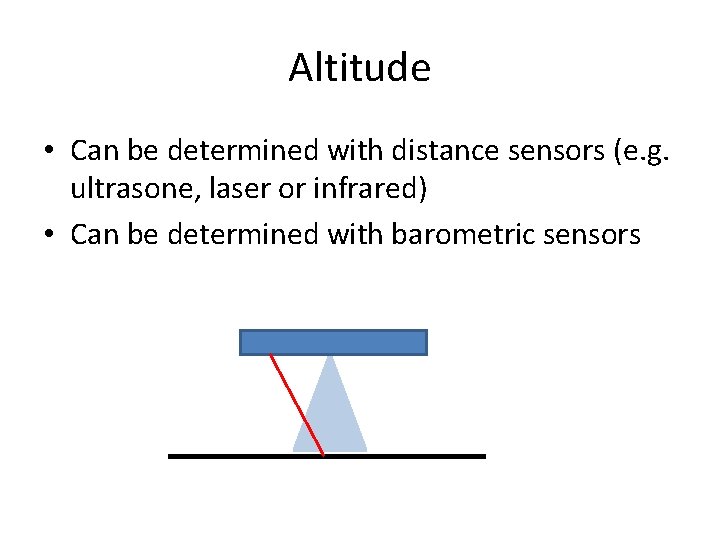
Altitude • Can be determined with distance sensors (e. g. ultrasone, laser or infrared) • Can be determined with barometric sensors
Lateral drift • Two movements you cannot really detect – Optical flow
Local control • Keeps the quadcopter stable. • Requires sensor fusion – (Extended) Kalman filter – Direct Cosine Matrix – Linear complementary filter
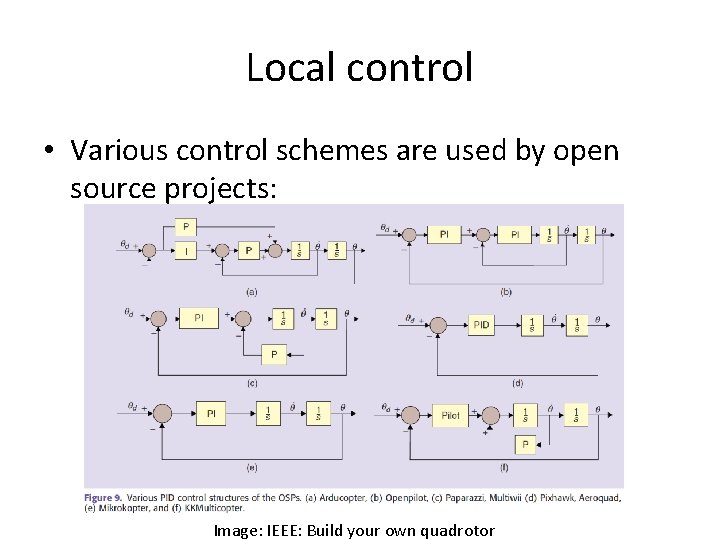
Local control • Various control schemes are used by open source projects: Image: IEEE: Build your own quadrotor
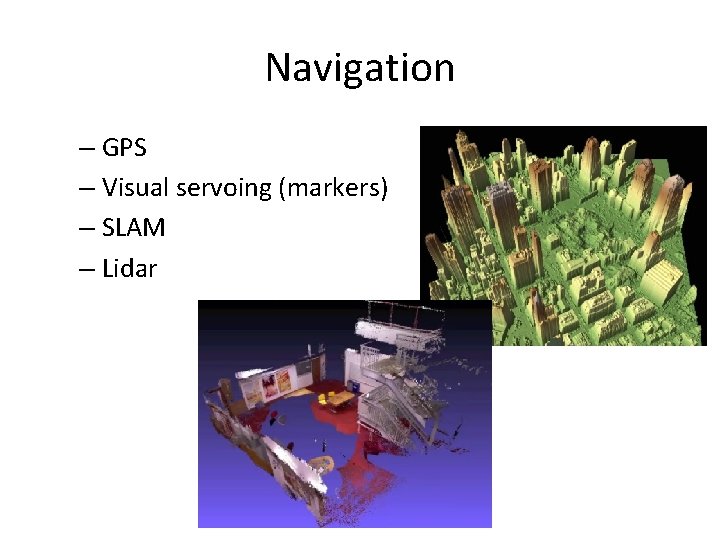
Navigation – GPS – Visual servoing (markers) – SLAM – Lidar
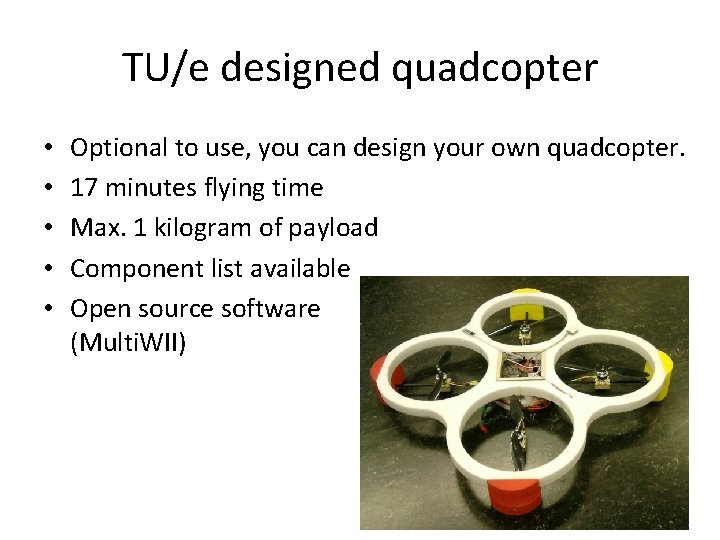
TU/e designed quadcopter • • • Optional to use, you can design your own quadcopter. 17 minutes flying time Max. 1 kilogram of payload Component list available Open source software (Multi. WII)
TU/e designed quadcopter
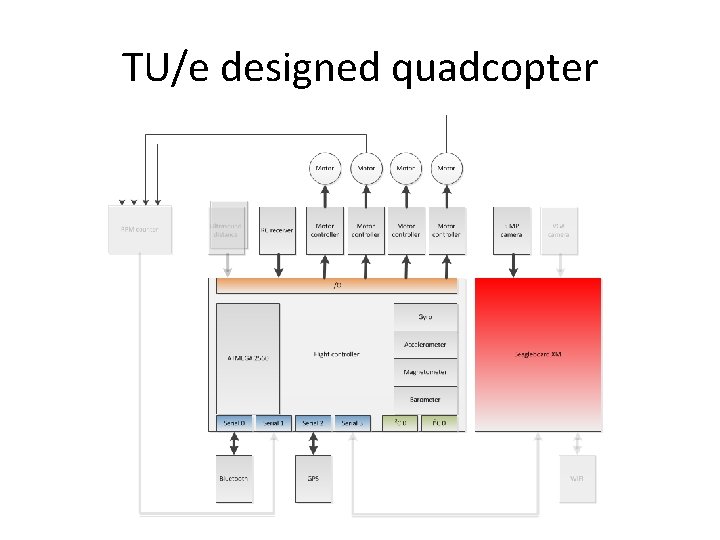
TU/e designed quadcopter
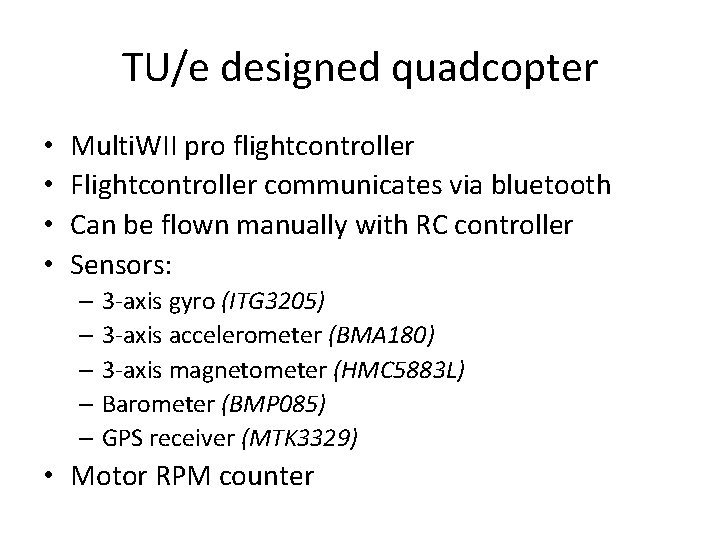
TU/e designed quadcopter • • Multi. WII pro flightcontroller Flightcontroller communicates via bluetooth Can be flown manually with RC controller Sensors: – 3 -axis gyro (ITG 3205) – 3 -axis accelerometer (BMA 180) – 3 -axis magnetometer (HMC 5883 L) – Barometer (BMP 085) – GPS receiver (MTK 3329) • Motor RPM counter
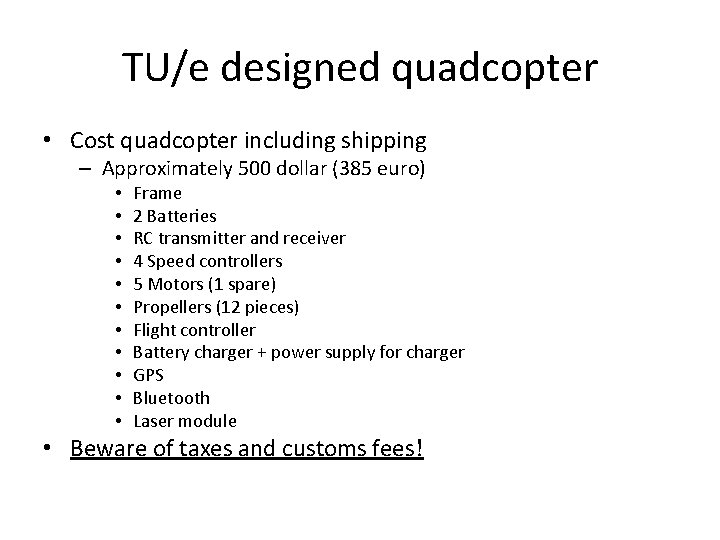
TU/e designed quadcopter • Cost quadcopter including shipping – Approximately 500 dollar (385 euro) • • • Frame 2 Batteries RC transmitter and receiver 4 Speed controllers 5 Motors (1 spare) Propellers (12 pieces) Flight controller Battery charger + power supply for charger GPS Bluetooth Laser module • Beware of taxes and customs fees!
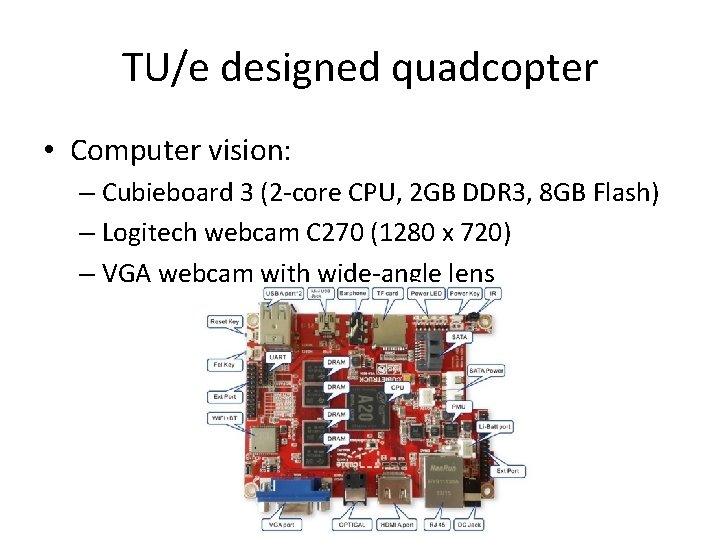
TU/e designed quadcopter • Computer vision: – Cubieboard 3 (2 -core CPU, 2 GB DDR 3, 8 GB Flash) – Logitech webcam C 270 (1280 x 720) – VGA webcam with wide-angle lens
TU/e designed quadcopter • Cost vision boards 155 dollar (115 euro) – Cubieboard 3 – Logitech webcam C 270 – VGA webcam • Wide angle lens • Beware of taxes and customs fees!
Lessons learned from last year • Try to have your quadcopter built and flying stable as soon as possible. • Ultrasound distance sensing is problematic on large quadcopters indoors. • Build quality greatly influences stability, sensor noise, etc. • Don’t discharge your batteries too much. • … no, a raspberry Pi is not fast enough …
Assignments 1. Build your quadcopter and get it flying. 2. Adjust the PID settings and try to find the most stable result. 3. Implement a downward facing camera to compensate for sideways drift and use the laser for altitude control. 4. Task of your choice: marker following, face detection, SLAM, etc.
Questions? • Thanks for your attention