
QPS Uses of Methyl Bromide and Alternatives Challenges
QPS Uses of Methyl Bromide and Alternatives: Challenges in South Asia Ganesan. S Agra, 25 th May 2017
Methyl Bromide - QPS or not QPS? Quarantine treatment or not? First, identify the target pest species to be controlled with MBr fumigation a. Exports: Is pest officially controlled in the destination country? b. Imports: Is pest officially controlled in the importing country? If the pest in question is not under official control by Government authorities, this is not a quarantine treatment but a controlled use. Pre-shipment or not? Treatment with MBr must be applied 21 days or less prior to export a. Exports: MBr treatment must be officially required by Government authorities in destination country b. Imports: MBr treatment must be officially required by importing country authorities c. “The official requirement for MBr treatment must have been in place before 7 December 1995” Treatments required by companies, banks (letter of credit) or other commercial entities are not considered QPS and count as controlled MB consumption. Source: UNEP

Minimizing MBr uses, Decisions under Montreal Protocol Year - Decision 1994 - VI/11 1998 - X/11 Particulars § Parties to refrain from use of MBr for QPS and to use non-ozone depleting technologies whenever possible § Parties to assess the volume and uses of MBr under QPS exemption including trend in use since 1991, the base year 2001 - XI/13 § Parties to use MBr recovery and recycling technology to reduce emission. To review national regulations with a view to removing the requirement to use MBr for QPS 2004 - XVI/10 § Parties to submit data identifying all known uses of MBr for QPS by commodity and application 2004 - XVI/11 § Parties to consider heat treatment (ISPM 15) for packing materials instead of MBr 2006 - XVII/11 § Recapturing and destruction of MBr from space fumigation 2008 - XX/6 § Parties to put in place a national strategy to reduce MBr use for QPS 2009 - XXI/10 § Parties to apply best practice measures to reduce MBr for QPS uses 2010 - XXII/5 § Parties to avoid multiple treatments of consignments with MBr unless a risk of an infestation with a pest has been identified 2012 -XXIV/15 § Improved reporting requirements as regards MBr consumption for QPS use
Decision XX/6 of 2008 Expects Parties to put in place a national strategy to reduce the use of MBr for phytosanitary measures on the following lines - Replacing MBr uses for QPS - Reducing MBr uses for QPS - Physically reducing their emission - Accurately recording the QPS uses of MBr
MBr reporting requirement under MP The Beijing Amendment (1999) required Parties to report, under Article 7, annual data on the total quantity of methyl bromide produced, imported and exported for all purposes and, separately, the quantity produced or imported for use as QPS, and feedstock. QPS production and consumption data remained confidential until 2008, when it was made publicly available through Decision XX/6 Source: UNEP
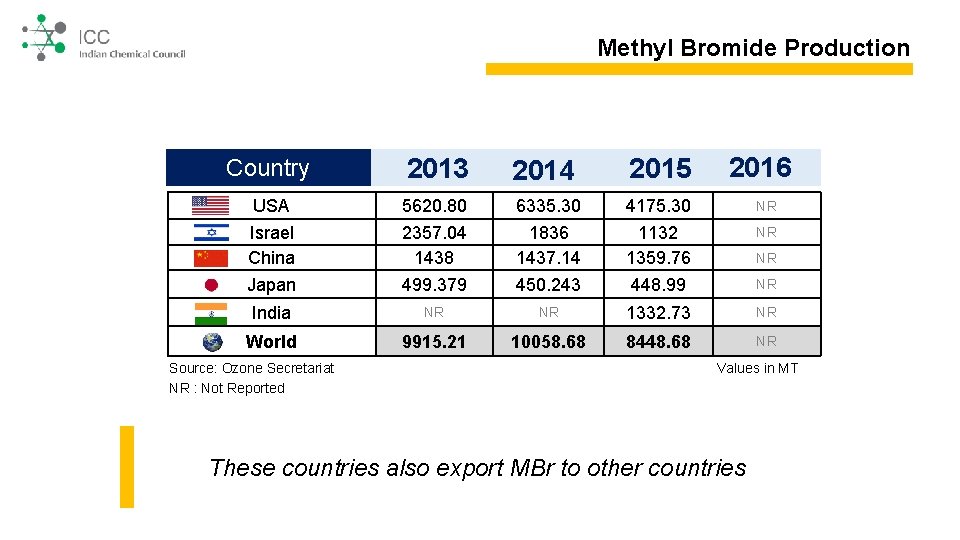
Methyl Bromide Production 2016 Country 2013 2014 2015 USA Israel China Japan 5620. 80 2357. 04 1438 499. 379 6335. 30 1836 1437. 14 450. 243 4175. 30 1132 1359. 76 448. 99 NR India NR NR 1332. 73 NR World 9915. 21 10058. 68 8448. 68 NR Source: Ozone Secretariat NR : Not Reported NR NR NR Values in MT These countries also export MBr to other countries
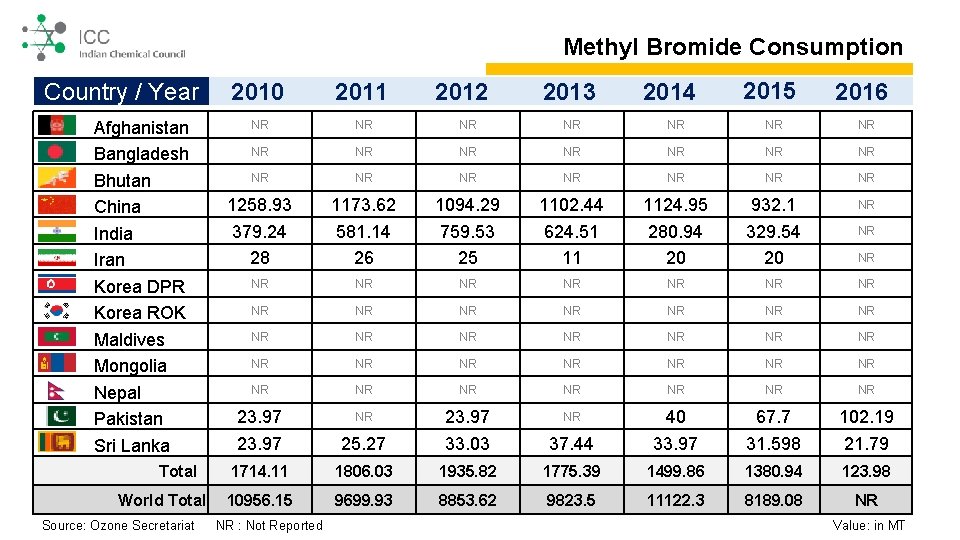
Methyl Bromide Consumption Country / Year Afghanistan Bangladesh Bhutan China India Iran Korea DPR Korea ROK Maldives Mongolia Nepal Pakistan Sri Lanka Total World Total Source: Ozone Secretariat 2012 2013 2016 2011 NR NR NR NR NR NR 1258. 93 379. 24 28 1173. 62 581. 14 26 1094. 29 759. 53 25 1102. 44 624. 51 11 1124. 95 280. 94 20 932. 1 329. 54 20 NR NR NR NR NR NR NR NR NR 23. 97 NR NR 25. 27 23. 97 33. 03 37. 44 40 33. 97 67. 7 31. 598 102. 19 21. 79 1714. 11 1806. 03 1935. 82 1775. 39 1499. 86 1380. 94 123. 98 10956. 15 9699. 93 8853. 62 9823. 5 11122. 3 8189. 08 NR NR : Not Reported 2014 2015 2010 NR NR Value: in MT
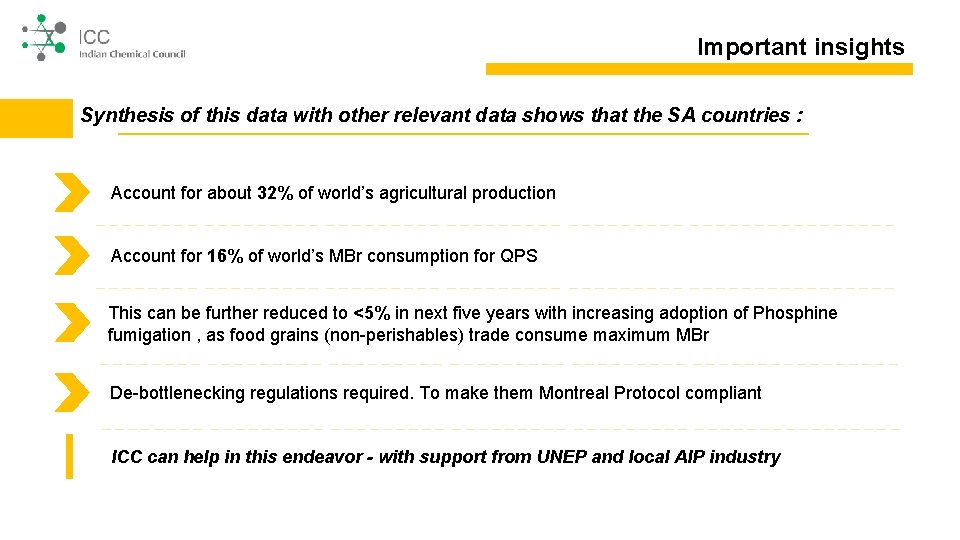
Important insights Synthesis of this data with other relevant data shows that the SA countries : _______________________________________ Account for about 32% of world’s agricultural production _________ ____________ Account for 16% of world’s MBr consumption for QPS _________ ____________ This can be further reduced to <5% in next five years with increasing adoption of Phosphine fumigation , as food grains (non-perishables) trade consume maximum MBr _________ ____________ De-bottlenecking regulations required. To make them Montreal Protocol compliant _________ ____________ ICC can help in this endeavor - with support from UNEP and local AIP industry
![Alert issued by MBTOC “……further reductions in atmospheric concentrations [of MBr]… will only occur](http://slidetodoc.com/presentation_image_h/f6a80bcb90568e3f4f7e07236c8fda31/image-10.jpg "Alert issued by MBTOC “……further reductions in atmospheric concentrations [of MBr]… will only occur")
Alert issued by MBTOC “……further reductions in atmospheric concentrations [of MBr]… will only occur if the remaining non-QPS uses in developing countries (A 5 Parties) and the few non-A 5 and A 5 critical uses are phased out, and if emissions or use of MB for QPS are reduced significantly. In 2014, the use of MB for QPS was at least three times the total used for non-QPS in non-A 5 and A 5 countries. -MBTOC 2014 Assessment Report
Ways to reduce MBr-QPS uses Review if QPS uses of MBr was an “official requirement” in the exporting/importing country before 7 th Dec 1995 _________ ____________ If it was not an “official requirement” prior to 7 th Dec 1995, disapprove its use by an order _________ ____________ Check the list of “notified quarantine pests”. Disapprove use of MBr for non-quarantine pest control _________ ____________ Make MBr fumigation Montreal Protocol compliant of 2008, mindful of Decision XX/6 of 2008 _. _________ ____________ Introduce regulatory and economic incentives to adopt MBr alternatives
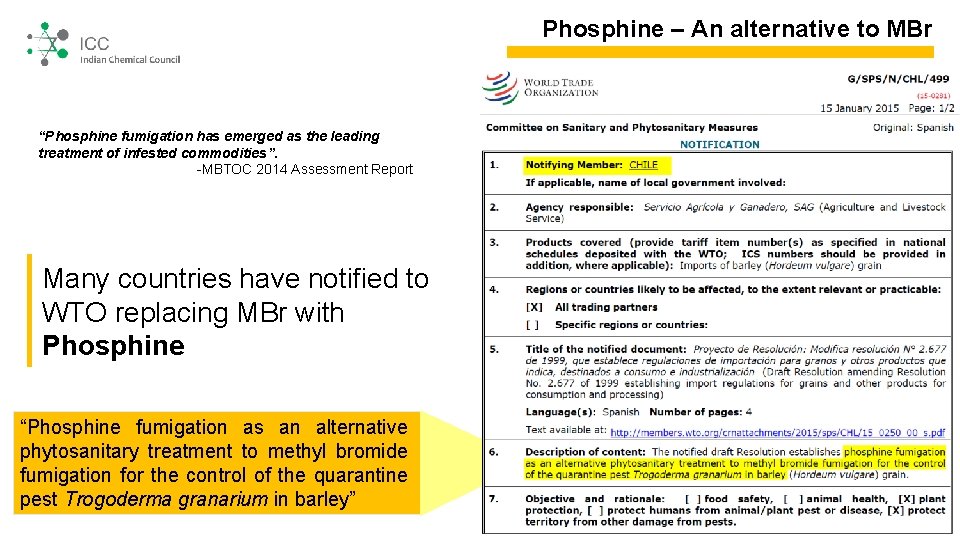
Phosphine – An alternative to MBr “Phosphine fumigation has emerged as the leading treatment of infested commodities”. -MBTOC 2014 Assessment Report Many countries have notified to WTO replacing MBr with Phosphine “Phosphine fumigation as an alternative phytosanitary treatment to methyl bromide fumigation for the control of the quarantine pest Trogoderma granarium in barley”
Phosphine Fumigation - SOME FACTS Used in >160 countries and it ranks number one fumigant for >60 years _________ ____________ Upon contact with atmosphere, Aluminum Phosphide releases toxic phosphine gas _________ ____________ Phosphine quickly spreads _ _ _ _ _and _ _ _penetrates into the commodity being fumigated ___________ _Phosphine completely kills all four stages of insects viz eggs, _ _ _ _ _ _ _ _ _larva, _ _pupa and adults __________ _Speed of mortality will be Adult _ _ _ _ _> _larva _ _ _ >_ _Pupa _ _ _>_Eggs and _ _ _ linked to rate of respiration ____________ Phosphine is practically insoluble in water, fats and oils and therefore has no appreciable reaction on the fumigated commodities _________ ____________ Phosphine disappears completely after fumigation from the treated area upon aeration _________ ____________ Phosphine does not adversely affect the quality of agricultural commodity fumigated _________ ____________ Unlike Methyl Bromide, phosphine is not an ozone depleting gas _________ _________ Phosphine released from aluminium phosphide is not persistent in the atmosphere. It is rapidly deactivated by photolysis (effect of sunlight)

Thank You Ganesan. S ganesanicc@gmail. com
- Slides: 14