
QPE Pilot Cruise Signal Coherence Tests Using Synthetic
- Slides: 25
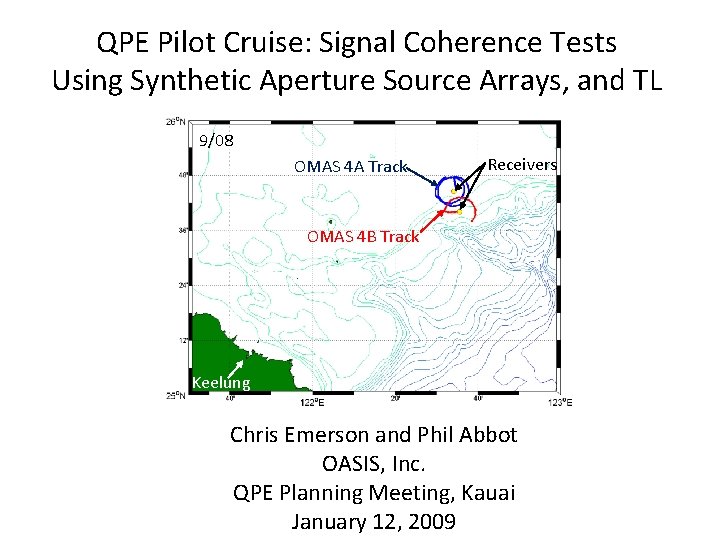
QPE Pilot Cruise: Signal Coherence Tests Using Synthetic Aperture Source Arrays, and TL 9/08 OMAS 4 A Track Receivers OMAS 4 B Track Keelung Chris Emerson and Phil Abbot OASIS, Inc. QPE Planning Meeting, Kauai January 12, 2009
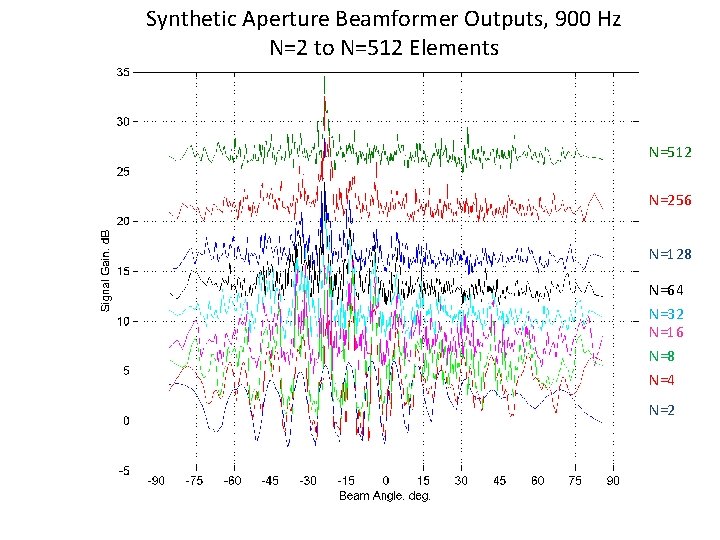
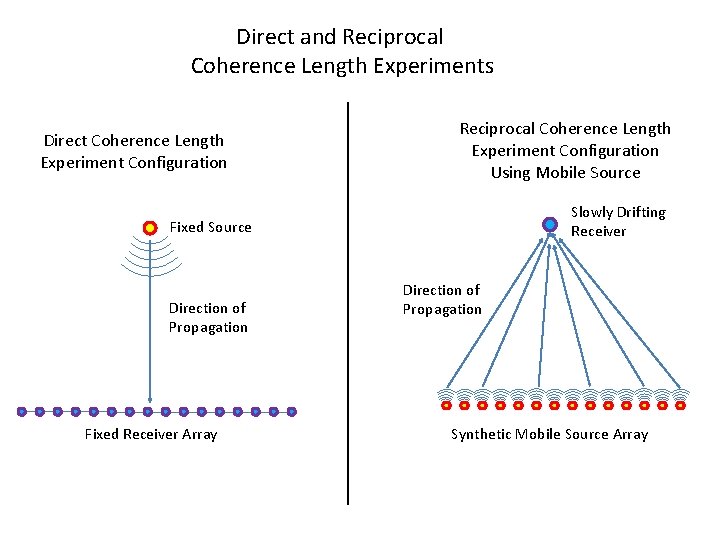
Objectives • Measure Signal Coherence Lengths in SECS shallow water using Synthetic Aperture Source Arrays • Method: – Reciprocity: replace physical receiver array with synthetic array of mobile source transmissions – Matched-filter (MF) process received OMAS signals – Phase correct signals to form equivalent linear array – Time-domain beamform using MF output for 2≤N≤ 512 transmissions – Measure signal gain of beamformer output vs. number of array elements (N), compare to 20 Log. N • Examine TL including variability (isotropy, translational invariance, frequency dependence)
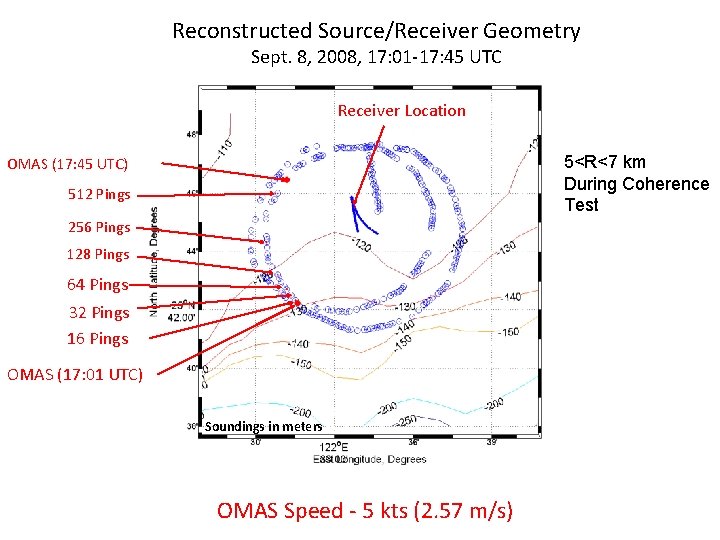
Reconstructed Source/Receiver Geometry Sept. 8, 2008, 17: 01 -17: 45 UTC Receiver Location 5<R<7 km During Coherence Test OMAS (17: 45 UTC) 512 Pings 256 Pings 128 Pings 64 Pings 32 Pings 16 Pings OMAS (17: 01 UTC) Soundings in meters OMAS Speed - 5 kts (2. 57 m/s)
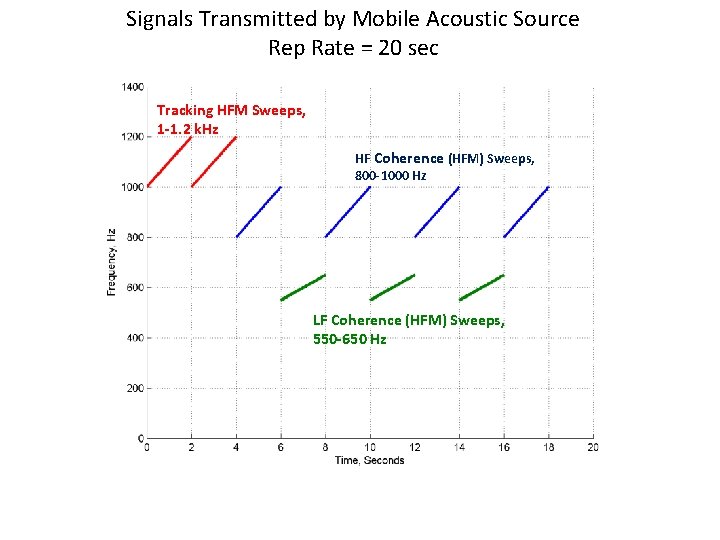
Signals Transmitted by Mobile Acoustic Source Rep Rate = 20 sec Tracking HFM Sweeps, 1 -1. 2 k. Hz HF Coherence (HFM) Sweeps, 800 -1000 Hz LF Coherence (HFM) Sweeps, 550 -650 Hz
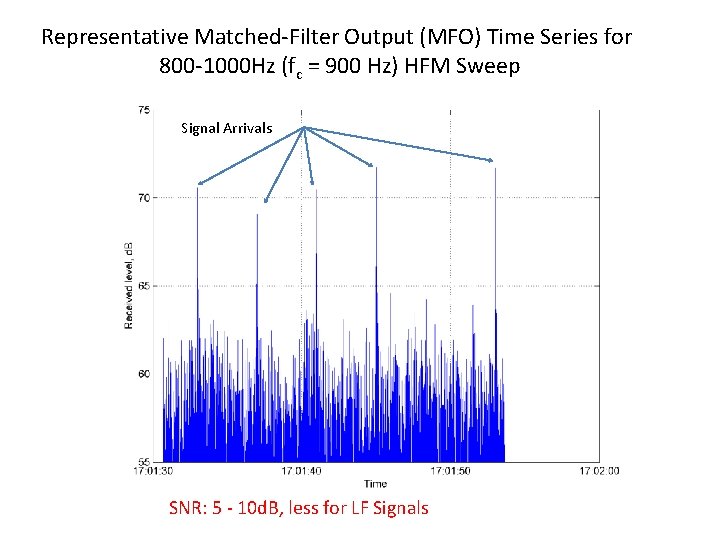
Representative Matched-Filter Output (MFO) Time Series for 800 -1000 Hz (fc = 900 Hz) HFM Sweep Signal Arrivals SNR: 5 - 10 d. B, less for LF Signals
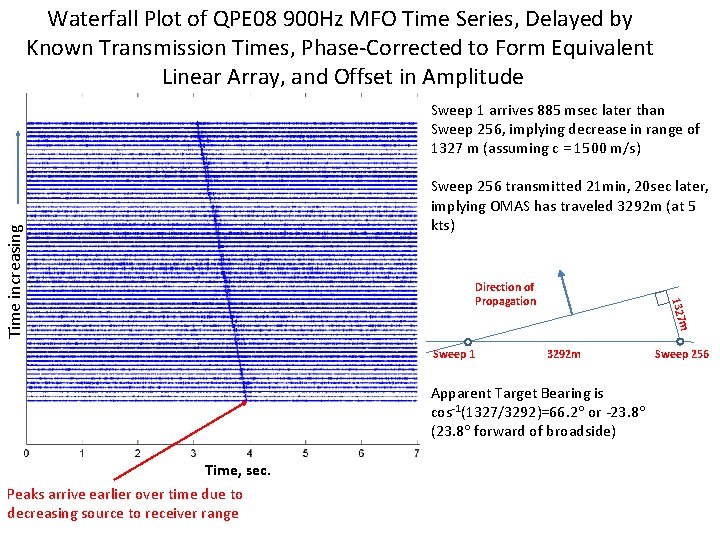
Waterfall Plot of QPE 08 900 Hz MFO Time Series, Delayed by Known Transmission Times, Phase-Corrected to Form Equivalent Linear Array, and Offset in Amplitude Sweep 256 transmitted 21 min, 20 sec later, implying OMAS has traveled 3292 m (at 5 kts) Direction of Propagation m 1327 Time increasing Sweep 1 arrives 885 msec later than Sweep 256, implying decrease in range of 1327 m (assuming c = 1500 m/s) Sweep 1 3292 m Apparent Target Bearing is cos-1(1327/3292)=66. 2° or -23. 8° (23. 8° forward of broadside) Time, sec. Peaks arrive earlier over time due to decreasing source to receiver range Sweep 256
Synthetic Aperture Beamformer Outputs, 900 Hz N=2 to N=512 Elements N=512 N=256 N=128 N=64 N=32 N=16 N=8 N=4 N=2
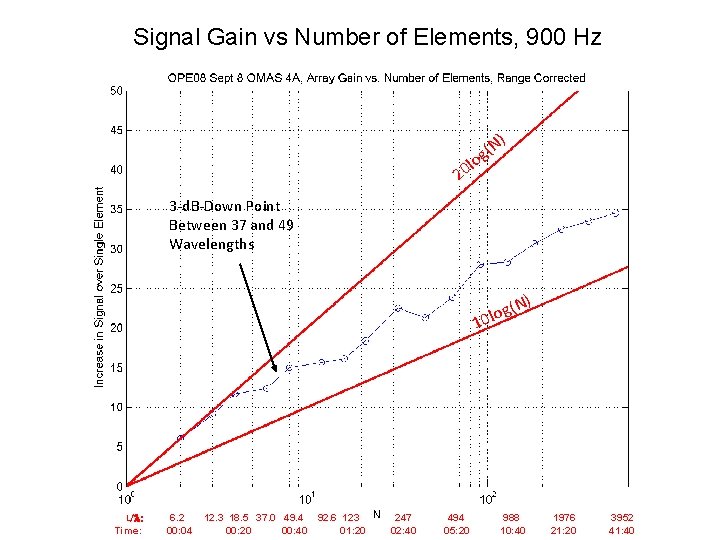
Signal Gain vs Number of Elements, 900 Hz ) g(N lo 0 2 3 -d. B-Down Point Between 37 and 49 Wavelengths N) ( g o 10 l L/l: Time: 6. 2 00: 04 12. 3 18. 5 37. 0 49. 4 00: 20 00: 40 92. 6 123 01: 20 247 02: 40 494 05: 20 988 10: 40 1976 21: 20 3952 41: 40
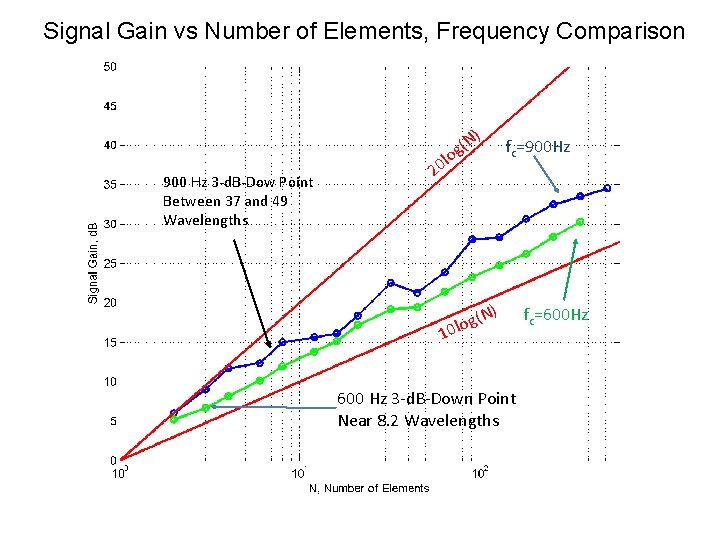
Signal Gain vs Number of Elements, Frequency Comparison ) 900 Hz 3 -d. B-Dow Point Between 37 and 49 Wavelengths g(N fc=900 Hz 0 lo 2 N) g( o l 10 600 Hz 3 -d. B-Down Point Near 8. 2 Wavelengths fc=600 Hz
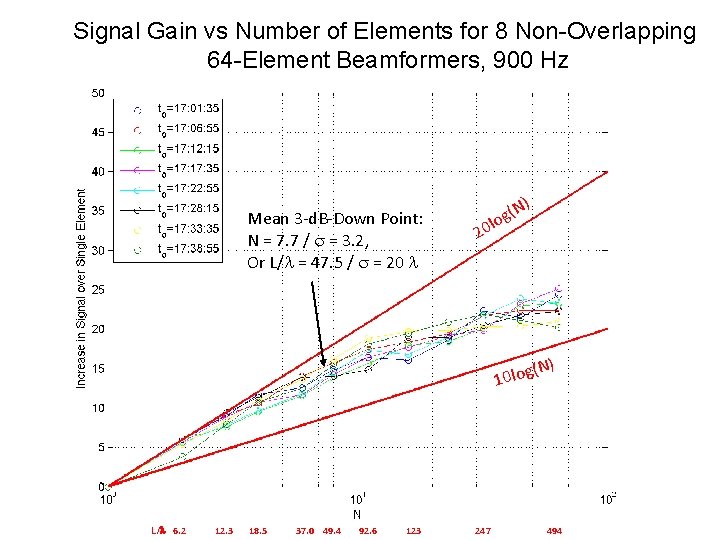
Signal Gain vs Number of Elements for 8 Non-Overlapping 64 -Element Beamformers, 900 Hz Mean 3 -d. B-Down Point: N = 7. 7 / = 3. 2, Or L/ = 47. 5 / = 20 ) (N g o l 20 N) ( 10 log L/l 6. 2 12. 3 18. 5 37. 0 49. 4 92. 6 123 247 494
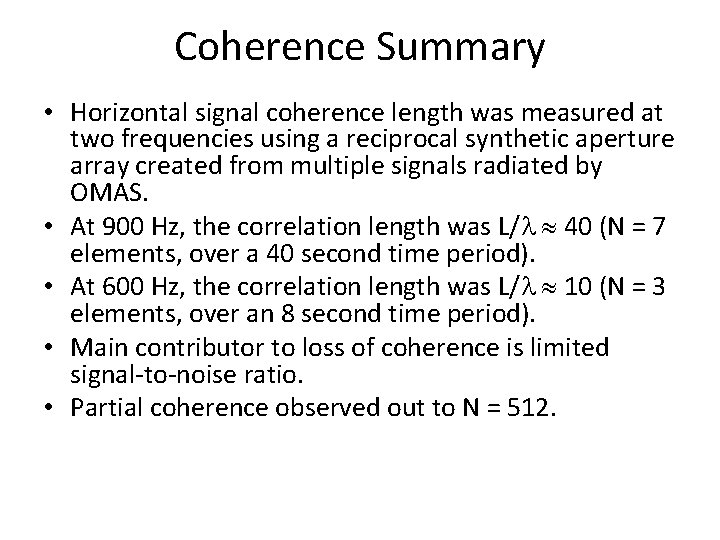
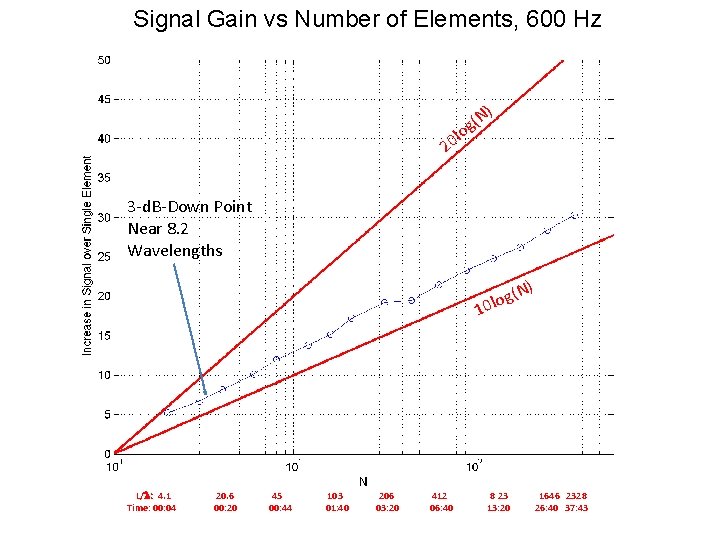
Coherence Summary • Horizontal signal coherence length was measured at two frequencies using a reciprocal synthetic aperture array created from multiple signals radiated by OMAS. • At 900 Hz, the correlation length was L/ 40 (N = 7 elements, over a 40 second time period). • At 600 Hz, the correlation length was L/ 10 (N = 3 elements, over an 8 second time period). • Main contributor to loss of coherence is limited signal-to-noise ratio. • Partial coherence observed out to N = 512.
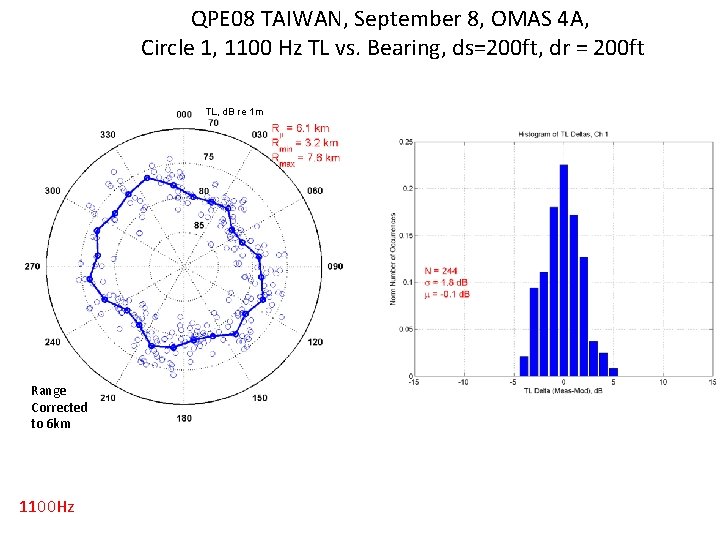
QPE 08 TAIWAN, September 8, OMAS 4 A, Circle 1, 1100 Hz TL vs. Bearing, ds=200 ft, dr = 200 ft TL, d. B re 1 m Range Corrected to 6 km 1100 Hz
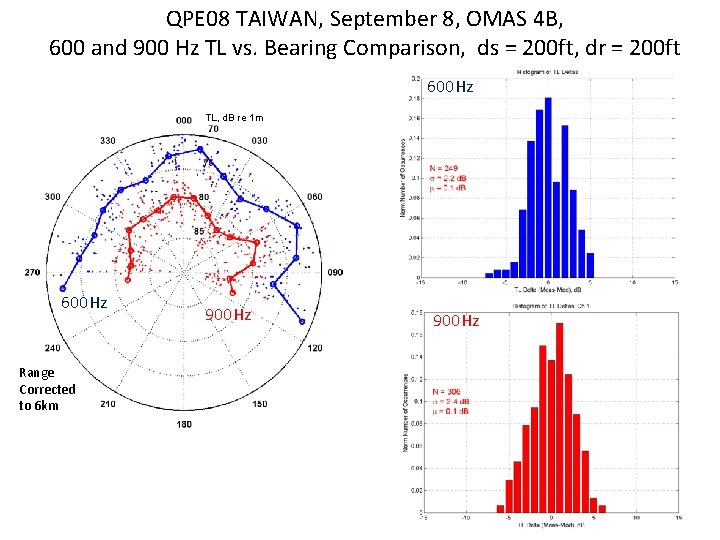
QPE 08 TAIWAN, September 8, OMAS 4 B, 600 and 900 Hz TL vs. Bearing Comparison, ds = 200 ft, dr = 200 ft 600 Hz TL, d. B re 1 m 600 Hz Range Corrected to 6 km 900 Hz
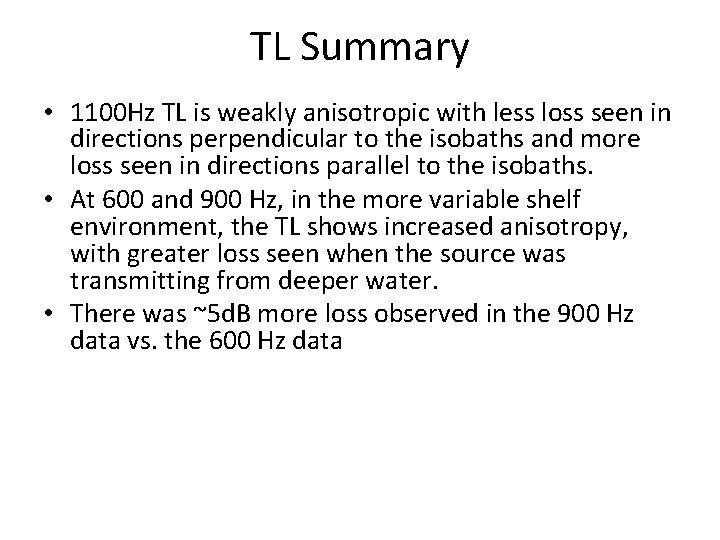
TL Summary • 1100 Hz TL is weakly anisotropic with less loss seen in directions perpendicular to the isobaths and more loss seen in directions parallel to the isobaths. • At 600 and 900 Hz, in the more variable shelf environment, the TL shows increased anisotropy, with greater loss seen when the source was transmitting from deeper water. • There was ~5 d. B more loss observed in the 900 Hz data vs. the 600 Hz data
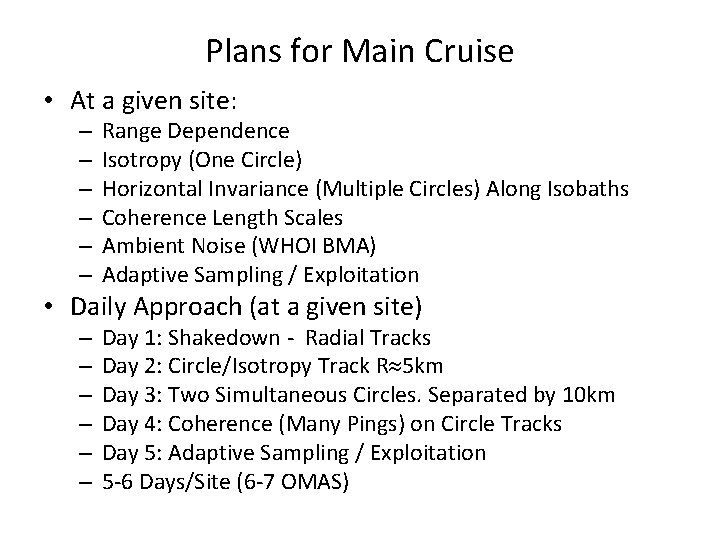
Plans for Main Cruise • At a given site: – – – Range Dependence Isotropy (One Circle) Horizontal Invariance (Multiple Circles) Along Isobaths Coherence Length Scales Ambient Noise (WHOI BMA) Adaptive Sampling / Exploitation • Daily Approach (at a given site) – – – Day 1: Shakedown - Radial Tracks Day 2: Circle/Isotropy Track R 5 km Day 3: Two Simultaneous Circles. Separated by 10 km Day 4: Coherence (Many Pings) on Circle Tracks Day 5: Adaptive Sampling / Exploitation 5 -6 Days/Site (6 -7 OMAS)
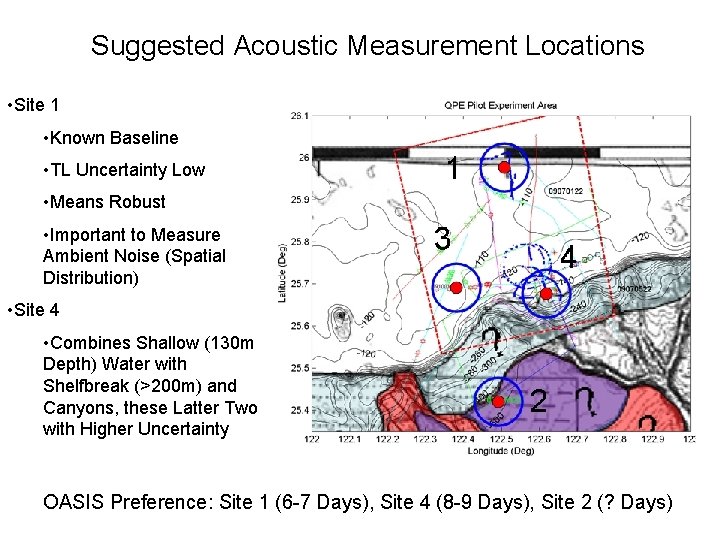
Suggested Acoustic Measurement Locations • Site 1 • Known Baseline • TL Uncertainty Low • Means Robust • Important to Measure Ambient Noise (Spatial Distribution) • Site 4 • Combines Shallow (130 m Depth) Water with Shelfbreak (>200 m) and Canyons, these Latter Two with Higher Uncertainty OASIS Preference: Site 1 (6 -7 Days), Site 4 (8 -9 Days), Site 2 (? Days)
Backups
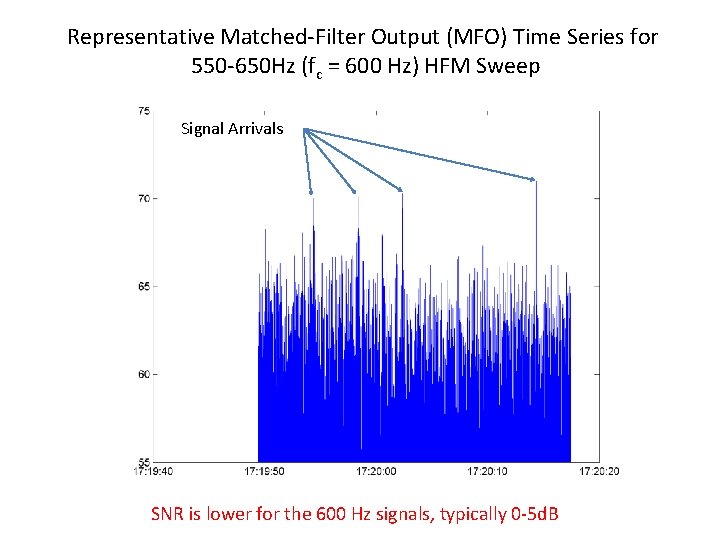
Representative Matched-Filter Output (MFO) Time Series for 550 -650 Hz (fc = 600 Hz) HFM Sweep Signal Arrivals SNR is lower for the 600 Hz signals, typically 0 -5 d. B
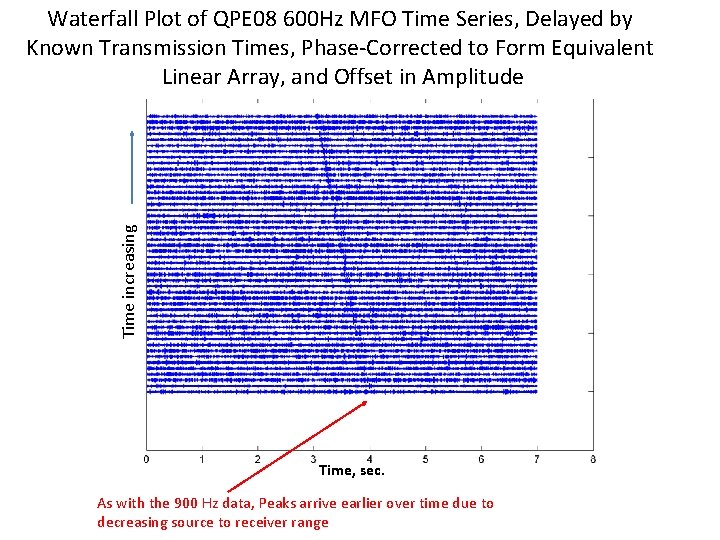
Time increasing Waterfall Plot of QPE 08 600 Hz MFO Time Series, Delayed by Known Transmission Times, Phase-Corrected to Form Equivalent Linear Array, and Offset in Amplitude Time, sec. As with the 900 Hz data, Peaks arrive earlier over time due to decreasing source to receiver range
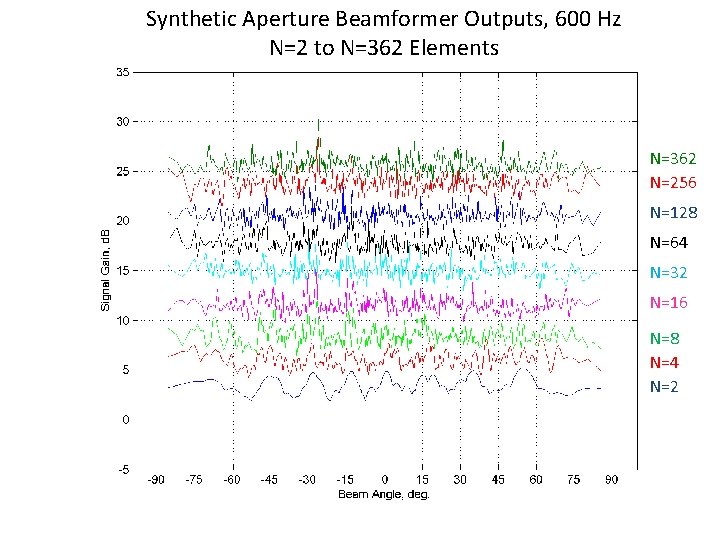
Synthetic Aperture Beamformer Outputs, 600 Hz N=2 to N=362 Elements N=362 N=256 N=128 N=64 N=32 N=16 N=8 N=4 N=2
Signal Gain vs Number of Elements, 600 Hz ) g(N lo 0 2 3 -d. B-Down Point Near 8. 2 Wavelengths N) g( o l 10 L/l: 4. 1 Time: 00: 04 20. 6 00: 20 45 00: 44 103 01: 40 206 03: 20 412 06: 40 8 23 13: 20 1646 2328 26: 40 37: 43
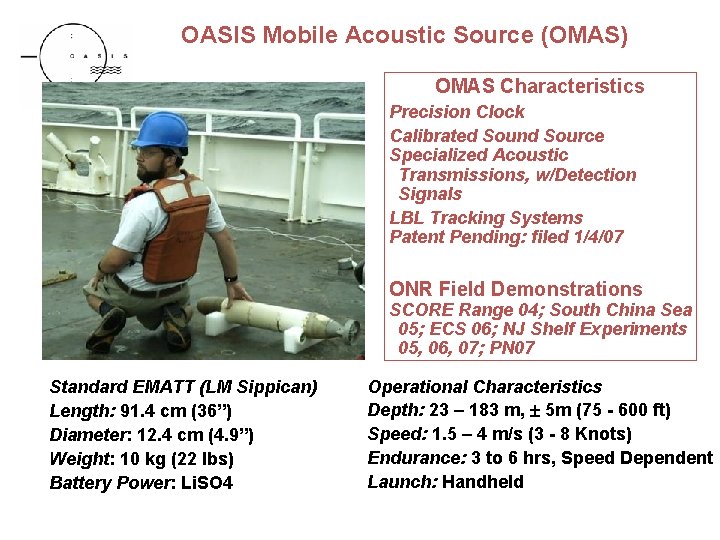
OASIS Mobile Acoustic Source (OMAS) OMAS Characteristics Precision Clock Calibrated Sound Source Specialized Acoustic Transmissions, w/Detection Signals LBL Tracking Systems Patent Pending: filed 1/4/07 ONR Field Demonstrations SCORE Range 04; South China Sea 05; ECS 06; NJ Shelf Experiments 05, 06, 07; PN 07 Standard EMATT (LM Sippican) Length: 91. 4 cm (36”) Diameter: 12. 4 cm (4. 9”) Weight: 10 kg (22 lbs) Battery Power: Li. SO 4 Operational Characteristics Depth: 23 – 183 m, 5 m (75 - 600 ft) Speed: 1. 5 – 4 m/s (3 - 8 Knots) Endurance: 3 to 6 hrs, Speed Dependent Launch: Handheld
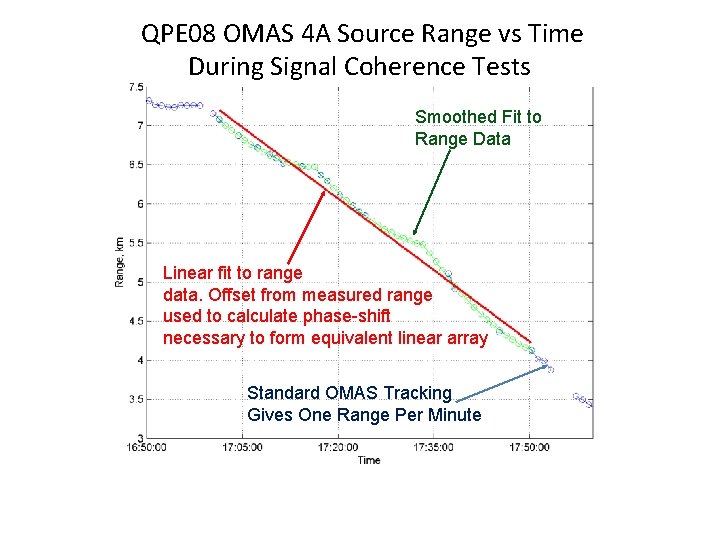
QPE 08 OMAS 4 A Source Range vs Time During Signal Coherence Tests Smoothed Fit to Range Data Linear fit to range data. Offset from measured range used to calculate phase-shift necessary to form equivalent linear array Standard OMAS Tracking Gives One Range Per Minute
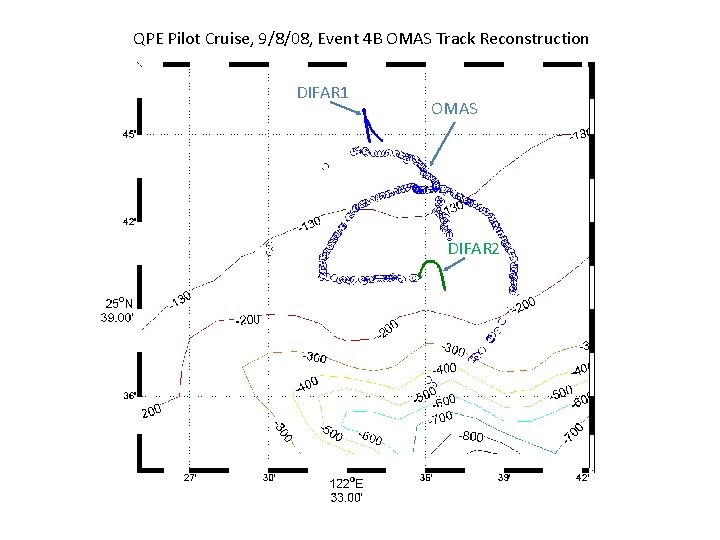
QPE Pilot Cruise, 9/8/08, Event 4 B OMAS Track Reconstruction DIFAR 1 OMAS DIFAR 2
Direct and Reciprocal Coherence Length Experiments Direct Coherence Length Experiment Configuration Reciprocal Coherence Length Experiment Configuration Using Mobile Source Slowly Drifting Receiver Fixed Source Direction of Propagation Fixed Receiver Array Direction of Propagation Synthetic Mobile Source Array