
QOS Lecture 3 Encapsulating Voice Packets for Transport
- Slides: 39
QOS Lecture 3 - Encapsulating Voice Packets for Transport © 2006 Cisco Systems, Inc. All rights reserved.
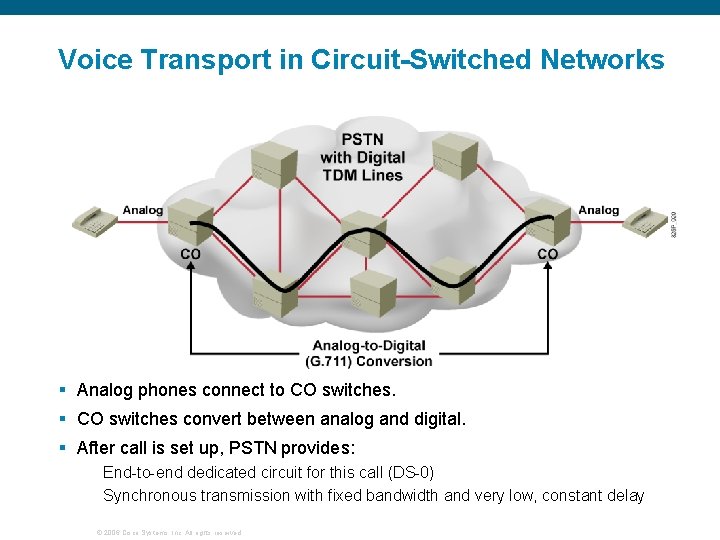
Voice Transport in Circuit-Switched Networks § Analog phones connect to CO switches. § CO switches convert between analog and digital. § After call is set up, PSTN provides: End-to-end dedicated circuit for this call (DS-0) Synchronous transmission with fixed bandwidth and very low, constant delay © 2006 Cisco Systems, Inc. All rights reserved.
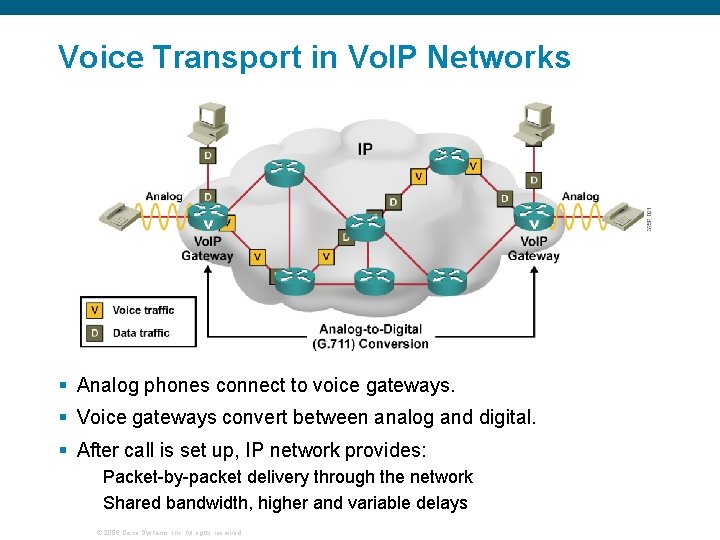
Voice Transport in Vo. IP Networks § Analog phones connect to voice gateways. § Voice gateways convert between analog and digital. § After call is set up, IP network provides: Packet-by-packet delivery through the network Shared bandwidth, higher and variable delays © 2006 Cisco Systems, Inc. All rights reserved.
Jitter § Voice packets enter the network at a constant rate. § Voice packets may arrive at the destination at a different rate or in the wrong order. § Jitter occurs when packets arrive at varying rates. § Since voice is dependent on timing and order, a process must exist so that delays and queuing issues can be fixed at the receiving end. § The receiving router must: Ensure steady delivery (delay) Ensure that the packets are in the right order © 2006 Cisco Systems, Inc. All rights reserved.
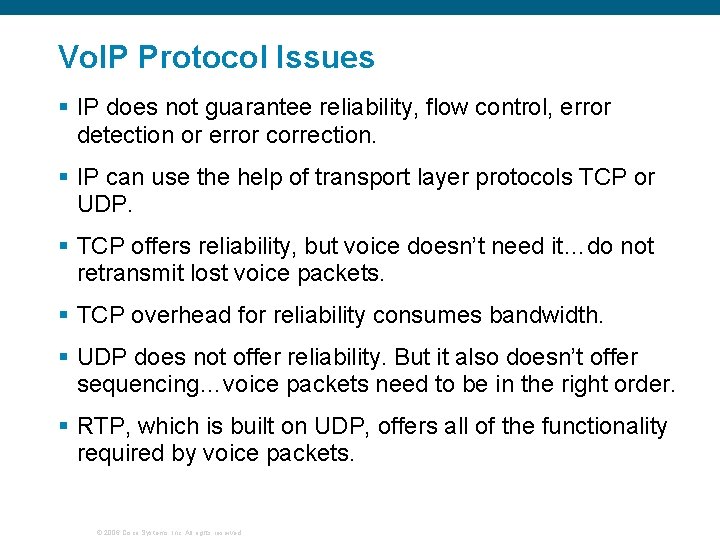
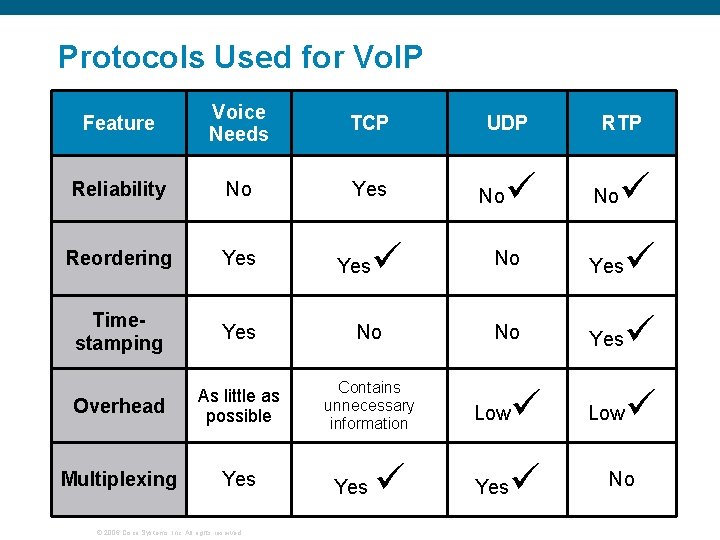
Vo. IP Protocol Issues § IP does not guarantee reliability, flow control, error detection or error correction. § IP can use the help of transport layer protocols TCP or UDP. § TCP offers reliability, but voice doesn’t need it…do not retransmit lost voice packets. § TCP overhead for reliability consumes bandwidth. § UDP does not offer reliability. But it also doesn’t offer sequencing…voice packets need to be in the right order. § RTP, which is built on UDP, offers all of the functionality required by voice packets. © 2006 Cisco Systems, Inc. All rights reserved.
Protocols Used for Vo. IP Feature Voice Needs TCP Reliability No Yes Reordering Yes Timestamping Yes No Overhead As little as possible Contains unnecessary information Multiplexing Yes © 2006 Cisco Systems, Inc. All rights reserved. Yes UDP No RTP No No Yes Low Yes Low No
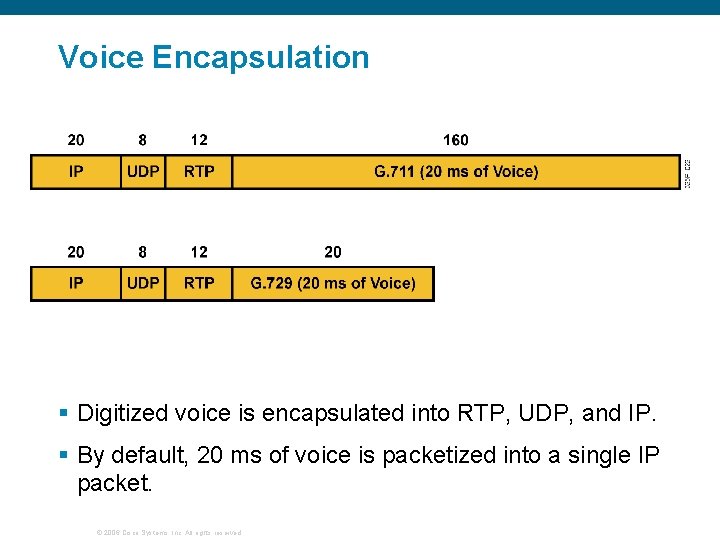
Voice Encapsulation § Digitized voice is encapsulated into RTP, UDP, and IP. § By default, 20 ms of voice is packetized into a single IP packet. © 2006 Cisco Systems, Inc. All rights reserved.
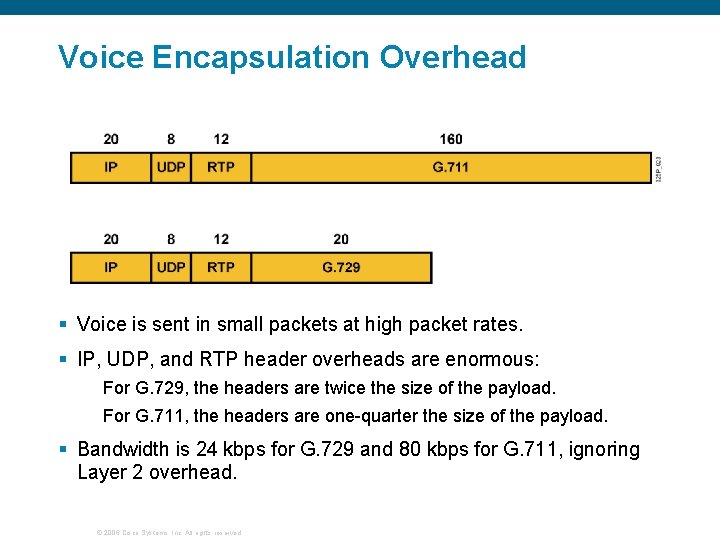
Voice Encapsulation Overhead § Voice is sent in small packets at high packet rates. § IP, UDP, and RTP header overheads are enormous: For G. 729, the headers are twice the size of the payload. For G. 711, the headers are one-quarter the size of the payload. § Bandwidth is 24 kbps for G. 729 and 80 kbps for G. 711, ignoring Layer 2 overhead. © 2006 Cisco Systems, Inc. All rights reserved.
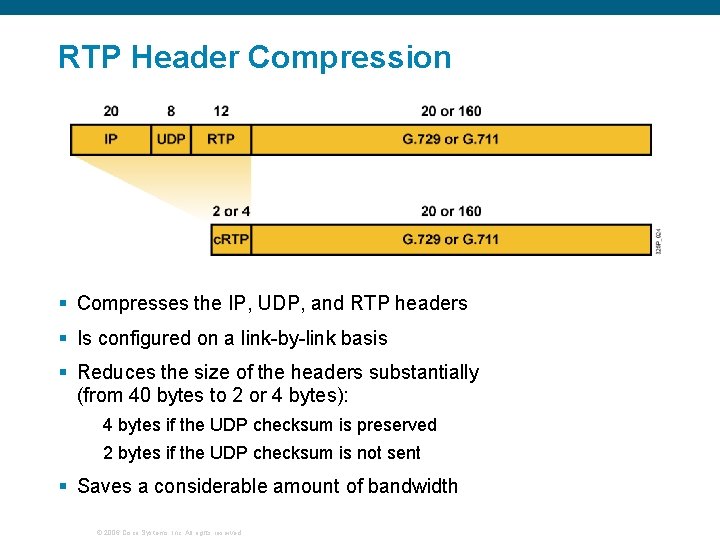
RTP Header Compression § Compresses the IP, UDP, and RTP headers § Is configured on a link-by-link basis § Reduces the size of the headers substantially (from 40 bytes to 2 or 4 bytes): 4 bytes if the UDP checksum is preserved 2 bytes if the UDP checksum is not sent § Saves a considerable amount of bandwidth © 2006 Cisco Systems, Inc. All rights reserved.
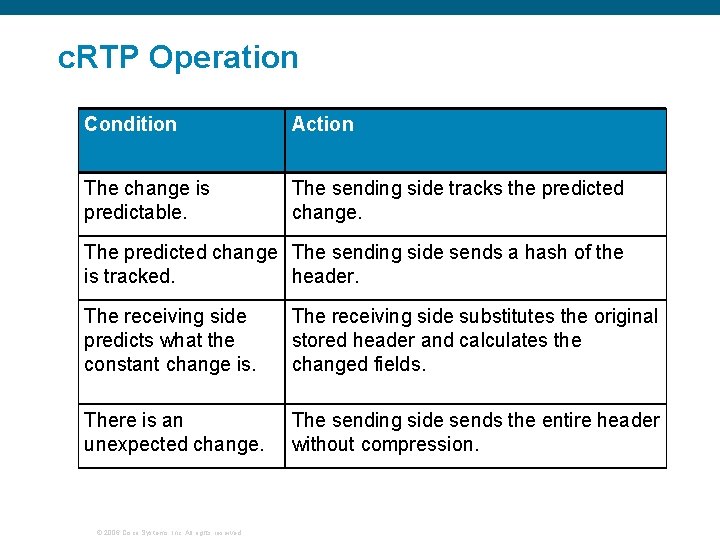
c. RTP Operation Condition Action The change is predictable. The sending side tracks the predicted change. The predicted change The sending side sends a hash of the is tracked. header. The receiving side predicts what the constant change is. The receiving side substitutes the original stored header and calculates the changed fields. There is an unexpected change. The sending side sends the entire header without compression. © 2006 Cisco Systems, Inc. All rights reserved.
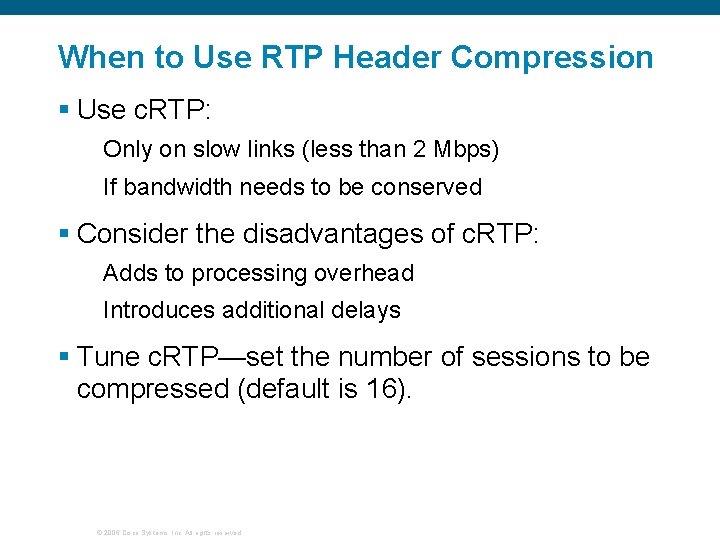
When to Use RTP Header Compression § Use c. RTP: Only on slow links (less than 2 Mbps) If bandwidth needs to be conserved § Consider the disadvantages of c. RTP: Adds to processing overhead Introduces additional delays § Tune c. RTP—set the number of sessions to be compressed (default is 16). © 2006 Cisco Systems, Inc. All rights reserved.
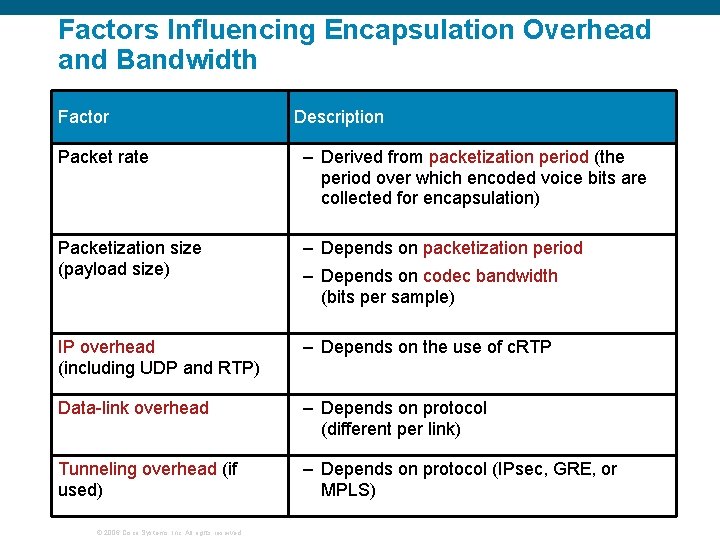
Factors Influencing Encapsulation Overhead and Bandwidth Factor Description Packet rate – Derived from packetization period (the period over which encoded voice bits are collected for encapsulation) Packetization size (payload size) – Depends on packetization period IP overhead (including UDP and RTP) – Depends on the use of c. RTP Data-link overhead – Depends on protocol (different per link) Tunneling overhead (if used) – Depends on protocol (IPsec, GRE, or MPLS) © 2006 Cisco Systems, Inc. All rights reserved. – Depends on codec bandwidth (bits per sample)
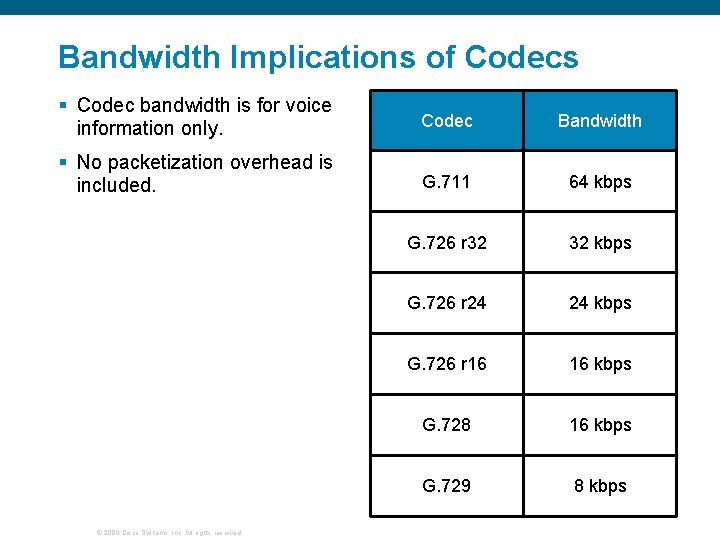
Bandwidth Implications of Codecs § Codec bandwidth is for voice information only. Codec Bandwidth § No packetization overhead is included. G. 711 64 kbps G. 726 r 32 32 kbps G. 726 r 24 24 kbps G. 726 r 16 16 kbps G. 728 16 kbps G. 729 8 kbps © 2006 Cisco Systems, Inc. All rights reserved.
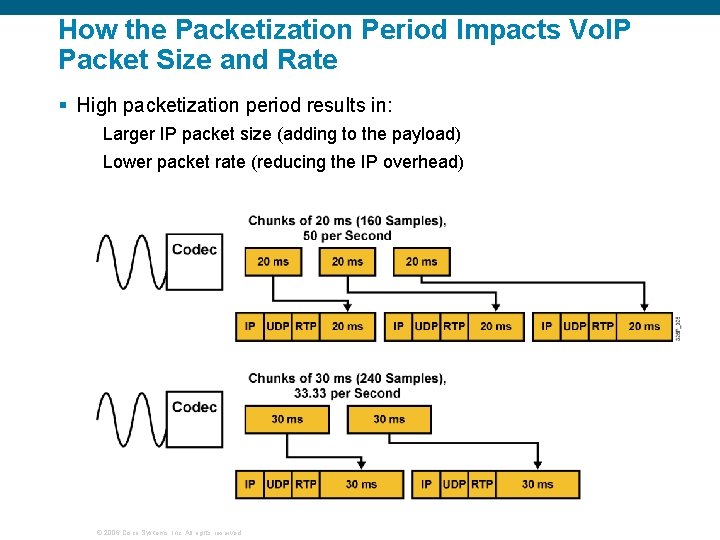
How the Packetization Period Impacts Vo. IP Packet Size and Rate § High packetization period results in: Larger IP packet size (adding to the payload) Lower packet rate (reducing the IP overhead) © 2006 Cisco Systems, Inc. All rights reserved.
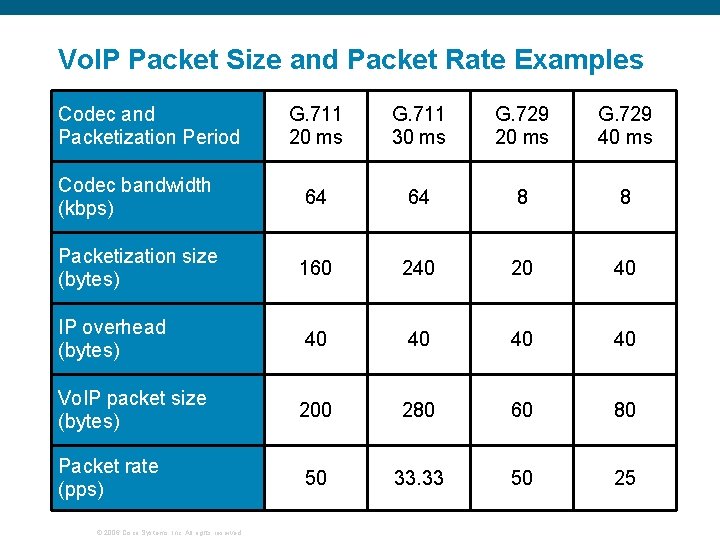
Vo. IP Packet Size and Packet Rate Examples Codec and Packetization Period G. 711 20 ms G. 711 30 ms G. 729 20 ms G. 729 40 ms Codec bandwidth (kbps) 64 64 8 8 Packetization size (bytes) 160 240 20 40 IP overhead (bytes) 40 40 Vo. IP packet size (bytes) 200 280 60 80 Packet rate (pps) 50 33. 33 50 25 © 2006 Cisco Systems, Inc. All rights reserved.
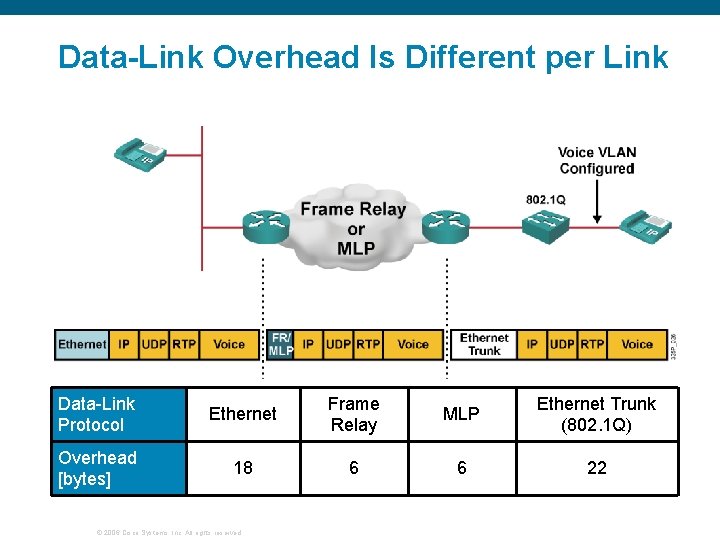
Data-Link Overhead Is Different per Link Data-Link Protocol Ethernet Frame Relay MLP Ethernet Trunk (802. 1 Q) Overhead [bytes] 18 6 6 22 © 2006 Cisco Systems, Inc. All rights reserved.
Security and Tunneling Overhead § IP packets can be secured by IPsec. § Additionally, IP packets or data-link frames can be tunneled over a variety of protocols. § Characteristics of IPsec and tunneling protocols are: The original frame or packet is encapsulated into another protocol. The added headers result in larger packets and higher bandwidth requirements. The extra bandwidth can be extremely critical for voice packets because of the transmission of small packets at a high rate. © 2006 Cisco Systems, Inc. All rights reserved.
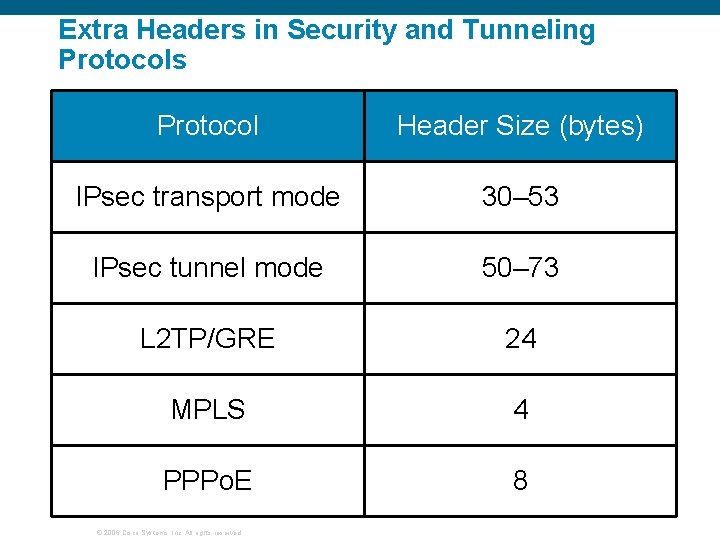
Extra Headers in Security and Tunneling Protocols Protocol Header Size (bytes) IPsec transport mode 30– 53 IPsec tunnel mode 50– 73 L 2 TP/GRE 24 MPLS 4 PPPo. E 8 © 2006 Cisco Systems, Inc. All rights reserved.
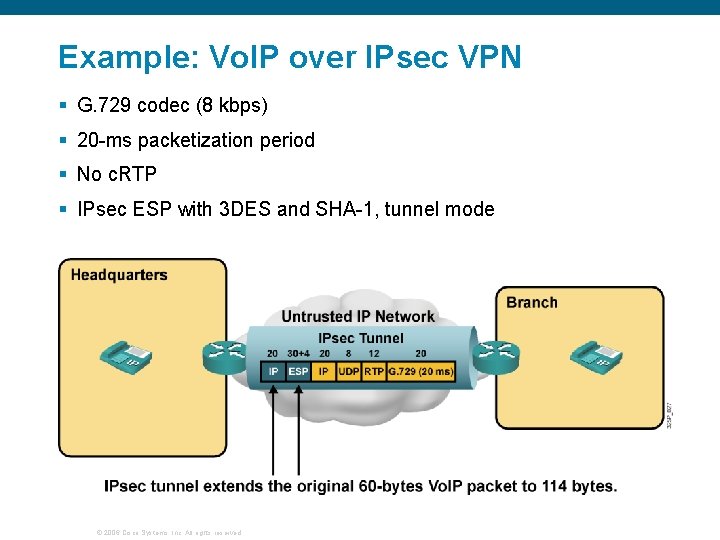
Example: Vo. IP over IPsec VPN § G. 729 codec (8 kbps) § 20 -ms packetization period § No c. RTP § IPsec ESP with 3 DES and SHA-1, tunnel mode © 2006 Cisco Systems, Inc. All rights reserved.
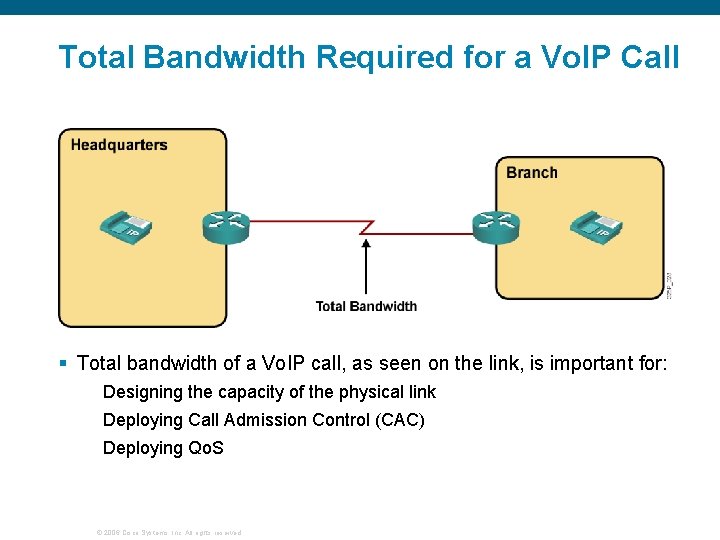
Total Bandwidth Required for a Vo. IP Call § Total bandwidth of a Vo. IP call, as seen on the link, is important for: Designing the capacity of the physical link Deploying Call Admission Control (CAC) Deploying Qo. S © 2006 Cisco Systems, Inc. All rights reserved.
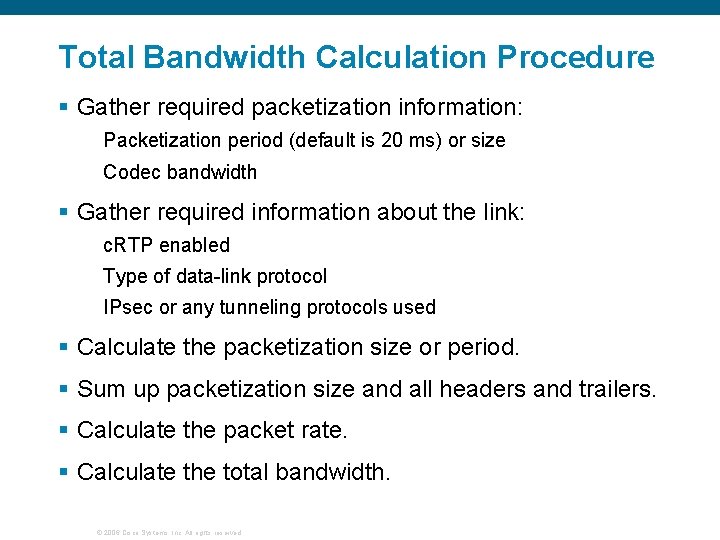
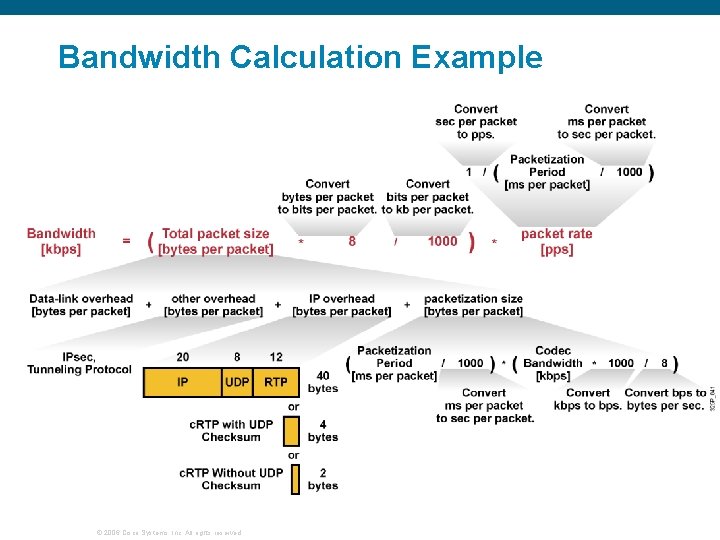
Total Bandwidth Calculation Procedure § Gather required packetization information: Packetization period (default is 20 ms) or size Codec bandwidth § Gather required information about the link: c. RTP enabled Type of data-link protocol IPsec or any tunneling protocols used § Calculate the packetization size or period. § Sum up packetization size and all headers and trailers. § Calculate the packet rate. § Calculate the total bandwidth. © 2006 Cisco Systems, Inc. All rights reserved.
Bandwidth Calculation Example © 2006 Cisco Systems, Inc. All rights reserved.
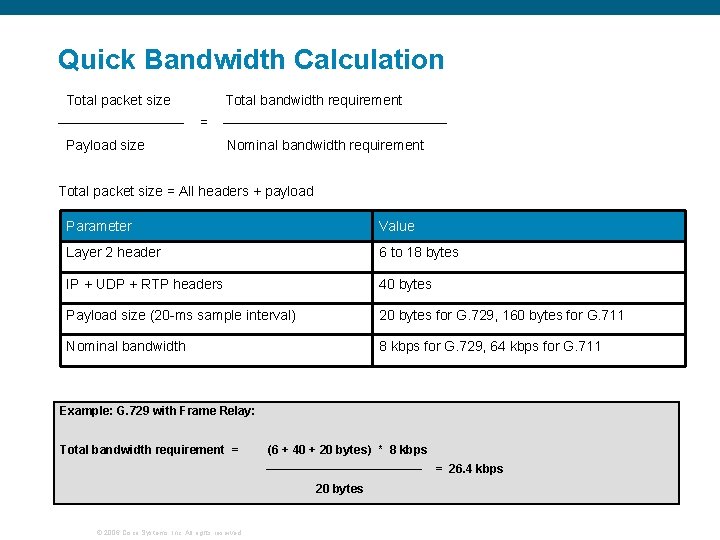
Quick Bandwidth Calculation Total packet size ————— Total bandwidth requirement = ———————— Payload size Nominal bandwidth requirement Total packet size = All headers + payload Parameter Value Layer 2 header 6 to 18 bytes IP + UDP + RTP headers 40 bytes Payload size (20 -ms sample interval) 20 bytes for G. 729, 160 bytes for G. 711 Nominal bandwidth 8 kbps for G. 729, 64 kbps for G. 711 Example: G. 729 with Frame Relay: Total bandwidth requirement = (6 + 40 + 20 bytes) * 8 kbps ——————— 20 bytes © 2006 Cisco Systems, Inc. All rights reserved. = 26. 4 kbps
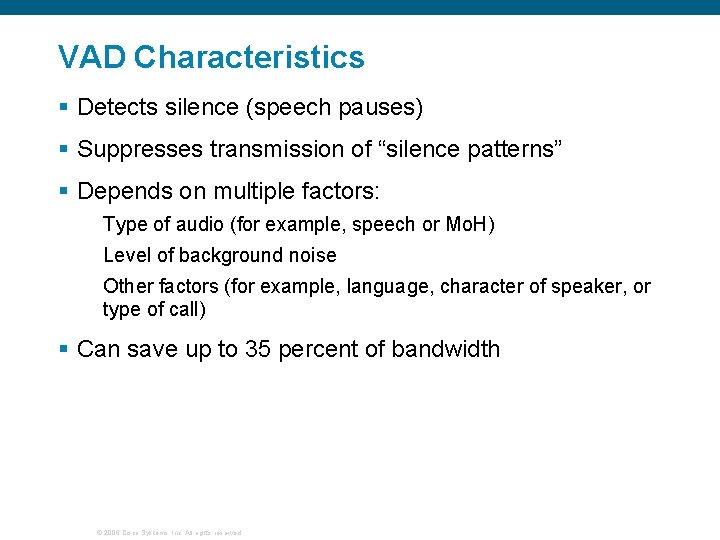
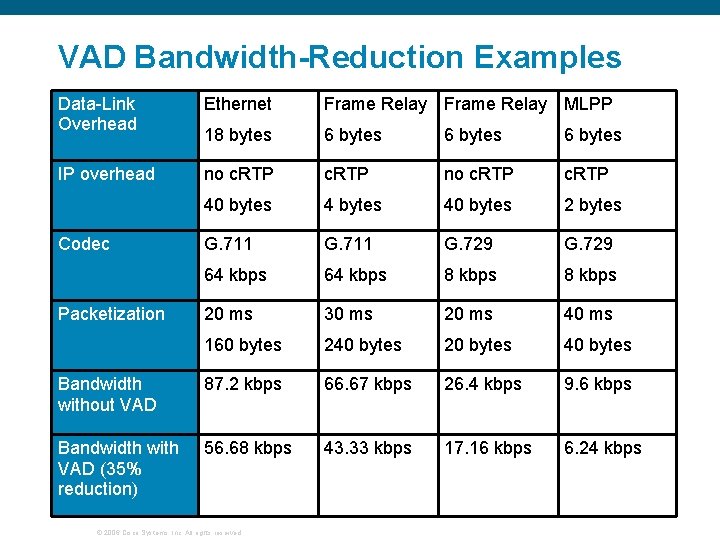
VAD Characteristics § Detects silence (speech pauses) § Suppresses transmission of “silence patterns” § Depends on multiple factors: Type of audio (for example, speech or Mo. H) Level of background noise Other factors (for example, language, character of speaker, or type of call) § Can save up to 35 percent of bandwidth © 2006 Cisco Systems, Inc. All rights reserved.
VAD Bandwidth-Reduction Examples Data-Link Overhead Ethernet Frame Relay MLPP 18 bytes 6 bytes IP overhead no c. RTP 40 bytes 2 bytes G. 711 G. 729 64 kbps 8 kbps 20 ms 30 ms 20 ms 40 ms 160 bytes 240 bytes 20 bytes 40 bytes Bandwidth without VAD 87. 2 kbps 66. 67 kbps 26. 4 kbps 9. 6 kbps Bandwidth with VAD (35% reduction) 56. 68 kbps 43. 33 kbps 17. 16 kbps 6. 24 kbps Codec Packetization © 2006 Cisco Systems, Inc. All rights reserved.
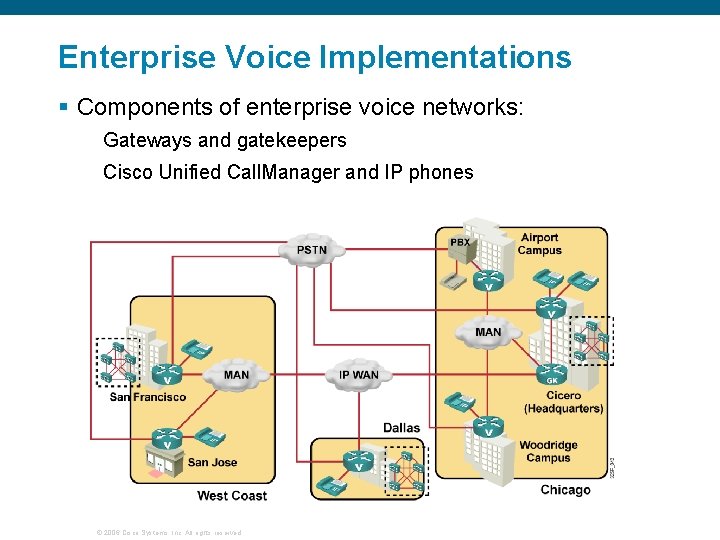
Enterprise Voice Implementations § Components of enterprise voice networks: Gateways and gatekeepers Cisco Unified Call. Manager and IP phones © 2006 Cisco Systems, Inc. All rights reserved.
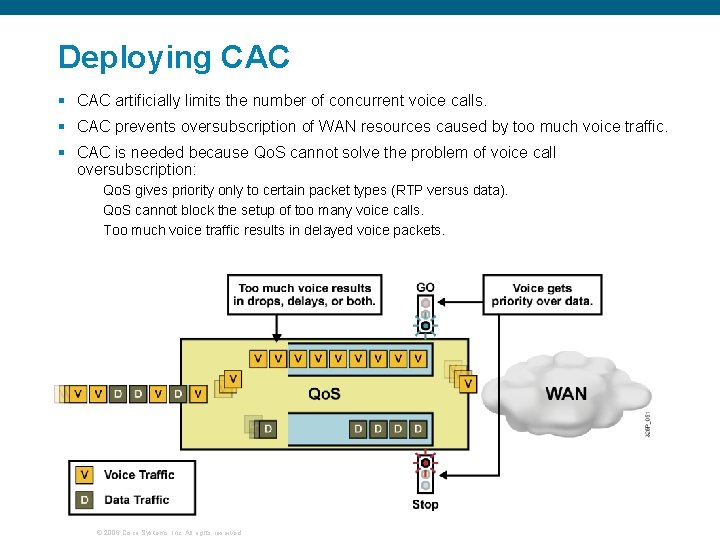
Deploying CAC § CAC artificially limits the number of concurrent voice calls. § CAC prevents oversubscription of WAN resources caused by too much voice traffic. § CAC is needed because Qo. S cannot solve the problem of voice call oversubscription: Qo. S gives priority only to certain packet types (RTP versus data). Qo. S cannot block the setup of too many voice calls. Too much voice traffic results in delayed voice packets. © 2006 Cisco Systems, Inc. All rights reserved.
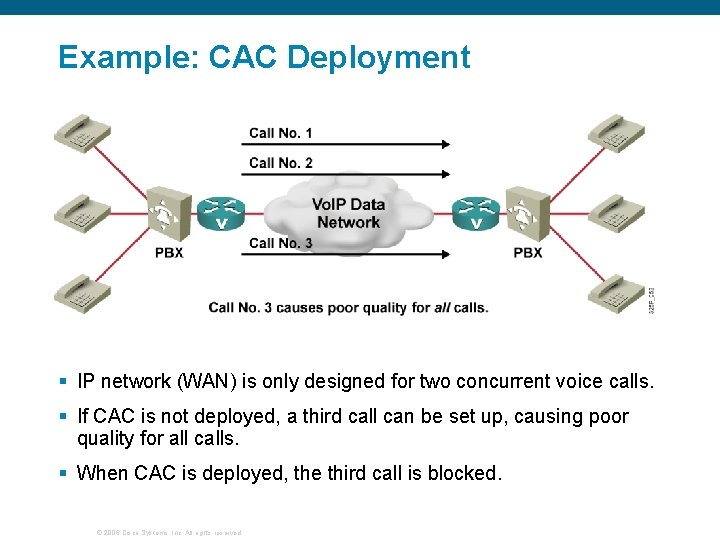
Example: CAC Deployment § IP network (WAN) is only designed for two concurrent voice calls. § If CAC is not deployed, a third call can be set up, causing poor quality for all calls. § When CAC is deployed, the third call is blocked. © 2006 Cisco Systems, Inc. All rights reserved.
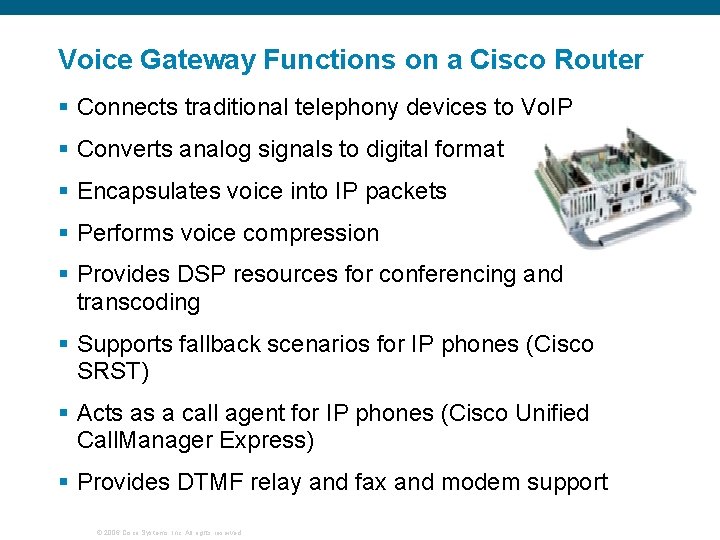
Voice Gateway Functions on a Cisco Router § Connects traditional telephony devices to Vo. IP § Converts analog signals to digital format § Encapsulates voice into IP packets § Performs voice compression § Provides DSP resources for conferencing and transcoding § Supports fallback scenarios for IP phones (Cisco SRST) § Acts as a call agent for IP phones (Cisco Unified Call. Manager Express) § Provides DTMF relay and fax and modem support © 2006 Cisco Systems, Inc. All rights reserved.
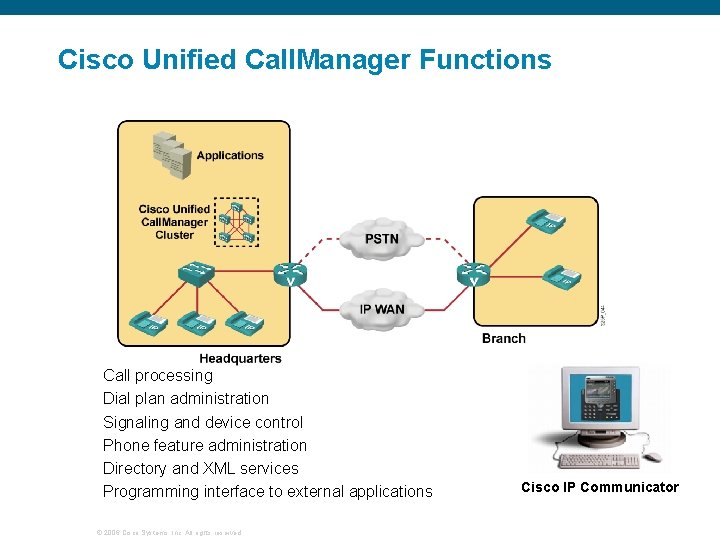
Cisco Unified Call. Manager Functions Call processing Dial plan administration Signaling and device control Phone feature administration Directory and XML services Programming interface to external applications © 2006 Cisco Systems, Inc. All rights reserved. Cisco IP Communicator
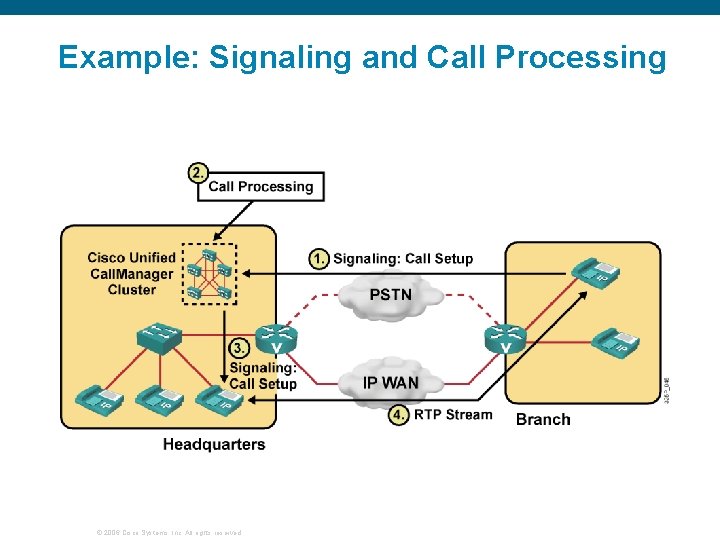
Example: Signaling and Call Processing © 2006 Cisco Systems, Inc. All rights reserved.
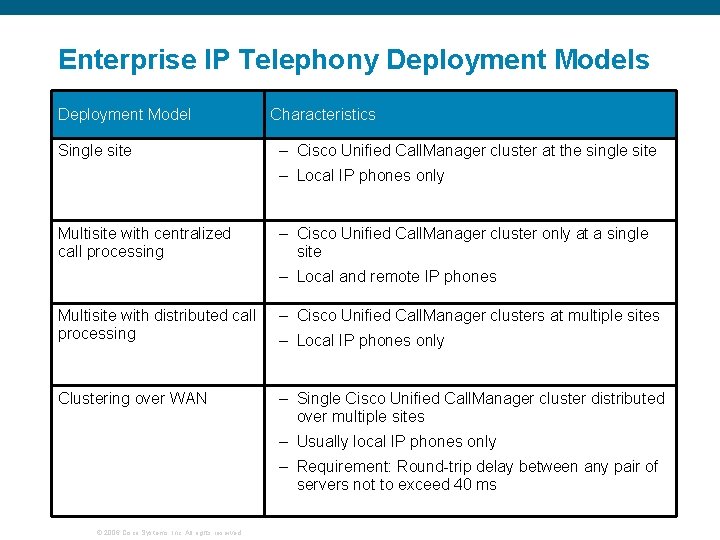
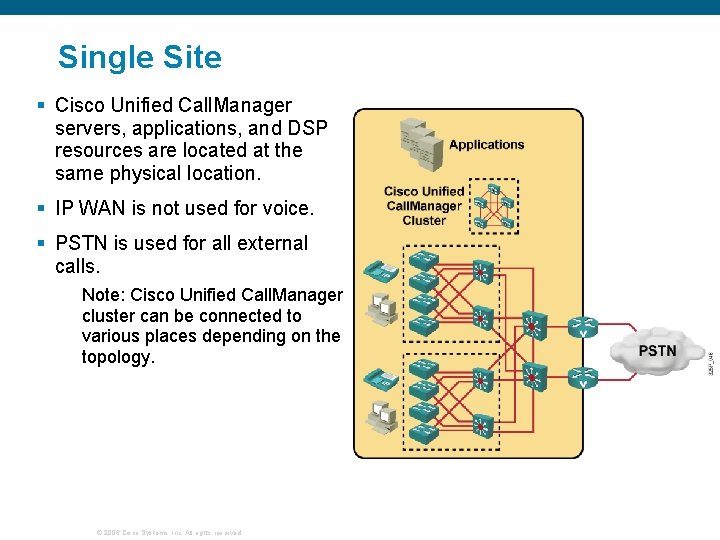
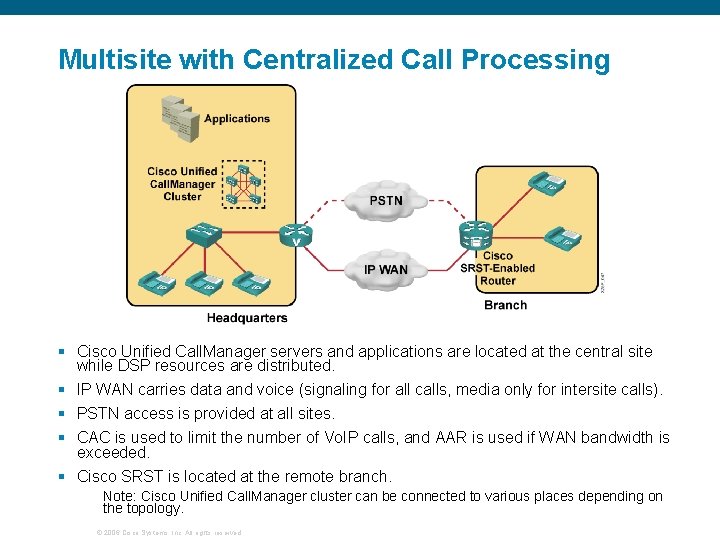
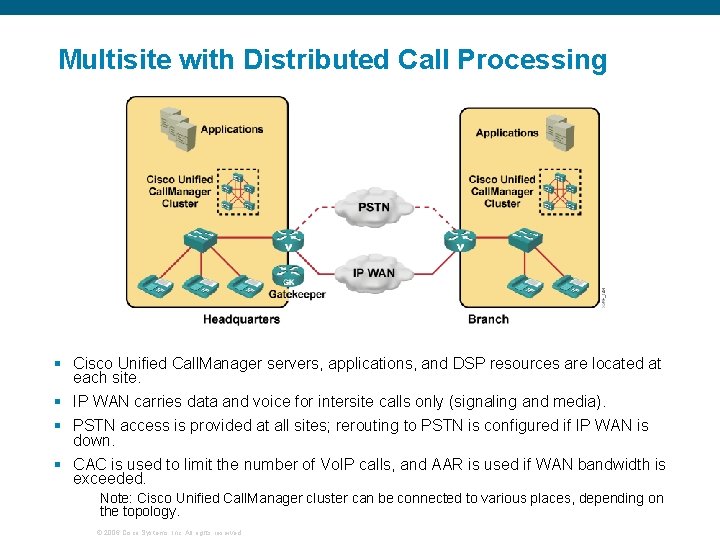
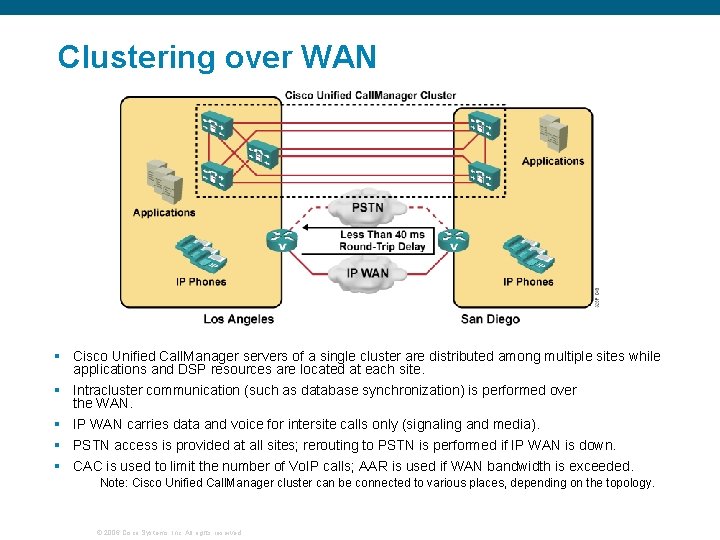
Enterprise IP Telephony Deployment Models Deployment Model Single site Characteristics – Cisco Unified Call. Manager cluster at the single site – Local IP phones only Multisite with centralized call processing – Cisco Unified Call. Manager cluster only at a single site – Local and remote IP phones Multisite with distributed call processing – Cisco Unified Call. Manager clusters at multiple sites Clustering over WAN – Single Cisco Unified Call. Manager cluster distributed over multiple sites – Local IP phones only – Usually local IP phones only – Requirement: Round-trip delay between any pair of servers not to exceed 40 ms © 2006 Cisco Systems, Inc. All rights reserved.
Single Site § Cisco Unified Call. Manager servers, applications, and DSP resources are located at the same physical location. § IP WAN is not used for voice. § PSTN is used for all external calls. Note: Cisco Unified Call. Manager cluster can be connected to various places depending on the topology. © 2006 Cisco Systems, Inc. All rights reserved.
Multisite with Centralized Call Processing § Cisco Unified Call. Manager servers and applications are located at the central site while DSP resources are distributed. § IP WAN carries data and voice (signaling for all calls, media only for intersite calls). § PSTN access is provided at all sites. § CAC is used to limit the number of Vo. IP calls, and AAR is used if WAN bandwidth is exceeded. § Cisco SRST is located at the remote branch. Note: Cisco Unified Call. Manager cluster can be connected to various places depending on the topology. © 2006 Cisco Systems, Inc. All rights reserved.
Multisite with Distributed Call Processing § Cisco Unified Call. Manager servers, applications, and DSP resources are located at each site. § IP WAN carries data and voice for intersite calls only (signaling and media). § PSTN access is provided at all sites; rerouting to PSTN is configured if IP WAN is down. § CAC is used to limit the number of Vo. IP calls, and AAR is used if WAN bandwidth is exceeded. Note: Cisco Unified Call. Manager cluster can be connected to various places, depending on the topology. © 2006 Cisco Systems, Inc. All rights reserved.
Clustering over WAN § Cisco Unified Call. Manager servers of a single cluster are distributed among multiple sites while applications and DSP resources are located at each site. § Intracluster communication (such as database synchronization) is performed over the WAN. § IP WAN carries data and voice for intersite calls only (signaling and media). § PSTN access is provided at all sites; rerouting to PSTN is performed if IP WAN is down. § CAC is used to limit the number of Vo. IP calls; AAR is used if WAN bandwidth is exceeded. Note: Cisco Unified Call. Manager cluster can be connected to various places, depending on the topology. © 2006 Cisco Systems, Inc. All rights reserved.
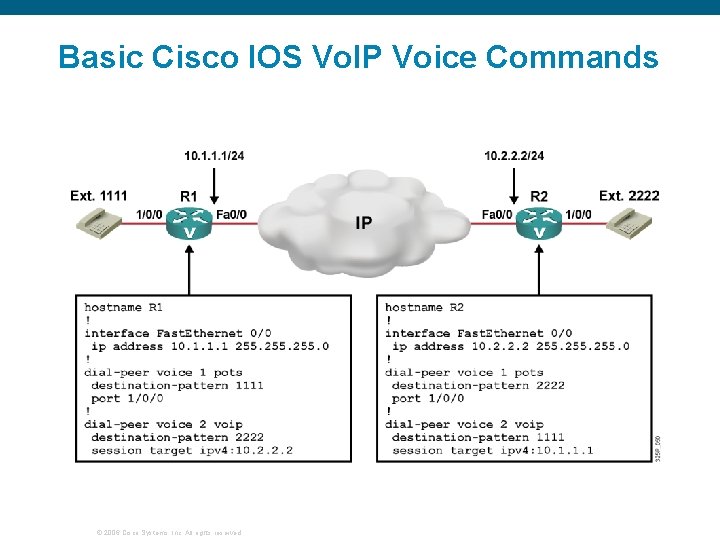
Basic Cisco IOS Vo. IP Voice Commands © 2006 Cisco Systems, Inc. All rights reserved.
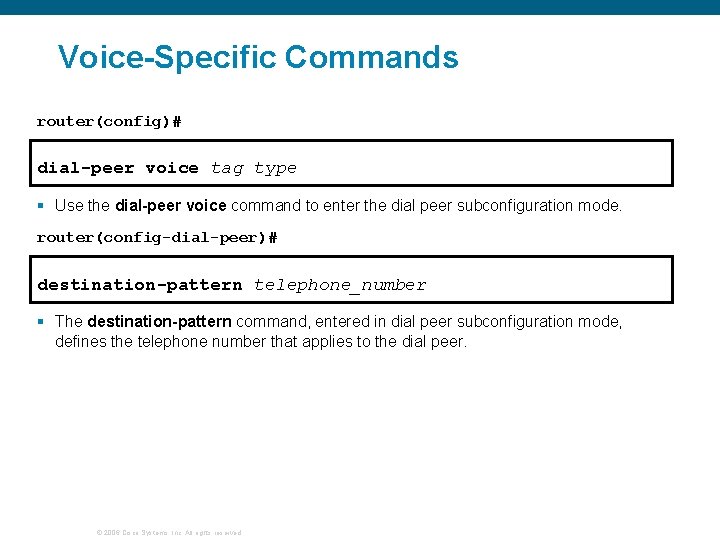
Voice-Specific Commands router(config)# dial-peer voice tag type § Use the dial-peer voice command to enter the dial peer subconfiguration mode. router(config-dial-peer)# destination-pattern telephone_number § The destination-pattern command, entered in dial peer subconfiguration mode, defines the telephone number that applies to the dial peer. © 2006 Cisco Systems, Inc. All rights reserved.
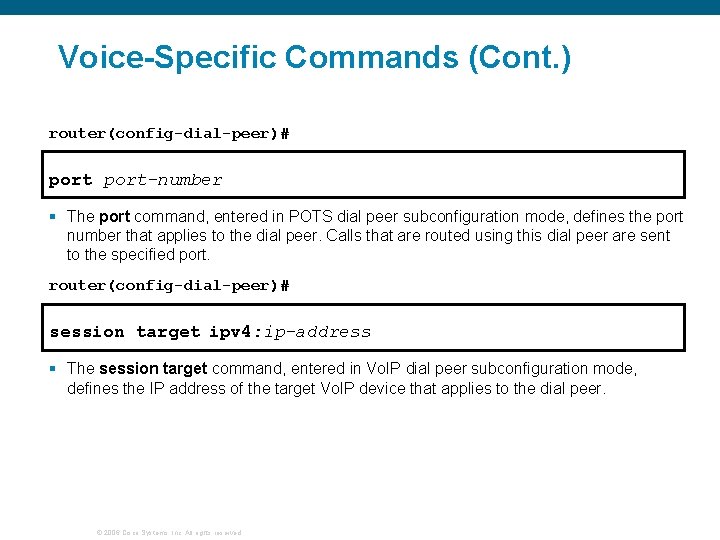
Voice-Specific Commands (Cont. ) router(config-dial-peer)# port-number § The port command, entered in POTS dial peer subconfiguration mode, defines the port number that applies to the dial peer. Calls that are routed using this dial peer are sent to the specified port. router(config-dial-peer)# session target ipv 4: ip-address § The session target command, entered in Vo. IP dial peer subconfiguration mode, defines the IP address of the target Vo. IP device that applies to the dial peer. © 2006 Cisco Systems, Inc. All rights reserved.