
QFT Examples from Nicole th Bolducs 7 Grade
QFT Examples from Nicole th Bolduc’s 7 Grade Classroom To find out more or ask questions, please reach out to Nicole: nbolduc@ellingtonschools. net
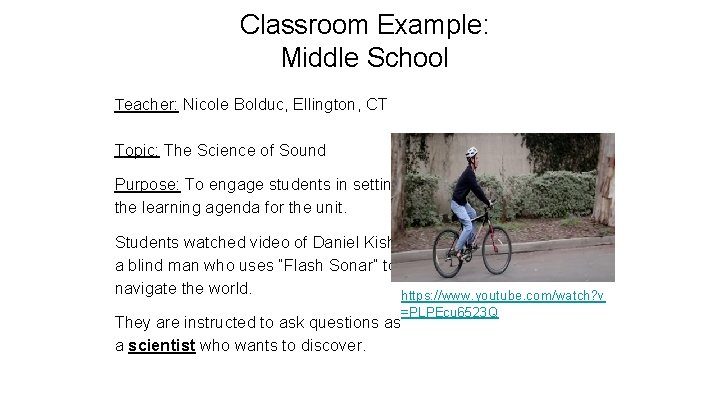
Classroom Example: Middle School Teacher: Nicole Bolduc, Ellington, CT Topic: The Science of Sound Purpose: To engage students in setting the learning agenda for the unit. Students watched video of Daniel Kish, a blind man who uses “Flash Sonar” to navigate the world. https: //www. youtube. com/watch? v =PLPEcu 6523 Q They are instructed to ask questions as a scientist who wants to discover.
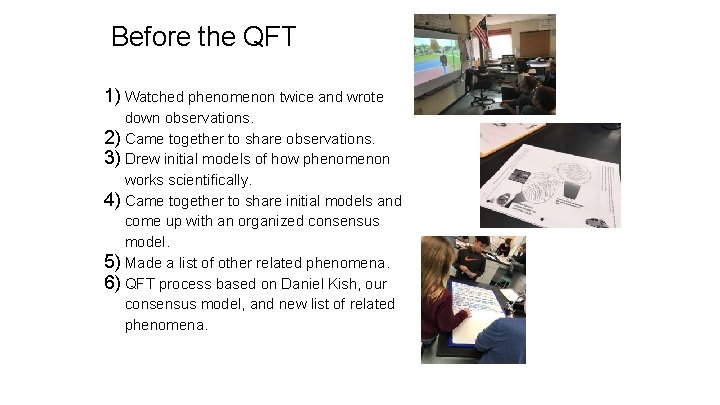
Before the QFT 1) Watched phenomenon twice and wrote down observations. 2) Came together to share observations. 3) Drew initial models of how phenomenon works scientifically. 4) Came together to share initial models and come up with an organized consensus model. 5) Made a list of other related phenomena. 6) QFT process based on Daniel Kish, our consensus model, and new list of related phenomena.
Selected Student Questions (Category A) What causes different sounds ● Does the clicking only work with ● Why do all the animals have special objects? different sounds? ● Why does fire make a “crackling” ● How does the speed that they click noise? effect what you are doing? ● Why do different things make ● What makes up sound? different sounds? ● How is echolocation used? Humans ● How can get something so loud? and animals? ● Does loud or quiet sounds help you ● Why when we yell does it echo? know where you are? ● How does lightning make sound? ● Does he have to make a louder ● How does snapping your fingers noise is he is in a larger make a noise? environment? ● Does the volume of the sound ● Do you have to click a certain way matter? to “see? ” ● Why does a tennis racket maker a ● Could the use of snapping vs “whoosh” sound? clicking make a difference? ● Can certain people hear dog Cick here to see ALL of their cetegorized questions whistles?
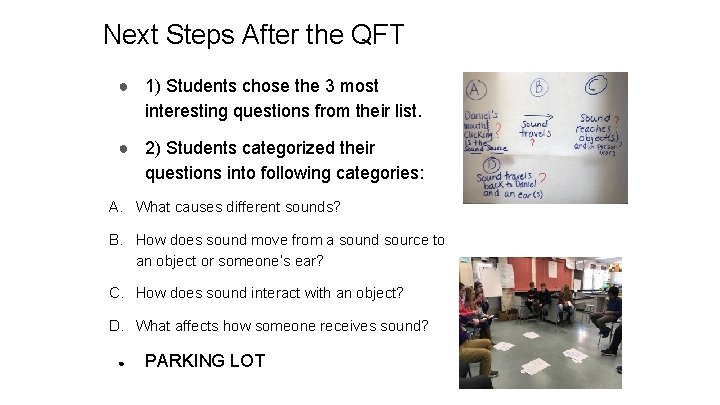
Next Steps After the QFT ● 1) Students chose the 3 most interesting questions from their list. ● 2) Students categorized their questions into following categories: A. What causes different sounds? B. How does sound move from a sound source to an object or someone’s ear? C. How does sound interact with an object? D. What affects how someone receives sound? ● PARKING LOT
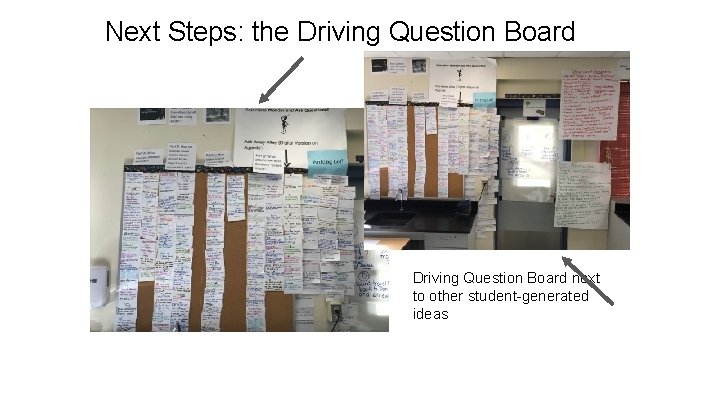
Next Steps: the Driving Question Board next to other student-generated ideas
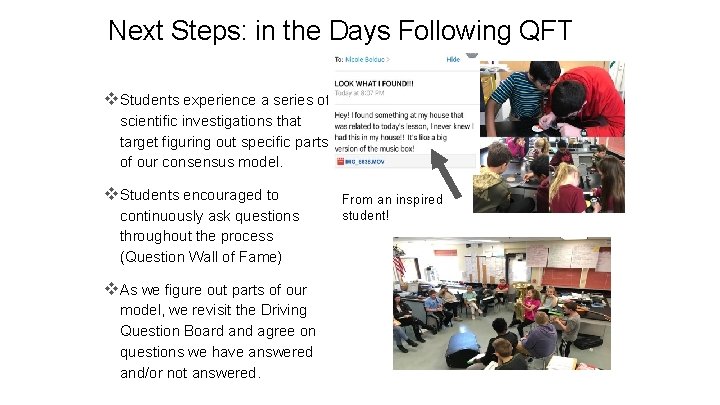
Next Steps: in the Days Following QFT v Students experience a series of scientific investigations that target figuring out specific parts of our consensus model. v Students encouraged to continuously ask questions throughout the process (Question Wall of Fame) v As we figure out parts of our model, we revisit the Driving Question Board and agree on questions we have answered and/or not answered. From an inspired student!
+ Classroom Example: 7 th Grade Teacher: Nicole Bolduc, Ellington, CT Topic: “The Universe and Its Stars” Unit Purpose: To engage students in setting the learning agenda for the unit
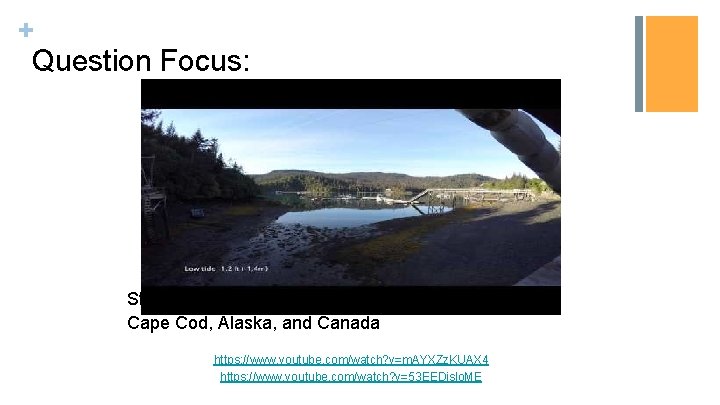
+ Question Focus: Students watched videos of dramatic tide change in Cape Cod, Alaska, and Canada https: //www. youtube. com/watch? v=m. AYXZz. KUAX 4 https: //www. youtube. com/watch? v=53 EEDislo. ME
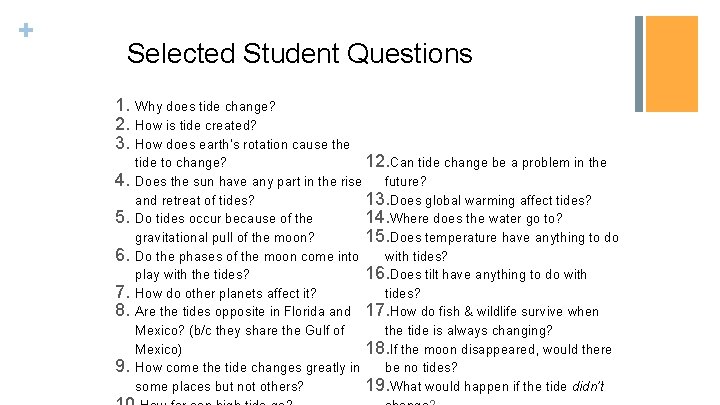
+ Selected Student Questions 1. Why does tide change? 2. How is tide created? 3. How does earth’s rotation cause the 4. 5. 6. 7. 8. 9. tide to change? 12. Can tide change be a problem in the Does the sun have any part in the rise future? and retreat of tides? 13. Does global warming affect tides? Do tides occur because of the 14. Where does the water go to? gravitational pull of the moon? 15. Does temperature have anything to do Do the phases of the moon come into with tides? play with the tides? 16. Does tilt have anything to do with How do other planets affect it? tides? Are the tides opposite in Florida and 17. How do fish & wildlife survive when Mexico? (b/c they share the Gulf of the tide is always changing? Mexico) 18. If the moon disappeared, would there How come the tide changes greatly in be no tides? some places but not others? 19. What would happen if the tide didn’t
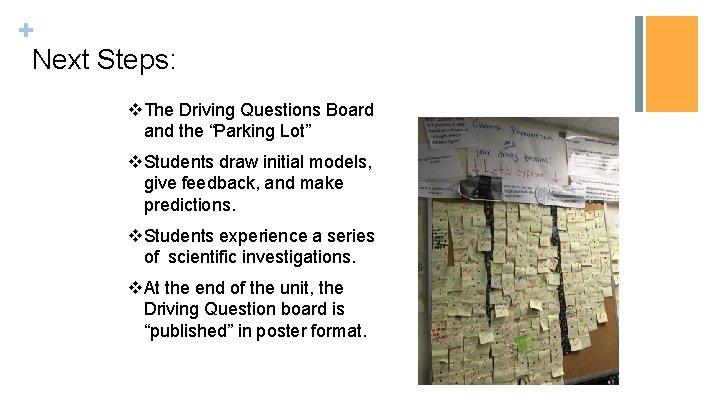
+ Next Steps: v. The Driving Questions Board and the “Parking Lot” v. Students draw initial models, give feedback, and make predictions. v. Students experience a series of scientific investigations. v. At the end of the unit, the Driving Question board is “published” in poster format.
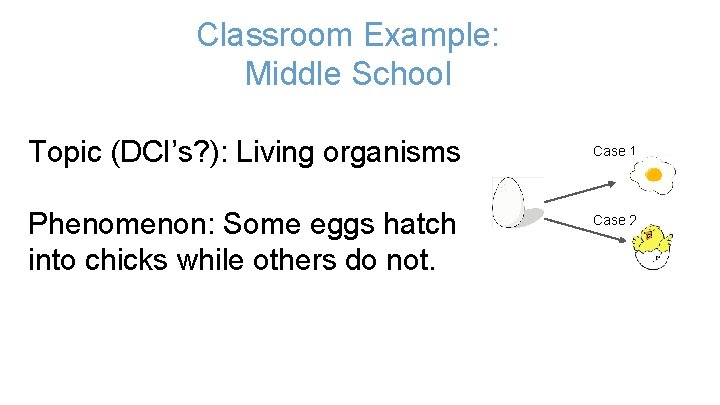
Classroom Example: Middle School Topic (DCI’s? ): Living organisms Phenomenon: Some eggs hatch into chicks while others do not. Case 1 Case 2
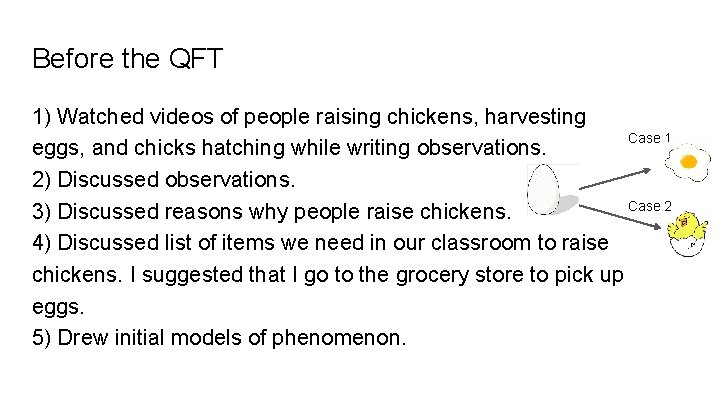
Before the QFT 1) Watched videos of people raising chickens, harvesting Case 1 eggs, and chicks hatching while writing observations. 2) Discussed observations. Case 2 3) Discussed reasons why people raise chickens. 4) Discussed list of items we need in our classroom to raise chickens. I suggested that I go to the grocery store to pick up eggs. 5) Drew initial models of phenomenon.
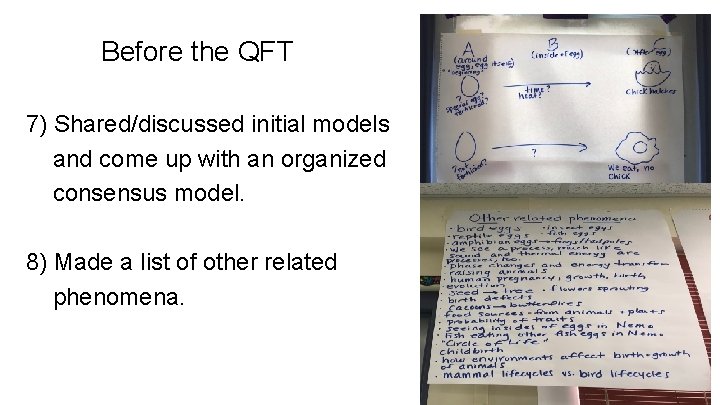
Before the QFT 7) Shared/discussed initial models and come up with an organized consensus model. 8) Made a list of other related phenomena.
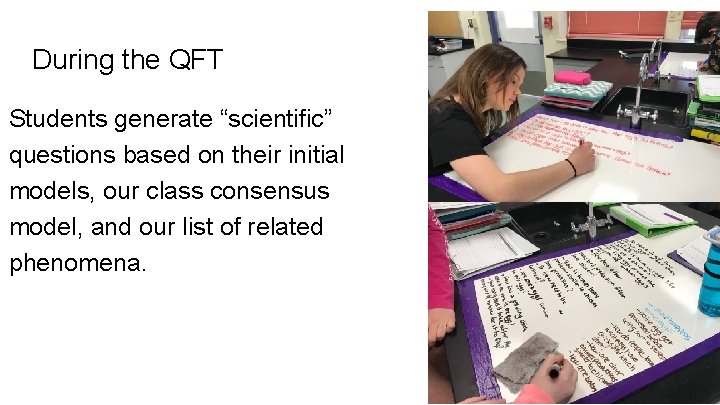
During the QFT Students generate “scientific” questions based on their initial models, our class consensus model, and our list of related phenomena.
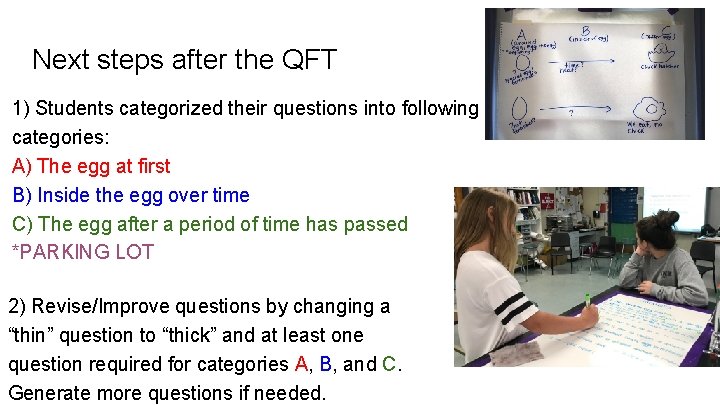
Next steps after the QFT 1) Students categorized their questions into following categories: A) The egg at first B) Inside the egg over time C) The egg after a period of time has passed *PARKING LOT 2) Revise/Improve questions by changing a “thin” question to “thick” and at least one question required for categories A, B, and C. Generate more questions if needed.
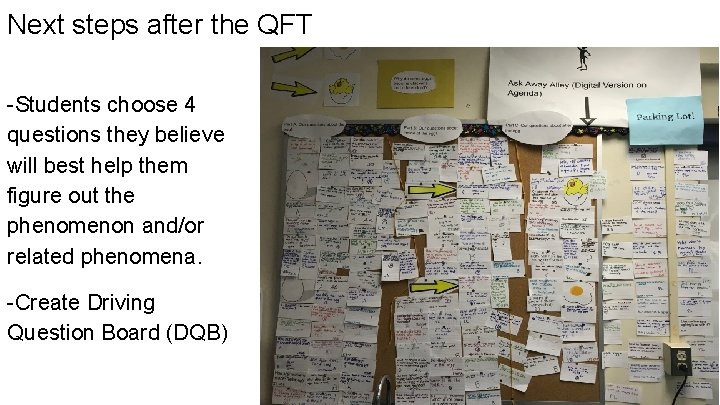
Next steps after the QFT -Students choose 4 questions they believe will best help them figure out the phenomenon and/or related phenomena. -Create Driving Question Board (DQB)
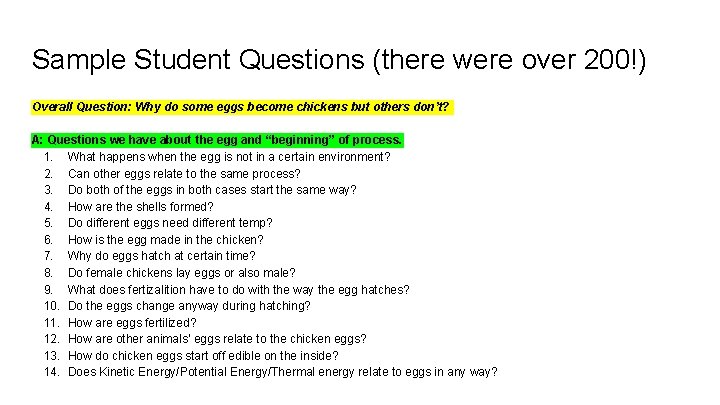
Sample Student Questions (there were over 200!) Overall Question: Why do some eggs become chickens but others don’t? A: Questions we have about the egg and “beginning” of process. 1. What happens when the egg is not in a certain environment? 2. Can other eggs relate to the same process? 3. Do both of the eggs in both cases start the same way? 4. How are the shells formed? 5. Do different eggs need different temp? 6. How is the egg made in the chicken? 7. Why do eggs hatch at certain time? 8. Do female chickens lay eggs or also male? 9. What does fertizalition have to do with the way the egg hatches? 10. Do the eggs change anyway during hatching? 11. How are eggs fertilized? 12. How are other animals’ eggs relate to the chicken eggs? 13. How do chicken eggs start off edible on the inside? 14. Does Kinetic Energy/Potential Energy/Thermal energy relate to eggs in any way?
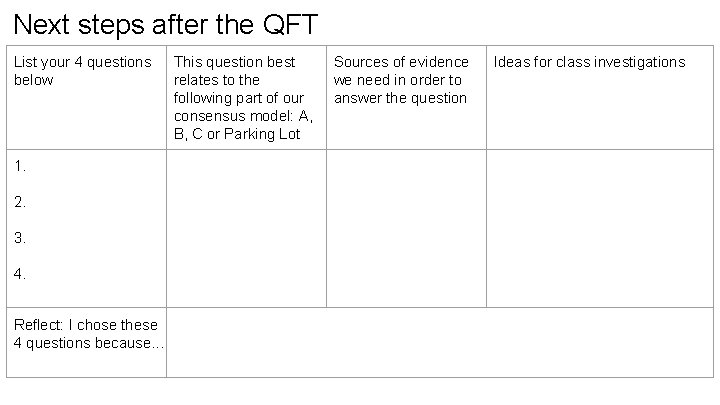
Next steps after the QFT List your 4 questions below 1. 2. 3. 4. Reflect: I chose these 4 questions because. . . This question best relates to the following part of our consensus model: A, B, C or Parking Lot Sources of evidence we need in order to answer the question Ideas for class investigations
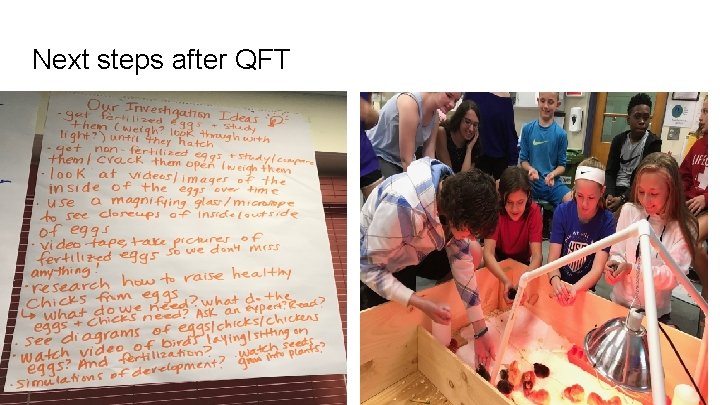
Next steps after QFT
- Slides: 20