
QEMU a Fast and Portable Dynamic Translator Fabrice
QEMU, a Fast and Portable Dynamic Translator Fabrice Bellard (affiliation? ) CMSC 691 talk by Charles Nicholas
Overview • QEMU is a system for creating emulators, i. e. programs that allow programs for Target machine A to run on Host machine B • For example, to allow a MIPS program (an OS plus apps) to run on an i 386 or x 64 host • By pre-compiling micro operations that make up guest machine instructions, QEMU gains speed over other approaches
What’s the Problem? • We want to run a binary for CPU A, but we only have machine B, so we need to emulate A • Testing a cross-compiler which has A as a target • We need to keep a lower profile than Virtual. Box
QEMU Has Many Parts • DYNGEN – “performs runtime conversion of the target CPU instructions into the host instruction set” – focus of this paper • • debugger UNIX user mode emulated devices (many more may exist now) and a GUI!
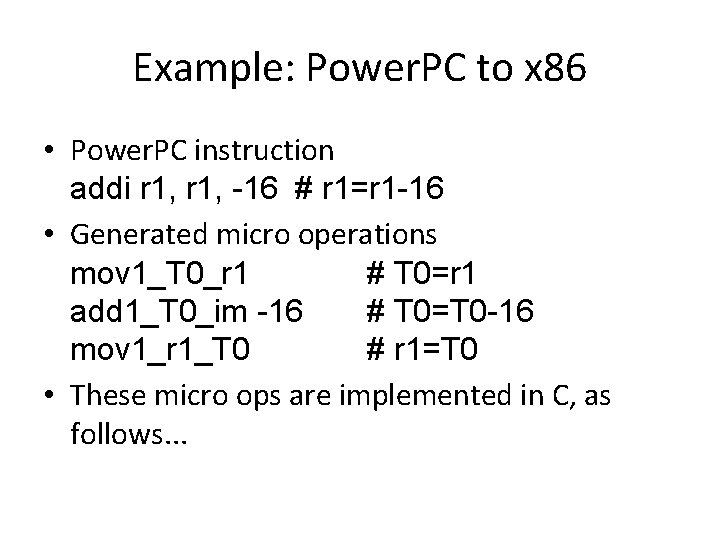
Example: Power. PC to x 86 • Power. PC instruction addi r 1, -16 # r 1=r 1 -16 • Generated micro operations mov 1_T 0_r 1 # T 0=r 1 add 1_T 0_im -16 # T 0=T 0 -16 mov 1_r 1_T 0 # r 1=T 0 • These micro ops are implemented in C, as follows. . .

Implement Each Micro Op • To implement the micro op mov 1_T 0_r 1 # T 0=r 1 • A short C function is written void op_mov 1_T 0_r 1(void){ T 0 = env->regs[1]; } • The various target CPU registers are part of the environment data structure, and T 0 is a variable
How Are These Functions Used? • The various micro op functions are compiled, and object code stored • When a target instruction is first found, the micro op object code sequences are concatenated in memory, and cached • System calls such as memcpy are used to handle target machine memory operations • Each target machine opcode needs to be handled (one would expect)
How Does DYNGEN Work? • The compiled C code (somefile. obj) is parsed, and the location of various micro ops noted. • The number of parameters of each micro op is noted, too. • GCC flags are used to simplify the parsing, and to assure that the micro op code is positionindependent. (Do you know what that means? Am I right on this point? )
Implementation Aspects • Target operations are grouped into Translated Blocks, delimited by branching ops • Translated Blocks are cached (to avoid translating the same code repeatedly) • Target CPU registers (including condition code flags) are just C variables • The Translated Blocks may have extra code to branch to each other, if that’s what would happen in target code. (Direct Block Chaining)
Other Issues • • Memory Management Self-modifying code (which malware may use!) Exceptions Interrupts
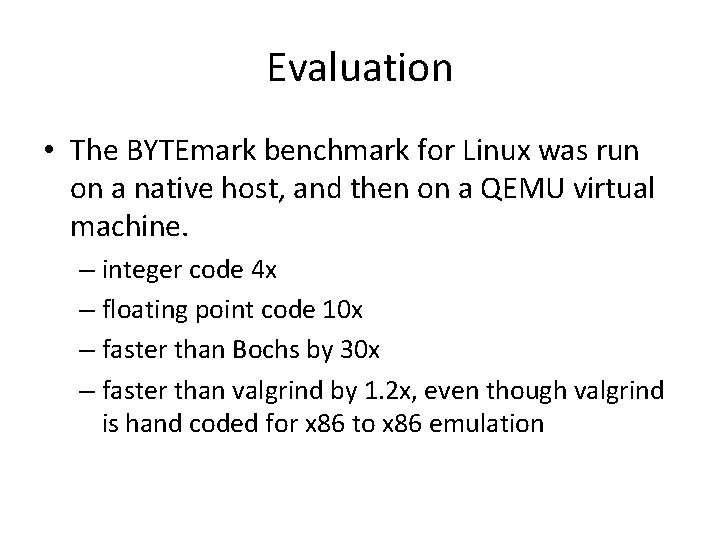
Evaluation • The BYTEmark benchmark for Linux was run on a native host, and then on a QEMU virtual machine. – integer code 4 x – floating point code 10 x – faster than Bochs by 30 x – faster than valgrind by 1. 2 x, even though valgrind is hand coded for x 86 to x 86 emulation
Conclusions • It’s possible to make a versatile emulator with decent performance – versatile: many (target, host) combinations • Lots of options regarding debugging or instrumenting code • There seems to be an active QEMU community • For more info, see http: //wiki. qemu. org
- Slides: 12