
QED Lamb shift proton charge radius puzzle etc
QED, Lamb shift, `proton charge radius puzzle' etc. Savely Karshenboim Pulkovo Observatory (ГАО РАН) (St. Petersburg) & Max-Planck-Institut für Quantenoptik (Garching)
Outline ¢ Different methods to determine the proton charge radius l l l ¢ spectroscopy of hydrogen (and deuterium) the Lamb shift in muonic hydrogen electron-proton scattering The proton radius: the state of the art l l electric charge radius magnetic radius
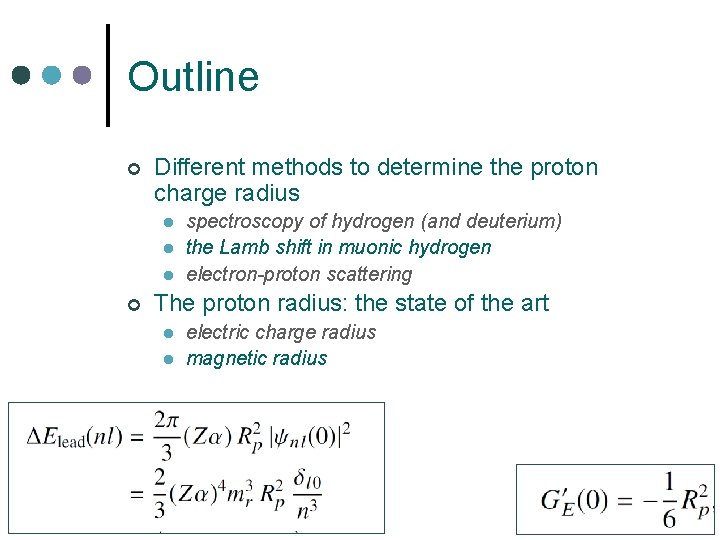
Outline ¢ Different methods to determine the proton charge radius l l l ¢ spectroscopy of hydrogen (and deuterium) the Lamb shift in muonic hydrogen electron-proton scattering The proton radius: the state of the art l l electric charge radius magnetic radius
Different methods to determine the proton charge radius ¢ ¢ Spectroscopy of hydrogen (and deuterium) The Lamb shift in muonic hydrogen Spectroscopy produces a model-independent result, but involves a lot of theory and/or a bit of modeling. ¢ Electron-proton scattering Studies of scattering need theory of radiative corrections, estimation of two-photon effects; the result is to depend on model applied to extrapolate to zero momentum transfer.
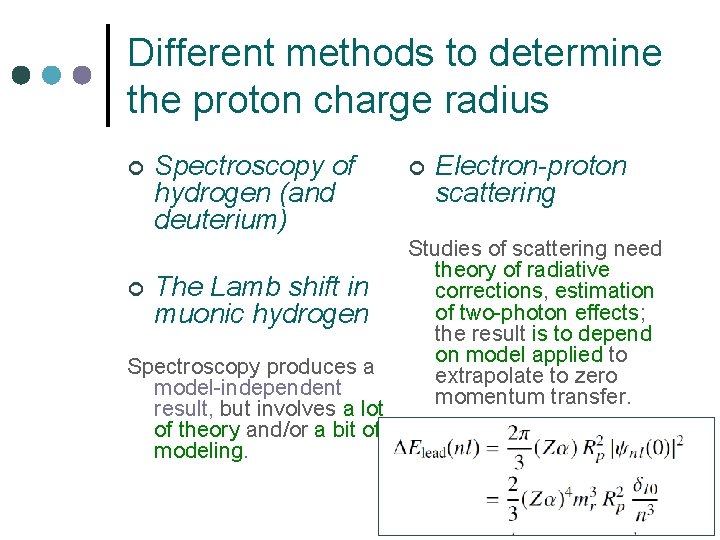
Different methods to determine the proton charge radius ¢ ¢ Spectroscopy of hydrogen (and deuterium) The Lamb shift in muonic hydrogen Spectroscopy produces a model-independent result, but involves a lot of theory and/or a bit of modeling. ¢ Electron-proton scattering Studies of scattering need theory of radiative corrections, estimation of two-photon effects; the result is to depend on model applied to extrapolate to zero momentum transfer.
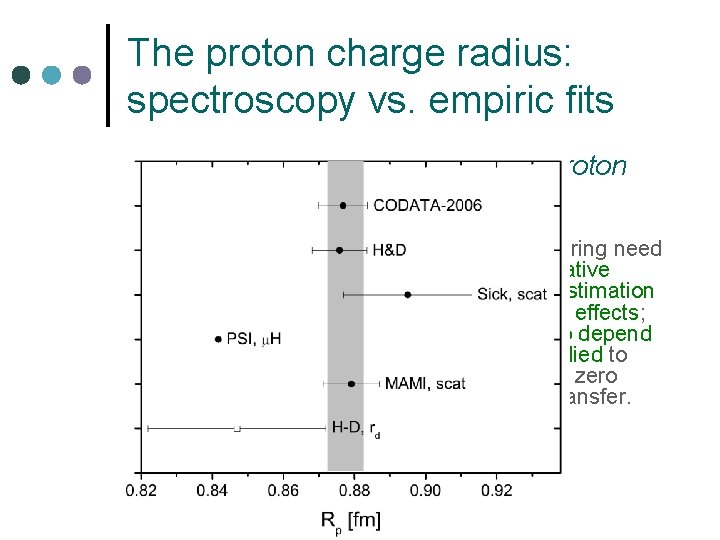
The proton charge radius: spectroscopy vs. empiric fits ¢ ¢ Spectroscopy of hydrogen (and deuterium) The Lamb shift in muonic hydrogen Spectroscopy produces a model-independent result, but involves a lot of theory and/or a bit of modeling. ¢ Electron-proton scattering Studies of scattering need theory of radiative corrections, estimation of two-photon effects; the result is to depend on model applied to extrapolate to zero momentum transfer.
The proton charge radius: spectroscopy vs. empiric fits ¢ ¢ Spectroscopy of hydrogen (and deuterium) The Lamb shift in muonic hydrogen Spectroscopy produces a model-independent result, but involves a lot of theory and/or a bit of modeling. ¢ Electron-proton scattering Studies of scattering need theory of radiative corrections, estimation of two-photon effects; the result is to depend on model applied to extrapolate to zero momentum transfer.
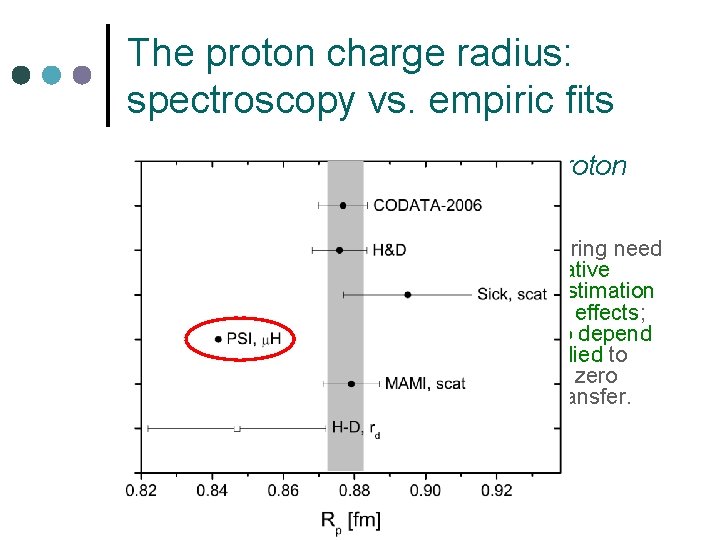
The proton charge radius: spectroscopy vs. empiric fits ¢ ¢ Spectroscopy of hydrogen (and deuterium) The Lamb shift in muonic hydrogen Spectroscopy produces a model-independent result, but involves a lot of theory and/or a bit of modeling. ¢ Electron-proton scattering Studies of scattering need theory of radiative corrections, estimation of two-photon effects; the result is to depend on model applied to extrapolate to zero momentum transfer.
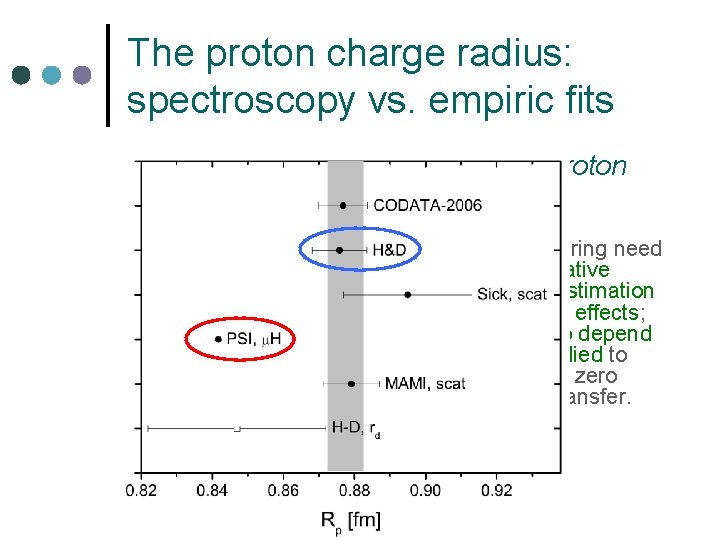
The proton charge radius: spectroscopy vs. empiric fits ¢ ¢ Spectroscopy of hydrogen (and deuterium) The Lamb shift in muonic hydrogen Spectroscopy produces a model-independent result, but involves a lot of theory and/or a bit of modeling. ¢ Electron-proton scattering Studies of scattering need theory of radiative corrections, estimation of two-photon effects; the result is to depend on model applied to extrapolate to zero momentum transfer.
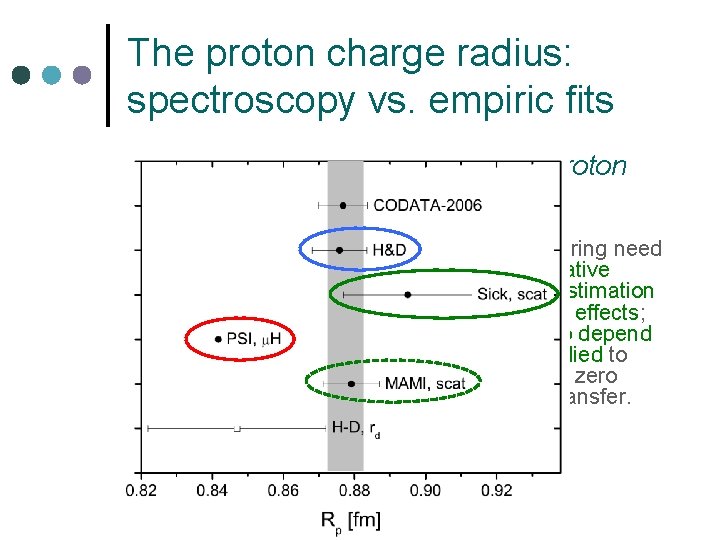
The proton charge radius: spectroscopy vs. empiric fits ¢ ¢ Spectroscopy of hydrogen (and deuterium) The Lamb shift in muonic hydrogen Spectroscopy produces a model-independent result, but involves a lot of theory and/or a bit of modeling. ¢ Electron-proton scattering Studies of scattering need theory of radiative corrections, estimation of two-photon effects; the result is to depend on model applied to extrapolate to zero momentum transfer.
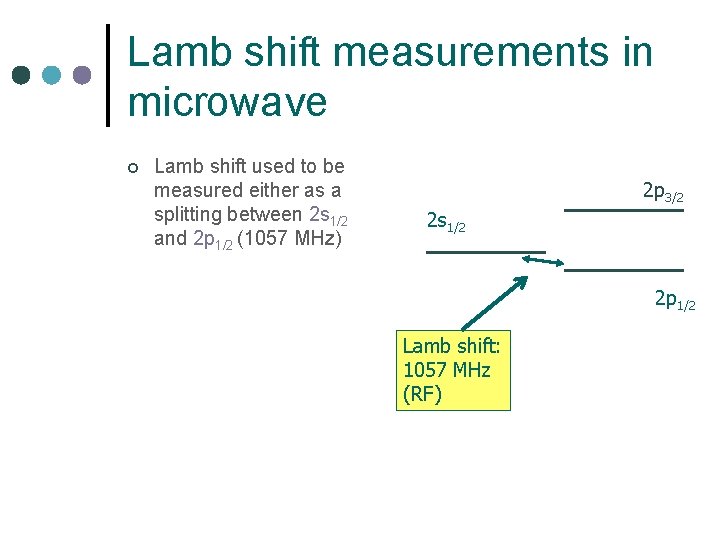
Lamb shift measurements in microwave ¢ Lamb shift used to be measured either as a splitting between 2 s 1/2 and 2 p 1/2 (1057 MHz) 2 p 3/2 2 s 1/2 2 p 1/2 Lamb shift: 1057 MHz (RF)

Lamb shift measurements in microwave ¢ Lamb shift used to be measured either as a splitting between 2 s 1/2 and 2 p 1/2 (1057 MHz) or a big contribution into the fine splitting 2 p 3/2 – 2 s 1/2 11 THz (fine structure). 2 p 3/2 2 s 1/2 2 p 1/2 Fine structure: 11 050 MHz (RF)
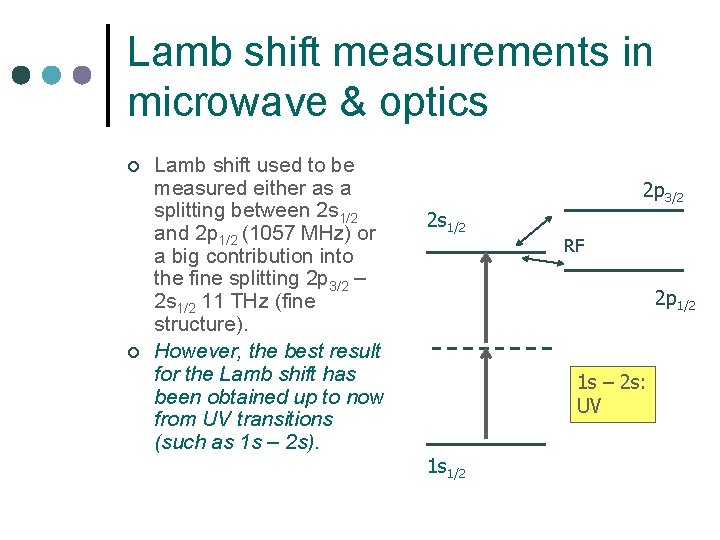
Lamb shift measurements in microwave & optics ¢ ¢ Lamb shift used to be measured either as a splitting between 2 s 1/2 and 2 p 1/2 (1057 MHz) or a big contribution into the fine splitting 2 p 3/2 – 2 s 1/2 11 THz (fine structure). However, the best result for the Lamb shift has been obtained up to now from UV transitions (such as 1 s – 2 s). 2 p 3/2 2 s 1/2 RF 2 p 1/2 1 s – 2 s: UV 1 s 1/2
Spectroscopy of hydrogen (and deuterium) Two-photon spectroscopy involves a number of levels strongly affected by QED. In “old good time” we had to deal only with 2 s Lamb shift. Theory for p states is simple since their wave functions vanish at r=0. Now we have more data and more unknown variables.
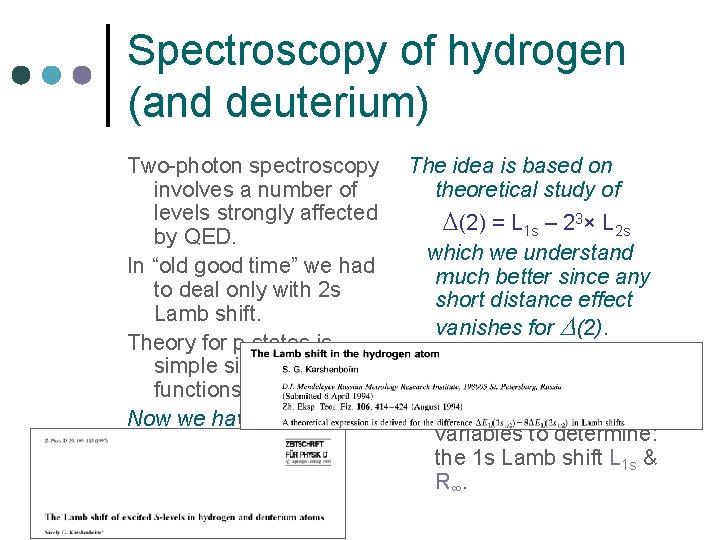
Spectroscopy of hydrogen (and deuterium) Two-photon spectroscopy involves a number of levels strongly affected by QED. In “old good time” we had to deal only with 2 s Lamb shift. Theory for p states is simple since their wave functions vanish at r=0. Now we have more data and more unknown variables. The idea is based on theoretical study of D(2) = L 1 s – 23× L 2 s which we understand much better since any short distance effect vanishes for D(2). Theory of p and d states is also simple. That leaves only two variables to determine: the 1 s Lamb shift L 1 s & R∞.
Spectroscopy of hydrogen (and deuterium) Two-photon spectroscopy involves a number of levels strongly affected by QED. In “old good time” we had to deal only with 2 s Lamb shift. Theory for p states is simple since their wave functions vanish at r=0. Now we have more data and more unknown variables. The idea is based on theoretical study of D(2) = L 1 s – 23× L 2 s which we understand much better since any short distance effect vanishes for D(2). Theory of p and d states is also simple. That leaves only two variables to determine: the 1 s Lamb shift L 1 s & R∞.
Lamb shift (2 s 1/2 – 2 p 1/2) in the hydrogen atom Uncertainties: There are data on a number of ¢ Experiment: 2 ppm transitions, but ¢ QED: < 1 ppm most of their ¢ Proton size: ~ 2 measurements are ppm (with Rp from e correlated. -p scattering)
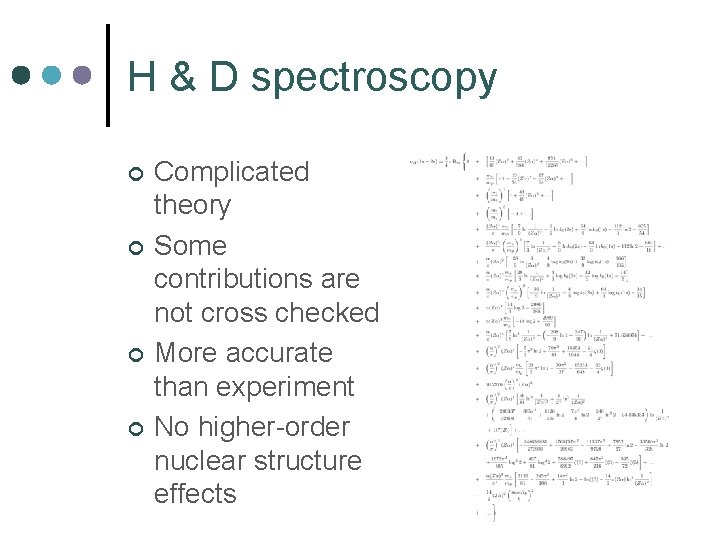
H & D spectroscopy ¢ ¢ Complicated theory Some contributions are not cross checked More accurate than experiment No higher-order nuclear structure effects
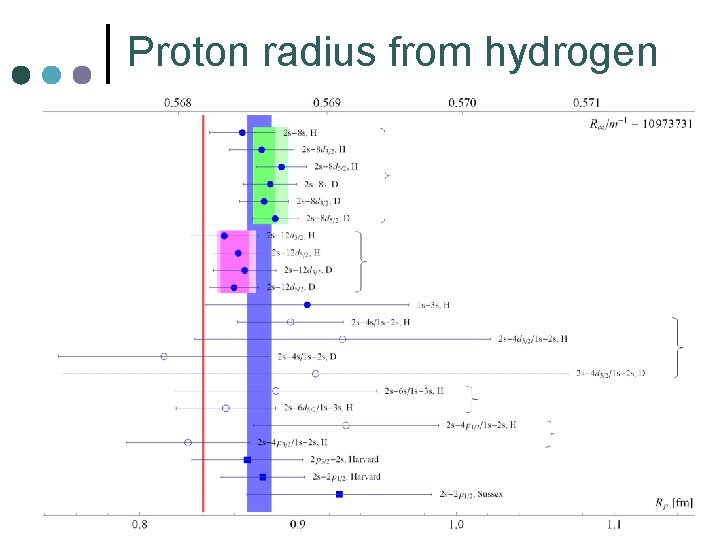
Proton radius from hydrogen
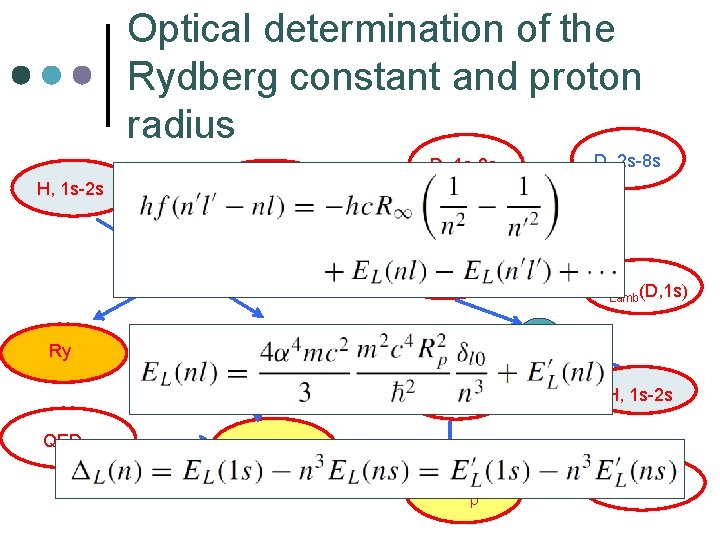
Optical determination of the Rydberg constant and proton radius H, 1 s-2 s H, 2 s-8 s D, 1 s-2 s Ry Ry ELamb(D, 1 s) ELamb(H, 1 s) QED D, 2 s-8 s H, 1 s-2 s Rp Rp QED
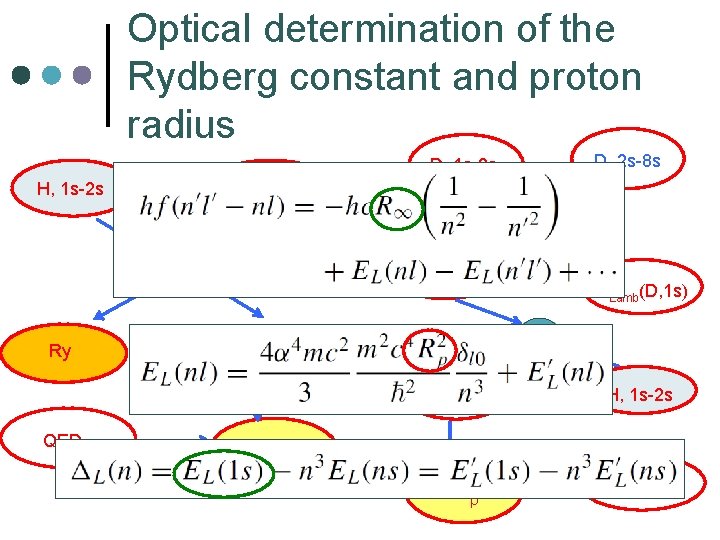
Optical determination of the Rydberg constant and proton radius H, 1 s-2 s H, 2 s-8 s D, 1 s-2 s Ry Ry ELamb(D, 1 s) ELamb(H, 1 s) QED D, 2 s-8 s H, 1 s-2 s Rp Rp QED
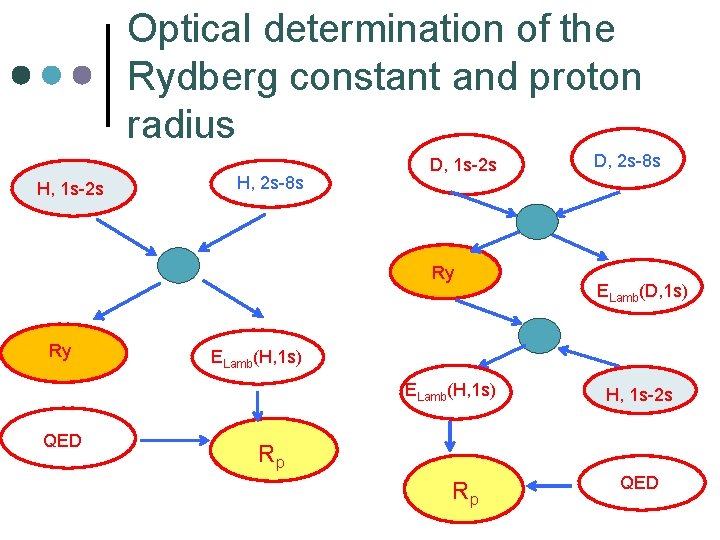
Optical determination of the Rydberg constant and proton radius H, 1 s-2 s H, 2 s-8 s D, 1 s-2 s Ry Ry ELamb(D, 1 s) ELamb(H, 1 s) QED D, 2 s-8 s H, 1 s-2 s Rp Rp QED
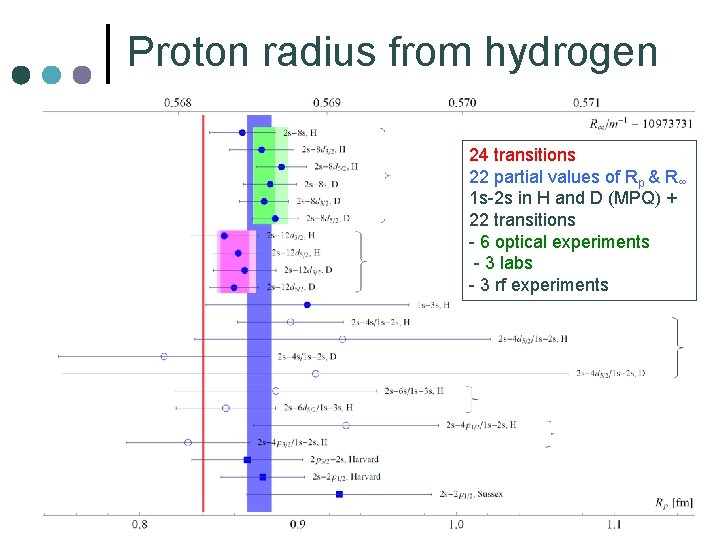
Proton radius from hydrogen 24 transitions 22 partial values of Rp & R∞ 1 s-2 s in H and D (MPQ) + 22 transitions - 6 optical experiments - 3 labs - 3 rf experiments
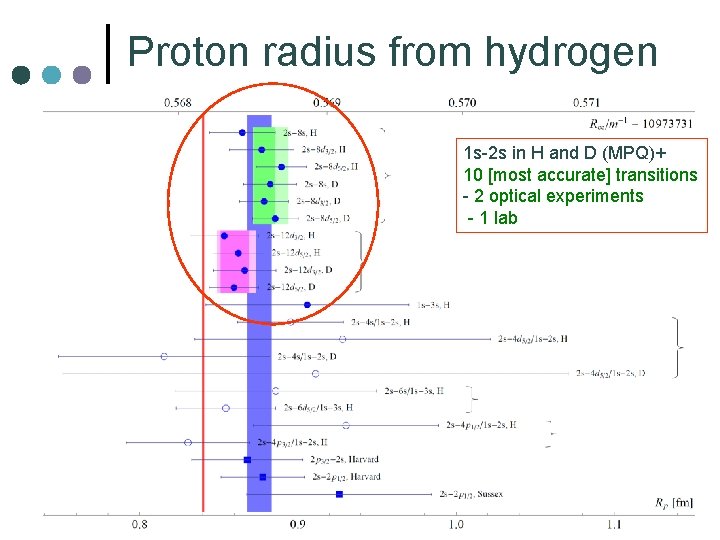
Proton radius from hydrogen 1 s-2 s in H and D (MPQ)+ 10 [most accurate] transitions - 2 optical experiments - 1 lab
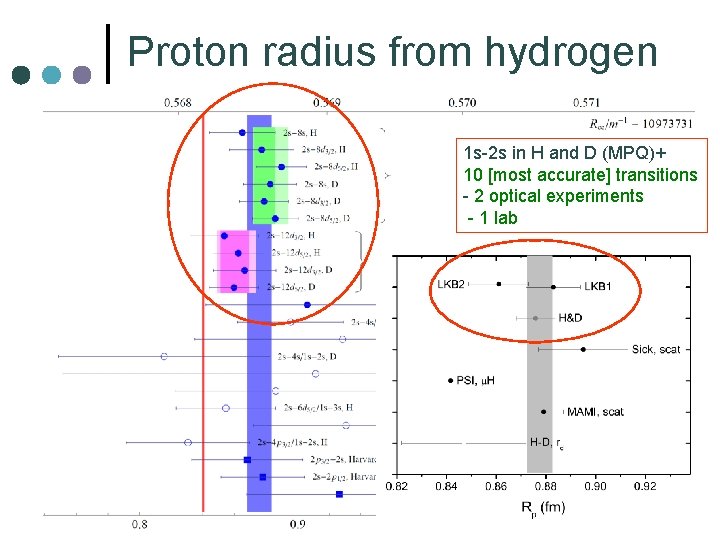
Proton radius from hydrogen 1 s-2 s in H and D (MPQ)+ 10 [most accurate] transitions - 2 optical experiments - 1 lab
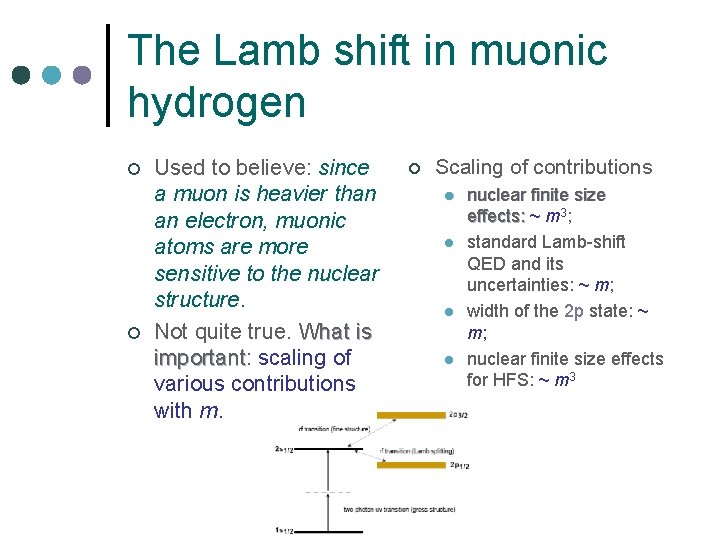
The Lamb shift in muonic hydrogen ¢ ¢ Used to believe: since a muon is heavier than an electron, muonic atoms are more sensitive to the nuclear structure. Not quite true. What is important: important scaling of various contributions with m. ¢ Scaling of contributions l l nuclear finite size effects: ~ m 3; standard Lamb-shift QED and its uncertainties: ~ m; width of the 2 p state: ~ m; nuclear finite size effects for HFS: ~ m 3
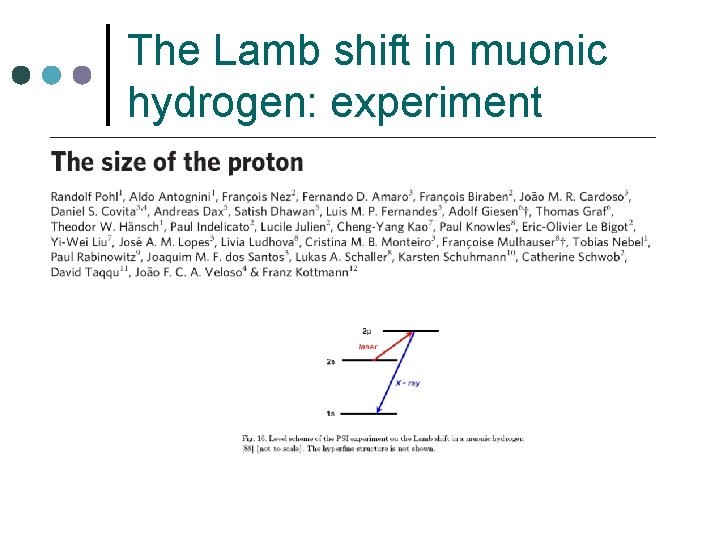
The Lamb shift in muonic hydrogen: experiment
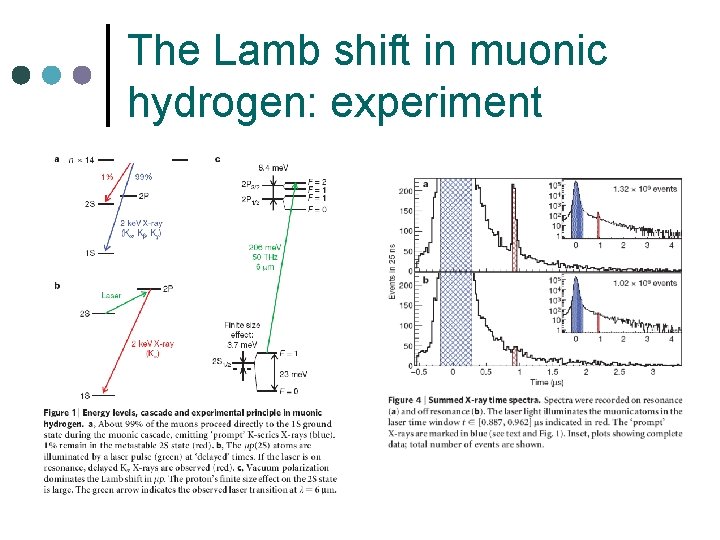
The Lamb shift in muonic hydrogen: experiment
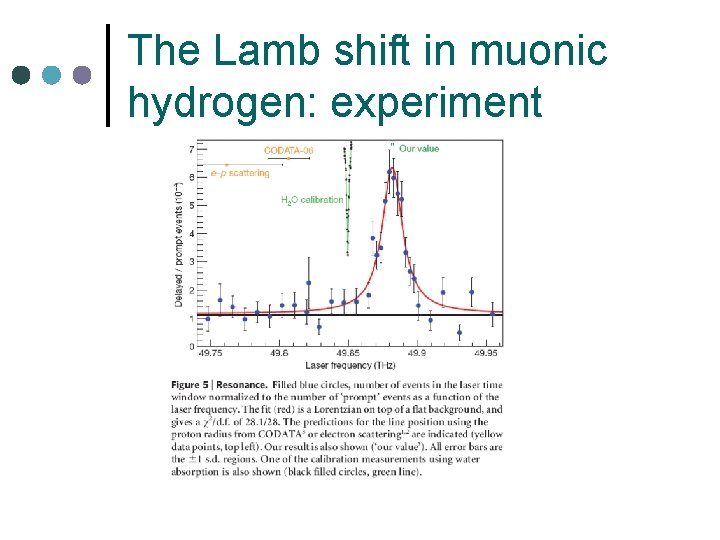
The Lamb shift in muonic hydrogen: experiment
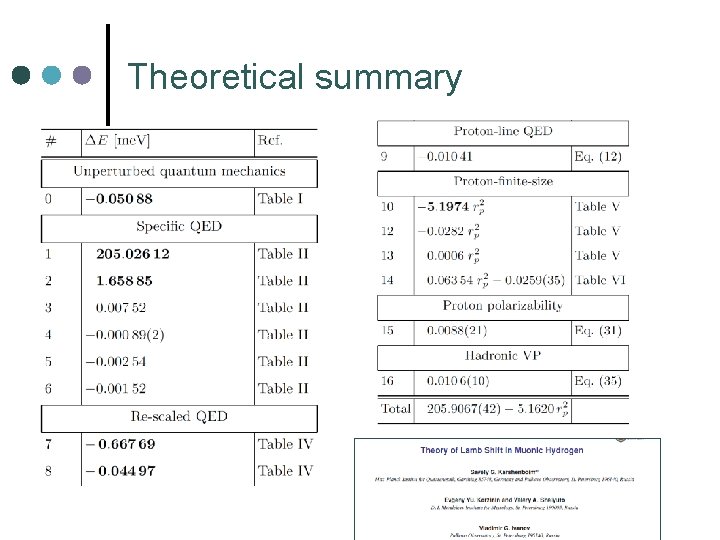
Theoretical summary
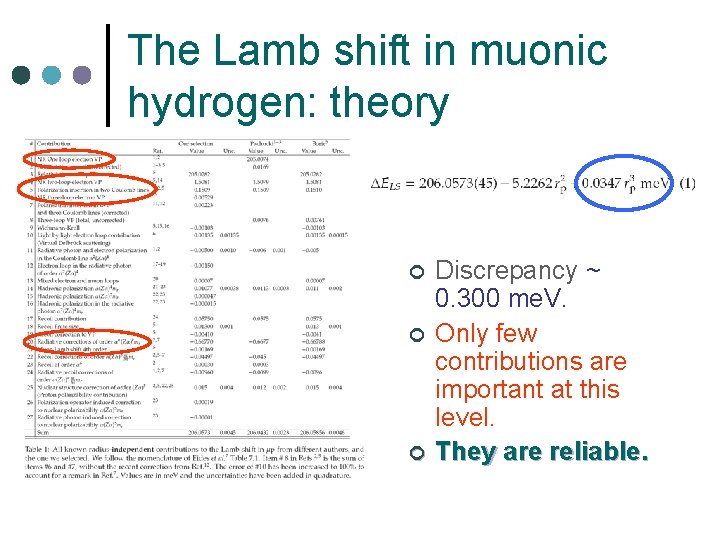
The Lamb shift in muonic hydrogen: theory ¢ ¢ ¢ Discrepancy ~ 0. 300 me. V. Only few contributions are important at this level. They are reliable.
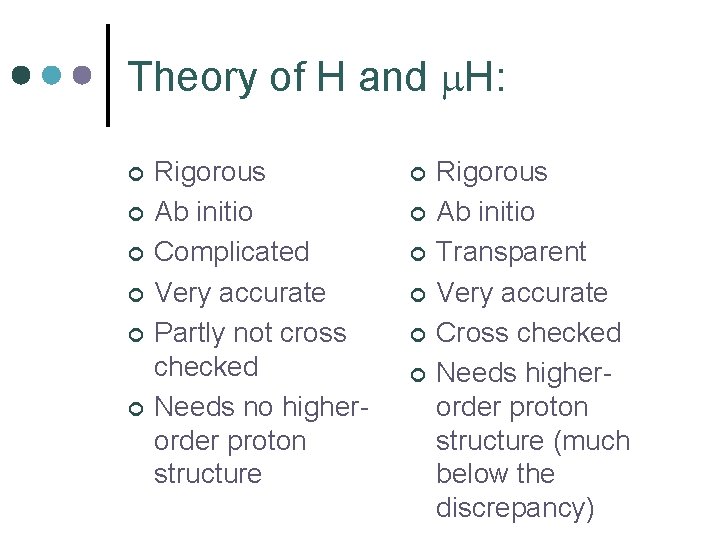
Theory of H and m. H: ¢ ¢ ¢ Rigorous Ab initio Complicated Very accurate Partly not cross checked Needs no higherorder proton structure ¢ ¢ ¢ Rigorous Ab initio Transparent Very accurate Cross checked Needs higherorder proton structure (much below the discrepancy)
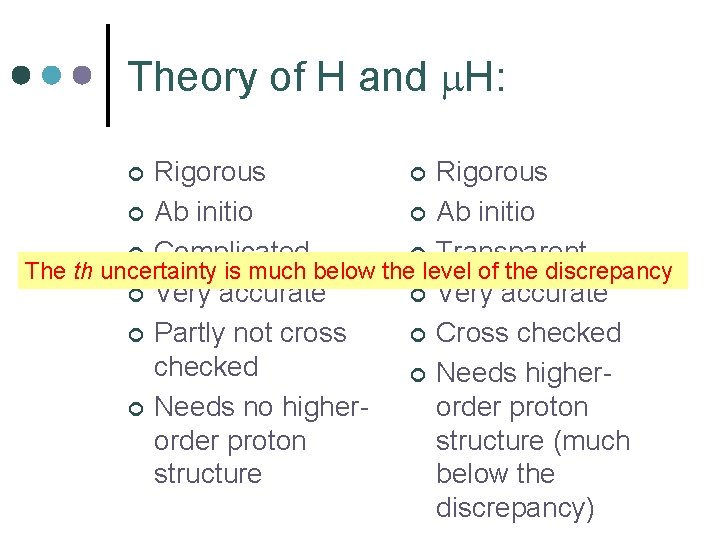
Theory of H and m. H: Rigorous ¢ Ab initio ¢ Complicated ¢ Transparent The th uncertainty is much below the level of the discrepancy ¢ Very accurate ¢ Partly not cross ¢ Cross checked ¢ Needs higher¢ Needs no higherorder proton structure (much structure below the discrepancy) ¢
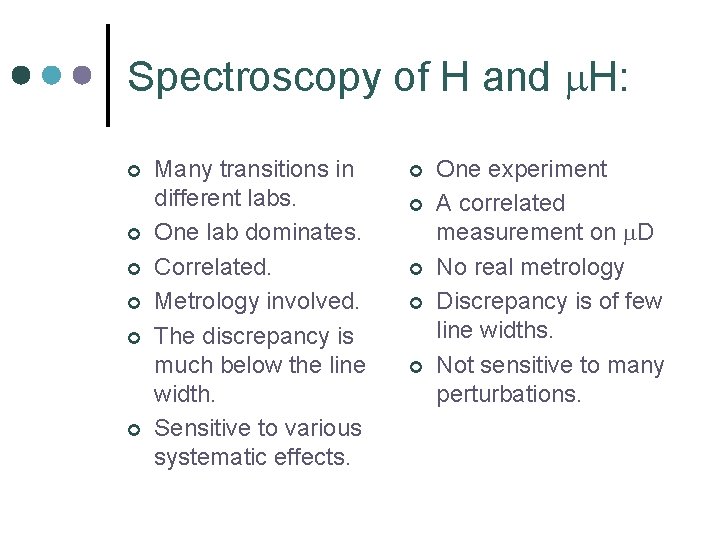
Spectroscopy of H and m. H: ¢ ¢ ¢ Many transitions in different labs. One lab dominates. Correlated. Metrology involved. The discrepancy is much below the line width. Sensitive to various systematic effects. ¢ ¢ ¢ One experiment A correlated measurement on m. D No real metrology Discrepancy is of few line widths. Not sensitive to many perturbations.
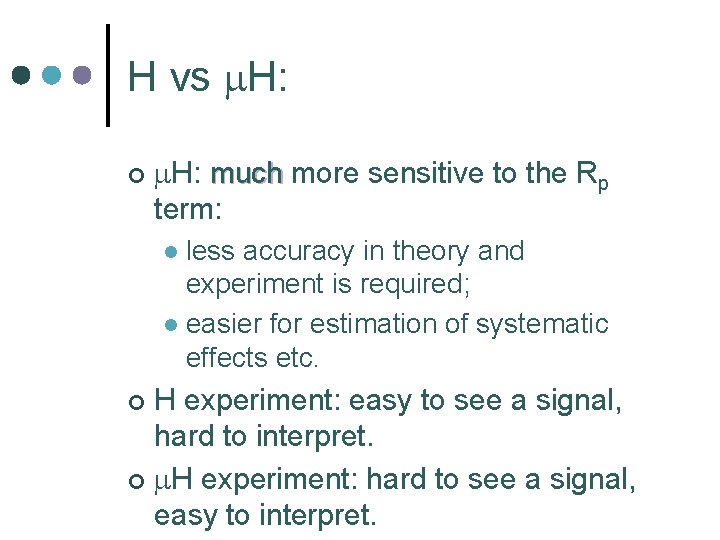
H vs m. H: ¢ m. H: much more sensitive to the Rp term: less accuracy in theory and experiment is required; l easier for estimation of systematic effects etc. l H experiment: easy to see a signal, hard to interpret. ¢ m. H experiment: hard to see a signal, easy to interpret. ¢
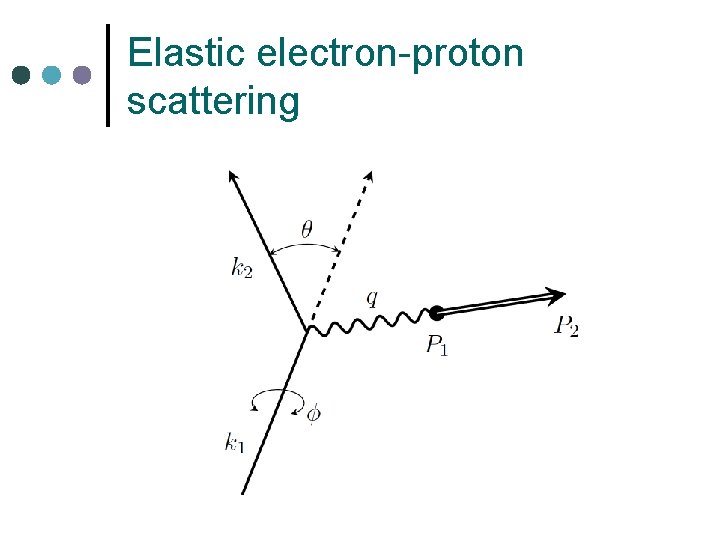
Elastic electron-proton scattering
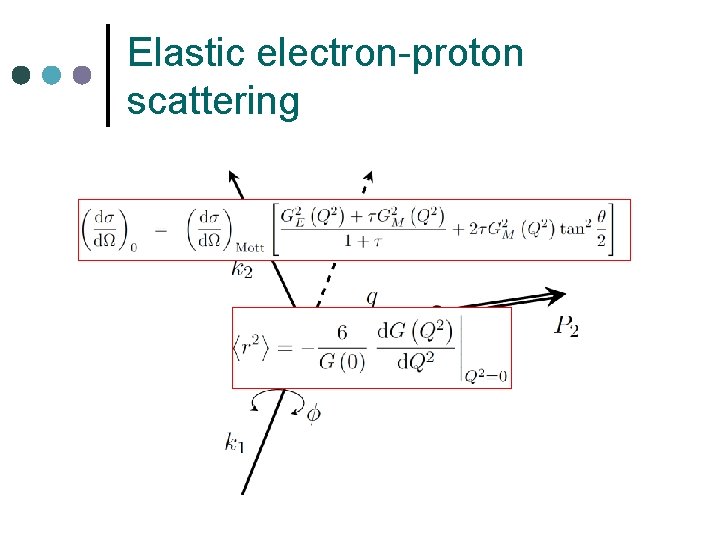
Elastic electron-proton scattering
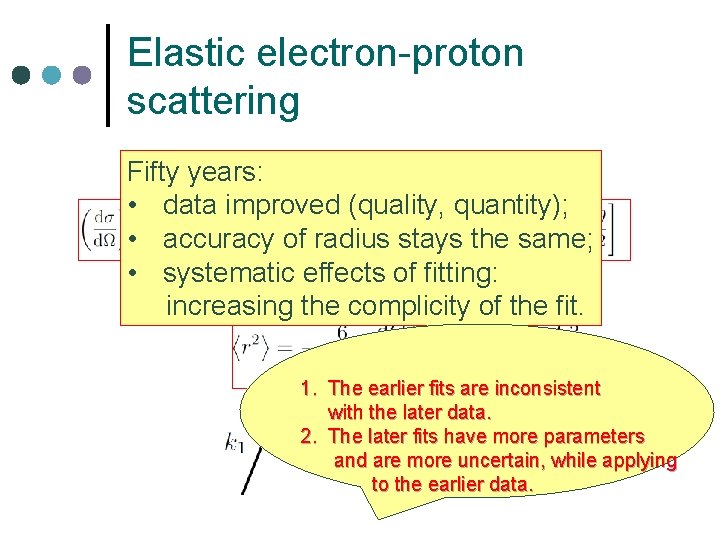
Elastic electron-proton scattering Fifty years: • data improved (quality, quantity); • accuracy of radius stays the same; • systematic effects of fitting: increasing the complicity of the fit. 1. The earlier fits are inconsistent with the later data. 2. The later fits have more parameters and are more uncertain, while applying to the earlier data.
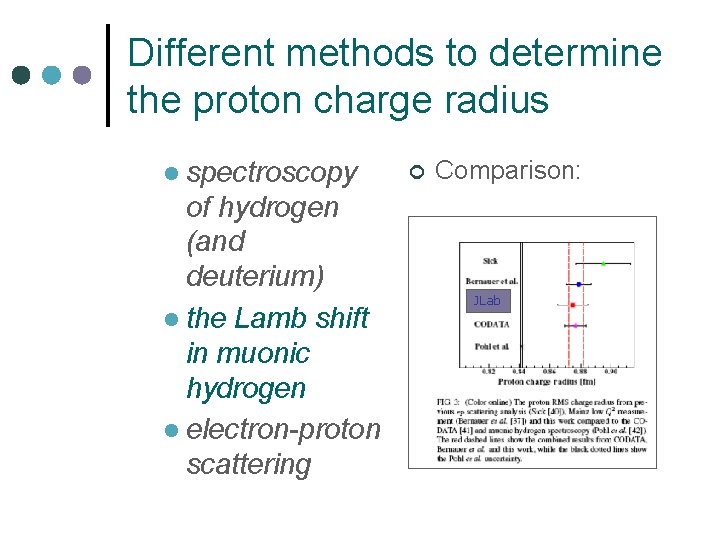
Different methods to determine the proton charge radius l spectroscopy of hydrogen (and deuterium) l the Lamb shift in muonic hydrogen l electron-proton scattering ¢ Comparison: JLab
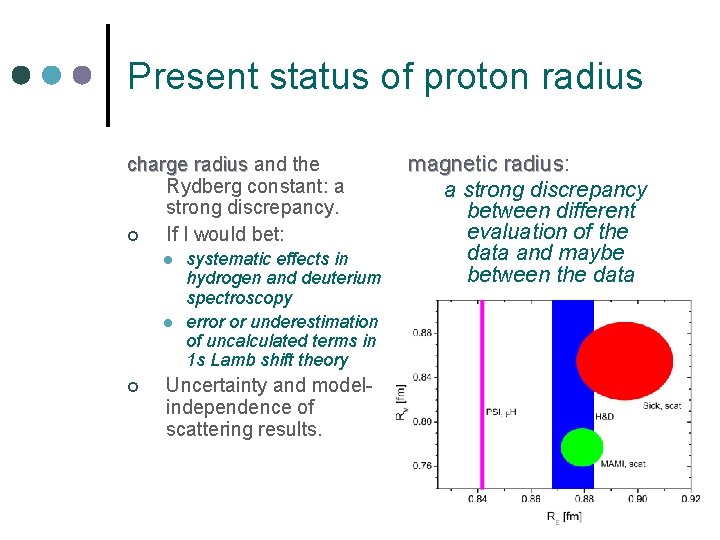
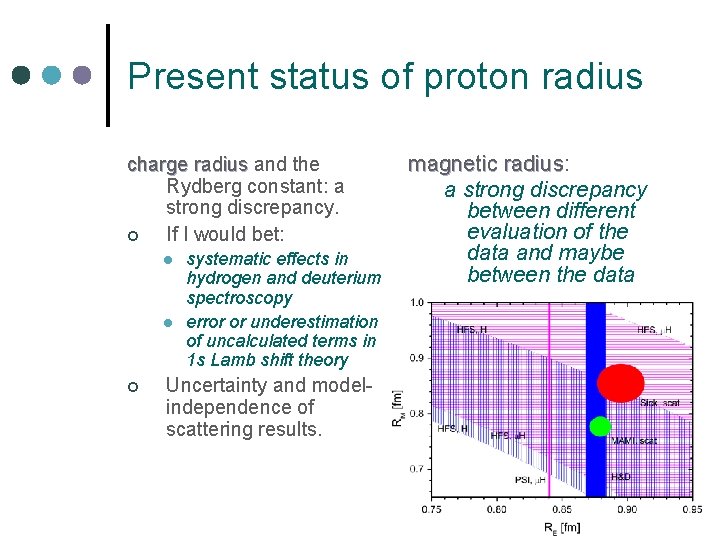
Present status of proton radius charge radius and the Rydberg constant: a strong discrepancy. ¢ If I would bet: l l ¢ systematic effects in hydrogen and deuterium spectroscopy error or underestimation of uncalculated terms in 1 s Lamb shift theory Uncertainty and modelindependence of scattering results. magnetic radius: radius a strong discrepancy between different evaluation of the data and maybe between the data
Present status of proton radius charge radius and the Rydberg constant: a strong discrepancy. ¢ If I would bet: l l ¢ systematic effects in hydrogen and deuterium spectroscopy error or underestimation of uncalculated terms in 1 s Lamb shift theory Uncertainty and modelindependence of scattering results. magnetic radius: radius a strong discrepancy between different evaluation of the data and maybe between the data
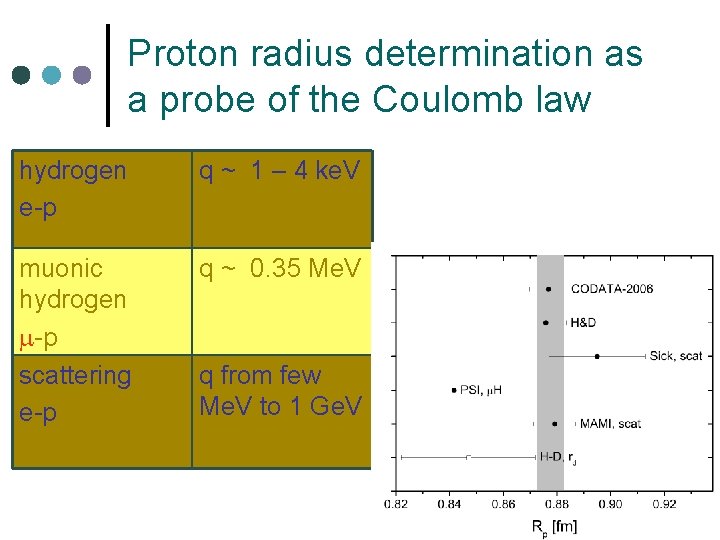
Proton radius determination as a probe of the Coulomb law hydrogen e-p q ~ 1 – 4 ke. V muonic hydrogen m-p scattering e-p q ~ 0. 35 Me. V q from few Me. V to 1 Ge. V
- Slides: 42