
QED 501 Group PBL Presentation Group Members Celeste
QED 501: Group PBL Presentation Group Members: / Celeste Loh Shi Min / Chwa Bee Lian / Eunice Tay Lay Min / Kenny Goh Siau Yang / Sumathi D/O A Krishnan
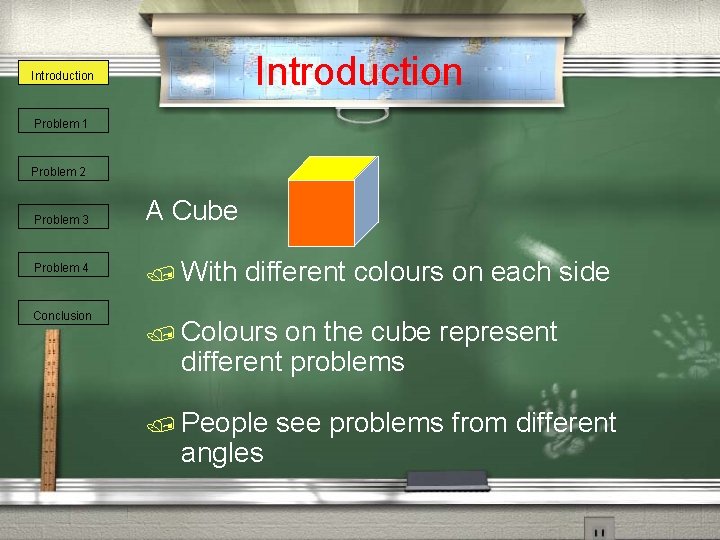
Introduction Problem 1 Problem 2 Problem 3 Problem 4 Conclusion A Cube / With different colours on each side / Colours on the cube represent different problems / People angles see problems from different
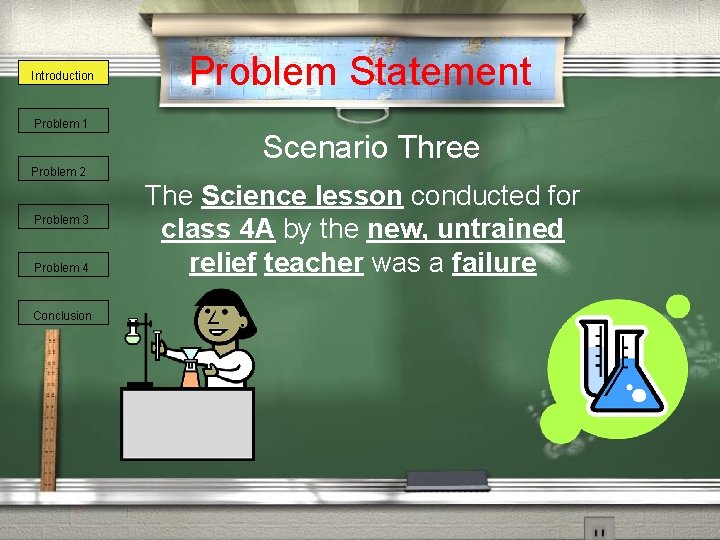
Introduction Problem 1 Problem Statement Scenario Three Problem 2 Problem 3 Problem 4 Conclusion The Science lesson conducted for class 4 A by the new, untrained relief teacher was a failure
Assumptions Introduction Problem 1 Problem 2 Problem 3 Problem 4 Conclusion / No buddy system / Incident happened during the first half of the Science lesson
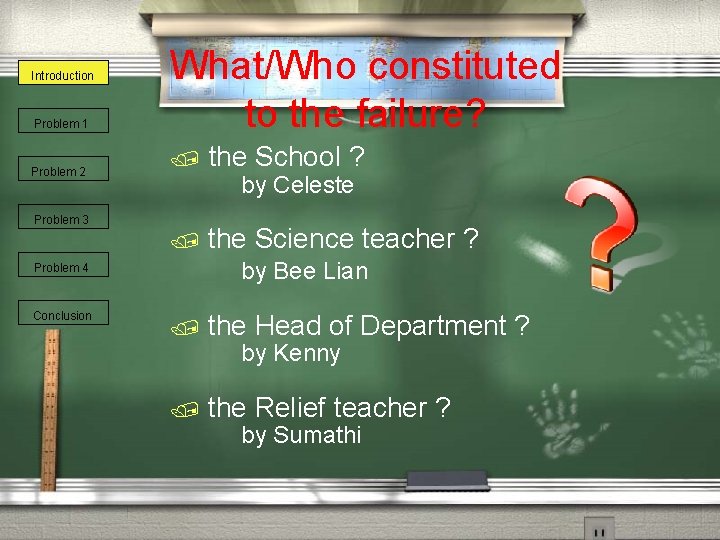
Introduction Problem 1 Problem 2 What/Who constituted to the failure? / by Celeste Problem 3 / the Science teacher ? by Bee Lian Problem 4 Conclusion the School ? / the Head of Department ? by Kenny / the Relief teacher ? by Sumathi
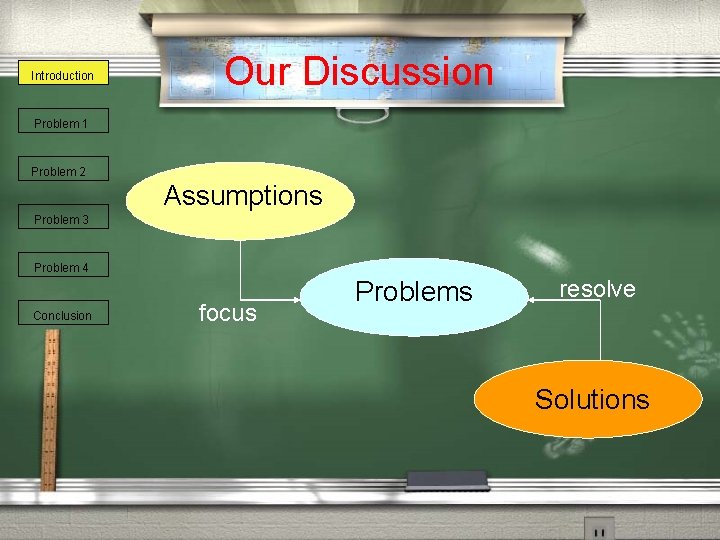
Introduction Our Discussion Problem 1 Problem 2 Assumptions Problem 3 Problem 4 Conclusion focus Problems resolve Solutions
Introduction Conclusion Problem 1 Problem 2 Problem 3 Problem 4 Conclusion / Summary (conclude the presentation) by Sumathi
Introduction Problem 1 Problem 2 Problem 3 Problem 4 Conclusion Problem 1: The School
Introduction Assumption Problem 1 Problem 2 Problem 3 Problem 4 Conclusion / Relief teachers should not be allowed to conduct any lessons in the science laboratories
Problems Introduction Problem 1 Problem 2 / Despite being new and inexperienced, the relief teacher was allowed access to the science laboratory / Poses a threat to the well-being of students Problem 3 Problem 4 Conclusion
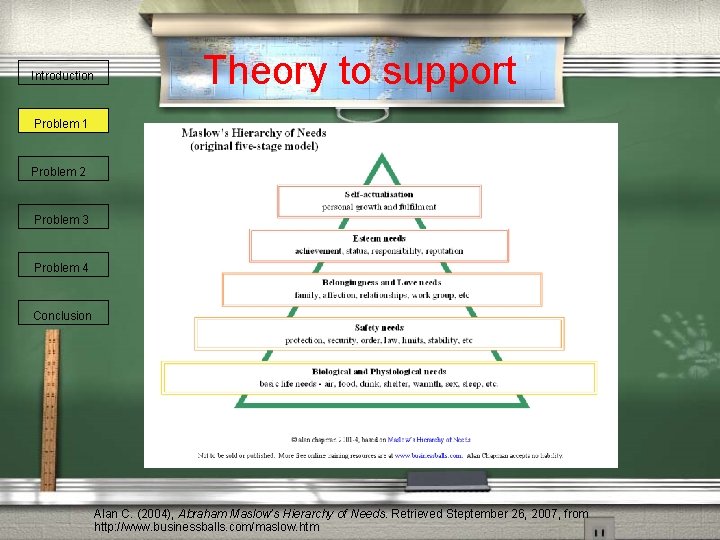
Introduction Theory to support Problem 1 Problem 2 Problem 3 Problem 4 Conclusion Alan C. (2004), Abraham Maslow’s Hierarchy of Needs. Retrieved Steptember 26, 2007, from http: //www. businessballs. com/maslow. htm
Solutions Introduction Problem 1 / The school should have been more stringent in their approval of access to the science laboratories / The relief teacher should have been briefed beforehand that he was not allowed access to the science laboratories / The school could set up security system for the laboratories / Buddy system Problem 2 Problem 3 Problem 4 Conclusion
Introduction Problem 1 Problem 2 Problem 3 Problem 4 Conclusion Problem 2: The Science teacher who was absent
Assumptions Introduction Problem 1 Problem 2 / The Science teacher would be away for a few days / The HOD was informed in advance / The Science teacher had prepared a lesson plan Problem 3 Problem 4 Conclusion
Problems Introduction Problem 1 Problem 2 / The lesson plan was not a detailed one / The lesson plan was unsuitable for the relief teacher / The relief teacher misunderstood the “Scientific discovery” Problem 3 Problem 4 Conclusion
Theory to support Introduction Problem 1 Problem 2 / The Science teacher has an external locus of control / The Science teacher did not make an effort to prepare an alternative lesson plan / As a result, the lesson was a failure Problem 3 Problem 4 Conclusion
Solutions Introduction Problem 1 Problem 2 Problem 3 Problem 4 Conclusion / There should be a backup plan / Backup plan should be given to the HOD or a buddy teacher before the Science teacher goes on leave
Introduction Problem 1 Problem 2 Problem 3 Problem 4 Conclusion Problem 3: The HOD
Assumptions Introduction Problem 1 Problem 2 Problem 3 Problem 4 Liaises and briefs the relief teacher on: 1. 2. Conclusion 3. Administrative matters and school procedures The lesson plan provided by the Science teacher who was absent Provide support for the relief teacher when he is in doubt
Problems Introduction Problem 1 / Inadequate support and information to the relief teacher to enable him to carry out his class duties effectively / Inappropriate for the relief teacher to be conducting the lesson, without the guidance of a buddy teacher or without further instructions from the HOD Problem 2 Problem 3 Problem 4 Conclusion
Theory to support Introduction Problem 1 / Problem 2 Problem 3 / Problem 4 Conclusion / / Vygotsky’s Zone of Proximal Development HOD may have failed in bridging the gap between what and how much the relief teacher should do in this lesson. HOD had not scaffold the delivery of the lesson plan, as prepared by the teacher (absent) The poor relief teacher was left to make the most of the time given to him
Introduction Problem 1 Problem 2 Problem 3 Problem 4 Conclusion Solutions / Communication: The HOD can arrange for a short meeting with the relief teacher / Scaffolding: The HOD can assign an experienced Science teacher to mentor the relief teacher / Encouragement: The HOD can also provide feedback and offer empathy for the relief teacher in distress
Introduction Problem 1 Problem 2 Problem 3 Problem 4 Conclusion Problem 4: The Relief teacher
Assumptions Introduction Problem 1 Problem 2 Problem 3 Problem 4 / Lesson plan was available / ‘Scientific Discovery’ / 2 periods with recess break in between / Main topic was on Magnets / Lesson was more of an after examination activity Conclusion
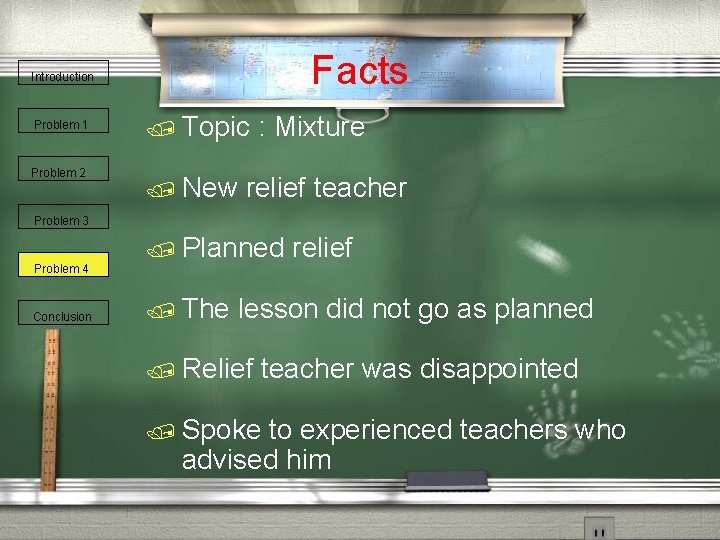
Facts Introduction Problem 1 Problem 2 / Topic / New : Mixture relief teacher Problem 3 Problem 4 Conclusion / Planned / The relief lesson did not go as planned / Relief teacher was disappointed / Spoke to experienced teachers who advised him
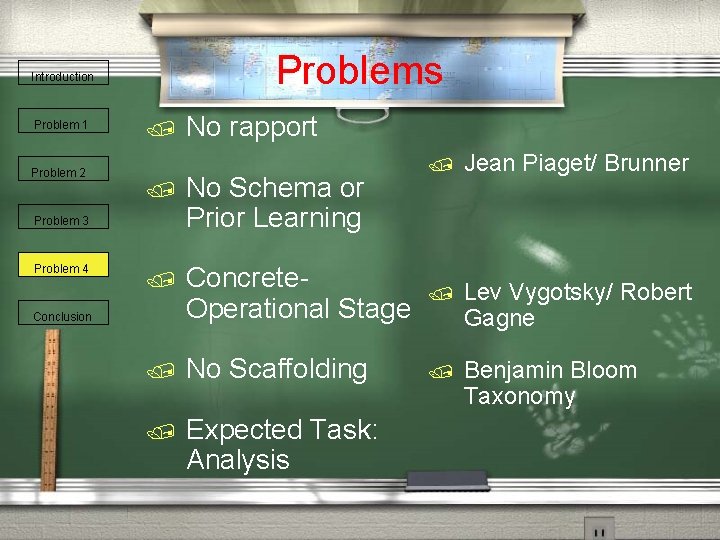
Problems Introduction Problem 1 Problem 2 / / Jean Piaget/ Brunner / No Schema or Prior Learning / Concrete. Operational Stage / Lev Vygotsky/ Robert Gagne / No Scaffolding / Benjamin Bloom Taxonomy / Expected Task: Analysis Problem 3 Problem 4 No rapport Conclusion
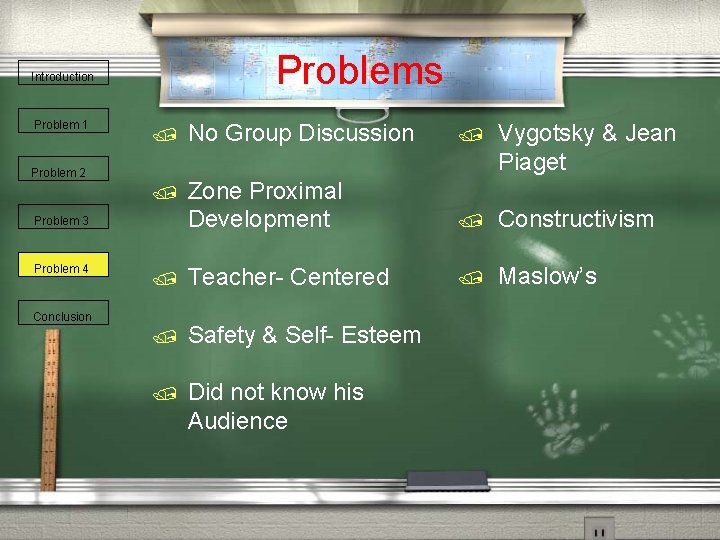
Problems Introduction Problem 1 / No Group Discussion / Vygotsky & Jean Piaget / Zone Proximal Development / Constructivism / Teacher- Centered / Maslow’s / Safety & Self- Esteem / Did not know his Audience Problem 2 Problem 3 Problem 4 Conclusion
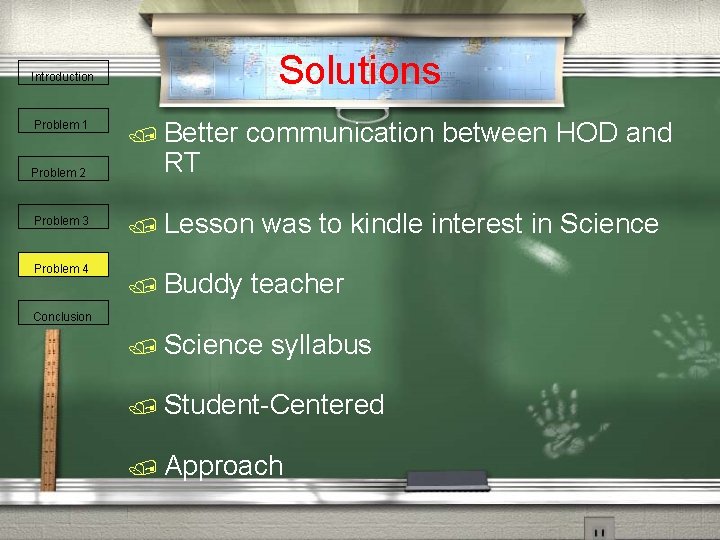
Solutions Introduction Problem 1 Problem 2 Problem 3 Problem 4 / Better RT communication between HOD and / Lesson / Buddy was to kindle interest in Science teacher Conclusion / Science syllabus / Student-Centered / Approach
Solutions : 2 nd Lesson Introduction Problem 1 / Build Rapport (Share something on himself) / Science is not just getting the facts but the process of investigation and learning is crucial / Student-Centered / 5 Es : Engage, Explore, Explain, Extend, Evaluate / Group sharing Problem 2 Problem 3 Problem 4 Conclusion
Summary Introduction / Engage our students especially so in Science / To really impact students during a lesson a teacher could remember CAP Problem 4 / C- Connections by prior knowledge Conclusion / A - Arouse through hand – on/minds-on activities / P - Predict through higher-order questions / Educational System Problem 1 Problem 2 Problem 3
Conclusion Introduction Problem 1 Problem 2 Problem 3 Problem 4 Conclusion / Who is the key person at fault ?
References /Books / Tan, O. S. Parksons, R. D. Hinson, S. L, Sardo. Brown, D. (2003). Educational Psychology: A Practitioner Approach (Asian Edition): Thomas Learning / Peters, J. M. , Stout, D. L. (2006). Science in Elementary Education: methods, concepts and inquiries: Pearson Prentice Hall. / Santrock, J. W. , (2008). Educational Psychology: Mc. Graw-Hill International Edition.
References /Journals / How Children Learn Science /Web Pages / www. businessballs. com; Alan Chapman 2001 -4 /Others / Lecture notes by Dr. Angeline Khoo
- Slides: 33