
QCD at the LHC James Stirling Cambridge University
QCD at the LHC James Stirling Cambridge University • introduction and overview • HO corrections • PDFs • LHC benchmarks • (double parton scattering) • summary apologies for omitting many topics of interest!
1 introduction and overview 2
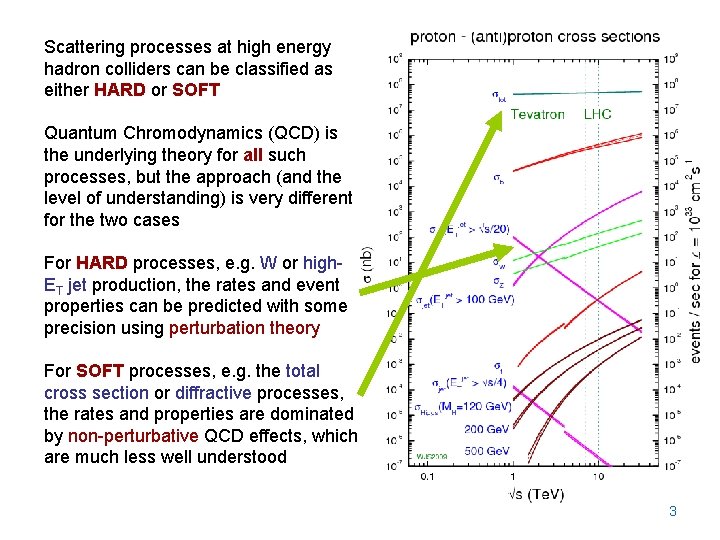
Scattering processes at high energy hadron colliders can be classified as either HARD or SOFT Quantum Chromodynamics (QCD) is the underlying theory for all such processes, but the approach (and the level of understanding) is very different for the two cases For HARD processes, e. g. W or high. ET jet production, the rates and event properties can be predicted with some precision using perturbation theory For SOFT processes, e. g. the total cross section or diffractive processes, the rates and properties are dominated by non-perturbative QCD effects, which are much less well understood 3
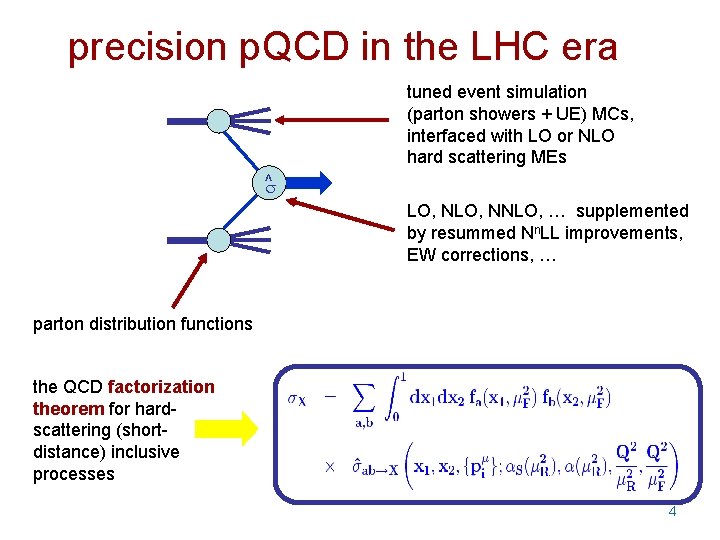
precision p. QCD in the LHC era tuned event simulation (parton showers + UE) MCs, interfaced with LO or NLO hard scattering MEs ^ LO, NNLO, … supplemented by resummed Nn. LL improvements, EW corrections, … parton distribution functions the QCD factorization theorem for hardscattering (shortdistance) inclusive processes 4
precision phenomenology • Benchmarking – inclusive SM quantities (V, jets, top, … ), calculated to the highest precision available (e. g. NNLO) – tools needed: robust jet algorithms, decays included, PDFs, … • Backgrounds e. g. anti-k. T (Cacciari, Salam, Soyez ) – new physics generally results in some combination of multijets, multileptons, missing ET – therefore, we need to know SM cross sections {V, VV, bb, tt, H, …} + jets to high precision `wish lists’ – ratios can be useful Note: V = *, Z, W 5
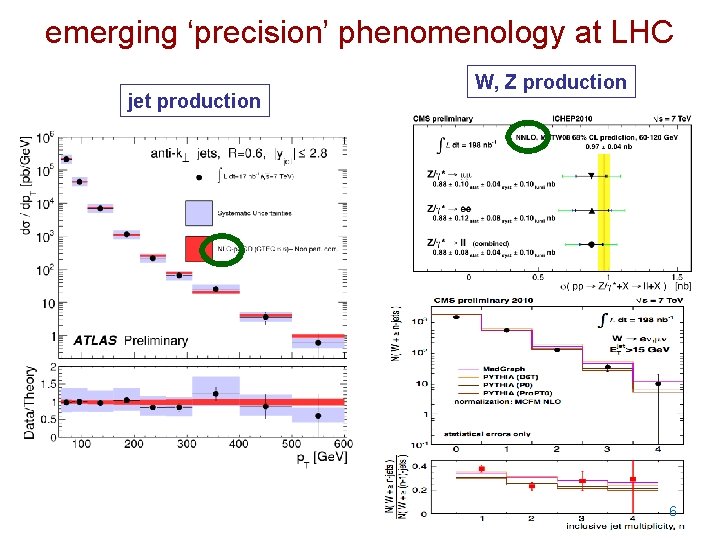
emerging ‘precision’ phenomenology at LHC jet production W, Z production 6
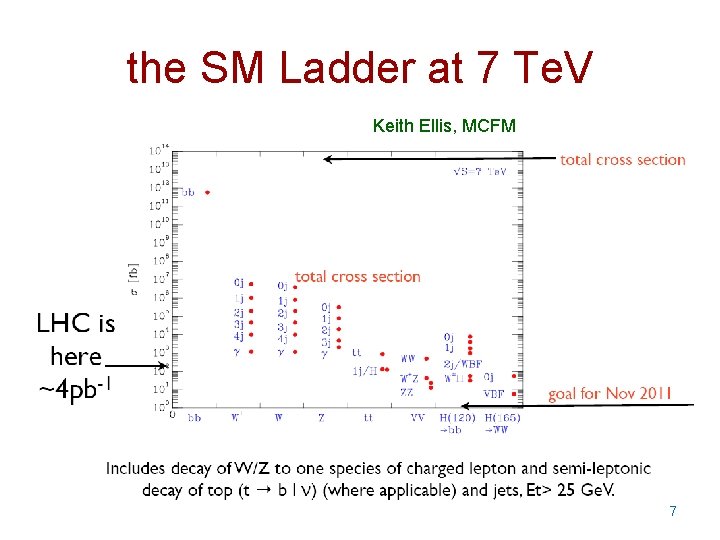
the SM Ladder at 7 Te. V Keith Ellis, MCFM 7
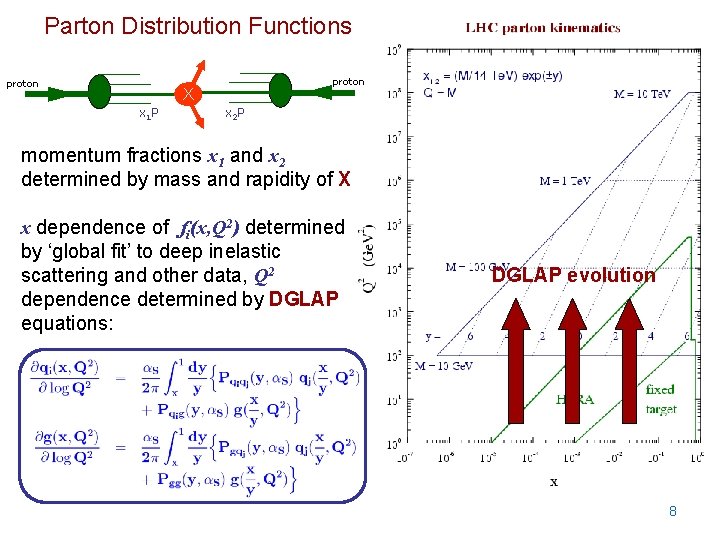
Parton Distribution Functions proton X x 1 P x 2 P momentum fractions x 1 and x 2 determined by mass and rapidity of X x dependence of fi(x, Q 2) determined by ‘global fit’ to deep inelastic scattering and other data, Q 2 dependence determined by DGLAP equations: DGLAP evolution 8
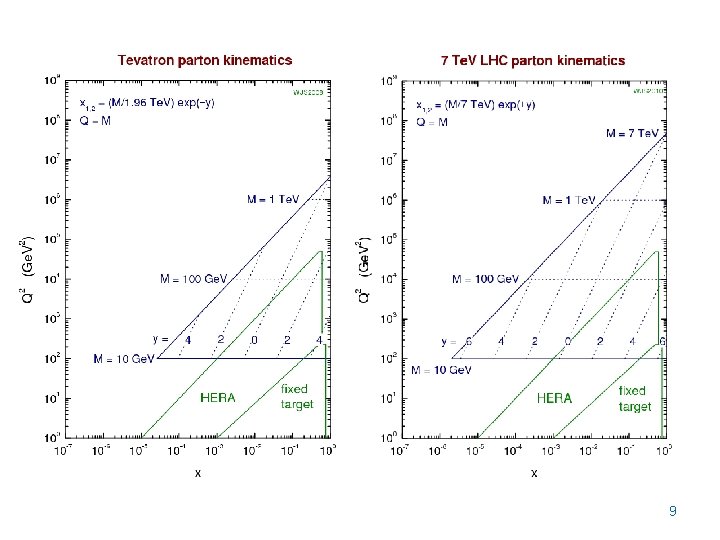
9
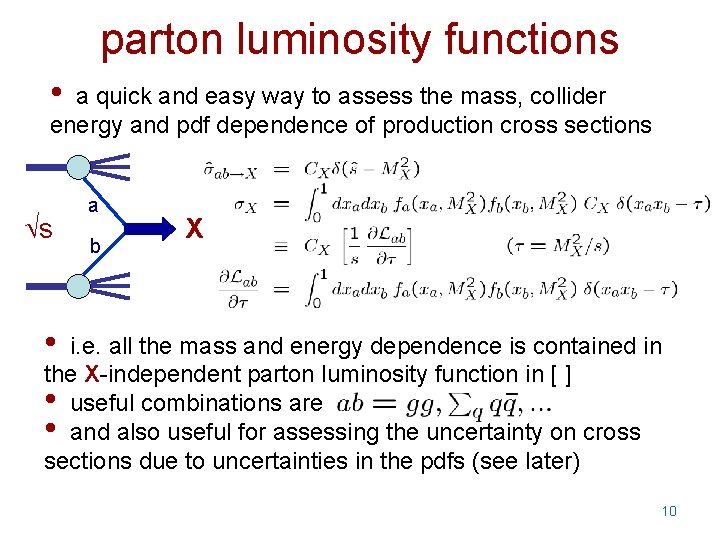
parton luminosity functions • a quick and easy way to assess the mass, collider energy and pdf dependence of production cross sections s a b X • i. e. all the mass and energy dependence is contained in the X-independent parton luminosity function in [ ] • useful combinations are • and also useful for assessing the uncertainty on cross sections due to uncertainties in the pdfs (see later) 10
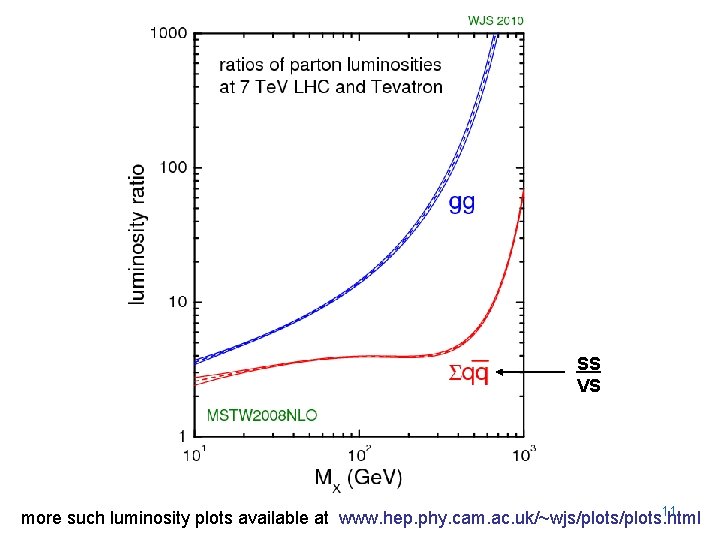
SS VS 11 more such luminosity plots available at www. hep. phy. cam. ac. uk/~wjs/plots. html
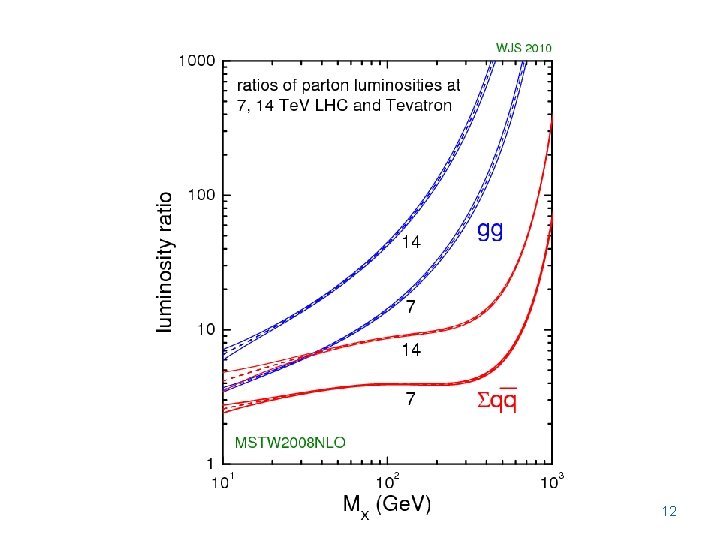
12
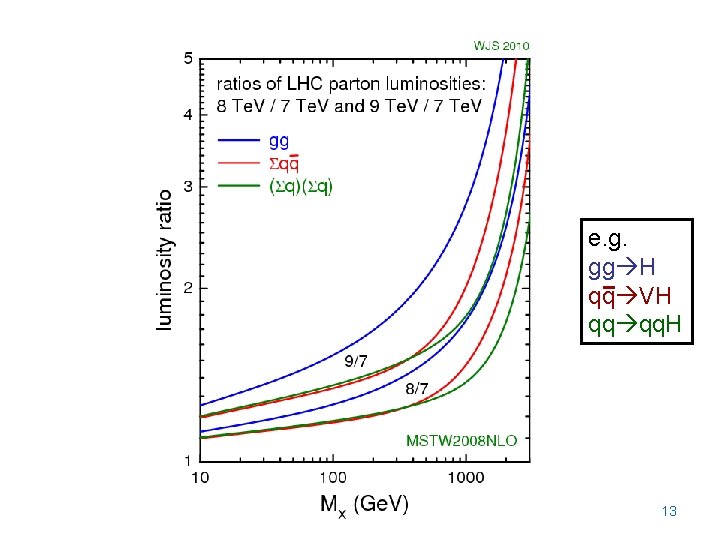
e. g. gg H qq VH qq qq. H 13
2 higher-order perturbative QCD corrections 14
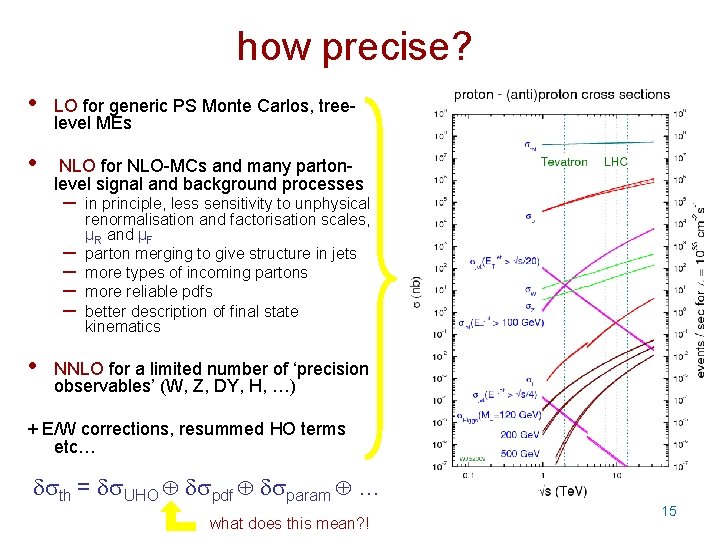
how precise? • LO for generic PS Monte Carlos, treelevel MEs • NLO for NLO-MCs and many partonlevel signal and background processes – – – • in principle, less sensitivity to unphysical renormalisation and factorisation scales, μR and μF parton merging to give structure in jets more types of incoming partons more reliable pdfs better description of final state kinematics NNLO for a limited number of ‘precision observables’ (W, Z, DY, H, …) + E/W corrections, resummed HO terms etc… th = UHO pdf param … what does this mean? ! 15
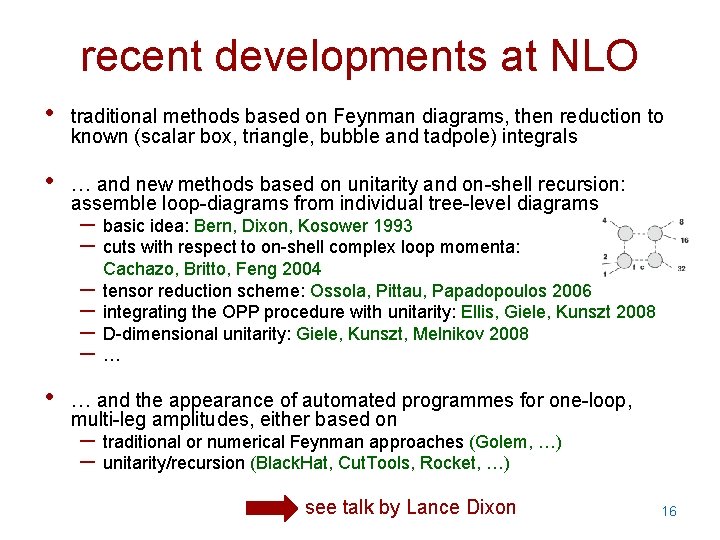
recent developments at NLO • traditional methods based on Feynman diagrams, then reduction to known (scalar box, triangle, bubble and tadpole) integrals • … and new methods based on unitarity and on-shell recursion: assemble loop-diagrams from individual tree-level diagrams – basic idea: Bern, Dixon, Kosower 1993 – cuts with respect to on-shell complex loop momenta: – – • Cachazo, Britto, Feng 2004 tensor reduction scheme: Ossola, Pittau, Papadopoulos 2006 integrating the OPP procedure with unitarity: Ellis, Giele, Kunszt 2008 D-dimensional unitarity: Giele, Kunszt, Melnikov 2008 … … and the appearance of automated programmes for one-loop, multi-leg amplitudes, either based on – traditional or numerical Feynman approaches (Golem, …) – unitarity/recursion (Black. Hat, Cut. Tools, Rocket, …) see talk by Lance Dixon 16
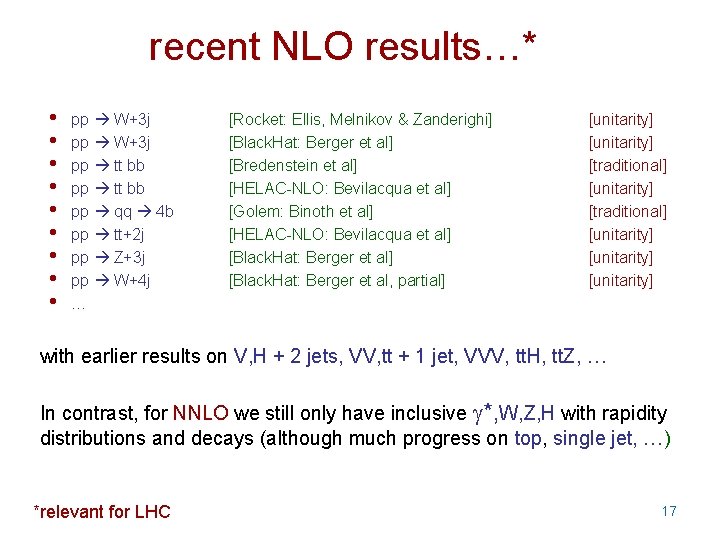
recent NLO results…* • • • pp W+3 j pp tt bb pp qq 4 b pp tt+2 j pp Z+3 j pp W+4 j … [Rocket: Ellis, Melnikov & Zanderighi] [Black. Hat: Berger et al] [Bredenstein et al] [HELAC-NLO: Bevilacqua et al] [Golem: Binoth et al] [HELAC-NLO: Bevilacqua et al] [Black. Hat: Berger et al, partial] [unitarity] [traditional] [unitarity] with earlier results on V, H + 2 jets, VV, tt + 1 jet, VVV, tt. H, tt. Z, … In contrast, for NNLO we still only have inclusive *, W, Z, H with rapidity distributions and decays (although much progress on top, single jet, …) *relevant for LHC 17
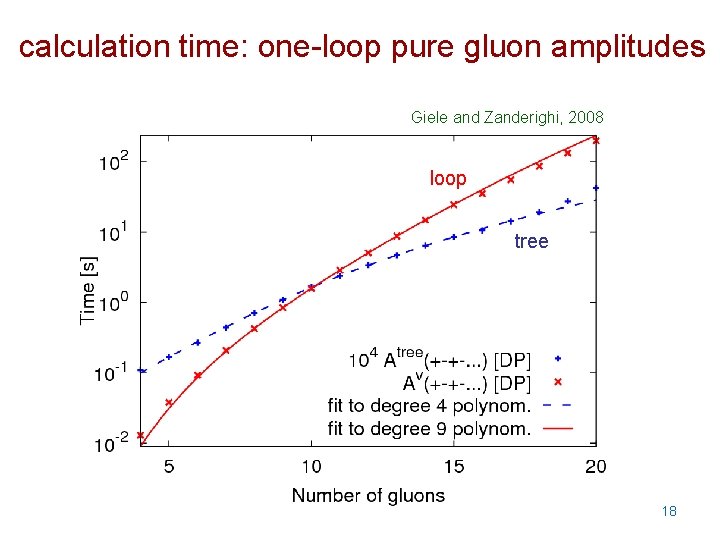
calculation time: one-loop pure gluon amplitudes Giele and Zanderighi, 2008 loop tree 18
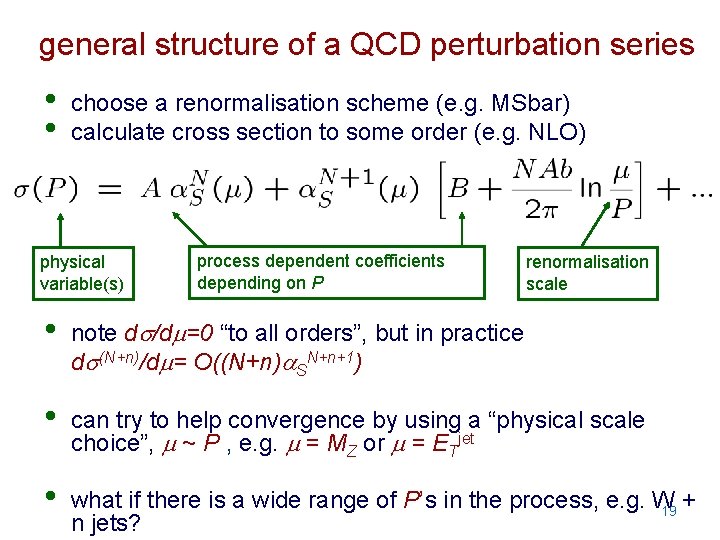
general structure of a QCD perturbation series • • choose a renormalisation scheme (e. g. MSbar) calculate cross section to some order (e. g. NLO) physical variable(s) process dependent coefficients depending on P renormalisation scale • note d /d =0 “to all orders”, but in practice d (N+n)/d = O((N+n) SN+n+1) • can try to help convergence by using a “physical scale choice”, ~ P , e. g. = MZ or = ETjet • what if there is a wide range of P’s in the process, e. g. W + 19 n jets?
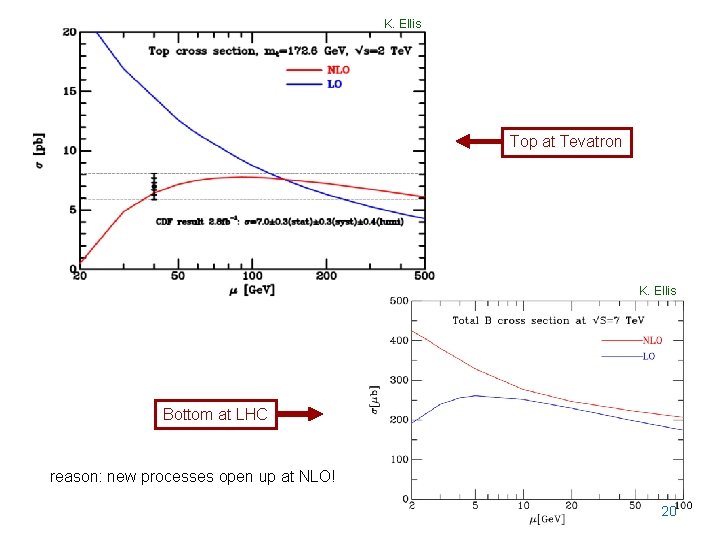
K. Ellis Top at Tevatron K. Ellis Bottom at LHC reason: new processes open up at NLO! 20
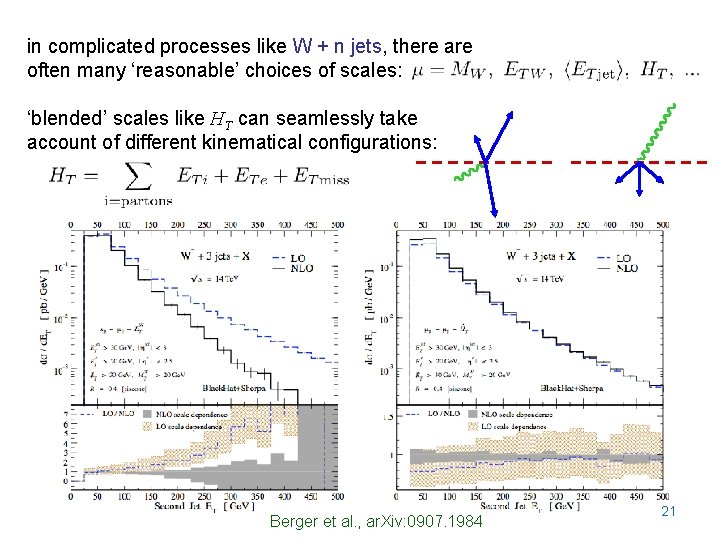
in complicated processes like W + n jets, there are often many ‘reasonable’ choices of scales: ‘blended’ scales like HT can seamlessly take account of different kinematical configurations: Berger et al. , ar. Xiv: 0907. 1984 21
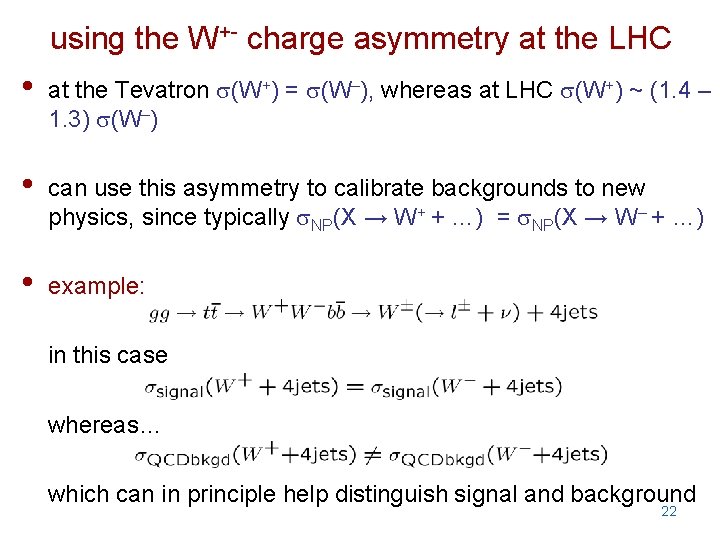
using the W+- charge asymmetry at the LHC • at the Tevatron (W+) = (W–), whereas at LHC (W+) ~ (1. 4 – 1. 3) (W–) • can use this asymmetry to calibrate backgrounds to new physics, since typically NP(X → W+ + …) = NP(X → W– + …) • example: in this case whereas… which can in principle help distinguish signal and background 22
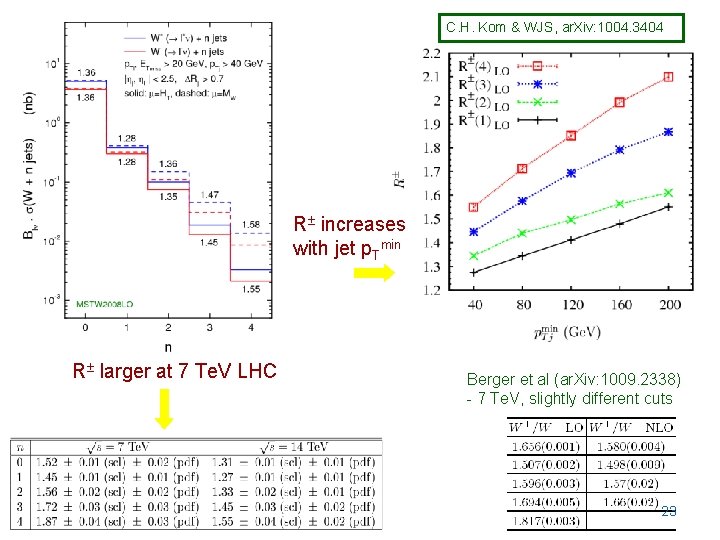
C. H. Kom & WJS, ar. Xiv: 1004. 3404 R increases with jet p. Tmin R larger at 7 Te. V LHC Berger et al (ar. Xiv: 1009. 2338) - 7 Te. V, slightly different cuts 23
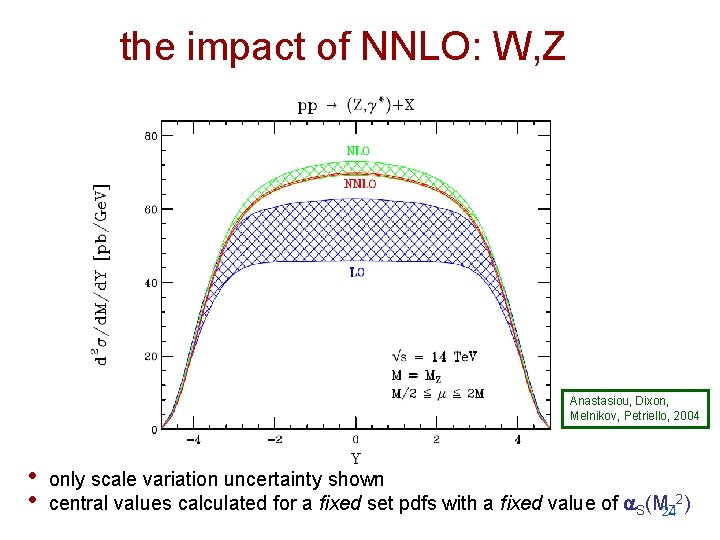
the impact of NNLO: W, Z Anastasiou, Dixon, Melnikov, Petriello, 2004 • • only scale variation uncertainty shown central values calculated for a fixed set pdfs with a fixed value of S(M 24 Z 2)
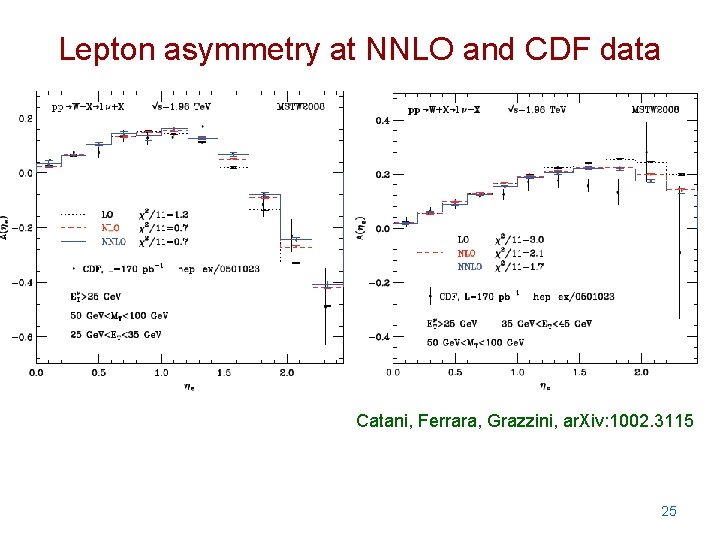
Lepton asymmetry at NNLO and CDF data Catani, Ferrara, Grazzini, ar. Xiv: 1002. 3115 25
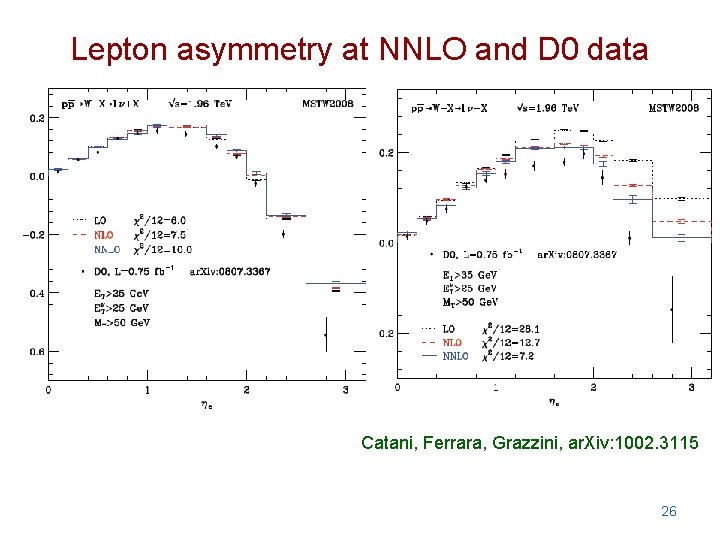
Lepton asymmetry at NNLO and D 0 data Catani, Ferrara, Grazzini, ar. Xiv: 1002. 3115 26
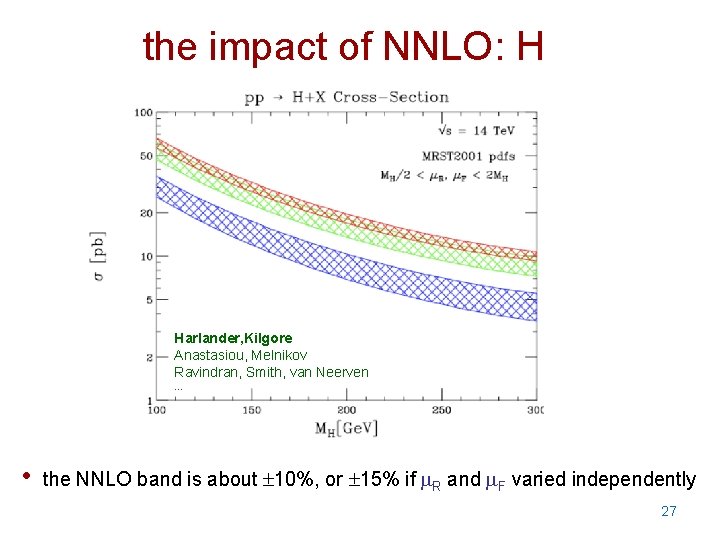
the impact of NNLO: H Harlander, Kilgore Anastasiou, Melnikov Ravindran, Smith, van Neerven … • the NNLO band is about 10%, or 15% if R and F varied independently 27
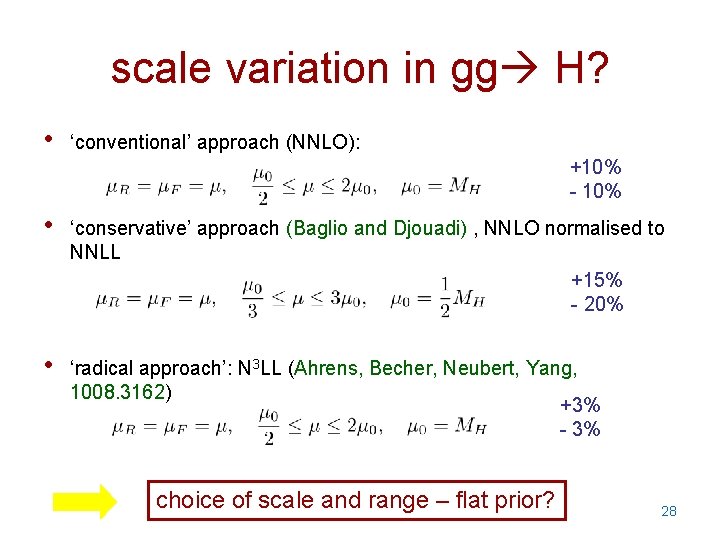
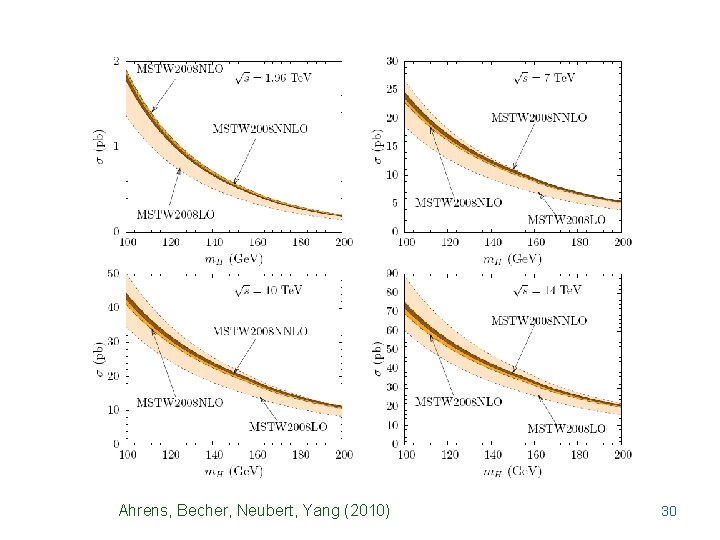
scale variation in gg H? • ‘conventional’ approach (NNLO): • ‘conservative’ approach (Baglio and Djouadi) , NNLO normalised to NNLL +15% - 20% • ‘radical approach’: N 3 LL (Ahrens, Becher, Neubert, Yang, 1008. 3162) +3% - 3% +10% - 10% choice of scale and range – flat prior? 28
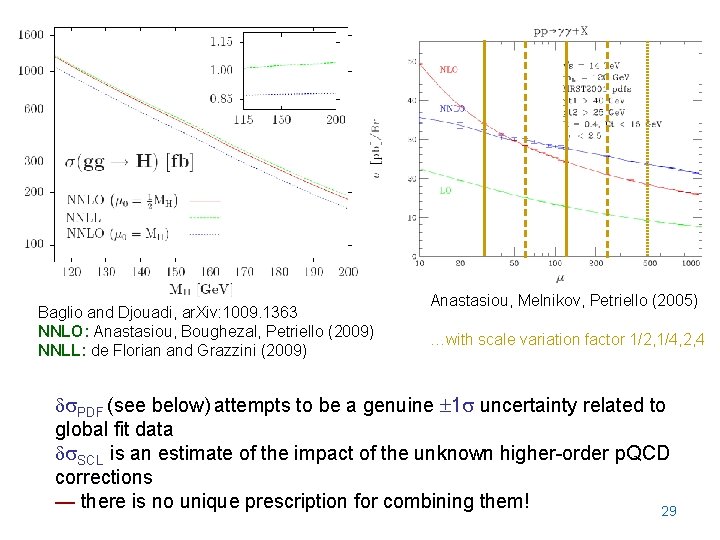
Baglio and Djouadi, ar. Xiv: 1009. 1363 NNLO: Anastasiou, Boughezal, Petriello (2009) NNLL: de Florian and Grazzini (2009) Anastasiou, Melnikov, Petriello (2005) …with scale variation factor 1/2, 1/4, 2, 4 PDF (see below) attempts to be a genuine 1 uncertainty related to global fit data SCL is an estimate of the impact of the unknown higher-order p. QCD corrections — there is no unique prescription for combining them! 29
Ahrens, Becher, Neubert, Yang (2010) 30
SM Higgs: Tevatron exclusion limits 31
3 parton distribution functions 32
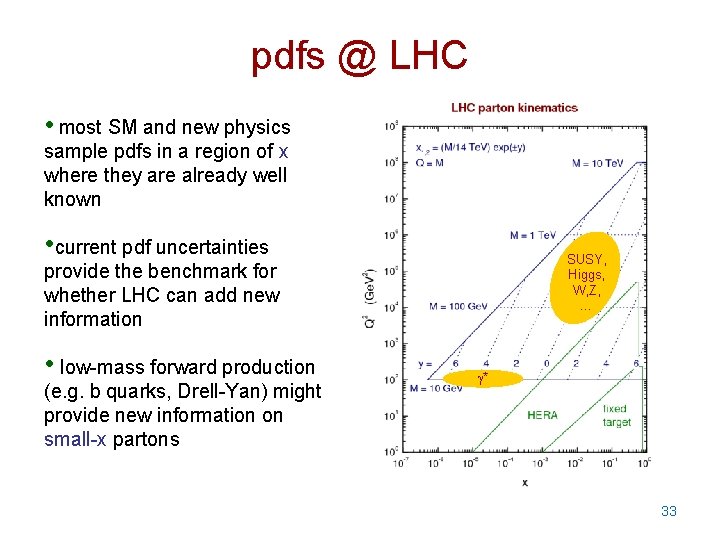
pdfs @ LHC • most SM and new physics sample pdfs in a region of x where they are already well known • current pdf uncertainties SUSY, Higgs, W, Z, … provide the benchmark for whether LHC can add new information • low-mass forward production (e. g. b quarks, Drell-Yan) might provide new information on small-x partons * 33
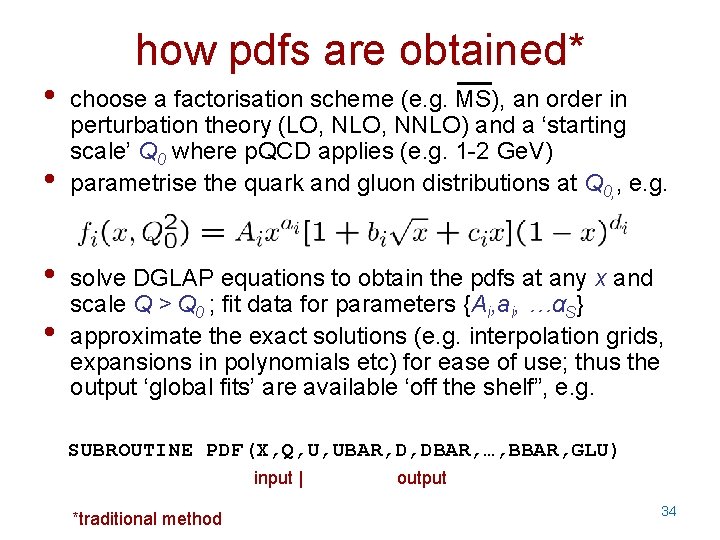
how pdfs are obtained* • • choose a factorisation scheme (e. g. MS), an order in perturbation theory (LO, NNLO) and a ‘starting scale’ Q 0 where p. QCD applies (e. g. 1 -2 Ge. V) parametrise the quark and gluon distributions at Q 0, , e. g. solve DGLAP equations to obtain the pdfs at any x and scale Q > Q 0 ; fit data for parameters {Ai, ai, …αS} approximate the exact solutions (e. g. interpolation grids, expansions in polynomials etc) for ease of use; thus the output ‘global fits’ are available ‘off the shelf”, e. g. SUBROUTINE PDF(X, Q, U, UBAR, D, DBAR, …, BBAR, GLU) input | *traditional method output 34
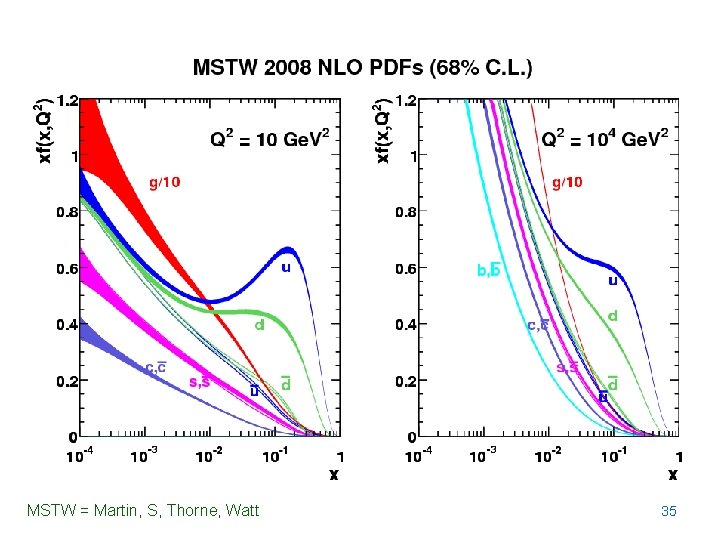
MSTW = Martin, S, Thorne, Watt 35
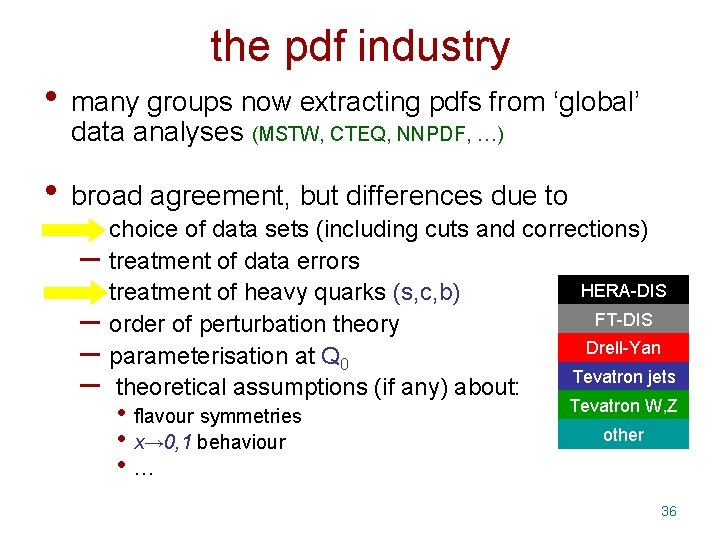
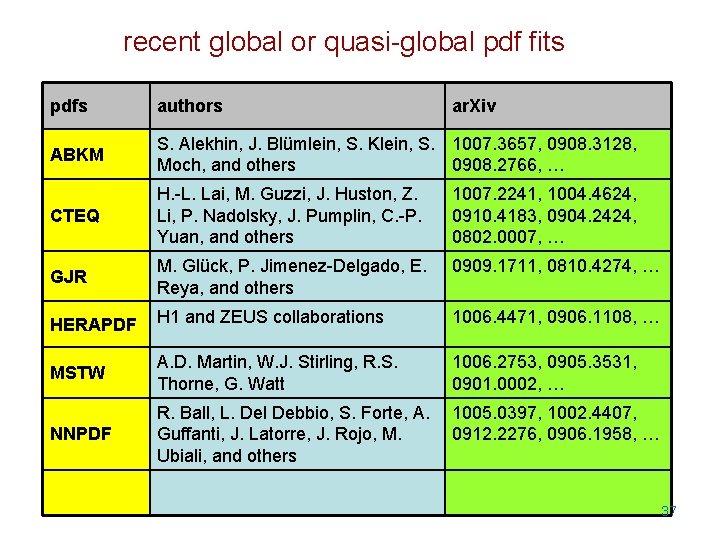
the pdf industry • many groups now extracting pdfs from ‘global’ data analyses (MSTW, CTEQ, NNPDF, …) • broad agreement, but differences due to – choice of data sets (including cuts and corrections) – treatment of data errors HERA-DIS – treatment of heavy quarks (s, c, b) FT-DIS – order of perturbation theory Drell-Yan – parameterisation at Q 0 Tevatron jets – theoretical assumptions (if any) about: Tevatron W, Z • flavour symmetries • x→ 0, 1 behaviour • … other 36
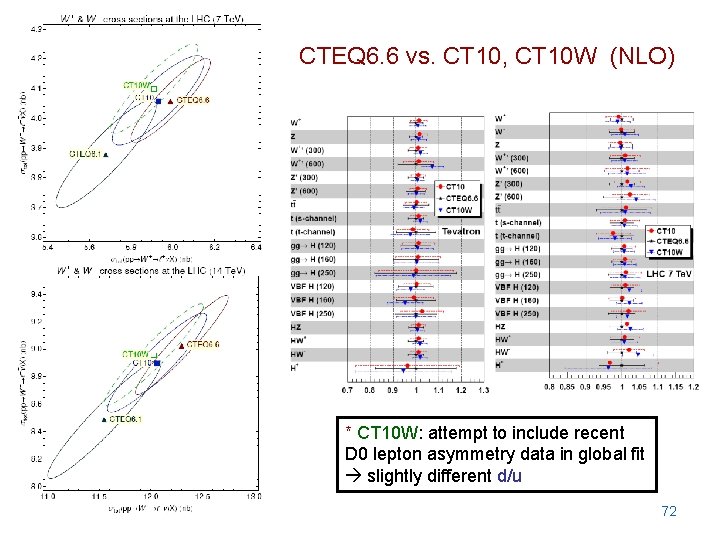
recent global or quasi-global pdf fits pdfs authors ar. Xiv ABKM S. Alekhin, J. Blümlein, S. Klein, S. 1007. 3657, 0908. 3128, Moch, and others 0908. 2766, … CTEQ H. -L. Lai, M. Guzzi, J. Huston, Z. Li, P. Nadolsky, J. Pumplin, C. -P. Yuan, and others 1007. 2241, 1004. 4624, 0910. 4183, 0904. 2424, 0802. 0007, … GJR M. Glück, P. Jimenez-Delgado, E. Reya, and others 0909. 1711, 0810. 4274, … HERAPDF H 1 and ZEUS collaborations 1006. 4471, 0906. 1108, … MSTW A. D. Martin, W. J. Stirling, R. S. Thorne, G. Watt 1006. 2753, 0905. 3531, 0901. 0002, … NNPDF R. Ball, L. Del Debbio, S. Forte, A. Guffanti, J. Latorre, J. Rojo, M. Ubiali, and others 1005. 0397, 1002. 4407, 0912. 2276, 0906. 1958, … 37
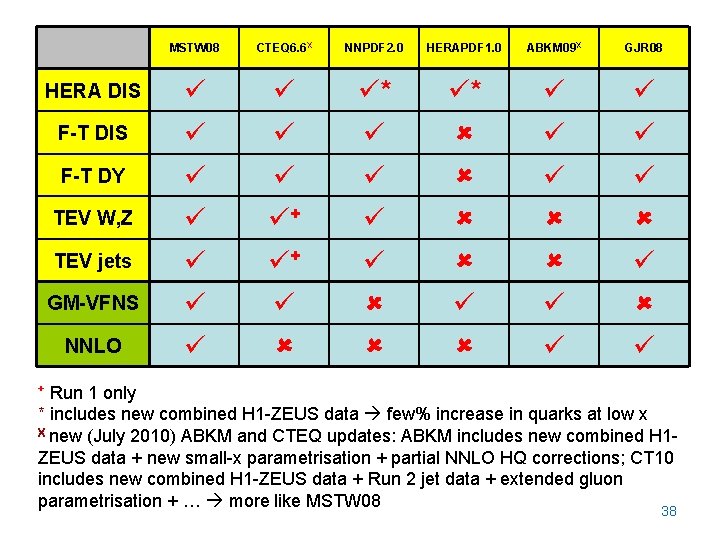
MSTW 08 CTEQ 6. 6 X NNPDF 2. 0 HERAPDF 1. 0 ABKM 09 X GJR 08 HERA DIS * * F-T DIS F-T DY TEV W, Z + TEV jets + GM-VFNS NNLO Run 1 only * includes new combined H 1 -ZEUS data few% increase in quarks at low x X new (July 2010) ABKM and CTEQ updates: ABKM includes new combined H 1 ZEUS data + new small-x parametrisation + partial NNLO HQ corrections; CT 10 includes new combined H 1 -ZEUS data + Run 2 jet data + extended gluon parametrisation + … more like MSTW 08 38 +
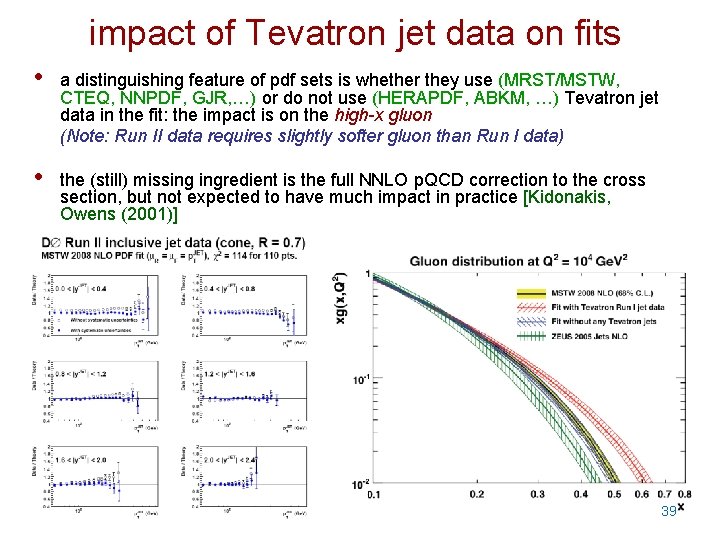
impact of Tevatron jet data on fits • a distinguishing feature of pdf sets is whether they use (MRST/MSTW, CTEQ, NNPDF, GJR, …) or do not use (HERAPDF, ABKM, …) Tevatron jet data in the fit: the impact is on the high-x gluon (Note: Run II data requires slightly softer gluon than Run I data) • the (still) missing ingredient is the full NNLO p. QCD correction to the cross section, but not expected to have much impact in practice [Kidonakis, Owens (2001)] 39
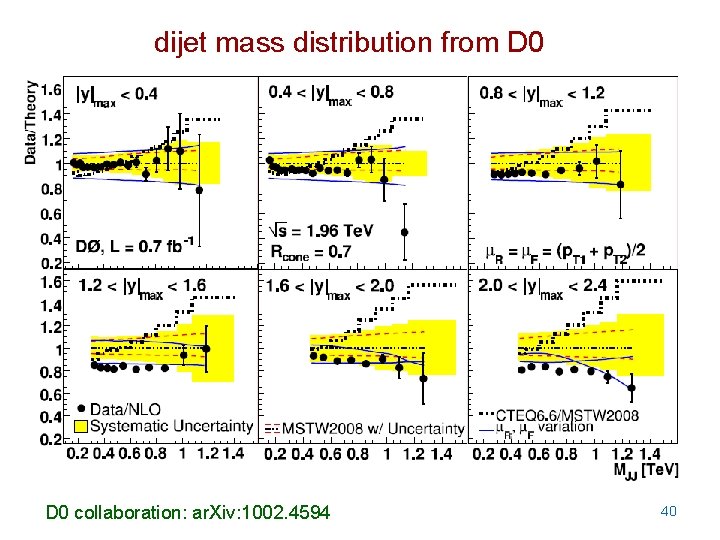
dijet mass distribution from D 0 collaboration: ar. Xiv: 1002. 4594 40
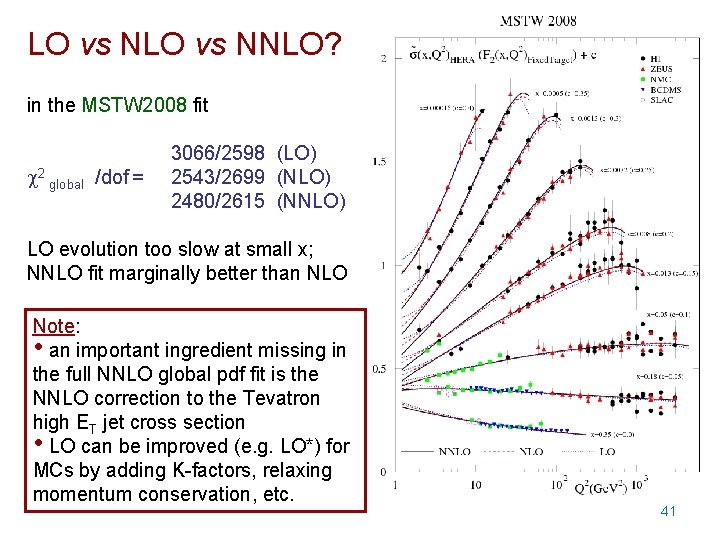
LO vs NNLO? in the MSTW 2008 fit 2 global /dof = 3066/2598 (LO) 2543/2699 (NLO) 2480/2615 (NNLO) LO evolution too slow at small x; NNLO fit marginally better than NLO Note: • an important ingredient missing in the full NNLO global pdf fit is the NNLO correction to the Tevatron high ET jet cross section • LO can be improved (e. g. LO*) for MCs by adding K-factors, relaxing momentum conservation, etc. 41
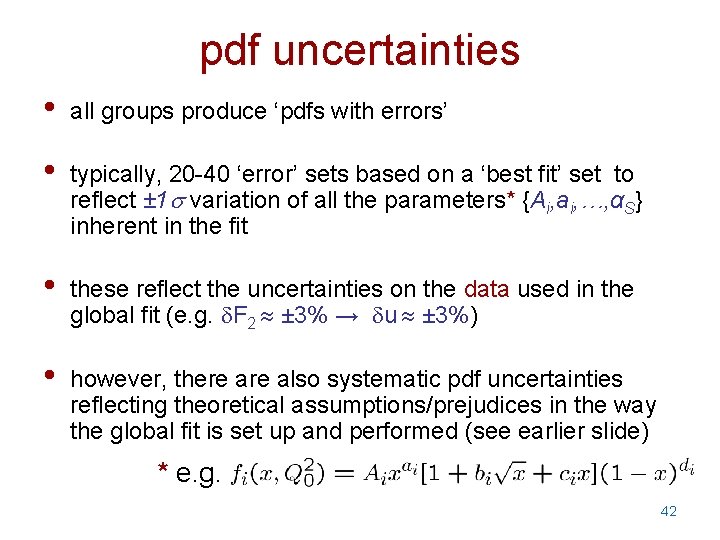
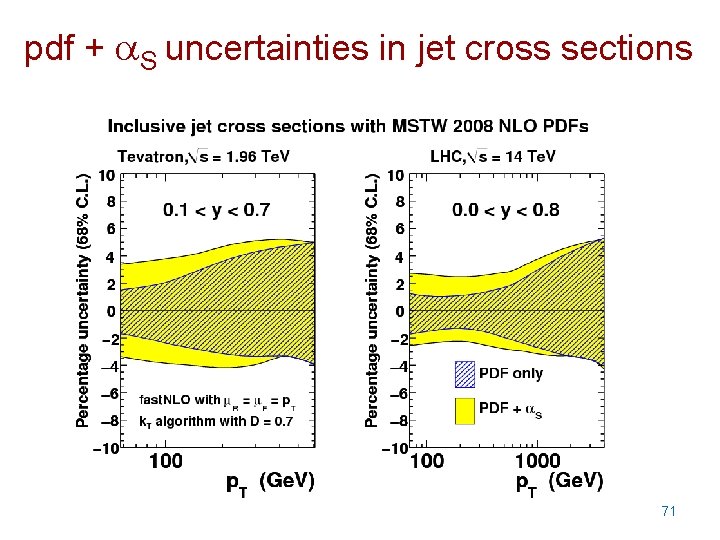
pdf uncertainties • all groups produce ‘pdfs with errors’ • typically, 20 -40 ‘error’ sets based on a ‘best fit’ set to reflect ± 1 variation of all the parameters* {Ai, ai, …, αS} inherent in the fit • these reflect the uncertainties on the data used in the global fit (e. g. F 2 ± 3% → u ± 3%) • however, there also systematic pdf uncertainties reflecting theoretical assumptions/prejudices in the way the global fit is set up and performed (see earlier slide) * e. g. 42
pdf uncertainties (contd. ) • NNPDF create many replicas of data and obtain PDF replicas in each case by fitting to training set and comparing to validation set uncertainty determined by spread of replicas. Direct relationship to 2 in global fit not trivial. • NNPDF and MSTW (due to extra parameters) have more complicated shape for gluon at smaller x and bigger small-x uncertainty, ditto for CTEQ at large x • different theory assumptions in strange quark pdf leads to vastly different uncertainties ― e. g. MSTW small, NNPDF large; feeds into other ‘light’ quarks • perhaps surprisingly, all get rather similar uncertainties for pdfs and predicted cross sections ― see later 43
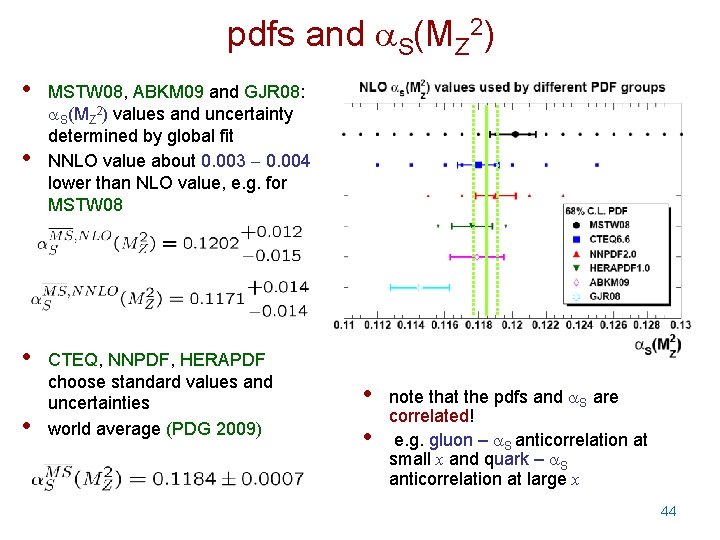
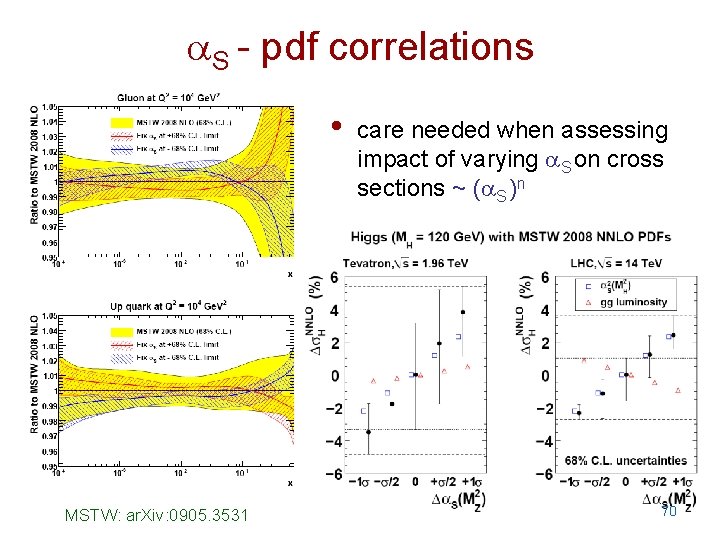
pdfs and S(MZ 2) • • MSTW 08, ABKM 09 and GJR 08: S(MZ 2) values and uncertainty determined by global fit NNLO value about 0. 003 0. 004 lower than NLO value, e. g. for MSTW 08 CTEQ, NNPDF, HERAPDF choose standard values and uncertainties world average (PDG 2009) • • note that the pdfs and S are correlated! e. g. gluon – S anticorrelation at small x and quark – S anticorrelation at large x 44
4 LHC benchmark cross sections 45
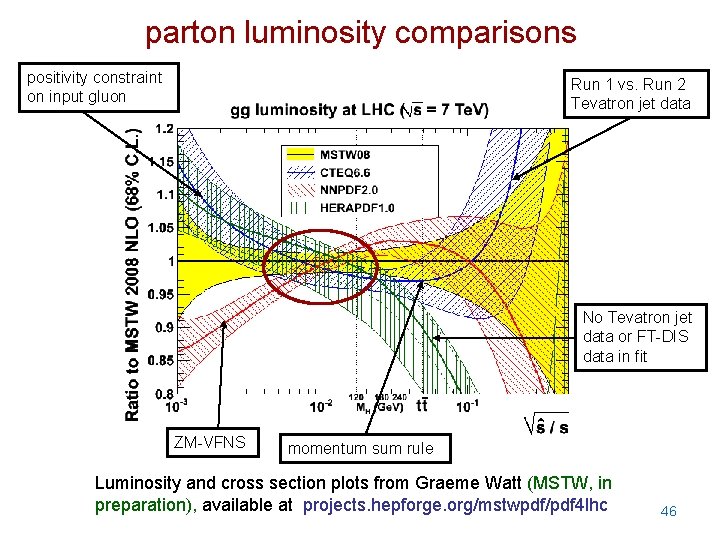
parton luminosity comparisons positivity constraint on input gluon Run 1 vs. Run 2 Tevatron jet data No Tevatron jet data or FT-DIS data in fit ZM-VFNS momentum sum rule Luminosity and cross section plots from Graeme Watt (MSTW, in preparation), available at projects. hepforge. org/mstwpdf/pdf 4 lhc 46
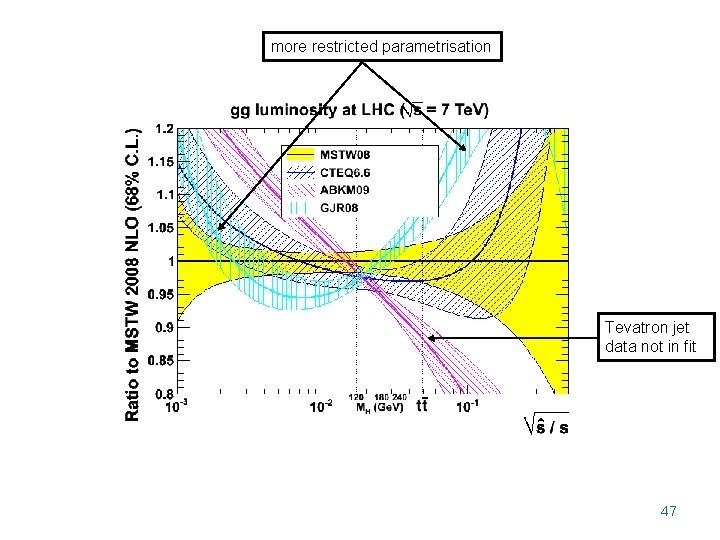
more restricted parametrisation Tevatron jet data not in fit 47
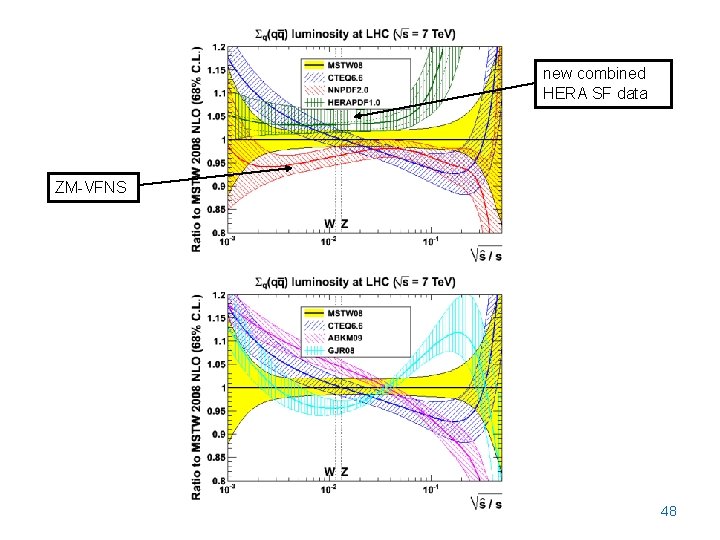
new combined HERA SF data ZM-VFNS 48
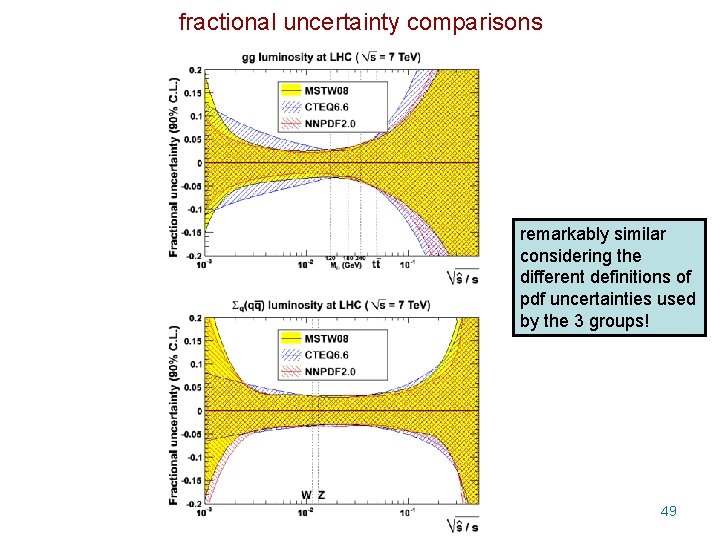
fractional uncertainty comparisons remarkably similar considering the different definitions of pdf uncertainties used by the 3 groups! 49
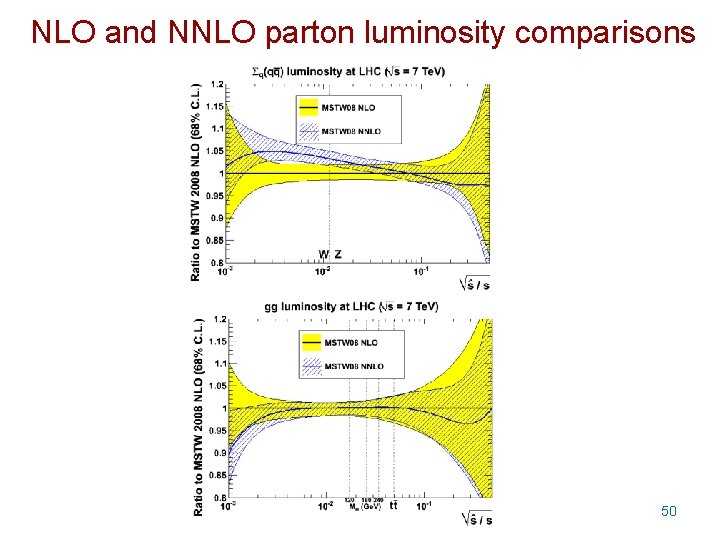
NLO and NNLO parton luminosity comparisons 50
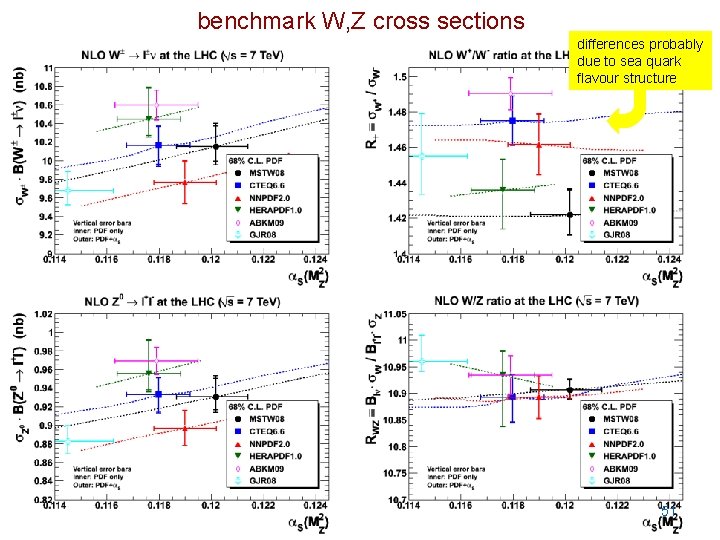
benchmark W, Z cross sections differences probably due to sea quark flavour structure 51
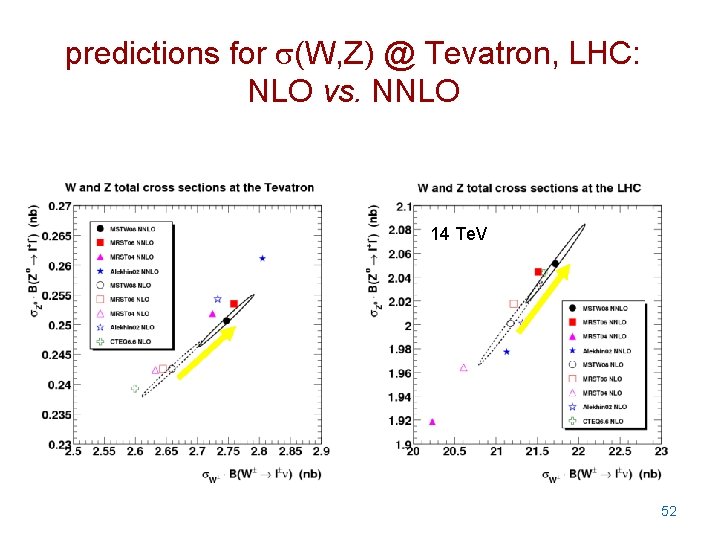
predictions for (W, Z) @ Tevatron, LHC: NLO vs. NNLO 14 Te. V 52
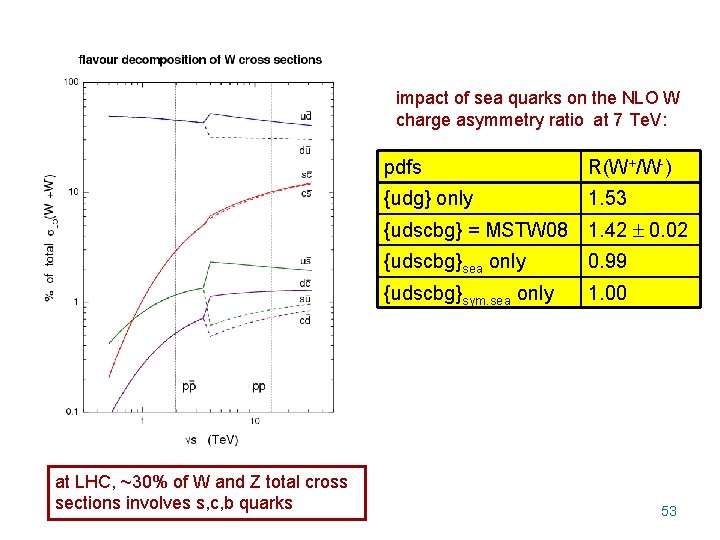
impact of sea quarks on the NLO W charge asymmetry ratio at 7 Te. V: at LHC, ~30% of W and Z total cross sections involves s, c, b quarks pdfs R(W+/W-) {udg} only 1. 53 {udscbg} = MSTW 08 1. 42 0. 02 {udscbg}sea only 0. 99 {udscbg}sym. sea only 1. 00 53
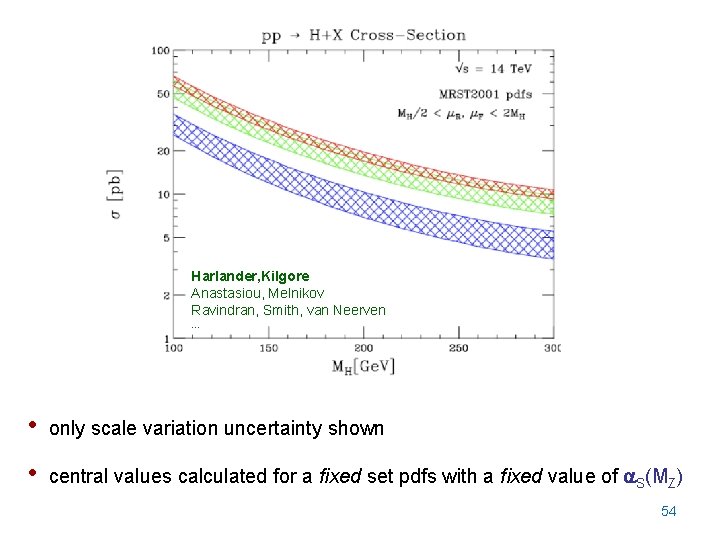
Harlander, Kilgore Anastasiou, Melnikov Ravindran, Smith, van Neerven … • only scale variation uncertainty shown • central values calculated for a fixed set pdfs with a fixed value of S(MZ) 54
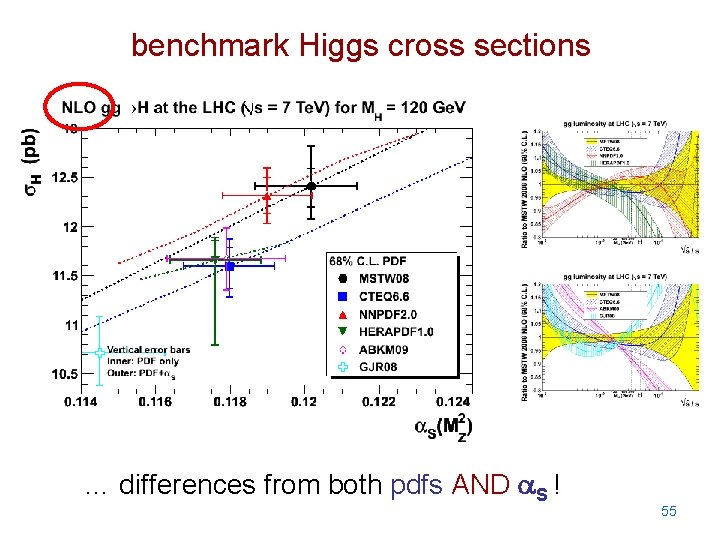
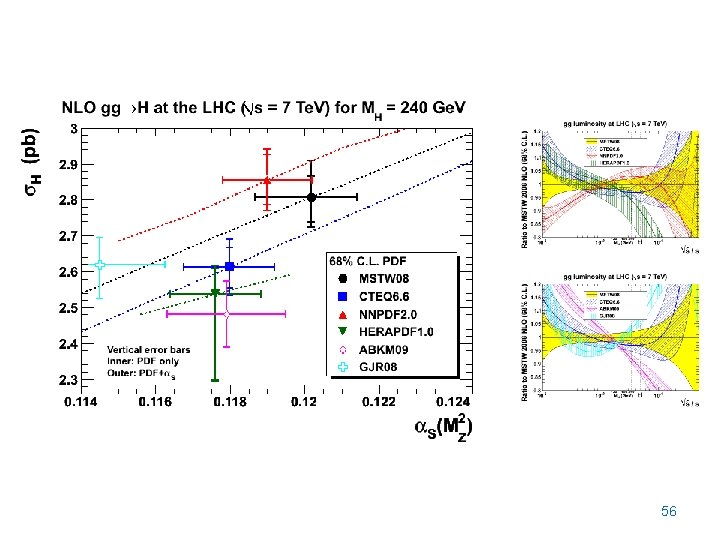
benchmark Higgs cross sections … differences from both pdfs AND S ! 55
56
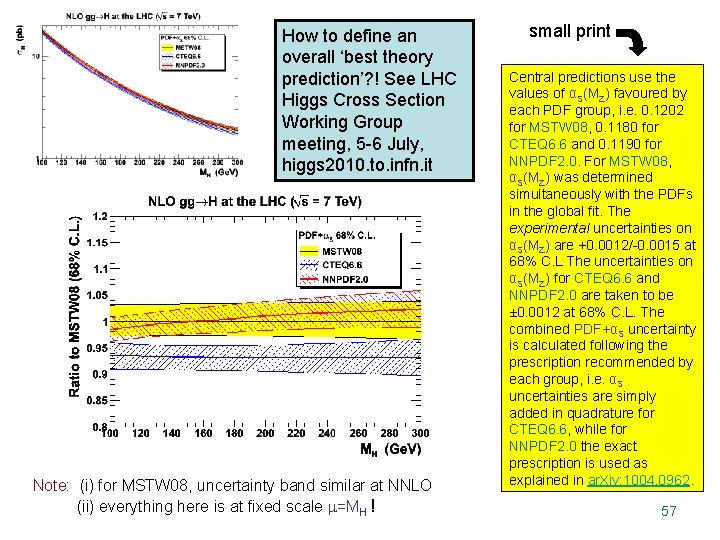
How to define an overall ‘best theory prediction’? ! See LHC Higgs Cross Section Working Group meeting, 5 -6 July, higgs 2010. to. infn. it Note: (i) for MSTW 08, uncertainty band similar at NNLO (ii) everything here is at fixed scale =MH ! small print Central predictions use the values of αS(MZ) favoured by each PDF group, i. e. 0. 1202 for MSTW 08, 0. 1180 for CTEQ 6. 6 and 0. 1190 for NNPDF 2. 0. For MSTW 08, αS(MZ) was determined simultaneously with the PDFs in the global fit. The experimental uncertainties on αS(MZ) are +0. 0012/-0. 0015 at 68% C. L The uncertainties on αS(MZ) for CTEQ 6. 6 and NNPDF 2. 0 are taken to be ± 0. 0012 at 68% C. L. The combined PDF+αS uncertainty is calculated following the prescription recommended by each group, i. e. αS uncertainties are simply added in quadrature for CTEQ 6. 6, while for NNPDF 2. 0 the exact prescription is used as explained in ar. Xiv: 1004. 0962. 57
summary • two major advances in the past few years: – – the NLO revolution – more and more SM background processes now known (see talks by Lance Dixon and others) better understanding of and continuing convergence between the various pdf sets (see the PDF discussions this week) • • • inclusion of combined HERA data (not yet in all fits) difficulty of reconciling Run II Tevatron W asymmetry data proper assessment of uncertainties due to treatment of heavy quark flavours (GM-VFNS optimal but not uniquely defined) beyond NNLO? e. g. influence of [ S ln(1/x)]n contributions, higher twists, … ‘QED pdfs’ (e. g. MRST 2004) • other issues ‘solved’: PS-MCs at NLO, robust jet algorithms, … • NNLO is the other major frontier: good for standard candles but no “+ jet” processes yet • • ‘scale variation uncertainty’ still a big issue: consensus needed • … and don’t forget other more novel applications of p. QCD (hard diffraction, 58 multiple parton interactions, etc. eagerly awaiting precision cross sections at 7 Te. V
5 double parton distributions For a `state of the art’ overview of Multiple Parton Interactions, see the talks at the recent DESY workshop: indico. desy. de/conference. Display. py? conf. Id=3241 59
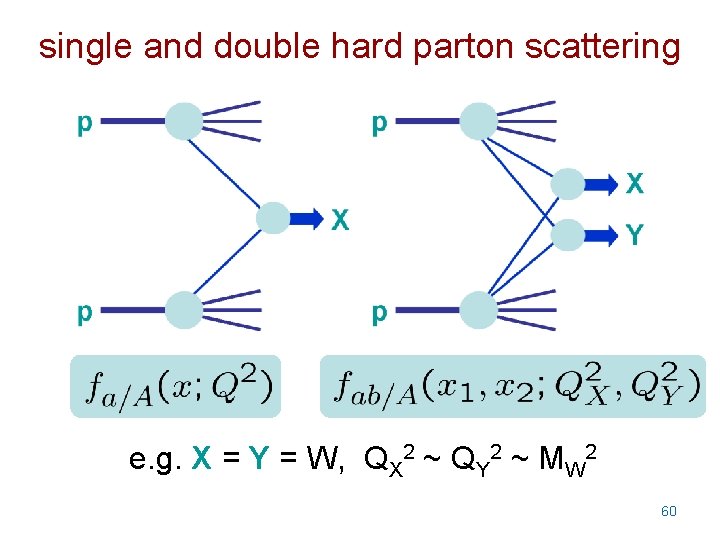
single and double hard parton scattering e. g. X = Y = W, QX 2 ~ QY 2 ~ MW 2 60
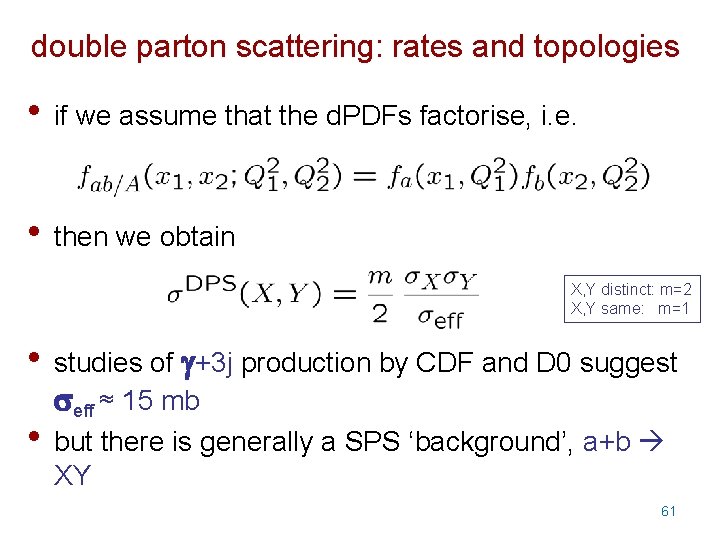
double parton scattering: rates and topologies • if we assume that the d. PDFs factorise, i. e. • then we obtain X, Y distinct: m=2 X, Y same: m=1 • studies of +3 j production by CDF and D 0 suggest eff ≈ 15 mb • but there is generally a SPS ‘background’, a+b XY 61
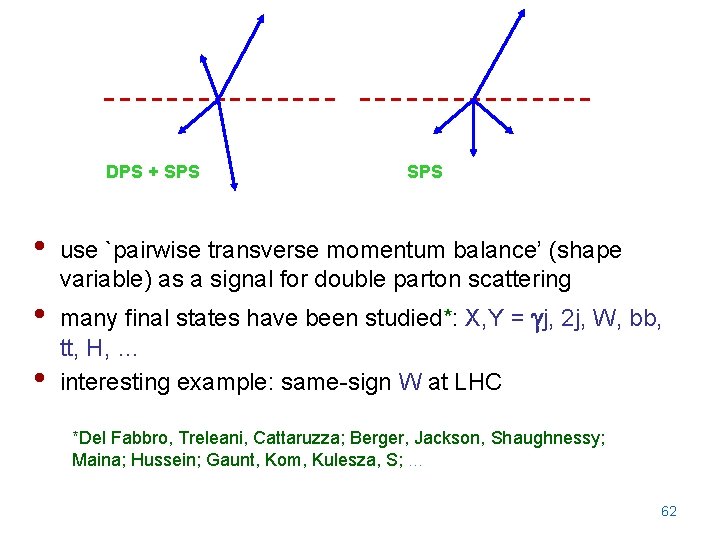
DPS + SPS • use `pairwise transverse momentum balance’ (shape variable) as a signal for double parton scattering • many final states have been studied*: X, Y = j, 2 j, W, bb, tt, H, … interesting example: same-sign W at LHC • *Del Fabbro, Treleani, Cattaruzza; Berger, Jackson, Shaughnessy; Maina; Hussein; Gaunt, Kom, Kulesza, S; … 62
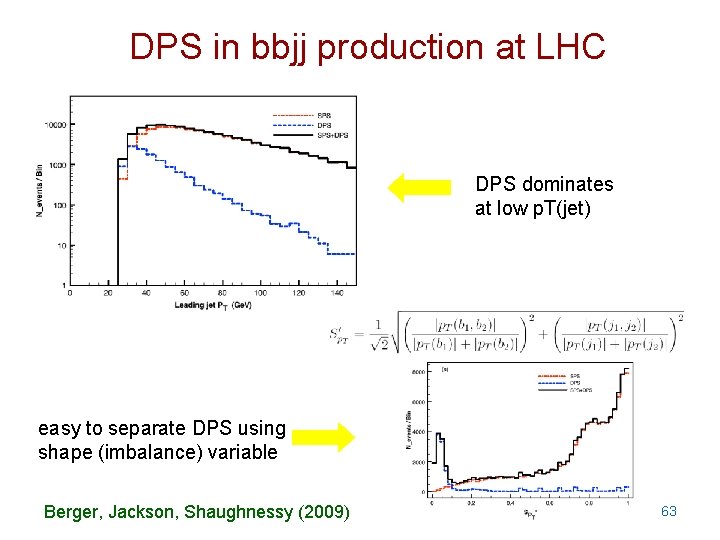
DPS in bbjj production at LHC DPS dominates at low p. T(jet) easy to separate DPS using shape (imbalance) variable Berger, Jackson, Shaughnessy (2009) 63
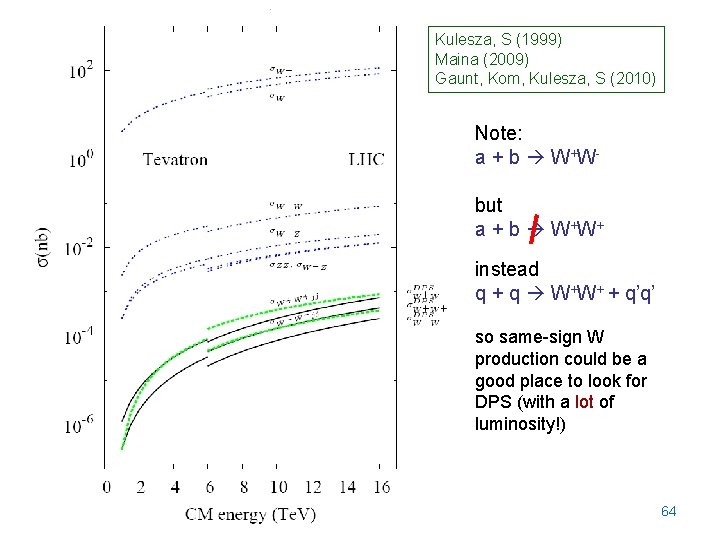
Kulesza, S (1999) Maina (2009) Gaunt, Kom, Kulesza, S (2010) Note: a + b W + Wbut a + b W + W+ instead q + q W+W+ + q’q’ so same-sign W production could be a good place to look for DPS (with a lot of luminosity!) 64
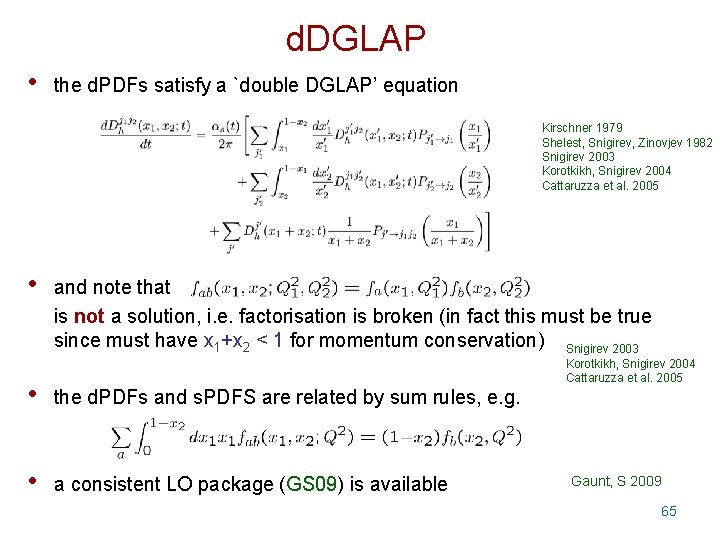
d. DGLAP • the d. PDFs satisfy a `double DGLAP’ equation Kirschner 1979 Shelest, Snigirev, Zinovjev 1982 Snigirev 2003 Korotkikh, Snigirev 2004 Cattaruzza et al. 2005 • and note that is not a solution, i. e. factorisation is broken (in fact this must be true since must have x 1+x 2 < 1 for momentum conservation) Snigirev 2003 Korotkikh, Snigirev 2004 Cattaruzza et al. 2005 • the d. PDFs and s. PDFS are related by sum rules, e. g. • a consistent LO package (GS 09) is available Gaunt, S 2009 65

extra slides 66
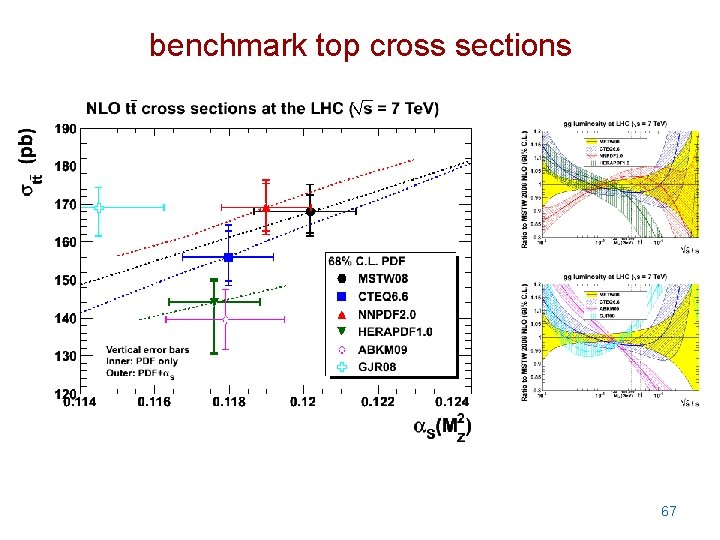
benchmark top cross sections 67
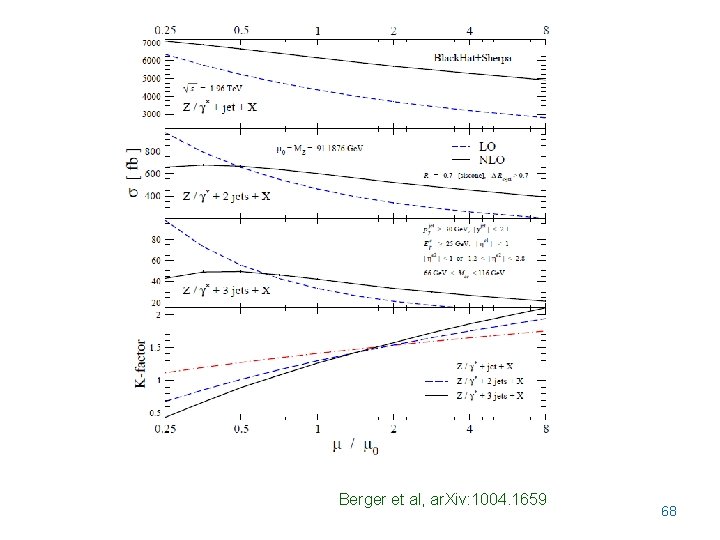
Berger et al, ar. Xiv: 1004. 1659 68
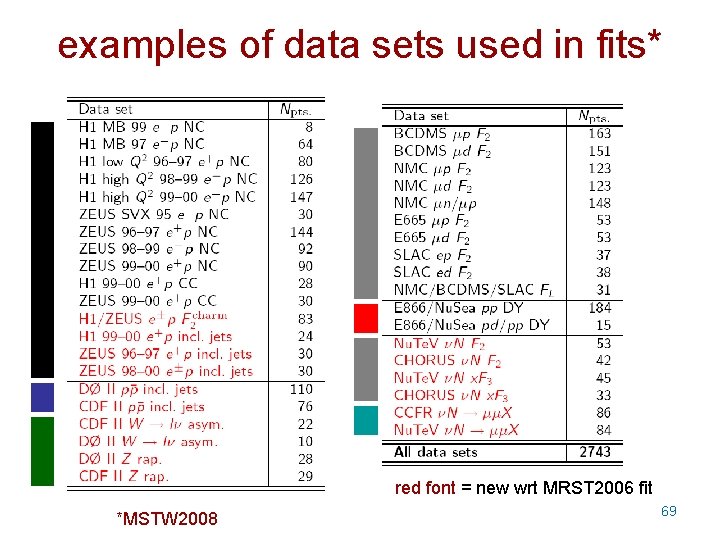
examples of data sets used in fits* red font = new wrt MRST 2006 fit *MSTW 2008 69
S - pdf correlations • MSTW: ar. Xiv: 0905. 3531 care needed when assessing impact of varying S on cross sections ~ ( S )n 70
pdf + S uncertainties in jet cross sections 71
CTEQ 6. 6 vs. CT 10, CT 10 W (NLO) * CT 10 W: attempt to include recent D 0 lepton asymmetry data in global fit slightly different d/u 72
improved LO pdfs • conventional wisdom is to match p. QCD order of pdfs with that of MEs • but, in practice, – LO = PDFs(LO) ME(LO) can be different from NLO = PDFs(NLO) ME(NLO), in both shape and normalisation – LO pdfs have very poor 2 in (LO) global fit (no surprise: NLO corrections at large and small x are significant and preferred by the data) • momentum conservation limits how much additional glue can be added to LO partons to compensate for missing NLO p. QCD corrections (e. g. to get correct evolution rate of small-x quarks) • therefore relax momentum conservation and redo LO fit; study the impact of this on 2, partons and cross sections • e. g. Thorne & Shertsnev 2007: LO* partons – 2: 3066/2235 → 2691/2235, momentum conservation: 100% → 113% 73
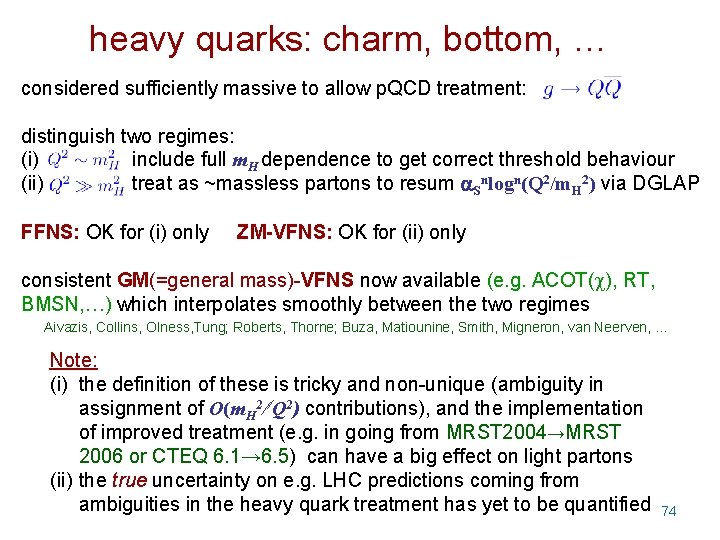
heavy quarks: charm, bottom, … considered sufficiently massive to allow p. QCD treatment: distinguish two regimes: (i) include full m. H dependence to get correct threshold behaviour (ii) treat as ~massless partons to resum Snlogn(Q 2/m. H 2) via DGLAP FFNS: OK for (i) only ZM-VFNS: OK for (ii) only consistent GM(=general mass)-VFNS now available (e. g. ACOT( ), RT, BMSN, …) which interpolates smoothly between the two regimes Aivazis, Collins, Olness, Tung; Roberts, Thorne; Buza, Matiounine, Smith, Migneron, van Neerven, … Note: (i) the definition of these is tricky and non-unique (ambiguity in assignment of O(m. H 2//Q 2) contributions), and the implementation of improved treatment (e. g. in going from MRST 2004→MRST 2006 or CTEQ 6. 1→ 6. 5) can have a big effect on light partons (ii) the true uncertainty on e. g. LHC predictions coming from ambiguities in the heavy quark treatment has yet to be quantified 74
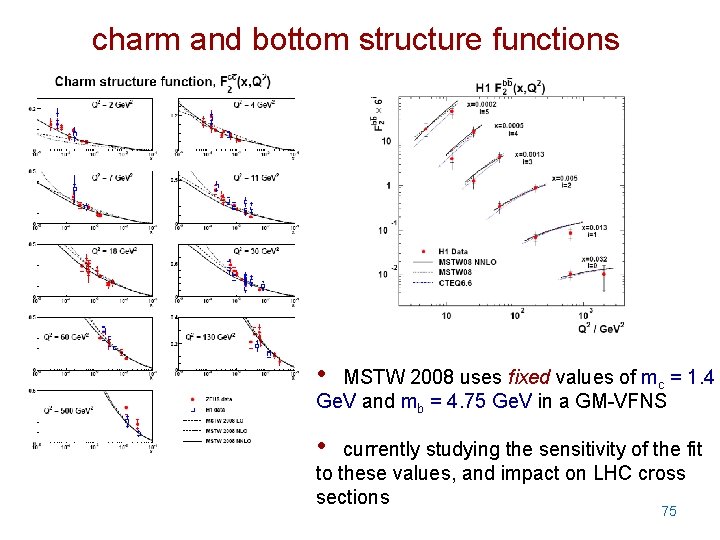
charm and bottom structure functions • MSTW 2008 uses fixed values of mc = 1. 4 Ge. V and mb = 4. 75 Ge. V in a GM-VFNS • currently studying the sensitivity of the fit to these values, and impact on LHC cross sections 75
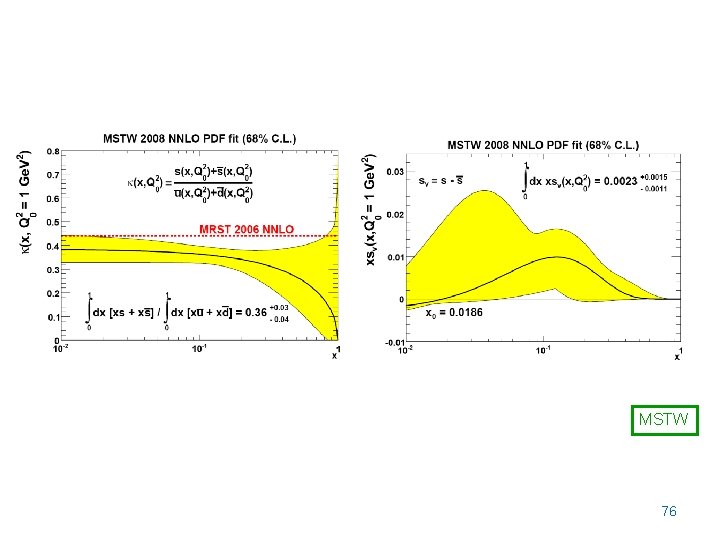
MSTW 76
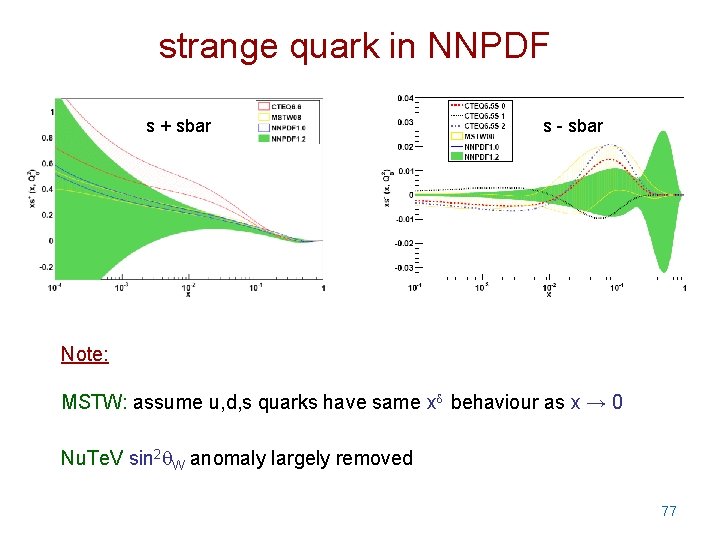
strange quark in NNPDF s + sbar s - sbar Note: MSTW: assume u, d, s quarks have same x behaviour as x → 0 Nu. Te. V sin 2 W anomaly largely removed 77
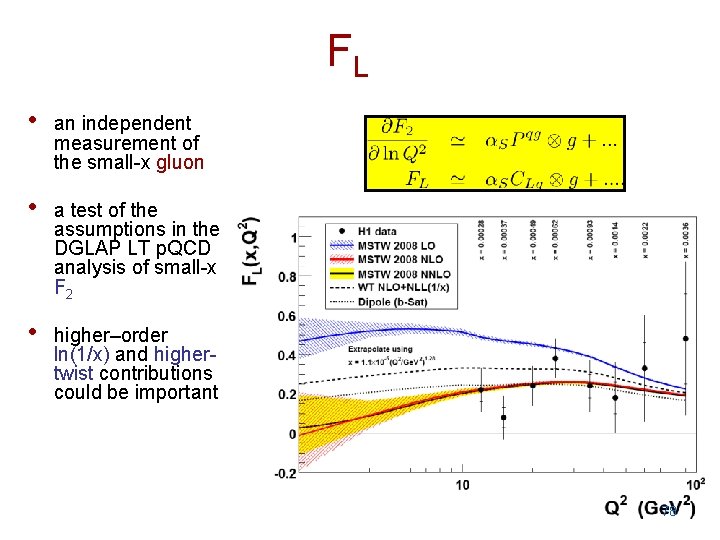
FL • an independent measurement of the small-x gluon • a test of the assumptions in the DGLAP LT p. QCD analysis of small-x F 2 • higher–order ln(1/x) and highertwist contributions could be important 78
79
LHC (14 Te. V) 80
- Slides: 80