
QCD and the quark Model Bilal Masud Centre
QCD and the quark Model Bilal Masud Centre for High Energy Physics Punjab University 6 th LHC School, 21 -31 August 2017, NCP, Islamabad. 1
Outline • • • Strong interactions and QCD Historical origin: parton model Electron proton elastic and inelastic scattering Bjorken scaling Scaling violation and a related Feynman diagram with quark-gluon vertex Colour charge and its Running. Path integrals of QCD; lattice gauge theory. Quark potential model Physics beyond the quark model: “QCD effects”. 2
Strong Interactions and QCD • QCD (Quantum Chromodynamics) is said to be theory of strong interactions. • It is said that “The strong interaction is the force that binds protons and neutrons together to form the nucleus. ” It is also “it is the force that holds quarks together to form protons, neutrons, . . ”. • Above can be a good popular presentation or motivation of ideas, but not any experimental signature in actual working science, like photon and neutrino detection are for electromagnetic and weak interaction respectively. 3
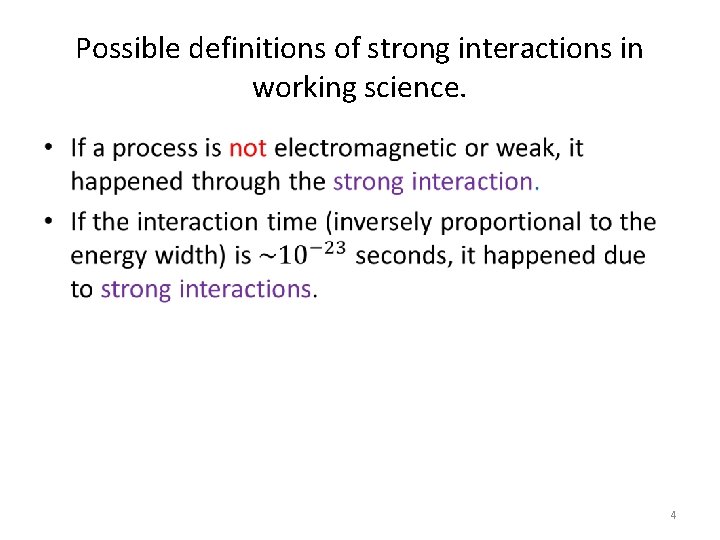
Possible definitions of strong interactions in working science. • 4
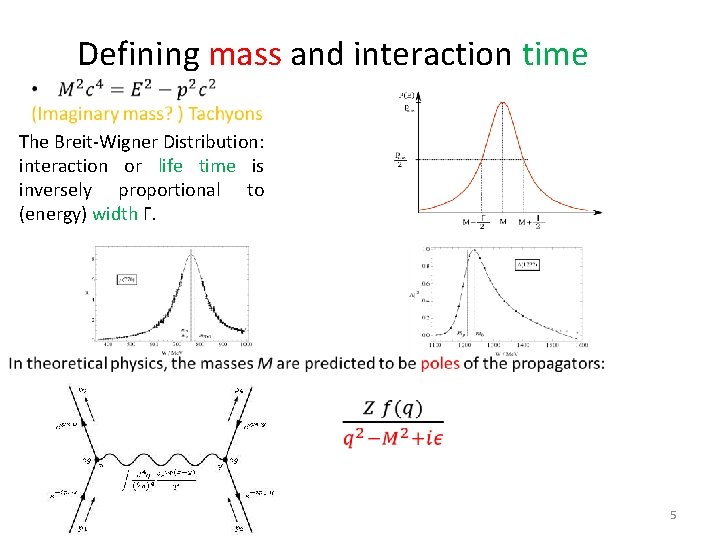
Defining mass and interaction time • The Breit-Wigner Distribution: interaction or life time is inversely proportional to (energy) width Γ. 5
No one-to-one correspondence of processes and theory (QED or QCD)? • A process, namely electron-proton inelastic scattering (strong or electromagnetic? ) is explained with the help of both QED and QCD. • First the simpler explanation (QED) was tried and when that failed to fully understand the relevant experiments, the help turned out to be theory called Quantum Chromodynamics (QCD). 6
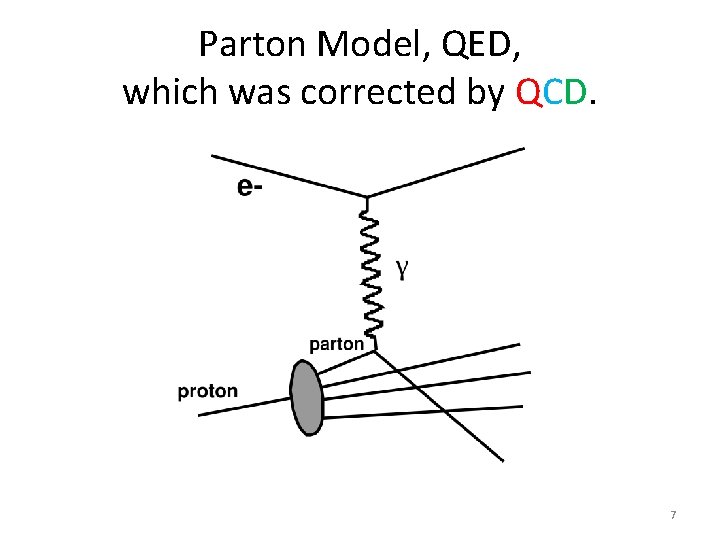
Parton Model, QED, which was corrected by QCD. 7
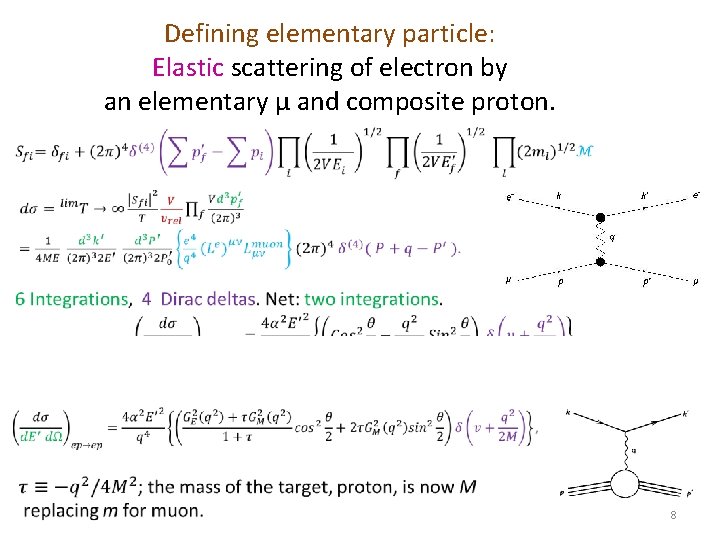
Defining elementary particle: Elastic scattering of electron by an elementary μ and composite proton. • 8
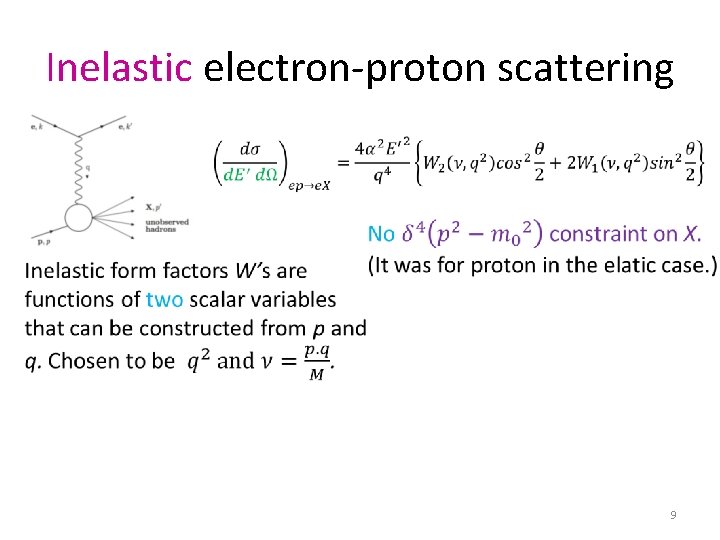
Inelastic electron-proton scattering 9
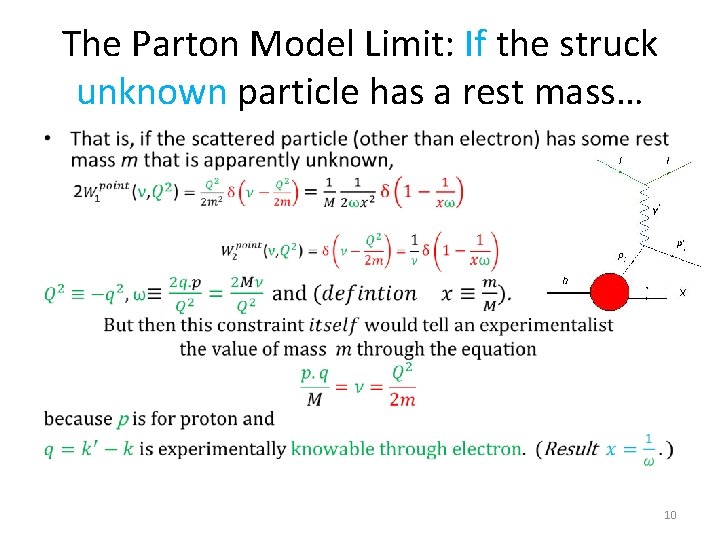
The Parton Model Limit: If the struck unknown particle has a rest mass… • 10
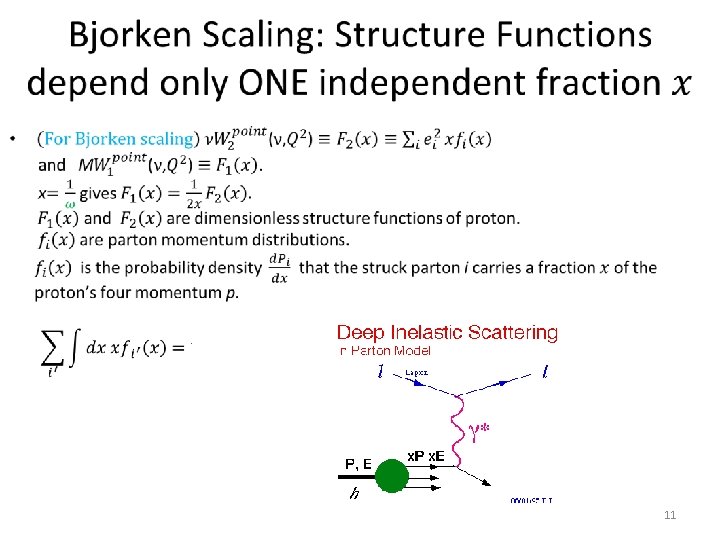

Implications for the Proton Structure: Only QED! Here, we need QCD! 12
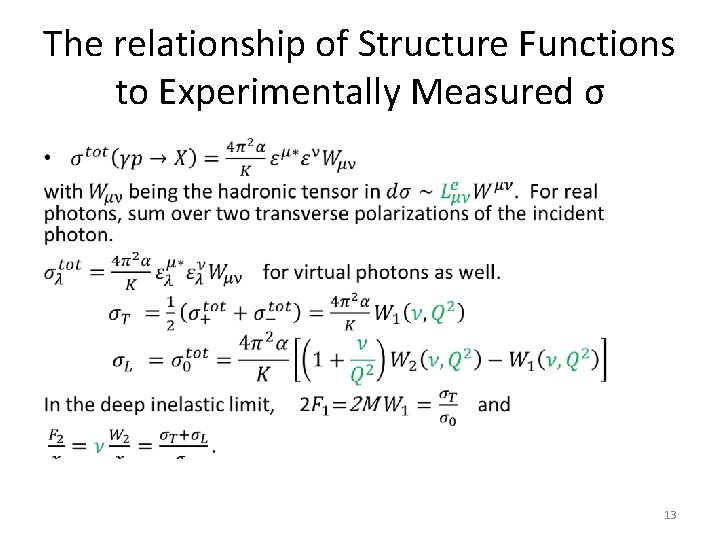
The relationship of Structure Functions to Experimentally Measured σ • 13
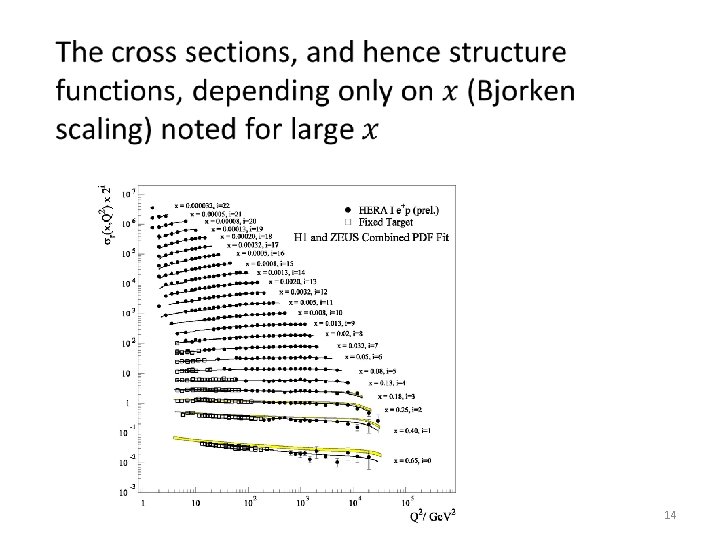
14
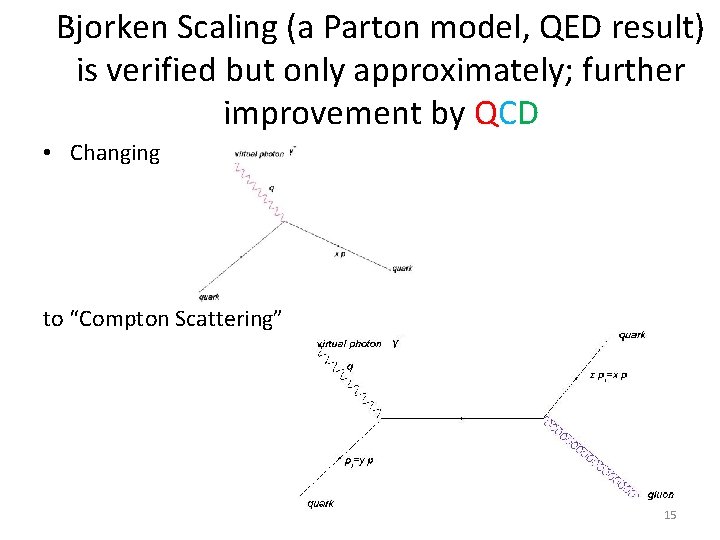
Bjorken Scaling (a Parton model, QED result) is verified but only approximately; further improvement by QCD • Changing to “Compton Scattering” 15
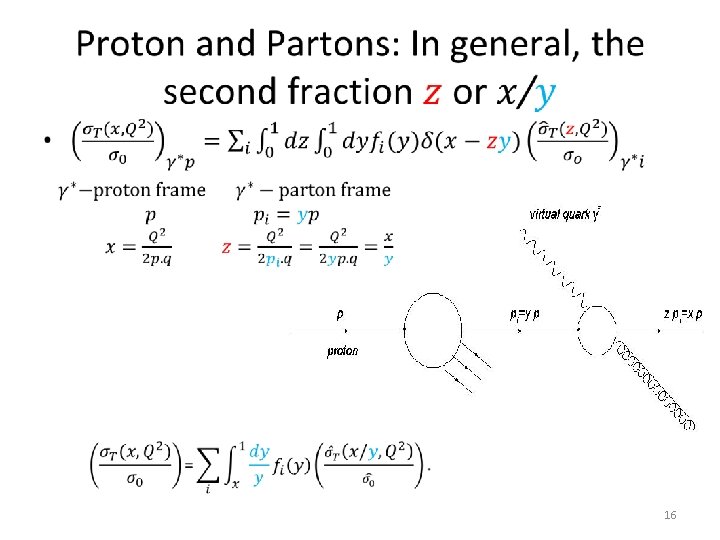
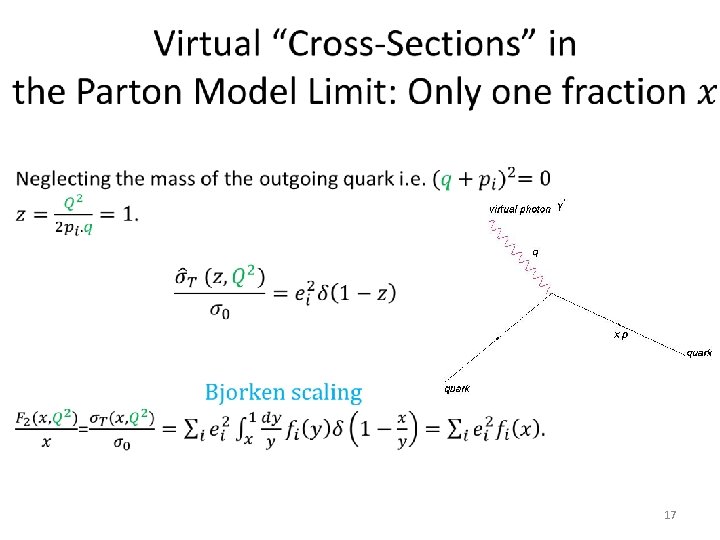
17
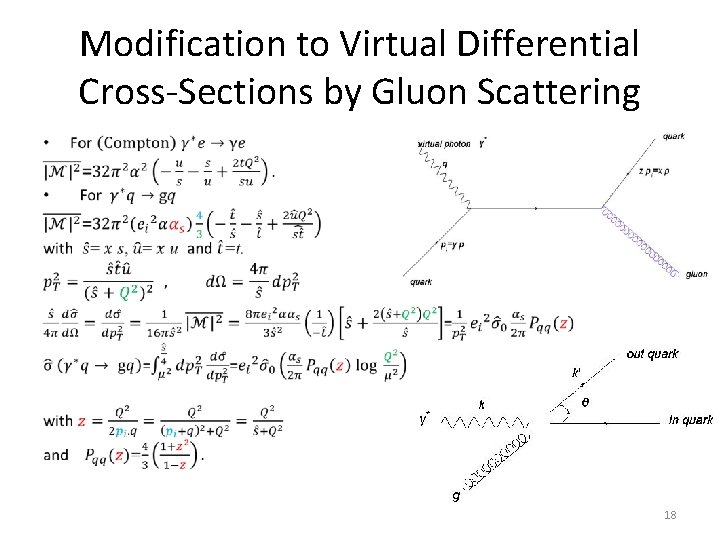
Modification to Virtual Differential Cross-Sections by Gluon Scattering • 18
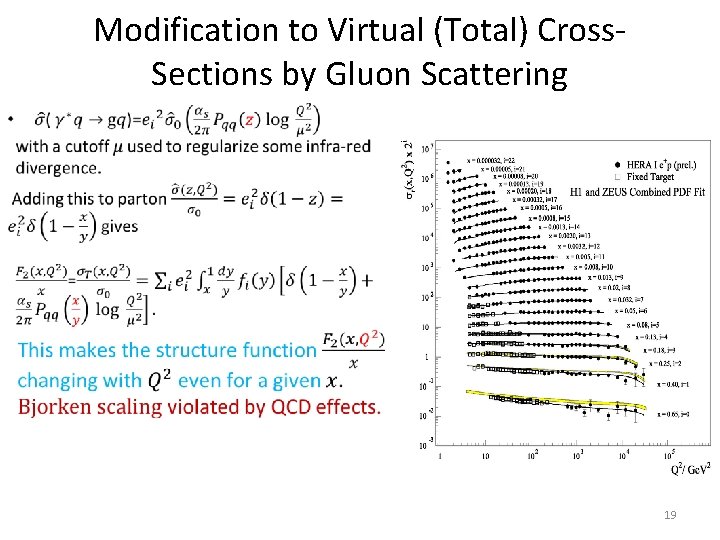
Modification to Virtual (Total) Cross. Sections by Gluon Scattering • 19
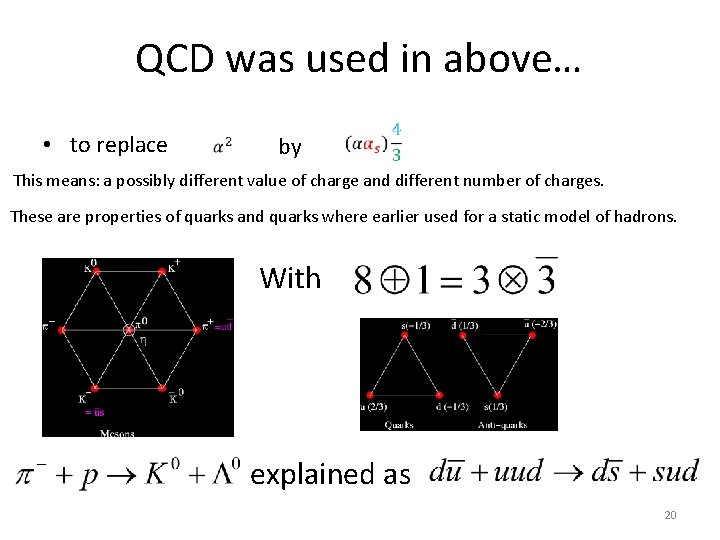
QCD was used in above… • to replace by This means: a possibly different value of charge and different number of charges. These are properties of quarks and quarks where earlier used for a static model of hadrons. With explained as 20
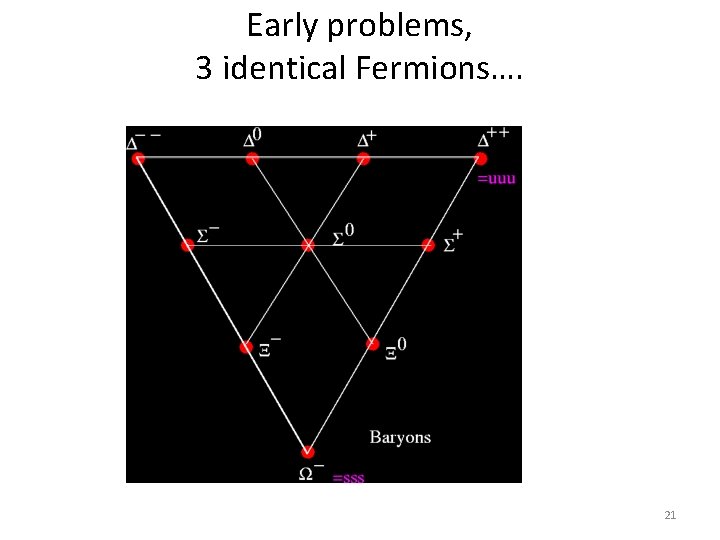
Early problems, 3 identical Fermions…. 21
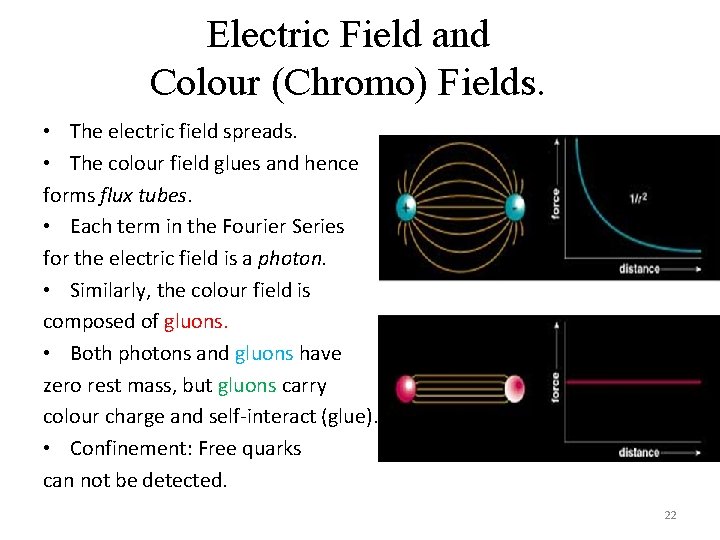
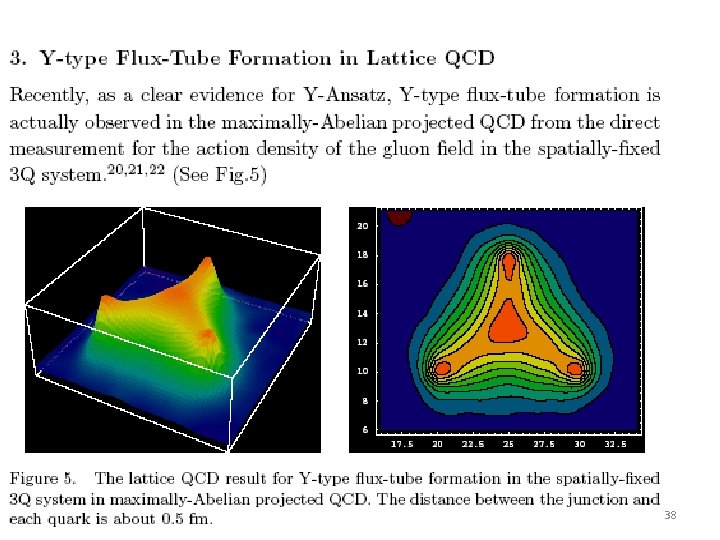
Electric Field and Colour (Chromo) Fields. • The electric field spreads. • The colour field glues and hence forms flux tubes. • Each term in the Fourier Series for the electric field is a photon. • Similarly, the colour field is composed of gluons. • Both photons and gluons have zero rest mass, but gluons carry colour charge and self-interact (glue). • Confinement: Free quarks can not be detected. 22
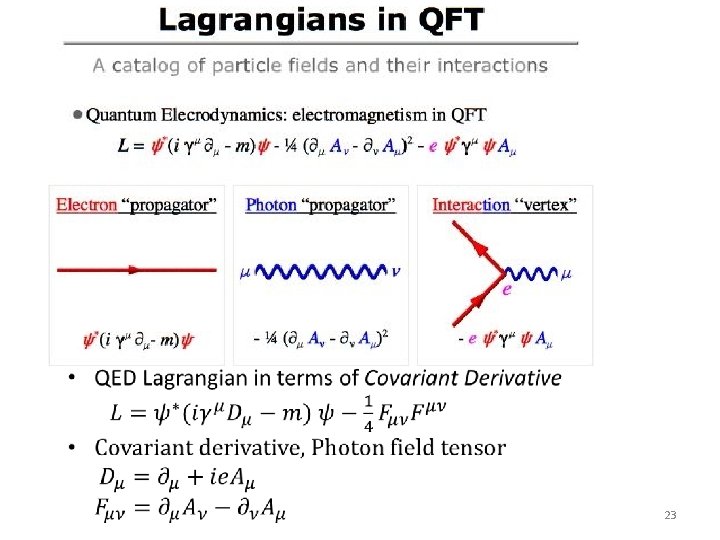
23
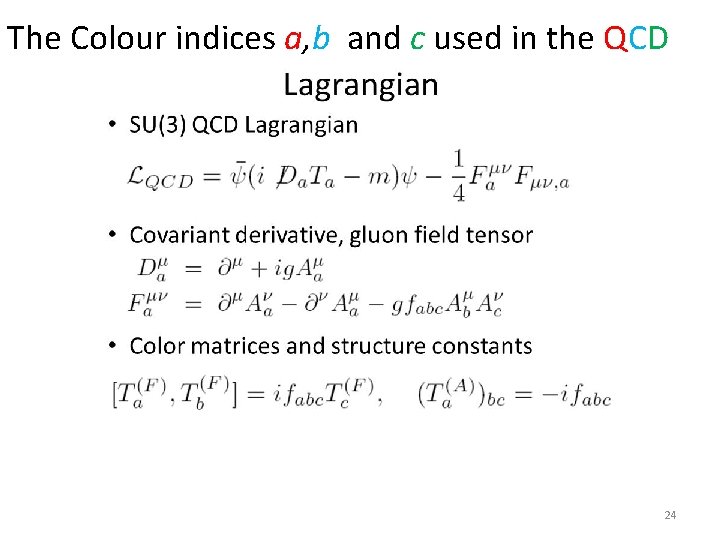
The Colour indices a, b and c used in the QCD 24
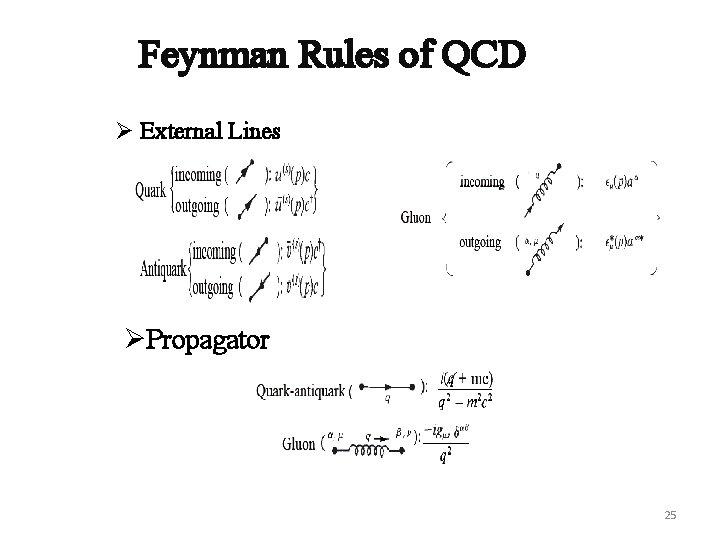
Feynman Rules of QCD Ø External Lines ØPropagator 25
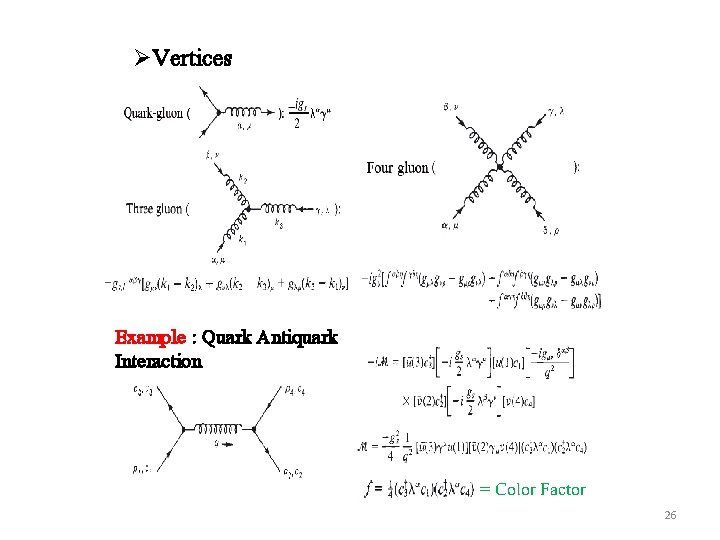
ØVertices Example : Quark Antiquark Interaction = Color Factor 26
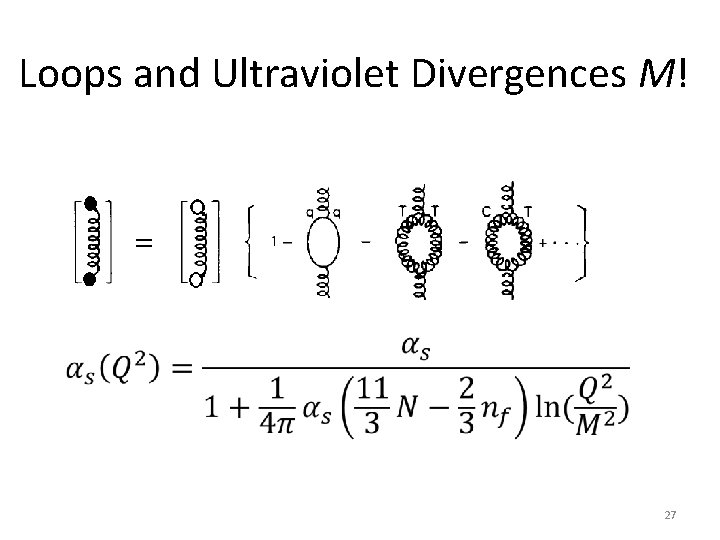
Loops and Ultraviolet Divergences M! • 27
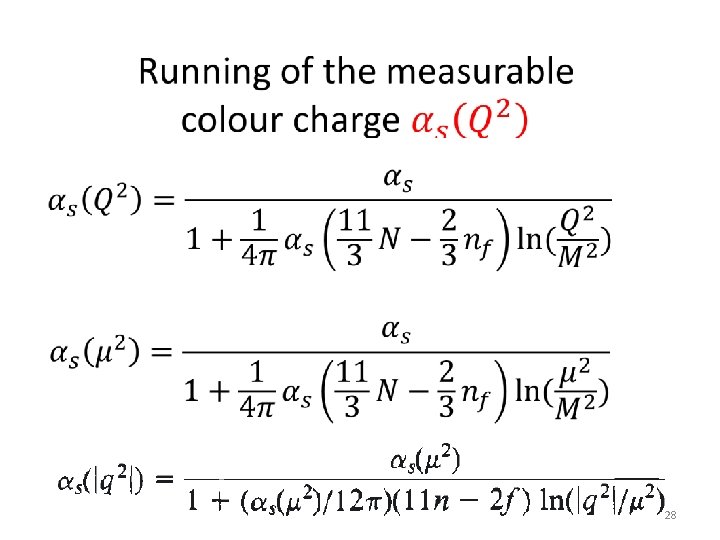
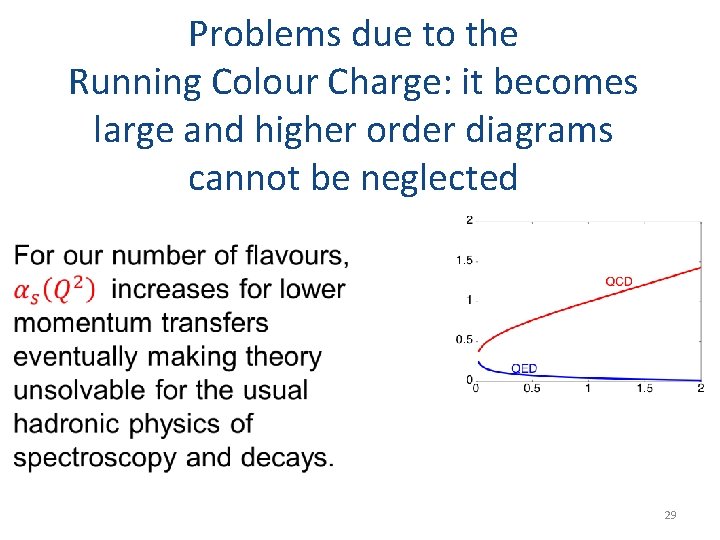
Problems due to the Running Colour Charge: it becomes large and higher order diagrams cannot be neglected 29
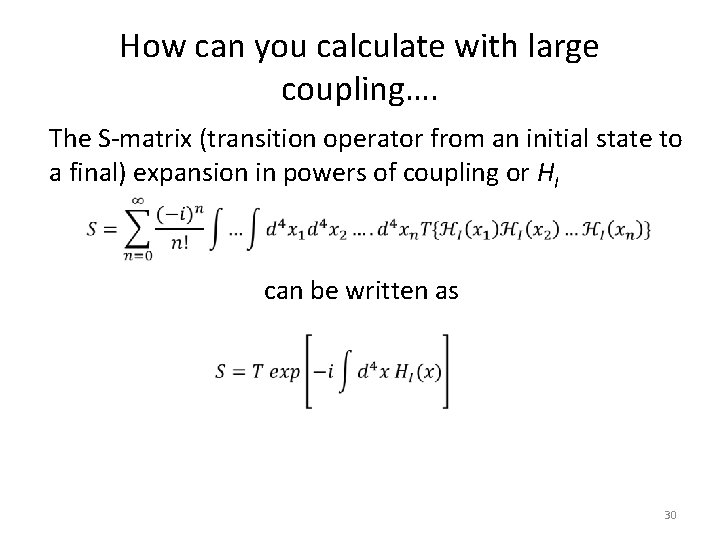
How can you calculate with large coupling…. The S-matrix (transition operator from an initial state to a final) expansion in powers of coupling or HI can be written as 30
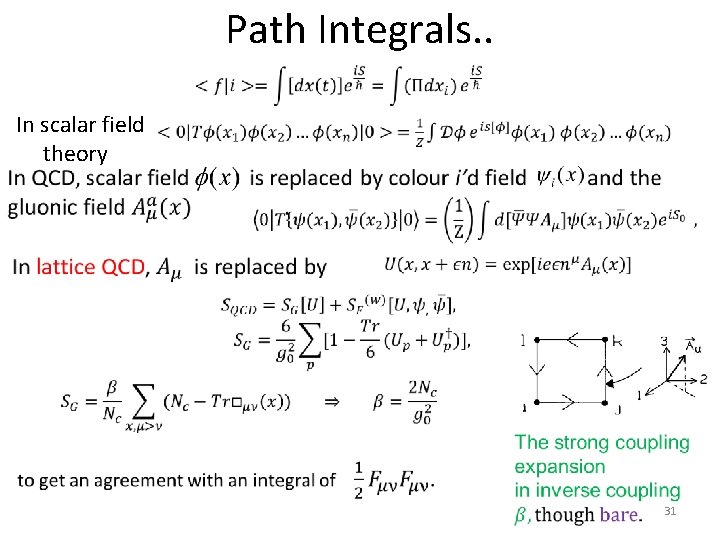
Path Integrals. . In scalar field theory 31
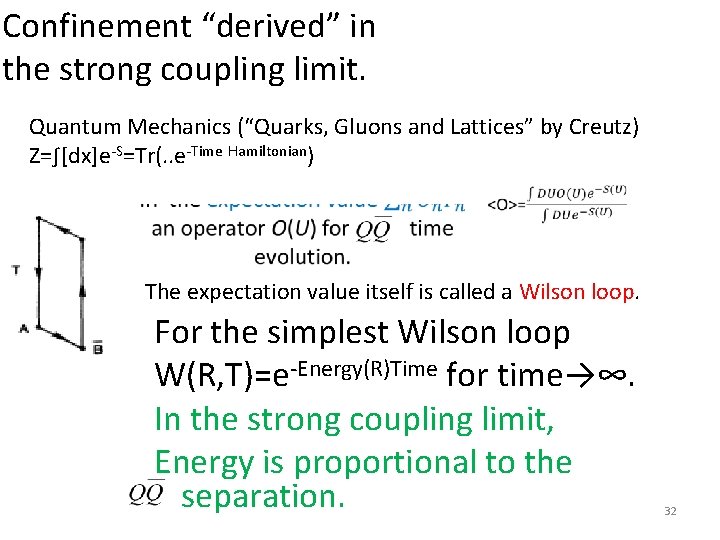
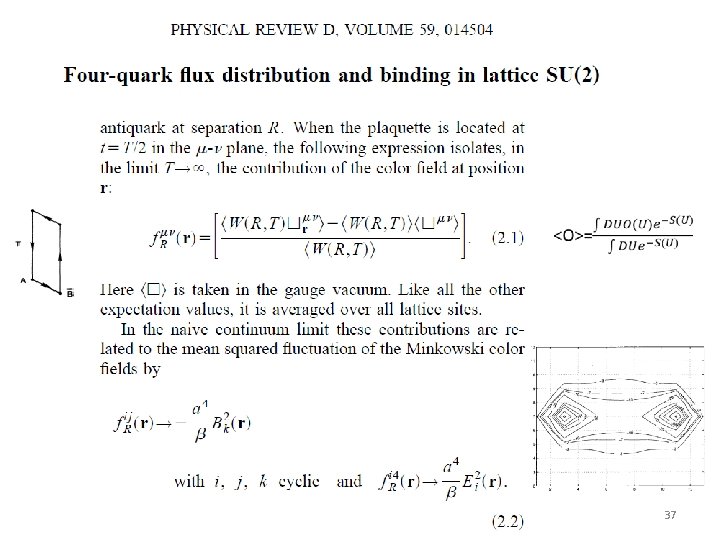
Confinement “derived” in the strong coupling limit. Quantum Mechanics (“Quarks, Gluons and Lattices” by Creutz) Z=∫[dx]e-S=Tr(. . e-Time Hamiltonian) The expectation value itself is called a Wilson loop. For the simplest Wilson loop W(R, T)=e-Energy(R)Time for time→∞. In the strong coupling limit, Energy is proportional to the separation. 32
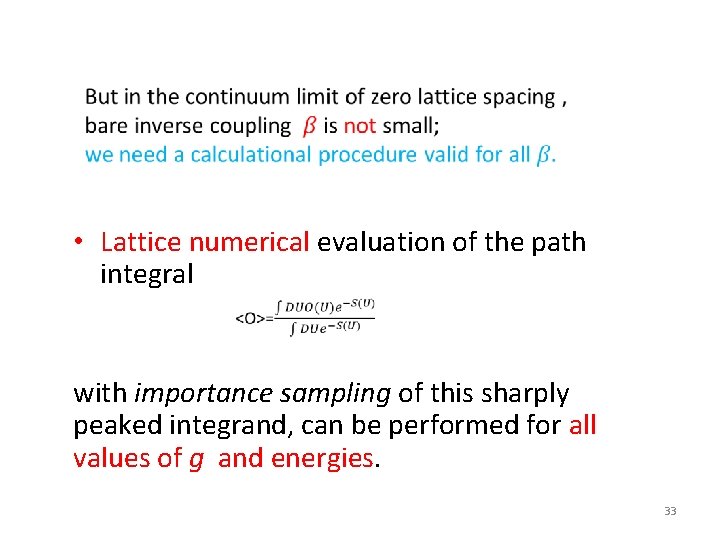
• Lattice numerical evaluation of the path integral with importance sampling of this sharply peaked integrand, can be performed for all values of g and energies. 33
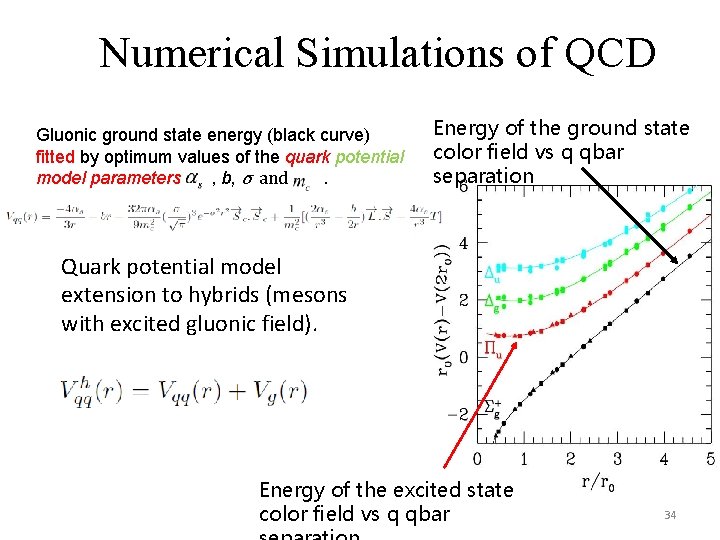
Numerical Simulations of QCD Gluonic ground state energy (black curve) fitted by optimum values of the quark potential model parameters , b, σ and. Energy of the ground state color field vs q qbar separation Quark potential model extension to hybrids (mesons with excited gluonic field). Energy of the excited state color field vs q qbar 34
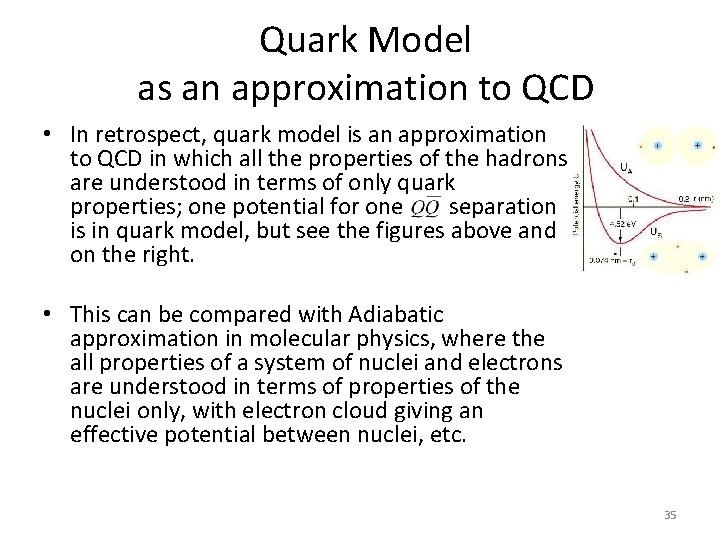
Quark Model as an approximation to QCD • In retrospect, quark model is an approximation to QCD in which all the properties of the hadrons are understood in terms of only quark properties; one potential for one separation is in quark model, but see the figures above and on the right. • This can be compared with Adiabatic approximation in molecular physics, where the all properties of a system of nuclei and electrons are understood in terms of properties of the nuclei only, with electron cloud giving an effective potential between nuclei, etc. 35
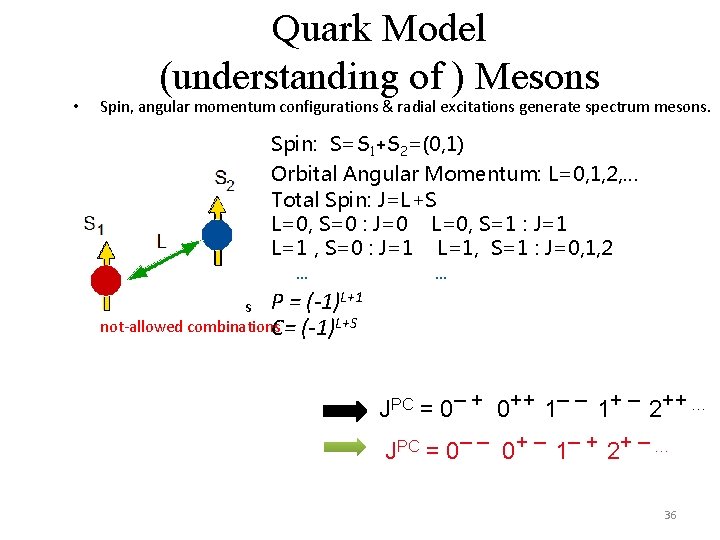
• Quark Model (understanding of ) Mesons Spin, angular momentum configurations & radial excitations generate spectrum mesons. Spin: S=S 1+S 2=(0, 1) Orbital Angular Momentum: L=0, 1, 2, … Total Spin: J=L+S L=0, S=0 : J=0 L=0, S=1 : J=1 L=1 , S=0 : J=1 L=1, S=1 : J=0, 1, 2 … … allowed combinations P = (-1) not-allowed combinations C= (-1)L+S L+1 JPC = 0– + 0++ 1– – 1+ – 2++ … JPC = 0– – 0+ – 1– + 2+ – … 36
37
38
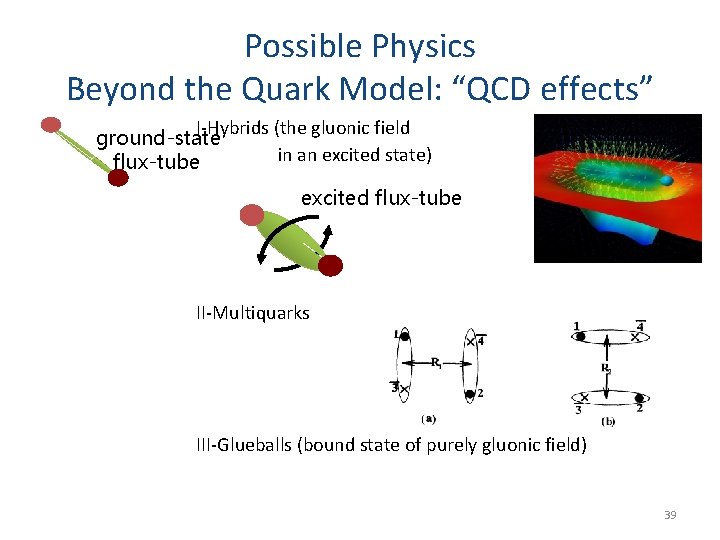
Possible Physics Beyond the Quark Model: “QCD effects” I-Hybrids (the gluonic field ground-state in an excited state) flux-tube excited flux-tube II-Multiquarks III-Glueballs (bound state of purely gluonic field) 39
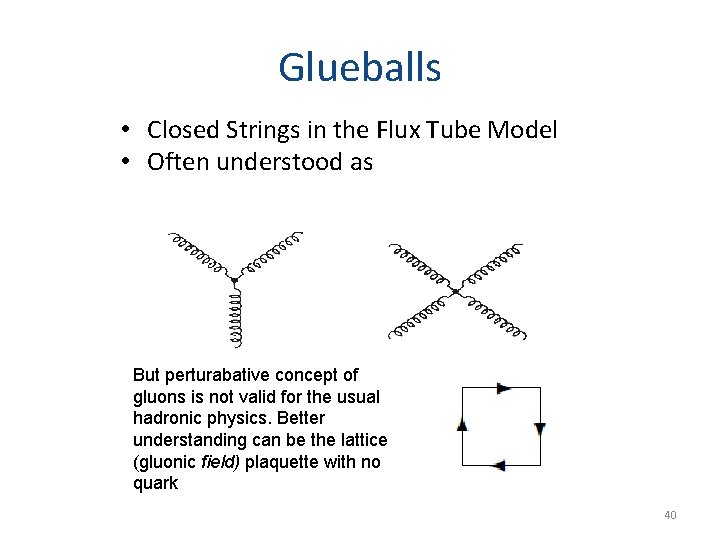
Glueballs • Closed Strings in the Flux Tube Model • Often understood as But perturabative concept of gluons is not valid for the usual hadronic physics. Better understanding can be the lattice (gluonic field) plaquette with no quark 40
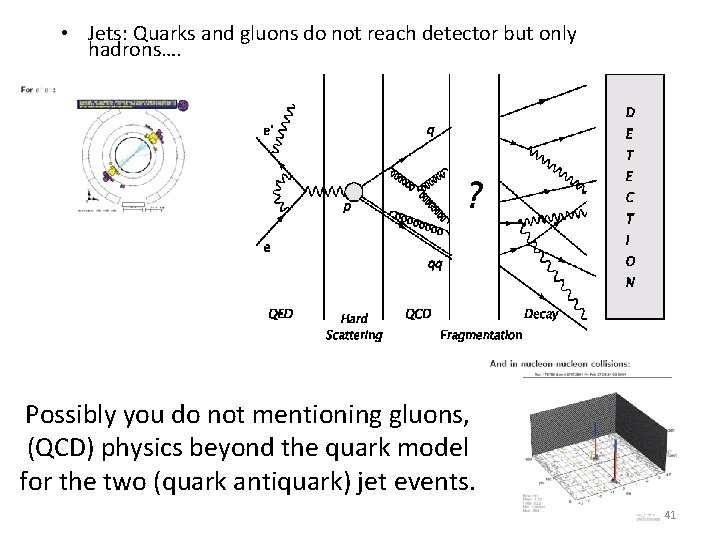
• Jets: Quarks and gluons do not reach detector but only hadrons…. Possibly you do not mentioning gluons, (QCD) physics beyond the quark model for the two (quark antiquark) jet events. 41
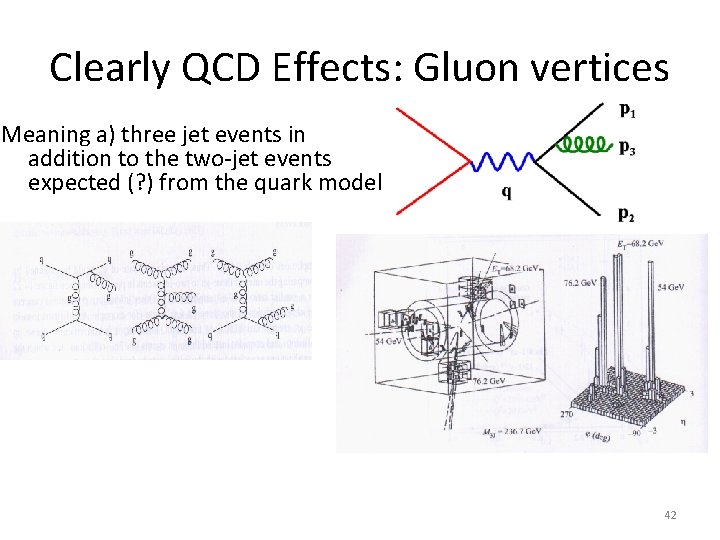
Clearly QCD Effects: Gluon vertices Meaning a) three jet events in addition to the two-jet events expected (? ) from the quark model 42
Summary • Not all properties of hadrons can be understood through QED; QCD is also needed. • Gluon self interaction and the resulting opposite trend in the running of the colour charge makes QCD much different to QED. • If quark properties are not sufficient to describe a phenomenon, it is a failure of the quark model and is called a “QCD effect”. 43
- Slides: 43