
QC Your RDBMS Data Using Dictionary Tables Harry
QC Your RDBMS Data Using Dictionary Tables Harry Droogendyk Stratia Consulting Inc.
QC Data n n ETL process data summarization test data creation verifying data is a good thing!
QC Data n rudimentary data QC n continuous n numeric variables n n eg. weight, balance count, min, max, sum, mean, stddev not all numeric data are really numbers categorical n frequency distributions
QC Data n what’s involved? n separate data into three categories n n n continuous categorical junk generate numeric analysis generate frequency distributions
QC Data n lazy programmers n n n don’t want to hard-code don’t want to think…. too much do want to be productive can we let the data drive the process?
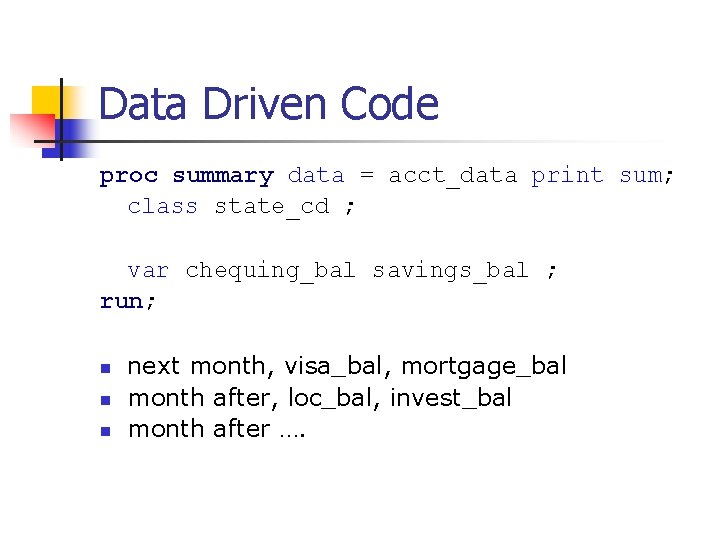
Data Driven Code proc summary data = acct_data print sum; class state_cd ; var chequing_bal savings_bal ; run; n next month, visa_bal, mortgage_bal month after, loc_bal, invest_bal month after ….
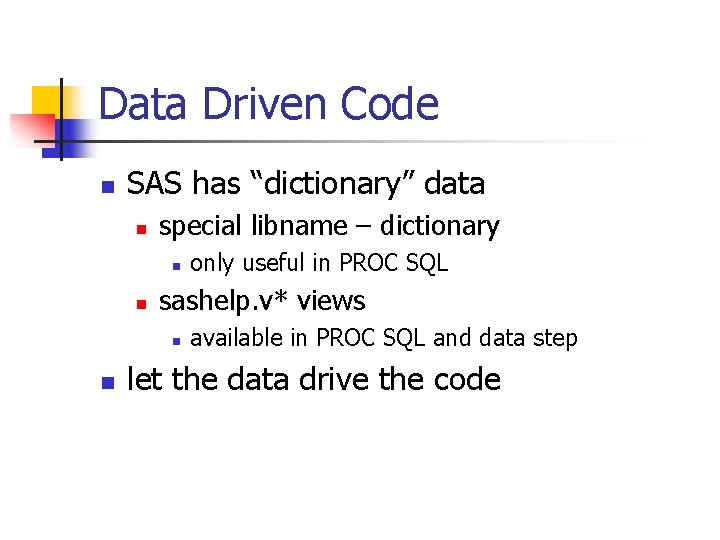
Data Driven Code n SAS has “dictionary” data n special libname – dictionary n n sashelp. v* views n n only useful in PROC SQL available in PROC SQL and data step let the data drive the code
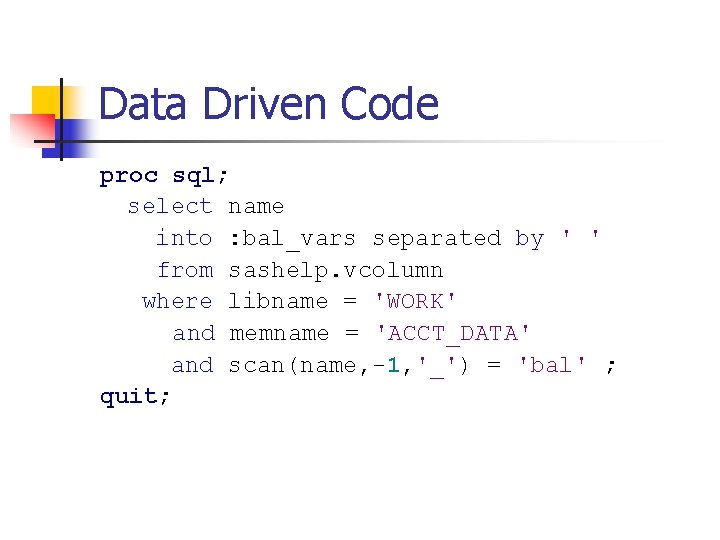
Data Driven Code proc sql; select name into : bal_vars separated by ' ' from sashelp. vcolumn where libname = 'WORK' and memname = 'ACCT_DATA' and scan(name, -1, '_') = 'bal' ; quit;
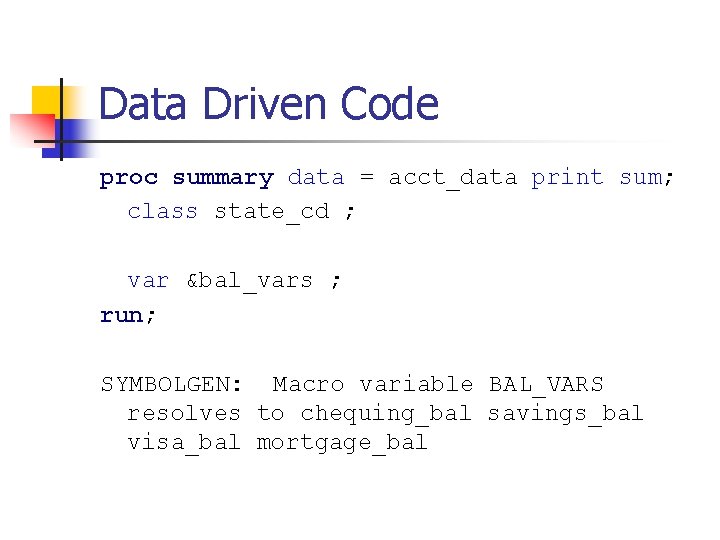
Data Driven Code proc summary data = acct_data print sum; class state_cd ; var &bal_vars ; run; SYMBOLGEN: Macro variable BAL_VARS resolves to chequing_bal savings_bal visa_bal mortgage_bal
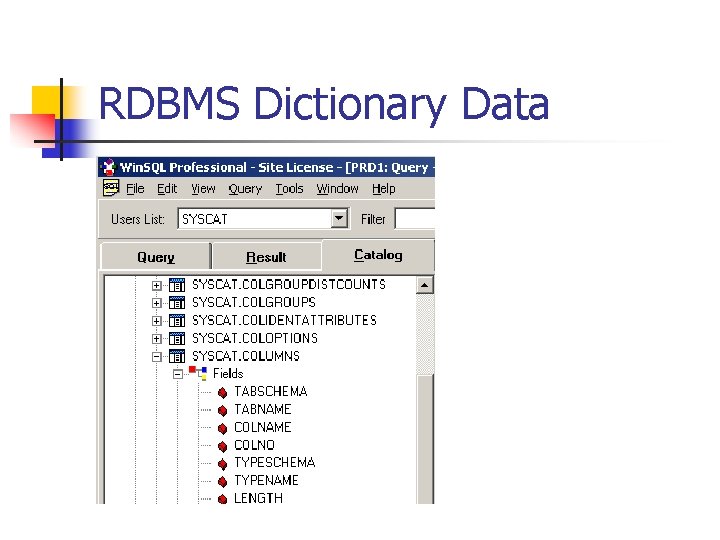
RDBMS Dictionary Data
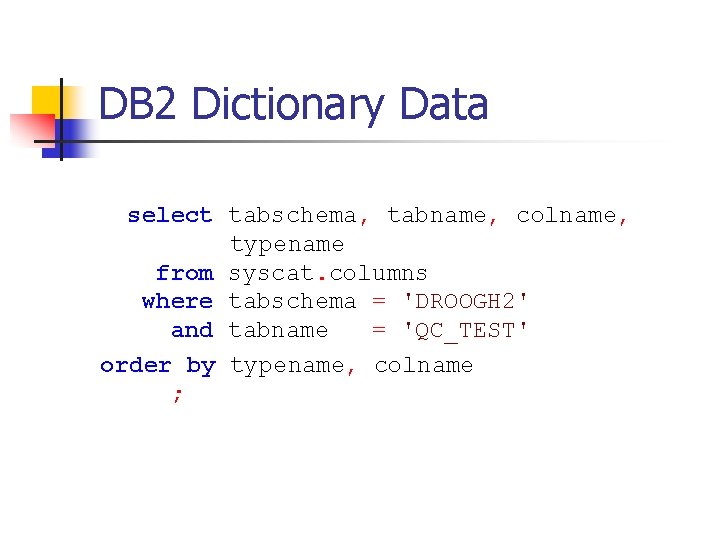
DB 2 Dictionary Data select tabschema, tabname, colname, typename from syscat. columns where tabschema = 'DROOGH 2' and tabname = 'QC_TEST' order by typename, colname ;
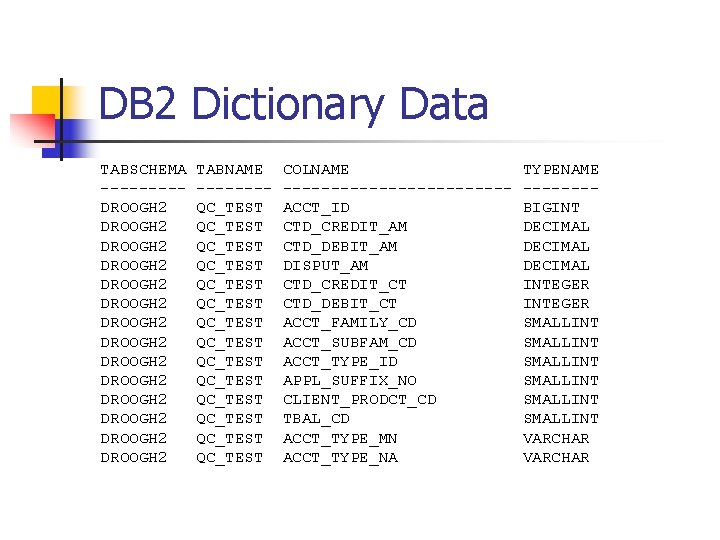
DB 2 Dictionary Data TABSCHEMA ----DROOGH 2 DROOGH 2 DROOGH 2 DROOGH 2 TABNAME -------QC_TEST QC_TEST QC_TEST QC_TEST COLNAME ------------ACCT_ID CTD_CREDIT_AM CTD_DEBIT_AM DISPUT_AM CTD_CREDIT_CT CTD_DEBIT_CT ACCT_FAMILY_CD ACCT_SUBFAM_CD ACCT_TYPE_ID APPL_SUFFIX_NO CLIENT_PRODCT_CD TBAL_CD ACCT_TYPE_MN ACCT_TYPE_NA TYPENAME -------BIGINT DECIMAL INTEGER SMALLINT SMALLINT VARCHAR

Teradata Dictionary Data select tablename, columntype from dbc. columns where databasename = ‘SANDBOX' and tablename = 'QC_TEST' order by columntype, columnname ;
RDBMS Dictionary Data n RDBMS metadata extraction n database specific syntax argh… SAS rules ! n n RDBMS libnames proc contents
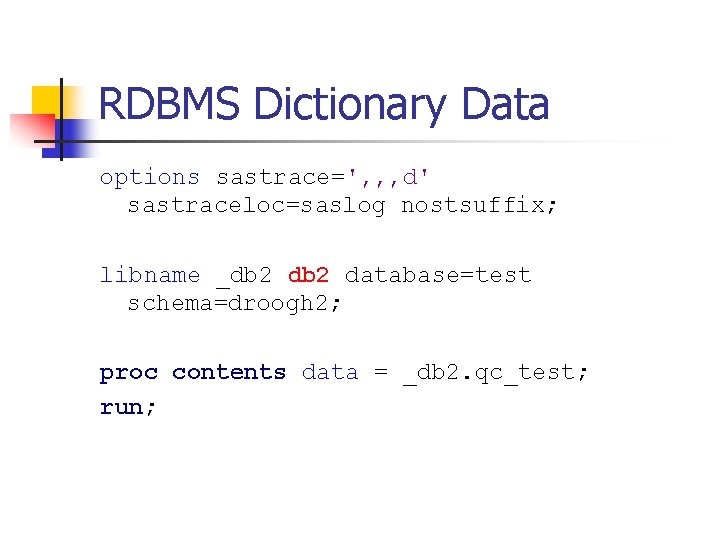
RDBMS Dictionary Data options sastrace=', , , d' sastraceloc=saslog nostsuffix; libname _db 2 database=test schema=droogh 2; proc contents data = _db 2. qc_test; run;
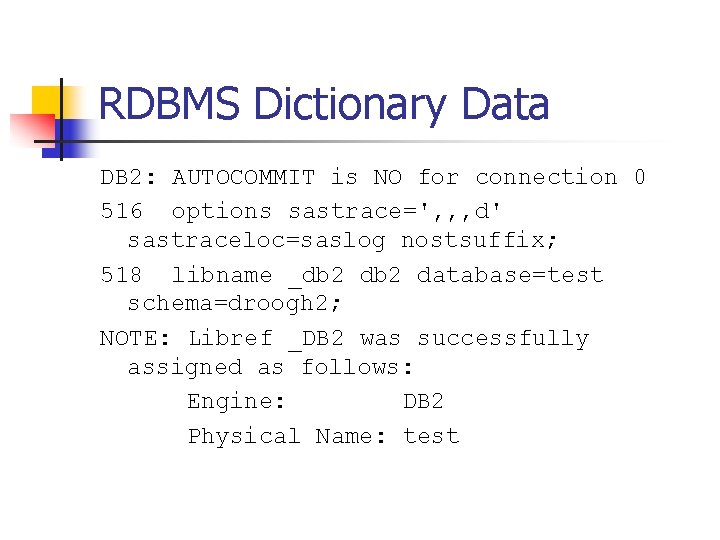
RDBMS Dictionary Data DB 2: AUTOCOMMIT is NO for connection 0 516 options sastrace=', , , d' sastraceloc=saslog nostsuffix; 518 libname _db 2 database=test schema=droogh 2; NOTE: Libref _DB 2 was successfully assigned as follows: Engine: DB 2 Physical Name: test
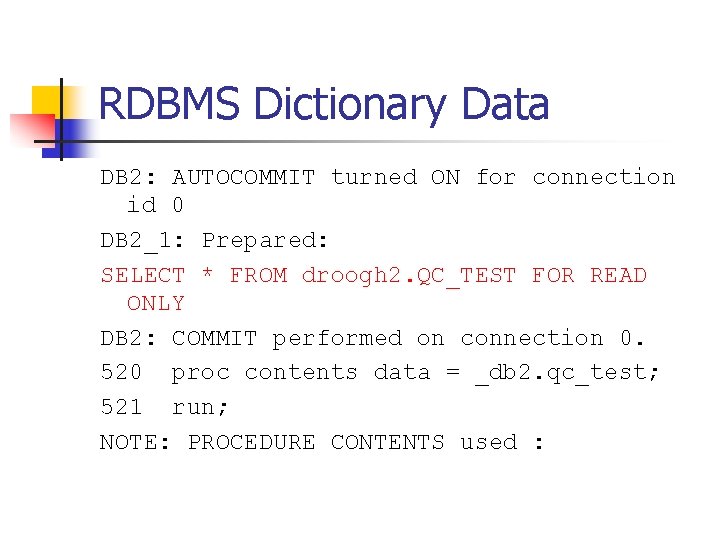
RDBMS Dictionary Data DB 2: AUTOCOMMIT turned ON for connection id 0 DB 2_1: Prepared: SELECT * FROM droogh 2. QC_TEST FOR READ ONLY DB 2: COMMIT performed on connection 0. 520 proc contents data = _db 2. qc_test; 521 run; NOTE: PROCEDURE CONTENTS used :
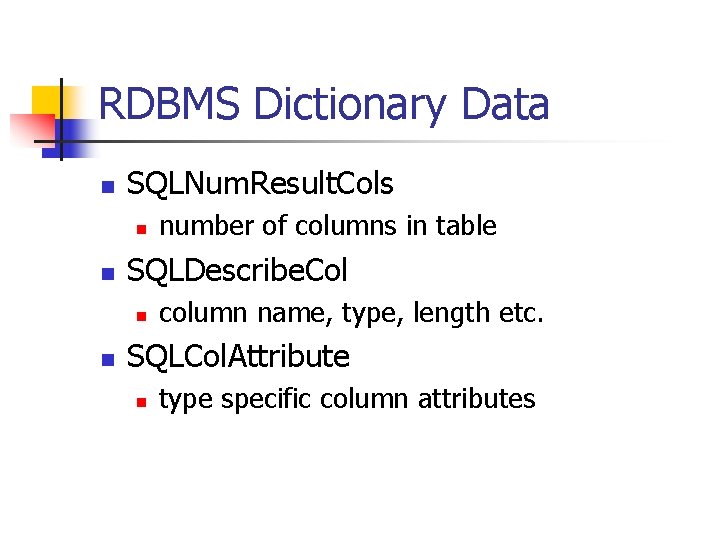
RDBMS Dictionary Data n SQLNum. Result. Cols n n SQLDescribe. Col n n number of columns in table column name, type, length etc. SQLCol. Attribute n type specific column attributes
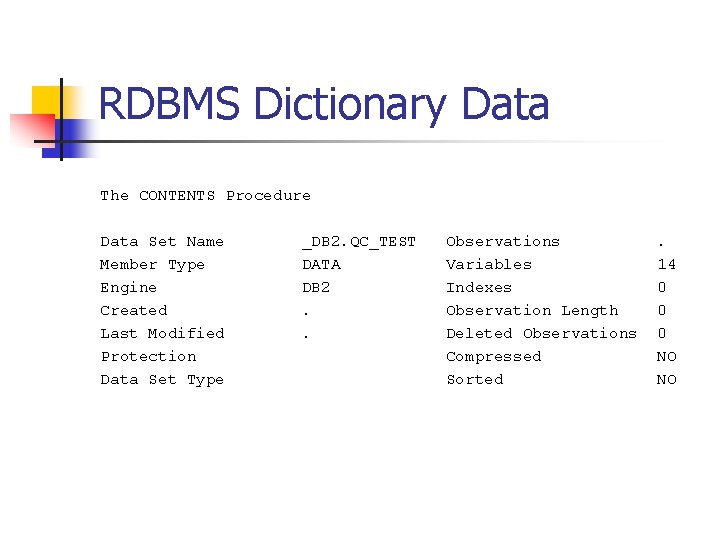
RDBMS Dictionary Data The CONTENTS Procedure Data Set Name Member Type Engine Created Last Modified Protection Data Set Type _DB 2. QC_TEST DATA DB 2. . Observations Variables Indexes Observation Length Deleted Observations Compressed Sorted . 14 0 0 0 NO NO
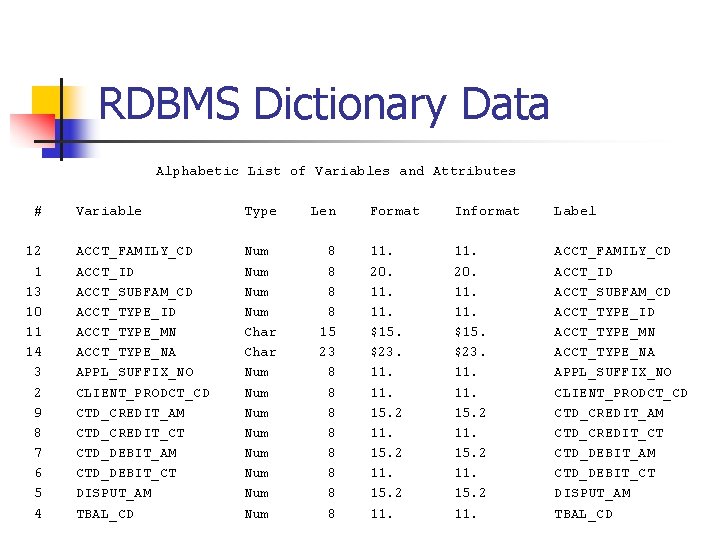
RDBMS Dictionary Data Alphabetic List of Variables and Attributes # 12 1 13 10 11 14 3 2 9 8 7 6 5 4 Variable Type Len ACCT_FAMILY_CD ACCT_ID ACCT_SUBFAM_CD ACCT_TYPE_ID ACCT_TYPE_MN ACCT_TYPE_NA APPL_SUFFIX_NO CLIENT_PRODCT_CD CTD_CREDIT_AM CTD_CREDIT_CT CTD_DEBIT_AM CTD_DEBIT_CT DISPUT_AM TBAL_CD Num Num Char Num Num 8 8 15 23 8 8 8 8 Format Informat Label 11. 20. 11. 11. $15. $23. 11. 11. 15. 2 11. ACCT_FAMILY_CD ACCT_ID ACCT_SUBFAM_CD ACCT_TYPE_ID ACCT_TYPE_MN ACCT_TYPE_NA APPL_SUFFIX_NO CLIENT_PRODCT_CD CTD_CREDIT_AM CTD_CREDIT_CT CTD_DEBIT_AM CTD_DEBIT_CT DISPUT_AM TBAL_CD
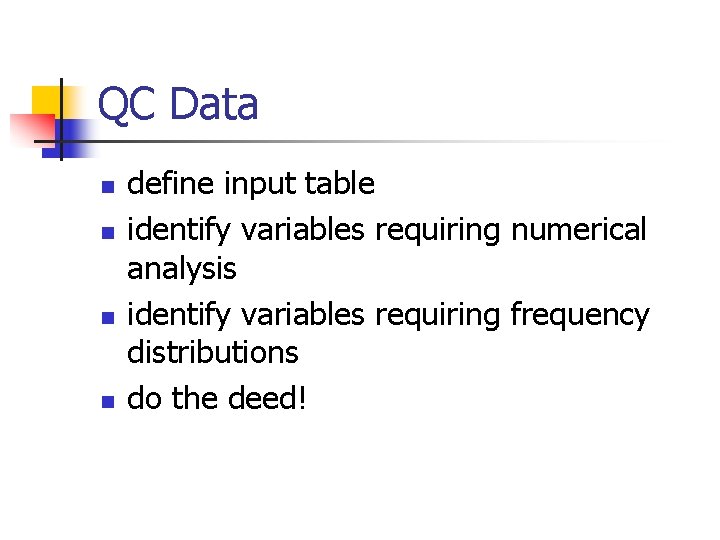
QC Data n n define input table identify variables requiring numerical analysis identify variables requiring frequency distributions do the deed!
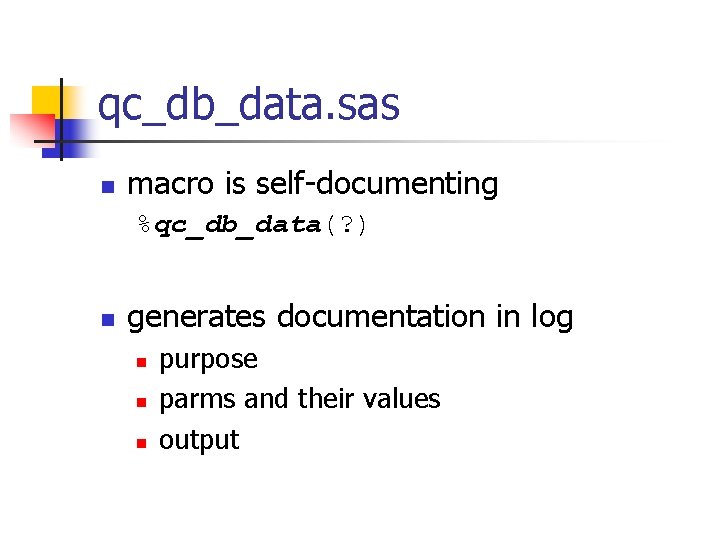
qc_db_data. sas n macro is self-documenting %qc_db_data(? ) n generates documentation in log n n n purpose parms and their values output
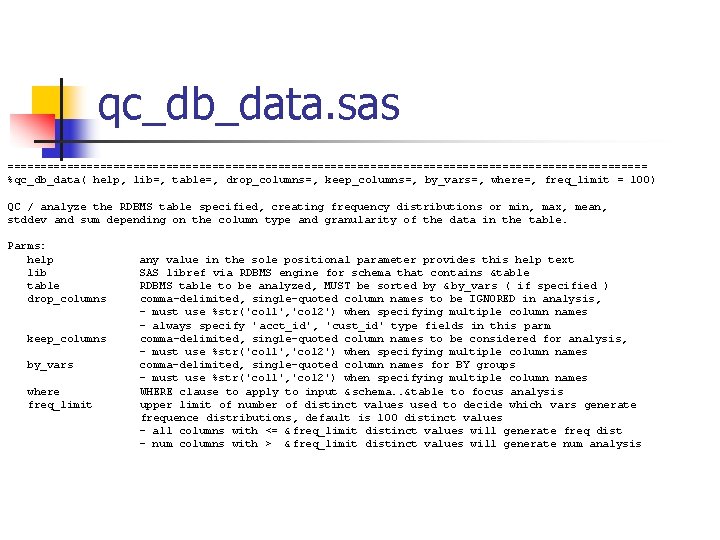
qc_db_data. sas ================================================= %qc_db_data( help, lib=, table=, drop_columns=, keep_columns=, by_vars=, where=, freq_limit = 100) QC / analyze the RDBMS table specified, creating frequency distributions or min, max, mean, stddev and sum depending on the column type and granularity of the data in the table. Parms: help lib table drop_columns keep_columns by_vars where freq_limit any value in the sole positional parameter provides this help text SAS libref via RDBMS engine for schema that contains &table RDBMS table to be analyzed, MUST be sorted by & by_vars ( if specified ) comma-delimited, single-quoted column names to be IGNORED in analysis, - must use %str('col 1', 'col 2') when specifying multiple column names - always specify 'acct_id', 'cust_id' type fields in this parm comma-delimited, single-quoted column names to be considered for analysis, - must use %str('col 1', 'col 2') when specifying multiple column names comma-delimited, single-quoted column names for BY groups - must use %str('col 1', 'col 2') when specifying multiple column names WHERE clause to apply to input &schema. . &table to focus analysis upper limit of number of distinct values used to decide which vars generate frequence distributions, default is 100 distinct values - all columns with <= &freq_limit distinct values will generate freq dist - num columns with > &freq_limit distinct values will generate num analysis
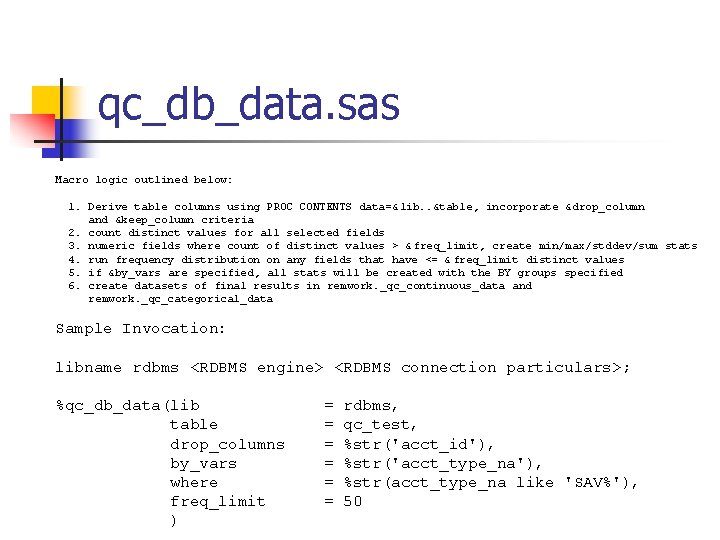
qc_db_data. sas Macro logic outlined below: 1. Derive table columns using PROC CONTENTS data=& lib. . &table, incorporate &drop_column and &keep_column criteria 2. count distinct values for all selected fields 3. numeric fields where count of distinct values > & freq_limit, create min/max/stddev/sum stats 4. run frequency distribution on any fields that have <= & freq_limit distinct values 5. if &by_vars are specified, all stats will be created with the BY groups specified 6. create datasets of final results in remwork. _qc_continuous_data and remwork. _qc_categorical_data Sample Invocation: libname rdbms <RDBMS engine> <RDBMS connection particulars>; %qc_db_data(lib table drop_columns by_vars where freq_limit ) = = = rdbms, qc_test, %str('acct_id'), %str('acct_type_na'), %str(acct_type_na like 'SAV%'), 50
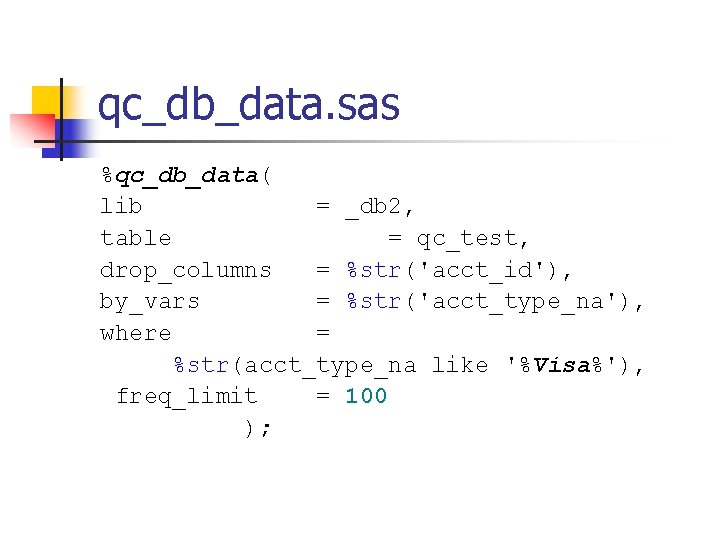
qc_db_data. sas %qc_db_data( lib = _db 2, table = qc_test, drop_columns = %str('acct_id'), by_vars = %str('acct_type_na'), where = %str(acct_type_na like '%Visa%'), freq_limit = 100 );
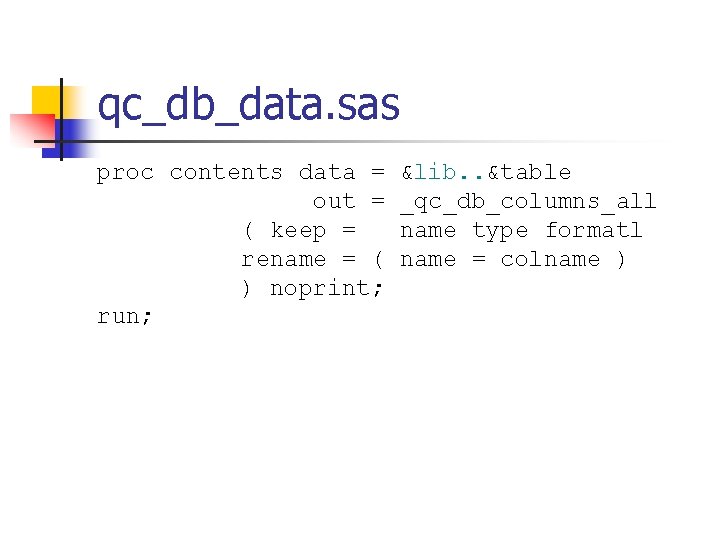
qc_db_data. sas proc contents data = out = ( keep = rename = ( ) noprint; run; &lib. . &table _qc_db_columns_all name type formatl name = colname )
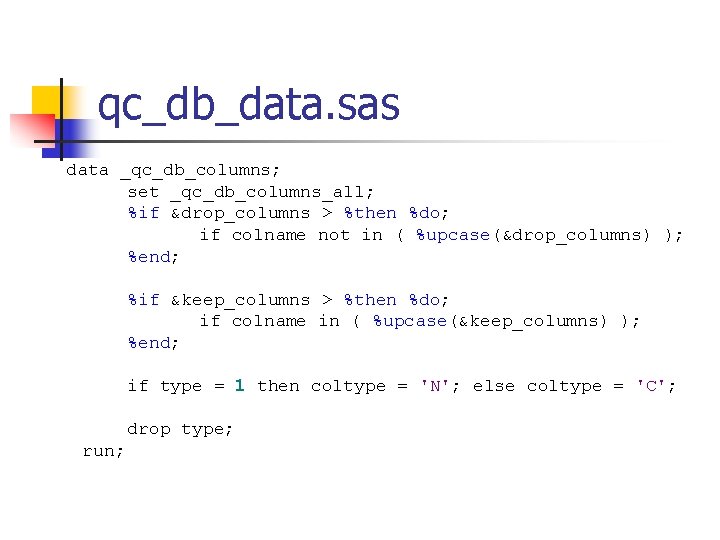
qc_db_data. sas data _qc_db_columns; set _qc_db_columns_all; %if &drop_columns > %then %do; if colname not in ( %upcase(&drop_columns) ); %end; %if &keep_columns > %then %do; if colname in ( %upcase(&keep_columns) ); %end; if type = 1 then coltype = 'N'; else coltype = 'C'; drop type; run;
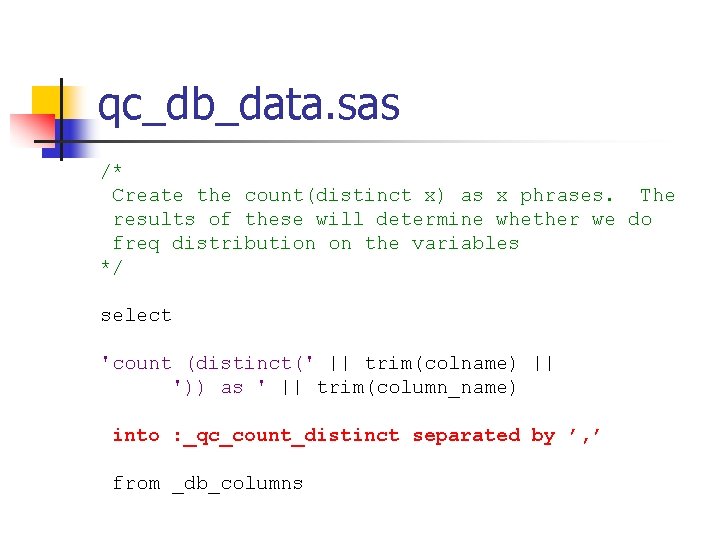
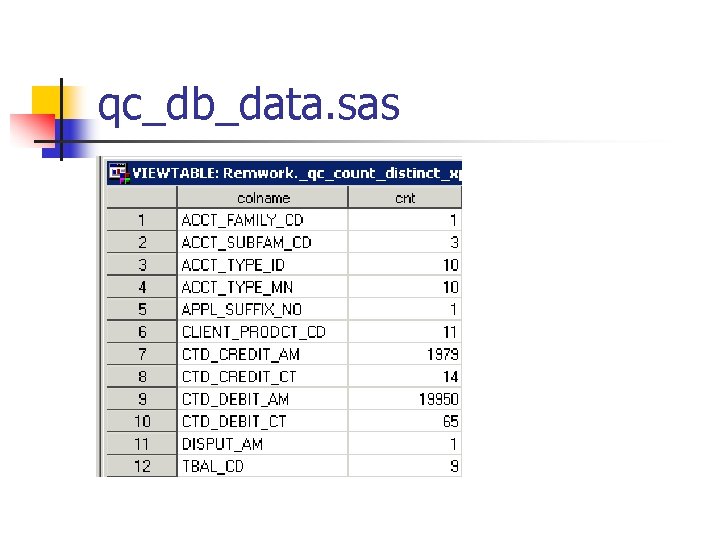
qc_db_data. sas /* Create the count(distinct x) as x phrases. The results of these will determine whether we do freq distribution on the variables */ select 'count (distinct(' || trim(colname) || ')) as ' || trim(column_name) into : _qc_count_distinct separated by ’, ’ from _db_columns
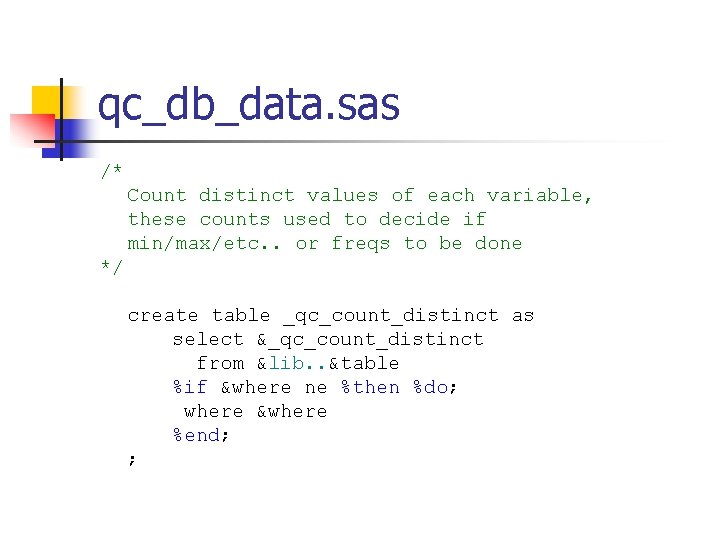
qc_db_data. sas /* Count distinct values of each variable, these counts used to decide if min/max/etc. . or freqs to be done */ create table _qc_count_distinct as select &_qc_count_distinct from &lib. . &table %if &where ne %then %do; where &where %end; ;
qc_db_data. sas
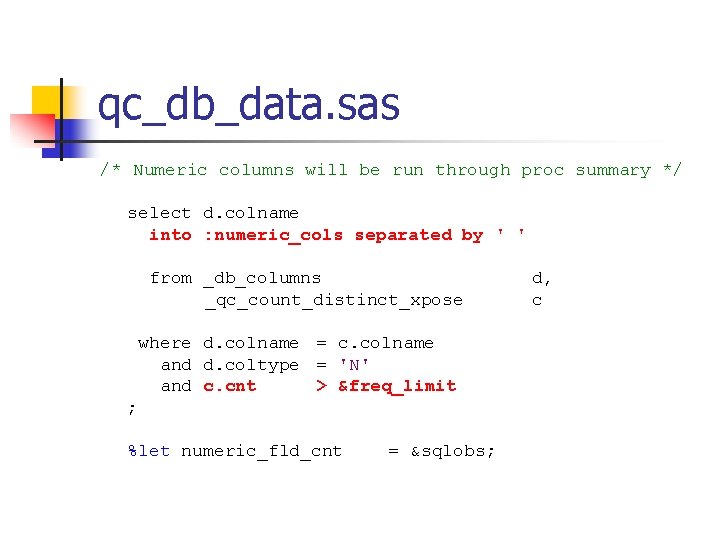
qc_db_data. sas /* Numeric columns will be run through proc summary */ select d. colname into : numeric_cols separated by ' ' from _db_columns _qc_count_distinct_xpose where d. colname = c. colname and d. coltype = 'N' and c. cnt > &freq_limit ; %let numeric_fld_cnt = &sqlobs; d, c
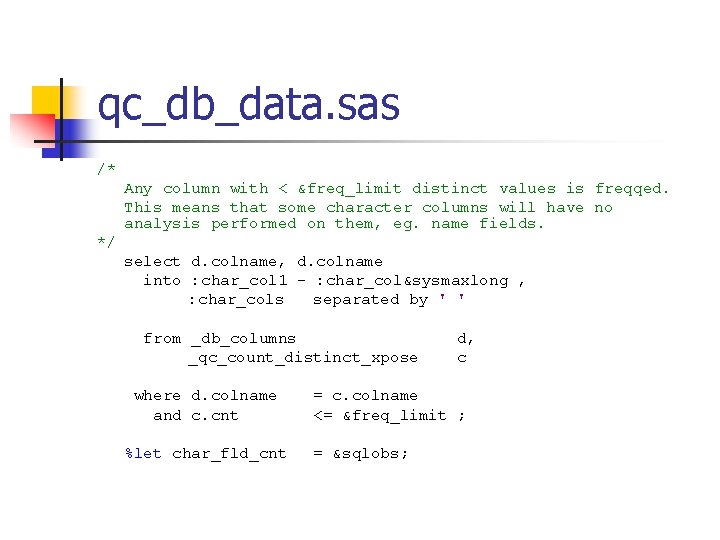
qc_db_data. sas /* Any column with < &freq_limit distinct values is freqqed. This means that some character columns will have no analysis performed on them, eg. name fields. */ select d. colname, d. colname into : char_col 1 - : char_col&sysmaxlong , : char_cols separated by ' ' from _db_columns _qc_count_distinct_xpose where d. colname and c. cnt %let char_fld_cnt d, c = c. colname <= &freq_limit ; = &sqlobs;
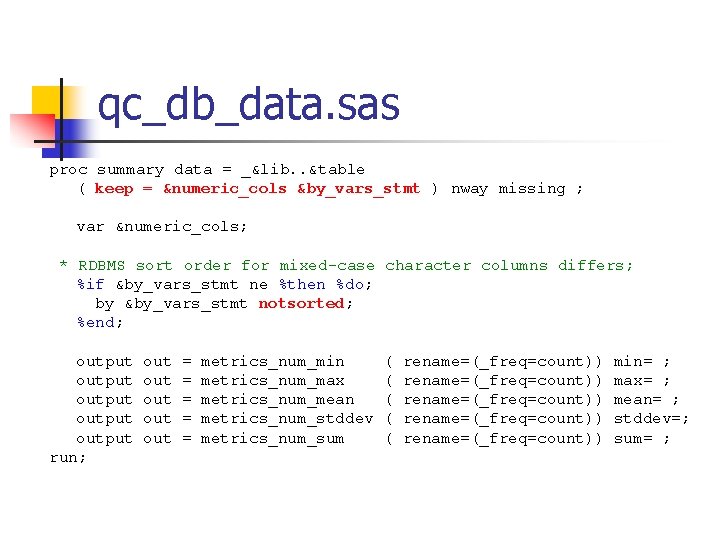
qc_db_data. sas proc summary data = _&lib. . &table ( keep = &numeric_cols &by_vars_stmt ) nway missing ; var &numeric_cols; * RDBMS sort order for mixed-case character columns differs; %if &by_vars_stmt ne %then %do; by &by_vars_stmt notsorted; %end; output output run; out out out = = = metrics_num_min metrics_num_max metrics_num_mean metrics_num_stddev metrics_num_sum ( ( ( rename=(_freq=count)) rename=(_freq=count)) min= ; max= ; mean= ; stddev=; sum= ;
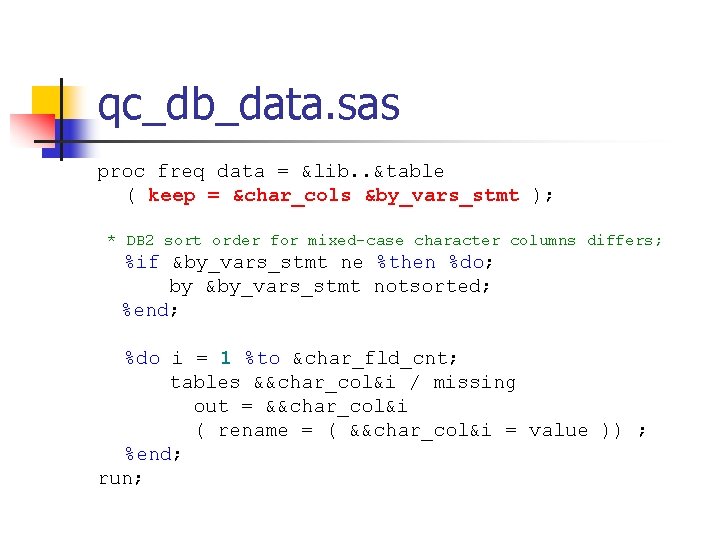
qc_db_data. sas proc freq data = &lib. . &table ( keep = &char_cols &by_vars_stmt ); * DB 2 sort order for mixed-case character columns differs; %if &by_vars_stmt ne %then %do; by &by_vars_stmt notsorted; %end; %do i = 1 %to &char_fld_cnt; tables &&char_col&i / missing out = &&char_col&i ( rename = ( &&char_col&i = value )) ; %end; run;
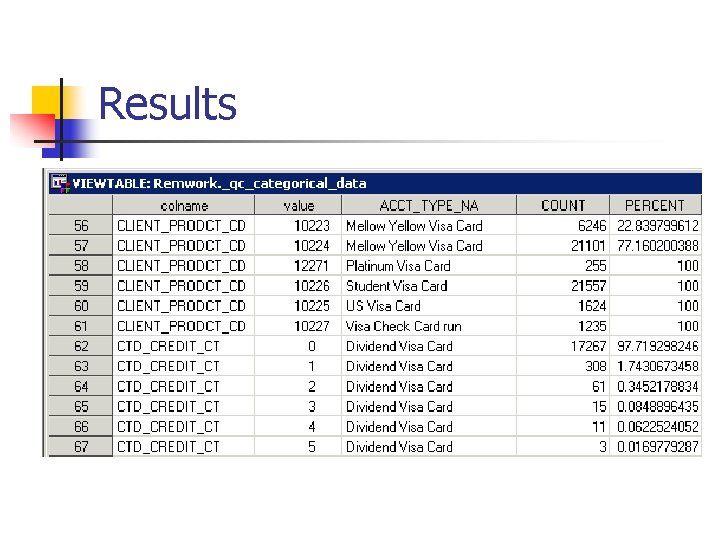
Results
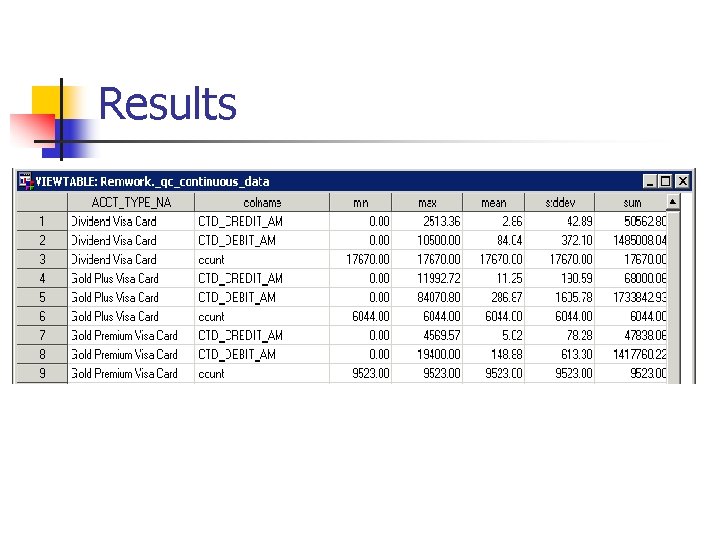
Results
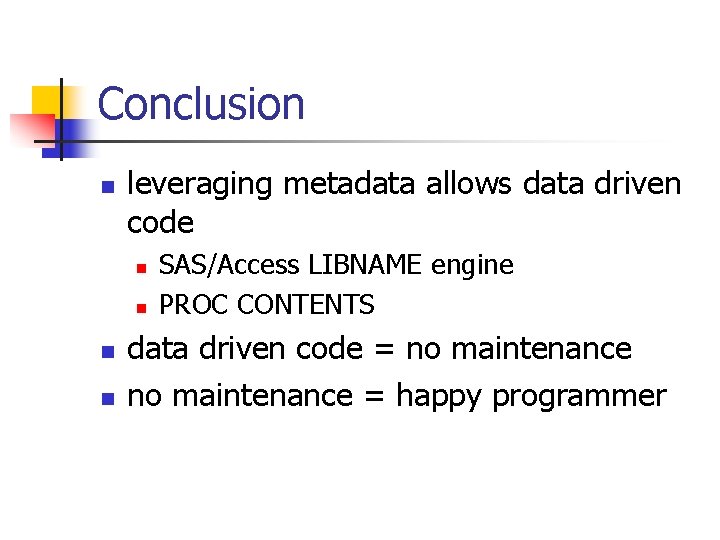
Conclusion n leveraging metadata allows data driven code n n SAS/Access LIBNAME engine PROC CONTENTS data driven code = no maintenance = happy programmer
Contact Harry Droogendyk, SAS Consultant conf@stratia. ca Phone: Web: 905 -512 -3827 www. stratia. ca/papers
- Slides: 38