
q Plant Tissues Tissue define as v It

- Slides: 9
q. Plant Tissues Ø Tissue define as: v. It is a group of homogenous cells having a common origin, structure and all of them together perform a similar or a set of similar functions. v. Classification of tissues: - Tissues are classified into two main groups depending on the capacity to divide into: v 1 -Meristematic or formative tissues (continuous state of division).
2 -Permanent tissues (majority, lost their power of division). q 1 -Meristematic or (formative tissues) Definition of Meristem: ØMeristem is a group of actively dividing cells that are in a continuous state of division to produce new cells, and responsible for the formation of another plant tissues.
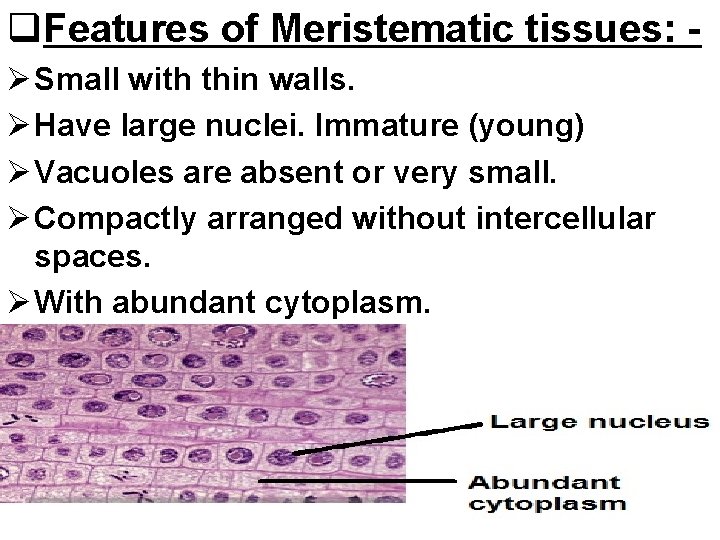
q. Features of Meristematic tissues: Ø Small with thin walls. Ø Have large nuclei. Immature (young) Ø Vacuoles are absent or very small. Ø Compactly arranged without intercellular spaces. Ø With abundant cytoplasm.
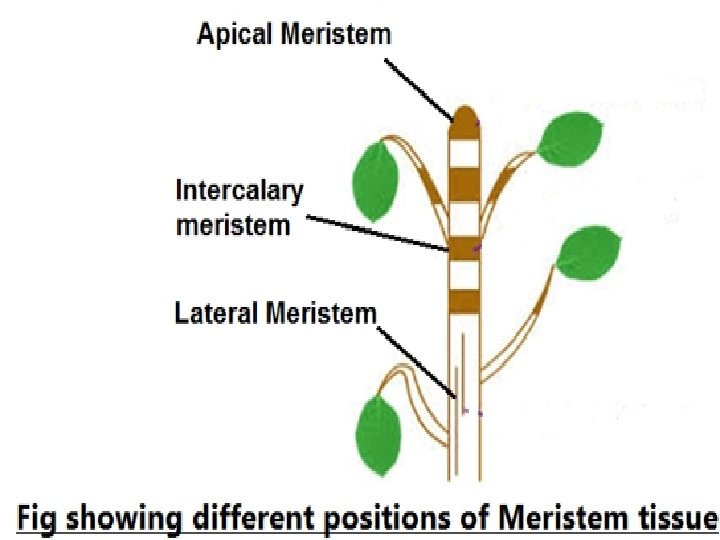
q. Classification of Meristems: Ø We can classify Meristems according to origin, position and function. Ø (1) Classification of Meristems based on origin and development: On the basis of origin meristems can be divided into three types: q(i) Promeristem. qii) Primary meristem. q (iii) Secondary meristem.
q(i) Promeristem. ØIt is the early embryonic meristem. It further divides to form primary meristem.
q(ii) Primary meristem: ØThese are derived from promeristem. ØBuild up the primary body of the plant. Primary meristem differentiated into three types they are: ØProtoderm. ØProcambium. ØGround Meristem.
(a) Protoderm meristem: It is the outermost layer of the stem and root and develops into the epidermis. (b) Ground Meristem: It develops to form the ground tissue system, (cortex and pith). (c) Procambium meristem: It lies just inside and develops into the vascular tissues system (primary xylem and primary phloem).
q. Secondary meristem: ØIt is derived from permanent tissues that retain the power of division and become meristematic. Øe. g. Cork-cambium (produce periderm). Vascular-cambium (produce secondary xylem& secondary phloem). ØIts function adds to plant body secondary tissues that functionally replace the early formed tissue (primary tissues).