
q PCR of Human ERV 3 and Mouse
- Slides: 1
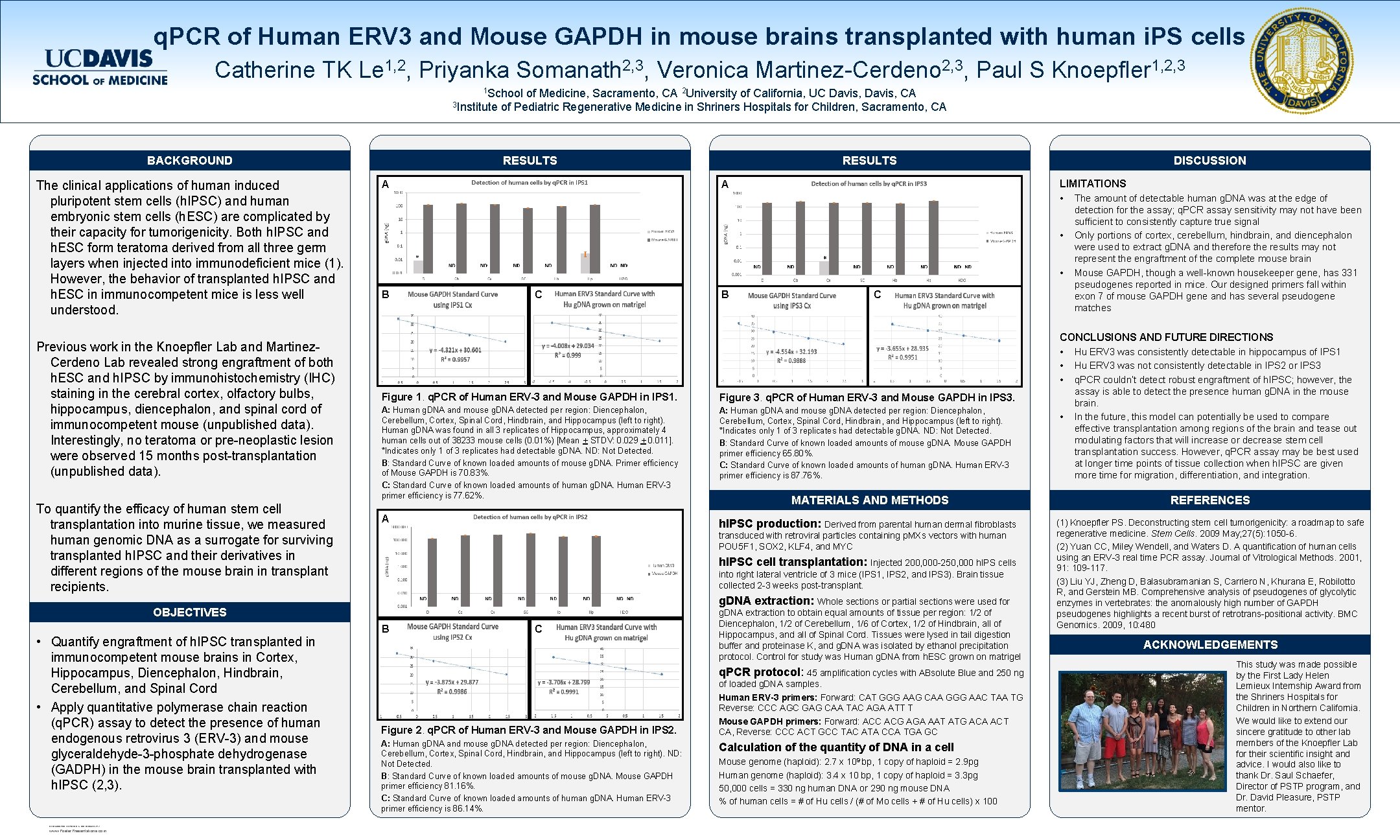
q. PCR of Human ERV 3 and Mouse GAPDH in mouse brains transplanted with human i. PS cells Catherine TK Le 1, 2, Priyanka Somanath 2, 3, Veronica Martinez-Cerdeno 2, 3, Paul S Knoepfler 1, 2, 3 1 School of Medicine, Sacramento, CA 2 University of California, UC Davis, CA 3 Institute of Pediatric Regenerative Medicine in Shriners Hospitals for Children, Sacramento, CA RESULTS BACKGROUND The clinical applications of human induced pluripotent stem cells (h. IPSC) and human embryonic stem cells (h. ESC) are complicated by their capacity for tumorigenicity. Both h. IPSC and h. ESC form teratoma derived from all three germ layers when injected into immunodeficient mice (1). However, the behavior of transplanted h. IPSC and h. ESC in immunocompetent mice is less well understood. Previous work in the Knoepfler Lab and Martinez. Cerdeno Lab revealed strong engraftment of both h. ESC and h. IPSC by immunohistochemistry (IHC) staining in the cerebral cortex, olfactory bulbs, hippocampus, diencephalon, and spinal cord of immunocompetent mouse (unpublished data). Interestingly, no teratoma or pre-neoplastic lesion were observed 15 months post-transplantation (unpublished data). To quantify the efficacy of human stem cell transplantation into murine tissue, we measured human genomic DNA as a surrogate for surviving transplanted h. IPSC and their derivatives in different regions of the mouse brain in transplant recipients. A RESEARCH POSTER PRESENTATION DESIGN © 2012 www. Poster. Presentations. com DISCUSSION LIMITATIONS • The amount of detectable human g. DNA was at the edge of A • • B C detection for the assay; q. PCR assay sensitivity may not have been sufficient to consistently capture true signal Only portions of cortex, cerebellum, hindbrain, and diencephalon were used to extract g. DNA and therefore the results may not represent the engraftment of the complete mouse brain Mouse GAPDH, though a well-known housekeeper gene, has 331 pseudogenes reported in mice. Our designed primers fall within exon 7 of mouse GAPDH gene and has several pseudogene matches CONCLUSIONS AND FUTURE DIRECTIONS • Hu ERV 3 was consistently detectable in hippocampus of IPS 1 • Hu ERV 3 was not consistently detectable in IPS 2 or IPS 3 • q. PCR couldn’t detect robust engraftment of h. IPSC; however, the assay is able to detect the presence human g. DNA in the mouse brain. In the future, this model can potentially be used to compare effective transplantation among regions of the brain and tease out modulating factors that will increase or decrease stem cell transplantation success. However, q. PCR assay may be best used at longer time points of tissue collection when h. IPSC are given more time for migration, differentiation, and integration. Figure 1. q. PCR of Human ERV-3 and Mouse GAPDH in IPS 1. Figure 3. q. PCR of Human ERV-3 and Mouse GAPDH in IPS 3. A: Human g. DNA and mouse g. DNA detected per region: Diencephalon, Cerebellum, Cortex, Spinal Cord, Hindbrain, and Hippocampus (left to right). Human g. DNA was found in all 3 replicates of Hippocampus, approximately 4 human cells out of 38233 mouse cells (0. 01%) [Mean + STDV: 0. 029 + 0. 011]. *Indicates only 1 of 3 replicates had detectable g. DNA. ND: Not Detected. B: Standard Curve of known loaded amounts of mouse g. DNA. Primer efficiency of Mouse GAPDH is 70. 83%. C: Standard Curve of known loaded amounts of human g. DNA. Human ERV-3 primer efficiency is 77. 62%. A: Human g. DNA and mouse g. DNA detected per region: Diencephalon, Cerebellum, Cortex, Spinal Cord, Hindbrain, and Hippocampus (left to right). *Indicates only 1 of 3 replicates had detectable g. DNA. ND: Not Detected. B: Standard Curve of known loaded amounts of mouse g. DNA. Mouse GAPDH primer efficiency 65. 80%. C: Standard Curve of known loaded amounts of human g. DNA. Human ERV-3 primer efficiency is 87. 76%. MATERIALS AND METHODS REFERENCES A h. IPSC production: Derived from parental human dermal fibroblasts (1) Knoepfler PS. Deconstructing stem cell tumorigenicity: a roadmap to safe regenerative medicine. Stem Cells. 2009 May; 27(5): 1050 -6. (2) Yuan CC, Miley Wendell, and Waters D. A quantification of human cells using an ERV-3 real time PCR assay. Journal of Vitrological Methods. 2001, 91: 109 -117. (3) Liu YJ, Zheng D, Balasubramanian S, Carriero N, Khurana E, Robilotto R, and Gerstein MB. Comprehensive analysis of pseudogenes of glycolytic enzymes in vertebrates: the anomalously high number of GAPDH pseudogenes highlights a recent burst of retrotrans-positional activity. BMC Genomics. 2009, 10: 480 transduced with retroviral particles containing p. MXs vectors with human POU 5 F 1, SOX 2, KLF 4, and MYC h. IPSC cell transplantation: Injected 200, 000 -250, 000 h. IPS cells into right lateral ventricle of 3 mice (IPS 1, IPS 2, and IPS 3). Brain tissue collected 2 -3 weeks post-transplant. g. DNA extraction: Whole sections or partial sections were used for OBJECTIVES • Quantify engraftment of h. IPSC transplanted in immunocompetent mouse brains in Cortex, Hippocampus, Diencephalon, Hindbrain, Cerebellum, and Spinal Cord • Apply quantitative polymerase chain reaction (q. PCR) assay to detect the presence of human endogenous retrovirus 3 (ERV-3) and mouse glyceraldehyde-3 -phosphate dehydrogenase (GADPH) in the mouse brain transplanted with h. IPSC (2, 3). RESULTS B C g. DNA extraction to obtain equal amounts of tissue per region: 1/2 of Diencephalon, 1/2 of Cerebellum, 1/6 of Cortex, 1/2 of Hindbrain, all of Hippocampus, and all of Spinal Cord. Tissues were lysed in tail digestion buffer and proteinase K, and g. DNA was isolated by ethanol precipitation protocol. Control for study was Human g. DNA from h. ESC grown on matrigel q. PCR protocol: 45 amplification cycles with ABsolute Blue and 250 ng Figure 2. q. PCR of Human ERV-3 and Mouse GAPDH in IPS 2. A: Human g. DNA and mouse g. DNA detected per region: Diencephalon, Cerebellum, Cortex, Spinal Cord, Hindbrain, and Hippocampus (left to right). ND: Not Detected. B: Standard Curve of known loaded amounts of mouse g. DNA. Mouse GAPDH primer efficiency 81. 16%. C: Standard Curve of known loaded amounts of human g. DNA. Human ERV-3 primer efficiency is 86. 14%. of loaded g. DNA samples. Human ERV-3 primers: Forward: CAT GGG AAG CAA GGG AAC TAA TG Reverse: CCC AGC GAG CAA TAC AGA ATT T Mouse GAPDH primers: Forward: ACC ACG AGA AAT ATG ACA ACT CA, Reverse: CCC ACT GCC TAC ATA CCA TGA GC Calculation of the quantity of DNA in a cell Mouse genome (haploid): 2. 7 x 10⁹ bp, 1 copy of haploid = 2. 9 pg Human genome (haploid): 3. 4 x 10 bp, 1 copy of haploid = 3. 3 pg 50, 000 cells = 330 ng human DNA or 290 ng mouse DNA % of human cells = # of Hu cells / (# of Mo cells + # of Hu cells) x 100 • ACKNOWLEDGEMENTS This study was made possible by the First Lady Helen Lemieux Internship Award from the Shriners Hospitals for Children in Northern California. We would like to extend our sincere gratitude to other lab members of the Knoepfler Lab for their scientific insight and advice. I would also like to thank Dr. Saul Schaefer, Director of PSTP program, and Dr. David Pleasure, PSTP mentor.