
q Internet protocol stack q Encapsulation q Connection

- Slides: 18
q Internet protocol stack q Encapsulation q Connection oriented VS connectionless services q Circuit Switching q Packet Switching q Store-and-forward switches q Multiplexing: TDM, FDM, Statistical multiplexing, CDMA
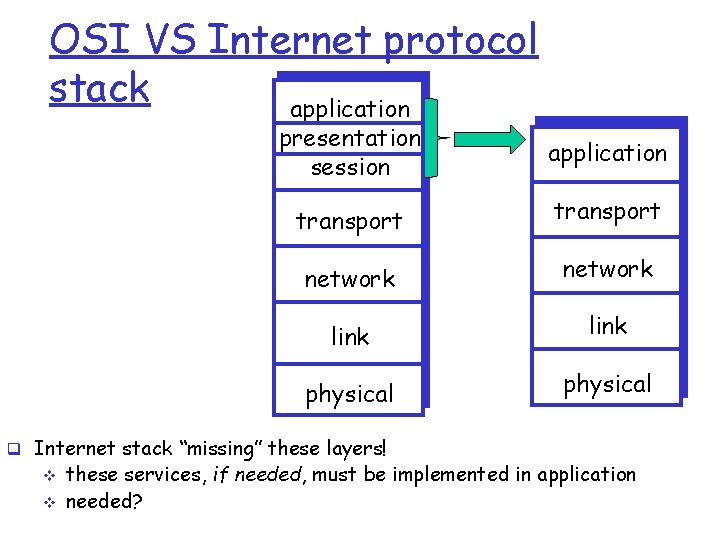
OSI VS Internet protocol stack application presentation session application transport network link physical q Internet stack “missing” these layers! v v these services, if needed, must be implemented in application needed?
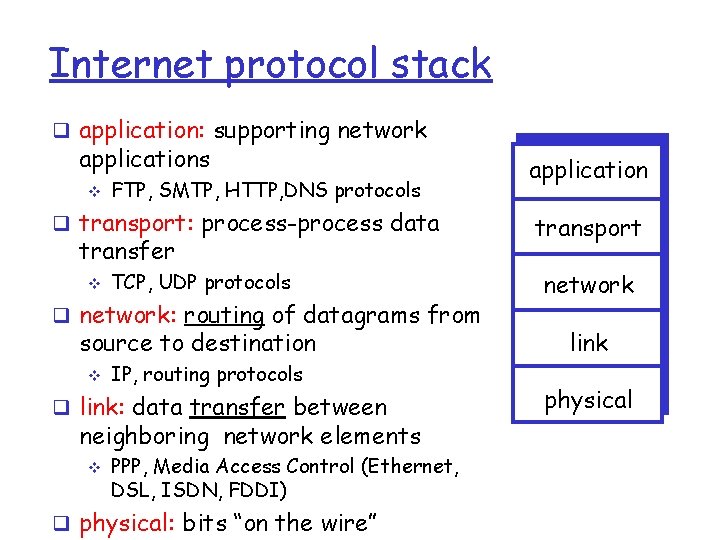
Internet protocol stack q application: supporting network applications v FTP, SMTP, HTTP, DNS protocols q transport: process-process data transfer v TCP, UDP protocols q network: routing of datagrams from source to destination v IP, routing protocols q link: data transfer between neighboring network elements v PPP, Media Access Control (Ethernet, DSL, ISDN, FDDI) q physical: bits “on the wire” application transport network link physical
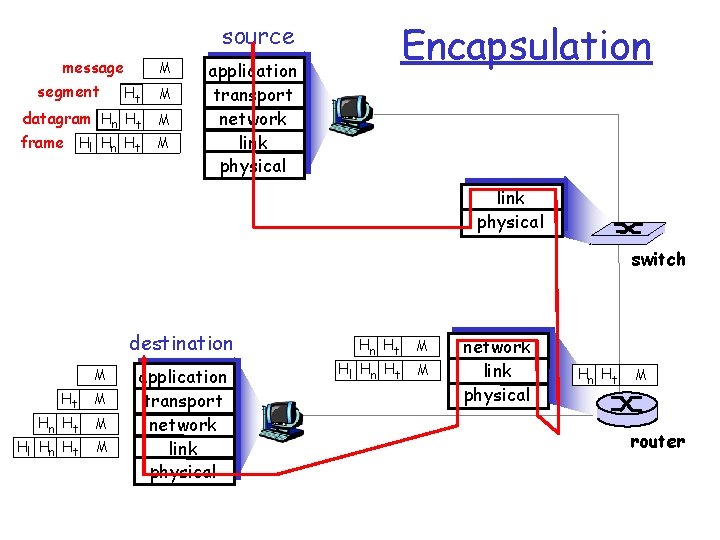
Encapsulation source message segment Ht M datagram Hn Ht M frame Hl Hn Ht M M application transport network link physical switch destination M Ht M Hn Ht Hl Hn Ht M M application transport network link physical Hn Ht Hl Hn Ht M M network link physical Hn Ht M router
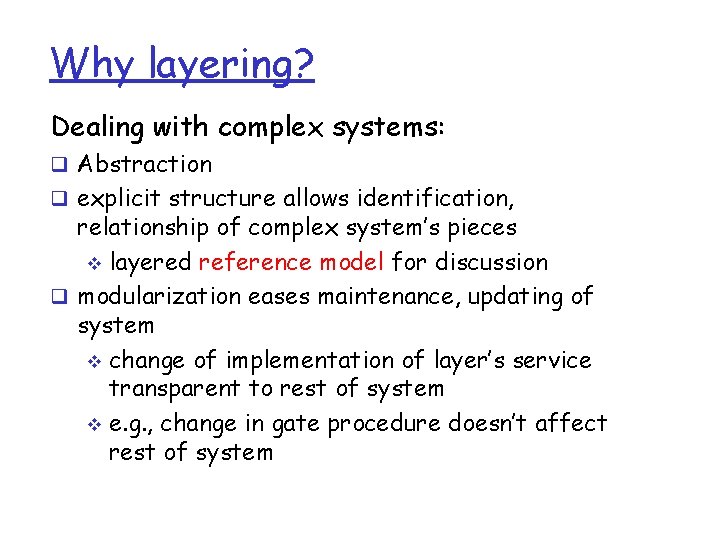
Why layering? Dealing with complex systems: q Abstraction q explicit structure allows identification, relationship of complex system’s pieces v layered reference model for discussion q modularization eases maintenance, updating of system v change of implementation of layer’s service transparent to rest of system v e. g. , change in gate procedure doesn’t affect rest of system
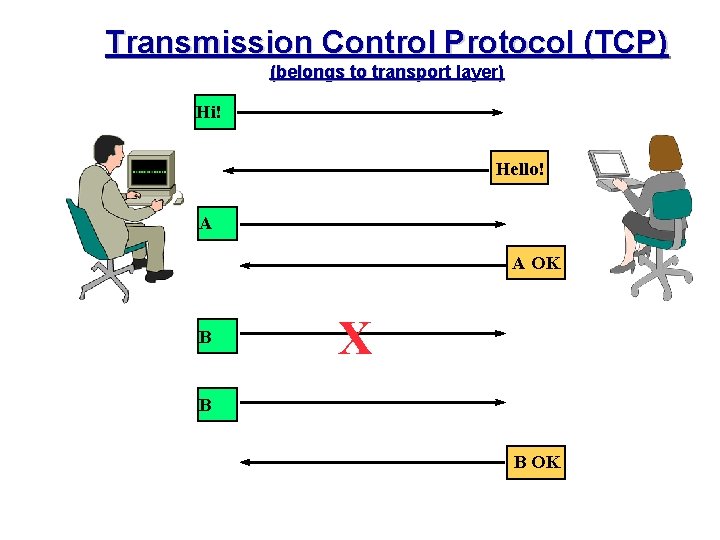
Connection Oriented services q Establish end to end logical or physical connection before any data are sent q Involves handshaking q Reliable data transfer may be involved (e. g. TCP) Data link layer examples: q Circuit mode communication q Virtual Circuits (packet switching). Same path! We just need a VCI. Transport layer examples: q TCP
Transmission Control Protocol (TCP) (belongs to transport layer) Hi! Hello! A A OK B X B B OK
Connectionless services q No handshaking! q Each data packet carries information about the destination address (datagram) Network layer example: q IP protocol Transport layer examples: q UDP
Connection oriented VS connectionless services q The distinction takes place in several layers q Packet switching examples in both categories q Connection oriented service on connectionless service? ? TCP/IP
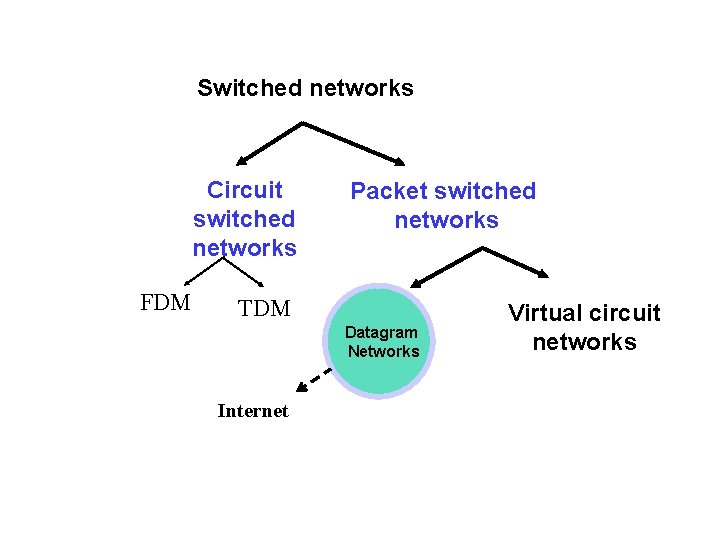
Switched networks Circuit switched networks FDM Packet switched networks TDM Datagram Networks Internet Virtual circuit networks
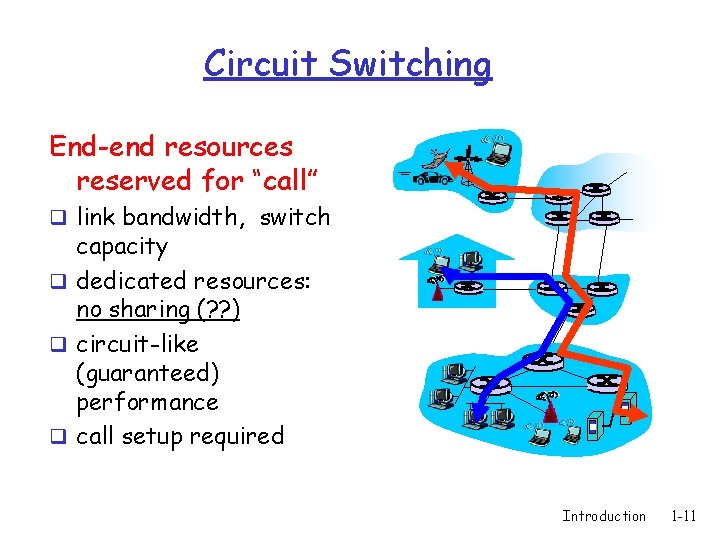
Circuit Switching End-end resources reserved for “call” q link bandwidth, switch capacity q dedicated resources: no sharing (? ? ) q circuit-like (guaranteed) performance q call setup required Introduction 1 -11
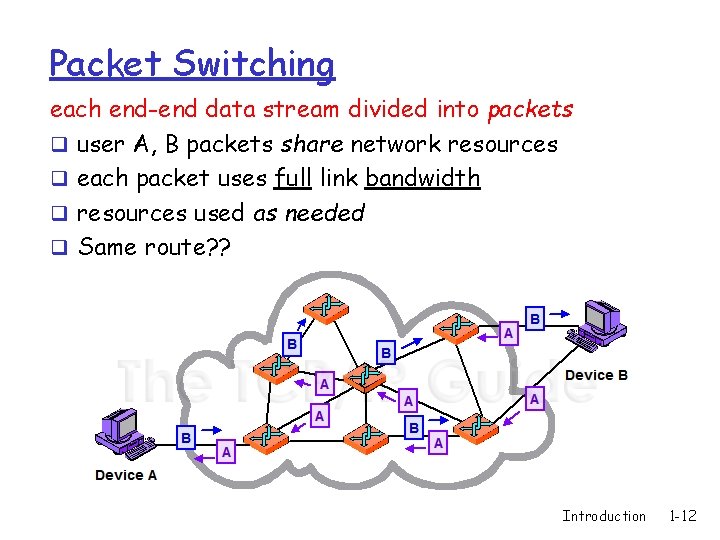
Packet Switching each end-end data stream divided into packets q user A, B packets share network resources q each packet uses full link bandwidth q resources used as needed q Same route? ? Introduction 1 -12
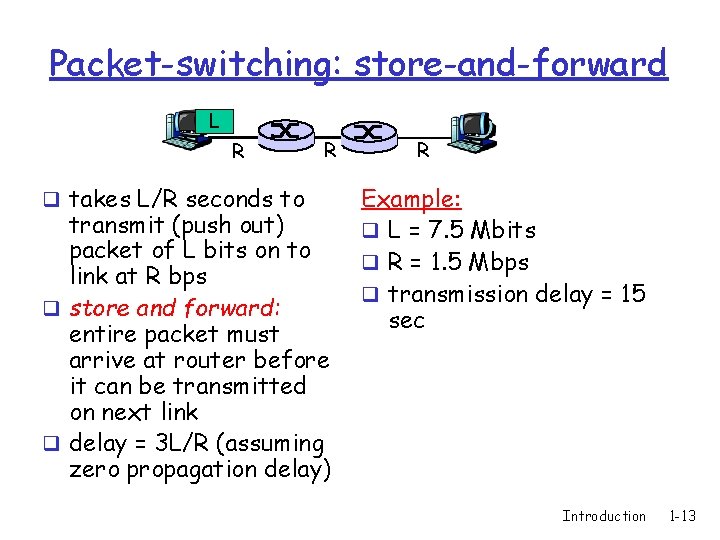
Packet-switching: store-and-forward L R q takes L/R seconds to R transmit (push out) packet of L bits on to link at R bps q store and forward: entire packet must arrive at router before it can be transmitted on next link q delay = 3 L/R (assuming zero propagation delay) R Example: q L = 7. 5 Mbits q R = 1. 5 Mbps q transmission delay = 15 sec Introduction 1 -13
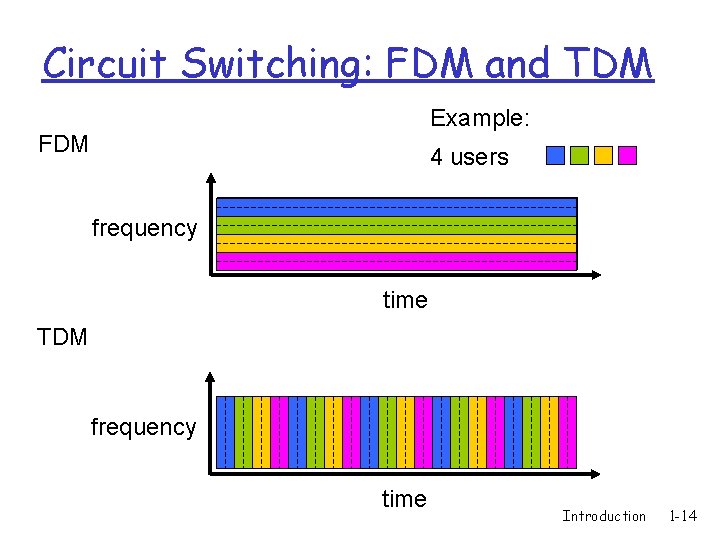
Circuit Switching: FDM and TDM Example: FDM 4 users frequency time TDM frequency time Introduction 1 -14
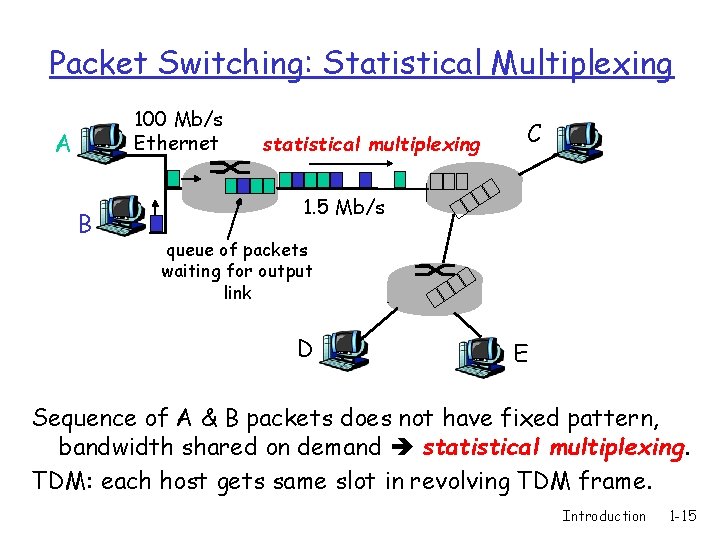
Packet Switching: Statistical Multiplexing 100 Mb/s Ethernet A B statistical multiplexing C 1. 5 Mb/s queue of packets waiting for output link D E Sequence of A & B packets does not have fixed pattern, bandwidth shared on demand statistical multiplexing. TDM: each host gets same slot in revolving TDM frame. Introduction 1 -15
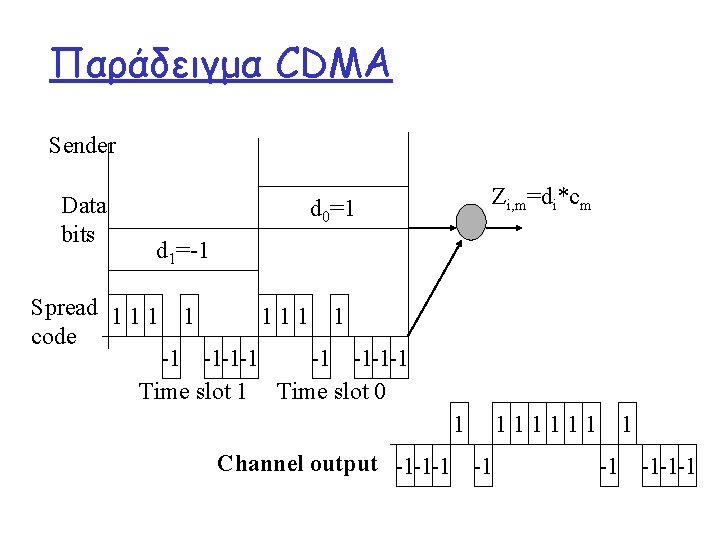
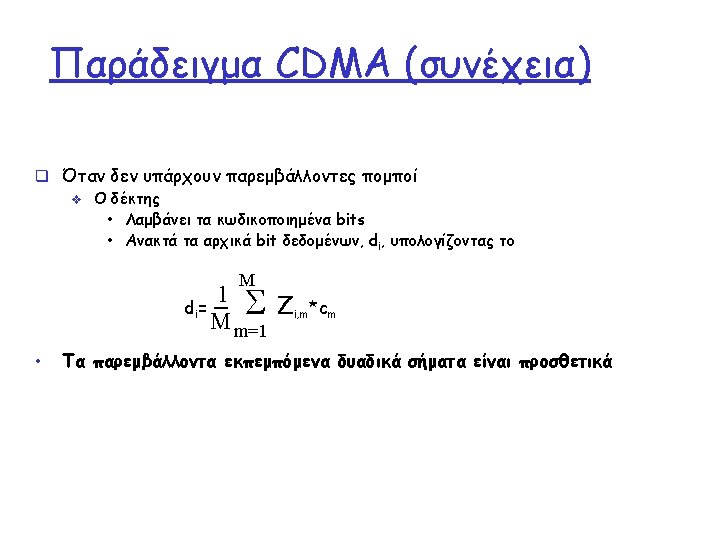
Παράδειγμα CDMA Sender Data bits Zi, m=di*cm d 0=1 d 1=-1 Spread 1 1 1 code 1 111 1 -1 -1 -1 -1 Time slot 0 1 Channel output -1 -1 -1 -1 111111 1 -1 -1 -1 -1