
Q 06 Work Energy Power 1 Two objects
Q 06. Work Energy & Power
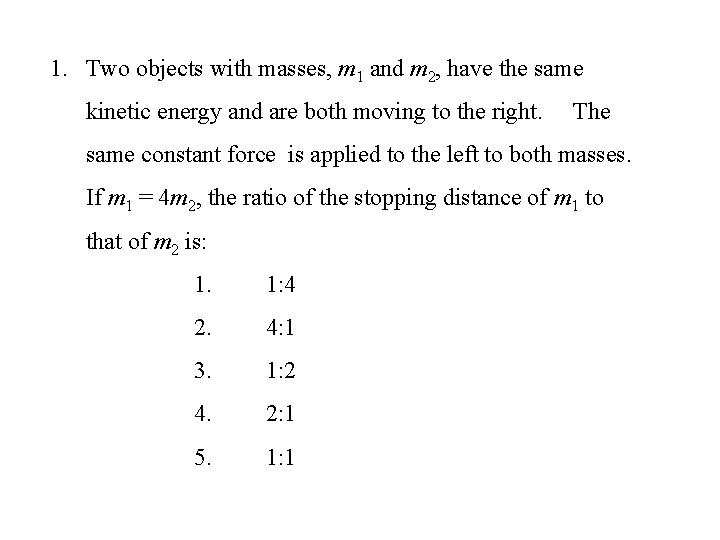
1. Two objects with masses, m 1 and m 2, have the same kinetic energy and are both moving to the right. The same constant force is applied to the left to both masses. If m 1 = 4 m 2, the ratio of the stopping distance of m 1 to that of m 2 is: 1. 1: 4 2. 4: 1 3. 1: 2 4. 2: 1 5. 1: 1
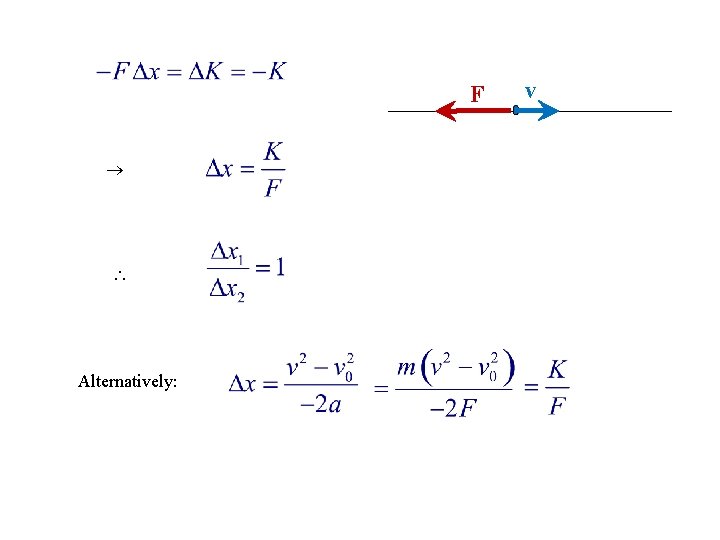
F Alternatively: v
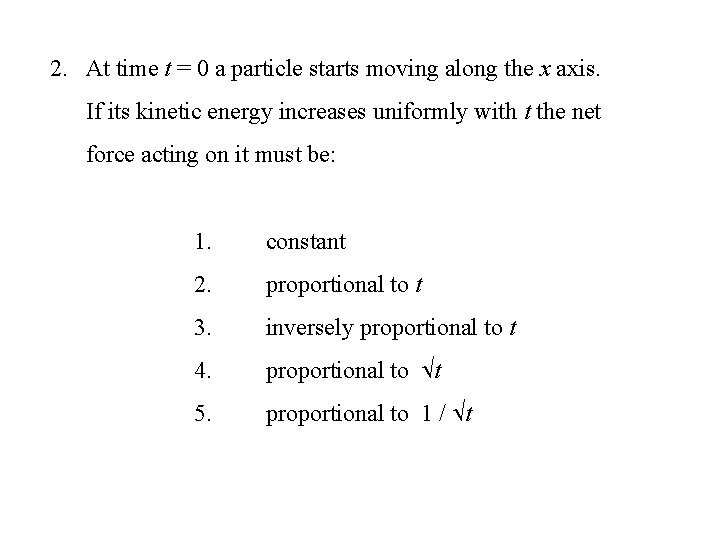
2. At time t = 0 a particle starts moving along the x axis. If its kinetic energy increases uniformly with t the net force acting on it must be: 1. constant 2. proportional to t 3. inversely proportional to t 4. proportional to t 5. proportional to 1 / t


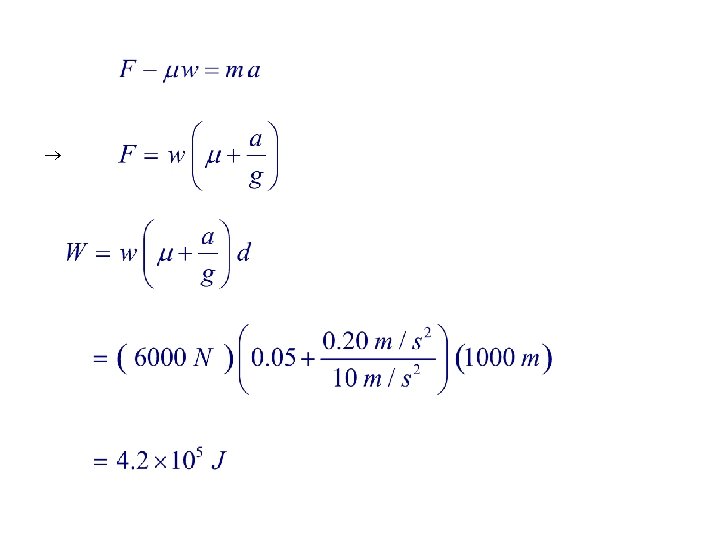
3. Camping equipment weighing 6000 N is pulled across a frozen lake by means of a horizontal rope. of kinetic friction is 0. 05. The coefficient How much work is done by the campers in pulling the equipment 1000 m if its speed is increasing at the constant rate of 0. 20 m/s 2 ? 1. – 1. 2 106 J 2. 1. 8 105 J 3. 1. 5 105 J 4. 2 105 J 5. 1. 5 106 J
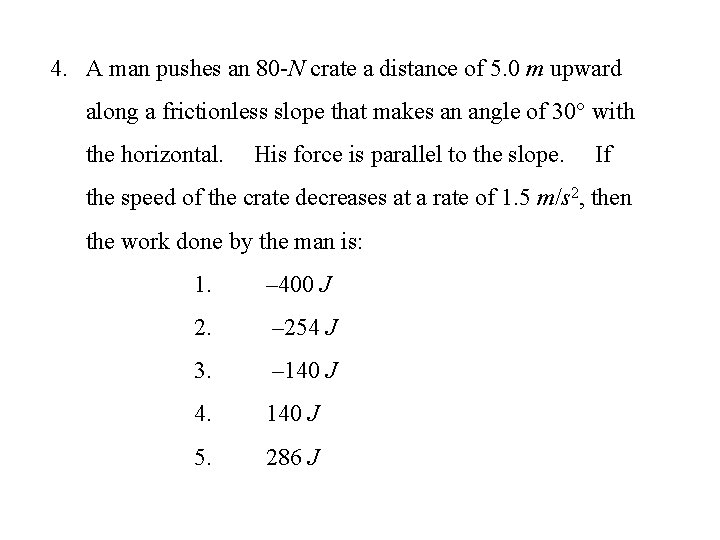
4. A man pushes an 80 -N crate a distance of 5. 0 m upward along a frictionless slope that makes an angle of 30° with the horizontal. His force is parallel to the slope. If the speed of the crate decreases at a rate of 1. 5 m/s 2, then the work done by the man is: 1. – 400 J 2. – 254 J 3. – 140 J 4. 140 J 5. 286 J
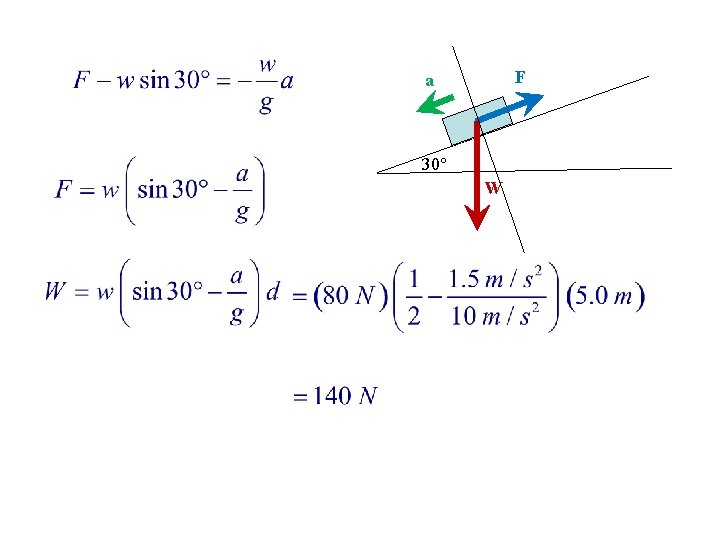
F a 30 W
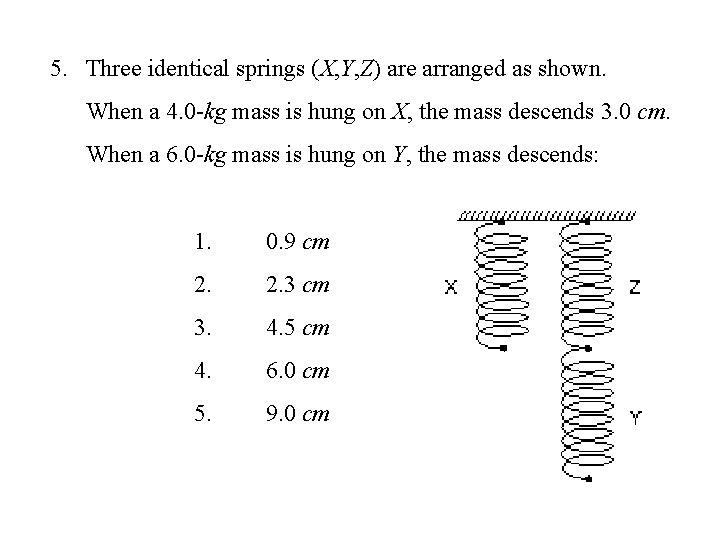
5. Three identical springs (X, Y, Z) are arranged as shown. When a 4. 0 -kg mass is hung on X, the mass descends 3. 0 cm. When a 6. 0 -kg mass is hung on Y, the mass descends: 1. 0. 9 cm 2. 3 cm 3. 4. 5 cm 4. 6. 0 cm 5. 9. 0 cm
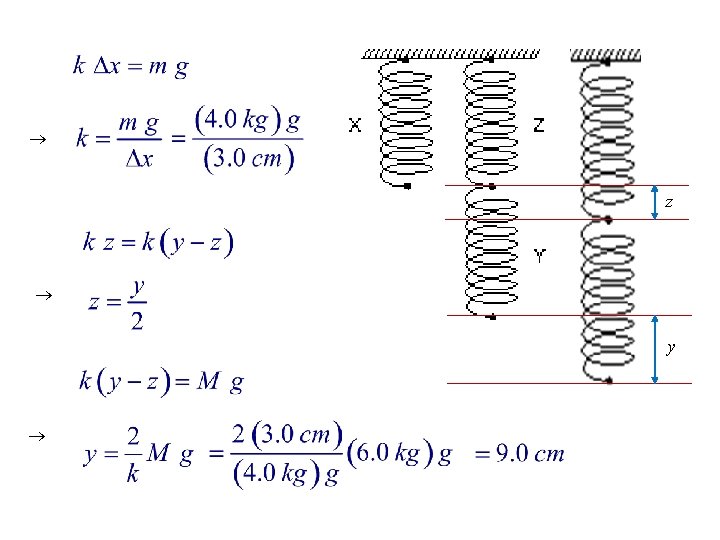
z y
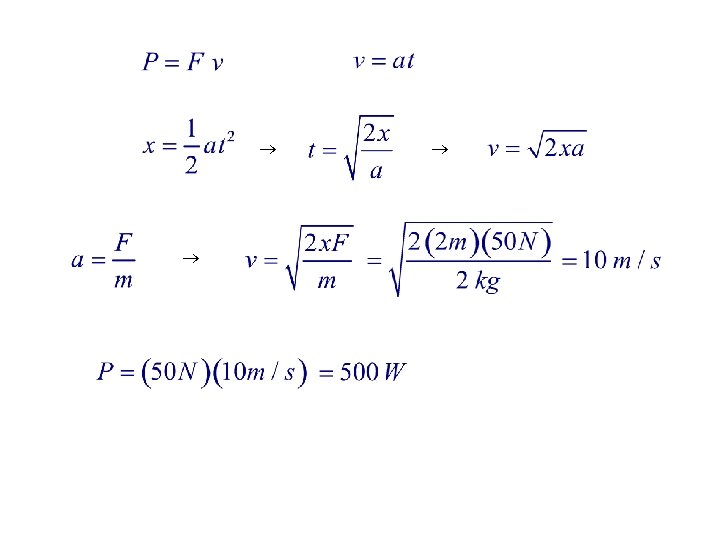
6. A 50 -N force is the only force on a 2 -kg crate that starts from rest. At the instant the object has gone 2 m the rate at which the force is doing work is: 1. 25 W 2. 75 W 3. 100 W 4. 500 W 5. 1000 W
- Slides: 13