
Python binding for Geant 4 toolkit using ReflexPy

Python binding for Geant 4 toolkit using Reflex/Py. ROOT tool Witek Pokorski Euro. Python 2006, CERN, Geneva 04. 07. 2006 W. Pokorski - CERN Simulation Project 1
Outline • Motivation • why do we need Python in Geant 4 • Short introduction to Geant 4 • basic Geant 4 applications • Creating Python binding • the power of Reflex/Py. ROOT • Some examples • Conclusion W. Pokorski - CERN Simulation Project 2
Motivation • to use Python for the construction of Geant 4 simulation applications • to allow quick prototyping and testing • to add flexibility in the configuration • to make the application setup more homogenous • to use Python shell as a powerful user interface for interactive running of Geant 4 • to use Python as the 'glue' between simulation and analysis applications • to allow interactive simulation and analysis sessions • to facilitate debugging of the simulation setups W. Pokorski - CERN Simulation Project 3
Introducing Geant 4 • Geant 4 - a toolkit for the simulation of the passage of particles through matter • implemented in C++ • used in high energy, nuclear, accelerator physics, studies in medical and space science, etc • complete range of functionality including tracking, geometry, physics models and hits • electromagnetic, hadronic and optical processes • energy range starting from (for some models) 250 e. V and extending to the Te. V energy range • world-wide collaboration of scientists and software engineers • main users: LHC experiments, Ba. Bar, Fermilab experiments, International Linear Collider, European Space Agency, Gamma Ray Large Area Space Telescope, medical physics, etc W. Pokorski - CERN Simulation Project 4
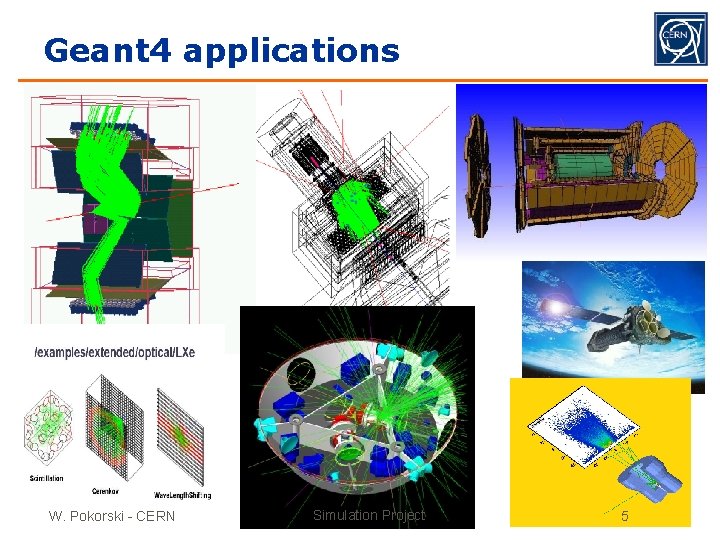
Geant 4 applications W. Pokorski - CERN Simulation Project 5
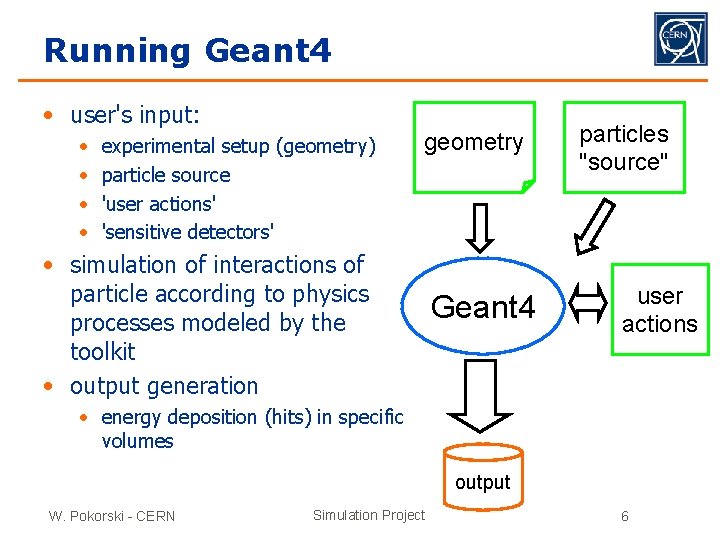
Running Geant 4 • user's input: • • experimental setup (geometry) particle source 'user actions' 'sensitive detectors' geometry • simulation of interactions of particle according to physics processes modeled by the toolkit • output generation Geant 4 particles "source" user actions • energy deposition (hits) in specific volumes output W. Pokorski - CERN Simulation Project 6
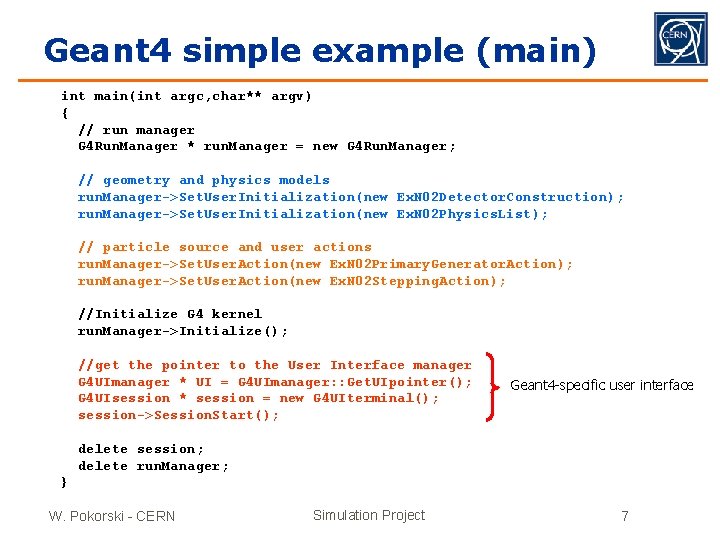
Geant 4 simple example (main) int main(int argc, char** argv) { // run manager G 4 Run. Manager * run. Manager = new G 4 Run. Manager; // geometry and physics models run. Manager->Set. User. Initialization(new Ex. N 02 Detector. Construction); run. Manager->Set. User. Initialization(new Ex. N 02 Physics. List); // particle source and user actions run. Manager->Set. User. Action(new Ex. N 02 Primary. Generator. Action); run. Manager->Set. User. Action(new Ex. N 02 Stepping. Action); //Initialize G 4 kernel run. Manager->Initialize(); //get the pointer to the User Interface manager G 4 UImanager * UI = G 4 UImanager: : Get. UIpointer(); G 4 UIsession * session = new G 4 UIterminal(); session->Session. Start(); Geant 4 -specific user interface delete session; delete run. Manager; } W. Pokorski - CERN Simulation Project 7
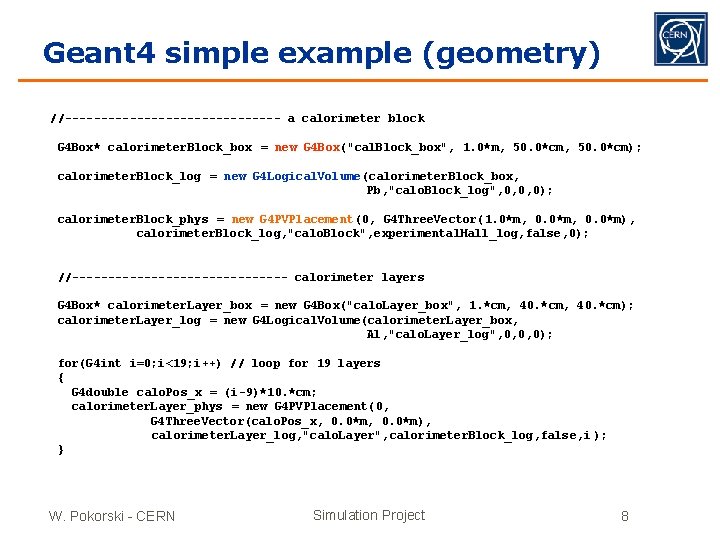
Geant 4 simple example (geometry) //--------------- a calorimeter block G 4 Box* calorimeter. Block_box = new G 4 Box("cal. Block_box", 1. 0*m, 50. 0*cm); calorimeter. Block_log = new G 4 Logical. Volume(calorimeter. Block_box, Pb, "calo. Block_log", 0, 0, 0); calorimeter. Block_phys = new G 4 PVPlacement(0, G 4 Three. Vector(1. 0*m, 0. 0*m), calorimeter. Block_log, "calo. Block", experimental. Hall_log, false, 0); //--------------- calorimeter layers G 4 Box* calorimeter. Layer_box = new G 4 Box("calo. Layer_box", 1. *cm, 40. *cm); calorimeter. Layer_log = new G 4 Logical. Volume(calorimeter. Layer_box, Al, "calo. Layer_log", 0, 0, 0); for(G 4 int i=0; i<19; i++) // loop for 19 layers { G 4 double calo. Pos_x = (i-9)*10. *cm; calorimeter. Layer_phys = new G 4 PVPlacement(0, G 4 Three. Vector(calo. Pos_x, 0. 0*m), calorimeter. Layer_log, "calo. Layer", calorimeter. Block_log, false, i ); } W. Pokorski - CERN Simulation Project 8
Where can Python help • top level configuration (geometry, etc) hardwired in the 'main' if implemented in C++ • Python could make the configuration more flexible • Python would allow dynamic loading of geometry, etc • Geant 4 user interface requires dedicated implementation ('messenger' classes) • Python would provide a natural interface to Geant 4 classes • powerful scripting language like Python would replace limited Geant 4 UI • using Python for configuration and interactivity adds homogeneity W. Pokorski - CERN Simulation Project 9
Introducing Reflex • Reflex - package developed at CERN to provide reflection capabilities for C++ • part of ROOT framework • talk by P. Mato "Interfacing Python and C++ frameworks" • reflection = ability of a programming language to introspect its data structure and interact with them at runtime without prior knowledge • reflection mechanism can be used for dynamic Python binding of C++ classes • Reflex features • non-intrusive, no code instrumentation required • reflection information is generated at the build time in form of dynamically loaded libraries (dictionaries) - 'selection' file used to specify the contents of the dictionary W. Pokorski - CERN Simulation Project 10
One word about ROOT • ROOT - an object-oriented data analysis framework • started in the context of NA 49 CERN experiment by R. Brun and F. Rademakers • some of the areas of application: • • C interpreter histograms and fitting input/output (persistency for C++ objects) 2 D and 3 D graphics • recently added • Reflex • Python binding W. Pokorski - CERN Simulation Project 11
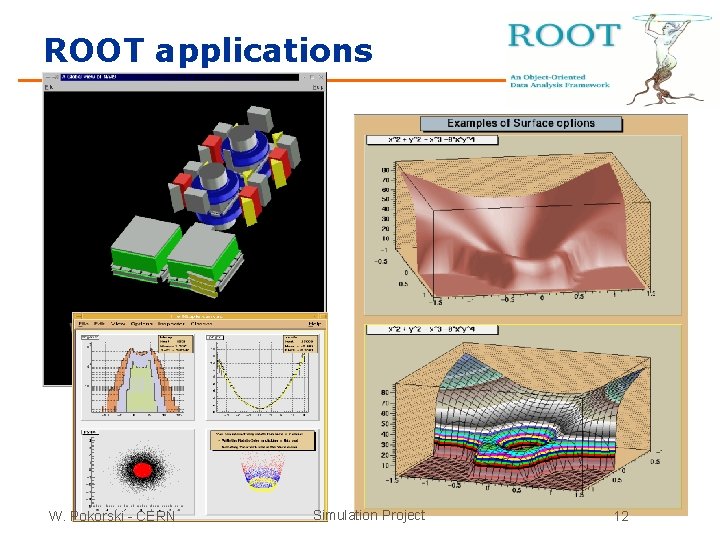
ROOT applications W. Pokorski - CERN Simulation Project 12
Using Reflex dictionary • Py. ROOT - Python module originally developed as the Python binding for ROOT classes • extended to provide Python binding for any C++ classes with the Reflex dictionary information • Python binding using Reflex/Py. ROOT does not require any instrumentation of the C++ code • no additional code required (like for BOOST-Python) • dictionary can be generated for any C++ class • Py. ROOT provides very useful emulation (pythonization) of several C++ constructs • STL iterators, null pointers, templates W. Pokorski - CERN Simulation Project 13
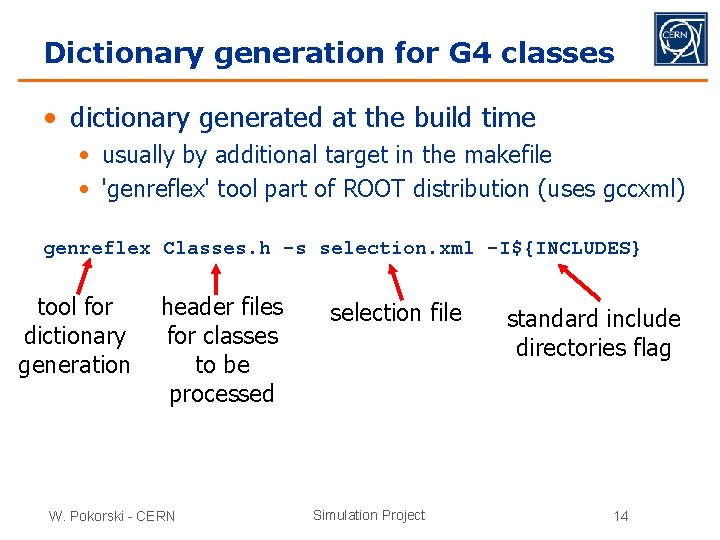
Dictionary generation for G 4 classes • dictionary generated at the build time • usually by additional target in the makefile • 'genreflex' tool part of ROOT distribution (uses gccxml) genreflex Classes. h -s selection. xml -I${INCLUDES} tool for dictionary generation header files for classes to be processed W. Pokorski - CERN selection file Simulation Project standard include directories flag 14
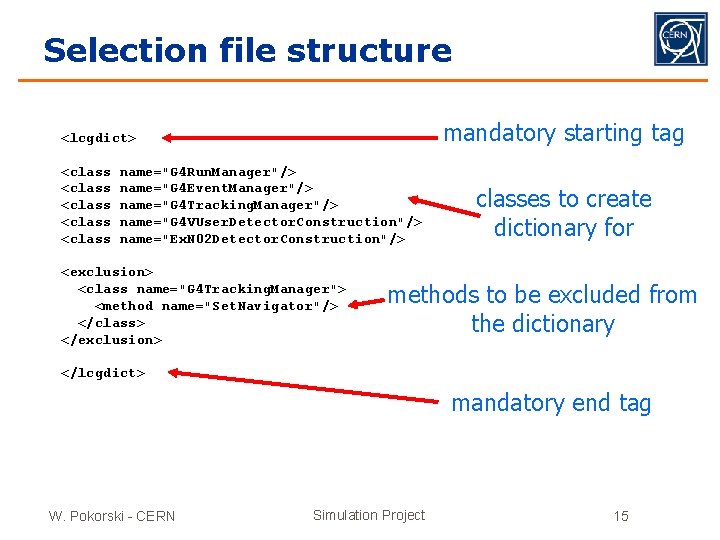
Selection file structure mandatory starting tag <lcgdict> <class <class name="G 4 Run. Manager"/> name="G 4 Event. Manager"/> name="G 4 Tracking. Manager"/> name="G 4 VUser. Detector. Construction"/> name="Ex. N 02 Detector. Construction"/> <exclusion> <class name="G 4 Tracking. Manager"> <method name="Set. Navigator"/> </class> </exclusion> classes to create dictionary for methods to be excluded from the dictionary </lcgdict> mandatory end tag W. Pokorski - CERN Simulation Project 15
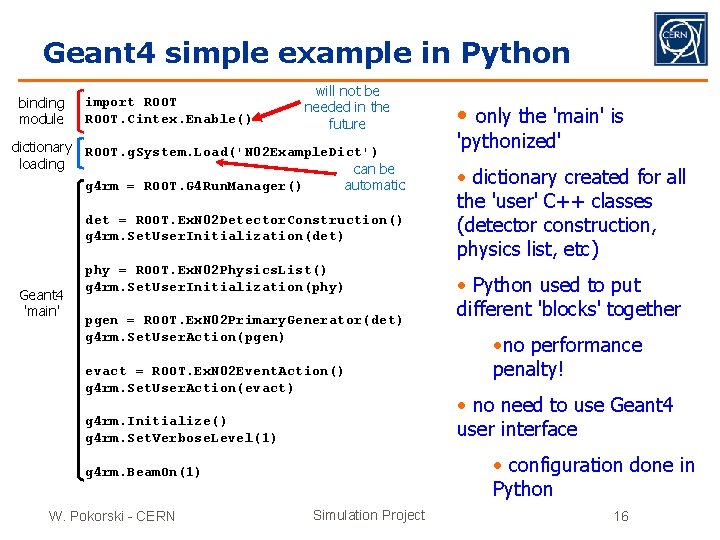
Geant 4 simple example in Python binding module import ROOT. Cintex. Enable() will not be needed in the future dictionary ROOT. g. System. Load('N 02 Example. Dict') loading can be g 4 rm = ROOT. G 4 Run. Manager() automatic det = ROOT. Ex. N 02 Detector. Construction() g 4 rm. Set. User. Initialization(det) Geant 4 'main' phy = ROOT. Ex. N 02 Physics. List() g 4 rm. Set. User. Initialization(phy) pgen = ROOT. Ex. N 02 Primary. Generator(det) g 4 rm. Set. User. Action(pgen) evact = ROOT. Ex. N 02 Event. Action() g 4 rm. Set. User. Action(evact) g 4 rm. Initialize() g 4 rm. Set. Verbose. Level(1) 'pythonized' • dictionary created for all the 'user' C++ classes (detector construction, physics list, etc) • Python used to put different 'blocks' together • no performance penalty! • no need to use Geant 4 user interface • configuration done in Python g 4 rm. Beam. On(1) W. Pokorski - CERN • only the 'main' is Simulation Project 16
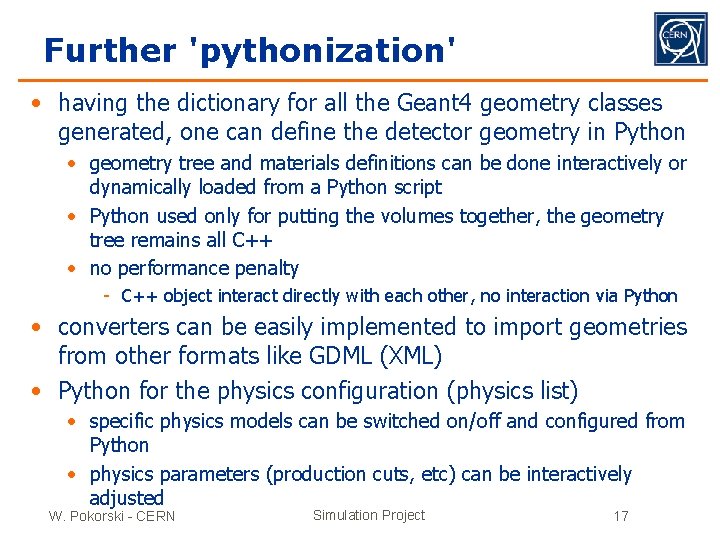
Further 'pythonization' • having the dictionary for all the Geant 4 geometry classes generated, one can define the detector geometry in Python • geometry tree and materials definitions can be done interactively or dynamically loaded from a Python script • Python used only for putting the volumes together, the geometry tree remains all C++ • no performance penalty - C++ object interact directly with each other, no interaction via Python • converters can be easily implemented to import geometries from other formats like GDML (XML) • Python for the physics configuration (physics list) • specific physics models can be switched on/off and configured from Python • physics parameters (production cuts, etc) can be interactively adjusted W. Pokorski - CERN Simulation Project 17
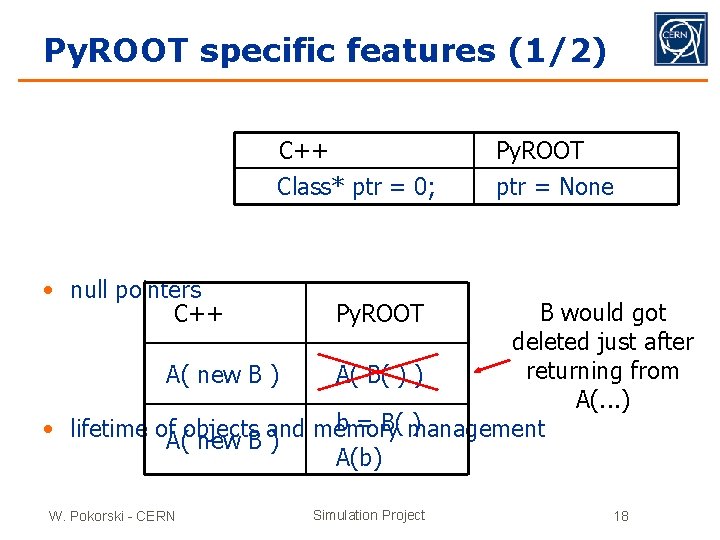
Py. ROOT specific features (1/2) C++ Class* ptr = 0; • null pointers C++ Py. ROOT ptr = None B would got deleted just after returning from A( new B ) A( B( ) ) A(. . . ) b = B( management ) • lifetime of. A(objects and memory new B ) A(b) W. Pokorski - CERN Py. ROOT Simulation Project 18
Py. ROOT specific features (2/2) • objects ownership • possibility of changing the ownership policy - objects can be own by Py. ROOT or by Geant 4 • possibility of using Python iterators on STL containers • 'for x in X' can be used for X being std: : vector • primitive types automatically converted • mapping of Python arrays to C++ arrays W. Pokorski - CERN Simulation Project 19
Interactive running with ROOT • Py. ROOT module contains Python binding for all ROOT classes • comes for free when loading binding for Geant 4 • ROOT can be run interactively together with the simulation application • Python naturally 'glues' different applications together • examples use cases • • histograms events persistency geometry persistency 3 D graphics (detector visulalization) W. Pokorski - CERN Simulation Project 20
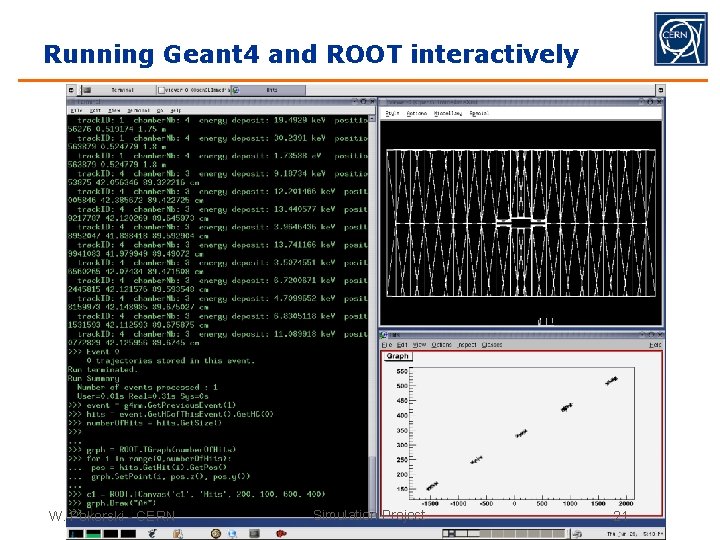
Running Geant 4 and ROOT interactively W. Pokorski - CERN Simulation Project 21
Some remarks • since the generation of the dictionary is not intrusive, it could be added to the standard Geant 4 procedure • users would immediately have the Python binding • persistency of Geant 4 objects would be possible - ROOT I/O could be used for detector geometry persistency W. Pokorski - CERN Simulation Project 22
Conclusions • Python bindings are starting to be common practice for scientific software • playing the role of a 'software bus' to connect different applications together • used as very powerful scripting language for configuration • with Reflex/Py. ROOT, Python binding for Geant 4 comes for free • Reflex dictionary used also for Geant 4 objects persistency • no performance penalty • Python only used for putting 'blocks' together and for setting options • improves modularization of Geant 4 applications • provides natural support for dynamic loading of components • improves interconnectivity with other applications W. Pokorski - CERN Simulation Project 23
- Slides: 23