
PYTHIA 8 2 Introduction and Tutorial Tutorial Set
- Slides: 26
PYTHIA 8. 2 Introduction and Tutorial
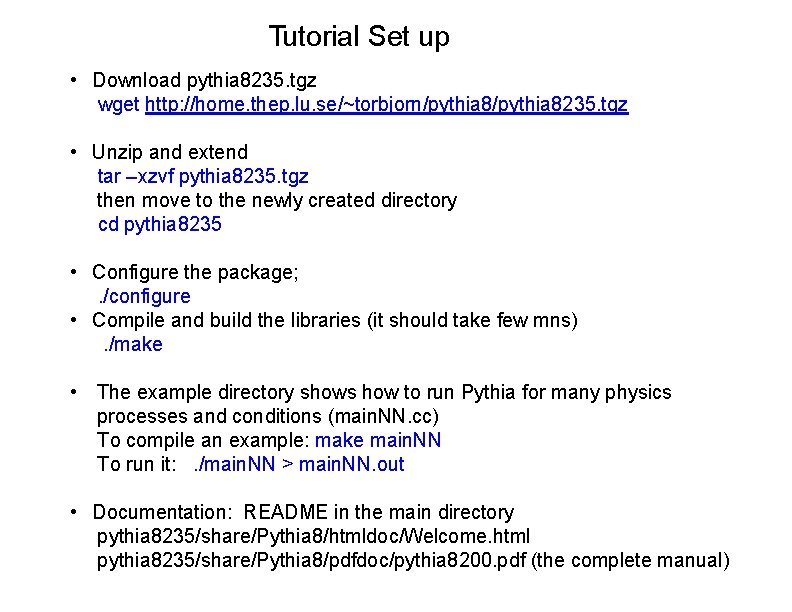
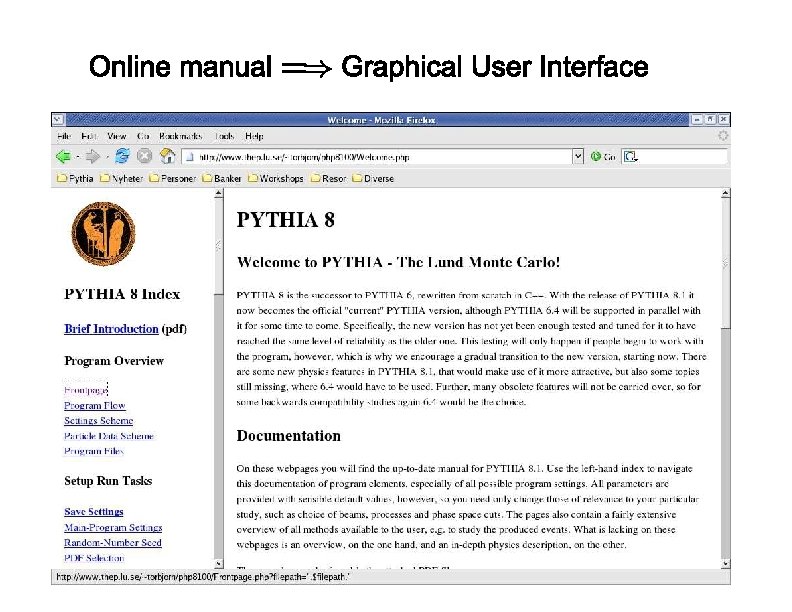
Tutorial Set up • Download pythia 8235. tgz wget http: //home. thep. lu. se/~torbjorn/pythia 8235. tgz • Unzip and extend tar –xzvf pythia 8235. tgz then move to the newly created directory cd pythia 8235 • Configure the package; . /configure • Compile and build the libraries (it should take few mns). /make • The example directory shows how to run Pythia for many physics processes and conditions (main. NN. cc) To compile an example: make main. NN To run it: . /main. NN > main. NN. out • Documentation: README in the main directory pythia 8235/share/Pythia 8/htmldoc/Welcome. html pythia 8235/share/Pythia 8/pdfdoc/pythia 8200. pdf (the complete manual)
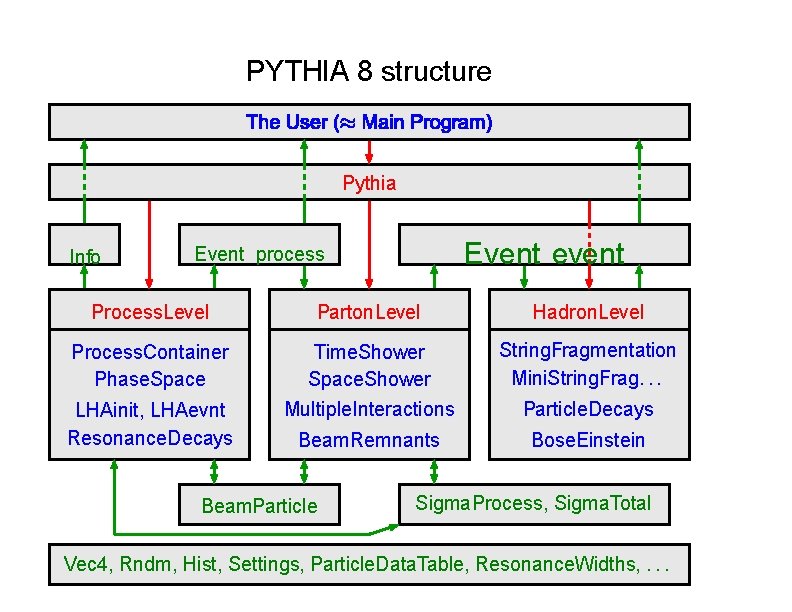
PYTHIA 8 structure Pythia Info Event event Event process Process. Level Parton. Level Hadron. Level Process. Container Phase. Space Time. Shower Space. Shower String. Fragmentation Mini. String. Frag. . . LHAinit, LHAevnt Resonance. Decays Multiple. Interactions Particle. Decays Beam. Remnants Bose. Einstein Beam. Particle Sigma. Process, Sigma. Total Vec 4, Rndm, Hist, Settings, Particle. Data. Table, Resonance. Widths, . . .
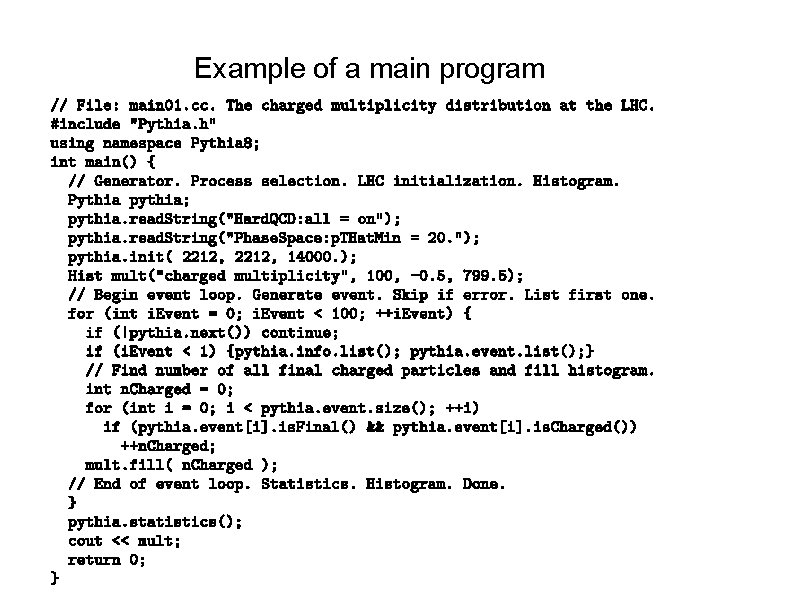
Example of a main program
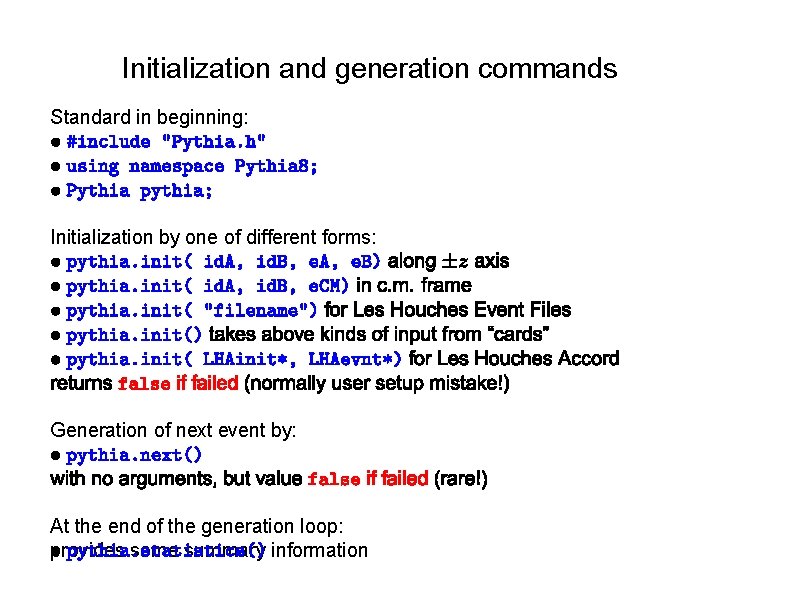
Initialization and generation commands Standard in beginning: Initialization by one of different forms: Generation of next event by: At the end of the generation loop: provides some summary information
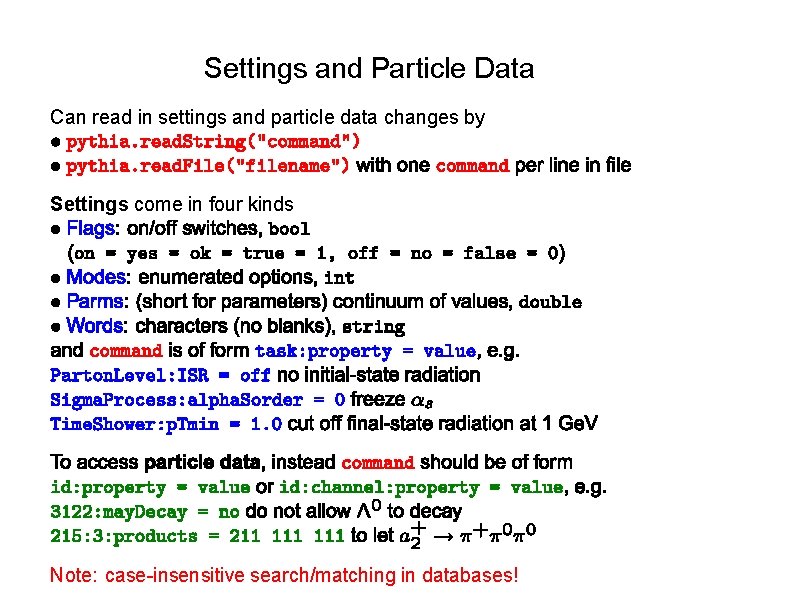
Settings and Particle Data Can read in settings and particle data changes by Settings come in four kinds Note: case-insensitive search/matching in databases!
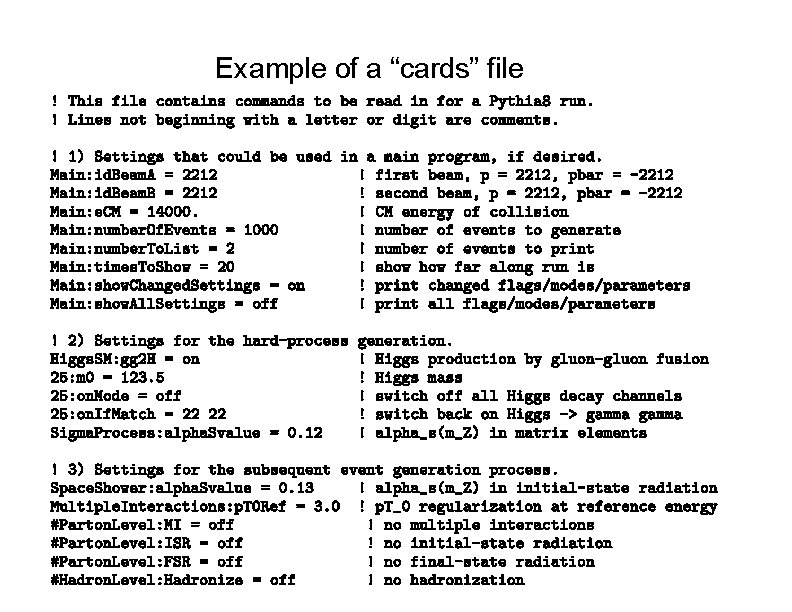
Example of a “cards” file
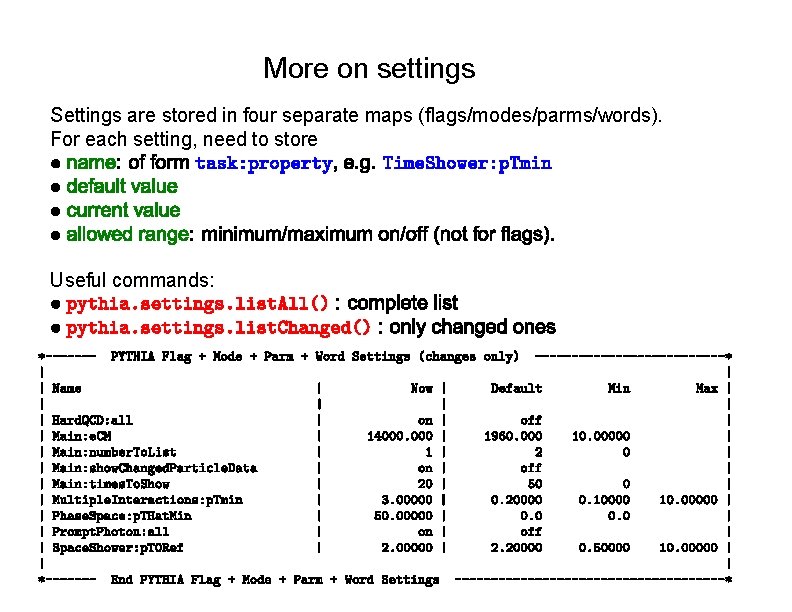
More on settings Settings are stored in four separate maps (flags/modes/parms/words). For each setting, need to store Useful commands:
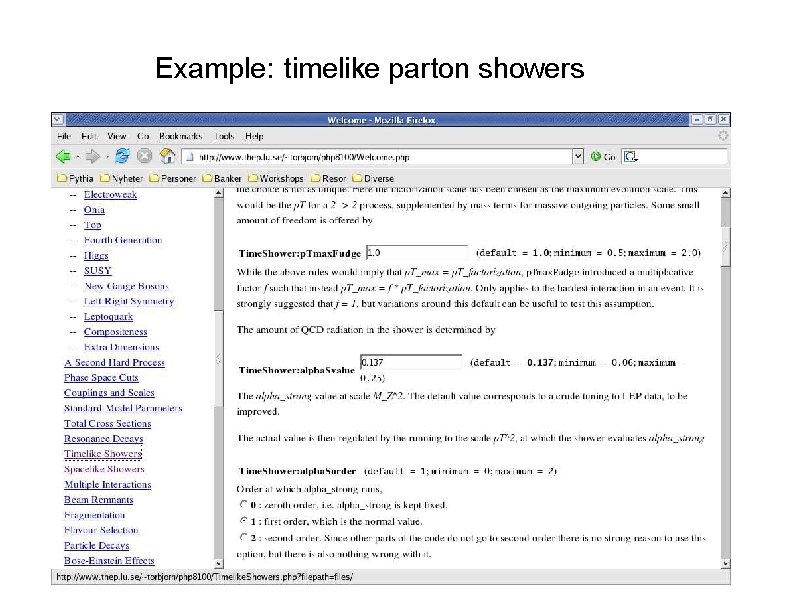
Example: timelike parton showers
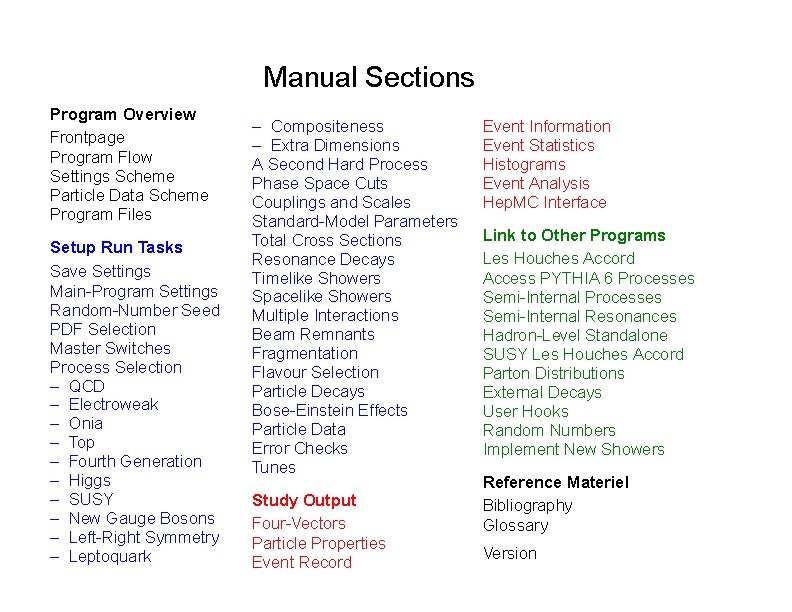
Manual Sections Program Overview Frontpage Program Flow Settings Scheme Particle Data Scheme Program Files Setup Run Tasks Save Settings Main-Program Settings Random-Number Seed PDF Selection Master Switches Process Selection – QCD – Electroweak – Onia – Top – Fourth Generation – Higgs – SUSY – New Gauge Bosons – Left-Right Symmetry – Leptoquark – Compositeness – Extra Dimensions A Second Hard Process Phase Space Cuts Couplings and Scales Standard-Model Parameters Total Cross Sections Resonance Decays Timelike Showers Spacelike Showers Multiple Interactions Beam Remnants Fragmentation Flavour Selection Particle Decays Bose-Einstein Effects Particle Data Error Checks Tunes Study Output Four-Vectors Particle Properties Event Record Event Information Event Statistics Histograms Event Analysis Hep. MC Interface Link to Other Programs Les Houches Accord Access PYTHIA 6 Processes Semi-Internal Resonances Hadron-Level Standalone SUSY Les Houches Accord Parton Distributions External Decays User Hooks Random Numbers Implement New Showers Reference Materiel Bibliography Glossary Version
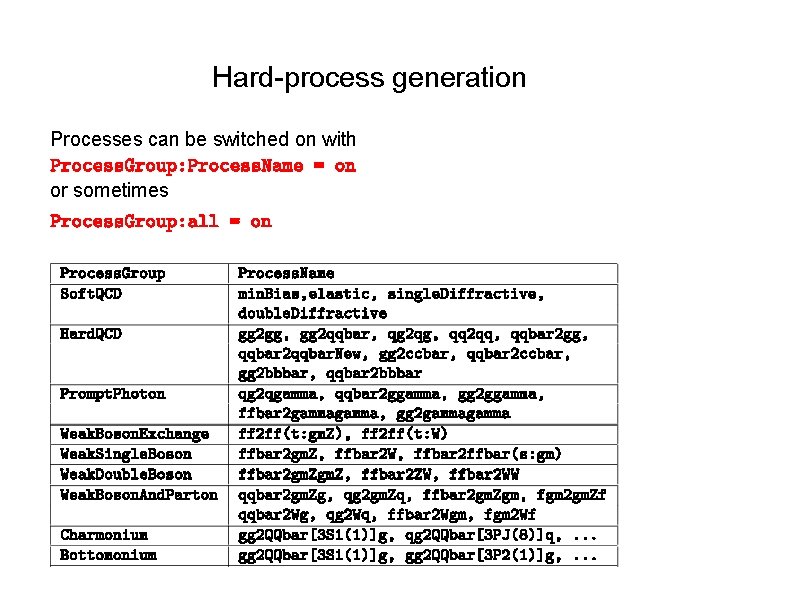
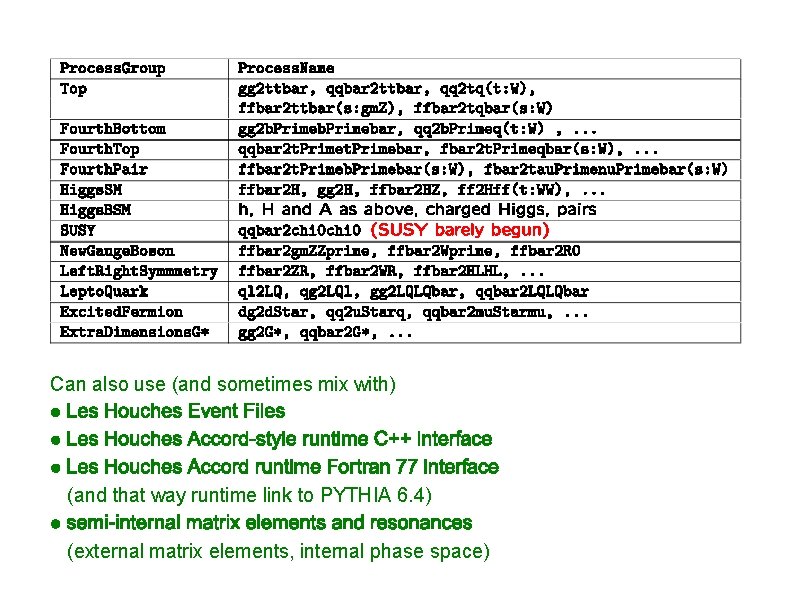
Hard-process generation Processes can be switched on with or sometimes
Can also use (and sometimes mix with) (and that way runtime link to PYTHIA 6. 4) (external matrix elements, internal phase space)
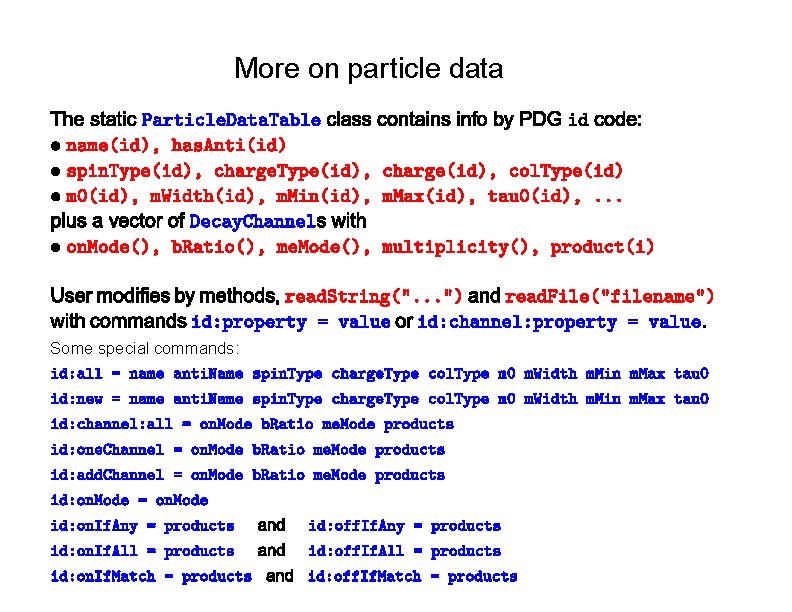
More on particle data Some special commands:
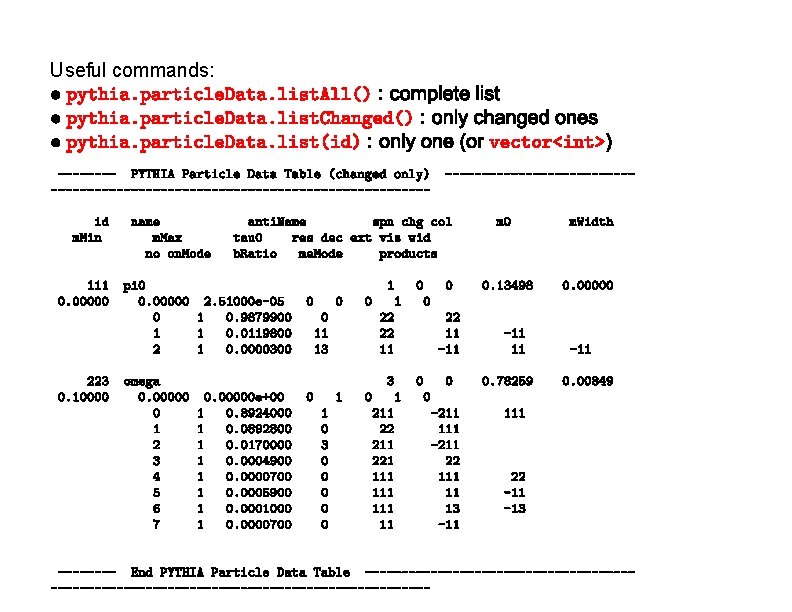
Useful commands:
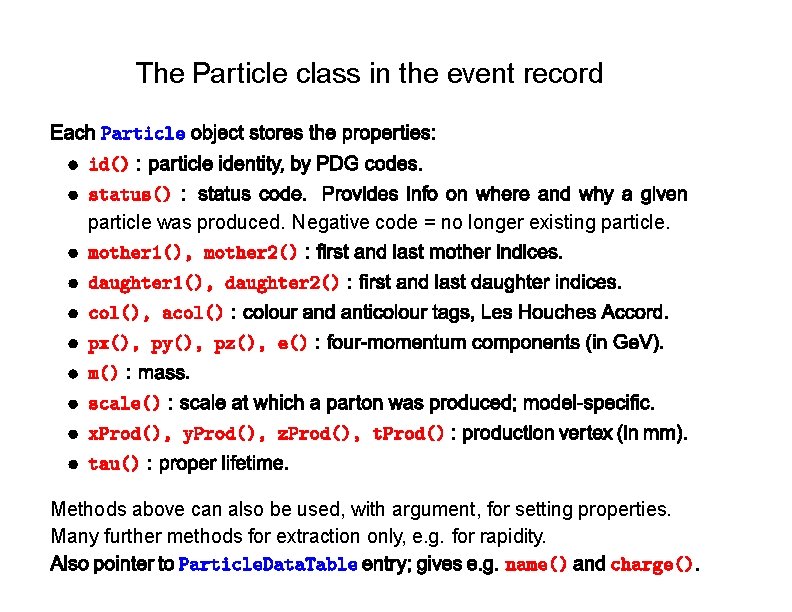
The Particle class in the event record particle was produced. Negative code = no longer existing particle. Methods above can also be used, with argument, for setting properties. Many further methods for extraction only, e. g. for rapidity.
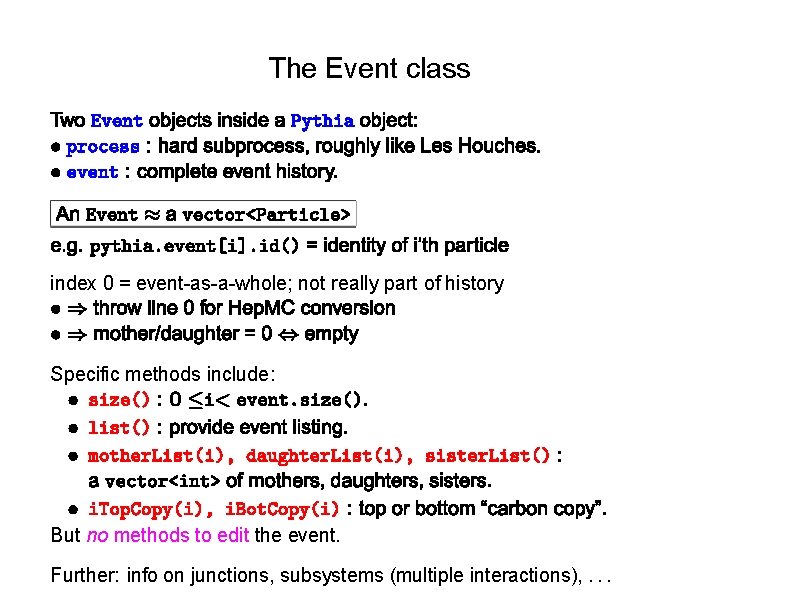
The Event class index 0 = event-as-a-whole; not really part of history Specific methods include: But no methods to edit the event. Further: info on junctions, subsystems (multiple interactions), . . .
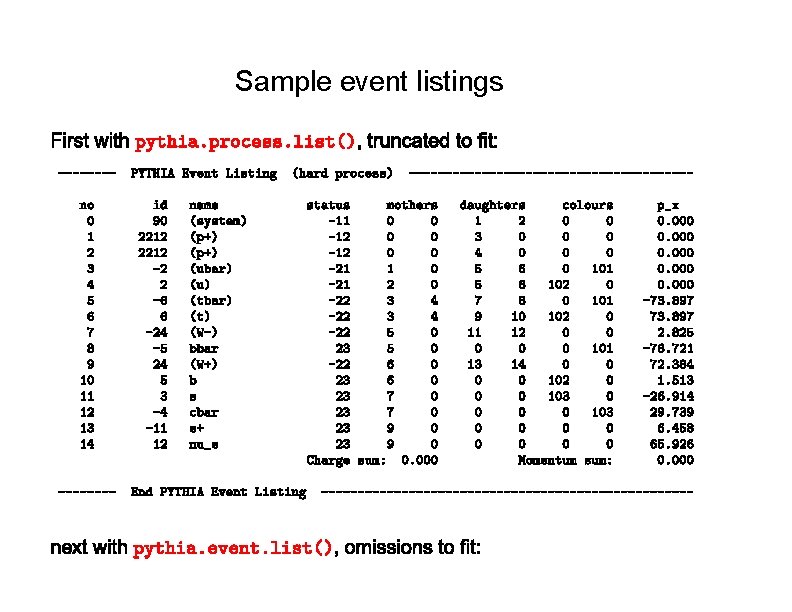
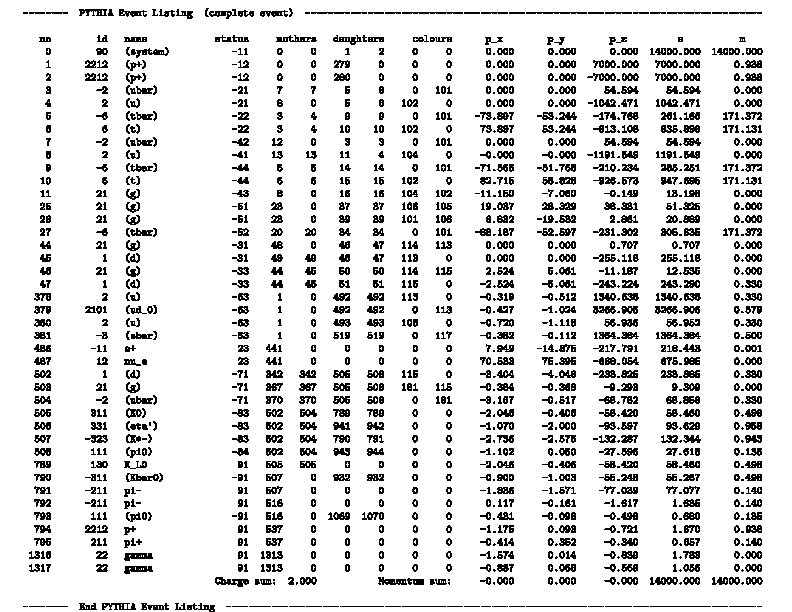
Sample event listings
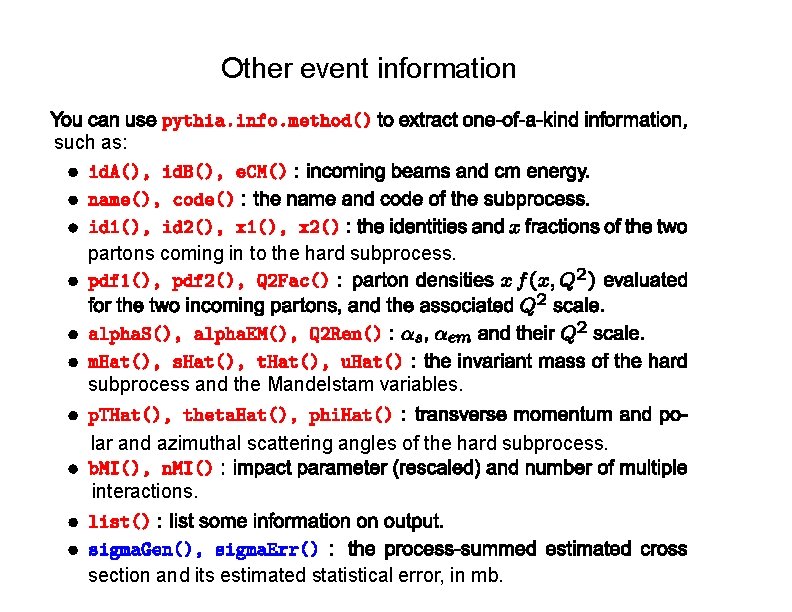
Other event information such as: partons coming in to the hard subprocess and the Mandelstam variables. lar and azimuthal scattering angles of the hard subprocess. interactions. section and its estimated statistical error, in mb.
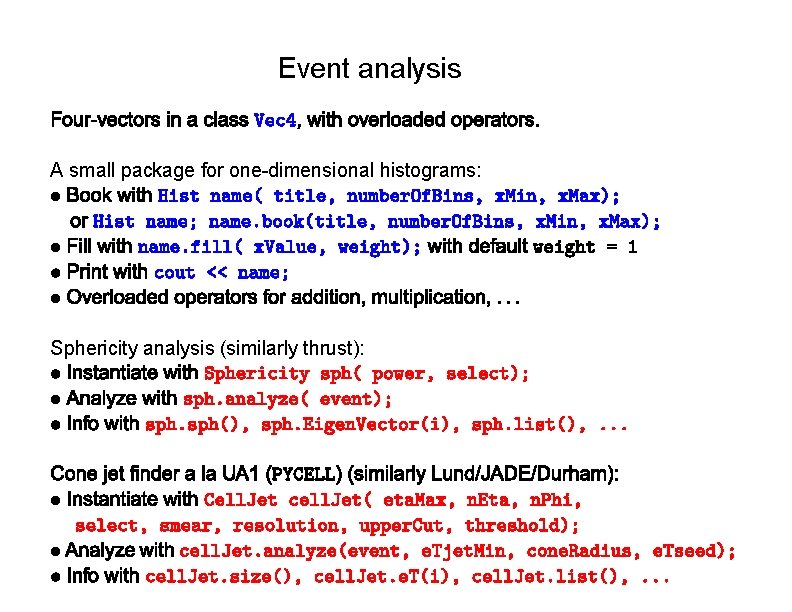
Event analysis A small package for one-dimensional histograms: Sphericity analysis (similarly thrust):
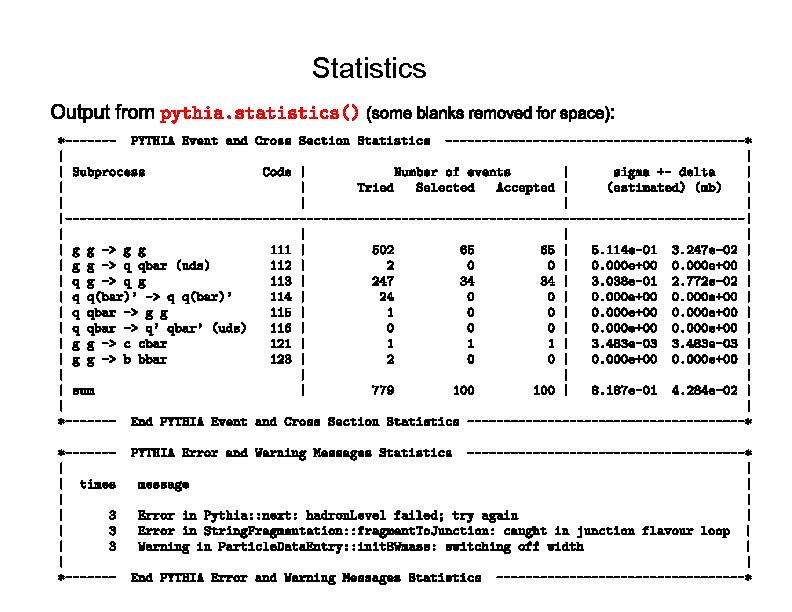
Statistics
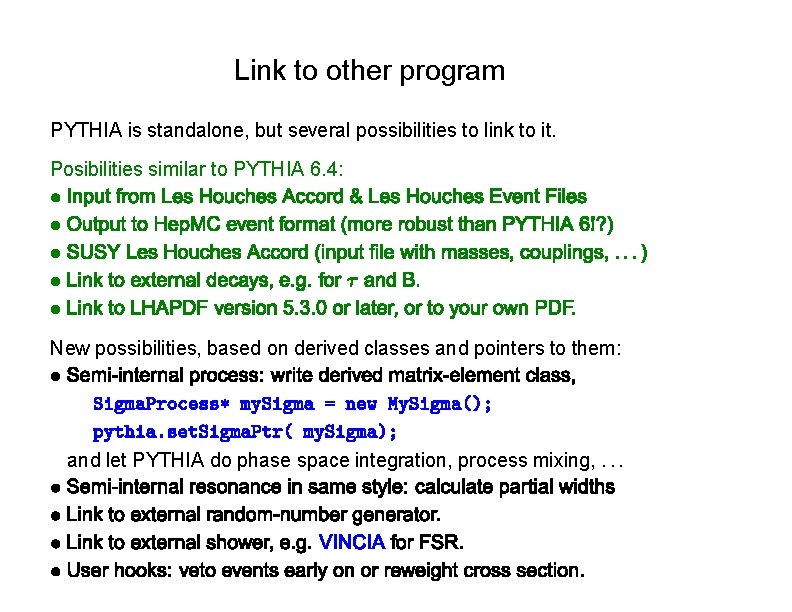
Link to other program PYTHIA is standalone, but several possibilities to link to it. Posibilities similar to PYTHIA 6. 4: New possibilities, based on derived classes and pointers to them: and let PYTHIA do phase space integration, process mixing, . . .
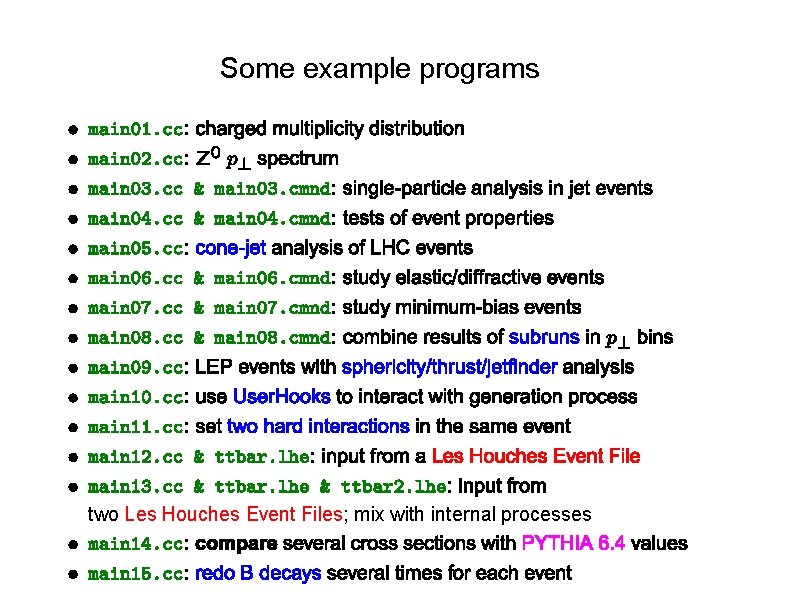
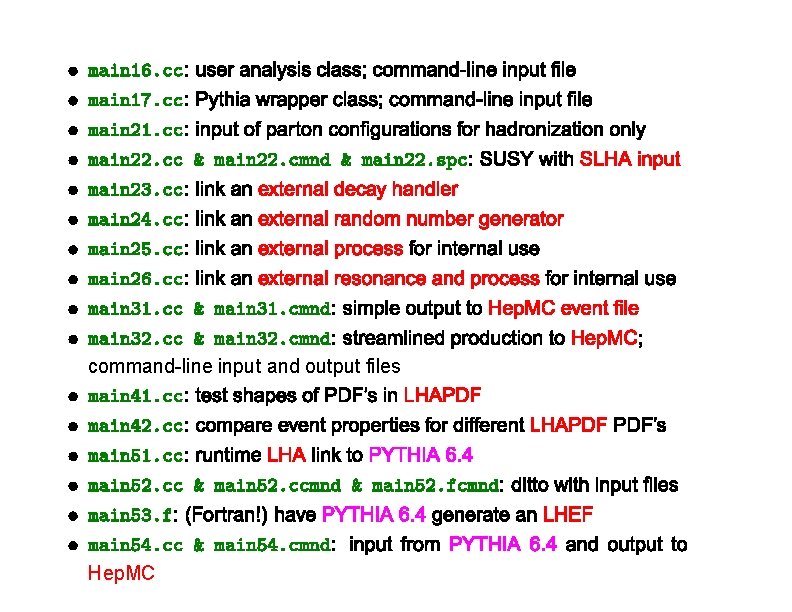
Some example programs two Les Houches Event Files; mix with internal processes
command-line input and output files Hep. MC
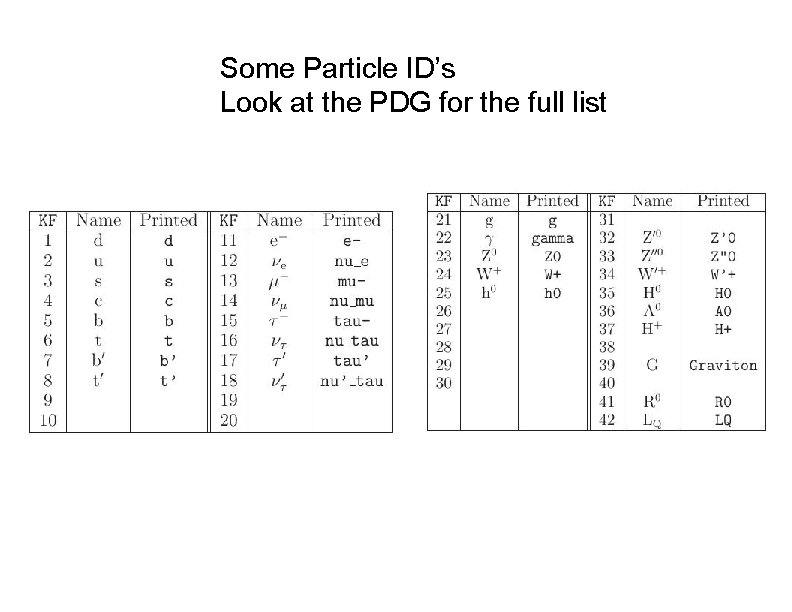
Some Particle ID’s Look at the PDG for the full list